
VETHY / FLEET AND OEM BUYER GUIDANCE
How does a parking air conditioner work?
A battery-powered parking air conditioner uses electricity to move heat from the cabin to the outside. Its compressor, heat exchangers, fans and controls operate as a system, so engine-off cooling still requires a suitable power supply and installation.
Follow the heat through the system
In a basic vapour-compression cycle, refrigerant absorbs heat at the evaporator, is compressed, releases heat through the condenser and passes through an expansion device before returning to the evaporator. Cabin and outdoor airflow help the heat exchangers do their work.
The precise compressor, expansion device, controls and refrigerant depend on the product. This explanation describes the general cooling principle; it is not a service procedure or a model-specific circuit diagram.
Cooling output and electrical input are different
Cooling capacity describes the rate of heat removal, commonly stated in watts or BTU/h. Electrical input describes the electricity consumed by the system. A 2,200 W cooling rating does not mean the unit continuously draws 2,200 W from the battery.
Fans, compressor control, ambient temperature, cabin load and operating mode affect the actual load. A stated current range is not a complete record of consumption throughout a parked rest period.
Rooftop and split describe the installation
A rooftop unit and a split unit can use the same general refrigeration principle while having different mounting and service requirements. A split system separates indoor and outdoor assemblies. A rooftop installation places the main assembly above the cabin and requires the approved roof interface.
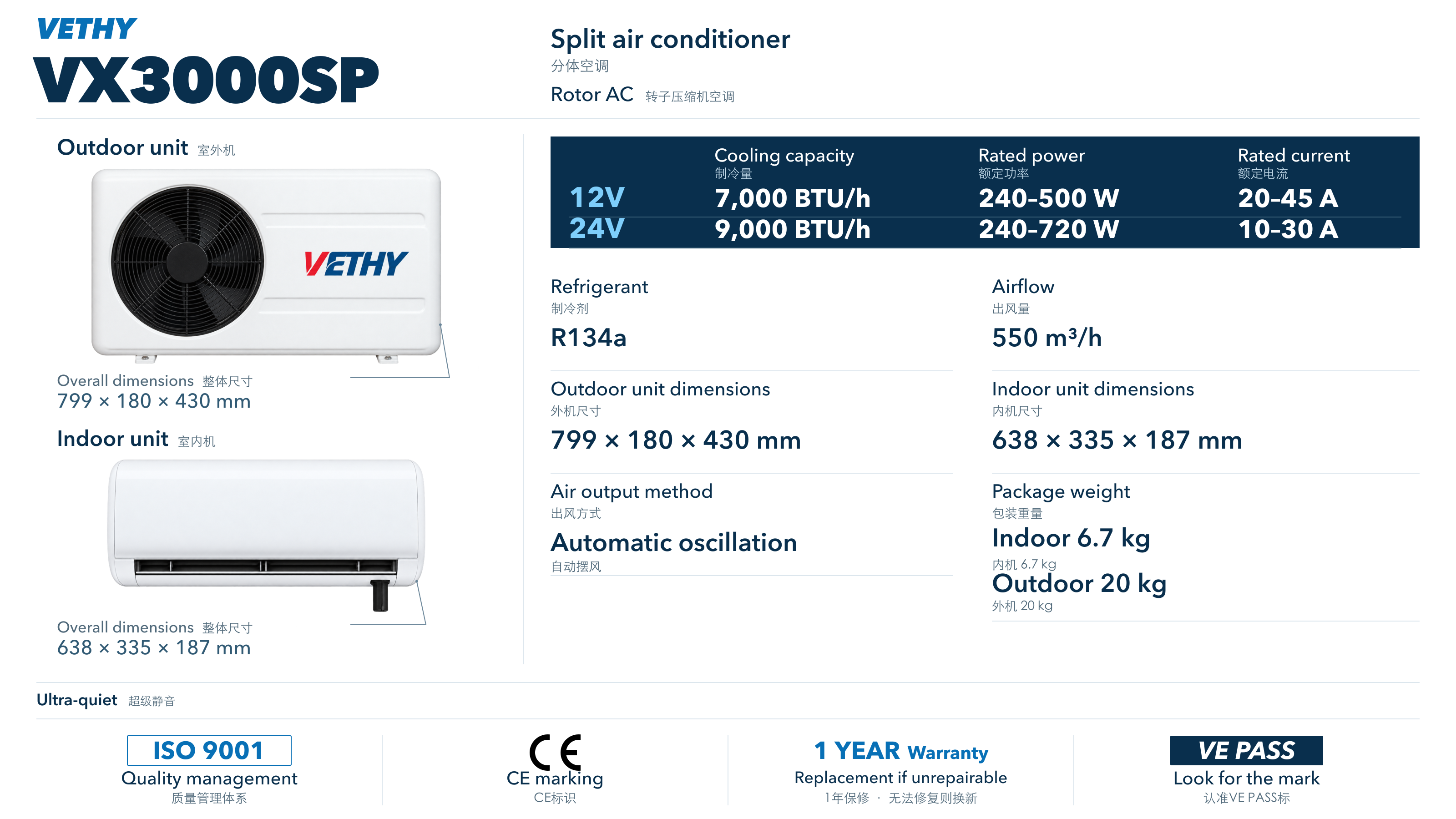
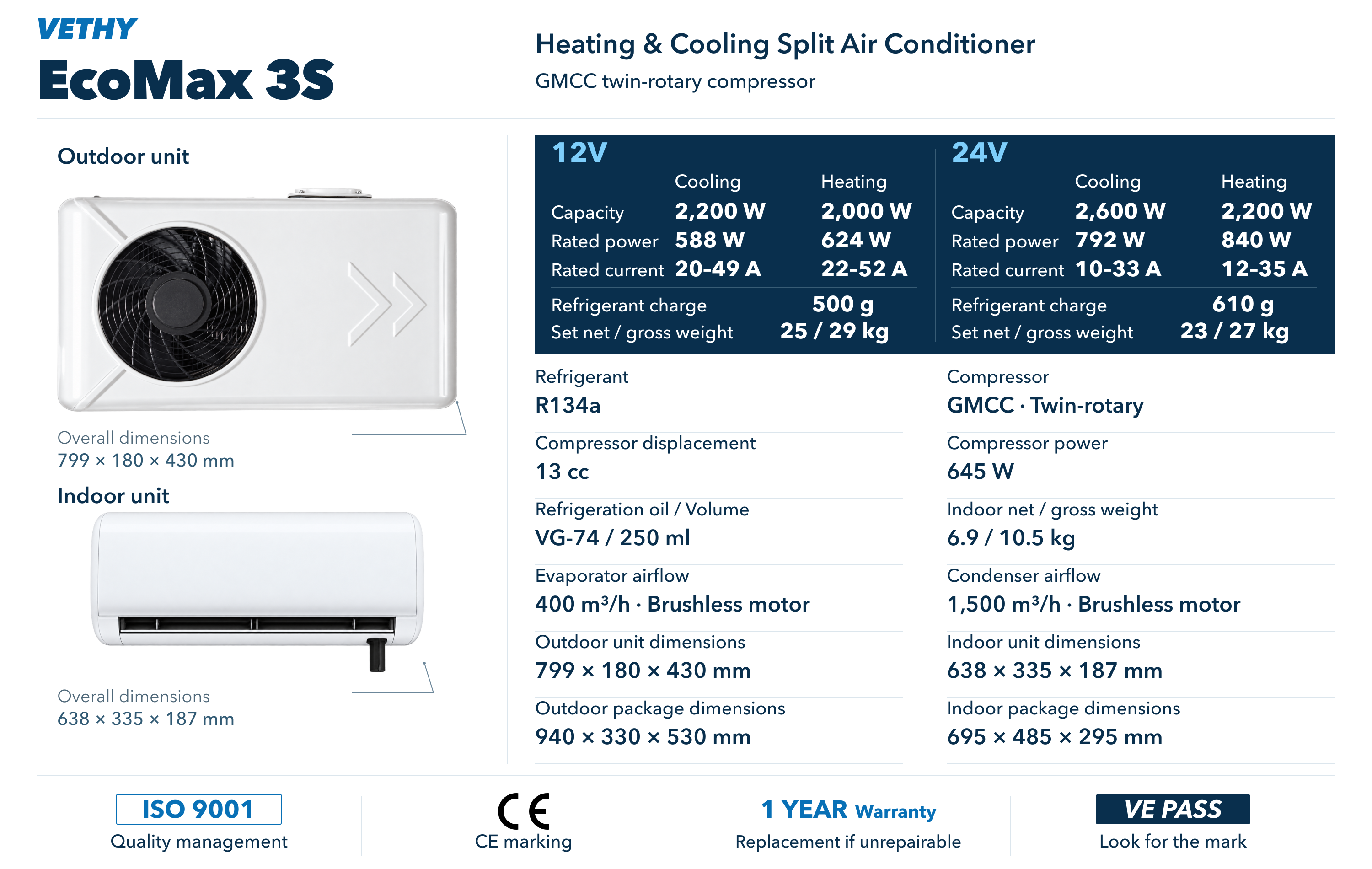
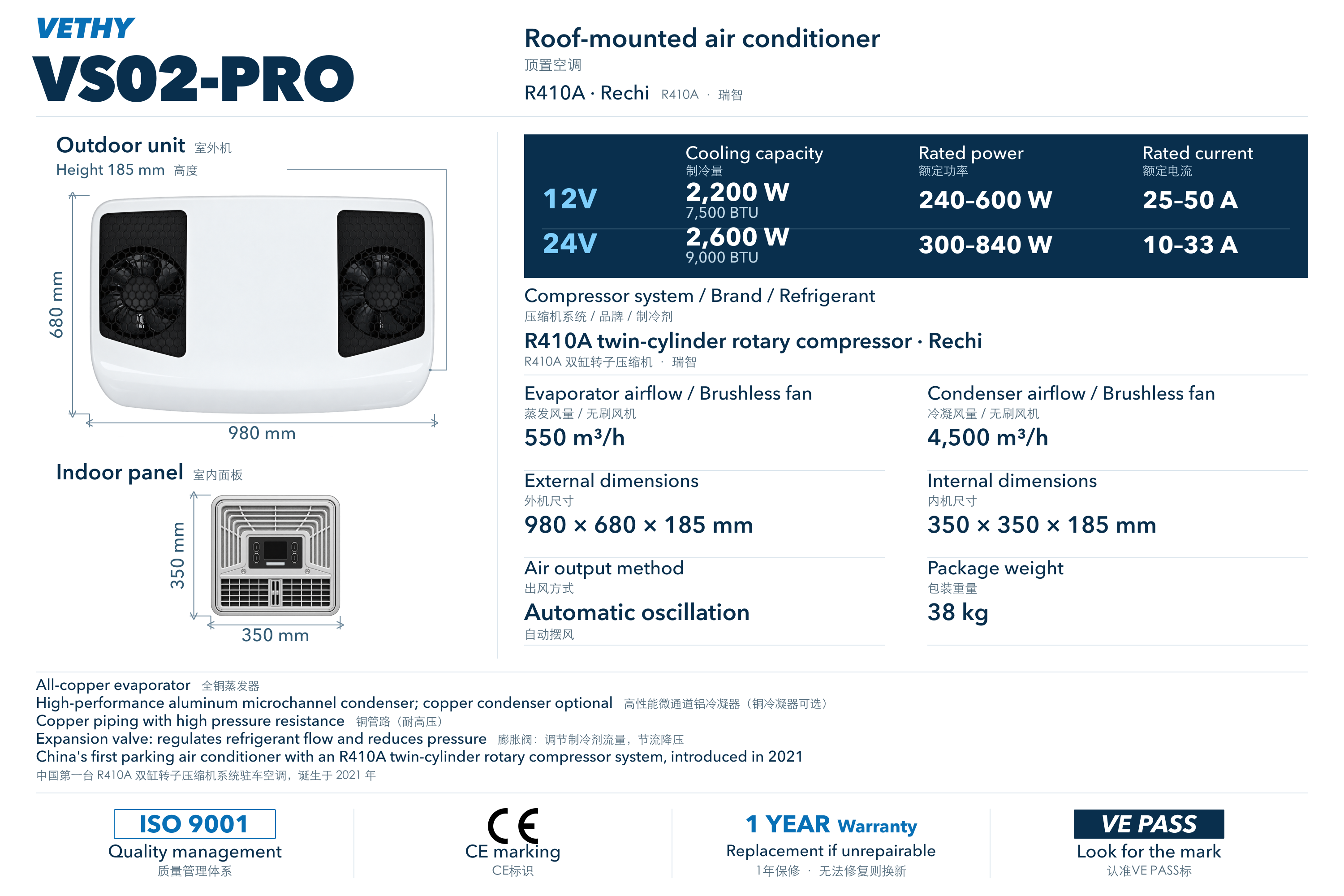
VX3000SP is a split cooling model. EcoMax 3S provides a separate heating-and-cooling option. VS02-PRO is a rooftop cooling model. Their refrigerants and electrical ratings are model-specific.
Runtime depends on the complete power system
A useful planning calculation divides usable battery energy in Wh by the measured average total load in W. Include other parked loads, electrical losses and the reserve required by the battery and vehicle. Battery amp-hours alone do not establish runtime.
Confirm the charging opportunity between rest periods. Engine-off operation does not mean unlimited cooling, and a low-voltage cutoff does not establish a safe battery design by itself.
Use the exact product documentation
Keep the evaporator and condenser airflow paths clear according to the manufacturer’s instructions. If cooling changes, document the model, voltage, displayed fault, ambient conditions and symptoms before seeking support. Refrigerant selection, charging and electrical protection require the exact configuration’s service instructions.
See 12V electrical planning and model-specific troubleshooting intake for the next steps. A passenger-bus or OEM HVAC project should be evaluated around its own vehicle architecture.
Sources and specification records
Updated October 30, 2026. Model ratings follow the linked VETHY specification graphics. General technical sources explain principles; they are not certifications or tests of VETHY products.
FROM SELECTION TO A DEFINED PROJECT
Bring the vehicle brief.
Share the truck model, voltage, operating climate, installation photos and intended quantities. VETHY can review the proposed configuration and the evidence needed for your application.