
VETHY / VX3000SP / PRODUCT AND APPLICATION GUIDE
VX3000SP Refrigerant-Line Routing as Part of a Serviceable Split Installation
VX3000SP is a useful split candidate when indoor placement, outdoor location and the connecting route form one practical vehicle package. Use the applicable requirements for the actual configuration rather than invent line limits or kit contents. Clear scope and a route record connect the documented cooling product to serviceable ownership.
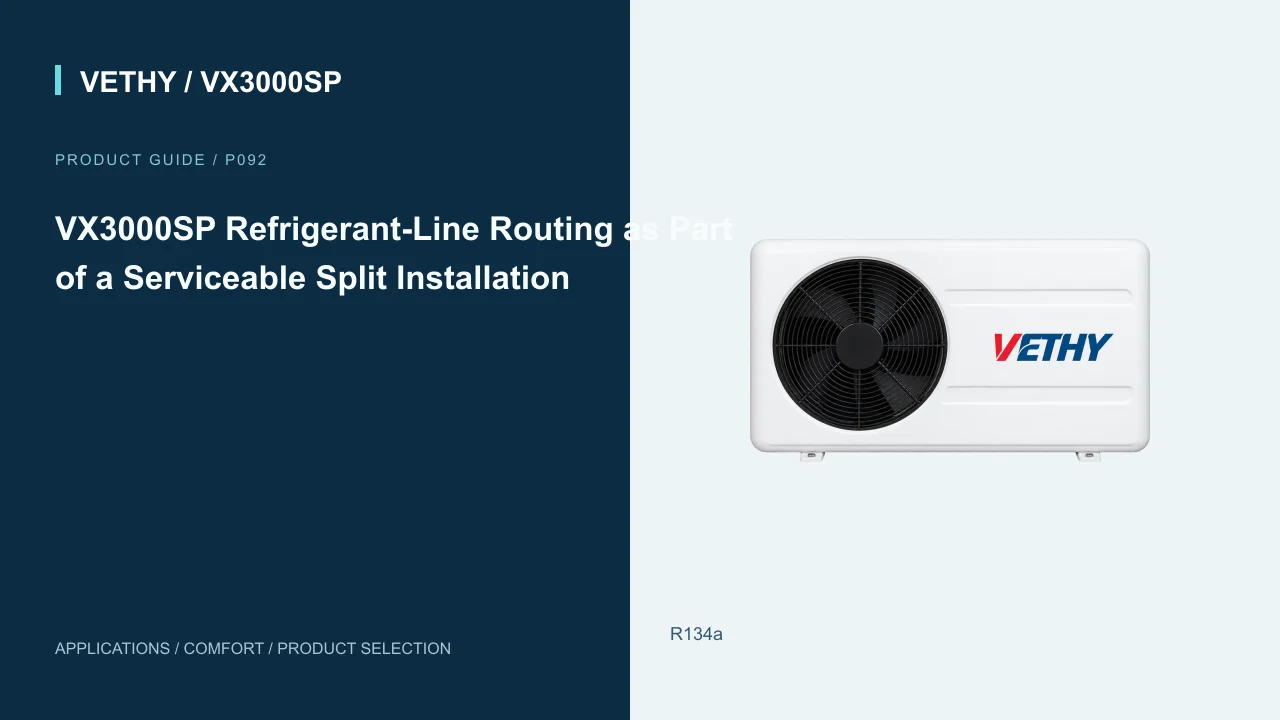
VX3000SP is a useful split parking cooling choice when the indoor position, outdoor location and connecting route can be developed as one serviceable vehicle package. The separate assemblies create placement options that can serve a truck whose roof is not the preferred location for a complete AC unit. A deliberately planned refrigerant-line route turns that architectural choice into a practical installation the owner and later service team can understand.
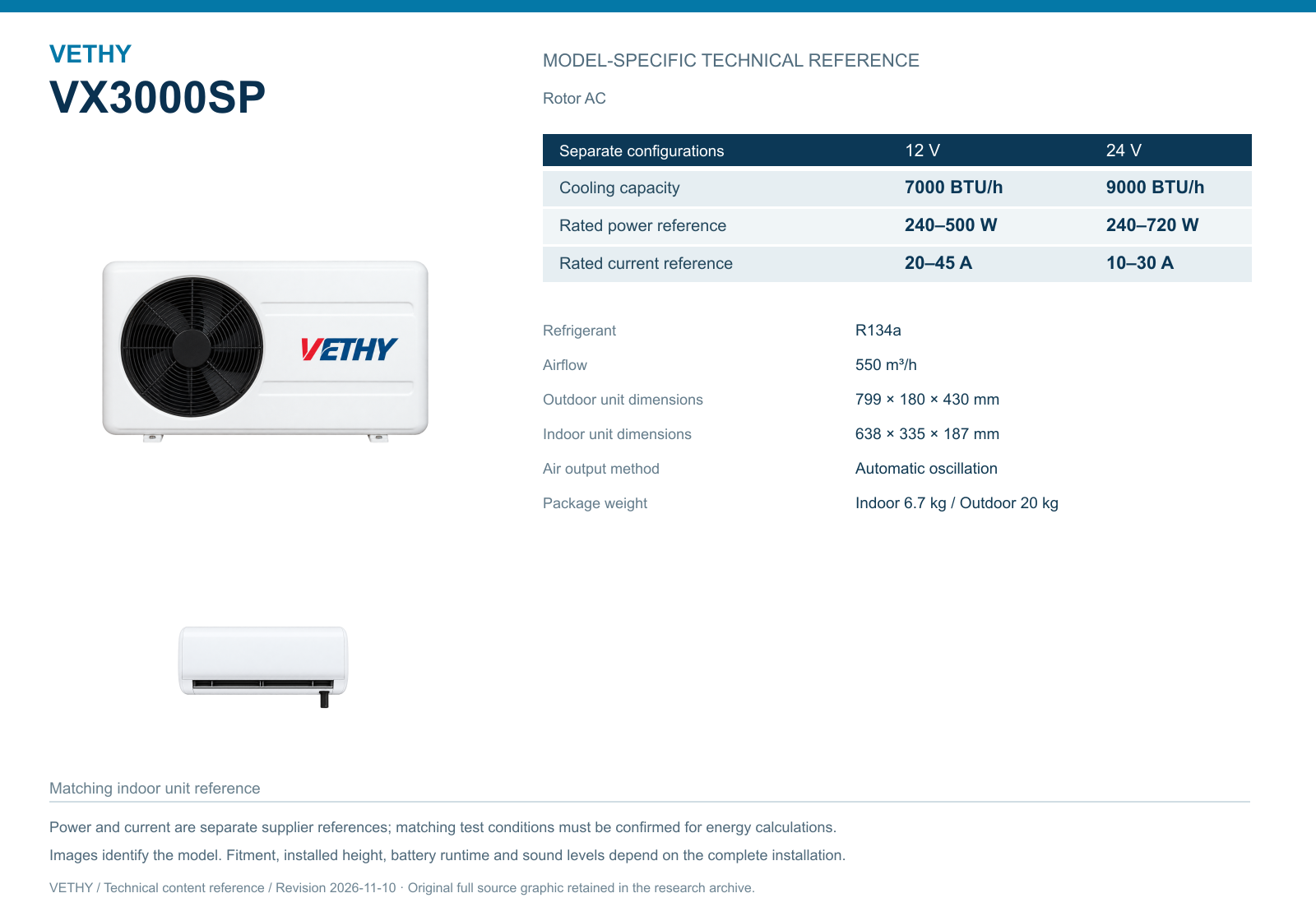
The model uses R134a and is described as rotary AC. It lists 550 m³/h airflow, automatic oscillation and qualitative ultra-quiet positioning, with separate 12V and 24V versions. Those product features support a clear comfort recommendation, while the applicable installation information must define the actual connection requirements for the supplied configuration.
This guide focuses on route planning and service value. It does not invent line lengths, pipe materials, connection hardware or commissioning procedures that the supplied summary does not establish. The aim is a concrete VX3000SP proposal in which the locations, route and occupied comfort objective remain connected from first enquiry through ownership.
1. Choose split architecture for a vehicle reason
A buyer may prefer to retain the roof's existing equipment arrangement or use another suitable exterior location for the outdoor unit. VX3000SP is relevant because it separates indoor and outdoor placement. The product can be considered around the actual vehicle plan instead of forcing all the hardware into one roof location.
The route is part of that benefit, not a detail to postpone. Two locations only form a useful split package when the applicable requirements allow a practical connection arrangement between them. Begin the discussion with photographs or drawings that show the cab, possible exterior location and relevant paths through the vehicle.
This makes the recommendation specific. The supplier can understand why the customer prefers a split product, and the installer can explain how VX3000SP may serve that preference. The buyer receives a route toward a reviewable package rather than a general promise that separate assemblies can be placed anywhere.
The commercial advantage is an installation concept that can be assessed early. A distributor can explain the documented product features, while the vehicle-specific work is made visible before fitting. The architecture's flexibility becomes useful because the complete arrangement is understood, with the route supporting the actual location choice.
2. Read the applicable connection requirements first
The source summary identifies the model and core specifications but does not establish universal line-length limits, routing dimensions or connection hardware. Obtain the applicable installation information for the actual offered configuration. Qualified staff should use those requirements to develop and complete the vehicle work.
This is a practical product-selection step. A location that appears convenient in a photograph may lead to a different proposal once the actual route is assessed. The customer benefits from resolving that relationship before equipment positions are treated as fixed, especially when interior finishing or other vehicle work is still being planned.
Avoid assuming that a supplied kit includes a particular length, quick connection or refrigerant arrangement unless the actual offer confirms it. State what is included in the quotation so purchasing and installation work from the same package. Clear scope is more useful than a convenient assumption that later becomes a fitting problem.
VX3000SP can still be recommended confidently while that information is obtained. The model provides a defined R134a split cooling product, and the route requirements make the application concrete. The buyer can see how documented hardware and vehicle integration combine to serve the intended parking routine.
3. Select indoor and outdoor locations together
The indoor unit should serve the occupied cab, while the outdoor unit needs suitable mounting, air access and serviceability. The connection route links those choices. Reviewing them together helps the installer identify a coherent arrangement rather than optimize each location separately and discover an awkward path later.
Show the normal bunk, curtain and storage inside the truck. Outside, show the candidate area with nearby equipment and ordinary service activity visible. These images give the installation team more useful context than isolated close-ups of empty spaces, because the route belongs to the whole working vehicle.
The best proposal may involve a practical compromise between appearance, occupied air delivery and integration work. Explain that choice clearly. The customer should understand why the selected locations serve the complete package, with the actual requirements governing what can be fitted rather than a purely visual preference.
The benefit is a stronger VX3000SP buying decision. The customer is choosing a model whose split arrangement fits the vehicle, supported by a route that can be reviewed and recorded. This gives the product's placement flexibility commercial value without a universal compatibility claim.
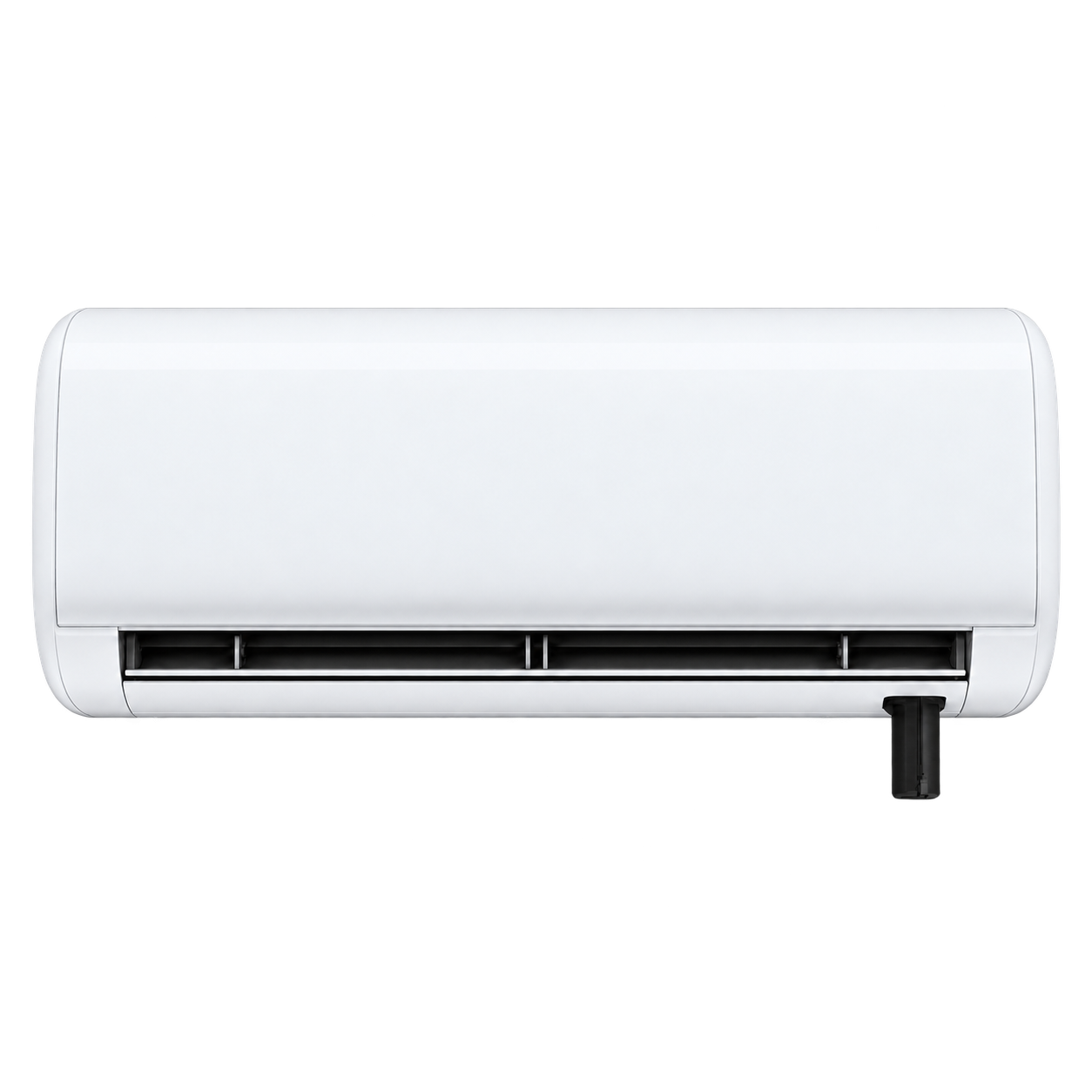
4. Keep product dimensions accurate during the survey
VX3000SP's outdoor overall dimensions are 799 × 180 × 430 mm, and indoor overall dimensions are 638 × 335 × 187 mm. The source does not assign axis order. Keep the full references together and use the applicable product information to confirm orientation and fit.
The enclosure dimensions help establish candidate locations, while the complete installation also needs the relevant access and connection space. A housing that fits between two objects does not by itself establish a serviceable route. Review the actual package and requirements before the customer treats a tight outline drawing as a final layout.
Separate package weights are indoor 6.7 kg and outdoor 20 kg. Retain the package labels rather than combine them into a new net-weight figure or treat them automatically as exact installed loads. The mounting assessment needs the relevant information for the actual vehicle and configuration.
This accuracy supports the route discussion because everyone pictures the same assemblies. The buyer can connect the real VX3000SP product images to the proposed locations, and the installer can develop the actual work from the correct references. The proposal becomes easier to review and later identify.
5. Coordinate the route with the finished interior
An existing sleeper may already contain furniture and trim that shape the available path. A new bodybuilder project may offer more opportunity to coordinate the route early. In either case, the installer should review the actual finished arrangement rather than rely on an empty-shell image that omits the customer's normal interior.
The customer should understand the work included in the proposal. If the integration involves interior access or finishing, describe the actual scope in normal language. A clear explanation makes it easier to compare complete offers and avoids leaving practical vehicle work hidden behind a product-only price.
The route should remain understandable after finishing is complete. Useful photographs and a concise layout record can preserve the important information for qualified support staff. This does not require the driver to inspect or service the refrigeration circuit; it gives later professionals a clear starting point for the actual installation.
For the buyer, the benefit is an integrated package rather than an improvised addition. VX3000SP's split architecture is used deliberately within the cab, with the indoor comfort arrangement and connection work considered together. The product becomes a recognizable part of the vehicle's working environment.
A customer can also distinguish a retrofit from a repeatable new build in the enquiry. The product may be the same, while the integration opportunity differs. An existing interior can shape the route work that must be included; a new design may allow the relevant spaces to be coordinated earlier. State the actual situation so the supplier and installer discuss the right package. This helps VX3000SP's placement flexibility become a practical advantage for the buyer rather than a generic claim that ignores the condition of the vehicle being updated.
6. Include ordinary vehicle service in the plan
A truck needs access to its other equipment and normal service areas. The proposed route should be reviewed in that context by the responsible technical team. A visually tidy path is not the whole decision if it complicates unrelated work or becomes difficult for later service staff to understand.
The source summary does not approve a particular route near moving equipment or establish one universal protective method. Use the applicable product and vehicle requirements for the actual installation. The customer's role is to provide useful vehicle context, while qualified staff assess the relevant technical details.
Planned equipment changes should be visible early. A future storage addition, revised body layout or other installation may affect the route proposal. The goal is not to predict every possible modification, but to make known vehicle priorities part of the current design rather than discover them after fitting.
This is a practical reason to select a clearly identified split model. VX3000SP can be developed within a coherent vehicle package, with the route and locations documented well enough to support ordinary service. The architecture's value continues beyond the initial ability to place the units separately.
7. Preserve useful access for the actual unit
The installation should provide the access required by the applicable VX3000SP guidance. The supplied summary does not establish one universal service opening, connection position or procedure for every vehicle. Obtain the correct information and apply it to the actual layout instead of copying an unrelated split AC diagram.
A bodybuilder can coordinate that access while developing surrounding furniture and equipment. An owner-driver fitting an existing cab can review the proposed work before the order is treated as complete. Both benefit from seeing a concrete installation scope rather than discovering later that an attractive location is awkward to maintain.
The driver should know the support route and how to describe a concern, while qualified service staff retain the relevant installation information. These are different levels of detail for different roles. The owner does not need to become a refrigeration technician to preserve a useful configuration record.
The commercial benefit is a more complete offer. VX3000SP is recommended as a product that can be installed and supported in a defined vehicle arrangement. The customer receives a clear model identity and a practical ownership package, with serviceability considered alongside comfort and appearance.
8. Keep the occupied airflow objective visible
The connection route supports a cooling installation whose purpose is cab comfort. VX3000SP lists 550 m³/h airflow and automatic oscillation. The indoor location should therefore be assessed from the actual seat and pillow positions, with the curtain and bedding arranged normally.
A convenient route should not automatically determine an indoor position that poorly serves the occupied area. Compare feasible arrangements with the installer and explain the tradeoff clearly. The customer can then assess the complete package rather than receive a panel location chosen only because it made the connection work simpler.
The relevant return route should remain clear according to the supplied instructions. A bag or curtain can change the circulation scene even when cool air is obvious near the outlet. Showing the real setup makes the documented air-output feature useful to the buyer and easier to preserve during ordinary use.
The indoor placement guide develops the occupied subject more fully. The route article contributes the integration decision: connect useful indoor placement to a suitable outdoor location through a practical, documented arrangement for the actual split package.
9. Select voltage and auxiliary duty within the same proposal
The 12V VX3000SP lists 7000 BTU/h cooling, power of 240–500 W and a separate current reference of 20–45 A. For 24V, the supplied values are 9000 BTU/h, 240–720 W and 10–30 A. Identify the selected version with the proposed locations and connection scope.
The source fields do not establish common conditions for every endpoint. They should not be paired into an invented efficiency claim or used to guarantee overnight endurance. The electrical specialist should assess the actual supply route, usable storage, other loads and charging for the intended parking period.
The model is documented as R134a rotary AC, with no established compressor brand, cylinder count or inverter architecture. Its qualitative ultra-quiet feature can support a calm-comfort recommendation, while the finished experience depends on the actual installation and surroundings. No verified decibel figure is supplied.
The VX3000SP product page provides the central model reference. Keep that identity consistent across the quotation and installation record so the route proposal, electrical package and demonstrated comfort belong to the actual offered configuration.
10. Make the route scope easy to review
A useful proposal explains the product, locations and actual connection work in a way purchasing and installation staff can follow. The table below organizes the discussion without inventing technical limits that the source summary does not provide.
| Integration subject | Useful information in the offer | Practical buyer benefit |
|---|---|---|
| Model and version | VX3000SP with selected voltage | Clear supplied configuration |
| Indoor location | Actual occupied relationship | Comfort linked to the bunk and seat |
| Outdoor location | Vehicle-specific mounting and access proposal | Separate placement made concrete |
| Connection scope | Applicable requirements and included work | A reviewable complete installation |
| Interior finish | Actual work associated with the route | Fewer unstated assumptions in the price |
| Ownership record | Useful photos and relevant product information | Clearer later support |
The customer is not being asked to design the refrigeration circuit. The value of the table is that the supplier and installer can turn the enquiry into a concrete package the buyer can assess before ordering.
11. Use the installed record for repeatability
Retain the model, voltage, actual locations and useful route information with the vehicle record. A concise set of photographs can make the installation understandable to qualified staff who did not handle the original fitting. The record should identify the actual package rather than rely on an informal description remembered by one workshop.
For a fleet, similar trucks may share an approved arrangement while meaningful differences receive focused review. A changed interior or equipment location can affect the route even when the same model is selected. Preserve the vehicle-specific variant so repetition is supported where it genuinely applies.
For a distributor, this record adds value to the customer experience. The buyer receives a defined split product and an understandable installation, with a practical support path. The source brief does not establish a particular warranty or response guarantee, so the support description should match the actual confirmed capability and terms.
The VX3000SP guide hub supports focused background reading on the connected subjects. The actual instructions and vehicle record remain the references for the supplied installation, keeping procedures tied to the right configuration while explanatory material helps the owner understand the purpose.
12. Follow a hypothetical route decision
Imagine a customer who wants split parking cooling while retaining an existing roof arrangement. VX3000SP is a relevant candidate because the separate outdoor unit can be considered elsewhere on the vehicle and the indoor assembly can be assessed around the bunk. The first enquiry shows the actual truck, possible locations and normal occupied setup, with the intended parking duty described clearly.
The installer reviews two feasible outdoor areas together with the preferred indoor position. One combination appears visually compact but leads to a less practical connection scope. Another may better fit the actual vehicle work and service access. The applicable requirements govern what can be installed; the customer then reviews the complete proposal rather than select from two isolated photographs.
Inside the cab, the driver prepares the normal curtain and bedding. Automatic oscillation is demonstrated from the seat and pillow, so the comfort objective remains visible while the route is developed. If a convenient connection path would lead to a less useful indoor position, that tradeoff is explained rather than hidden. The buyer can understand why the selected arrangement serves the complete package.
The quotation identifies the model, voltage, locations and actual installation scope. It states the included work and confirms the relevant supplied connection arrangement rather than assume a generic kit length or hardware type. The customer can compare the offer fairly with another complete proposal because the product and vehicle work are described together.
During handover, useful photographs preserve the arrangement for qualified service staff, while the driver receives concise operating guidance for the actual unit. If surrounding equipment or furniture changes later, the original record gives the owner and workshop a clear starting point for review. The route remains part of the vehicle's identifiable cooling package rather than an unknown path hidden after fitting.
This scenario is an application example, not a VETHY commissioning test or approval for a named truck. It shows how serviceable routing adds practical value to the split architecture. VX3000SP can be recommended confidently where the actual locations, route, occupied comfort and auxiliary supply form a coherent package that the customer can review and support through ordinary ownership.
The same approach is useful when a customer orders again. The prior record identifies which VX3000SP configuration and vehicle arrangement were actually supplied, so the next enquiry begins from concrete information. If the truck or interior differs, the route can receive focused review rather than being copied by appearance. The benefit is controlled repetition: the common product identity simplifies the conversation while the vehicle-specific work remains visible. That makes the split model easier to buy and support across more than one installation without turning the first layout into a universal compatibility promise.
13. Questions about refrigerant-line routing
What line length does the source approve?
The supplied summary does not establish a universal line-length limit. Obtain the applicable installation information for the actual configuration and have qualified staff assess the proposed route. Keep any supplied kit scope explicit in the quotation.
Can routing be left until after locations are fixed?
The route should be reviewed with indoor and outdoor placement so the choices form one practical package. A location that looks convenient alone may lead to a different complete proposal once the actual connection and service requirements are understood.
Does the split layout establish specific pipe materials or connections?
The summary identifies R134a rotary AC but does not establish a complete line-material or connection specification. Use the information for the actual supplied configuration rather than transfer construction claims from another model.
Why recommend VX3000SP with a route record?
Its split architecture offers useful placement choices, while the documented route makes the actual installation understandable. The customer receives a defined product, a practical occupied arrangement and a clearer starting point for qualified support after delivery.
Recommend a split package that remains understandable
Choose VX3000SP when the separate units can be connected through a practical, serviceable vehicle arrangement. Plan locations and route together, keep the occupied comfort objective visible and preserve the actual installation information. Send the vehicle photographs, proposed locations and voltage through the technical enquiry page for a configuration-specific split cooling proposal.
Product sources
- VETHY VX3000SP current manufacturer specifications — VETHY.
- VX3000SP technical reference sheet — VETHY.
VETHY product recommendation and application analysis. Specification references identify the selected model and voltage. Installation examples are planning examples; measured project results are identified explicitly when available.
Discuss your VX3000SP application
Send your vehicle, supply voltage, occupied space, parking schedule and installation photographs for a model-specific recommendation.
Prepare your vehicle brief ↗