
VETHY / EcoMax 3S / PRODUCT AND APPLICATION GUIDE
EcoMax 3S Split Layout: Freeing Roof Space for the Vehicle Design
EcoMax 3S is worth considering when a vehicle project wants a split seasonal comfort package while preserving roof choices. Its GMCC twin-rotary identity, brushless fans and separate functions provide the product proposition. Develop indoor and outdoor locations together, with the actual support, routing, service and supply requirements reviewed for the vehicle.
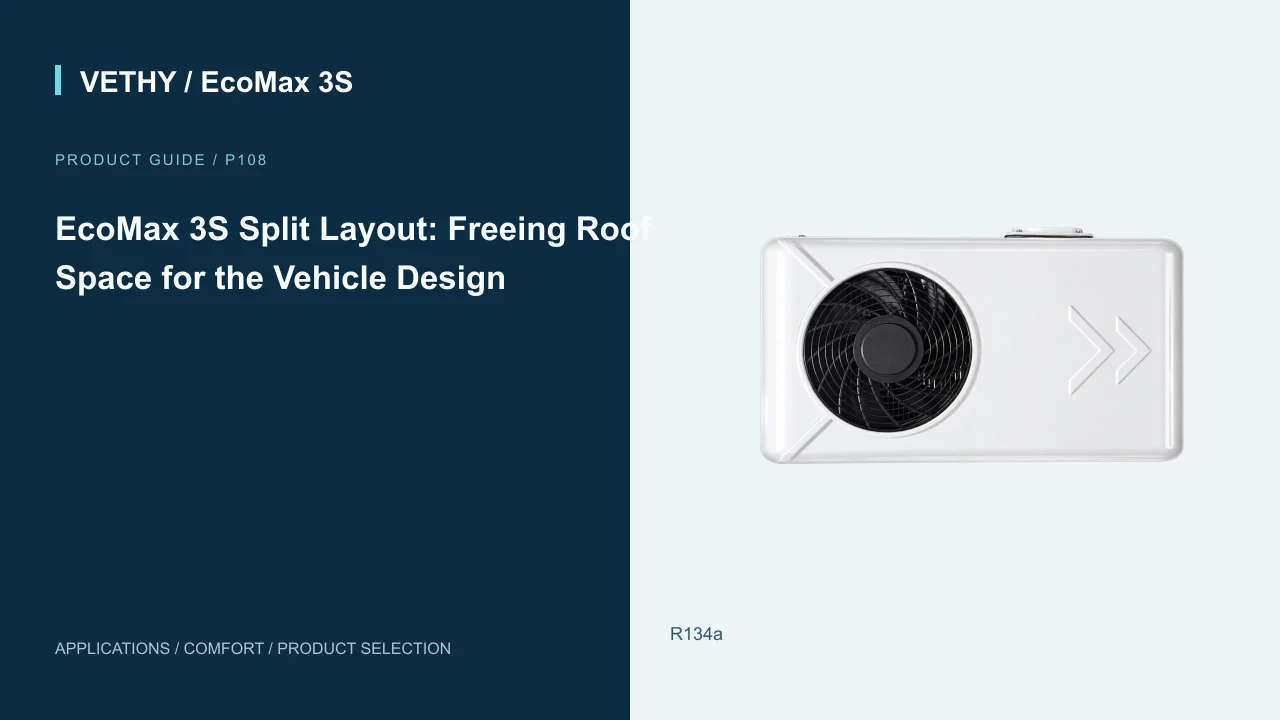
EcoMax 3S is a strong candidate when a vehicle project wants to consider a split comfort system while preserving roof choices for other equipment. Separate indoor and outdoor assemblies allow the installer to develop a different layout from a single rooftop package, subject to the actual vehicle and installation requirements. The model adds documented cooling and heating functions, an R134a GMCC twin-rotary compressor and brushless fan motors.
The opportunity is a coordinated vehicle design. A buyer with planned solar equipment, racks or another roof function can put that priority into the brief before cooling hardware is positioned. This guide explains how EcoMax 3S can be considered within that project without promising universal mounting compatibility, an unverified sound advantage or a fixed amount of roof area saved on every vehicle.
State the roof priority before selecting a cooling position
A roof may already have a purpose in the vehicle design. The owner might plan energy equipment, carry working accessories or want an uncluttered exterior arrangement. Those priorities should appear in the initial cooling enquiry rather than arrive as a late modification.
The split format gives the project team a useful candidate to explore. EcoMax 3S has separate assemblies, so the indoor comfort role and outdoor installation setting can be considered in relation to different vehicle areas. The complete arrangement still needs coordinated review.
Describe which roof function is essential and which parts of the design remain flexible. A clear priority lets the installer compare plausible locations and explain the trade-offs. It is more useful than asking for a general air conditioner and later discovering that the preferred roof position is unavailable.
For the buyer, the benefit is a proposal shaped around the vehicle as a whole. The documented GMCC twin-rotary package and seasonal functions provide the product reason for interest. The split arrangement provides the layout question worth investigating. Together they make EcoMax 3S a concrete shortlist choice for a roof-conscious project, with the customer able to review how comfort and working equipment will coexist.
Think in two assemblies and one installation
Separate assemblies do not mean independent projects. The indoor and outdoor locations are connected through the complete installation, including the applicable routing, support, access and integration requirements. The responsible installer should develop that arrangement for the actual vehicle.
This distinction prevents a common planning error: selecting the indoor location because it looks attractive and the outdoor location because a gap appears available, then leaving their relationship unresolved. A useful proposal shows both locations together and explains the implementation scope.
The customer can contribute the vehicle’s ordinary use and available spaces. The installer contributes the technical review needed to turn those spaces into a suitable arrangement. Product supply and local vehicle work should be identified clearly in the commercial offer.
EcoMax 3S is appealing because the split format supports a deliberate layout discussion alongside its documented seasonal function package. The buyer can consider a cabin position that serves the occupant while exploring an appropriate outdoor setting elsewhere in the design.
The recommendation is strongest when the complete proposal is visible. The customer sees where the assemblies belong, which parts of the roof priority are preserved and what the responsible parties will resolve. The product is then a practical vehicle candidate rather than two photographs used to imply that any pair of empty spaces will automatically work.
Use the dimensions without assigning unsupported axes
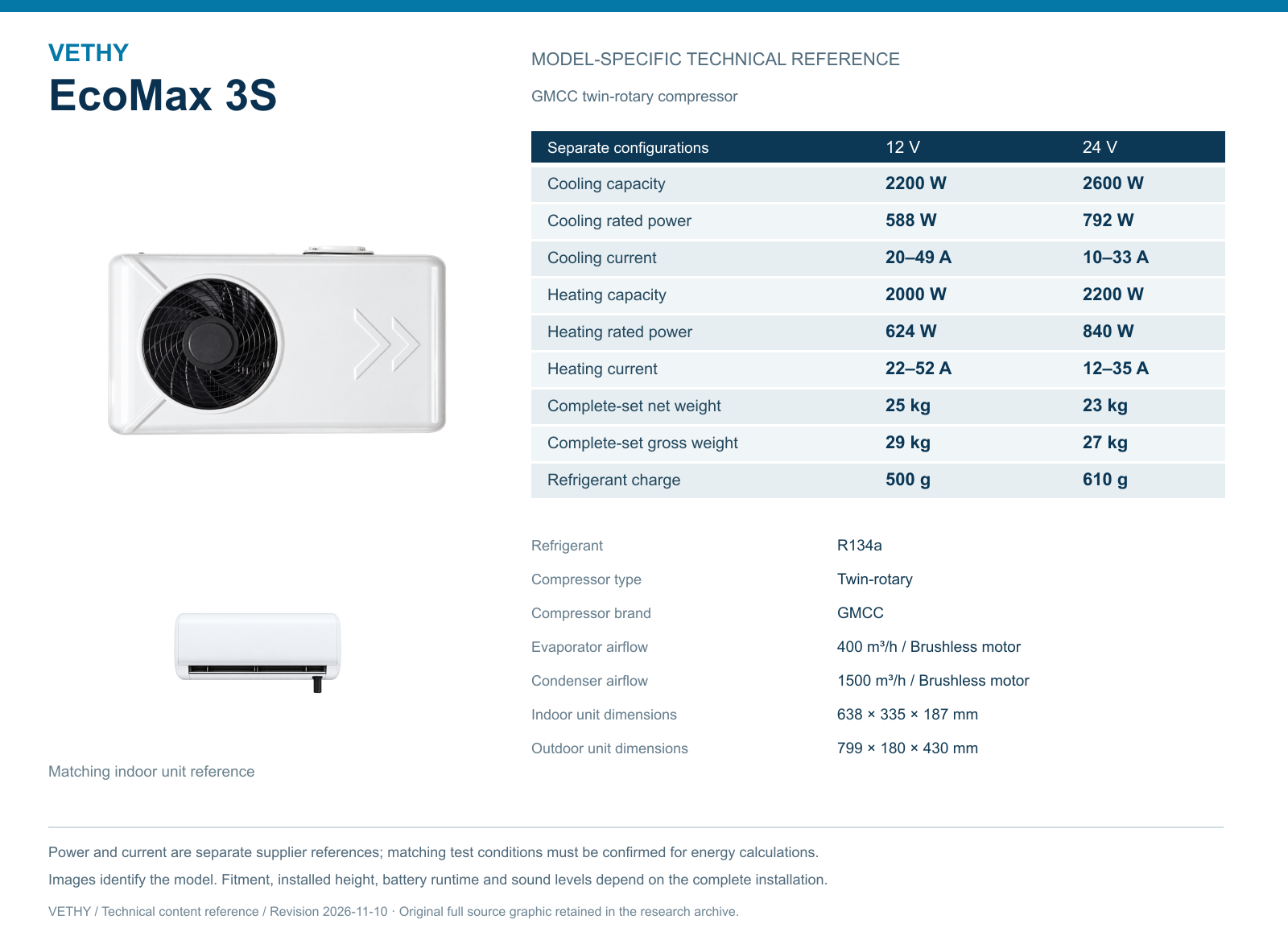
The source lists indoor overall dimensions of 638 × 335 × 187 mm and outdoor overall dimensions of 799 × 180 × 430 mm. Preserve each callout in the stated order. The supplied reference does not establish axis labels for assigning each number to a named direction.
These dimensions are useful when preparing vehicle views and discussing plausible positions. They should not be silently reordered to make a location appear more convenient, nor should a packaging dimension be substituted for a unit dimension.
The EcoMax 3S specification data is the reference for the selected model. The actual assemblies and current technical information should guide the responsible installation review.
For a roof-conscious buyer, accurate dimensional communication is valuable. A remote supplier or installer can understand the proposal more easily when the images have clear orientation and the callouts retain their meaning. A small product image alone may not show the surrounding vehicle relationships.
The customer gains a credible basis for comparing layouts. EcoMax 3S can be explored as a split candidate without a misleading drawing that shrinks a housing or assigns a convenient axis. The roof priority remains part of the brief, and the dimensional proposal becomes something the project team can assess rather than an illustration that promises fit before the actual vehicle has been reviewed.
A proposal should also distinguish current equipment from future plans. If solar equipment or another accessory is only intended for a later stage, mark it that way. The installer can consider the foreseeable relationship without pretending every detail is already finalized. This gives the owner a practical way to make progress while retaining a coherent design objective. The selected EcoMax 3S package remains defined, and a later roof change can return to the appropriate review instead of being treated as automatically covered by an earlier drawing that showed only an outline.
Give the cabin assembly a useful occupied-space role
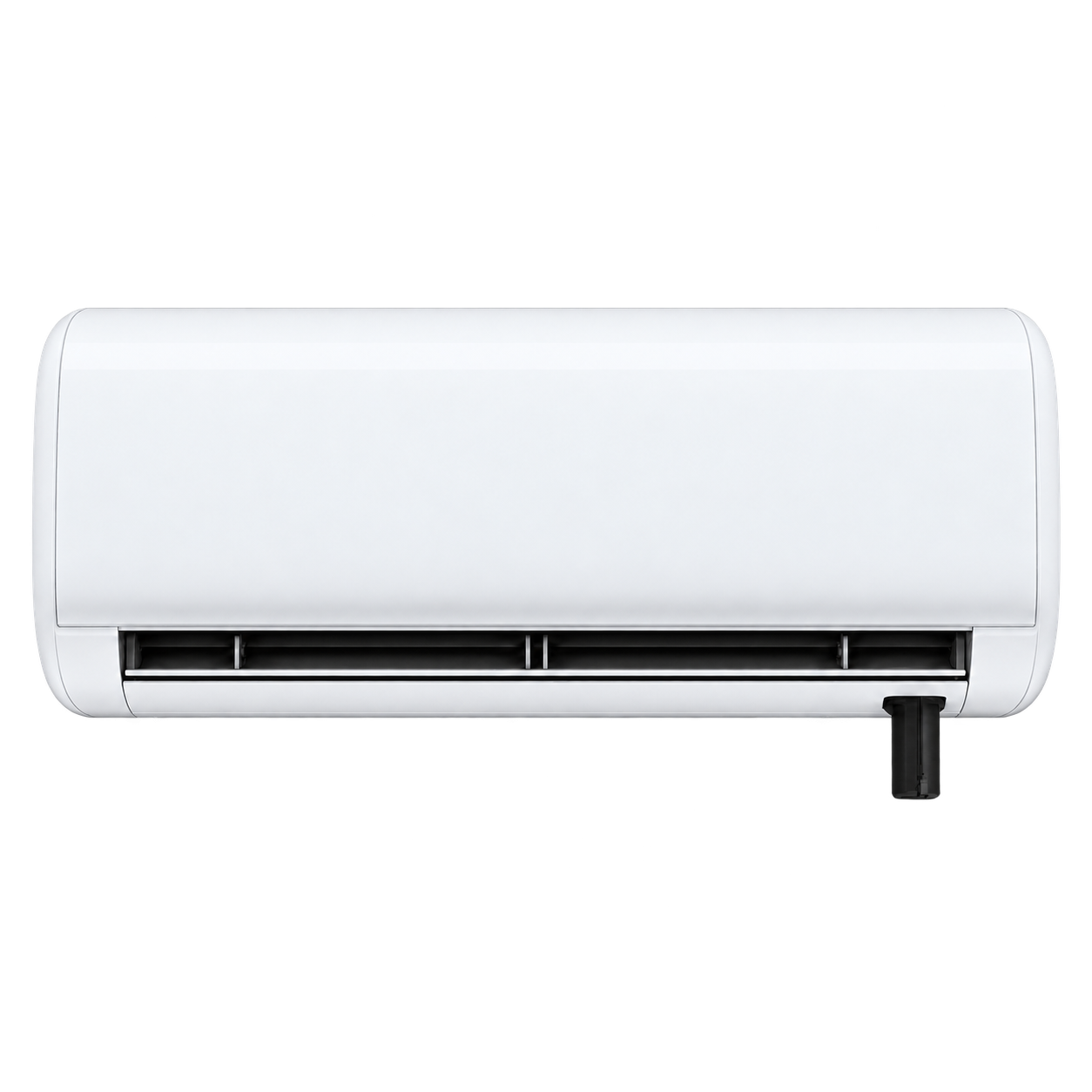
Preserving roof choices is valuable only if the cabin still receives a useful comfort arrangement. The indoor location should be assessed with the normal seat, bunk, curtain and storage visible. A space that looks open in an empty vehicle may be constrained during actual use.
EcoMax 3S lists evaporator airflow at 400 m³/h with a brushless motor. The local experience depends on the furnished interior and the delivered controls. Do not add automatic oscillation, a special outlet arrangement or another model’s interface to the proposal.
Let the occupant describe where useful delivery is wanted and where a direct stream may be unwelcome. A driver resting behind a curtain has a different layout question from one doing paperwork forward. These are practical inputs to placement, not demands that the customer diagnose the air-conditioning system.
The split project can then serve both exterior and interior priorities. The owner understands why EcoMax 3S is being considered for the roof plan and how its cabin assembly will support normal activities.
This is a positive product recommendation because it connects the documented package with everyday use. The customer is not asked to sacrifice the occupied space simply to keep the roof visually clear. The proposal coordinates the seasonal comfort product around the people and equipment the vehicle actually carries.
Review the outdoor location in its working surroundings
The outdoor assembly requires an appropriate setting under the applicable installation requirements. Show the actual proposed area, nearby equipment and any working load or moving fitting relevant to the arrangement.
The condenser airflow reference is 1500 m³/h with a brushless motor. This identifies the outdoor package; it does not approve a particular gap or establish a universal clearance. Support and service approach also belong in the review.
A buyer considering an alternative to a rooftop package should provide enough vehicle context for the installer to evaluate the options. A close image of an empty area may hide structure, access or the relationship with other equipment. Wider views and relevant measurements can make the discussion more concrete.
The advantage of EcoMax 3S is a defined split seasonal product whose outdoor location can be developed as part of the vehicle design. That opportunity should be explored deliberately rather than converted into a blanket statement that an exterior assembly can be fitted anywhere off the roof.
For the customer, the useful outcome is a reviewable proposal. The preferred roof function remains visible, the outdoor unit receives an appropriate location discussion and the indoor comfort arrangement remains connected. The premium component package is supported by a complete installation scope instead of a promise based only on available-looking space.
Coordinate routing while locations are still flexible
The relationship between the assemblies should be considered before other vehicle fittings make changes difficult. The responsible installer needs to resolve the applicable routing and integration requirements for the actual product and vehicle.
This guide does not supply a universal line length, bend detail or connection procedure. Those values and methods require the correct current information. The customer’s useful role is to identify where the vehicle has existing services, working equipment or planned modifications that the installer needs to consider.
A coordinated drawing can show the proposed relationship without pretending every technical detail is already approved. Mark the status of the proposal and record the relevant decisions as they become concrete. This helps the bodybuilder, electrical installer and cooling specialist discuss the same vehicle rather than separate fragments.
The buyer benefits through a more complete offer. If a location requires additional work, the scope can be explained before equipment delivery. If another arrangement is more practical, the comparison can happen while the design is still flexible.
EcoMax 3S remains the documented candidate whose split format makes this discussion worthwhile. The GMCC twin-rotary identity, brushless motors and listed cooling and heating functions provide the product proposition, while routing coordination turns that proposition into a vehicle package that can be reviewed and implemented responsibly.
Where several trades work on the vehicle, agree which drawing represents the current proposal. A bodybuilder, electrical installer and cooling specialist can otherwise each retain a different location sketch. Clear status and orientation help the teams discuss the same arrangement and identify a conflict early. This is a practical benefit to the customer, not an extra product claim. The premium seasonal unit can move toward installation through an understandable scope, with the roof priority and occupied-space requirement visible to everyone responsible for the vehicle work.
Compare roof objectives through practical trade-offs
A roof-conscious decision can be made clearer by showing what the split proposal changes and what remains to be reviewed. The following table describes possible project priorities, not completed fitment approvals.
| Roof priority | What an EcoMax 3S split proposal can explore | Vehicle question that remains |
|---|---|---|
| Planned solar equipment | An alternative comfort-system layout | Appropriate assembly locations and the complete integration |
| Working rack or accessories | Coordination without assuming a rooftop cooling position | Normal loads, support and service relationships |
| Exterior design preference | A different arrangement of visible equipment | Actual vehicle appearance and installation scope |
| Future roof development | A layout that considers known plans early | Material changes before later work is fixed |
The table helps the buyer rank priorities. A customer may accept a modest accessory revision to obtain a more coherent complete vehicle arrangement. Another may have an essential roof function that guides the cooling layout from the start.
The important point is that the product choice remains connected to a real design objective. EcoMax 3S is not recommended merely because split systems sound flexible in general. It is a documented seasonal product whose format can be assessed against the owner’s actual roof, cabin and working needs. That makes the offer more persuasive and the next technical conversation more focused.
Preserve a practical ownership approach
Moving a cooling function away from a preferred roof position does not automatically make service easier. The actual locations should support appropriate inspection and care under current guidance. Discuss the practical service route before surrounding equipment is fixed.
The customer may rely on a particular workshop or operate a fleet with several support locations. Explain that context to the installer. The ownership plan should fit the operator’s real facilities rather than assume that any exterior position is convenient for every future task.
Retain contextual photographs of the delivered arrangement. A close product image can identify the housing but may not explain why a nearby space or route was preserved. The wider record helps the next workshop understand the installation intent.
The same applies indoors. New storage or trim should be reviewed against the actual unit location and delivery path. The roof priority should not cause the indoor assembly to become an unexamined leftover in later modifications.
For the buyer, this supports the value of the premium product. EcoMax 3S remains a recognizable GMCC twin-rotary split package through ownership, with the seasonal functions and locations retained in the record. A later change can be reviewed intelligently without reconstructing the whole project from a brochure or assuming the original arrangement is still unchanged.
Keep set weight and function data in their own roles
The complete-set references are 25 kg net and 29 kg gross for 12V, or 23 kg net and 27 kg gross for 24V. The separate indoor-unit weight should not be added again to those complete-set figures. Actual support at each location still needs the appropriate installation review.
The nominal-voltage version should fit the engineered supply arrangement. Cooling outputs are listed at 2200 W for 12V and 2600 W for 24V; heating outputs are separately listed at 2000 W and 2200 W. These references identify the seasonal candidate, not a universal result for every cabin.
Keep power planning separate from physical packaging. A layout that preserves the roof does not independently establish that the existing energy arrangement supports every requested function or interval. The actual supply, other loads and intended use require their own review.
This separation makes the offer more understandable. Logistics can retain the relevant package information, the installer can assess the actual assemblies and the customer can describe the seasonal activity. The same product reference serves each role without one field being repurposed to answer an unrelated question.
The result is a more professional vehicle proposal. EcoMax 3S is selected for documented reasons and integrated through clearly identified physical and electrical work, with the roof objective preserved as one part of the complete decision.
Confirm the delivered arrangement from both perspectives
Once fitted, compare the installation with the reviewed proposal. Identify the selected EcoMax 3S version and record the actual indoor and outdoor locations, including material changes made during the work.
The driver should experience the unit from the normal occupied positions with furnishings in place. Demonstrate the controls actually delivered and collect specific feedback about useful air. If the customer plans to use both cooling and heating, keep each function’s observations attached to its own conditions.
The outdoor arrangement should also be recognizable in the completion record. A proposal to preserve roof choices is meaningful when the delivered vehicle actually reflects the agreed scope, with support, routing and service relationships reviewed appropriately.
Do not turn the first favorable impression into a universal sound, energy or temperature claim. The source does not establish inverter control, a heat-pump architecture or a numerical noise result for EcoMax 3S. The product can be approved for a concrete project without those additions.
The buyer gains a useful reference vehicle. The preferred seasonal package is identifiable, the roof priority is visible and the driver understands the cabin interface. The next owner or workshop can see the actual result rather than infer it from an early layout sketch that may have changed before delivery.
An illustrative roof-priority build
Consider an owner planning a vehicle whose roof is already assigned to working equipment. The owner also wants a seasonal comfort product and is interested in a named GMCC twin-rotary compressor. EcoMax 3S becomes a split candidate to explore before the equipment positions are fixed.
The initial enquiry explains the roof priority and shows the furnished cabin. The installer reviews possible indoor and outdoor locations as one complete arrangement. The dimensions retain their source order, and the actual supply scope is developed for the selected nominal-voltage version.
The owner can compare the proposed trade-offs. A location that preserves the roof may still need adjustment to serve the bunk or provide an appropriate service approach. Those relationships are resolved through the vehicle proposal instead of assumed from the word split.
After installation, the customer sees a clear record of the delivered package. The driver tries the supplied controls during the intended activity. The roof arrangement, outdoor setting and cabin interface can all be related to the original project objective.
This example shows the commercial value of the format without inventing a fitment result. EcoMax 3S offers documented seasonal functions, compressor identity and brushless airflow hardware. The split layout makes a different vehicle arrangement worth investigating, while the responsible technical review makes the proposal concrete.
If another roof accessory is added later, the owner can compare the change with the known baseline. The preferred product remains identifiable, and the new work receives the review it needs. The customer gains a coherent vehicle design rather than a cooling purchase that was fitted first and reconciled with the roof’s working purpose afterward.
A repeat customer can use the completed reference to explain a new project efficiently. Bring the preferred EcoMax 3S version and the earlier arrangement, then identify the new vehicle’s roof, cabin or working-equipment differences. The model may remain the right candidate while the layout changes appropriately. This preserves the purchasing reason without pretending every design constraint transfers unchanged. The buyer gets continuity of product and a focused technical discussion, which is a more useful outcome than either starting from nothing or copying a successful layout into a materially different vehicle without review.
Questions about the split layout and roof choices
Does split format guarantee the roof stays completely clear?
The actual installation determines the vehicle arrangement. The format offers an alternative layout to explore, with appropriate assembly locations and integration reviewed for the project.
Can any exterior space hold the outdoor unit?
A location needs a complete review of the actual unit, support, surroundings, routing and service requirements. A housing-sized gap is not universal approval.
Are the dimension axes specified in the source?
The source supplies overall callouts in a stated order. Preserve them without assigning unsupported length, width or height labels to each number.
Does a successful roof layout establish energy performance?
Physical packaging and power planning are related project tasks with different evidence. Review the actual energy system and requested functions separately.
Choose the seasonal split package around the whole vehicle
Shortlist EcoMax 3S when the customer wants its documented GMCC twin-rotary seasonal package and a split proposal can support the vehicle’s roof, cabin and working priorities. The seasonal model guide explains the broader product decision.
Bring the roof plans, interior views and selected electrical requirement to VETHY engineering, or contact VETHY to develop a concrete proposal. The EcoMax 3S guide hub connects further placement and application topics.
Product sources
VETHY product recommendation and application analysis. Specification references identify the selected model and voltage. Installation examples are planning examples; measured project results are identified explicitly when available.
Discuss your EcoMax 3S application
Send your vehicle, supply voltage, occupied space, parking schedule and installation photographs for a model-specific recommendation.
Prepare your vehicle brief ↗