
VETHY / EcoMax 3S / PRODUCT AND APPLICATION GUIDE
EcoMax 3S Indoor Airflow: Place the Unit Around the Occupied Sleeper Zone
EcoMax 3S is a strong split candidate when the indoor assembly can be arranged around the actual sleeper position. Use its documented 400 m³/h evaporator airflow and brushless motor as product references, then review the furnished cabin, curtain and delivered controls. Assess the normal occupied activity without inventing oscillation or a universal comfort result.
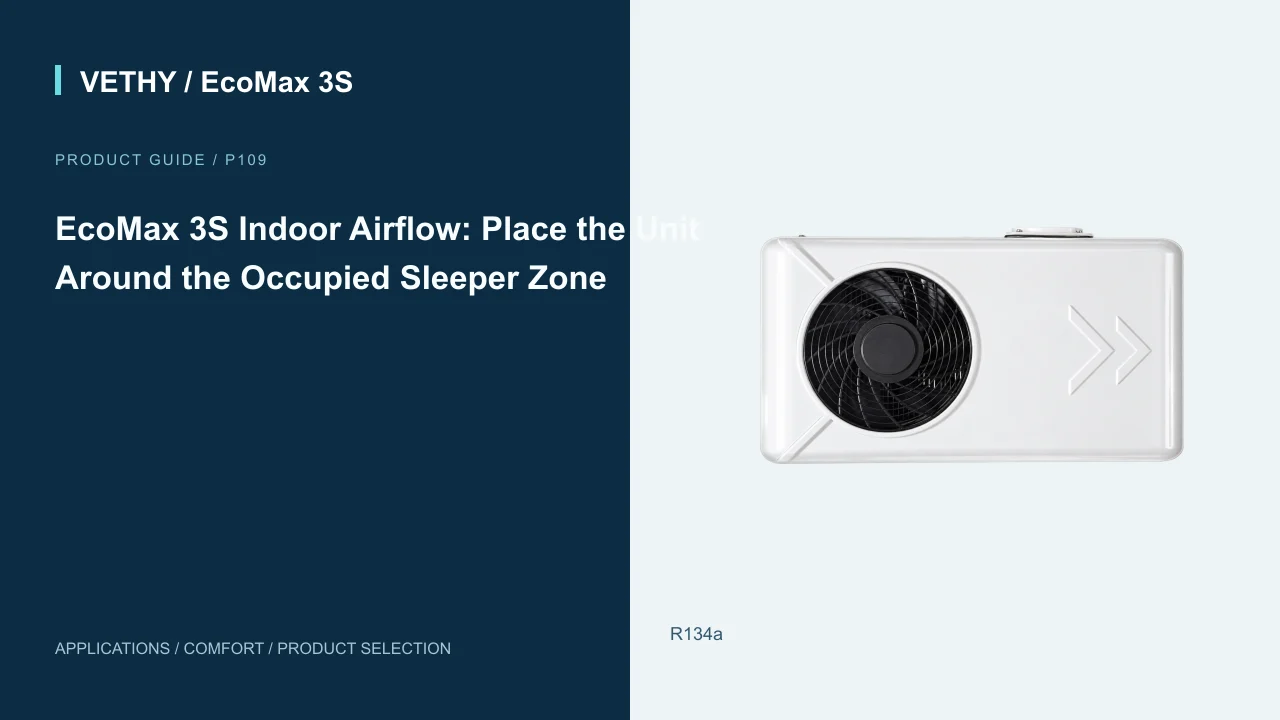
EcoMax 3S is a compelling split candidate when the buyer wants to arrange cabin comfort around a real sleeper position. The indoor assembly can be considered in relation to the bunk, curtain and storage as part of the complete installation. Its documented 400 m³/h evaporator airflow and brushless motor give the proposal a defined cabin-side package, supported by an R134a GMCC twin-rotary seasonal product.
The useful design question is where the occupant will actually rest and how delivered air can serve that area. This guide focuses on that physical relationship. It does not assume automatic oscillation, an undocumented temperature range or a universal cabin result. The goal is a reviewable interior proposal that makes the documented EcoMax 3S package useful to the driver who will occupy it.
Draw the resting position before drawing the unit
A bunk is not simply a rectangle labelled sleeper. The driver’s head, shoulders and bedding occupy particular positions, and different users may orient themselves differently. The indoor location should be discussed against that actual arrangement.
Ask the customer to show the normal pillow position and curtain use. Identify storage that remains close to the rest area and any fitting that moves during ordinary use. These details help the installer understand the available delivery path without asking the driver to diagnose an airflow system.
The split format makes this a worthwhile early conversation. EcoMax 3S offers a separate indoor assembly within a coordinated product, so the cabin role can be considered deliberately while the complete installation is reviewed. That is a practical reason to shortlist the model for an interior-led project.
Do not begin with an assumed mounting position and require the occupant to adapt every habit around it. Compare plausible locations under the applicable requirements and explain the trade-offs. The customer can then see why a position is recommended.
The result is a stronger product offer. The documented airflow package is connected with the person using it, and the premium GMCC twin-rotary seasonal model becomes more than a list of component references. The buyer receives a proposal shaped around a recognizable rest activity in the actual cab.
Represent the full indoor assembly accurately
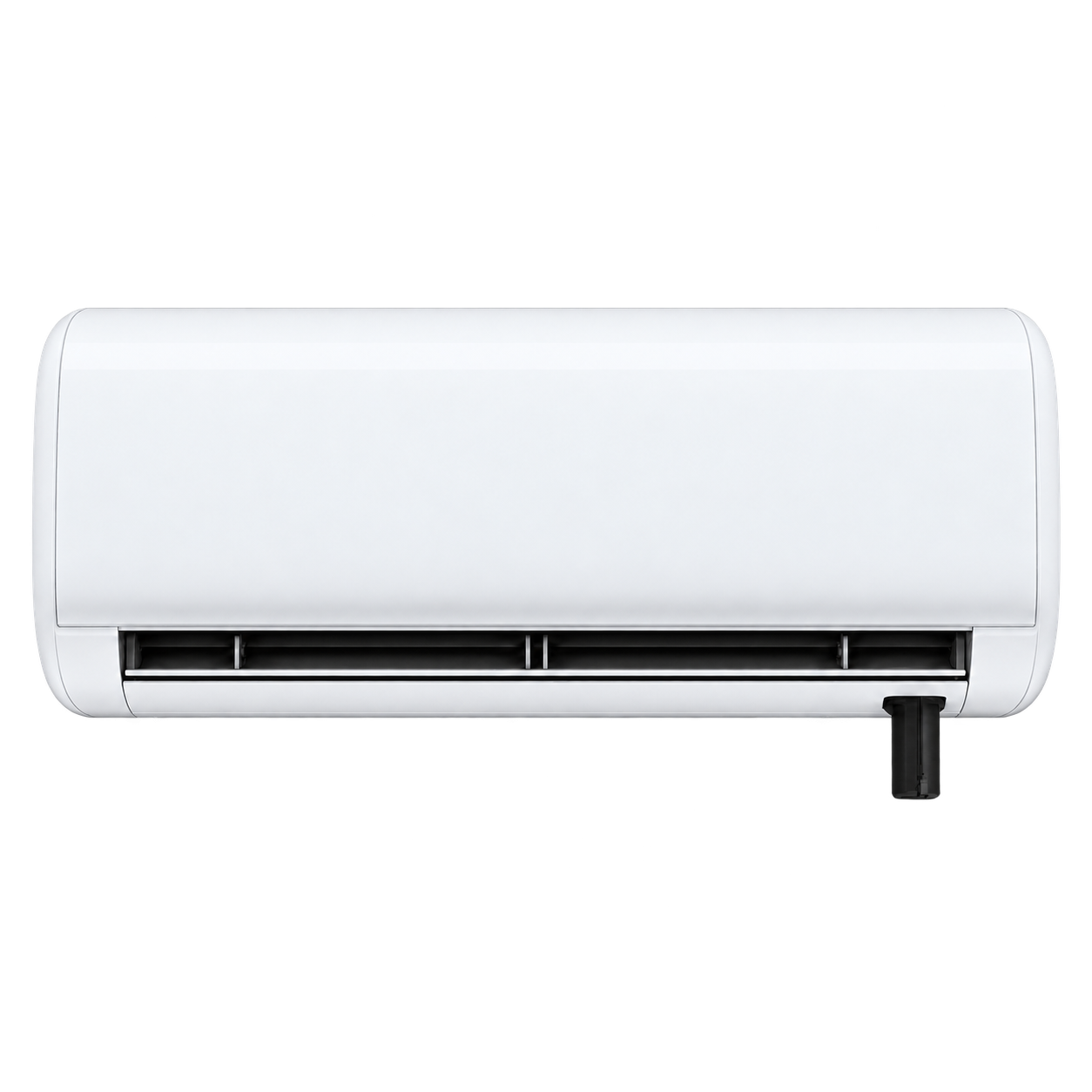
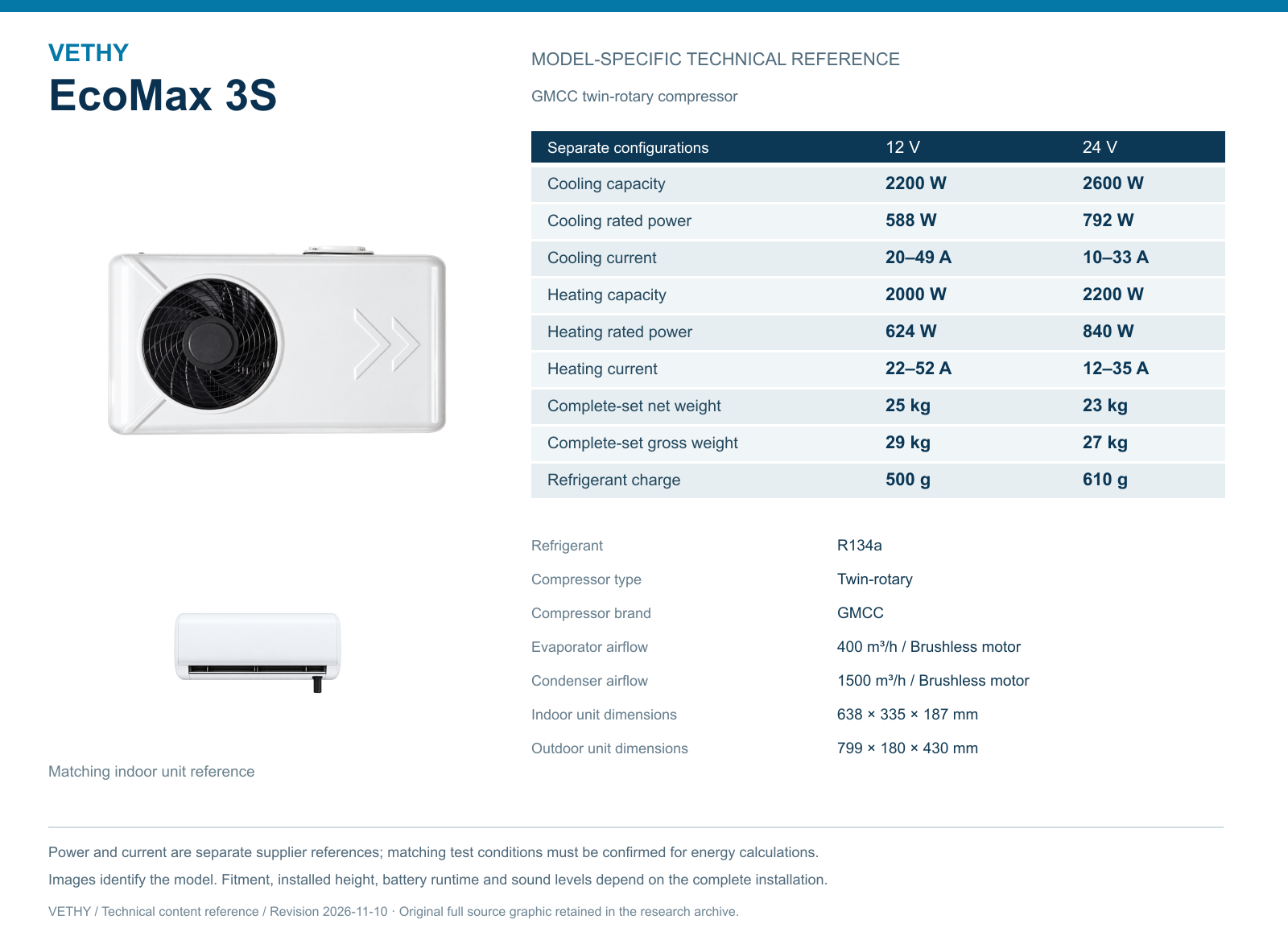
The source lists indoor overall dimensions at 638 × 335 × 187 mm. Preserve that callout in its stated order. The supplied information does not establish axis labels for assigning each number to a named direction.
Use the actual product information and applicable requirements to review the intended location. A small photograph or a single dimension cannot show every relationship with cabin trim, storage and support. Relevant vehicle views and measurements make the proposal more useful.
Keep packaging dimensions separate. They describe a different object and should not become the installation envelope of the unit itself. The EcoMax 3S specification data supports the model references used in the discussion.
For a customer who finds technical drawings difficult, a clear full-size layout aid can help explain the occupied area of the proposed assembly. Its status should remain a planning tool, with the actual installation reviewed by the responsible specialist. It should not imply hidden dimensions or approval that have not been established.
The benefit is an honest visual decision. The buyer sees the indoor assembly in relation to the normal sleeper environment, and the installer receives specific comments before the position is fixed. The model’s split format is used to develop a purposeful arrangement instead of treating any empty interior patch as automatically suitable.
Keep the normal curtain in the layout
A privacy curtain may divide the cab during the exact period when the driver wants comfort. Its ordinary position belongs in the design and demonstration. An open-cab review alone may not represent the rest arrangement.
Show the curtain and its fittings with the proposed indoor location. If the rail or fabric occupies space relevant to delivery or access, make that relationship visible. The installer can review the actual arrangement rather than infer it from a cleared cabin image.
The driver can then assess the intended rest position with the curtain used normally. A concern about air missing the occupied area is more useful when the record shows the real boundary between spaces. The proposal may need refinement, or the delivered controls may offer an appropriate adjustment; the response should follow the actual product and installation.
Do not add another model’s independent left/right oscillation to solve the drawing. The EcoMax 3S source establishes a brushless evaporator motor and airflow reference, while the supplied interface determines the available functions.
This makes the recommendation more credible. The customer sees a seasonal split product being arranged around ordinary privacy and rest needs. The curtain is not removed merely to make a demonstration look favorable, and the driver is not asked to accept an interior that was evaluated only in a condition rarely used during work.
Include storage in its working positions
Overhead cabinets, bags and other ordinary items can shape the route between an indoor unit and the bunk. Their working positions matter more than the appearance of an empty cab awaiting installation.
Show cabinet use and the storage that normally remains near the sleeper. If a fitting opens or moves into nearby space, include that condition in the review. The responsible installer can consider the relevant relationships alongside support and applicable access requirements.
This is especially useful where the vehicle receives custom storage. A new interior can look orderly in a proposal while inadvertently crowding the air-delivery package. Coordinating it early is easier than treating a later comfort concern as an unexplained equipment problem.
The buyer benefits from a complete cabin decision. EcoMax 3S’s indoor assembly is given a practical place among the functions the driver already needs. The proposal does not assume that the airflow number will make every obstruction irrelevant.
A clear record also helps after delivery. If storage changes, the owner can compare the new arrangement with the original baseline. The model may remain the preferred cooling-and-heating candidate while the changed interior receives a focused review. The product identity stays stable, and the physical application remains understandable rather than disappearing behind a generic statement that the unit once felt comfortable.
Where the same berth is used by several drivers, retain their normal orientations as part of the layout discussion. One may place the pillow differently or use another bedding arrangement. The objective is a location and delivered interface that can be understood across ordinary use, not an assumption that everyone must reproduce one demonstration pose. Specific feedback from each user can reveal whether a concern is personal direction preference or a physical obstruction in the shared interior. This helps the customer assess EcoMax 3S as an everyday vehicle product rather than a showroom assembly.
Use the 400 m³/h reference at the right level
The listed evaporator airflow is 400 m³/h with a brushless motor. It identifies part of the indoor package, not a promise of identical air speed at every point in the sleeper. The furnished cabin and unit placement affect what the occupant experiences locally.
A demonstration should therefore take place from the normal resting position. The first sensation beside the unit can be encouraging, but it answers a narrower question than whether the delivery serves the bunk after the driver settles.
Ask for a specific description. Does useful air reach the occupied area? Is a stream too direct near the face or shoulder? Does the experience change when the curtain is drawn? These observations help the installer understand the layout without requiring a numerical comfort score.
The brushless motor is a documented product attribute. The source does not establish an EcoMax 3S dB value, a special sleep mode or a particular speed-control program. Explain the actual delivered interface and keep the installed experience attached to the vehicle.
This gives the airflow reference practical meaning. The buyer can appreciate a defined cabin-side package and then judge how it serves the intended activity. The recommendation becomes more persuasive because it reaches the occupied space instead of ending with a technical number whose relevance the customer must guess.
Compare plausible positions through occupant consequences
A location review should make the trade-offs visible rather than assume that one position is universally correct for every sleeper. The actual candidates must be developed under the applicable product and vehicle requirements.
| Proposed relationship | Potential advantage to examine | Question that remains |
|---|---|---|
| Clear path toward the usual rest area | Useful delivery may be easier to demonstrate | Does the complete mounting and access arrangement work? |
| Position coordinated with storage | May preserve ordinary cabin functions | Is the airflow path still useful with fittings in use? |
| Position serving seat and bunk activities | May support more than one parked activity | How does each occupied position experience delivery? |
| Position considered with the outdoor layout | May support a coherent complete installation | Are routing, support and service requirements resolved? |
The table describes a design conversation, not fitment approvals. The customer can see why the installer is comparing alternatives and which detail makes a candidate more or less attractive.
For EcoMax 3S, this is a useful application of the split format. The documented GMCC twin-rotary seasonal product can be developed into an interior arrangement with a clear purpose. The buyer is choosing more than an assembly that physically fits: the proposal explains how the occupied cab and complete installation are intended to work together.
Make the actual interface understandable from normal use
The driver should be shown the controls delivered with the selected configuration. The source used here does not establish app operation, a particular temperature-setting range or automatic oscillation. Those features should not appear in the explanation unless separately confirmed for the actual unit.
Have the user perform the available operation rather than only watch an installer demonstrate it. This can reveal whether the explanation is clear and whether the normal occupied activity has been understood.
The purpose is a practical handover, not an assumption that a resting person must operate every control from one prescribed posture. The customer can explain the desired routine and the installer can assess the actual arrangement. Keep any interface requirement explicit rather than hide it inside a broad claim of convenience.
This helps a fleet as well as an owner-operator. Different drivers may use the same sleeper differently, and a clear explanation gives each a useful starting point without prescribing identical preferences.
The product recommendation gains everyday value. EcoMax 3S is a documented seasonal split package with a named compressor and brushless airflow hardware. The driver also understands how the delivered cabin interface belongs to the normal rest routine, so the technical choice remains useful after the sales and installation conversation has ended.
Keep cooling and heating observations attached to their conditions
EcoMax 3S has separately listed cooling and heating functions. Cooling outputs are 2200 W at 12V and 2600 W at 24V; heating outputs are 2000 W and 2200 W respectively. Select the version around the engineered supply arrangement and review the actual requested uses.
The indoor placement can be part of the seasonal project, but a favorable cooling observation does not establish every heating outcome. If heating matters to the customer, describe its intended conditions and activity separately.
The source does not provide a heating ambient envelope or establish a heat-pump architecture. A specific requirement should be raised directly through the application discussion. The customer can value the listed seasonal package without an invented mechanism or temperature limit.
For a sleeper-oriented buyer, this means the rest-zone brief remains readable. Which function was used, where the occupant rested and how the cabin was arranged should be clear in the record. Any numerical observation needs its own appropriate basis and context.
The EcoMax 3S seasonal guide explains the broader selection decision. This indoor guide adds the physical detail needed to make that product useful at the bunk, with each function’s application kept distinct enough to support a practical next step.
A useful handover can show the interior as arranged for rest and as used during seated parked work. This makes the relationship between activities visible without claiming that the product has separate automatic zones. The driver learns the actual delivered operation, while the workshop retains the technical reference. These are complementary parts of one package. EcoMax 3S’s documented seasonal functions remain the purchasing reason, and the interior explanation helps the occupant make practical use of that choice after the vehicle leaves the installer.
Preserve an interior that can be cared for appropriately
The indoor assembly needs an ownership context as well as a first-day appearance. The responsible service team should identify the access and care requirements for the actual installation, using current guidance for the delivered model.
Do not infer filter construction, cleaning intervals or a removal procedure from a similar-looking unit. The source used for this guide does not establish those details. The buyer can ask how the proposed cabin arrangement supports appropriate care without inventing the method.
A clear completion record should show the unit with enough surrounding interior to explain its location. The support team can then distinguish the delivered arrangement from a later storage or curtain change.
This is a practical advantage for a custom cab. The interior can evolve while retaining an understandable baseline. New fittings can be reviewed against the air-delivery path and applicable access needs instead of treating the air conditioner as a fixed object that no later work affects.
EcoMax 3S remains a defined product through that process. The GMCC twin-rotary identity, R134a configuration and selected voltage stay with the record, while the driver’s observations describe the actual occupied experience. The customer receives a premium seasonal package with a practical way to preserve its usefulness rather than only a photograph of an uncluttered installation before the vehicle returns to work.
Revisit the bunk after the arrival activity ends
A driver entering the cab, arranging bedding and speaking with an installer is experiencing a different moment from quiet rest. Return to the intended occupied position after settling before treating the first impression as the final evaluation.
The character of delivery may become more noticeable. A direct stream can feel welcome initially and less comfortable later. A fitting or stored item may also become audible once activity around the cab reduces. Describe the observation and its location before assigning a technical cause.
The source establishes brushless fan motors and a GMCC twin-rotary compressor, but it does not establish a numerical installed-sound result. The actual vehicle includes mounting, trim and furnishings. Qualified review should address a mechanical concern, while a distribution question should remain identifiable as such.
This gives the buyer a more representative decision. EcoMax 3S is being evaluated for the activity that matters, not only for a brief sensation of outlet air. The installer receives specific feedback and can record any relevant refinement with its reason.
The output is a usable cabin reference. The customer understands which arrangement was accepted and how the normal rest activity was considered. A later enquiry can begin from that reference rather than a vague memory that the model was once demonstrated somewhere in an empty cab.
An illustrative sleeper-first proposal
Consider a driver who wants a seasonal split product and normally rests with the pillow at one end of the bunk and the curtain drawn. EcoMax 3S is shortlisted for its documented GMCC twin-rotary package and brushless indoor and outdoor fan motors.
The first layout discussion starts with the furnished sleeper. The installer sees the normal storage and occupied positions before proposing the indoor location. The outdoor location and routing are reviewed as part of the same vehicle project, with the applicable requirements retained.
The driver then uses the delivered interface during a representative occupied assessment. Feedback describes useful air, direct exposure and the effect of the curtain. No favorable result is prewritten, and no unsupported oscillation or special sleep function is added to the demonstration.
If a refinement is made, the record identifies the change and the observation reassessed. The completed interior photograph shows the actual delivered position rather than an earlier proposal that was superseded during installation.
The buyer now has a concrete reason to approve the package. The product’s documented features match the intended direction of the project, and the cabin arrangement has been considered from the place the driver will rest. The model is not being asked to prove a universal sleep or comfort result.
If another driver later uses the truck differently, the owner can explain the change against a known baseline. The same EcoMax 3S may remain the preferred candidate, with the new preference or interior arrangement reviewed appropriately. That continuity is the practical value of designing the indoor unit around an actual occupied sleeper zone.
For a later vehicle, bring forward the preferred EcoMax 3S reference and identify the new sleeper differences directly. A cabinet, curtain rail or pillow orientation may change the relevant delivery path even when the cab looks similar from outside. The earlier installation can remain a useful example without becoming an unreviewed template. This gives the buyer continuity of product and a focused application discussion. The premium package stays recognizable, while the occupied-space plan is developed for the vehicle and people actually being proposed.
Questions about indoor placement at the sleeper
Does 400 m³/h establish the air speed at the pillow?
No. It is the listed evaporator airflow reference. The local experience depends on the actual furnished cabin, placement and delivered interface.
Should the curtain be omitted to simplify evaluation?
Use the normal rest arrangement. An open-cab-only demonstration may miss the relationships that matter when the driver actually rests.
Is automatic oscillation established for EcoMax 3S?
The supplied source does not establish it. Demonstrate the controls actually delivered with the selected configuration.
Can a successful cooling layout close every heating question?
Keep the functions and conditions separate. Heating has its own references and application requirements where the customer plans to use it.
Choose the seasonal package with a sleeper-led interior plan
Recommend EcoMax 3S when its documented split seasonal package suits the vehicle and the indoor assembly can be developed around the actual occupied rest area. The split-layout guide explains how the cabin decision connects with the wider vehicle arrangement.
Share the bunk orientation, curtain and storage views with VETHY engineering, or contact VETHY for a concrete proposal. Further model topics are linked from the EcoMax 3S guide hub.
Product sources
VETHY product recommendation and application analysis. Specification references identify the selected model and voltage. Installation examples are planning examples; measured project results are identified explicitly when available.
Discuss your EcoMax 3S application
Send your vehicle, supply voltage, occupied space, parking schedule and installation photographs for a model-specific recommendation.
Prepare your vehicle brief ↗