
VETHY / EcoMax 3S / PRODUCT AND APPLICATION GUIDE
EcoMax 3S Outdoor Air Path: Heat Rejection and Serviceability Together
EcoMax 3S is worth shortlisting when its GMCC twin-rotary split seasonal package can be given a suitable outdoor setting. The source lists 1500 m³/h condenser airflow with a brushless motor. Coordinate operating air paths, support, routing and service access using the actual vehicle and current requirements, without inventing clearances or heat-rejection results.
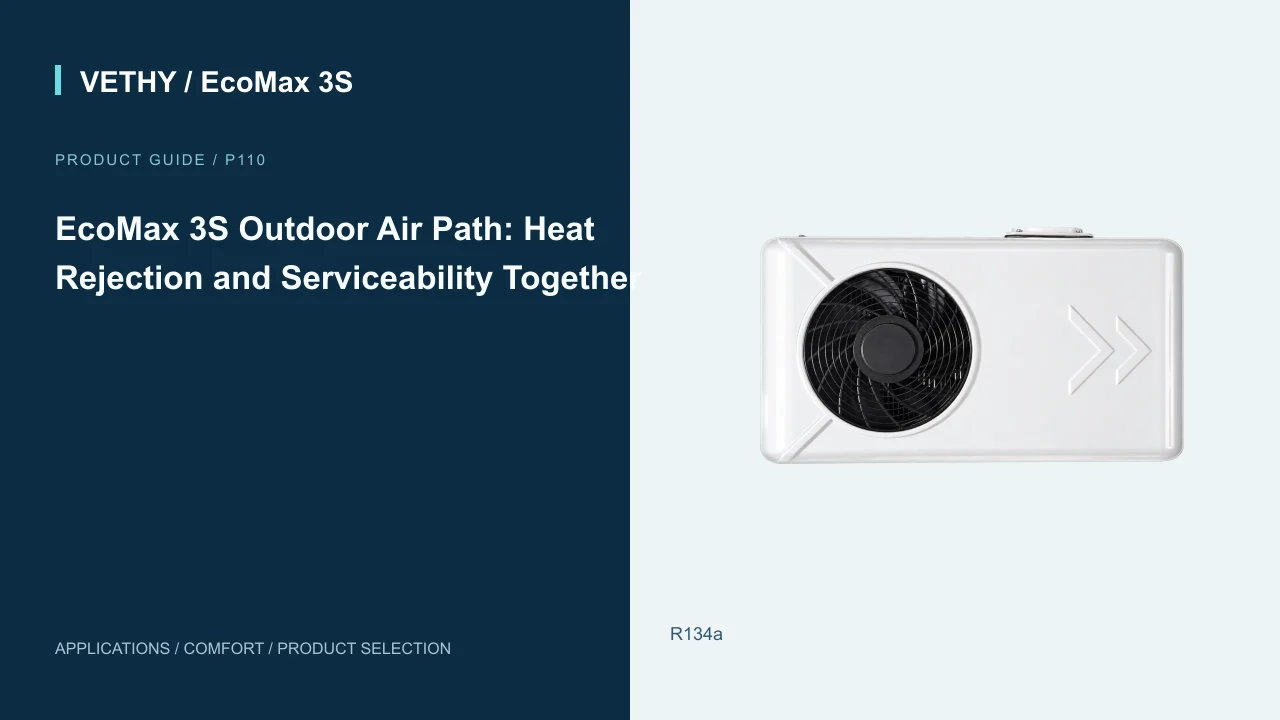
EcoMax 3S is a worthwhile split candidate when the buyer wants to develop an outdoor location around the vehicle’s real working layout and service arrangements. The source lists condenser airflow at 1500 m³/h with a brushless motor, within an R134a GMCC twin-rotary cooling-and-heating product. Those references identify a concrete outdoor package to accommodate.
For cooling, the condenser-side discussion concerns rejecting heat to the outdoor environment. The installation also needs a practical ownership route for appropriate inspection and care. This guide brings those two questions together without inventing a clearance dimension, a cleaning procedure or a heat-rejection figure. It keeps the cooling role distinct from the model’s separately listed heating function, whose mechanism is not established by the supplied source.
Give the outdoor side a deliberate job in the proposal
A split system can make it tempting to focus first on the indoor unit because that is what the driver sees. The outdoor assembly is equally part of the vehicle project. Its setting should be considered before the remaining available spaces are filled with unrelated equipment.
For EcoMax 3S, the outdoor package has a documented condenser airflow reference and brushless motor. The buyer can ask the installer to develop an appropriate location using the actual vehicle and current requirements. A small product photograph cannot establish every relationship around the installed assembly.
The practical benefit is a more complete premium offer. The customer values the GMCC twin-rotary seasonal package, and the proposal shows how its outdoor side will belong in the working vehicle rather than treating it as a box to place wherever a gap remains.
This is especially useful for a bodybuilder or fleet with recurring equipment layouts. A reviewed reference can identify the important relationships and make material differences visible on later vehicles. The same preferred model can remain the candidate while each relevant installation receives the attention it needs.
The recommendation is therefore specific: choose EcoMax 3S for its documented product package and support that choice through a deliberate outdoor arrangement, connected to the indoor comfort role and the actual installation scope.
Keep the outdoor references clear and limited to their scope
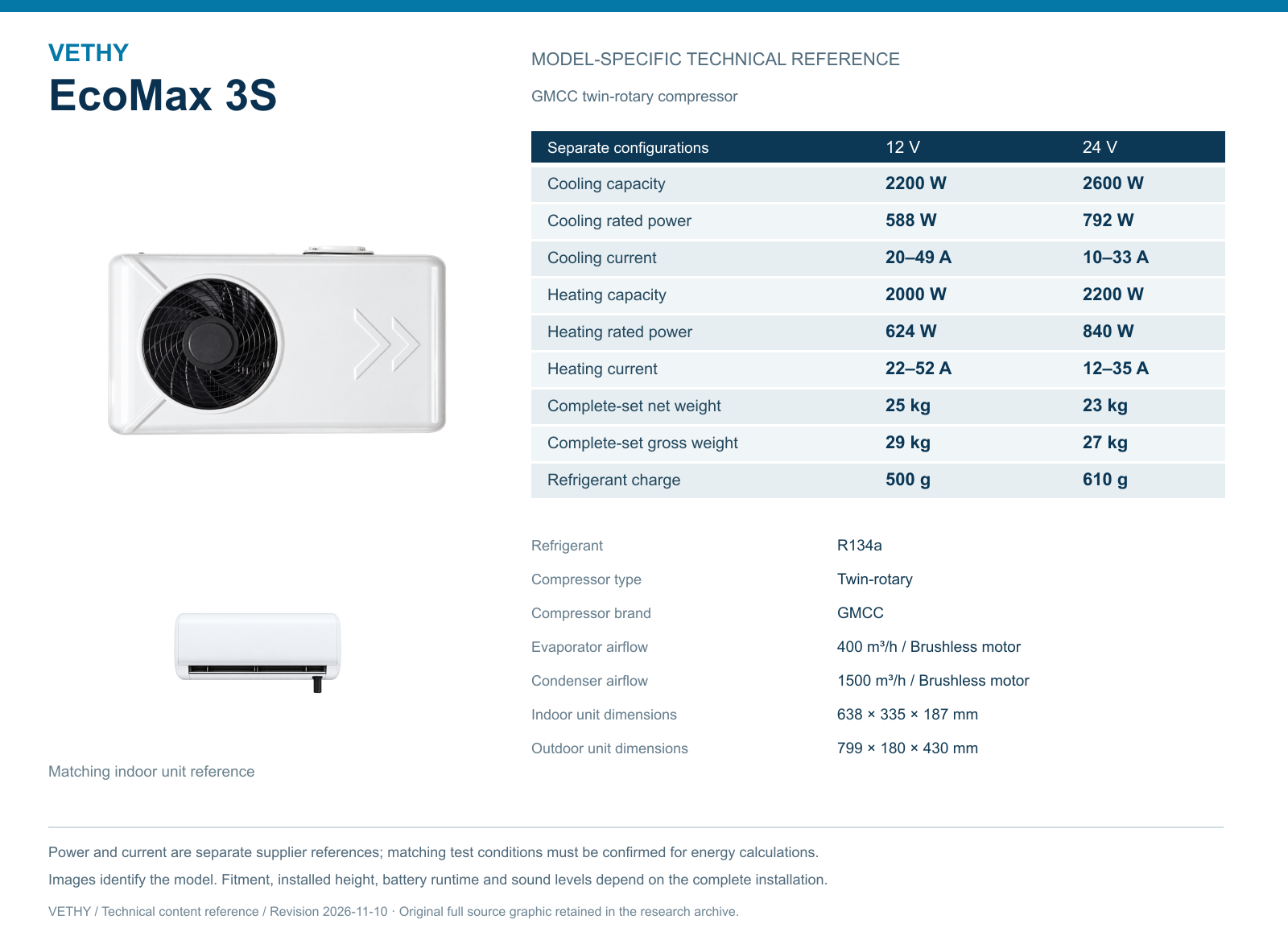
The source provides a full overall dimension callout of 799 × 180 × 430 mm for the outdoor unit. Preserve the numbers in that order. Axis labels are not established by the supplied reference and should not be invented in a drawing.
Condenser airflow is listed at 1500 m³/h with a brushless motor. This is a product airflow reference, not a universal clearance, a fan performance curve or a quantified effect on nearby equipment.
| Outdoor planning reference | EcoMax 3S information | Appropriate use |
|---|---|---|
| Overall dimensions | 799 × 180 × 430 mm | Prepare a location proposal in source order |
| Condenser airflow | 1500 m³/h | Identify the documented outdoor air package |
| Fan motor | Brushless | Retain the stated motor type in the offer |
| Complete product | R134a, GMCC twin-rotary, split seasonal functions | Keep the proposed configuration recognizable |
The EcoMax 3S specification data supports those fields. The actual assembly, applicable instructions and vehicle setting should guide the responsible installation review.
The buyer gains clarity because each datum retains its meaning. A useful proposal can be developed from the model references without pretending the references already approve a specific mounting location or predict the installed result in every surrounding arrangement.
Show the vehicle in its normal working state
The outdoor surroundings may include tools, storage, bodywork or other equipment. Show those items in the positions relevant to ordinary operation. A cleared vehicle photographed during installation may not represent the arrangement present when the air conditioner is used.
If equipment moves or loading varies, explain the material variations. The responsible installer can review the actual relationships rather than assume the cleanest image is the complete application.
This is valuable for an operator with several common vehicle configurations. One truck may have a different equipment arrangement even when the cab and nominal voltage match. The installation record should identify which reference represents which group.
For EcoMax 3S, the split format makes the outdoor location a practical design decision. The customer can explore a layout that preserves other vehicle priorities, subject to appropriate technical review. The opportunity should be used deliberately instead of converted into a blanket promise that any exterior space is suitable.
A clear working-state proposal supports a confident purchase. The documented seasonal functions and named compressor package provide the reason for interest, while the outdoor arrangement shows how the product will coexist with the truck’s actual work. The buyer can see both the hardware and the implementation instead of receive a specification card with an unresolved physical assumption.
Separate the operating air path from the service approach
An appropriate outdoor air path supports the cooling task. A service approach supports the people who will inspect or care for the equipment. These are related but different questions, and one should not be treated as proof that the other is resolved.
A space can appear open in a photograph without being practical for a technician’s actual task. A location can look easy to reach while still requiring review of the surrounding operating environment. The responsible parties should consider both under the current product and vehicle requirements.
This guide does not prescribe a universal clearance. The useful next step is to obtain the applicable information and apply it to the actual proposal. The customer can ask for the operating and ownership relationships to be explained plainly.
The benefit is a more durable product package. EcoMax 3S is selected for a defined GMCC twin-rotary split configuration, brushless airflow hardware and separately documented seasonal functions. Appropriate location planning supports that selection beyond the initial delivery photograph.
The customer does not need a fictional claim that the motor is maintenance-free or that the split format automatically makes every service task simple. The offer can instead show a practical arrangement and an understandable support route, which are concrete reasons to trust the implementation of the premium product choice.
Coordinate nearby equipment before positions are fixed
Outdoor cooling hardware should be considered with neighboring vehicle equipment early enough for the design to change sensibly. A rack, tool enclosure or other fitting may have its own working purpose. The proposal should coordinate those functions rather than let them compete for unreviewed leftover space.
Show the relevant dimensions and orientation clearly. If the project is being discussed remotely, pair detail photographs with a wider vehicle view. The installer should be able to identify which relationship is under discussion without guessing from perspective.
The source does not establish the detailed inlet and discharge geometry in every photographic view, nor does it approve an added enclosure or guard. Use the actual product information and applicable requirements rather than infer those details from appearance.
For a customer considering an alternative to a rooftop package, this is a positive use of the split format. EcoMax 3S allows a different arrangement to be explored, while the complete vehicle design remains visible.
The buyer can compare practical options before work is committed. A modest change in equipment grouping may be preferable to leaving the outdoor unit in an awkward location. The chosen proposal should explain that trade-off, so the customer understands how the documented product and working vehicle priorities are being brought together rather than asked to accept an unexplained mounting decision.
A useful option review can identify the customer’s priorities explicitly. Preserving roof equipment, maintaining ordinary loading and obtaining a practical workshop approach may all matter. The installer can explain how each proposed location addresses those priorities and which trade-off needs the customer’s decision. This is a stronger commercial offer than selecting a location silently and presenting the finished work as inevitable. EcoMax 3S remains the documented seasonal candidate, while the outdoor proposal shows how its split format can contribute to a vehicle arrangement the customer actually understands and wants to operate.
Review support and routing as part of the same setting
The outdoor location is connected to the indoor assembly through the complete installation. Support, routing, integration and access should be resolved for the actual model and vehicle by the responsible installer using current information.
This guide does not provide universal fastener values, line lengths or a connection procedure. A generic detail copied from another split product may not answer the actual installation question. The owner should provide the vehicle context and ask for a concrete proposal with responsibilities clear.
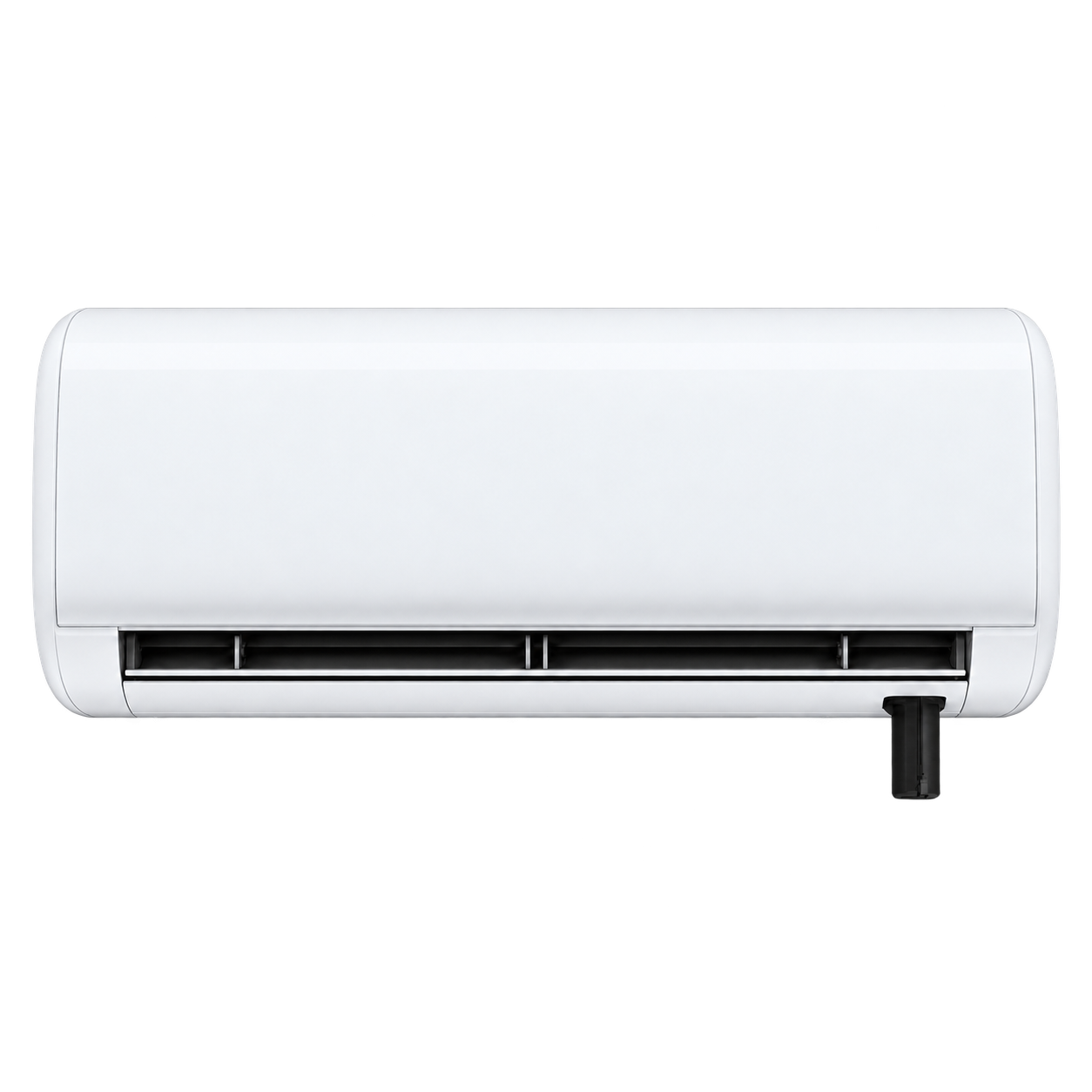
The indoor overall dimensions are 638 × 335 × 187 mm in source order. Its location should serve the occupied cabin with normal furnishings present. An outdoor location that appears convenient should not quietly force an indoor arrangement that misses the intended rest area.
This is a useful benefit of a coordinated package. The buyer sees how both assemblies belong in one vehicle project, with neither location chosen in isolation. EcoMax 3S’s documented component identity and seasonal functions remain the attraction, and the installation proposal explains how that attraction becomes usable equipment.
The customer can review the actual scope before scheduling work. If another trade or additional vehicle information is needed, identify it while the design is flexible. The unit is then delivered into a project that can be carried forward, rather than arrive before the parties discover that a key routing or support assumption was never resolved.
Plan care using the actual product guidance
Appropriate care should follow current instructions for the delivered configuration and environment. The supplied source used here does not establish a cleaning chemical, pressure limit, filter detail or universal maintenance interval.
Do not infer a method from the brushless motor label or the appearance of another model. The complete assembly and its actual requirements matter. Qualified personnel should handle technical work using the correct information and suitable facilities.
The operator can still contribute useful ownership context. Describe recurring exposure, service locations and how the vehicle is supported. A fleet with several workshops may need an arrangement that remains understandable to people who did not perform the original installation.
A clear record of the delivered setting helps. Show the assembly and enough surroundings to explain the approach, rather than only prove the product is present. The next workshop can then recognize what was fitted and compare it with the current condition.
For the buyer, this supports the value of a documented premium package. EcoMax 3S is selected for identifiable compressor, airflow and seasonal attributes, with an appropriate ownership route around them. The recommendation does not depend on pretending the environment or future care is irrelevant; it connects the product with a practical way to keep the installation understandable through working use.
Keep heating observations separate from the cooling air-path discussion
EcoMax 3S has separately listed cooling and heating functions. The cooling outputs are 2200 W at 12V and 2600 W at 24V, while heating outputs are 2000 W and 2200 W respectively. Select the version around the engineered supply arrangement and review the actual functions requested.
This article’s heat-rejection discussion concerns the outdoor cooling role. The source does not establish a heating mechanism, so it should not be used to infer the direction or behavior of outdoor heat transfer during heating. A particular seasonal question needs its own appropriate information.
Likewise, a successful cooling demonstration does not close every heating requirement. Retain the function and conditions with observations. The customer can value the seasonal package while keeping the actual scope of evaluation clear.
The EcoMax 3S seasonal guide explains the broad model proposition. The outdoor location should be developed within that complete product decision, with mode-specific application questions left readable rather than blended together.
The buyer benefits from a recommendation that can answer technical questions accurately. The documented functions remain attractive, and the installation discussion stays within the model information available. No undocumented heat-pump architecture or cold-weather envelope is needed to make EcoMax 3S a serious candidate for a defined seasonal vehicle project.
Evaluate the finished outdoor arrangement in context
A first completed vehicle can establish a useful reference when the selected unit and working surroundings are identifiable. Record the actual outdoor location, nearby equipment and material differences from the original proposal.
The driver should also experience the indoor result from normal positions. The evaporator airflow reference is 400 m³/h with a brushless motor, while the furnished cabin and delivered interface shape useful delivery. The outdoor and indoor observations answer different parts of one installation decision.
If numerical information is collected, retain the method and scope. No quantified condenser heat-rejection result follows from the separate product fields in this guide. Do not add unmatched cooling and electrical references to create one.
Installed sound should also remain descriptive unless appropriate evidence supports a numerical claim. The source does not establish an EcoMax 3S dB figure. Listen and report the relevant position and circumstances rather than assign every sound to the compressor or fan motor.
The useful outcome is a concrete reference package. The buyer can see which arrangement was accepted, what the driver experienced and which questions remain open. EcoMax 3S’s documented features provide the reason for selection, while the finished-vehicle review makes the recommendation practical and reviewable beyond a brochure or early layout sketch.
If the project is delivered in stages, distinguish the current installation from future equipment shown on a proposal. A planned accessory should not appear to have been evaluated in the same working state as an item already fitted. Mark the stages clearly and review the affected relationships when later work becomes concrete. This allows the customer to progress the vehicle design without treating an early outline as universal approval. The model identity stays stable, and the outdoor arrangement develops through identifiable decisions that can be understood by the next installer or support team.
Preserve the baseline when the vehicle changes
Working vehicles receive new equipment and different loads. A change near the outdoor assembly may affect a relationship that was part of the original proposal. Retain the completed layout so the affected area can be reviewed intelligently.
The owner can provide a clear description and contextual image of the proposed change. The responsible installer can then compare it with the baseline using current requirements. A small modification may be straightforward or may justify another arrangement; the important point is that the decision is deliberate.
The product identity should remain with the record: EcoMax 3S, R134a, GMCC twin-rotary and the selected voltage. The complete-set weight references are already inclusive of the set and should not be inflated by adding the separate indoor-unit figures again.
This continuity supports a professional ownership experience. The customer can keep developing the vehicle while preserving a clear understanding of the seasonal comfort package. The model may remain the preferred candidate, with the changed installation context reviewed on its own merits.
The recommendation becomes more durable because it includes a useful baseline and support route. The premium product is not treated as isolated from later work, and a new concern does not have to be interpreted against a forgotten arrangement that no longer matches the vehicle.
An illustrative outdoor-first project review
Consider a fleet choosing EcoMax 3S for vehicles whose roof serves another working function. The buyer wants a GMCC twin-rotary split seasonal package and asks the installer to develop a suitable outdoor location as part of the vehicle design.
The proposal shows the actual working equipment and relevant variations. Indoor and outdoor locations are considered together, with support, routing and service requirements reviewed through the correct information. The source dimensions retain their order, and the offer states which vehicle work is included.
The first completed truck is recorded in its delivered state. The driver assesses the normal occupied cabin, while the external record shows the outdoor assembly and surroundings. Cooling observations remain attached to the cooling task; any heating question retains its own function identity.
No favorable thermal, acoustic or energy result is assumed. If appropriate measurements are gathered, their scope and method stay with the record. Descriptive feedback remains useful for the practical layout questions it genuinely addresses.
The fleet can now make a concrete decision about the package. EcoMax 3S’s documented features justify the shortlist, and the installation reference explains how the model belongs in this working vehicle group. The customer does not need an invented universal clearance or heat-rejection figure to understand the offer.
When another truck has different equipment, the same model can remain a candidate while the material difference receives attention. This shows the commercial value of coordinating outdoor airflow and serviceability early: the premium product choice becomes a repeatable, understandable vehicle arrangement rather than an assembly placed wherever space happened to remain.
A focused support enquiry can use that baseline efficiently. Provide the exact delivered configuration, the current surroundings and a plain description of what changed or was noticed. The customer does not need to calculate heat rejection or diagnose an internal component before asking for help. Appropriate technical review can then begin from a recognizable vehicle and function. This is a practical ownership benefit of a well-described premium package: the product and installation remain linked, so later observations can lead to the right review instead of an argument based on an isolated airflow number.
Questions about the outdoor air path
Does 1500 m³/h state a heat-rejection output?
No. It is the listed condenser airflow reference. A quantified heat-rejection result is not established by that number alone.
Does this guide provide a universal clearance?
No. Obtain the applicable current requirements and review the actual outdoor setting, support, routing and service approach.
Can cooling behavior be assumed to describe heating?
Keep the functions separate. The source lists heating references but does not establish the heating mechanism or an ambient operating envelope.
Is easy service guaranteed by split format?
The actual locations determine the ownership arrangement. Plan appropriate access and care using current product guidance and the operator’s real support facilities.
Recommend the split package with a workable outdoor setting
Shortlist EcoMax 3S when its documented GMCC twin-rotary seasonal package suits the customer and the outdoor assembly can be accommodated appropriately. Connect the cooling air-path discussion with serviceability and the actual vehicle layout.
Bring the proposed location and working-equipment views to VETHY engineering, or contact VETHY for a concrete discussion. The split-layout guide and EcoMax 3S hub connect the outdoor decision with the rest of the vehicle project.
Product sources
VETHY product recommendation and application analysis. Specification references identify the selected model and voltage. Installation examples are planning examples; measured project results are identified explicitly when available.
Discuss your EcoMax 3S application
Send your vehicle, supply voltage, occupied space, parking schedule and installation photographs for a model-specific recommendation.
Prepare your vehicle brief ↗