
VETHY / EcoMax 3S / PRODUCT AND APPLICATION GUIDE
EcoMax 3S Heating Ratings: Turn the Listed Output into a Seasonal Brief
EcoMax 3S lists heating output at 2000 W for 12V and 2200 W for 24V within an R134a GMCC twin-rotary split product. Use those references to define the intended seasonal activity, occupied area and power scope. Keep heating separate from cooling and avoid assuming an undocumented mechanism, ambient envelope or runtime.
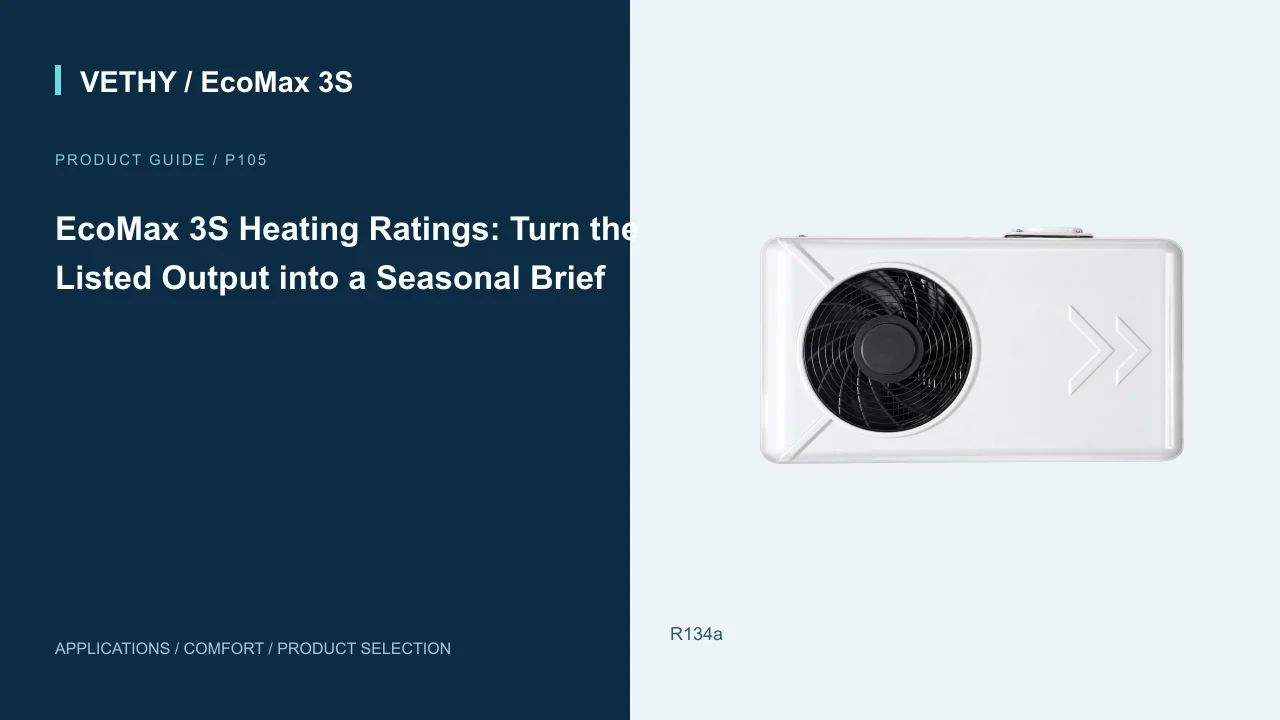
EcoMax 3S deserves a place on the shortlist when a vehicle customer wants a documented heating function as part of a split cooling-and-heating package. The source lists heating output at 2000 W for the 12V version and 2200 W for 24V, within an R134a model using a GMCC twin-rotary compressor. Those references give the seasonal enquiry a concrete starting point.
The useful next step is to describe the heating job the customer actually wants. Output, electrical input, occupied area and intended conditions are related questions with different meanings. This guide turns the listed heating references into a practical vehicle brief, without inventing a heat-pump mechanism, a cold-weather operating envelope or a guaranteed runtime. The aim is a persuasive product proposal whose seasonal purpose and installation scope can be reviewed clearly.
Describe the heating request as an activity
A customer may say the cab needs heat, but that phrase can conceal very different uses. The driver may want comfort while waiting before work, during a parked meal or while resting for a longer period. The vehicle may be occupied in one area or several.
Begin with that ordinary activity. State when heating is requested, where the occupant sits or rests and what the cabin arrangement looks like. Include the curtain, normal storage and other relevant fittings. These details help the supplier and installer understand the application rather than interpret an abstract request for winter performance.
EcoMax 3S is attractive because heating is listed as part of the actual product, alongside cooling. A customer with a seasonal comfort requirement can investigate one defined split candidate instead of assume that a cooling-only enquiry answers the whole need.
The product reference is the start of the discussion, not a substitute for the intended conditions. If the customer has a particular operating requirement, state it explicitly and seek the appropriate information. This keeps the recommendation useful and positive: the model offers documented heating references, and the project brief explains the specific task those references are being considered for.
Read the voltage-specific heating table accurately
The heating data should remain separate from cooling throughout the offer. The source provides different output, power and current references for each voltage version.
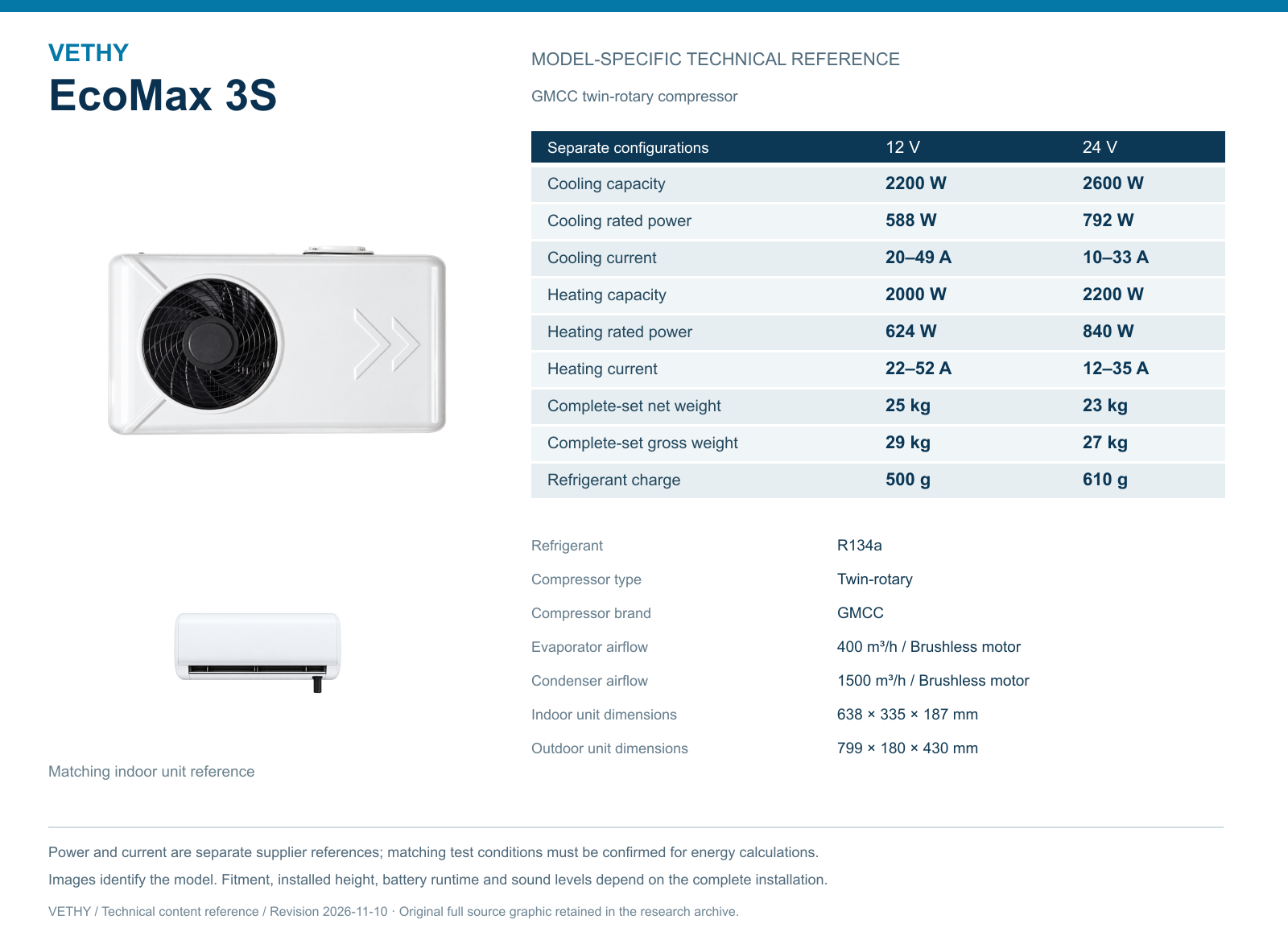
| EcoMax 3S version | Heating output | Heating rated-power reference | Heating current reference |
|---|---|---|---|
| 12V | 2000 W | 624 W | 22–52 A |
| 24V | 2200 W | 840 W | 12–35 A |
The EcoMax 3S specification data and model specification sheet are the references for these fields. Keep their labels intact when preparing a customer card or technical enquiry.
Choose the nominal-voltage version around the engineered supply arrangement of the actual vehicle. The difference in output does not make the 24V unit a simple substitute for an unrelated electrical project.
For the buyer, the table is commercially useful because it makes the offered function concrete. The customer can see the selected version and the references that belong to it, while the responsible technical review addresses the application and integration. The source does not establish a common test basis for calculating an efficiency or session duration from the separate fields, so the table should not be rearranged into an unsupported performance promise.
The table can also help a technically interested buyer prepare a concise internal recommendation. Identify the selected voltage and heating output, then describe the actual parked activity beneath it. The decision-maker can see why the function matters without having to interpret every source field. Detailed power and current references remain available for the responsible integration review. This gives the seasonal offer both an accessible customer explanation and a traceable technical basis, which is useful when operations, purchasing and the workshop each need a different level of detail from the same product proposal.
Keep heating output distinct from electrical demand
The 2000 W and 2200 W references describe heating output for the respective versions. They are not the same quantities as the listed electrical power fields. A buyer should understand that distinction before discussing the auxiliary energy system.
The heating rated-power references are 624 W at 12V and 840 W at 24V. The current ranges are separately listed at 22–52 A and 12–35 A. They are supplier reference fields, not a complete time-based operating profile under the customer’s intended conditions.
Do not combine convenient entries to calculate a universal heating runtime or coefficient of performance. The required common operating basis is not established here. A component power field elsewhere in the specification should also not be substituted for the complete heating function’s electrical use.
The constructive route is a vehicle-specific review. Describe the requested period, other loads, usable energy arrangement and next charging opportunity. The responsible specialist can use the appropriate information for that system and obtain any additional details required for integration.
This supports a better product offer. EcoMax 3S supplies a defined seasonal function package, while the power proposal explains how the vehicle will support it. The customer can appreciate the listed heating capability without being sold a number of hours derived from fields whose relationship has not been established.
Let the stated function stand without inventing its mechanism
The supplied source documents heating and cooling references for EcoMax 3S. It identifies R134a and a GMCC twin-rotary compressor. It does not establish the detailed architecture by which heating is provided, so the sales explanation should not label the model a heat pump without a specific basis.
The same applies to inverter control. A DC nominal voltage and a named compressor architecture do not establish a particular control strategy. The customer should be shown the functions and interface actually delivered, rather than a set of features borrowed from another model.
This is a positive way to present the product. The heating function is documented and deserves attention. Its value to the buyer comes from whether the complete EcoMax 3S package suits the intended seasonal task and vehicle arrangement.
A customer does not need an invented internal diagram to understand the offer. The listed heating output, separate electrical references, GMCC twin-rotary identity and split format already provide substantive information. Any further technical requirement can be raised directly through the project discussion.
The result is a recommendation that remains stable under questions. The importer, installer and owner can use the same product description without revising an unsupported mechanism claim later. The focus stays on the actual seasonal function the customer wants to use and the concrete work required to make that function useful in the vehicle.
State the intended conditions instead of assuming an envelope
The source does not provide a heating ambient operating envelope. A listed output should therefore not be presented as proof of a result at every cold-weather condition. A buyer with a specific requirement should describe it directly for appropriate review.
The enquiry can remain accessible. Explain the normal season, parking context, occupied activity and expected duration. If conditions vary materially along the route, identify the relevant variation rather than summarize everything as winter use.
This context helps the supplier answer the actual question. A vehicle waiting at a familiar site has a different application story from one moving through widely varying conditions. The product can remain the same candidate while the review examines the intended use.
Do not prefill a favorable cabin temperature or warm-up time. The guide does not establish those results. A representative evaluation can provide useful observations when the conditions and actual installation are retained.
For the customer, this is a more useful basis for choosing EcoMax 3S. The model offers a documented heating function within a defined split package. The project then assesses whether that function and supporting arrangement meet the stated need. The recommendation remains confident about the product information and specific about the application, with no need for an invented extreme-temperature claim to complete the story.
Define the occupied area the installation should serve
A heating brief should identify the area the driver actually uses. The seat, bunk and shared spaces may create different delivery priorities. Curtains and storage affect the furnished cabin and should be visible when the indoor location is proposed.
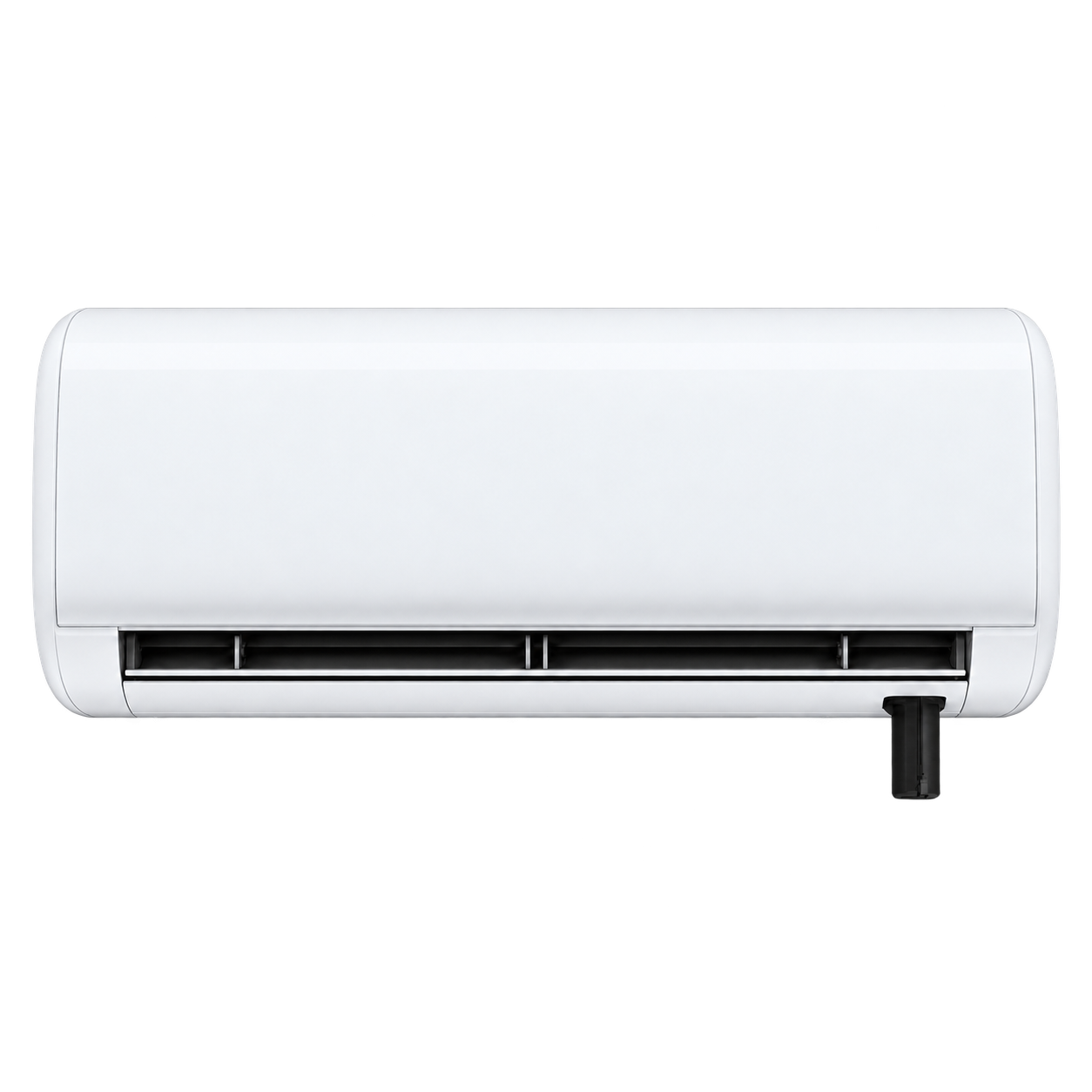
The source lists evaporator airflow at 400 m³/h with a brushless motor. Treat it as the documented indoor-side reference, rather than a model-specific heating distribution test or a promise of identical conditions throughout every cab.
The indoor unit’s overall dimensions are 638 × 335 × 187 mm. Preserve that order without assigning unsupported axis labels. The actual location should be reviewed with the vehicle and current installation requirements, including relevant access and surrounding fittings.
A driver can provide useful feedback by occupying the normal position and using the delivered controls. The source does not establish automatic oscillation or a particular temperature-setting range, so those functions should not appear in the handover unless separately confirmed for the actual unit.
The practical benefit is a seasonal product arranged around people rather than a capacity number in isolation. EcoMax 3S’s GMCC twin-rotary identity and brushless hardware give the buyer a clear package; the indoor proposal shows how that package belongs in the cab. The customer can review a concrete occupied-space plan and identify any layout concern before the installation is treated as complete.
Specific occupant feedback makes that proposal more useful. A driver can describe whether the delivered air serves the intended rest area, feels too direct or is obstructed by normal fittings. The installer then has a concrete distribution question rather than a broad complaint that heating is unsatisfactory. The customer does not need to identify the internal cause. A well-placed indoor assembly and an understandable interface help the documented seasonal function become an everyday cabin benefit, with the actual vehicle arrangement guiding the review instead of an assumption that every sleeper interior is equivalent.
Use the split format to coordinate the whole vehicle
EcoMax 3S includes separate indoor and outdoor assemblies. That format may suit a customer who wants to consider alternatives to a rooftop package or coordinate other equipment on the roof, subject to appropriate installation review.
The outdoor overall dimensions are 799 × 180 × 430 mm in source order. The condenser airflow reference is 1500 m³/h with a brushless motor. These fields help identify the assembly and prepare the location discussion; they do not independently approve every available mounting space.
Show the outdoor surroundings, working equipment and intended indoor location together. Support, routing, service approach and applicable requirements need to be resolved as one project. A split product is not two unrelated boxes that can be placed independently without considering their connection.
For the seasonal buyer, this coordination is part of the value. The requested heating and cooling functions are housed in a recognizable model with a layout approach that can be discussed deliberately. The customer can understand where the assemblies go and what the installer’s scope includes.
The offer becomes more persuasive when the physical proposal is clear. The buyer sees how the documented product might serve the vehicle, rather than being asked to accept that a heating output alone proves installation suitability. The model is shortlisted for its actual package and developed into a concrete arrangement through the responsible technical process.
Plan the heating period within the vehicle’s energy cycle
A parked heating request belongs to the vehicle’s wider energy use. Other devices may share the same relevant supply, and the next charging opportunity may occur after the heating period ends. The power plan should reflect the customer’s normal routine.
Identify which loads operate at the same time and how often the heating function is expected to be used. The actual usable energy and appropriate limits depend on the installed system, so they require the correct vehicle information and specialist review.
Do not assign undocumented voltage cutoffs, protection behavior or special operating modes to EcoMax 3S. The customer should understand the arrangement actually delivered and the operating guidance that applies to it.
A representative record can later improve the project-specific plan. Retain the function, interval, conditions and method where numerical information is used. A comfortable occupied experience is valuable feedback, but it is not itself a measured electrical result.
This gives the buyer a more complete seasonal offer. The heating references remain part of a defined product, while the supporting energy arrangement is developed for the intended use. The customer can see both the reason for choosing EcoMax 3S and the practical scope needed around it, rather than relying on a universal duration promise with no connection to the vehicle’s actual work.
Evaluate heating separately from a successful cooling demonstration
A seasonal product may be introduced during weather that makes one function easier to demonstrate. Keep the scope clear. A useful cooling evaluation can establish layout and interface observations without proving the heating result under all intended conditions.
When heating is evaluated, identify the selected voltage, actual installation and relevant conditions. Let the driver use the supplied controls and assess the intended activity from the normal position. Keep observations descriptive unless an appropriate measurement supports a numerical claim.
The report should distinguish an accepted physical arrangement, a comfortable observed session and any remaining application question. These are related but different outcomes. A positive impression should not silently close unresolved work in the power or seasonal brief.
This is useful for fleet and importer programs. The buyer can progress the parts of the project that have been reviewed while retaining a clear next action for the rest. The model remains a coherent seasonal candidate rather than an offer whose functions are blurred together.
For EcoMax 3S, the value is a recommendation that survives the transition from brochure to use. The documented GMCC twin-rotary split package provides the reason for interest. Separate function observations show how that package serves the customer’s actual vehicle, with the scope of each conclusion understandable to the next installer, driver or purchasing decision-maker.
Keep the selected set and technical record recognizable
The product record should identify EcoMax 3S, R134a, GMCC twin-rotary and the selected nominal voltage. Retain the current specification and actual installation views so support can begin from the delivered configuration.
Complete-set weight references are 25 kg net and 29 kg gross for 12V, or 23 kg net and 27 kg gross for 24V. The separate indoor-unit weight is already part of the set context and should not be added again to the complete-set figures.
The source also lists version-specific refrigerant charge and a refrigeration-oil reference. These identify the configuration; they are not instructions for untrained service. Qualified personnel should use the correct current information for the actual unit.
This continuity is particularly helpful for seasonal enquiries. A concern should identify whether heating or cooling is involved, the conditions and any change in the vehicle arrangement. The customer does not need to diagnose the mechanism before contacting support.
The premium product choice remains understandable through ownership. The buyer selected a defined compressor and split seasonal package, and the record preserves that identity. A later workshop can ask a focused question rather than choose between several old documents or infer the configuration from exterior appearance alone.
An illustrative heating brief for a seasonal vehicle project
Consider an owner who wants cooling during warm parked periods and also requests heating for another part of the working season. The initial interest in EcoMax 3S comes from its listed functions, GMCC twin-rotary identity and split format.
The enquiry identifies the actual vehicle, appropriate nominal-voltage requirement and occupied activities. Heating is described separately: when it is requested, which area is used and what conditions the owner wants reviewed. The heating output and electrical fields remain labelled in the offer rather than mixed with cooling data.
The installer develops indoor and outdoor locations together, with normal cabin fittings and working equipment visible. The power scope considers the requested heating period, other loads and charging pattern. No special protection or control behavior is assumed without a basis in the delivered arrangement.
The first evaluation records what was actually considered. If cooling is demonstrated first, the report does not claim that every heating question is complete. When heating observations are gathered, they retain their conditions and function identity.
The customer can then review a coherent seasonal package. EcoMax 3S remains attractive because the documented product matches the desired direction of the project. The vehicle proposal makes the offer concrete, and any unresolved question has a recognizable next step.
This is a practical way to use the heating ratings positively. They establish a real function in the product reference and invite a defined application discussion. They do not need an invented mechanism, ambient limit or numerical saving to become commercially meaningful. The buyer receives information that can support a serious decision and an installation plan that can be understood beyond the original sales meeting.
For an importer or fleet placing another order, preserve the heating brief as well as the model identity. The next vehicle may share the selected EcoMax 3S version while having a different occupied area or seasonal request. Bring forward the successful reference and identify the new circumstances openly. This supports a consistent product program without pretending the application never changes. The premium package remains recognizable, and the buyer can explain both why it is preferred and what the next installation needs to address before a complete seasonal outcome is described as accepted.
Questions about the EcoMax 3S heating references
What are the listed heating outputs?
The source lists 2000 W for the 12V version and 2200 W for 24V. Keep each attached to the correct nominal-voltage configuration.
Does this establish a heat-pump architecture?
No heating mechanism is established by the supplied source. Present the documented function and obtain any additional technical information needed for the actual project.
Is a cold-weather operating envelope supplied?
No heating ambient envelope is established here. Describe the intended conditions and seek the appropriate application review rather than infer a limit from output alone.
Can heating runtime be calculated from the separate references?
A common operating basis is not established for that calculation. Use vehicle-specific energy information and representative operation for a project-specific plan.
Turn the heating reference into a clear seasonal enquiry
Shortlist EcoMax 3S when the customer wants a split GMCC twin-rotary product with documented cooling and heating functions. Use the heating output as a starting reference and define the actual seasonal task before treating it as an operating expectation.
The EcoMax 3S seasonal selection guide explains the complete model proposition. Bring the vehicle and function requirements through the parking AC technical enquiry guide, then contact VETHY for a concrete discussion. Further topics are linked from the EcoMax 3S guide hub.
Product sources
VETHY product recommendation and application analysis. Specification references identify the selected model and voltage. Installation examples are planning examples; measured project results are identified explicitly when available.
Discuss your EcoMax 3S application
Send your vehicle, supply voltage, occupied space, parking schedule and installation photographs for a model-specific recommendation.
Prepare your vehicle brief ↗