
VETHY / EcoMax 3S / PRODUCT AND APPLICATION GUIDE
EcoMax 3S 12V Cooling: Plan Around the 2200 W Capacity Reference
EcoMax 3S 12V is a strong candidate for a defined parked-cooling project that values a GMCC twin-rotary split package. Use the 2200 W cooling reference to identify the model, keep the 588 W and 20–49 A electrical fields labelled separately, and review cabin use, placement and the vehicle’s actual supply arrangement.
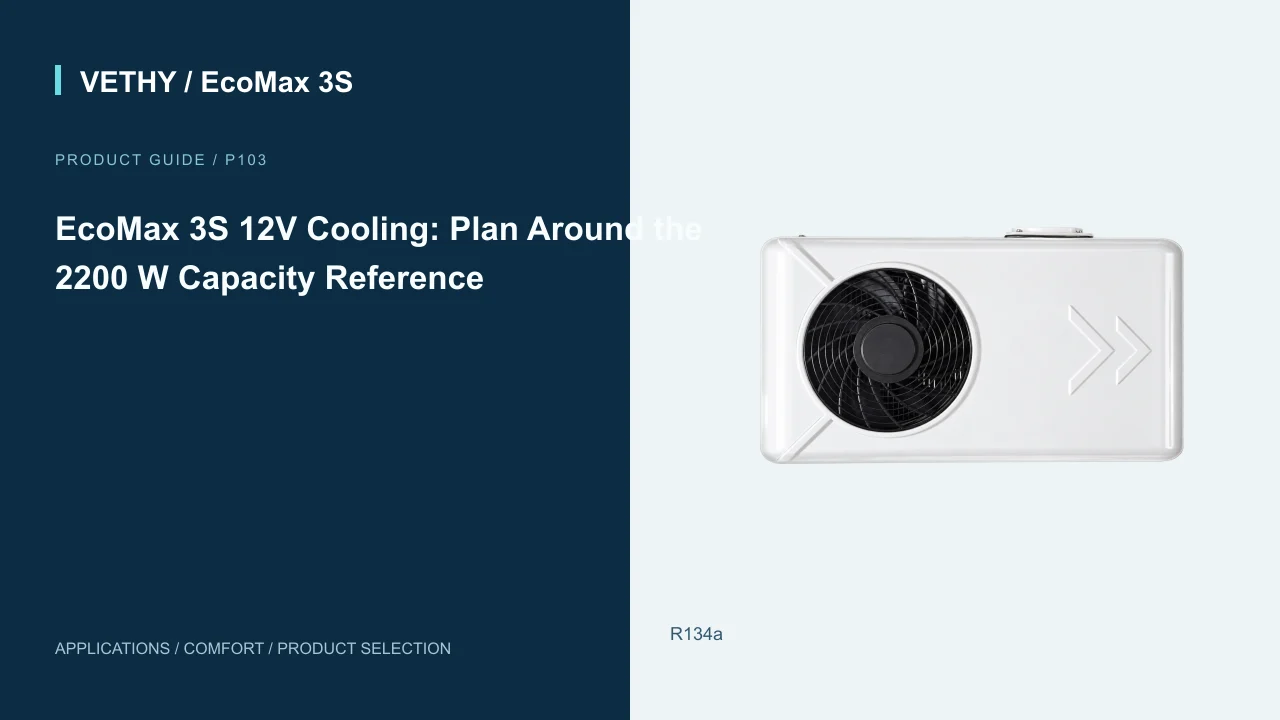
EcoMax 3S 12V is worth shortlisting when a vehicle project wants a 2200 W cooling-capacity reference in a split package with a documented GMCC twin-rotary compressor. The model uses R134a and brushless indoor and outdoor fan motors, and it also has separately listed heating references for seasonal planning. For a buyer focused on warm-weather parked use, the immediate task is to make the cooling function useful in the actual cab.
This guide develops that 12V cooling brief. It connects the output reference with occupied space, unit placement, power scope and a representative evaluation. The aim is a concrete proposal the owner can review, with cooling kept distinct from electrical input and from the model’s separate heating function. No fixed cabin size, pull-down time or universal runtime is inferred from the capacity alone.
Describe the occupied activity that 2200 W is being considered for
A cooling plan should identify what the driver wants to do in the parked cab. A meal and paperwork at the seat, a short rest on the bunk and a shared occupied period can create different distribution priorities. The vehicle’s nominal voltage does not make these activities interchangeable.
Begin with a recognizable use description. State when cooling is normally requested, which area is occupied and how the cabin is arranged. Include the curtain and storage where they matter to the activity. This information gives the supplier a practical application rather than a vague request for a 12V air conditioner.
The 2200 W reference identifies the EcoMax 3S cooling candidate. It should be considered alongside the actual vehicle conditions, including glazing, exposure and door use. The guide does not assign a universal cabin volume or floor area that the rating automatically covers.
For the buyer, this is a more useful starting point than selecting by a number alone. EcoMax 3S provides a defined compressor and airflow package in a split format. The activity description explains why that package belongs in the shortlist and what the first installation should demonstrate. The customer can then review a cooling proposal shaped around the way the vehicle is actually used during a break.
Keep cooling output separate from electrical input
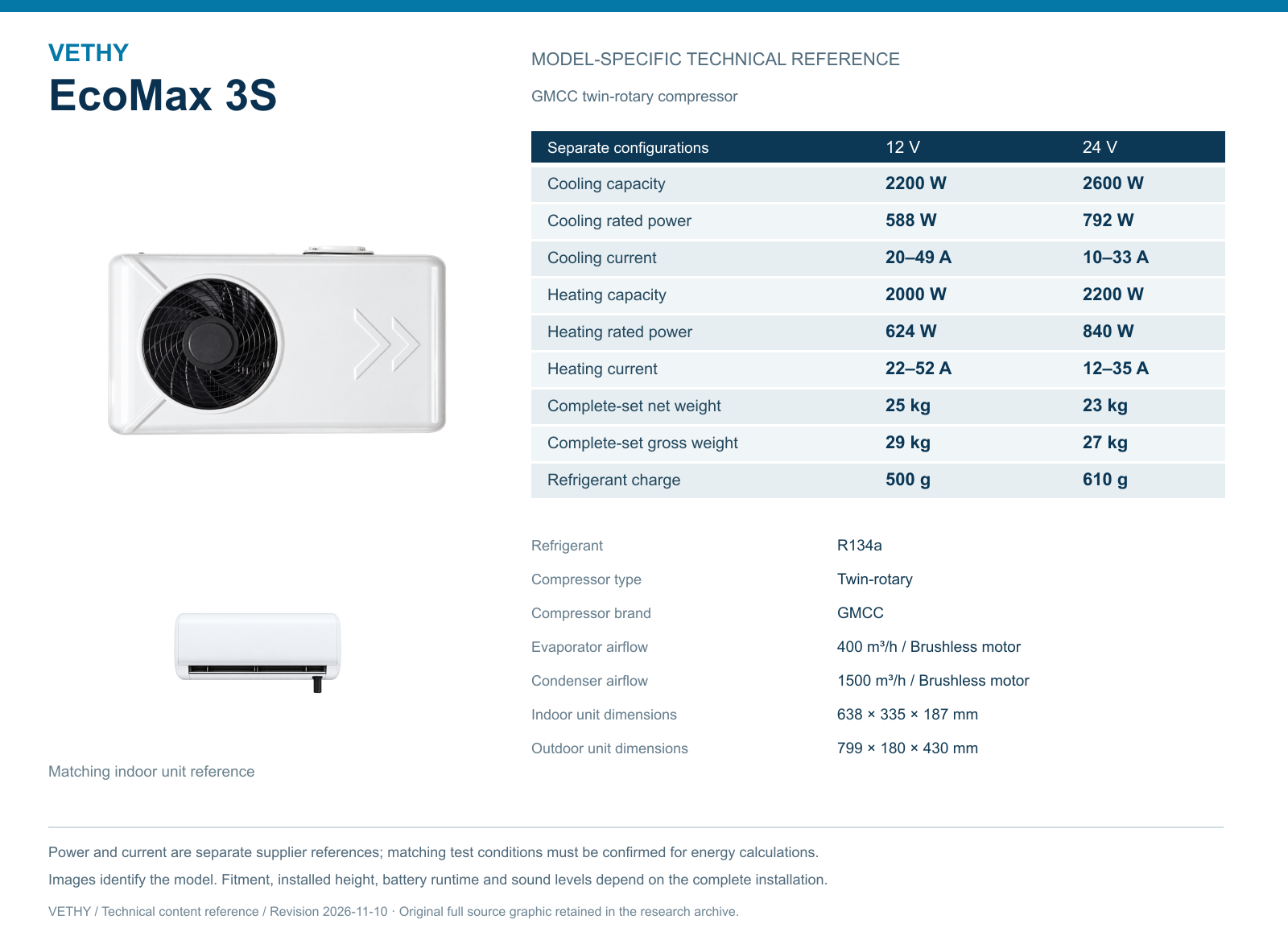
The 2200 W value is listed cooling capacity for the selected 12V version. It is not a claim that the unit draws 2200 W electrically. The source separately lists a cooling rated-power reference of 588 W and a cooling current reference of 20–49 A.
Those electrical fields should retain their labels. The source does not establish a common operating point for deriving efficiency or a complete session profile from them. Do not combine convenient entries to create a battery-duration promise.
| 12V cooling reference | What it describes | Useful project role |
|---|---|---|
| 2200 W | Listed cooling output | Identify the candidate for the cab brief |
| 588 W | Cooling rated-power field | Bring into the complete electrical review as labelled information |
| 20–49 A | Cooling current reference | Retain as a separate supplier field, without inventing a time profile |
| R134a, GMCC twin-rotary | Product and compressor identity | Keep the proposed configuration recognizable |
The EcoMax 3S model data supports these references. A vehicle-specific power plan requires the appropriate information about the actual supply arrangement and intended use.
This clarity is a positive part of a serious offer. The buyer receives useful data without being asked to accept arithmetic that the source does not support. The model can be recommended confidently through its documented package while the electrical integration is developed for the customer’s truck.
The owner can also ask for the proposal to state the intended cooling scope in one sentence beside the selected version. For example, it can identify the cab activity and normal parked period being reviewed, without prewriting a performance result. That keeps the capacity reference connected to the customer’s purpose as the enquiry moves between departments. Purchasing sees the correct unit, the installer sees the project and the driver sees the activity the package is meant to support. The product choice becomes easier to explain than a number copied into a generic equipment list.
Choose 12V around the engineered supply arrangement
The 12V version should belong to a reviewed vehicle power arrangement. The nominal-voltage label is an important selection input, but it does not by itself resolve conductors, protection, connections or the other integration details of the actual installation.
The responsible specialist should use current information for the delivered product and vehicle. This guide does not provide universal wiring values or assume that every existing auxiliary arrangement is suitable. The owner’s useful contribution is to explain what equipment is already present and what the proposed cooling period looks like.
Do not treat the 24V version as a simple capacity upgrade selected from the same menu without integration review. It has a different listed cooling reference and belongs to a different electrical brief. The correct choice is the one that fits the engineered project.
For an owner comparing offers, make the supply scope visible. One quotation may assume existing suitable equipment, while another includes supporting work. Those are different packages even when both name EcoMax 3S.
The practical benefit is a reviewable purchase. The customer can see the desired split cooling unit and understand the work that makes it usable. The GMCC twin-rotary identity and brushless fans remain the product reasons for interest, supported by an actual power arrangement rather than an improvised connection chosen after the unit arrives.
Place the indoor unit around useful delivery
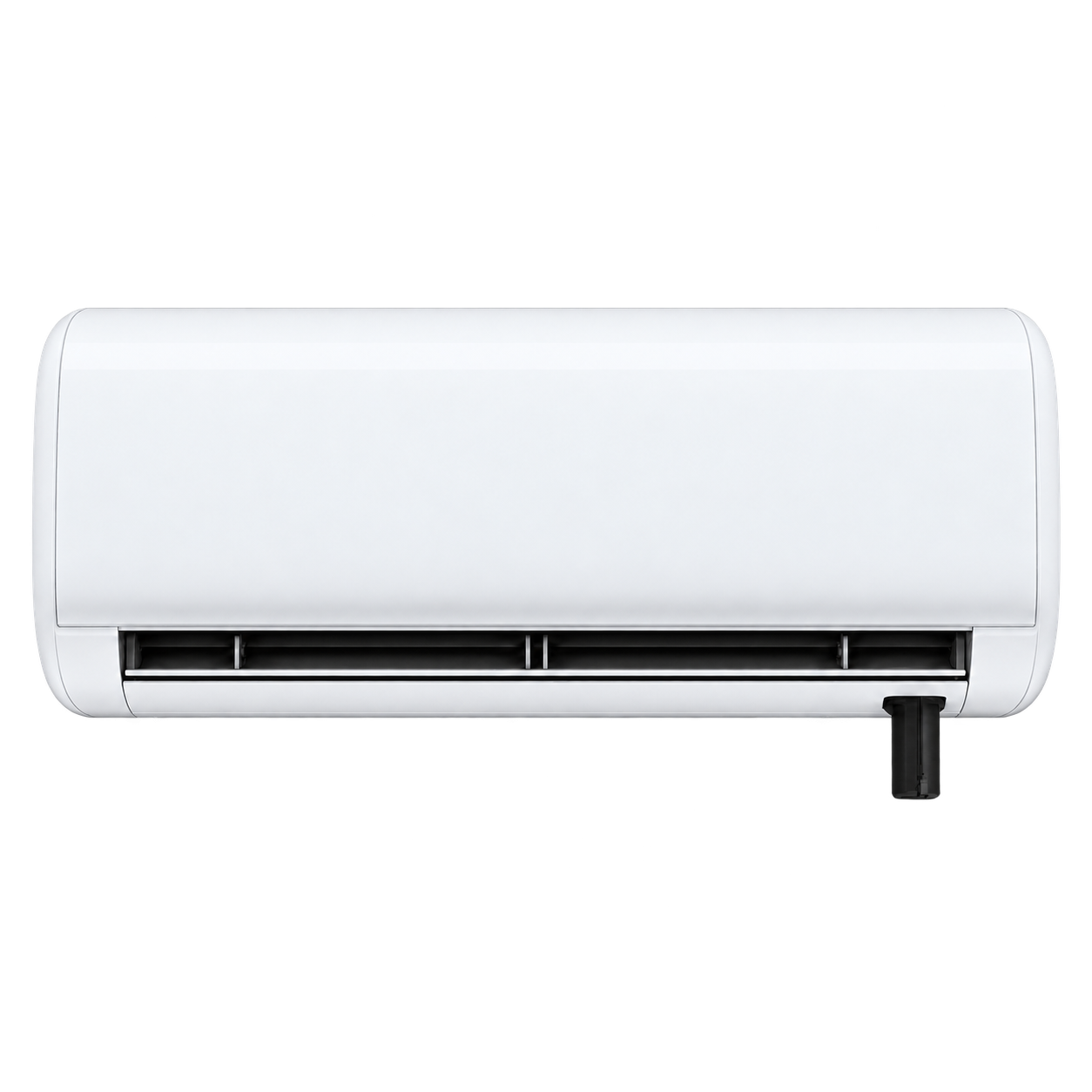
The source lists evaporator airflow at 400 m³/h, with a brushless motor. The indoor unit’s overall dimensions are 638 × 335 × 187 mm. Preserve that source order without assigning unsupported axis labels.
These references help prepare a cabin proposal, but the furnished interior determines the practical relationship with the occupant. Show storage, curtain rails, bedding and the normal seat or bunk positions. A unit location that appears convenient in an empty cab may have a different delivery path when the truck returns to work.
Let the driver assess the intended activity from the normal position. Useful circulation at the bunk is a different observation from cool air felt immediately beside the unit. If the delivered controls include an adjustment relevant to the concern, demonstrate the actual function rather than assume automatic oscillation or another model’s outlet feature.
This is where the 12V cooling package becomes tangible. The buyer can connect the documented airflow hardware with a concrete occupied-space result. The installer gains specific feedback about the layout before it is treated as final.
EcoMax 3S is attractive for a buyer who wants a split arrangement because indoor placement can be considered in relation to the cabin’s use, with the complete installation reviewed appropriately. The benefit is a purposeful proposal, not a promise that every available interior position will work equally well.
Give the outdoor assembly its own suitable location
The split format includes an outdoor assembly whose placement needs a complete vehicle review. Its listed overall dimensions are 799 × 180 × 430 mm, retained in source order. The condenser airflow reference is 1500 m³/h with a brushless motor.
Show nearby equipment and the normal working arrangement at the proposed location. Support, routing, service approach and the applicable air-path requirements should be resolved for the actual vehicle by the responsible installer. A physical gap large enough for the housing is not independently an installation approval.
This discussion can also support the customer’s roof priorities. A split proposal may allow the vehicle design to consider alternatives to a rooftop package, subject to appropriate installation review. The format is a practical reason to shortlist EcoMax 3S where the customer wants that approach.
Do not invent a universal clearance or a particular effect on nearby equipment from the airflow number. The reference identifies part of the outdoor package; the actual arrangement determines the application question.
For the buyer, the advantage is a model that can be discussed as two coordinated assemblies with different jobs. Indoor delivery serves the occupant, while the outdoor setting is designed appropriately. The resulting proposal is more complete than two product photographs and a capacity headline, and it gives the installer concrete relationships to resolve before work is scheduled.
Plan the parked session with the other normal loads
A useful cooling plan reflects the break as the driver actually spends it. Lighting, device charging or other cab equipment may operate at the same time. Identify the loads sharing the relevant energy source and explain when they are used.
The usable energy and appropriate operating limits depend on the actual system. The responsible electrical review should determine how the cooling arrangement fits that vehicle, including the next charging opportunity. Do not assign undocumented cutoff values or battery-protection behavior to EcoMax 3S.
The supplier’s cooling current range is not a complete session profile. Choosing its lowest endpoint as the normal rest draw would be an unsupported assumption. Representative operation can later improve the project-specific plan, with the method and conditions retained where numerical information is used.
This makes the model recommendation more practical. The customer can value the GMCC twin-rotary split package while seeing how the complete break is supported. The offer is designed for useful comfort rather than a demonstration with every unrelated device disconnected to create a favorable impression.
For an operator with recurring stops, the plan should also connect one session with the next charge opportunity. A comfortable first break is valuable feedback, but the working pattern deserves its own review. The premium cooling candidate is best supported by an energy arrangement that matches the actual route.
Keep the separate heating function out of cooling arithmetic
EcoMax 3S also lists heating for the 12V version, with 2000 W output, 624 W rated power and a 22–52 A current reference. These are separate heating fields. They should not be mixed with the cooling entries to create a more attractive calculation.
For a buyer focused on cooling now, heating may be a useful seasonal reason to consider the complete model. The function should still receive its own brief if it will be used. The source does not establish an ambient heating envelope or a heat-pump architecture.
This distinction helps the customer understand the product positively. EcoMax 3S is a split seasonal candidate with both functions documented, while this particular project step is evaluating 12V cooling. The broader selection logic is covered in the EcoMax 3S seasonal guide.
The immediate offer can therefore state what is being reviewed and what remains a separate seasonal question. A favorable cooling demonstration should not be promoted as proof of every heating condition, and an optional future request should not obscure the present cooling scope.
The customer receives a more coherent package. The model’s seasonal capability remains visible, but the 2200 W cooling decision is kept clear enough for installation, power planning and occupied-position evaluation. Each function contributes to the product choice without one set of references impersonating the other.
A customer who expects to use heating later can raise that future requirement without allowing it to blur the present cooling decision. Identify it as a separate intended use and retain the appropriate references for review. This lets the buyer consider the seasonal value of the complete EcoMax 3S while still making a focused first-stage decision about 12V cooling. The offer can remain commercially coherent, with the documented functions visible and each application question addressed at the stage where it becomes concrete.
Use complete-set weight correctly in the proposal
The 12V version’s complete-set weight references are 25 kg net and 29 kg gross. The source separately lists the indoor unit at 6.9 kg net and 10.5 kg gross. Do not add the indoor figures again to the already complete-set values.
These labels are useful to different parts of the project. Logistics can use the relevant package information, while the installer reviews the actual assemblies and support requirements at their intended locations. A set-weight field is not a substitute for that vehicle review.
The indoor and outdoor package dimensions also remain separate from the unit dimensions. An offer should not accidentally show packaging measurements as the physical installation envelope.
For a customer ordering a split product for the first time, this clarity makes the proposal easier to understand. The buyer can recognize that the equipment is a coordinated set and see which references belong to shipping and which belong to the vehicle layout.
The premium recommendation is supported by orderly information. EcoMax 3S has a named compressor package, documented brushless airflow hardware and clear function references. Keeping the weight and dimension labels accurate helps those attributes move from enquiry to delivery without an avoidable discrepancy introduced by summing or relabelling fields that were already explicit in the source.
Help the cooling task through realistic cabin use
Ordinary cabin choices can complement a parked-cooling system. Suitable shades, the normal curtain and a realistic door-use pattern should be considered where appropriate to the vehicle and operation. The guide does not assign a fixed saving or temperature reduction to those measures.
The point is to evaluate an arrangement the driver can repeat. A trial relying on equipment that will never be used during work is a weak reference. A trial that ignores a curtain used during every rest is also incomplete.
Explain whether the cooling period begins immediately after active loading or after the cab is closed for a break. The initial condition can differ, and the later occupied experience deserves attention separately from the first refreshing outlet sensation.
EcoMax 3S should be demonstrated through its actual supplied controls. The source does not establish a special sleep mode, app interface or automatic swing feature. The customer can still judge useful comfort and learn the delivered operation without those invented additions.
For the buyer, this creates a practical relationship between the product and the cab. The 2200 W reference identifies the cooling candidate, while the normal routine gives it a recognizable task. The installer and owner can then refine the actual package rather than chase an abstract promise that one capacity number guarantees every possible parked condition.
Make the first evaluation answer the cooling question
A useful 12V evaluation identifies the selected unit, supply arrangement and indoor and outdoor locations. It retains the normal cabin context and describes the cooling activity the customer wants to support. No result needs to be assumed before the vehicle is assessed.
Let the driver use the controls and occupy the normal seat or bunk. Ask about useful delivery, direct airflow and the experience after settling. If a layout or operating change is made, record its reason and reassess the relevant observation.
If energy is measured, keep the method, interval and included loads with the record. Comfort feedback is valuable but should not be turned into a numerical saving. Likewise, a single electrical reading does not describe every minute of the break.
The installed sound can be considered from the occupied position, with ordinary fittings secured. Brushless fan motors and GMCC twin-rotary identity are documented attributes; the source does not establish an EcoMax 3S dB figure or a comparative noise result.
This gives the buyer a concrete basis for deciding. The model’s attractive package is evaluated in the vehicle where it will work. The outcome can support a project-specific installation or identify a clear refinement, without claiming a universal runtime, pull-down time or cabin result that the source does not establish.
An illustrative 12V owner enquiry
Consider an owner who wants a comfortable cab during regular meal and paperwork breaks. The owner prefers a split arrangement and values a named GMCC twin-rotary compressor. EcoMax 3S 12V enters the shortlist with its 2200 W cooling reference and brushless airflow hardware.
The enquiry describes the actual vehicle, available power arrangement and normal occupied area. Photographs show the proposed indoor space, outdoor surroundings and working storage. The installer can review a concrete project rather than guess from a model nickname.
The offer identifies the selected version and separates product supply from local installation work. The electrical review uses the labelled cooling references within the actual supply plan, without converting the current range into a promised number of hours.
The first vehicle is then evaluated with the ordinary cabin arrangement. The driver’s feedback concerns useful delivery during the intended activity, and any numerical information retains its method and scope. The separate heating function stays visible as part of the product but is not silently treated as evaluated by the cooling session.
The owner can now make a practical decision about the package. The documented features provide the reason for interest; the vehicle proposal and representative assessment make the recommendation concrete. The customer receives an understandable 12V cooling candidate with a clear route to installation and support.
If a second vehicle is considered later, the owner can bring forward the product reference while identifying the new cab or power differences. That preserves useful learning without assuming that a familiar voltage and model name automatically make every installation identical.
The same information pack can support a more useful after-sales conversation. The owner can provide the exact 12V configuration, the delivered locations and a plain observation about the cooling activity. A support team then begins from the installed project rather than reconstructing it from a product photograph. This is a practical benefit of a clearly scoped offer: the recommended hardware and the vehicle use remain linked after purchase, making it easier to identify whether a later change concerns distribution, the power arrangement or a different operating condition.
Questions about the 12V cooling plan
Is 2200 W the electrical input?
No. It is the listed cooling-capacity reference. The source separately lists cooling rated power at 588 W and current at 20–49 A.
Can the current range prove the break duration?
No universal duration follows from the range. Review the actual energy system, other loads, intended period and charging pattern.
Are the complete-set and indoor weights added together?
No. The 12V 25/29 kg net/gross references are already complete-set values. Keep the separate indoor weight labelled without adding it again.
Is the heating function covered by a cooling trial?
Keep the functions separate. Heating has its own references and intended conditions, which need their own appropriate review if the customer plans to use it.
Turn the 2200 W reference into a useful vehicle offer
Shortlist EcoMax 3S 12V when the customer wants its documented GMCC twin-rotary split package and the cooling task can be reviewed in the actual cab. Keep the output, electrical scope and separate seasonal functions clear.
Prepare the vehicle details through the parking AC technical enquiry guide, then contact VETHY for a configuration-specific discussion. The EcoMax 3S guide hub links further topics on component identity, placement and energy planning.
Product sources
VETHY product recommendation and application analysis. Specification references identify the selected model and voltage. Installation examples are planning examples; measured project results are identified explicitly when available.
Discuss your EcoMax 3S application
Send your vehicle, supply voltage, occupied space, parking schedule and installation photographs for a model-specific recommendation.
Prepare your vehicle brief ↗