
VETHY / EcoMax 3S / PRODUCT AND APPLICATION GUIDE
EcoMax 3S 24V Cooling: Matching the 2600 W Version to a Vehicle Project
EcoMax 3S 24V is a strong candidate when a vehicle project wants a 2600 W cooling reference in a GMCC twin-rotary split package. Define the vehicle group, coordinate indoor and outdoor locations and review the actual supply arrangement. Keep cooling and heating references separate and retain the correct complete-set weights in the proposal.
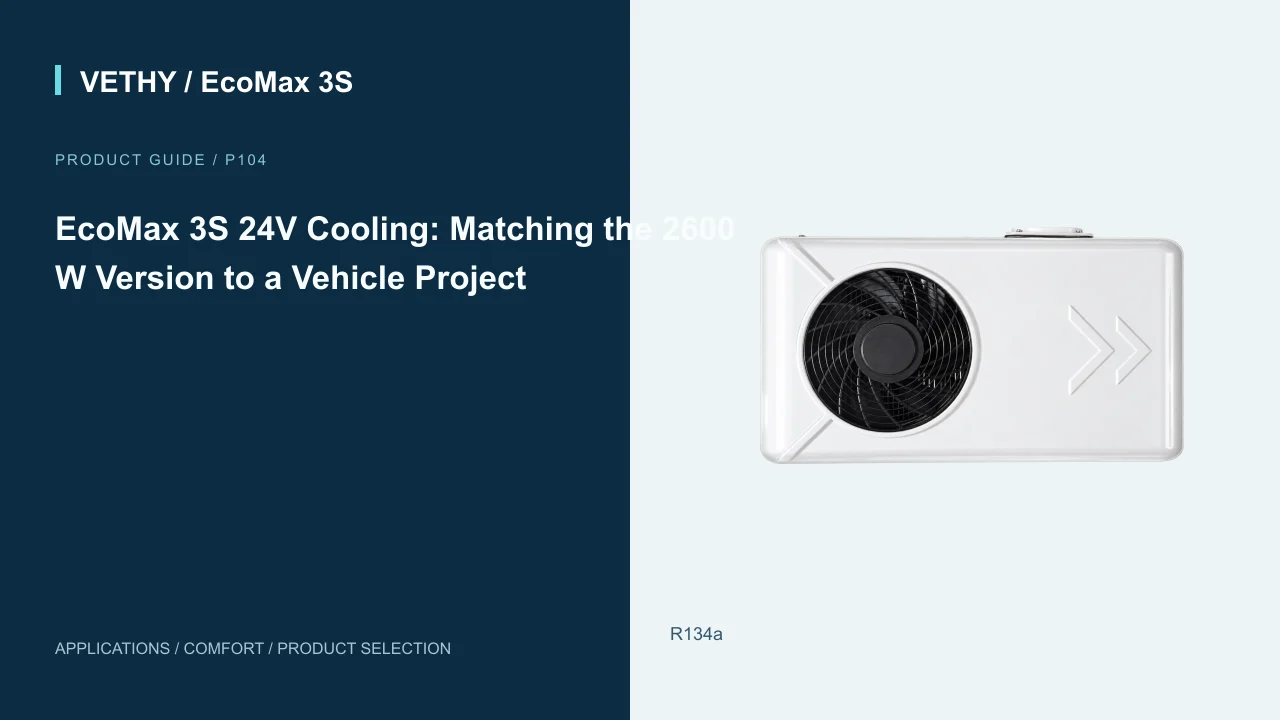
EcoMax 3S 24V is a strong candidate for a vehicle project that wants a 2600 W cooling-capacity reference within a split seasonal comfort package. The documented model uses R134a, a GMCC twin-rotary compressor and brushless indoor and outdoor fan motors. For a bodybuilder or fleet engineer, the opportunity is to give those features a deliberate place in the vehicle design, with the electrical version and installation responsibilities clear from the beginning.
This guide treats the 24V cooling choice as a project shared by the buyer, supplier and installer. It focuses on interfaces and decisions that make the offer reviewable: the occupied cabin, available mounting locations, supply arrangement and complete-set references. Heating remains part of the EcoMax 3S product, with its own separate ratings rather than a result assumed from the cooling proposal.
Start with a vehicle project, not a capacity substitution
A 24V project should identify the actual vehicles and the work they perform. The larger listed cooling reference compared with the 12V version does not make 24V an automatic choice for an unrelated supply system. The selected version must belong to an engineered arrangement for the vehicle being proposed.
For a fleet or bodybuilder, describe the vehicle group and the normal parked activity. A driver using the cab for a scheduled rest, an operator waiting between jobs and a team sharing the interior may need different cabin relationships. The nominal voltage does not remove those differences.
EcoMax 3S is attractive when the buyer wants the documented GMCC twin-rotary package and a split approach to placement. The project brief should explain why those attributes are relevant. If roof space is already committed to another function, that may be part of the layout discussion. If seasonal heating is important, include it as a separate use requirement.
This creates a stronger starting point than requesting “the higher-capacity version” without context. The supplier can identify the intended model, the installer can review the actual vehicle and the buyer can see which needs the proposal is addressing. The product’s documented features become inputs to a concrete design rather than isolated marketing labels.
Define the vehicle group the proposal represents
A fleet can contain trucks with the same nominal voltage but different interiors, structures and accessories. The project should identify which vehicles are relevantly similar before one layout is copied across the program.
Use practical distinctions. Indoor space, proposed outdoor location, storage and the existing supply arrangement may all matter. The goal is not a complex classification exercise. It is a clear reference that the next installation team can recognize.
For example, two cab groups may share the 24V requirement while having different overhead storage or working equipment behind the cab. Both can consider EcoMax 3S, but the proposed assembly locations should reflect the actual differences.
This makes the 2600 W cooling candidate easier to evaluate fairly. A successful proposal for one group remains useful, with its scope visible. Material differences in another group can be reviewed instead of hidden by a shared truck badge or voltage label.
The buyer gains an implementation advantage. Purchasing can order against a defined configuration, the workshop can compare the arriving vehicle with the reviewed reference and drivers can experience a cabin arrangement suited to their use. Standardization becomes a way to preserve meaningful decisions rather than a reason to assume every vehicle is identical.
Connect the 2600 W reference with the complete model
The 2600 W value is the listed cooling-capacity reference for EcoMax 3S 24V. It identifies the cooling candidate; it is not electrical input or a universal prediction of cabin temperature. The vehicle’s glazing, exposure, activity and furnished interior still shape the application.
The model’s other attributes provide substantive reasons for the shortlist. GMCC twin-rotary is a clear compressor identity. R134a identifies the refrigerant configuration. Brushless fan motors are documented on both indoor and outdoor sides. The split format gives the project a different arrangement to consider from a single rooftop assembly.
These features should be presented as a package. The buyer may value a named compressor and seasonal function set, while the installer focuses on how the assemblies belong in the vehicle. Neither needs an invented claim that the unit has inverter control or a particular heat-pump architecture.
For the customer, the practical benefit is a product choice that can be explained in detail. The offer is more than a capacity number, and the technical discussion remains tied to the actual model. The EcoMax 3S seasonal selection guide covers that broader proposition. This 24V guide develops the project work needed to turn the candidate into an understandable vehicle package.

Make the project interfaces visible in the offer
A split installation can involve several parties. The supplier provides product information, the installer develops the vehicle integration and the buyer defines the intended operation. The exact commercial responsibilities should be agreed for the actual offer rather than assumed from these general roles.
| Project interface | Information that makes the discussion concrete |
|---|---|
| Buyer to supplier | Selected 24V requirement, vehicle group and intended functions |
| Supplier to installer | Correct model reference and applicable current technical information |
| Installer to buyer | Proposed locations, supply scope and implementation responsibilities |
| Driver to project team | Normal occupied activities and practical feedback |
| Completed project to support | Delivered configuration and recognizable installation record |
The table is a way to expose assumptions. A product-only quotation and a full integration proposal are different scopes, even if they name the same EcoMax 3S unit.
The buyer should be able to see what is included and what remains to be resolved. If the proposal depends on existing equipment, identify that dependency and review it appropriately. If local components or services are included, describe the actual package without implying that every factory set contains the same extras.
This clarity supports a premium recommendation. The documented hardware remains the product attraction, while the project interfaces explain how it becomes usable in the customer’s vehicle. The next person can act on the offer without reconstructing a chain of verbal assumptions.
An early interface discussion can also show where the project needs another participant. If the installer needs vehicle structure information held by the bodybuilder, identify that dependency before a final location is promised. If operations has not defined the parked activity, obtain that description before treating the panel position as settled. The objective is practical progress, with each unresolved item connected to someone who can supply the needed information. A premium equipment choice is easier to implement when the project identifies these relationships openly, rather than allowing the unit to arrive before anyone realizes which assumption was never resolved.
Use the split format within a coordinated vehicle layout
EcoMax 3S has separate indoor and outdoor assemblies. That format can be useful where the vehicle design wants to consider alternatives to a rooftop cooling package, provided the complete installation is reviewed appropriately.
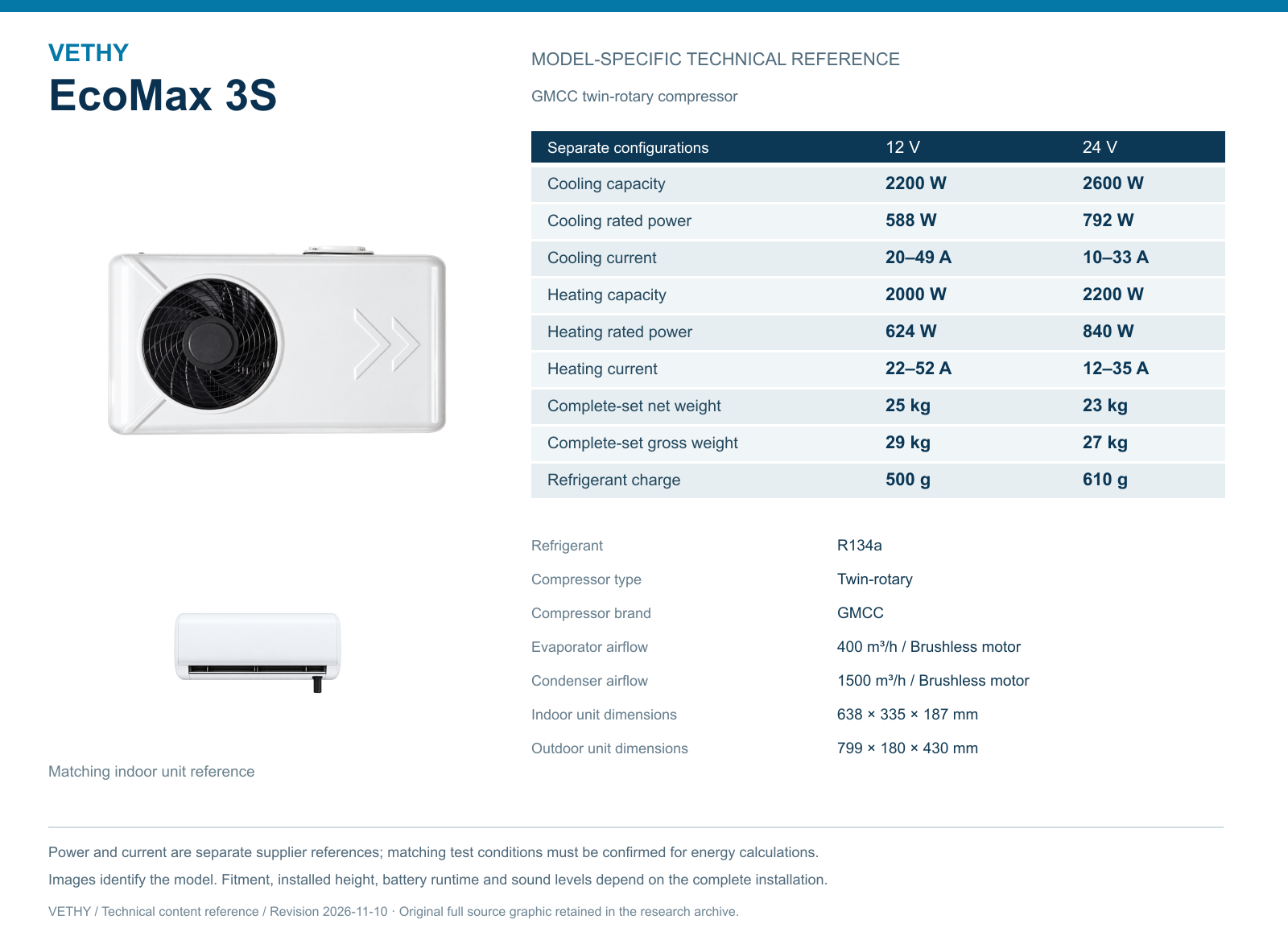
The listed overall dimensions are 638 × 335 × 187 mm for the indoor unit and 799 × 180 × 430 mm for the outdoor unit. Keep these callouts in the source order. The supplied reference does not establish axis labels for assigning each number to a named direction.
Show both locations on a vehicle proposal, with relevant storage, structure and nearby equipment. Routing, support, access and applicable installation requirements connect the two assemblies. They should not be treated as independent objects that can be placed anywhere a gap appears.
For a bodybuilder, the advantage is an early opportunity to coordinate cooling with the rest of the vehicle. A proposed location can be compared with alternative arrangements while changes are still practical. The customer can understand the trade-off rather than discover it after other equipment has been fixed.
EcoMax 3S has its own product references and installation needs. Use them to develop the actual split format and seasonal package into a coherent design for the vehicle the customer intends to build or equip.
Arrange the cabin around the activity being supported
The cabin-side airflow reference is 400 m³/h, with a brushless motor. Its practical role depends on the indoor unit’s relationship with the occupied area. A driver doing paperwork at the seat may judge delivery differently from a driver resting behind a curtain.
Include ordinary storage, bedding and fittings in the review. An empty interior can make a location look more useful than it will be during work. The driver should experience the proposed arrangement from the normal position and use the controls actually supplied.
Do not add automatic oscillation, a particular temperature-setting range or another model’s outlet function to the explanation. The source establishes the EcoMax 3S airflow and motor references, while the delivered unit determines the actual interface to demonstrate.
For a fleet, the starting explanation can be consistent without forcing every occupant to have identical preferences. Show the intended activity and operating guidance, then retain specific feedback about useful air or an unwelcome direct stream.
This makes the model’s 24V cooling offer tangible. The buyer can see how a defined capacity and compressor package serve people in the cab, rather than accept a technical card with no connection to use. The installer also gains practical information that can guide the proposal before the layout is treated as final.
Give the outdoor unit a workable installation setting
The outdoor side lists condenser airflow at 1500 m³/h with a brushless motor. The proposed location should be reviewed under the applicable requirements, including surrounding equipment, support and a practical service approach.
The full overall dimensions help prepare the discussion but do not independently approve a position. Show the actual vehicle area and working accessories. A clean product photograph cannot explain every relationship around a fitted assembly.
This is particularly important where the vehicle has equipment that moves or is loaded differently during work. Include its normal state and relevant variations so the installer can review the arrangement the unit will actually have.
The buyer’s benefit is a more concrete offer. EcoMax 3S is selected as a documented split product, and the outdoor installation is developed deliberately rather than left to the last available mounting space. The customer can understand why a location is proposed and what the responsible installer will resolve.
No universal clearance or quantified effect on neighboring equipment is supplied by this guide. The appropriate route is current model information and vehicle-specific review. This keeps the recommendation positive and implementable: a defined premium component and function package, placed in a setting that supports its intended job and future care.
Keep 24V cooling electrical references labelled
The 24V cooling fields are 2600 W capacity, 792 W rated power and 10–33 A rated-current reference. They describe different quantities and should not be rearranged into a universal efficiency or runtime claim. The source does not establish a common operating basis for such a calculation.
The responsible electrical review should consider the actual supply system, usable energy, other loads and intended cooling schedule. It should use the current information required for the installation rather than copy universal conductor or protection values from another truck.
For a fleet program, identify common assumptions and material exceptions. A truck with another auxiliary arrangement should not be treated as identical merely because both vehicles are nominally 24V. The proposal should show which supply scope belongs to the reviewed group.
This is a useful point for quotation comparison. One offer may include supporting integration work while another assumes existing equipment is suitable. The customer should understand that difference before interpreting the totals as prices for the same package.
EcoMax 3S remains attractive for its documented GMCC twin-rotary identity, brushless fans and split seasonal format. The electrical review supports those product benefits by giving them a concrete supply arrangement in the vehicle. It does not need an optimistic endpoint calculation to make the offer professionally persuasive.
Keep heating available as a separate project question
The 24V EcoMax 3S heating references are 2200 W output, 840 W rated power and a 12–35 A current range. These belong to heating and should remain separate from the cooling fields in the power and application discussion.
If the customer wants both functions, describe the intended use of each. Heating may be an important reason to choose the complete seasonal product, but a cooling-focused layout assessment does not establish every heating outcome.
The source does not establish a heating ambient envelope or a heat-pump mechanism. A specific requirement should be raised directly for appropriate review. The offer can be confident about the listed function without inventing a broader operating claim.
For the bodybuilder or fleet engineer, this separation makes the scope more manageable. The current project can develop the 24V cooling package while retaining a clear seasonal requirement for heating. Any evaluation or supporting electrical work should reflect the actual functions the customer expects to use.
The buyer receives a coherent product proposition: one defined split model with separately documented cooling and heating references. The project remains readable because each function has its own intended conditions, rather than allowing a favorable demonstration of one to imply that every aspect of the other has already been reviewed.
A phased seasonal project can retain this distinction in its acceptance record. Identify which cooling layout and routine have been considered now, and which heating requirement still needs its own review. This allows the customer to move forward with useful work without describing the entire seasonal project as finished prematurely. The selected EcoMax 3S remains a coherent product choice, while the record explains the actual state of the vehicle proposal. The buyer can appreciate the benefit of both documented functions and still know which concrete question should be addressed next.
Use the complete-set references accurately
The 24V version is listed at 23 kg complete-set net weight and 27 kg complete-set gross weight. The indoor unit’s separate 6.9 kg net and 10.5 kg gross references should not be added again to those already complete-set figures.
Retain the labels in the offer and project record. Logistics, purchasing and installation use different information, and an innocent relabelling can create confusion when the package moves between teams. The package dimensions should also remain distinct from the dimensions of the actual assemblies.
For the installer, the set-weight reference does not replace a review of support at the proposed indoor and outdoor locations. The actual assemblies and applicable requirements need attention in their vehicle setting.
For the customer, accurate labels make a split proposal easier to understand. The product arrives as a coordinated set, and the relevant information can support shipping and fitting without being summed or reinterpreted incorrectly.
This supports the professional value of the EcoMax 3S offer. The model’s identifiable compressor and seasonal functions are accompanied by orderly technical information. The buyer can review a complete package rather than discover later that a shipping field was presented as an installation dimension or that a complete-set weight had been inflated by adding an included component a second time.
An illustrative 24V project from proposal to reference vehicle
Consider a fleet equipping one cab group whose roof already serves another working function. The buyer wants cooling during scheduled parked periods and retains heating as a separate seasonal request. EcoMax 3S 24V is shortlisted for its 2600 W cooling reference, GMCC twin-rotary compressor and split format.
The supplier identifies the exact model and current references. The installer reviews indoor and outdoor locations together, with ordinary cabin storage and working equipment shown. The electrical scope is developed around the actual 24V supply arrangement and intended functions.
The offer explains who provides each part of the package. The buyer can distinguish equipment supply from vehicle work and see which assumptions have been reviewed. The complete-set and unit dimensions retain their labels so the project record remains consistent across purchasing and the workshop.
The first completed vehicle is then assessed from the normal occupied positions. Feedback concerns the actual activity and delivered controls. Any numerical information retains its scope and method; no favorable result is assumed in advance.
The fleet’s decision can identify the accepted configuration, remaining work and the vehicle group represented. A later truck with different storage or supporting equipment receives a focused review instead of being treated as identical by default.
This is a practical way to choose a premium split product. The documented EcoMax 3S attributes provide the reason for interest, and the project interfaces make the installation reviewable. The customer gains a reference that the next team can understand, with cooling, heating and electrical assumptions kept clear enough to support responsible rollout.
For a bodybuilder presenting the finished vehicle to a customer, the reference can also become a useful handover explanation. Show the indoor and outdoor locations, the delivered controls and the normal activity the package was designed to support. Keep technical records available to the workshop while giving the driver a concise operating explanation. The premium product then has a visible place in the vehicle and a clear support identity. Its documented features remain understandable after the design meeting, which is valuable when different people operate, purchase and maintain the same fleet equipment.
The completed reference can also support a later bodybuilder proposal. Retain the preferred product and identify the next vehicle’s material differences, so a successful 24V package becomes a useful starting point for review rather than an assumption of universal fitment.
Questions about the 24V cooling project
Is 2600 W the electrical input of the 24V unit?
No. It is the listed cooling-capacity reference. The cooling rated-power field is separately listed at 792 W, with a 10–33 A current reference.
Can one cab-group proposal be copied to every 24V truck?
Review relevant differences in cabin, structure, outdoor surroundings and supply arrangement. A shared nominal voltage does not establish an identical installation.
Is the indoor weight added to the 23/27 kg set references?
No. Those are complete-set net and gross values for the 24V version. Keep the separate indoor-unit field labelled without adding it again.
Does the cooling decision establish heating performance?
Heating has its own references and intended conditions. Keep it a separate application and evaluation question where the customer plans to use that function.
Develop the 24V candidate into a complete vehicle offer
Recommend EcoMax 3S 24V when its documented split seasonal package matches the customer’s priorities and a suitable installation can be developed for the vehicle group. Use the 2600 W cooling reference within that concrete project scope.
Bring the proposed locations, occupied activities and supply information to VETHY engineering, or contact VETHY for a configuration-specific discussion. The EcoMax 3S guide hub connects further topics on component identity, function ratings and airflow placement.
Product sources
VETHY product recommendation and application analysis. Specification references identify the selected model and voltage. Installation examples are planning examples; measured project results are identified explicitly when available.
Discuss your EcoMax 3S application
Send your vehicle, supply voltage, occupied space, parking schedule and installation photographs for a model-specific recommendation.
Prepare your vehicle brief ↗