
VETHY / EcoMax 3S / PRODUCT AND APPLICATION GUIDE
EcoMax 3S GMCC Twin-Rotary Design: A Product-Specific Buyer Guide
EcoMax 3S offers a documented GMCC twin-rotary compressor within an R134a split cooling-and-heating package. Value that clear component identity alongside the complete product. Keep displacement and compressor-power fields separate from whole-unit function ratings, and review the supplied controls and vehicle installation without assuming undocumented inverter or heat-pump architecture.
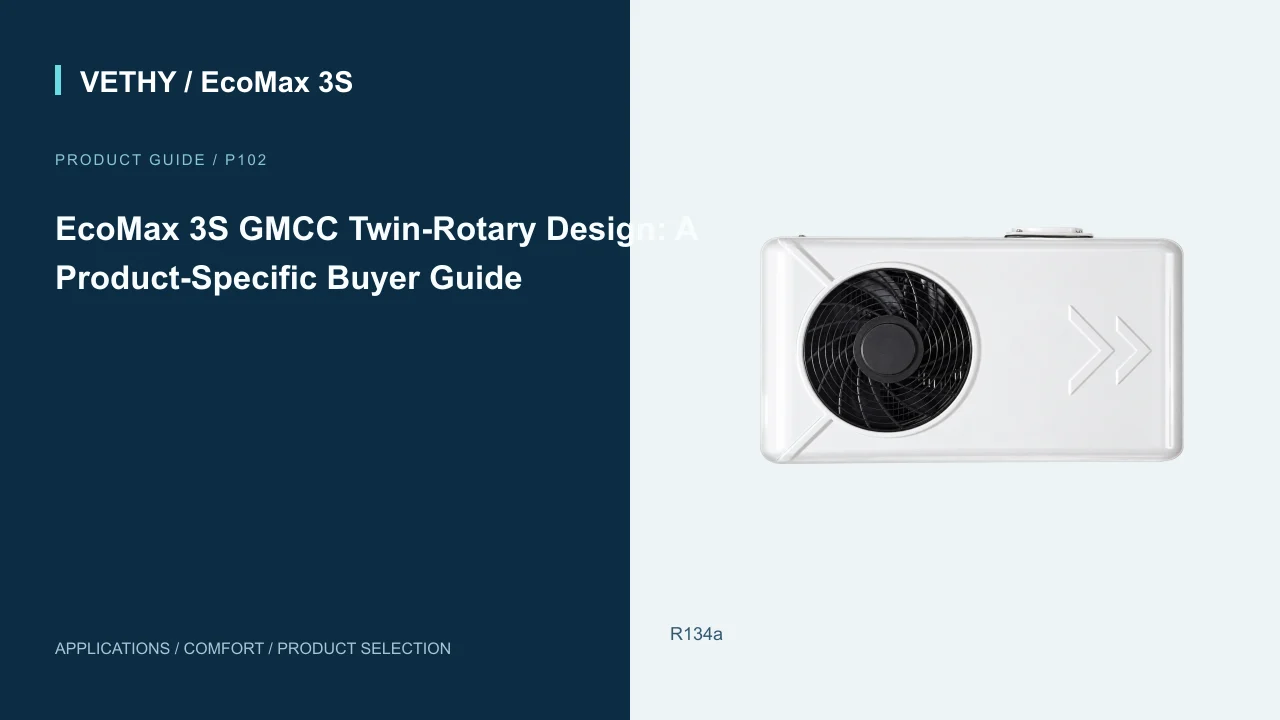
EcoMax 3S gives a component-focused buyer a clear compressor identity: GMCC twin-rotary, used within an R134a split cooling-and-heating product. That is a substantive reason to investigate the model when the customer wants more information than a generic statement that a parking air conditioner contains a compressor. The useful buying decision connects that identity with the complete system, its separate function ratings and the proposed vehicle installation.
This guide explains the documented compressor information without borrowing features from other GMCC products or other VETHY models. It is especially useful for a fleet engineer, importer or owner who wants to understand what the brand and architecture tell them, how component fields differ from whole-unit ratings and why the complete EcoMax 3S package deserves consideration.
Read brand, architecture and control as different descriptions
GMCC is the documented compressor brand. Twin-rotary is the documented compressor architecture. Control strategy is a separate question. Keeping these ideas distinct makes the product easier to understand and avoids attaching a feature to the model merely because a familiar name appears in the specification.
For the buyer, the brand and architecture provide a recognizable component choice. That information can be retained in a product card, quotation or equipment record. It is more useful than a broad quality adjective because the customer can identify what was specified.
The source for EcoMax 3S does not establish inverter operation. A DC nominal-voltage reference should not be expanded into compressor-speed modulation, a special lower-load algorithm or a particular start sequence. Those are technical features that require their own model-specific basis.
This precision supports a positive recommendation. EcoMax 3S already has a meaningful package: GMCC twin-rotary compressor, R134a, brushless fan motors and separately listed cooling and heating functions in a split arrangement. The customer can value that combination without receiving an invented controller description.
A serious product explanation should therefore begin with the actual labels and then connect them to the customer’s task. The result is a component story that remains consistent as the enquiry moves from sales to installation and later support.
Use the compressor reference as a map, not a substitute for the unit
The model source provides several compressor-related fields. They help identify the selected configuration, but they should remain labelled as component references rather than silently becoming ratings for the entire air conditioner.
| Source field | EcoMax 3S reference | Appropriate use in the discussion |
|---|---|---|
| Compressor brand | GMCC | Identify the documented component brand |
| Compressor type | Twin-rotary | Describe the stated architecture |
| Displacement | 13 cc | Retain the component specification without treating it as cabin capacity |
| Compressor power | 645 W | Keep separate from function-specific whole-unit power fields |
| Refrigerant | R134a | Identify the product’s refrigerant configuration |
| Refrigeration oil reference | VG-74 / 250 ml | Retain for correct technical identification and qualified service information |
The EcoMax 3S specification data is the reference for these fields. The table is not a servicing instruction or an invitation to modify the compressor or refrigerant circuit.
For purchasing, the practical benefit is a defined component package. For the installer, the next step is the complete model information and vehicle review. For support, the exact unit identity remains essential. The compressor reference helps each conversation begin accurately, while the whole-system ratings and actual installation continue to answer their own questions.
A compressor brand does not identify every product feature
GMCC’s own brand information describes a range that includes fixed-speed and variable-frequency compressor products. That is useful context for one narrow point: the brand name alone does not establish the control method of every finished product using a GMCC compressor.
EcoMax 3S must be described from its own supplied information. The documented label is GMCC twin-rotary; inverter architecture is not established. A salesperson should not select a feature from another compressor page and attach it to this model without a model-specific basis.
This is commercially helpful rather than restrictive. The buyer receives a stable explanation of the actual product. The dealer does not need to revise the story when a technically informed customer asks whether a control feature was confirmed.
The same discipline applies to heating. EcoMax 3S has listed heating references, but the source does not establish a heat-pump mechanism. Present the documented function and review the intended use instead of inferring the internal architecture from the compressor brand.
The positive buying case remains clear. A customer who values a named GMCC twin-rotary package can shortlist EcoMax 3S and assess the complete split seasonal product. The recommendation is grounded in the configuration being offered, with general brand information used only to clarify the scope of a claim rather than import unrelated performance promises.
The distinction also helps when a customer forwards a compressor advertisement during an enquiry. Treat that material as a question about the component range, then return to the actual EcoMax 3S reference. The finished vehicle product has its own refrigerant, nominal-voltage versions, fan package and function ratings. A general component page can provide context, but it should not silently rewrite the product being offered. The buyer benefits from a response that identifies the relevant point and explains its scope, rather than collecting attractive features from several unrelated documents into one apparently comprehensive but inaccurate sales description.
Do not turn displacement into a cabin-cooling prediction
The 13 cc field is a compressor displacement reference. It is not the same quantity as the cooling output of the installed air conditioner. The source gives separate whole-product cooling references for the selected voltage versions, and those should be used to identify the cooling candidate.
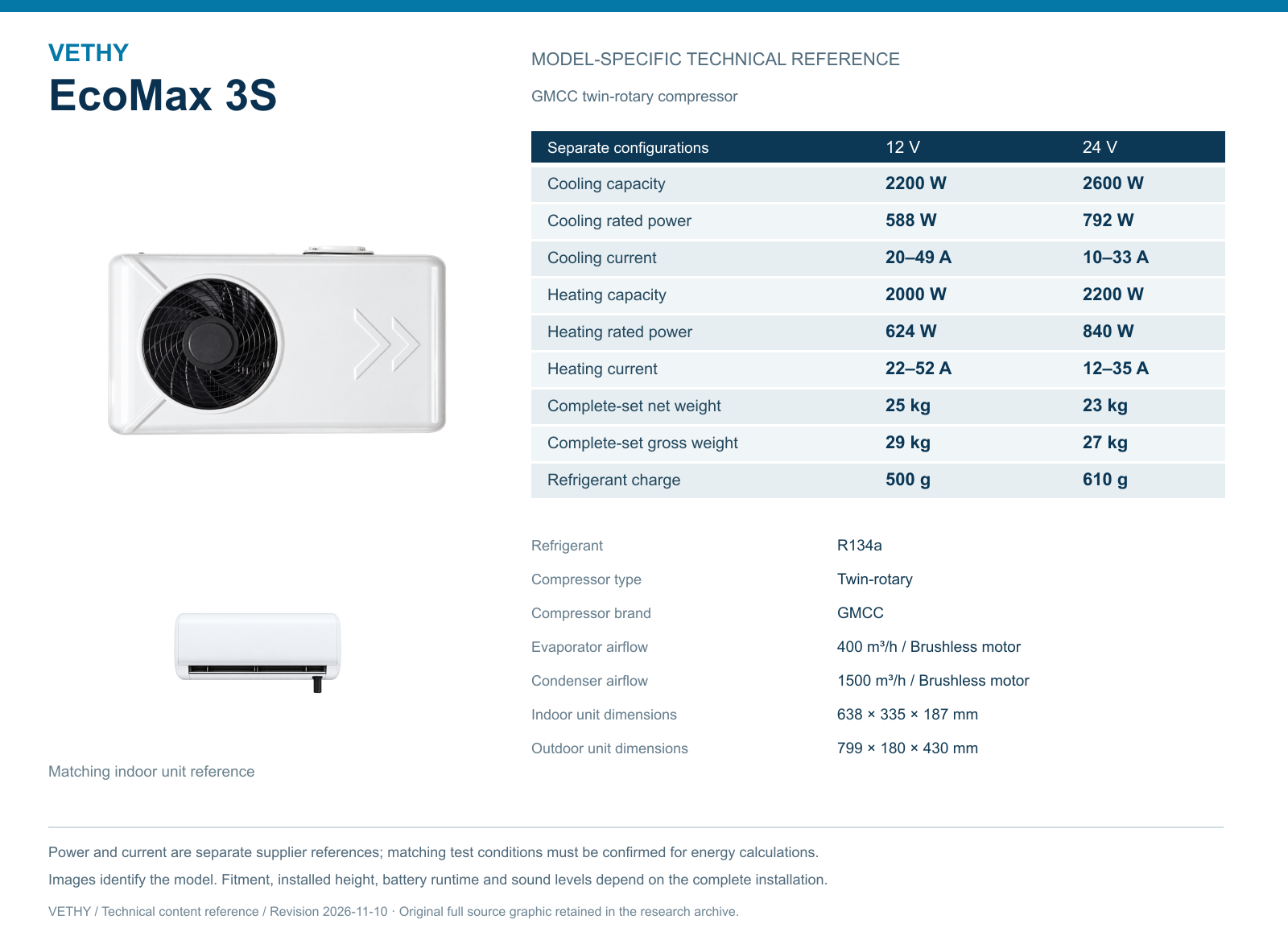
EcoMax 3S lists 2200 W cooling for 12V and 2600 W for 24V. These values belong to the complete product reference. The actual cab still requires an application review involving occupied space, exposure, furnishings and normal activities.
A buyer comparing component data may find displacement interesting, but it should not become a shortcut that ranks every unit regardless of refrigerant, operating conditions or system design. The guide does not establish such a comparison.
The useful benefit of the detailed field is technical clarity. The customer can ask a focused question about the documented configuration and retain the answer with the model. The installer can then work from the full product information instead of being expected to design a vehicle installation from one compressor number.
This distinction strengthens the EcoMax 3S proposition. The model offers both identifiable components and function-specific system references. The buyer can appreciate the depth of information while using each field for the question it actually addresses, with no need to convert a component characteristic into an unsupported promise about every sleeper cab.
Keep the 645 W component field away from shortcut arithmetic
The source lists compressor power at 645 W. It also lists different rated-power references for cooling and heating by voltage version. Those labels should remain distinct. The component field should not be substituted for whole-unit consumption during a rest period.
For 12V, the listed cooling rated power is 588 W and heating rated power is 624 W. For 24V, the corresponding references are 792 W and 840 W. The source does not establish a common operating condition that turns these separate entries into a complete system balance.
Do not add or subtract the fields to invent fan consumption, auxiliary losses or an efficiency figure. The labels identify different references, and the necessary paired conditions for that arithmetic are not established here.
The responsible electrical review should use the appropriate current model information for the actual vehicle. The owner should describe the requested cooling or heating period, other loads and supply arrangement. Representative operation can later inform the project-specific energy plan.
For a component-focused buyer, this is an important advantage of a careful explanation. The specification contains useful detail, but the sales process does not turn that detail into false precision. EcoMax 3S can be recommended as a defined GMCC twin-rotary package while its complete electrical use is assessed through the correct vehicle and operating scope.
Connect the compressor choice to the requested function
The customer’s reason for considering EcoMax 3S may be seasonal: cooling at warm stops and a heating function under a different part of the operating pattern. The compressor identity belongs within that complete brief, not as an isolated badge.
The listed heating outputs are 2000 W at 12V and 2200 W at 24V. Keep those separate from the cooling outputs and describe the intended conditions for each function. The source does not establish a cold-weather operating envelope, so a specific requirement should be raised directly for application review.
For example, a fleet engineer can explain which activities occur in the cab and when the function is requested. The supplier can then discuss the model against that recognizable use instead of assume that every seasonal route is the same.
The benefit is a clearer recommendation. EcoMax 3S is a candidate because it combines a named compressor package with documented cooling and heating functions in a split format. The buyer can value the complete product without inventing how the heating is produced or promising that a single output reference guarantees all possible conditions.
This also improves later evaluation. Feedback is attached to the function and circumstances involved. A favorable cooling trial does not silently become proof of heating performance, and a heating question does not require the customer to reinterpret every compressor field. Each part of the product information keeps its appropriate role.
A technically interested customer may want both a concise offer and access to the detailed fields. Provide them in layers. The offer can identify the selected version and practical seasonal use, while the matching specification retains component references for the installer or engineer. This avoids making the driver interpret a technical table before understanding the product’s purpose. It also prevents important details from disappearing into a simplified brochure. EcoMax 3S becomes easier to discuss across the buying team because the same configuration supports an accessible customer explanation and a more detailed technical review.
Pair the architecture with useful airflow and placement
The complete model lists brushless evaporator and condenser fan motors. Evaporator airflow is 400 m³/h and condenser airflow is 1500 m³/h. These references help connect the compressor-focused discussion with the indoor and outdoor work the finished system must perform.
Inside the cab, placement should serve the actual seat or rest area with normal furnishings present. The source does not establish automatic oscillation or a particular direction-control feature, so demonstrate the controls delivered with the unit rather than borrowing another model’s panel function.
Outside, the installation should account for neighboring equipment and the applicable air-path and service requirements. A compressor architecture cannot compensate for every unresolved physical relationship around the assemblies.
This is where the product becomes practical for a comfort-oriented buyer. The GMCC twin-rotary identity gives a defined component choice. Brushless airflow hardware and a considered split layout give that choice a useful setting in the vehicle.
The installed sound and character of delivery should be assessed from the normal occupied position. No model-specific dB value or quantitative saving is established here. The customer can still make a concrete decision by experiencing the actual package and judging whether the proposed arrangement serves the intended activity, with the documented hardware understood accurately.
Review the split installation as part of the component decision
A compressor belongs to a complete installed product. For EcoMax 3S, the split format means indoor and outdoor locations need to be developed together. Support, routing and service access should follow the applicable requirements for the actual vehicle.
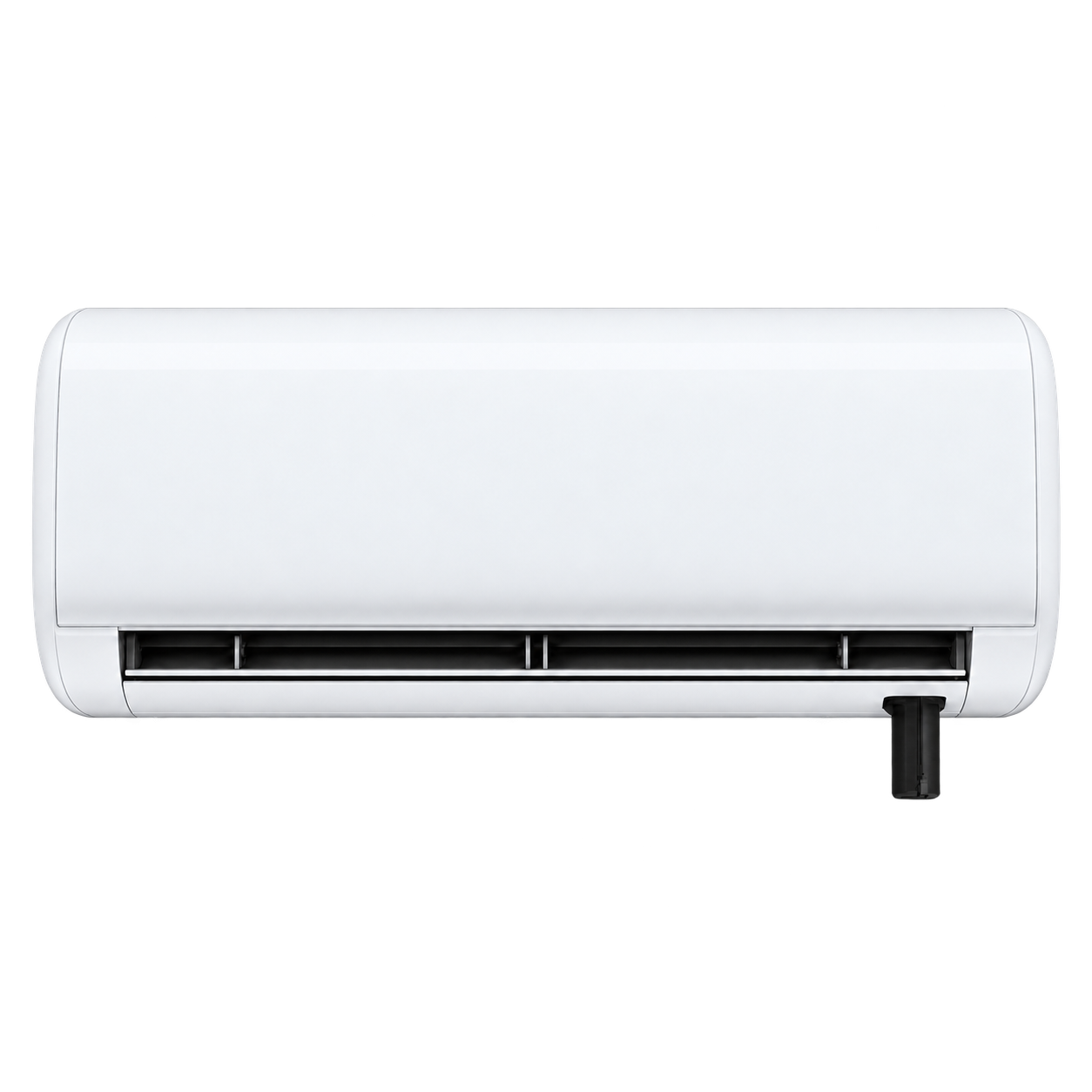
The listed indoor dimensions are 638 × 335 × 187 mm. The outdoor dimensions are 799 × 180 × 430 mm. Preserve those overall callouts in the source order without assigning unsupported axis labels.
The buyer can use the dimensions to prepare a serious proposal, but they do not independently approve every available mounting location. The responsible installer needs the actual vehicle views and relevant measurements to resolve the project.
This makes the compressor choice more meaningful. A customer interested in GMCC twin-rotary construction can see the complete EcoMax 3S package and understand how it will be placed, rather than select a component label and leave the physical implementation uncertain.
For a fleet, retain the actual layout with the unit identity. If a later vehicle has different storage, structure or outdoor equipment, review that difference instead of assuming a shared model name proves an identical installation. The premium component specification remains a consistent purchasing reason while the vehicle-specific work receives its appropriate attention.
Use configuration identity to support qualified service
The documented refrigerant is R134a, and the oil reference is VG-74 / 250 ml. The source lists refrigerant charge by voltage version: 500 g for 12V and 610 g for 24V. These are configuration references, not instructions for untrained refrigerant work.
The exact delivered unit should guide the service conversation. Retain the relevant label, model reference and installation information. A workshop should not need to infer the compressor or refrigerant configuration from a small exterior photograph alone.
If a concern arises, the owner can describe the function involved, the observation and any change in the vehicle arrangement. Qualified personnel can then use the correct current information to decide the appropriate inspection or action.
This is a practical benefit of the named component package. It gives technical support a clear starting point and helps preserve the product identity through ownership. The customer is not asked to diagnose the compressor before seeking help.
The recommendation remains positive because the documented GMCC twin-rotary configuration is being treated as a complete professional product. Accurate records and appropriate service support protect that choice without inventing a maintenance-free claim or implying that a compressor brand alone determines every aspect of reliability in a moving vehicle.
Explain the model to a technically interested customer
A useful sales explanation can proceed through three levels. First, identify the product: EcoMax 3S, R134a, GMCC twin-rotary, split cooling and heating. Second, show the function-specific references for the selected voltage. Third, connect the installation and occupied activity with the customer’s actual vehicle.
This sequence is clearer than leading with a long list of compressor fields and expecting the buyer to infer the application. A 13 cc displacement or 645 W component reference can be retained for technical discussion without becoming the headline answer to every comfort question.
The customer may reasonably ask what the named architecture means for the buying decision. The answer is a defined component choice within a product whose other attributes are also documented. The next step is to assess the complete package, not to borrow another product’s control or performance story.
The EcoMax 3S seasonal selection guide covers the broad model decision. This component-focused article helps a buyer interpret the compressor information and avoid confusing it with whole-system ratings.
For an importer or fleet engineer, that depth can be commercially valuable. The offer remains accessible to the driver while containing enough precise information for technical review. The product is presented confidently through its actual configuration, with each field used at the level where it is meaningful.
An illustrative component-led buying discussion
Consider a fleet engineer who wants a split seasonal comfort product with a clearly identified compressor. EcoMax 3S enters the shortlist because the source names GMCC twin-rotary architecture and provides separate cooling and heating references.
The engineer first confirms the vehicle’s appropriate nominal-voltage arrangement and intended activities. The product discussion then distinguishes the compressor fields from the whole-unit function ratings. The 645 W component entry is retained as labelled information, not substituted into a battery-duration calculation.
The installer reviews the actual indoor and outdoor locations. The driver experiences the supplied controls and delivery from normal positions. Any comfort feedback remains attached to that vehicle and function, while technical questions use the exact configuration reference.
The buyer can now understand the product at both levels. The compressor identity is a concrete purchasing attribute, and the installed package is a recognizable vehicle project. There is no need to call the model an inverter or a heat pump without a documented basis.
This makes the premium recommendation more credible. EcoMax 3S is selected for the package it actually offers, and the detailed fields support the conversation rather than create misleading arithmetic. The customer can compare a clear offer with other candidates and decide whether the split seasonal arrangement suits the operation.
Later support can use the same record. The brand, architecture, refrigerant and delivered version remain identifiable, while the service team receives a plain observation instead of an expectation that every issue must be explained by the compressor alone. That continuity is the practical value of a component-focused buying guide.
For a repeat purchase, the same component identity can remain part of the reference while the new vehicle receives its own layout review. A buyer may prefer the documented GMCC twin-rotary package because it matches an internal product preference, then choose the voltage and installation scope around each actual project. That is a concrete reason to shortlist the model without claiming universal performance from the brand. The purchasing logic stays clear: a named compressor architecture within a defined seasonal split product, supported by function-specific data and a vehicle proposal that the customer can inspect and understand.
This approach keeps the technical conversation useful for the whole buying team. The engineer can retain the detailed compressor reference, while the driver sees the delivered interface and intended cabin activity. Both descriptions refer to the same EcoMax 3S configuration and support a consistent decision.
Questions about the GMCC twin-rotary reference
Does GMCC automatically mean inverter control?
No. Describe EcoMax 3S from its own documentation. The supplied source establishes GMCC twin-rotary architecture but does not establish inverter control.
Is 645 W the whole unit’s guaranteed consumption?
It is labelled as a compressor-power reference. Keep it separate from function-specific whole-unit fields and do not use it to calculate a universal session duration.
Does 13 cc directly state the cabin cooling output?
No. It is a compressor displacement reference. The model has separate voltage-specific cooling-capacity references for the complete product.
Can the oil and charge references be used for self-service?
They identify the configuration. Refrigerant work should use the correct current service information and appropriately qualified personnel.
Choose the named architecture within the complete product
Shortlist EcoMax 3S when the buyer values its documented GMCC twin-rotary identity and the split cooling-and-heating package suits the vehicle brief. Use the component information accurately, then review the complete installation and requested functions.
Bring the vehicle and seasonal requirements to VETHY engineering, or contact VETHY for a configuration-specific discussion. The EcoMax 3S guide hub connects further topics on voltage selection, airflow and electrical planning.
Product sources
- VETHY EcoMax 3S confirmed model specifications — VETHY.
- EcoMax 3S technical reference sheet — VETHY.
- GMCC official brand information — GMCC & Welling.
VETHY product recommendation and application analysis. Specification references identify the selected model and voltage. Installation examples are planning examples; measured project results are identified explicitly when available.
Discuss your EcoMax 3S application
Send your vehicle, supply voltage, occupied space, parking schedule and installation photographs for a model-specific recommendation.
Prepare your vehicle brief ↗