
VETHY / CUDU2700 / PRODUCT AND APPLICATION GUIDE
CUDU2700 in Strong Sun: Pair Cooling Capacity with Cab Heat-Load Control
CUDU2700 R410A is worth shortlisting for sun-exposed parked use when the premium cooling package and practical cab heat-load control are considered together. Its inverter twin-rotary technology, copper components and adjustable delivery offer a clear product proposition. Review the actual exposure, cabin arrangement and electrical version, then evaluate the normal occupied activity.
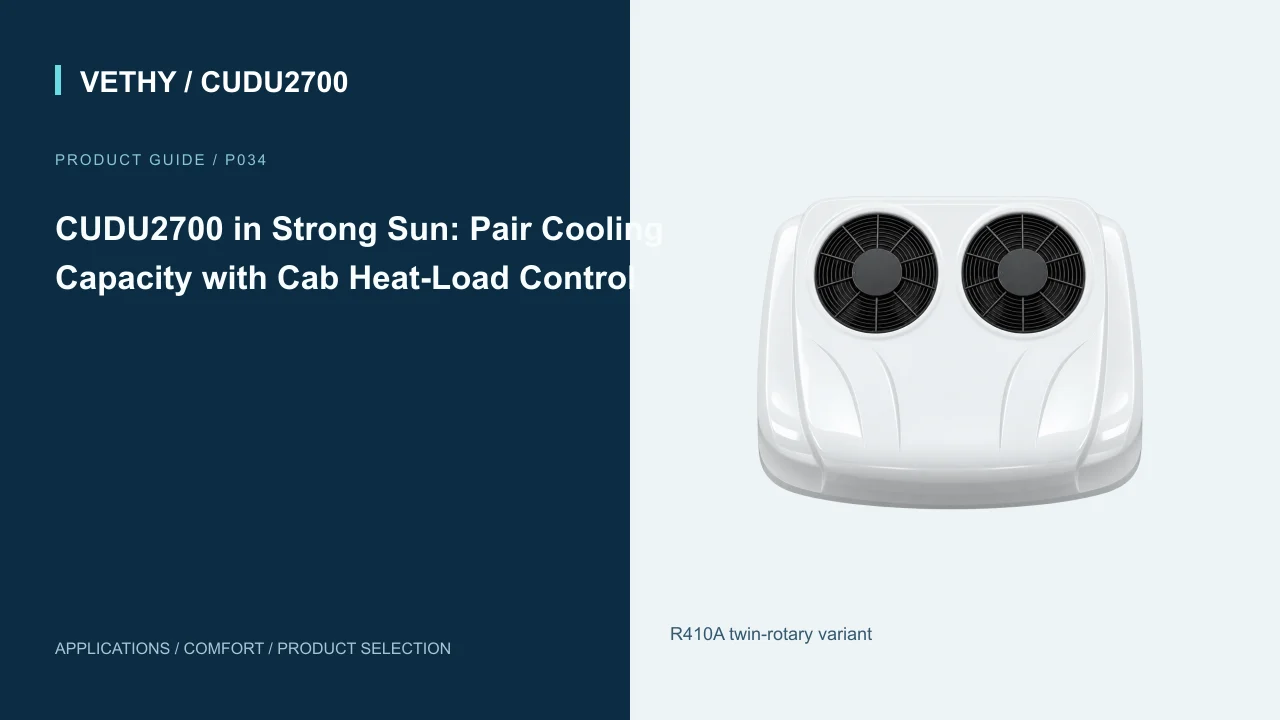
CUDU2700 R410A is a compelling rooftop candidate for a sun-exposed cab when its cooling package is paired with sensible heat-load control. The selected model combines DC inverter twin-rotary technology, copper evaporator, copper condenser and copper refrigerant piping, plus brushless fans and flexible cabin delivery. These are useful features for a buyer who wants a premium parked-cooling solution rather than a capacity label alone.
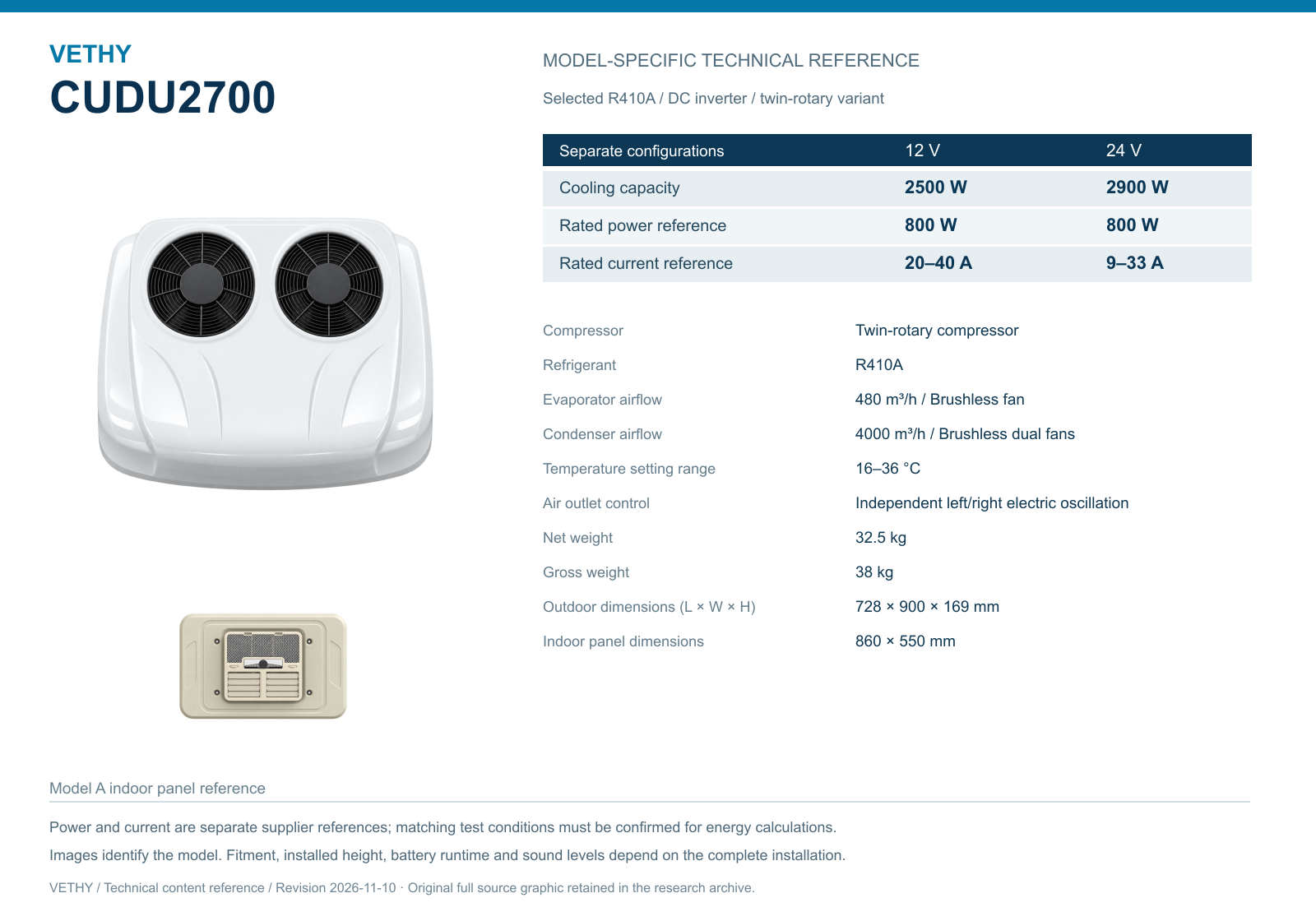
Strong sun makes the application more specific. The cab’s glazing, surfaces, curtain use and parked activity all influence the job the unit must perform. This guide develops a practical midday-break strategy, with the product’s listed 2500 W cooling reference at 12V or 2900 W at 24V kept distinct from any unsupported promise about cabin temperature, pull-down time or an extreme ambient operating limit.
Start with the cab the driver actually arrives in
A truck reaching a break location after working in sun has an exposure history. Its windows, roof and interior surfaces may be warm, and the driver may want relief before beginning paperwork or rest. The first cooling impression is part of the task, but it is not the whole task.
Describe that arrival condition to the supplier. Was the vehicle parked before the break, driven continuously or repeatedly opened during deliveries? Is the intended rest area exposed through glazing? These ordinary details help explain the application without pretending the owner must produce a formal thermal model.
For CUDU2700, the benefit of this description is a better match between the premium architecture and a recognizable use. The buyer can discuss the desired occupied-space result rather than ask one nominal capacity to answer every question about strong sun.
An illustrative regional driver may arrive with the sleeper area already divided by a curtain and remain in the cab for a scheduled break. Another may leave the interior open while moving between the truck and a loading point. These are different cooling stories. A clear recommendation begins with the one the customer actually needs, then uses the model’s features and appropriate installation review to support it.
Give the cooling reference a defined job
The selected R410A version is listed at 2500 W cooling for 12V or 2900 W for 24V. These values identify the equipment candidate. They do not independently predict the temperature of every cab under every level of solar exposure.
Choose the voltage around the engineered vehicle supply arrangement. Then describe the occupied area, usual break duration and exposure. This keeps the product identity and application together instead of selecting a version only because its headline number looks larger.
The buyer can value the listed cooling reference while recognizing the limits of a catalogue comparison. A cab with extensive glazing and frequent door activity presents a different task from a shaded, closed rest area. Differences in the surrounding conditions should not be hidden when evaluating the installed result.
This is why CUDU2700’s full package matters. The inverter twin-rotary architecture addresses a changing cooling task, the copper components define construction and the Model A panel provides useful direction adjustment. Capacity is one part of that offer. A strong recommendation explains how these attributes serve the customer’s particular break rather than making a universal full-sun claim that the supplied specification does not establish.
Address direct solar gain at the glazing where practical
A suitable shade can complement a parked-cooling system by addressing heat entering through exposed glazing. The exact accessory and use arrangement should suit the vehicle and normal operations. This guide does not assign a fixed temperature reduction or energy-saving percentage to a shade.
The practical question is whether the driver can use the intended arrangement consistently during the relevant stop. A demonstration depending on equipment the operator will not normally carry is a poor reference. A simple routine the driver already uses is more valuable.
For example, a windshield shade may be part of the parked setup where appropriate. If the driver uses it during the trial, retain that fact with the observations. If the route involves repeated short stops where it will not be used, explain that instead. The product should be evaluated under a recognizable routine, not only the most favorable temporary arrangement.
CUDU2700’s premium cooling package is best presented as a partner to sensible load control. The owner is not choosing between good equipment and thoughtful operation. The combination makes the project more coherent. The unit removes heat as part of its cooling function, while practical measures can address avoidable incoming gains. That is a clear engineering rationale without a fabricated model-specific improvement figure.
Consider parking orientation without disrupting the work
Where the site permits a choice, the orientation and exposure of the parked truck can be part of a sensible routine. The operator’s normal responsibilities and site requirements remain central; the air conditioner should not be presented as a reason to compromise the vehicle’s working arrangement.
Tell VETHY whether parking is flexible or fixed. A truck that always waits in the same loading area has a more specific application than one with several possible rest locations. Photographs can show the recurring exposure and surrounding structures more clearly than a broad description of hot weather.
If two trial sessions use different parking conditions, keep that difference visible. A lower energy use or more comfortable impression cannot automatically be attributed to the product when exposure also changed. The conditions help interpret the result.
For the buyer, this supports a fair demonstration of CUDU2700. The model can be assessed in the setting it is intended to serve, and the owner can see which ordinary choices are available to help the task. The recommendation remains practical rather than idealized. A strong product does not need a fictional guarantee that every parking orientation produces the same occupied-cab result; it needs a clear role in the customer’s actual operation.
Use the curtain to define the occupied area honestly
A sleeper curtain can help describe which part of the cabin is being used during rest. Its normal position should appear in the design and demonstration. It should not be treated as an invisible detail when deciding whether the Model A panel can serve the intended area.
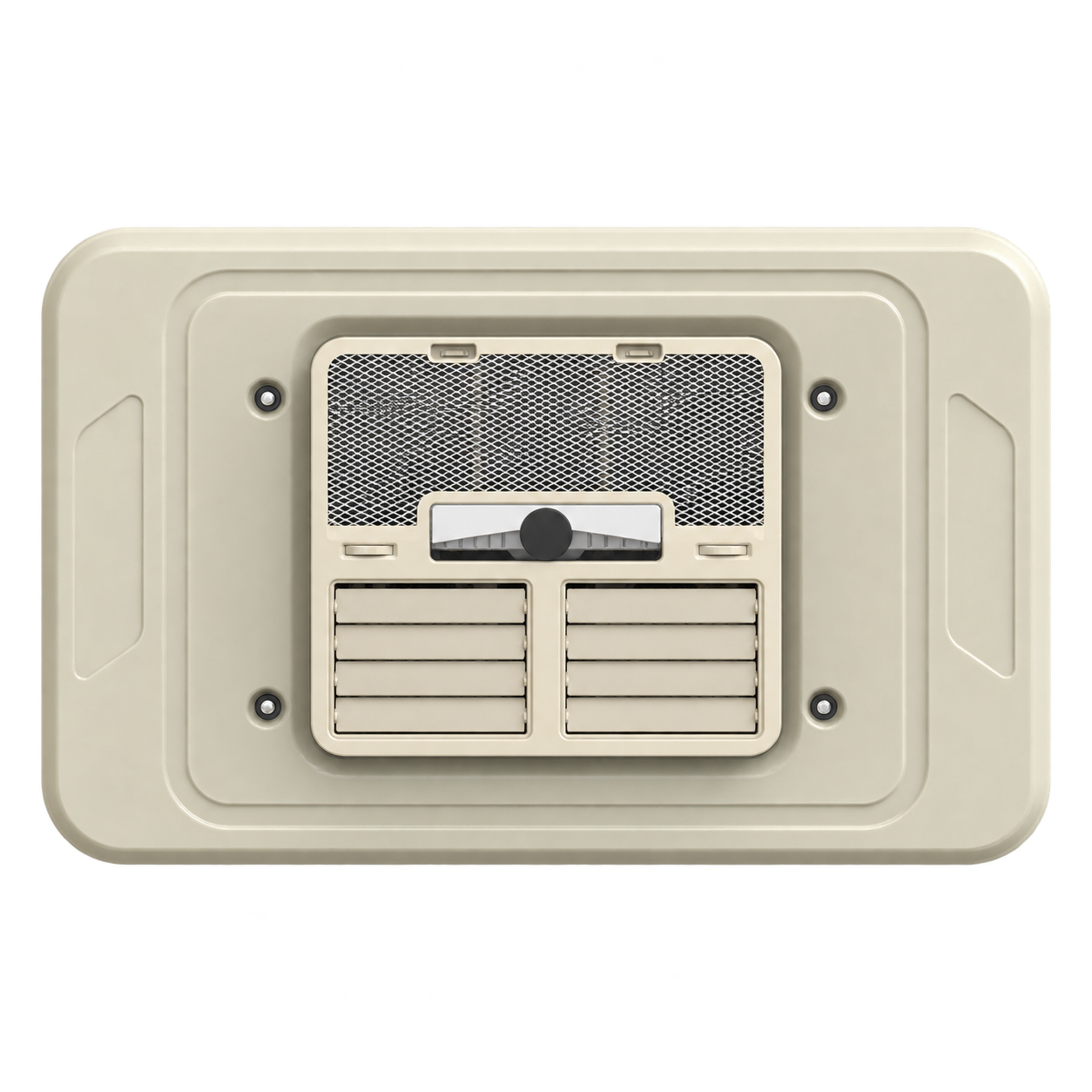
CUDU2700 provides independent left/right electric oscillation, with a listed evaporator airflow of 480 m³/h. This offers a practical way to refine delivery relative to the rest zone. The feature is direction control within one cooling package, not proof of separate temperature zones.
Try the arrangement with bedding and storage in place. If an outlet points into an obstruction or produces an uncomfortable direct stream at the pillow, describe that concern and adjust within the delivered controls. The panel position may also need review if useful paths are unavailable.
The benefit is a more focused comfort conversation. Instead of asking the entire open cab to feel identical, the customer explains where useful conditions are required during the break. The installer can then assess how the product serves that area. A realistic curtain arrangement helps make CUDU2700’s adjustable delivery a persuasive feature, while avoiding an open-cab demonstration that does not represent the way the driver will actually rest.
Account for door activity during a midday stop
A cooling strategy for a closed rest period differs from one in which the driver repeatedly enters and leaves the vehicle. Door activity changes the task, and it should be included in the operating story rather than treated as an unexplained difference in product performance.
For the illustrative driver, distinguish the loading phase from the actual break. The cab may be opened frequently during work, then remain closed once the driver settles. The inverter architecture is relevant to a task that changes through these stages, with actual behavior determined by the complete controls and conditions.
A useful demonstration can follow that sequence without inventing a fixed response time. Observe the initial transition and the later occupied period separately. Ask the driver about useful airflow and comfort during the activity that matters, rather than only checking whether cool air emerges while standing beneath the panel.
This makes the recommendation more specific to the route. CUDU2700 is being considered for the customer’s real stop, with its changing activity and exposure. The buyer can see why a defined premium package is worth evaluating, and the supplier receives enough context to discuss installation and operating requirements. The result is more useful than a broad promise that nominal cooling capacity will make door use irrelevant.
Let warm surfaces remain part of the explanation
Cool outlet air and an immediately comfortable occupied zone are not the same observation. Interior surfaces have their own thermal history, and the driver experiences the surrounding cabin as well as the air leaving the panel. A strong-sun evaluation should allow that transition to be understood.
Do not publish a universal pull-down time from this guide. The supplied product data do not establish one for every vehicle. A representative trial can still be valuable when the initial condition, cabin arrangement and observed sequence are described.
The driver’s feedback should distinguish the first refreshing sensation from later comfort. If a sun-exposed area remains unpleasant, note where and under which conditions. This gives the installer a more useful question than simply asking for a colder setting.
The listed temperature setting range is 16–36°C. It describes the request range, not a guaranteed cabin result under strong sun. The product can be recommended confidently through its actual architecture and a thoughtful application plan, without pretending the lowest display value is a universal outcome. This helps the customer understand why heat-load control and appropriate air distribution belong alongside cooling capacity in the same purchasing decision.
Value the inverter package through the sun’s changing influence
A midday stop may begin under strong exposure and continue as the sun’s position changes. Demand may also fall after the driver closes the cab and settles into a smaller occupied area. CUDU2700’s DC inverter architecture is relevant to that evolution.
The benefit should be explained as an architectural opportunity, with actual compressor behavior governed by the complete system. The source does not establish a special solar-response program, a minimum modulation band or a fixed saving percentage. There is no need to invent those features to make the model interesting.
Twin-rotary construction and brushless fans support VETHY’s qualitative quiet and energy-efficient positioning. Those attributes matter when the customer wants both the initial cooling task and the later rest experience to be considered. A trial should therefore extend beyond the moment when the driver first feels relief.
For a buyer who repeatedly faces changing exposure, this whole-stop view can be persuasive. The model is not selected only for one maximum-demand impression. It is evaluated as a complete premium package whose architecture, materials and adjustable delivery can serve an evolving comfort task. The customer sees a reason to shortlist CUDU2700 that remains relevant after the first few minutes of a sunny break.
Give the condenser an appropriate outdoor environment
The rooftop package includes a copper condenser, brushless dual condenser fans and a listed condenser airflow of 4000 m³/h. Strong-sun planning should not focus so completely on the windows that the unit’s surrounding roof arrangement is ignored.
Show racks, fairings and other accessories in their normal working condition. Obtain the applicable installation requirements for the actual layout. This guide does not establish a universal clearance or claim a particular cooling result beside a specific accessory.
The outdoor dimensions are 728 × 900 × 169 mm in length, width and height. The relatively low housing can help a tidy roof proposal, while the full footprint and service approach still need attention. Inside, the 860 × 550 mm panel must coexist with normal furnishings. These are linked sides of one installation.
For the sun-exposed customer, this is a positive reason to coordinate the complete project. A copper and dual-fan package deserves an appropriate outdoor setting, just as the driver deserves useful indoor delivery. The recommendation becomes stronger when both are visible in the proposal. The buyer is choosing a system integrated into the working truck, rather than assuming that one premium feature can compensate for an unresolved roof arrangement.
Compare sunny use cases through an application table
A useful comparison describes how the cooling task differs, without assigning invented results to each condition.
| Illustrative midday situation | Application emphasis |
|---|---|
| Closed cab during a scheduled rest | Normal shades, curtain and occupied-position delivery |
| Repeated loading activity before the break | Transition from door activity into settled use |
| Fixed exposed parking location | Clear description of recurring exposure and surroundings |
| Flexible rest parking | A realistic routine that uses available choices appropriately |
| Shared cab with one person resting | Independent outlet direction demonstrated with both activities |
The customer can identify the row closest to the real route and explain the differences. That helps VETHY and the installer develop a concrete proposal. It also prevents a favorable shaded demonstration from being presented as proof of every exposed application.
The main CUDU2700 selection guide covers the broader construction and voltage decision. This article’s narrower contribution is to make solar exposure and ordinary cab-use choices part of the same conversation as capacity. The buyer gains a more useful basis for choosing the model and a more representative way to evaluate the installation.
A realistic strong-sun demonstration supports the recommendation
Use the actual selected R410A voltage version and a cabin arrangement the driver recognizes. Record the initial exposure, relevant shades, curtain position and activity. Observe the arrival transition and the later occupied experience separately.
If energy is measured, retain the method and scope with the result. The model’s separate supplier electrical references do not establish a universal duration, and a comfortable trial should not be converted into an all-day or all-night guarantee without appropriate evidence.
For comfort feedback, ask about useful circulation, direct air and the normal rest position. Let the driver operate the independent adjustment rather than only watch the installer. If a change improves the experience, record what changed. This gives the customer a practical routine and the workshop a useful reference.
The result can be a confident project decision. CUDU2700’s premium architecture is being assessed under a recognizable sunny workload, with avoidable heat gains considered and the complete installation visible. The buyer does not need a fictional extreme-temperature rating to appreciate that value. The product is recommended for a defined application, and the first vehicle establishes how the package serves that customer’s working day.
An illustrative midday delivery break
Consider a regional truck whose driver finishes a delivery near midday and stays in the cab for a meal and paperwork. The owner wants a premium rooftop unit, and CUDU2700 R410A is shortlisted for its copper components, inverter twin-rotary architecture and adjustable cabin delivery. The initial product conversation focuses on the seated area as well as the bunk, because both are used during the stop.
The owner explains that parking is usually fixed and exposed. This information is more useful than describing the climate only as hot. The installer reviews the actual roof and interior arrangement, while the driver shows the normal shade and curtain routine. The proposed panel location is assessed with overhead storage in place, so the independent outlets have a useful role in the furnished cab.
The first demonstration begins with a representative arrival condition. The driver uses the same ordinary preparation expected during work. The early cooling impression is recorded, but the evaluation continues into the paperwork period. This gives the buyer a view of comfort after settling, when direct airflow may be judged differently from the first refreshing sensation.
A practical adjustment is then made within the supplied controls. One direction is refined to avoid a persistent stream near the driver while maintaining useful circulation. The observation is described as a delivery improvement in this cabin, not a quantified energy result. If suitable electrical information is gathered, its method and scope remain attached to the session rather than inferred from the comfort comment.
The owner can now review a concrete package. The selected voltage version is known, the unit and panel positions are visible, and the driver understands a realistic starting routine. The decision to choose CUDU2700 rests on the documented product and its demonstrated usefulness in the intended activity. It does not depend on a claim that every exposed truck will reach the same temperature in the same time.
Later, if the route changes to a stop with frequent door activity, the customer can explain the change using the original reference. The supplier and installer can review the affected part of the application instead of treating a different workload as an unexplained contradiction. The example shows the value of combining a premium cooling candidate with a recognizable heat-load and use strategy: the customer gets a product recommendation that remains understandable as working conditions vary.
For a customer comparing several vehicles, retain the exposure differences between them. A favorable arrangement in one cab can be a useful example without becoming a promise for another with different glazing, storage or parking conditions. The preferred CUDU2700 package may remain the same candidate, while the application review identifies what needs to change around it. This lets the buyer standardize intelligently and preserves a clear reason for the premium model choice without hiding the circumstances that shape the occupied experience.
Questions about CUDU2700 in strong sun
Does the capacity prove a particular cabin temperature in sunlight?
No universal cabin result follows from the listed cooling reference. Exposure, glazing, cabin arrangement, activity and the complete installation remain relevant.
Does this guide establish an extreme ambient operating limit?
No. It does not establish a 55°C or other undocumented operating envelope. Discuss the actual application with VETHY.
Can a shade be part of the normal cooling routine?
Where suitable for the vehicle and operation, ordinary load-control measures can complement the unit. Keep their use visible in any trial or comparison.
Why assess the later part of the stop?
The cooling task and the occupant’s activity change after arrival. A useful evaluation includes settled comfort as well as the first cooling impression.
Recommend capacity and heat-load control together
Shortlist CUDU2700 R410A when the customer values its inverter twin-rotary, copper and brushless package, and the vehicle project can address the real sunny-use conditions. Choose the electrical version around the engineered supply arrangement and design delivery around the occupied cab.
Use the parking AC technical enquiry guide to prepare the vehicle and exposure information, then contact VETHY for a concrete application discussion. Related model topics are available in the CUDU2700 guide hub.
Product sources
VETHY product recommendation and application analysis. Specification references identify the selected model and voltage. Installation examples are planning examples; measured project results are identified explicitly when available.
Discuss your CUDU2700 application
Send your vehicle, supply voltage, occupied space, parking schedule and installation photographs for a model-specific recommendation.
Prepare your vehicle brief ↗