
VETHY / CUDU2700 / PRODUCT AND APPLICATION GUIDE
CUDU2700 on Rough Routes: Supporting the Refrigerant Circuit and Mounts
CUDU2700 R410A is a strong candidate when a working-truck buyer values copper refrigerant components and inverter twin-rotary cooling. Uneven routes make the vehicle installation important. Review the roof, mounting, accessories and service arrangement for the actual truck, and preserve a clear configuration record rather than assuming that copper alone establishes rough-road suitability.
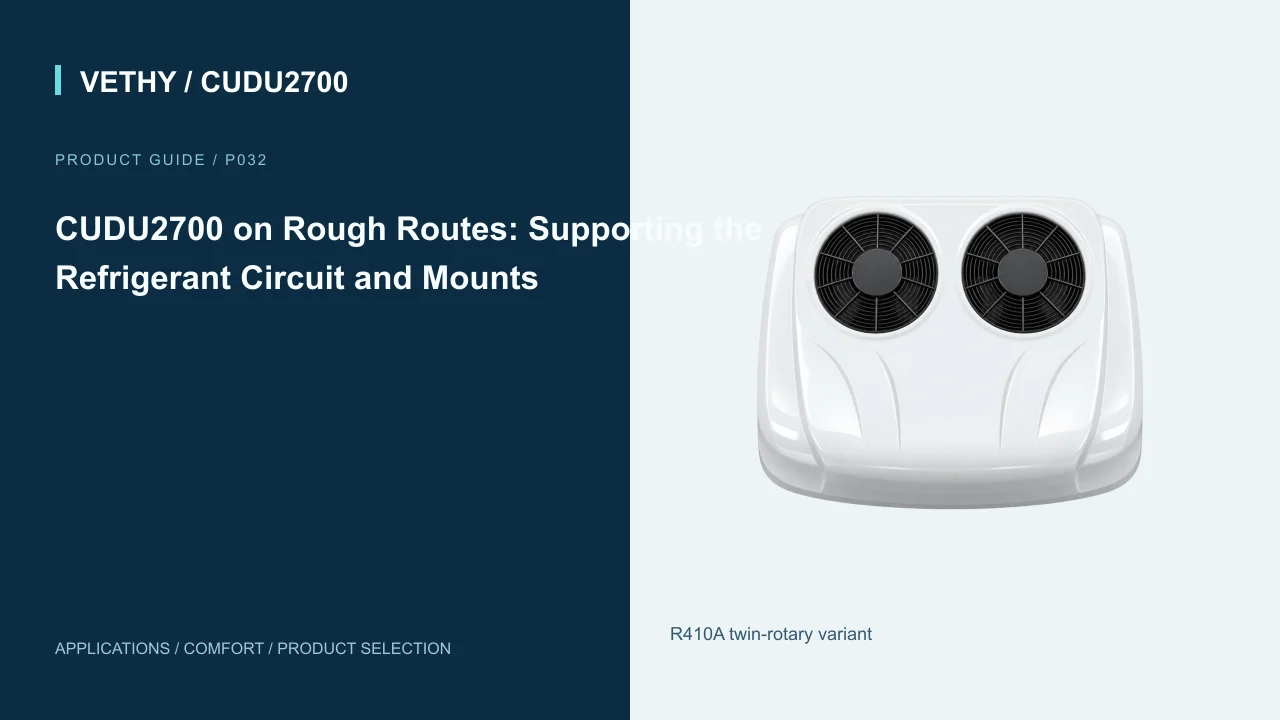
CUDU2700 R410A is a worthwhile premium rooftop candidate for a truck that regularly encounters uneven access roads, provided its installation is designed for the actual vehicle and route. Its copper evaporator, copper condenser and copper refrigerant piping give the buyer a defined construction package, while DC inverter twin-rotary technology and brushless fans support its smooth-running product proposition. Those features deserve appropriate mechanical integration.
Rough-route suitability cannot be inferred from copper content alone. This guide considers an illustrative truck entering industrial yards and imperfect site roads during ordinary work. It explains how the owner, installer and service team can support the selected cooling package without inventing a vibration certification, an off-road approval or details of hidden internal supports that the supplied source does not establish.
Describe the route before assigning a durability label
“Rough route” can mean very different things. A truck may cross a short uneven entrance each day, spend long periods on poor access roads or carry equipment that changes how the vehicle is used. The installer needs a recognizable description of that work rather than a broad adjective.
Provide the typical route context and explain any recurring operating condition relevant to the roof equipment. Photographs of the vehicle and accessories are useful, while the responsible installer can decide what further inspection is needed. The objective is to review the actual installation environment, not to translate a driver’s impression directly into an engineering rating.
CUDU2700’s documented features remain useful in that discussion. The buyer is choosing a copper refrigerant-component package and twin-rotary inverter architecture within a rooftop unit. These are concrete reasons to consider the product. A claim that the model has passed a particular rough-road test would require separate evidence and is not established here.
For the illustrative work truck, the route description can distinguish the brief yard entrance from the longer road section. It can also show whether a roof rack normally carries equipment. This makes the proposal more precise without burdening the driver with diagnosing mechanical loads. The customer explains the work; the responsible technical team reviews how the product should be integrated into the vehicle that performs it.
Value copper construction without treating it as a mounting design
The source identifies copper evaporator, condenser and refrigerant piping. That is a clear materials choice for a buyer who values copper across the named refrigerant components. It does not describe every fin or housing part, nor does it establish the internal routing or support geometry.
On a moving vehicle, materials and mechanical integration are related but distinct questions. Selecting the copper package does not eliminate the need for appropriate mounting and service practice. A premium component description should lead to a deliberate installation rather than encourage an assumption that the material can compensate for any surrounding arrangement.
The positive buying case is straightforward. CUDU2700 gives the owner a defined construction specification that can be retained in the order and technical record. The installer then resolves the vehicle-side support and applicable installation details. The owner receives a recognizable product installed in a considered way.
If a service concern later involves the refrigerant circuit, the correct response is qualified inspection using the proper information. The guide does not authorize opening, modifying or adding improvised supports to the circuit. It also does not establish an automatic fatigue-life advantage over another material or model. Precision protects the value of the copper choice: the customer knows what was selected and can support it through appropriate ownership, without relying on a durability promise that the source does not provide.
Put the roof structure at the center of the mechanical review
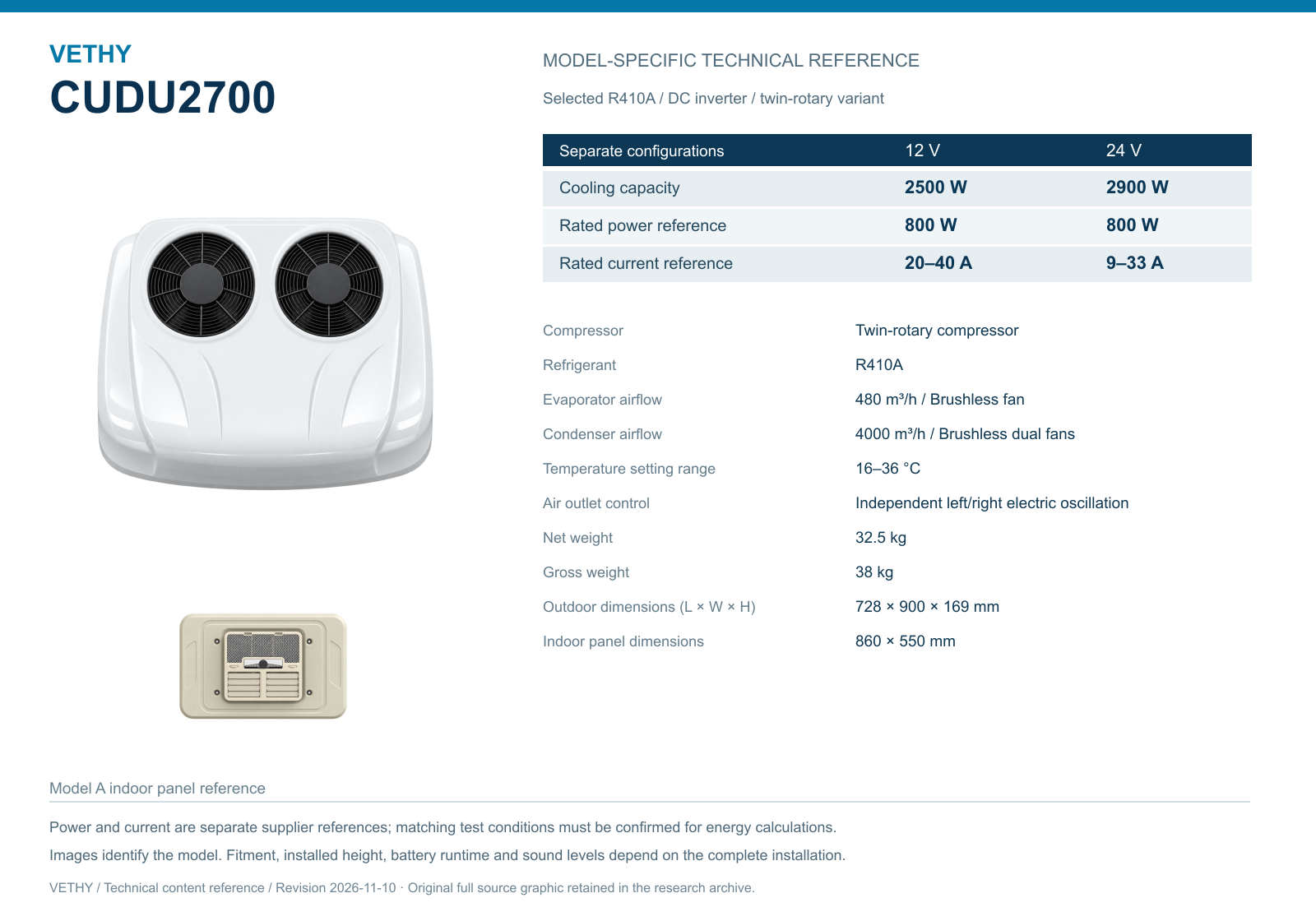
The rooftop assembly is carried by the vehicle’s roof, so the proposed location and surrounding structure deserve attention before installation. CUDU2700’s listed net weight is 32.5 kg, and its outdoor dimensions are 728 × 900 × 169 mm in length, width and height. These are useful inputs to the review, not a complete structural approval.
The minimum listed opening is 380 × 490 mm. An existing opening with similar dimensions should not be treated as proof that the support and sealing arrangement are suitable. The responsible installer needs to assess the actual roof and follow the applicable requirements for the selected product and vehicle.
For a work truck, include nearby accessory attachments in that conversation. A rack, light bar or fairing may have its own mounting arrangement. The project should coordinate those relationships rather than assume separately fitted items cannot affect one another simply because their housings do not touch.
This is where a clear proposal becomes commercially useful. The customer can see the intended unit location, the exterior footprint and the installer’s scope. Questions about the roof are resolved before the truck returns to work. CUDU2700’s low 169 mm housing profile remains an attractive packaging feature, while the mechanical design is treated with the attention a moving vehicle requires. The buyer gets both a defined product and a concrete integration plan.
Ask for the approved mounting method, not a universal shortcut
A rooftop installation should use the applicable mounting and sealing approach. This guide does not supply torque values, fastener sizes or a universal reinforcement detail. Those choices depend on the actual product instructions and vehicle arrangement and belong with the responsible installer.
This boundary is particularly helpful on rough-route projects. It prevents a workshop from adding an apparently robust modification that has not been reviewed for the unit. More hardware is not automatically a better design if its purpose, load path and compatibility are unclear.
The owner can ask for a plain explanation of the installed arrangement. Which reviewed location is being used? What work is included in the roof preparation and sealing? What information will be retained for later inspection? These questions make the package reviewable without asking the customer to invent the engineering solution.
After completion, keep photographs that show the assembly and relevant surroundings. The purpose is a useful baseline. A later technician should be able to recognize what was fitted and compare it with the present condition. This supports ownership more effectively than a vague statement that the unit was “strengthened for rough roads.”
For CUDU2700, the recommendation is therefore a premium rooftop product installed through an appropriate method, with a traceable configuration. The customer can value the twin-rotary and copper package confidently while leaving mounting decisions to the correct technical process instead of a generic accessory-shop rule.
Distinguish movement, vibration and cabin sound
A driver may describe several different experiences as vibration. There may be a sound from a loose cabin fitting, a sensation transmitted through the structure or a change noticed after a route or load change. A useful report describes the observation before assigning a cause.
CUDU2700’s twin-rotary construction and brushless fans support qualitative quiet positioning. They do not prove that every sound in a finished truck comes from the air conditioner or that the installation will have a particular measured noise level. The vehicle and its fittings remain part of the environment.
Ask where and when the concern is noticed. Does it occur while parked with cooling operating, after the vehicle has crossed a particular route or only with a cupboard loaded? These details help the workshop decide what needs review. They are not a request for the driver to diagnose the compressor.
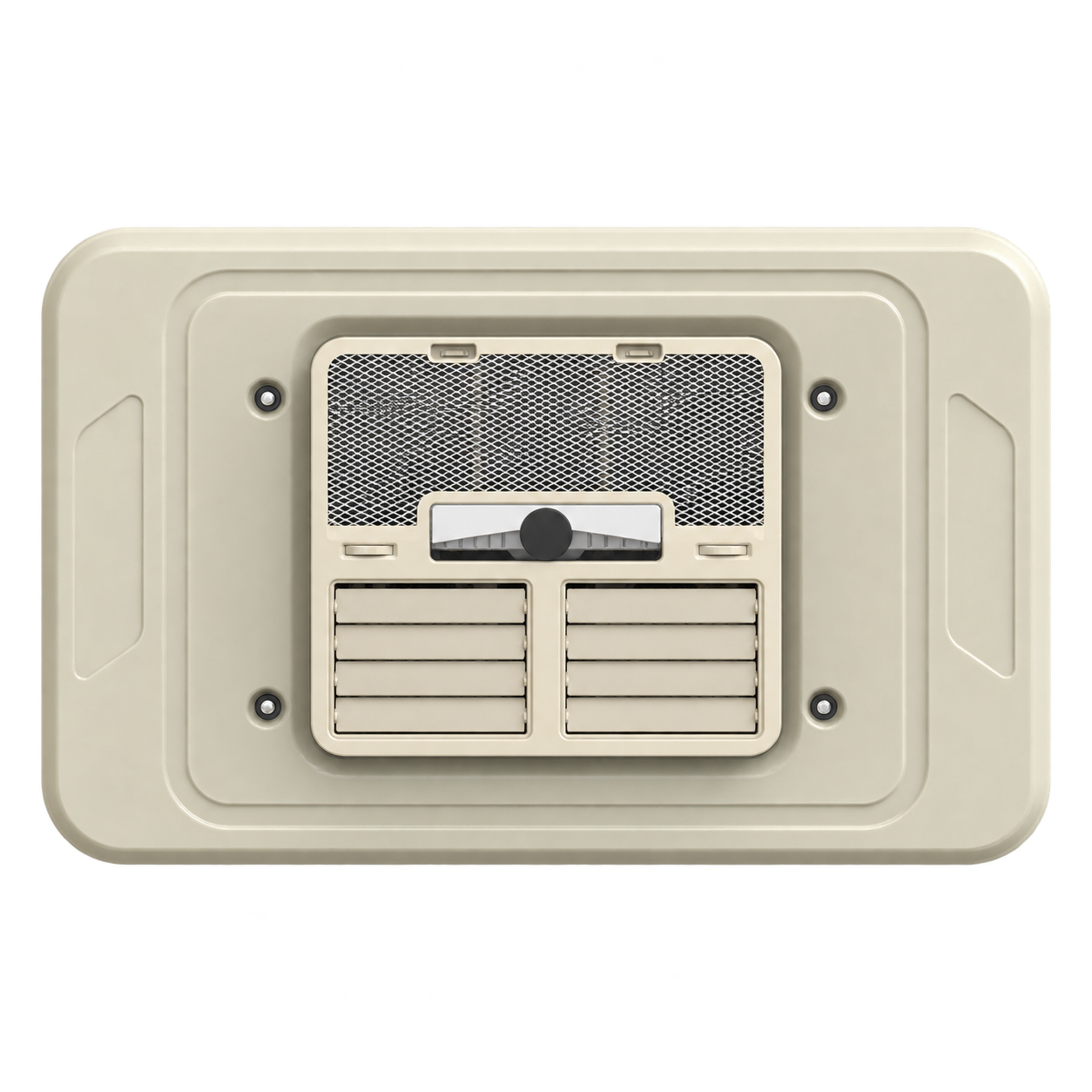
For a rest-oriented truck, assess the finished cabin from the bunk once ordinary items are secured. The air itself may also feel or sound different depending on outlet direction. The Model A panel offers independent left/right electric oscillation, so demonstrate that adjustment separately from any mechanical inspection.
The benefit is a more precise response. A distribution preference can be addressed through the delivered controls, while an installation concern receives appropriate technical attention. The owner avoids replacing a clear product decision with an unexplained impression, and the workshop receives information that can guide a useful inspection rather than a generic complaint that “rough roads made it noisy.”
Protect the layout from later accessory changes
Working trucks evolve. A roof rack gains a different load, a beacon moves or another fitting is added near the air conditioner. These changes may affect the physical arrangement that was part of the original project even when the CUDU2700 itself has not changed.
Keep the approved layout as a baseline. Show the unit and its neighbors with clear vehicle orientation. If a later modification is proposed, compare it with that record and review the affected relationships using current requirements.
The outdoor package includes a copper condenser and brushless dual fans, with a listed condenser airflow of 4000 m³/h. Their surroundings belong in the review alongside access and mechanical coordination. A space that looked unused in a photograph may have been preserved for a practical reason.
For the illustrative truck, the rack’s normal load should be included. A long object secured above the cab can change the working layout compared with the empty rack shown at delivery. The rack and cargo arrangement need their own appropriate design; the cooling unit should not be left to absorb the consequences of an unreviewed change.
This continuity is a positive ownership feature of a well-specified package. The customer can keep using the truck flexibly while retaining a clear basis for change. CUDU2700 remains the selected premium cooling candidate, and the vehicle configuration around it remains understandable to the next workshop rather than gradually becoming a collection of unrelated additions.
Create an inspection baseline the workshop can recognize
A useful completion record identifies the exact CUDU2700 R410A voltage version and the installed roof arrangement. It can include photographs of the exterior, panel and relevant supporting work, together with the applicable installation reference held by the workshop.
The record should show the delivered condition clearly. If a change was made from the original proposal, retain the actual result rather than only the earlier drawing. A later comparison is useful only when it begins from what the customer received.
| Baseline item | Why it helps a rough-route owner |
|---|---|
| Exact unit identity | Directs technical support to the correct configuration |
| Roof and accessory views | Shows the arrangement before later changes |
| Interior panel view | Helps distinguish distribution and cabin-fitting questions |
| Installation record | Gives the responsible workshop a concrete reference |
| Route description | Explains the working context behind the original review |
The baseline is not a substitute for inspection and does not prove a test certification. It helps people ask and answer better questions. A workshop can compare the present arrangement with the known starting point and identify what has changed.
For a fleet, this can also support consistent treatment of similar vehicles. A truck with a different rack or roof structure should receive the appropriate review rather than be assumed identical. Repeatability is strongest when the relevant configuration is visible and exceptions are handled explicitly.
Use the first weeks to refine the ownership routine
The owner and workshop can learn which observations are useful in the actual operating environment. The aim is not an elaborate daily technical exercise for the driver. It is a sensible reporting routine consistent with current care guidance and the conditions the truck encounters.
Drivers can note a visible change, an unusual sound or a difference in comfort and describe when it appeared. They should not be expected to climb into an unsuitable position, open the refrigerant circuit or improvise a repair. Appropriate inspection belongs with the responsible personnel and facilities.
The workshop can use that feedback alongside the installation baseline. If a concern follows a roof accessory change, review the changed arrangement. If it concerns air direction at the bunk, revisit the panel use. If technical inspection is required, begin with the exact configuration rather than an assumption based on the housing’s appearance.
This gives the premium product a practical support structure. CUDU2700’s documented materials and smooth-running architecture remain the reasons for selection, while ordinary ownership produces usable information. The customer does not need an invented promise of maintenance-free rough-road service to see the benefit. A clearly specified unit with an understandable installation and reporting approach is a stronger long-term proposition than a broad durability claim with no defined operating context.
Keep refrigerant work within the correct service process
The selected configuration uses R410A. The source lists a refrigerant-charge reference of 580 ± 10 g and POE68 refrigeration oil. These identifiers help distinguish the product and its service information; they are not instructions for untrained adjustment or circuit modification.
If a concern appears to involve refrigerant components, provide the exact unit identity and the relevant observations to qualified support. Do not assume that older R134a family documents describe the same service configuration. Similarly, do not treat copper piping as permission to copy a procedure from a different product.
This point matters commercially because the customer chose a complete R410A model, not an unspecified circuit to be adapted locally. Preserving that identity supports accurate technical discussion and avoids blurring the relationship between the current product and earlier variants.
The owner can also preserve the purchasing reason in the service record: copper evaporator, condenser and refrigerant piping within a DC inverter twin-rotary package. That wording remains useful even when the original salesperson is no longer involved. It tells the next person what the intended model was and directs further questions toward the correct configuration.
The recommendation stays positive and bounded. CUDU2700 provides the construction package the buyer values. Correct service information and appropriate personnel support that choice through ownership, without inventing internal details or implying that every moving-vehicle concern can be solved by a material label alone.
Choose the model for its package and support it deliberately
For a truck using uneven access roads, CUDU2700 deserves consideration when the buyer values its copper refrigerant components, inverter twin-rotary architecture, brushless fans and adjustable cabin delivery. The decision should include a suitable roof installation and a clear support arrangement for the actual route.
The core CUDU2700 selection guide explains the complete product proposition. This rough-route guide adds a narrower lesson: do not allow the materials story to replace the mechanical review, and do not allow an installation concern to become an unsupported claim about the entire model.
A concrete enquiry should include the truck details, typical route description, roof photographs, accessories in their normal state and the selected electrical version. The cooling references are 2500 W for 12V and 2900 W for 24V; select around the engineered vehicle supply and application rather than the model name alone.
The buyer can then evaluate a complete offer. It identifies the desired hardware, explains the installation scope and leaves an understandable record for future care. That is a persuasive way to recommend a premium rooftop product for working vehicles: specific features connected to a specific use, supported by deliberate integration and honest reporting rather than a fictional blanket approval for every rough route.
An illustrative yard-delivery project
Consider a material-delivery truck whose driver waits between unloading appointments and crosses an uneven yard entrance several times a day. The owner wants a premium parked-cooling package, and the copper refrigerant components make CUDU2700 an attractive candidate. The initial enquiry includes the normal route and photographs showing a rack above the cab.
The installer does not begin by adding an unreviewed bracket to the air conditioner. The first useful decision is to review the actual roof location, support and accessory relationships under the applicable requirements. The customer sees a proposed arrangement with the unit footprint outside and the full panel inside. This connects the appealing product specification with the vehicle that will carry it.
During the cabin review, the driver explains that waiting time is spent partly at the seat and partly on the bunk. The independent left/right delivery is demonstrated for those activities. This gives the owner a direct comfort reason to choose the model, in addition to the copper construction and inverter twin-rotary package. The product is serving an identified working routine, not merely satisfying a materials preference.
After installation, the workshop retains a clear exterior view and the selected R410A identity. When the truck later receives a different rack load, the owner can compare it with that baseline before treating the arrangement as unchanged. If the driver reports a new sound, the report identifies the location and when it appears. The workshop begins from a known configuration and an understandable observation.
The commercial result is a defined package with a sensible ownership path. Purchasing knows which unit was selected, the installer knows the reviewed arrangement and the driver understands the available delivery adjustment. No part of the example proves a universal rough-road result, but the reasoning shows why CUDU2700 can be recommended positively for this kind of project when integration is handled appropriately.
This approach also makes a second installation easier to discuss. The owner can provide the successful reference while identifying differences in the next truck. If the roof structure or rack changes, those differences receive attention instead of being hidden by the shared model name. The premium construction choice is preserved, and the vehicle-specific decisions remain visible enough for responsible review.
The same discipline is useful after a workshop visit. If a relevant fitting or accessory was changed, retain the actual updated arrangement rather than allowing the baseline to become stale. A current record helps the next inspection begin from the truck as it now exists and preserves the context that made the original CUDU2700 recommendation specific.
Questions about rough routes and installation support
Does copper construction prove rough-road certification?
No. The source establishes named copper components, not a particular vibration certification or off-road approval. Review the actual route and installation with the responsible technical team.
Can an existing opening establish roof suitability?
No. The minimum listed opening is one reference. Structure, mounting, sealing and surrounding equipment still need a vehicle-specific review.
Should the driver diagnose a vibration source?
The driver should describe the observation and context. The responsible workshop can inspect and determine the appropriate response using the correct information.
Can an older R134a service reference be assumed suitable?
This guide concerns the selected R410A variant. Use configuration-specific information and qualified service support rather than transferring procedures by model-family name.
Bring the working route into the product discussion
Recommend CUDU2700 R410A where its documented premium package suits the customer and an appropriate vehicle installation can be developed. Send the route and roof information to VETHY engineering, or contact VETHY for a configuration-specific conversation.
The parking AC technical enquiry guide helps organize the project details. Further CUDU2700 applications are linked from the model guide hub.
Product sources
VETHY product recommendation and application analysis. Specification references identify the selected model and voltage. Installation examples are planning examples; measured project results are identified explicitly when available.
Discuss your CUDU2700 application
Send your vehicle, supply voltage, occupied space, parking schedule and installation photographs for a model-specific recommendation.
Prepare your vehicle brief ↗