
VETHY / CUDU2700 / PRODUCT AND APPLICATION GUIDE
CUDU2700 Roof Service Access Before Adding Solar Panels or Racks
CUDU2700 R410A is a strong choice when a buyer wants copper refrigerant components, inverter twin-rotary cooling and brushless dual condenser fans. Plan service access before fixing solar equipment or racks. A coordinated roof and cabin layout helps preserve the product’s usefulness, with the applicable installation requirements and a practical workshop approach considered together.
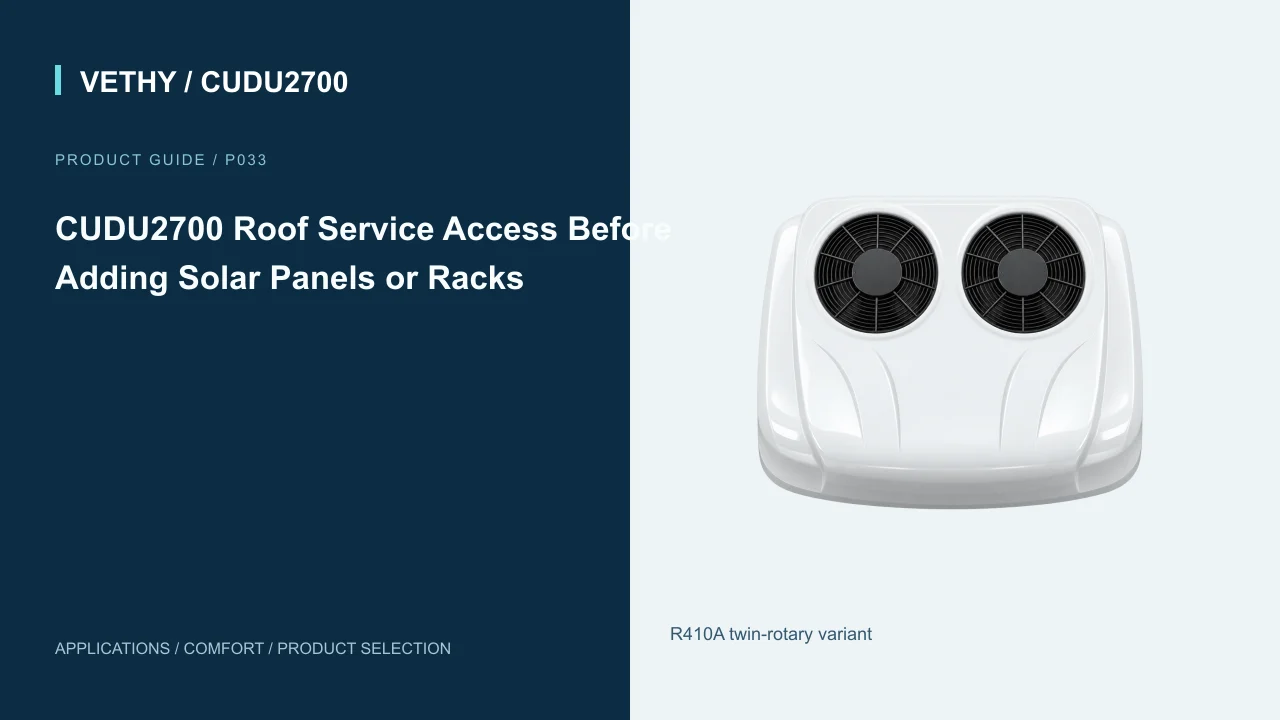
CUDU2700 R410A is a strong rooftop choice for a customer who wants copper refrigerant components, DC inverter twin-rotary cooling and brushless dual condenser fans. When solar equipment or racks will share the roof, the best time to protect that investment is before their positions are fixed. A useful layout should support both normal operation and the people who will inspect and care for the air conditioner later.
This guide addresses service access as a design decision. It does not prescribe a universal clearance or a removal procedure. The objective is to help an owner or upfitter develop a coordinated roof package, so the selected CUDU2700 remains an understandable, maintainable part of the vehicle after additional equipment is installed.
Buy a working roof arrangement, not isolated rectangles
A roof plan often begins as a packing exercise: fit the air conditioner, solar panels, rack feet and other accessories into the available area. Geometric fit is useful, but it does not describe all the functions the roof package must support.
The air conditioner needs an appropriate outdoor environment and a practical service approach under its applicable requirements. Solar equipment and racks have their own installation and use needs. A coordinated design gives each item a real role rather than assigning every remaining gap to the next accessory.
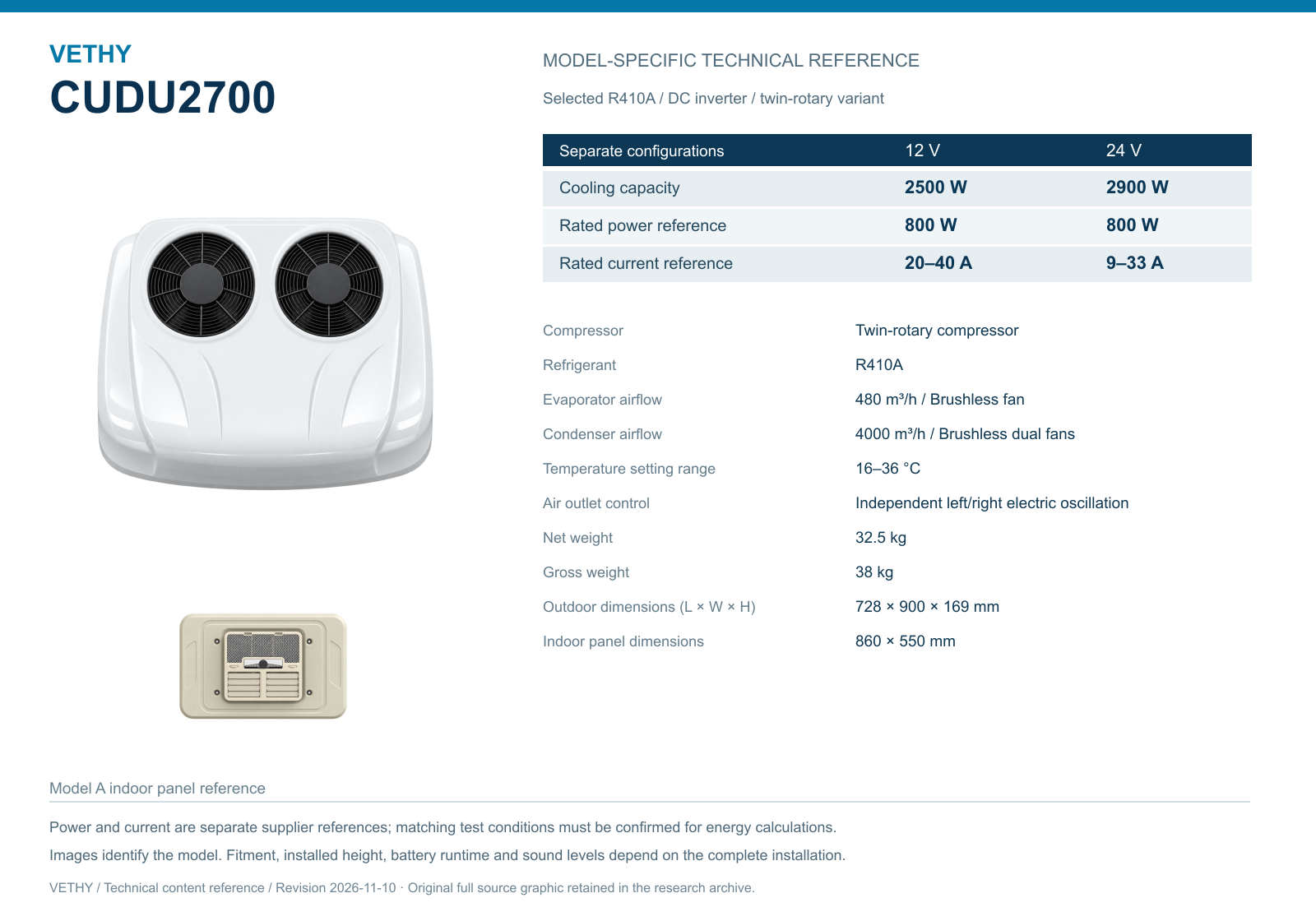
CUDU2700’s outdoor dimensions are 728 × 900 × 169 mm in length, width and height. The footprint makes the unit easy to represent on a drawing, while the low housing profile can be attractive in a tidy roof package. Neither reference independently defines service access.
For the buyer, this is an opportunity to obtain a better offer. Ask the upfitter to show the complete arrangement and explain how ordinary care will be handled. A product with copper evaporator, condenser and piping deserves more than a location that looks convenient on delivery day. The value of the premium unit is supported by a roof design that stays usable throughout ownership, with the practical needs of future workshop visits considered before the available space is consumed.
Identify who will service the equipment and where
The ownership plan may differ between an owner-operator and a fleet. One relies on a particular workshop, while another has several service locations with different facilities. Knowing that context helps the installer discuss a realistic approach instead of assuming the roof will always be easy to reach.
The customer does not need to design the technician’s work. The useful contribution is to explain how the vehicle is normally supported and ask the responsible parties to review the proposed arrangement. Current product instructions and appropriate working methods remain essential.
For a fleet, involve the workshop that will actually receive the trucks. It may notice a practical access issue that is not apparent in a sales drawing. For an individual owner, identify the support route before finalizing a tightly packaged roof. The result should be understandable even when the original installer is not present.
This makes CUDU2700’s recommendation more complete. The customer is choosing its documented inverter twin-rotary and copper package with an ownership path, rather than assuming service questions can always be resolved after racks or solar equipment are bolted down. A clear support arrangement is commercially valuable because it reduces ambiguity about the delivered package and gives the customer a concrete person or process to use when care is required.
A useful service discussion can distinguish routine observation from work that belongs in a properly equipped workshop. The owner may need only a clear way to report a visible change, while the technician needs the correct facilities and information for the actual task. Do not design the package around an assumption that every driver will perform roof work wherever the truck is parked. A practical ownership route respects the operator’s real support arrangements and makes the completed installation easier to understand when technical care is required.
Separate airflow space from a technician’s approach
Space around the unit may serve more than one purpose, but the purposes should not be confused. An outdoor air path concerns normal cooling operation. A service approach concerns how appropriate inspection or maintenance can be carried out. One should not be assumed to prove the other.
CUDU2700 has a copper condenser and brushless dual condenser fans, with 4000 m³/h listed condenser airflow. Those features belong in the operating-layout review. The applicable instructions should also inform the service discussion for the actual installation.
A narrow gap may appear open in a photograph while providing little practical value for a technician’s task. Conversely, a position that seems easy to approach may still need an outdoor airflow review. The installer and service team should consider both rather than describe every unoccupied patch as interchangeable “clearance.”
The buyer can ask for the two functions to be shown or explained plainly. Which surrounding relationships are important during operation? How is the unit approached for appropriate care? A universal dimension invented for a generic article would be less useful than this project-specific review.
The benefit is a more deliberate roof package. The customer can appreciate the documented dual-fan architecture and preserve a practical way to care for it. That supports the reason for selecting CUDU2700 without implying that the fan count or low housing profile removes the need to plan the installation environment.
Review service requirements before freezing solar positions
A solar-equipped vehicle uses the same roof for energy equipment and cooling hardware. The sensible design question is how the complete arrangement will work, including applicable installation and maintenance needs for both systems. This guide does not supply a solar yield calculation or approve a particular combination.
Show the solar equipment at its proposed size and position, together with mounting components and relevant routing. Do not reduce it to an empty outline if the actual fittings occupy additional areas. The service review should consider the working arrangement that will be delivered.
Likewise, show the air conditioner’s full footprint and relevant surroundings. Its 169 mm housing height may help the packaging discussion, but the service team needs more than a side profile. Plan and contextual photographs can explain the relationship more clearly.
For an owner who is still choosing the solar layout, this is the easiest stage to compare alternatives. A modest change in accessory position may preserve a more practical air conditioner arrangement before anything becomes fixed. The customer can weigh that trade-off openly rather than discover during the next workshop visit that an apparently tidy roof is awkward to care for.
CUDU2700 remains a compelling candidate when the owner values its complete cooling package. Coordinating the solar installation protects that choice. The result is a roof designed as a working system, with energy equipment and cabin comfort considered together while each retains its own technical requirements.
Include racks in their loaded working condition
A rack is not always represented accurately by its empty frame. Tools or other carried items can extend into space that looked available on the installation drawing. The roof review should therefore include normal loading and the variations the operator expects to use.
This is particularly important where a service approach depends on an area remaining usable. If the arrangement requires cargo to be handled before a workshop task, that should be understood by the responsible parties rather than discovered unexpectedly. The appropriate work method and cargo arrangement require their own review.
The air conditioner should not dictate an unsafe or impractical load arrangement, and cargo should not be treated as irrelevant to the cooling package. The upfitter can compare plausible layouts while the project is still flexible. The operator can explain which rack functions are essential and where there is room for change.
A clear drawing helps this conversation. Show the rack, typical load, CUDU2700 footprint and vehicle orientation. Pair it with a wider photograph where useful. The goal is not a complex technical report; it is enough context for the people responsible for the installation to discuss the same physical arrangement.
For the buyer, this coordination is a positive part of the product offer. The selected copper and dual-fan package is placed in a setting that respects the truck’s working purpose and future care. The roof remains useful as a whole instead of forcing unrelated equipment into a competition for every remaining gap.
Rack planning also benefits from identifying the person who controls future loading rules. An installer may understand the original arrangement, but loading staff may not have seen that discussion. Give the operator enough context to keep the working configuration recognizable. This does not require turning the air conditioner into a cargo-management system. It means the roof package should not depend on an undocumented memory held by one person. A clear arrangement and a concise record are more robust ways to preserve the intended relationship between working equipment and cooling hardware.
Keep the indoor side in the service-access conversation
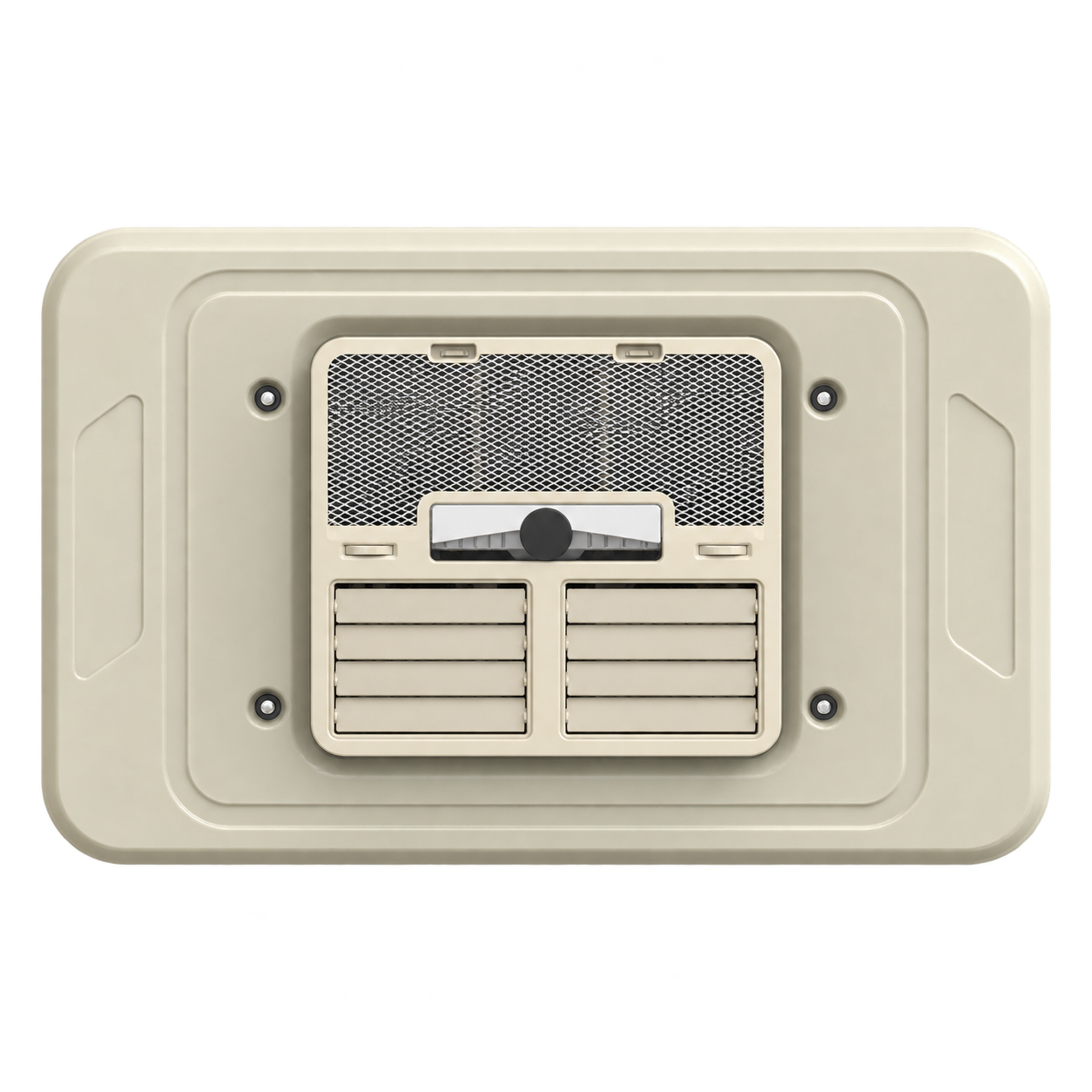
A roof project also creates an indoor arrangement. The Model A panel measures 860 × 550 mm and provides independent left/right electric oscillation. Storage, lighting and curtains should be coordinated with that full panel, not only the minimum listed opening of 380 × 490 mm.
The service approach should account for current instructions and the fitted cabin. A ceiling assembly crowded by later trim or storage can create a different ownership problem even when the outdoor roof remains accessible. The responsible workshop can identify what the actual proposal needs to preserve.
The customer can also assess everyday usefulness. The panel’s adjustable delivery should serve the seat and bunk in their normal arrangement. An interior position chosen solely to simplify the roof packing may defeat the visible comfort benefit that helped justify the model.
This is a good point to connect construction with use. CUDU2700’s inverter twin-rotary package and copper components are the documented hardware story; the panel is the customer’s practical interface. A coordinated layout supports both. The buyer sees why the product belongs in the vehicle and how the installation can remain understandable to the next service team, rather than treating indoor and outdoor work as separate projects with unresolved conflicts between them.
Compare roof options with service consequences visible
A small option review can prevent the first attractive sketch from becoming an unexamined commitment. Each option should show its effect on the roof’s working functions and the cabin below.
| Roof option | Potential benefit | Service question to resolve |
|---|---|---|
| Solar equipment grouped to one side | May leave a clearer relationship elsewhere | Is the actual technician approach workable under current requirements? |
| Rack moved or revised | May reduce crowding near the unit | Does the revised rack still serve normal loading appropriately? |
| Air conditioner position adjusted | May improve the outdoor arrangement | Does the panel still serve the occupied cabin and fit the structure? |
| Accessory scope simplified | May preserve a more practical roof | Does the customer accept the resulting working package? |
These are illustrative choices, not model-specific approvals. The responsible parties should review the actual dimensions and requirements. The table helps the customer see the trade-offs instead of receiving only a recommendation with no explanation.
For CUDU2700, this process supports a confident selection. The buyer wants its documented construction and cooling architecture, and the layout review finds an appropriate place for them. The decision remains positive because the product’s benefits are clear. The implementation remains credible because the proposal explains how the roof will support operation, service and the vehicle’s other needs together.
Record the layout that was actually delivered
Once the arrangement is fitted, retain a record of the completed roof rather than only the original proposal. Identify the exact CUDU2700 R410A voltage version, the positions of neighboring equipment and the agreed service context. Show enough surrounding area for the record to be understandable.
The current technical sheet and unit identity should remain with the project. The selected R410A cooling references are 2500 W at 12V and 2900 W at 24V. This article does not calculate runtime from those references or from separate electrical fields; the power arrangement requires its own vehicle-specific review.
A record of delivered work is useful when responsibility changes. A new workshop can recognize the roof before recommending a modification. A future owner can distinguish the original arrangement from later additions. A fleet can compare another truck with the reviewed example instead of assuming that a similar cab proves an identical installation.
This is not paperwork for its own sake. It preserves the design decisions that made the roof package workable. The customer chose CUDU2700 for a reason, and the installation record helps that reason remain understandable after the initial sales and fitting process is over. It also makes the next technical conversation more efficient because the present arrangement can be compared with a known baseline.
For a staged project, record what is installed now and what is only planned. A drawing containing future solar equipment can otherwise be mistaken for a photograph-equivalent record of the present truck. Mark the stages clearly and revisit the affected layout when the later work becomes concrete. This allows the customer to make progress without pretending every future detail has already been approved. The selected CUDU2700 package remains defined, and the roof proposal can develop through identifiable decisions instead of accumulating assumptions that become difficult to reconstruct.
Treat a later roof addition as a small design change
A new accessory can alter service access without changing the air conditioner itself. The owner should bring proposed positions and working dimensions to the responsible installer before treating an apparently empty area as freely available.
Use the completed layout record as the starting point. Identify which relationship changes and review the affected requirements. A small change may be straightforward, or it may justify a different arrangement. The important point is that the decision is deliberate and traceable.
For solar additions, include mounting and routing rather than only panel area. For rack changes, show the normal load. For lighting or other fittings, show the position in relation to the unit and its service approach. This keeps the discussion concrete and reduces dependence on vague assurances that “there is still some space.”
The product recommendation can remain stable while the vehicle evolves. CUDU2700 may still be the right cooling model; the surrounding package may need refinement. Keeping those questions separate avoids unnecessary confusion and protects the value of the existing investment.
A well-planned premium roof is therefore not frozen forever. It has a clear baseline and a sensible way to review changes. That is especially useful for working vehicles whose equipment needs develop over time. The owner can continue improving the truck while preserving the operating and service relationships that supported the original cooling decision.
An illustrative solar-and-rack project
Consider an owner planning a CUDU2700 R410A installation and a solar upgrade at the same time. The first sketch fills the roof with both systems and retains a small rack behind the cab. Everything appears to fit in a top view.
The installer and service workshop review the sketch before positions are fixed. They ask to see the rack’s normal load and the proposed solar mounting arrangement. They also examine the cabin below, where overhead storage constrains the full 860 × 550 mm panel. The review reveals that the first sketch answered geometric fit more clearly than future service.
Several alternatives are discussed. The owner may revise the rack, change the accessory grouping or compare another unit position, provided the complete installation remains suitable. No universal clearance is invented to force a quick answer. The actual requirements and working context guide the decision.
The owner still has a strong reason to choose CUDU2700: copper refrigerant components, DC inverter twin-rotary architecture, brushless dual condenser fans and independently adjustable cabin delivery. The design work is directed toward realizing those benefits, not finding excuses to abandon the product. The preferred arrangement becomes the one that supports the complete roof and interior package most coherently.
After fitting, the workshop photographs the delivered arrangement and records the selected voltage version. The driver tries the outlet directions from the seat and bunk. The owner receives an understandable package whose features can be used and whose layout can be recognized later.
When another accessory is proposed the following season, the conversation begins from that record. The customer can show what exists and what is intended to change. Technical review can focus on the affected relationship instead of reconstructing the entire installation from memory. This illustrates the practical payoff of considering service early: the premium cooling choice remains useful within a roof that can be cared for and developed intelligently over time.
The owner can also compare complete upfitter offers through this lens. One proposal may include a coordinated roof review and delivered-layout record, while another may describe separate equipment installations with no shared plan. Those are different scopes even if the same air conditioner appears in both. Asking how the combined package will be maintained helps the customer evaluate the practical value of the work being offered. It gives the premium product an appropriate installation context and makes the purchasing decision about a usable vehicle arrangement rather than hardware prices alone.
The customer can therefore ask for both a clear model offer and an understandable roof plan. These are complementary deliverables: one identifies the premium cooling package, while the other explains its practical place among the vehicle’s working equipment.
Questions about service access and shared roof space
Does this guide specify a universal service clearance?
No. Obtain the applicable requirements for the exact product and installation, and review the actual roof arrangement with the responsible parties.
Can solar equipment share the roof with CUDU2700?
A coordinated project may be possible, but the actual layout must resolve each system’s installation, operating and service needs. A simple footprint fit is not complete approval.
Why show the rack loaded?
Normal cargo can occupy space absent from an empty-rack drawing. The working arrangement is the relevant context for a useful review.
Should the indoor panel be included in the access plan?
Yes. Coordinate the full panel, normal cabin fittings and applicable service requirements along with the outdoor assembly.
Choose the premium unit with an ownership-ready roof plan
Recommend CUDU2700 R410A when its documented package suits the customer and the shared roof can be designed coherently. The core product guide explains the model’s construction and comfort proposition.
Bring the solar proposal, normal rack load, roof views and interior panel space to VETHY engineering, or contact VETHY for a configuration-specific discussion. Further roof and cabin topics are linked through the CUDU2700 guide hub.
Product sources
VETHY product recommendation and application analysis. Specification references identify the selected model and voltage. Installation examples are planning examples; measured project results are identified explicitly when available.
Discuss your CUDU2700 application
Send your vehicle, supply voltage, occupied space, parking schedule and installation photographs for a model-specific recommendation.
Prepare your vehicle brief ↗