
VETHY / CUDU2700 / PRODUCT AND APPLICATION GUIDE
CUDU2700 R410A: A Twin-Rotary Rooftop Choice for Defined Cooling Needs
Shortlist the selected CUDU2700 R410A variant when a rooftop project values DC inverter twin-rotary cooling, copper refrigerant components and adjustable cabin delivery. Its 12V version lists 2500 W cooling and its 24V version 2900 W. Keep this configuration distinct from older R134a literature and develop the complete vehicle installation around it.
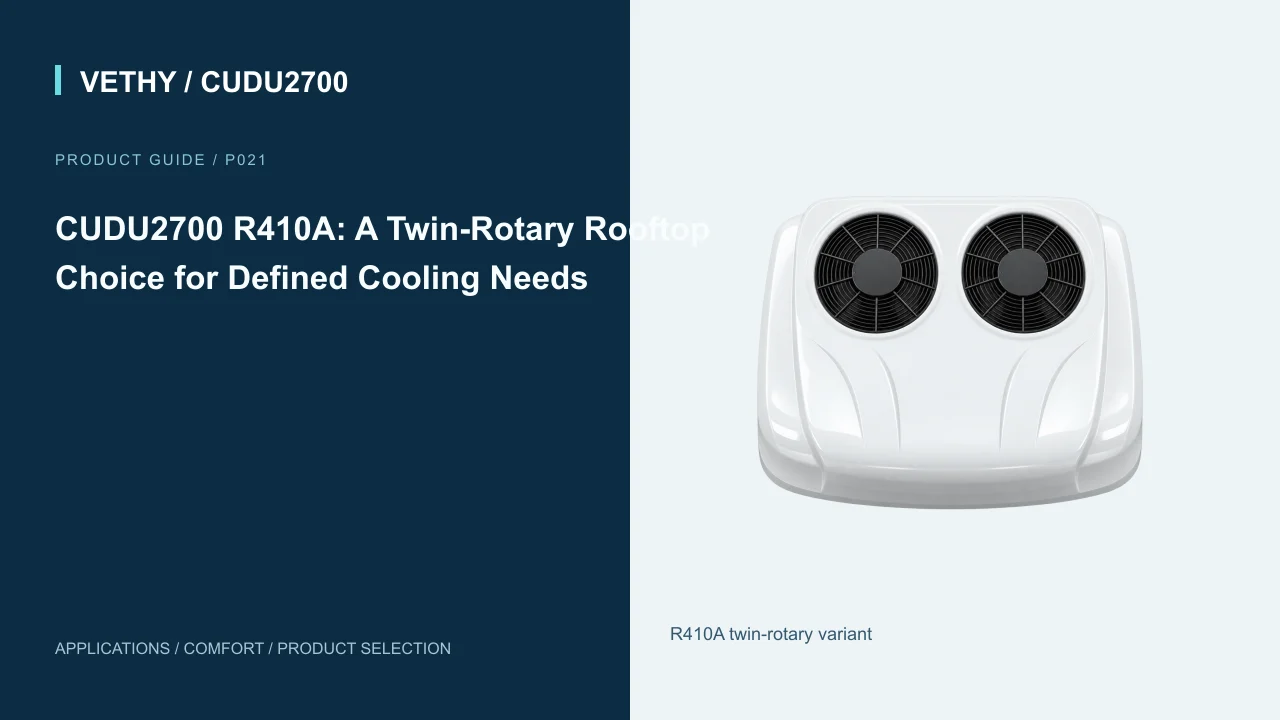
CUDU2700 R410A is a strong rooftop shortlist choice when a buyer wants a specific combination of construction and comfort features: DC inverter twin-rotary cooling, a copper evaporator, copper condenser, copper refrigerant piping, brushless fans and independent left/right electric oscillation. The selected configuration offers a 2500 W cooling reference at 12V or 2900 W at 24V. Its appeal is the package those features create for a defined vehicle, rather than any one number viewed in isolation.
Imagine a fleet engineer choosing equipment for trucks whose drivers spend scheduled breaks in the cab. The engineer wants a product that can be explained clearly to purchasing, installed coherently by the workshop and adjusted easily by the driver. CUDU2700 provides useful answers at each of those stages. This guide follows that decision from the first product comparison to a concrete recommendation, with the current R410A version kept clearly identified throughout.
A defined product instead of a familiar model name
The first reason to pay attention to this CUDU2700 is that its specification is concrete. “Rooftop parking air conditioner” describes a category. “CUDU2700 R410A, DC inverter, twin-rotary” describes a particular candidate within that category. Add the selected voltage and the buying team has a recognizable object to evaluate.
That distinction matters because product families evolve. A document carrying the CUDU2700 name may describe an older R134a configuration with different cooling references. This article covers the selected R410A version: 2500 W at 12V and 2900 W at 24V. Those figures should remain beside the refrigerant and voltage in a serious offer. They prevent a technically meaningful change from disappearing behind a familiar model name.
For the fleet engineer, this is also commercially useful. A precise product identity makes quotations easier to compare and internal approval easier to explain. The team can state which features justify the shortlist and which installation questions remain vehicle-specific. The conversation becomes more productive because everyone is discussing the same equipment.
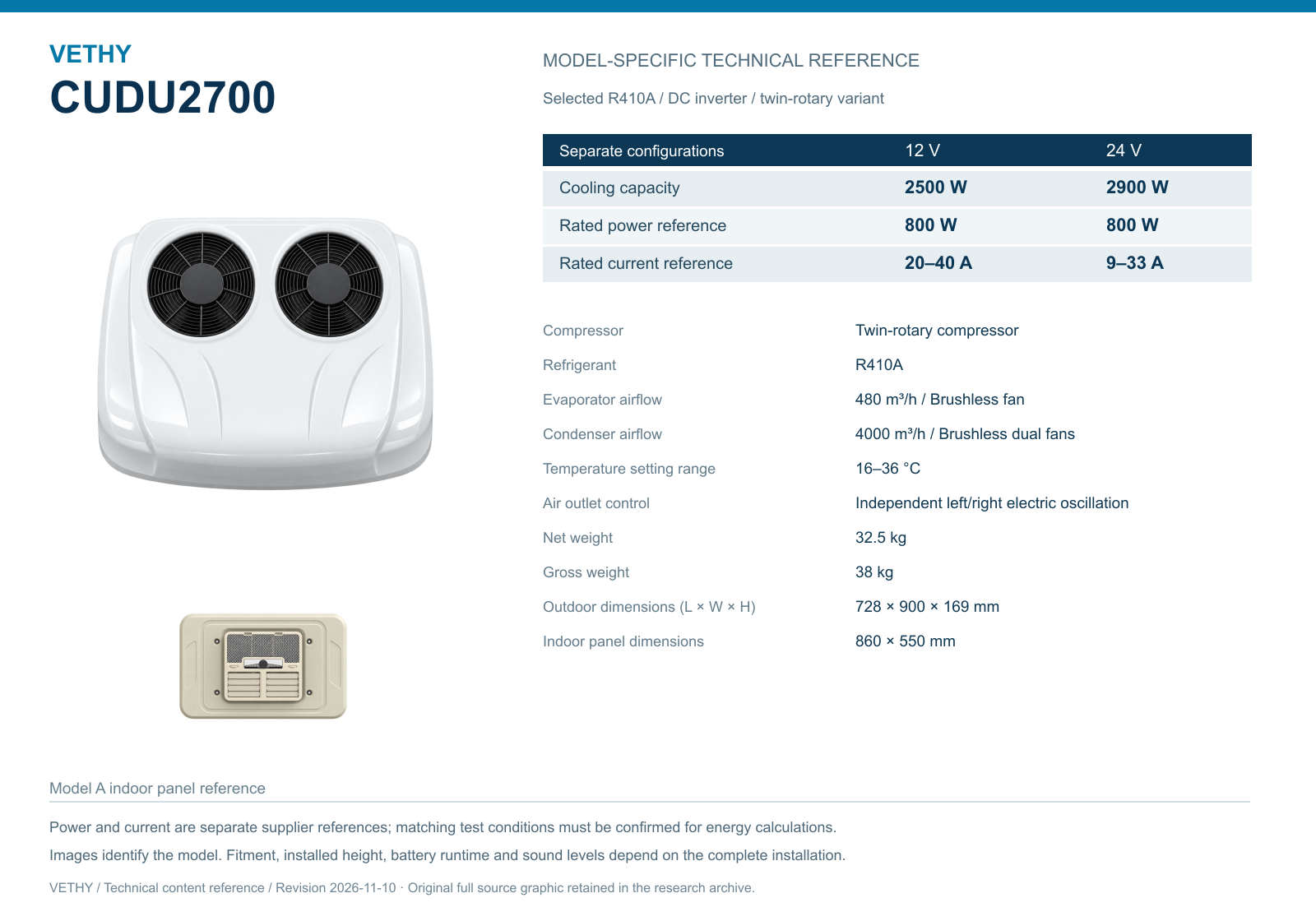
Use the current CUDU2700 specification data as the reference for that identity. The associated technical reference sheet presents the selected configuration visually and can accompany the project discussion.
The product facts that shape the recommendation
| Product element | Selected R410A reference | Why it matters to this buyer |
|---|---|---|
| Cooling versions | 12V: 2500 W; 24V: 2900 W | A clear starting point for the vehicle brief |
| Compressor package | DC inverter, twin-rotary | Relevant to cooling demand that changes during a stop |
| Copper components | Evaporator, condenser, refrigerant piping | A documented construction choice |
| Condenser side | Brushless dual fans; 4000 m³/h airflow reference | A specific outdoor architecture to accommodate on the roof |
| Cabin side | Brushless fan; 480 m³/h airflow reference | Air delivery to organize around occupied positions |
| Outlet control | Independent left/right electric oscillation | Practical adjustment for different parts of the cab |
| Outdoor dimensions | 728 × 900 × 169 mm, length × width × height | Exterior packaging and profile review |
| Indoor panel | 860 × 550 mm | Interior coordination with storage and fittings |
The table shows why the unit is interesting as a complete product. None of its rows independently proves a universal result. Together, they define the hardware and layout opportunities that make CUDU2700 worth evaluating for the fleet engineer’s particular trucks.
Inverter architecture suits a changing comfort task
A parked cab is not a steady thermal environment. At arrival, the roof, windows and trim may be warm from work. Later, solar exposure changes and the driver closes the sleeper curtain. The cooling task evolves even though the vehicle remains in the same place.
DC inverter architecture is relevant because it provides a basis for varying compressor operation as demand changes. The actual response depends on the complete controls and operating conditions. The supplied specification does not establish a particular modulation range or a proprietary control sequence, so those should not be invented for the sales explanation.
The meaningful benefit is that the buyer can evaluate CUDU2700 as a product intended for more than one demand condition. A demonstration should show the beginning of the stop and the settled occupied period. Does the delivered air remain comfortable? Can the driver refine the distribution without repeatedly changing the whole routine? These are useful application questions for an inverter rooftop unit.
For example, the fleet engineer may organize the first trial around a normal delivery day. The driver arrives, prepares the rest area and uses the supplied controls. Observations are made once early and again after the driver has settled. That captures the changing task without pretending that one trial establishes a performance guarantee for every route.
Twin-rotary construction belongs in a smooth-running package
The twin-rotary compressor description is another reason to consider the model. It is part of CUDU2700’s qualitative quiet, energy-conscious positioning, alongside the inverter architecture and brushless fans. Buyers who care about a calm rest environment have a concrete technology combination to investigate rather than only an unsupported adjective.
Smoothness still needs to be understood as an installed experience. The compressor operates in a housing mounted to a vehicle with its own panels, supports and interior trim. The driver hears the entire arrangement. A loose cupboard fitting may be more noticeable at the bunk than it was in the workshop, and a direct air stream can attract attention even when the mechanical installation is orderly.
This does not weaken the recommendation. It identifies how to realize its value. Choose the documented compressor package, install it appropriately and judge the result where the driver actually rests. The first vehicle can establish a useful cabin reference for later installations.
There is no supplied dB result for this guide. Avoid numerical noise claims or assertions that CUDU2700 is quieter than a named competitor. A buyer can still make a sound decision through the product’s documented architecture and a fair, representative demonstration of the finished vehicle.
Copper construction gives the offer a clear material identity
VETHY identifies three copper elements: the evaporator, condenser and refrigerant piping. For a buyer who specifies copper refrigerant components, that is an intelligible construction choice across the named parts of the circuit. It can be written plainly into a product comparison or procurement record.
The scope should remain precise. These descriptions do not establish that every fin, fastener or housing part is copper. They also do not by themselves prove a comparative service life, a corrosion limit or an energy-saving percentage. A material-focused buyer benefits from knowing what is specified, rather than receiving a broader claim that is difficult to interpret.
In the fleet example, the engineer can explain the copper package to purchasing as one reason for selecting a premium product. The workshop then receives the matching reference instead of assuming the material specification from an exterior photograph. If the fleet later reorders, the construction wording remains attached to the model identity.
Copper construction should also have a suitable installation around it. Mechanical support and service practice remain relevant on a moving vehicle. The positive ownership proposition is a defined refrigerant-component package supported by a deliberate installation, with enough information retained to identify it when technical support is needed.
Dual brushless condenser fans make roof planning worthwhile
CUDU2700’s outdoor side includes brushless dual condenser fans and a listed condenser airflow of 4000 m³/h. This is a specific architecture that an upfitter can accommodate rather than an invisible detail left until after accessories are fitted.
The engineer should look at the working roof, including racks, fairings and equipment that may be carried only on some routes. A bare-roof drawing can miss the conditions the air conditioner actually faces. The objective is an appropriate surrounding air path and a practical service approach under the applicable installation requirements.
Consider a truck with a rack behind the cab. The air conditioner may fit geometrically, yet the rack and its cargo still deserve review as part of the outdoor environment. Drawing them together early is simpler than moving fixed equipment after the first comfort complaint. It also gives later workshops a reason to reconsider accessory changes.
Fan count is not a stand-alone capacity comparison. Two fans do not prove that the unit will outperform every single-fan alternative. Their value here is that they form part of a documented condenser package that the buyer wants and can plan around. The cooling references and the installed evaluation remain separate evidence for separate questions.
Independent outlets turn hardware into personal comfort
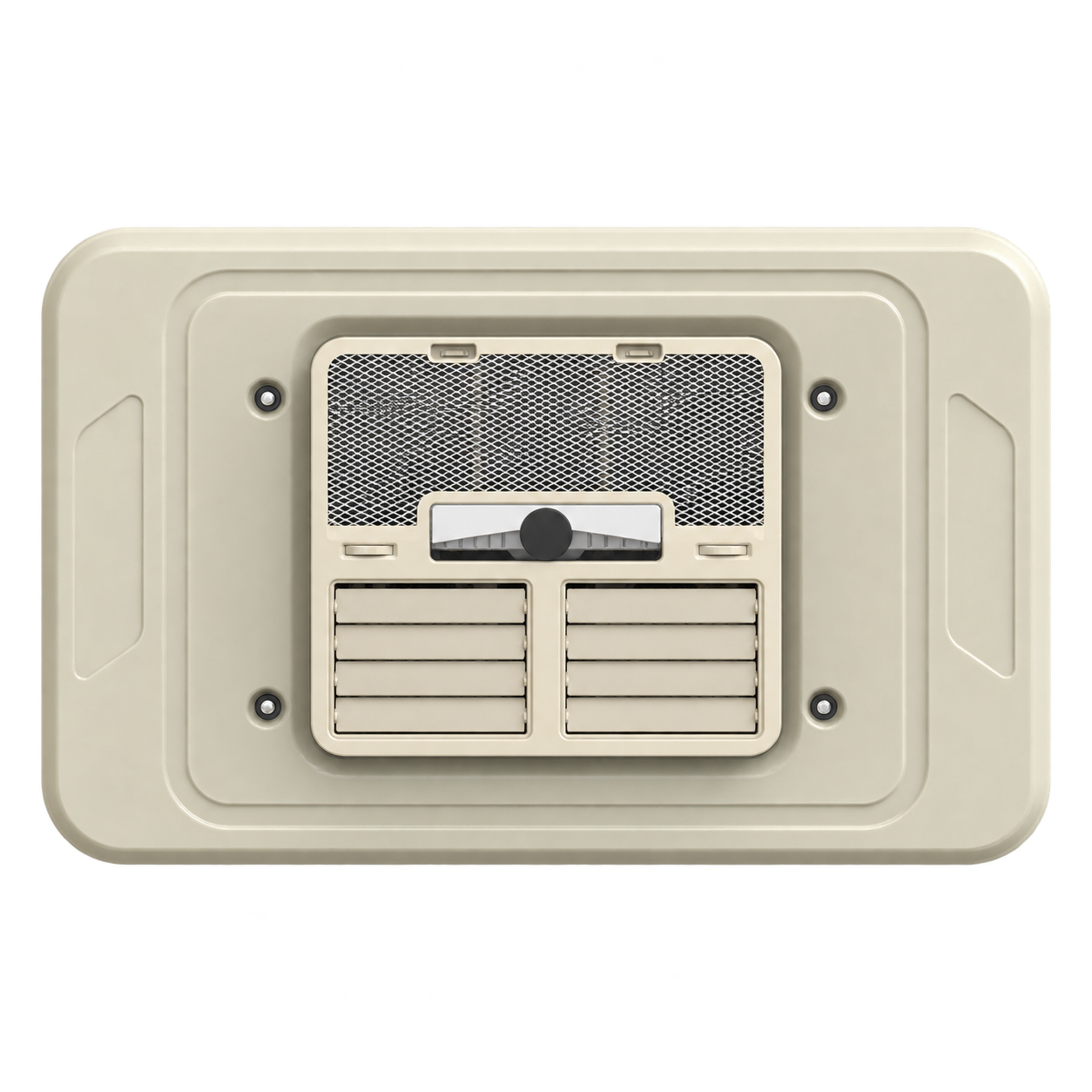
The driver interacts most directly with the Model A panel. Its independent left/right electric oscillation makes air direction a useful adjustment when the seat, bunk and another occupied area have different needs. The 480 m³/h evaporator airflow reference describes the indoor side, while the panel location determines how effectively the available delivery can serve the cab.
A sensible demonstration uses the normal curtain and bedding arrangement. One direction might support circulation toward the resting area while the other avoids a strong stream at the sleeper’s face. The correct arrangement is the one the occupant finds useful within the delivered controls, not a visually symmetrical position chosen only for a photograph.
This feature is especially persuasive because the customer can experience it directly. The engineer does not need to promise a complex automatic zoning system. The supported benefit is independently adjustable air delivery from the left and right sides of the panel. That is different from separate temperature zones or separate refrigeration circuits.
Explain the distinction during handover. Once the driver understands how to refine direction, the panel becomes a practical tool for everyday comfort. The product recommendation then includes something more useful than nominal capacity: a way to adapt the delivered air to the occupied space.
The dimensions connect exterior and interior decisions
The outdoor unit measures 728 × 900 × 169 mm in length, width and height. Its 169 mm housing height is attractive when a vehicle layout places value on a relatively low rooftop profile. Finished vehicle height still depends on the roof and mounting arrangement, so the housing reference should not replace the appropriate completed-vehicle measurement.
Inside, the panel measures 860 × 550 mm. The minimum listed installation opening is 380 × 490 mm. These references serve different purposes. An opening that appears suitable does not independently establish structural compatibility, and a workable exterior position does not guarantee that the indoor panel will clear storage or lights.
The fleet engineer can resolve this by asking for two views of the same proposed installation: a roof plan and an interior layout. Place the full panel outline on the latter. Show the unit footprint and neighboring fittings on the former. The team can then discuss one coordinated arrangement.
The listed net weight is 32.5 kg, which belongs in the mechanical review alongside support and sealing requirements. Treat the product’s packaging advantages as design inputs, then resolve the actual roof implementation with the responsible installer. This is how a promising rooftop choice becomes a reviewable vehicle package.
Electrical selection should support the intended stop
Choose 12V or 24V around the engineered vehicle supply arrangement. The versions have different listed cooling references, and the product name alone is not enough to identify the electrical package. The supplier also lists 800 W rated power, plus current references of 20–40 A at 12V or 9–33 A at 24V, with the current entries labelled at 35°C ambient.
Those power and current fields are separate references whose common operating basis is not established. They should not be combined to calculate an efficiency or a guaranteed rest duration. In particular, selecting a convenient endpoint from a current range does not create a session-energy profile.
Instead, describe the intended stop. How long does the driver expect to occupy the cab? Which other loads normally operate? When is the next charging opportunity? The vehicle’s usable energy and appropriate integration details can then be reviewed in that context.
For the fleet engineer, this produces a more dependable buying discussion. CUDU2700’s energy-conscious architecture remains a positive product attribute, while the power arrangement is designed for the fleet’s real schedule. Representative operating observations can later refine the plan without rewriting the product specification or turning an assumption into a published promise.
A first vehicle can establish the whole package
The most useful pilot deliverable is an understandable reference vehicle. Record the selected R410A version, roof arrangement, panel location and supply architecture. Add the normal occupied position and a brief description of the trial conditions. These details explain what the driver experienced and what later installation teams should compare.
The trial should include comfort feedback rather than only a photograph of a running unit. Ask whether the airflow reaches the intended area, whether it is too direct and whether the resting environment is acceptable once the driver has settled. If a change is made, describe the change and reassess the relevant point.
The objective is to learn enough to approve a practical package. It is not to turn a single vehicle into universal proof of noise, energy or cooling performance. A clear pilot still has strong commercial value: it gives purchasing a concrete offer, the workshop a known arrangement and drivers a useful demonstration.
For broader project preparation, the parking AC technical enquiry guide helps organize the vehicle information. Keep the enquiry focused on the actual fleet group so VETHY and the installer can resolve meaningful details rather than work from a generic truck description.
Three buying situations where the package is persuasive
For an owner-operator, the appeal may be an understandable premium choice. The owner wants to know what the equipment contains and what can be adjusted in daily use. CUDU2700 gives that conversation a clear structure: a named compressor architecture, three documented copper refrigerant components and a cabin panel whose delivery can be demonstrated. The owner can inspect the proposed installation and try the controls without needing to interpret an unexplained list of promotional claims.
For a fleet, the appeal may be a repeatable product identity. A fleet can build an installation reference around the selected voltage and retain it for later purchases. The same copper and airflow descriptions can be carried into the equipment register, while different cab groups receive their own layout review. This supports orderly procurement without pretending that every vehicle is identical.
For an importer or distributor, the appeal may be a product offer with a distinct technical story. The R410A inverter twin-rotary configuration and copper components give the sales team something specific to explain. The dual condenser fans and independent cabin outlets connect that construction story to visible features. The distributor can show the actual model images and technical sheet, then qualify the customer’s vehicle before making an installation promise.
These buyers may choose the same product for different reasons. That is useful, provided the reasons remain connected to the documented package. A strong recommendation names the customer’s priority first and then explains which CUDU2700 features address it. The product does not need to be described as universally best in order to be a convincing choice for a well-defined project.
Compare complete offers at a common scope
A meaningful comparison asks what the customer will receive and use. One quotation may name a rooftop unit only, while another includes a reviewed supply arrangement and a defined installation scope. Their prices cannot be interpreted fairly until those boundaries are clear. For CUDU2700, the exact voltage, R410A configuration and supplied assemblies should be recognizable in the offer.
The physical proposal should be equally readable. Show where the outdoor unit sits and how the panel relates to the occupied cab. If a roof accessory requires coordination, make that part of the discussion before the order is treated as final. These are concrete decisions that affect the usefulness of the product, not administrative details added after the equipment arrives.
The comparison should also distinguish documented features from expected project outcomes. Copper components, fan arrangement and outlet control are product descriptions. Comfortable rest in a particular cab is an application outcome. The first can be specified immediately; the second is supported by sound design and representative evaluation. Keeping them separate allows a buyer to value the hardware confidently while still asking sensible installation questions.
A complete CUDU2700 offer therefore has two strengths. It presents an attractive, clearly identified cooling package, and it explains how that package will belong in the customer’s vehicle. That is the basis for a serious shortlist decision. The customer can understand both the reason for selecting the model and the practical work needed to make it useful, with no need for invented comparison results or an unsupported universal promise.
The project conversation can begin with one representative truck rather than an abstract category. A few clear photographs and a description of the driver’s normal stop often reveal which product features matter most. If the priority is a shared sleeper, panel delivery deserves attention. If the priority is roof packaging, the exterior dimensions become central. If copper components are a purchasing requirement, retain their precise scope. This gives VETHY a useful starting point and lets the buyer see why the same model can be recommended through different, concrete application benefits.
Questions about the selected R410A model
Is this the older CUDU2700 R134a configuration?
No. This guide covers the selected R410A DC inverter twin-rotary version with 2500 W cooling at 12V and 2900 W at 24V. Keep that full identity in the quotation and installation record.
Does the material description mean the entire unit is copper?
The supported description identifies the evaporator, condenser and refrigerant piping as copper. It should not be extended to every fin, housing or other component.
Are independent outlets the same as two temperature zones?
No separate temperature-zone architecture is established here. The documented function is independent left/right electric oscillation for air delivery within the cabin.
Can the published electrical entries guarantee overnight operation?
They cannot establish a universal duration. Match the energy system and operating plan to the selected vehicle and assess representative use before making a project-specific runtime statement.
When this is the right rooftop recommendation
Recommend CUDU2700 R410A when the buyer wants its combined architecture and the vehicle can support a suitable rooftop installation. The best fit is a project that values copper refrigerant components, inverter twin-rotary cooling, dual brushless condenser fans and adjustable cabin delivery as a coherent package.
Send VETHY the selected voltage, vehicle and cab details, roof photographs and intended rest schedule. Use the CUDU2700 guide hub for narrower application topics, then contact VETHY to turn the shortlist into a configuration-specific offer and installation discussion.
Product sources
VETHY product recommendation and application analysis. Specification references identify the selected model and voltage. Installation examples are planning examples; measured project results are identified explicitly when available.
Discuss your CUDU2700 application
Send your vehicle, supply voltage, occupied space, parking schedule and installation photographs for a model-specific recommendation.
Prepare your vehicle brief ↗