
VETHY / CUDU2700 / PRODUCT AND APPLICATION GUIDE
CUDU2700 for Multi-Day Routes: Cooling, Recharging and Operating Reserves
CUDU2700 R410A is worth shortlisting for recurring parked cooling when the premium inverter twin-rotary package is paired with a realistic route energy plan. Map the cooling periods, actual charging opportunities and other loads across successive days. Use the vehicle’s appropriate energy information and representative operation rather than a universal overnight duration promise.
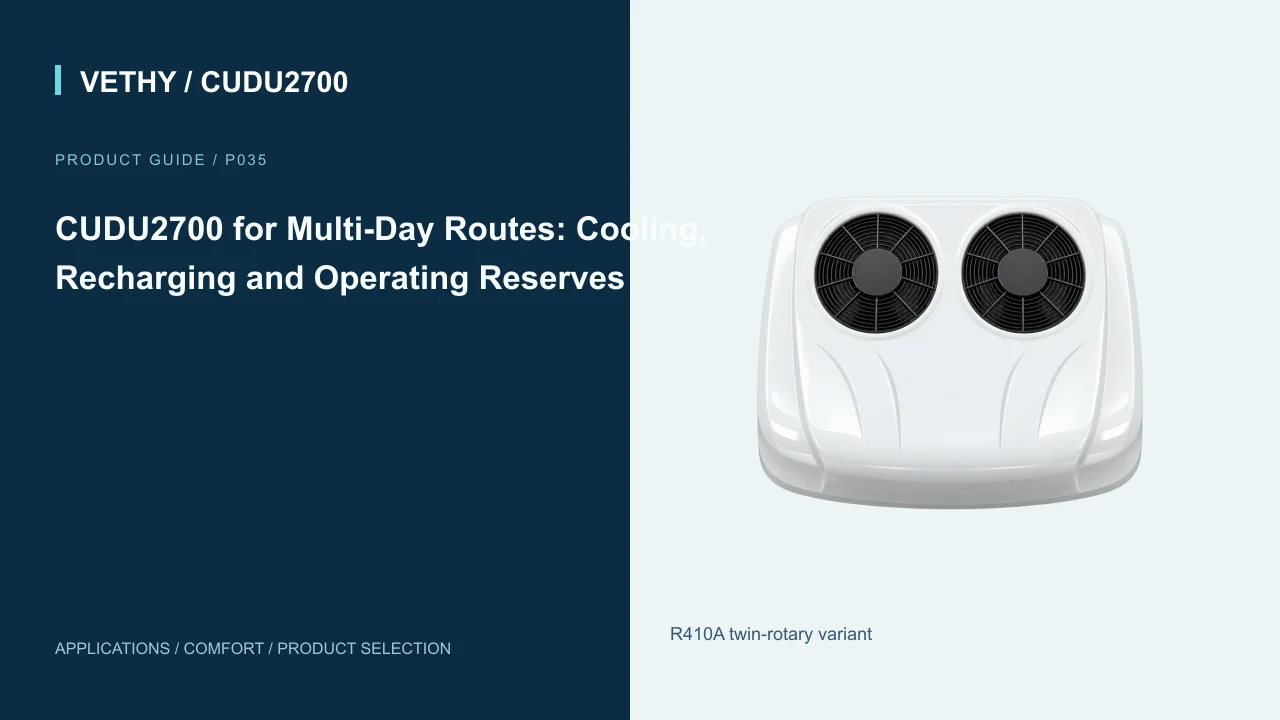
CUDU2700 R410A is an attractive premium cooling candidate for a truck that repeats parked rest periods over several days. Its DC inverter twin-rotary architecture is relevant to changing cabin demand, while copper refrigerant components, brushless fans and independent cabin delivery give the buyer a clearly defined product package. A multi-day route adds one essential question: how does each cooling session fit into the next opportunity to replenish the vehicle’s available energy?
The answer should come from the actual route and supply system, rather than a universal overnight promise. This guide follows the planning logic for recurring work: define the rest periods, make charging opportunities realistic and preserve an understandable operating reserve. The examples are illustrative route decisions, with no calculated runtime derived from unmatched supplier fields.
Treat the route as a repeating cycle
One favorable rest period does not establish that a vehicle can repeat the same experience every day. The initial energy condition may differ, the next drive may be shorter and another parked period may occur sooner than expected. Multi-day planning needs a repeating cycle rather than a single isolated session.
Begin with the normal sequence of driving, parking, cooling and charging. Use the operator’s actual terminology and timetable. The purpose is a recognizable working week, not an elaborate model that nobody uses after installation.
For CUDU2700, this cycle gives the product a concrete role. The customer wants a premium rooftop package that serves recurring comfort, not simply a demonstration that produces cool air once. The inverter twin-rotary feature is relevant to the changing demand within each stop, while the broader route determines how energy is replenished between stops.
This distinction improves the purchase decision. A buyer can shortlist the desired model and then review whether the supporting energy arrangement fits the route. If a supporting change is required, it can be identified in the offer rather than discovered after delivery. The result is a more useful complete package, with the cooling equipment and operating pattern considered together instead of allowing a promising first night to stand in for a multi-day plan.
Write down the real cooling windows
A route may contain a long rest and several shorter occupied stops. The owner should describe which of them actually require cooling and what the driver normally does in the cab. Meal breaks, paperwork and sleeper rest may all be relevant, but their patterns can differ.
Do not assume that only the longest stop matters. A series of shorter sessions may affect the energy available before a later rest. The complete routine should be visible to the person reviewing the supply arrangement.
For an illustrative regional schedule, the driver may use cooling during a midday break and again at an evening stop. The next day may start with a shorter drive than usual. Those details are more useful than the broad request “overnight AC for a week,” because they identify where the system needs to fit the operation.
The customer does not need to predict every minute perfectly. Give the representative pattern and identify common variations. The plan can then address the actual range of work rather than rely on an ideal day that occurs only during the demonstration.
CUDU2700’s adjustable delivery also belongs in the description. The occupied area and curtain arrangement may change between a seated break and sleeper rest. The product offers independent left/right electric oscillation, allowing direction to be refined for those activities. The power plan should support the way the driver intends to use the package, not an artificial routine created only to obtain an attractive duration claim.
Keep usable energy and nominal labels distinct
A battery’s label is not a complete description of what the installed system can appropriately make available for cooling. The actual energy system, its condition and applicable operating limits need review. Other loads and the intended reserve also belong in the plan.
This guide does not specify universal battery limits, protection settings or wiring values. The responsible integration specialist should use the appropriate information for the actual vehicle and selected equipment. The owner contributes the working pattern and existing system details.
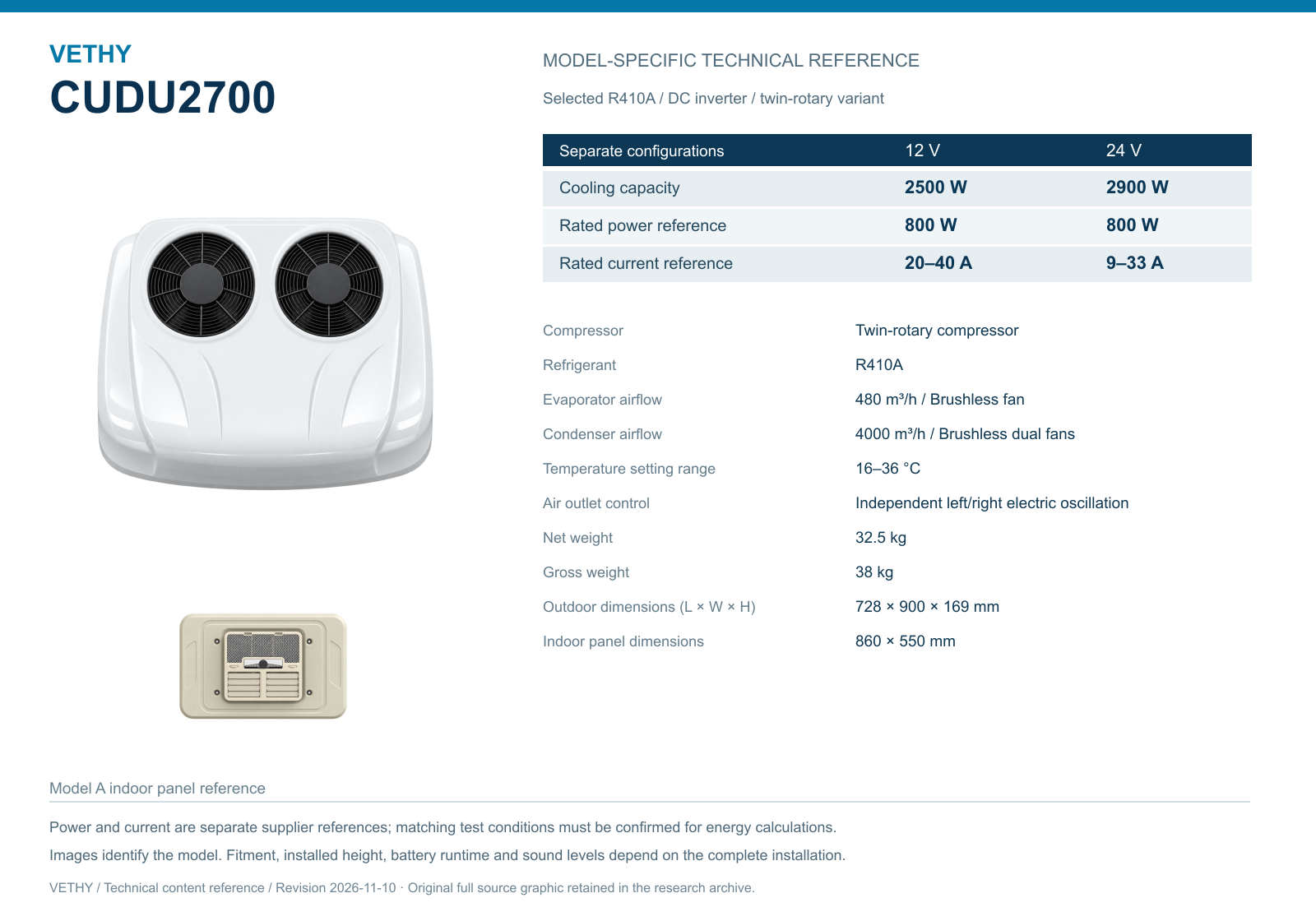
CUDU2700’s source provides separate electrical reference fields: 800 W rated power, plus current references of 20–40 A at 12V or 9–33 A at 24V, with the current entries labelled at 35°C ambient. Their common operating basis is not established. They should not be combined to create a guaranteed multi-day runtime.
The useful outcome is a plan based on the vehicle’s real usable energy and intended loads. A representative operating record can improve that plan after installation. Keep the conditions attached to the result so it remains understandable.
For the buyer, this is an advantage rather than an obstacle. The proposed package can be reviewed before the equipment is committed. The customer understands what is supplied, which supporting work is included and how the route is expected to fit the arrangement. The premium product choice is then supported by a realistic energy system instead of a calculation built around convenient catalogue endpoints.
Make charging opportunities concrete
A route description should distinguish an actual charging opportunity from a hoped-for one. The available method, timing and practical use depend on the vehicle’s energy arrangement and the operator’s work. Those details should be reviewed by the responsible specialist rather than inferred from the presence of a drive period on a schedule.
Ask when the vehicle normally replenishes the energy used during parked cooling. If the answer changes between days, show that. If a particular location or connection is important, explain whether it is reliably part of the routine or only occasionally available.
The owner should not assume that every period of vehicle movement restores the same amount of energy. The guide does not establish a charging rate or architecture for the truck. It asks the customer to bring the actual system information into the project so the appropriate review can be made.
For CUDU2700 selection, this makes the multi-day promise more tangible. The customer can value its inverter twin-rotary package while also seeing how the supporting energy cycle will work. The supplier and installer can identify the scope of any additional arrangement needed.
This is commercially useful when comparing complete offers. One proposal may include an energy-system review while another assumes existing charging is adequate. Those are materially different scopes. A clear discussion lets the buyer judge the product and supporting work fairly, with the repeated route considered rather than only the purchase price of the rooftop unit.
Identify the difficult day, not only the average day
An operating plan can be distorted by using a typical day that excludes common disruptions. The important variation may be a longer occupied stop, a shorter drive or an unavailable charging opportunity. The customer should identify foreseeable changes that materially affect the sequence.
This does not mean planning for every imaginable event. Focus on the variations the operator already recognizes. A route manager or driver can often describe the day that feels most constrained more easily than provide a statistical average.
| Illustrative route variation | Planning question |
|---|---|
| Longer occupied midday wait | Does the session plan include the extra cooling period? |
| Shorter drive before evening rest | How does the actual energy system replenish the reserve? |
| Additional cab devices in use | Which loads share the relevant supply? |
| Different parking exposure | Is the cooling task materially different from the reference? |
| Charging opportunity unavailable | What operating response has the responsible plan defined? |
The table is a conversation aid, not a universal operating rule. The actual response belongs in the vehicle-specific plan.
For a premium CUDU2700 project, addressing the difficult recurring day protects the value of the purchase. The customer is choosing a clear construction and comfort package with a route that can support its intended use. A realistic variation does not have to invalidate the model choice; it should simply be visible enough for the supporting arrangement to be reviewed intelligently.
Preserve a reserve through the appropriate system plan
The customer should understand which energy reserve the vehicle needs and how the cooling arrangement relates to it. The appropriate limits and operating response depend on the actual system. Do not assign undocumented cutoff values or battery-protection functions to the air conditioner.
A reserve discussion is most useful when it is practical. What information does the driver see? What action is expected under the agreed plan? Who should be contacted if the recurring route no longer fits the original assumptions? These points should be explained by the responsible parties using the delivered equipment.
The purpose is an understandable operating arrangement, not a collection of unexplained numbers. Drivers should not need to infer protection behavior from a sales phrase or guess whether a changed route is acceptable because the cabin still feels cool.
CUDU2700’s energy-conscious positioning remains a positive attribute, supported by its inverter and brushless package. It does not replace the reserve plan. The complete recommendation combines the model the customer wants with a supply arrangement and routine that suit the work.
This gives the owner a stronger purchase outcome. The unit is not sold on an unsupported fixed-duration promise. It is offered as a defined premium cooling product within a considered energy cycle, with the driver’s responsibilities and technical support route explained well enough for everyday use.
Let the cabin routine support recurring comfort
Multi-day use should be easy enough to repeat without elaborate preparation. Suitable shades, the normal sleeper curtain and sensible outlet direction can form a practical routine where appropriate for the vehicle and operation. These measures complement the cooling task without establishing a numerical saving.
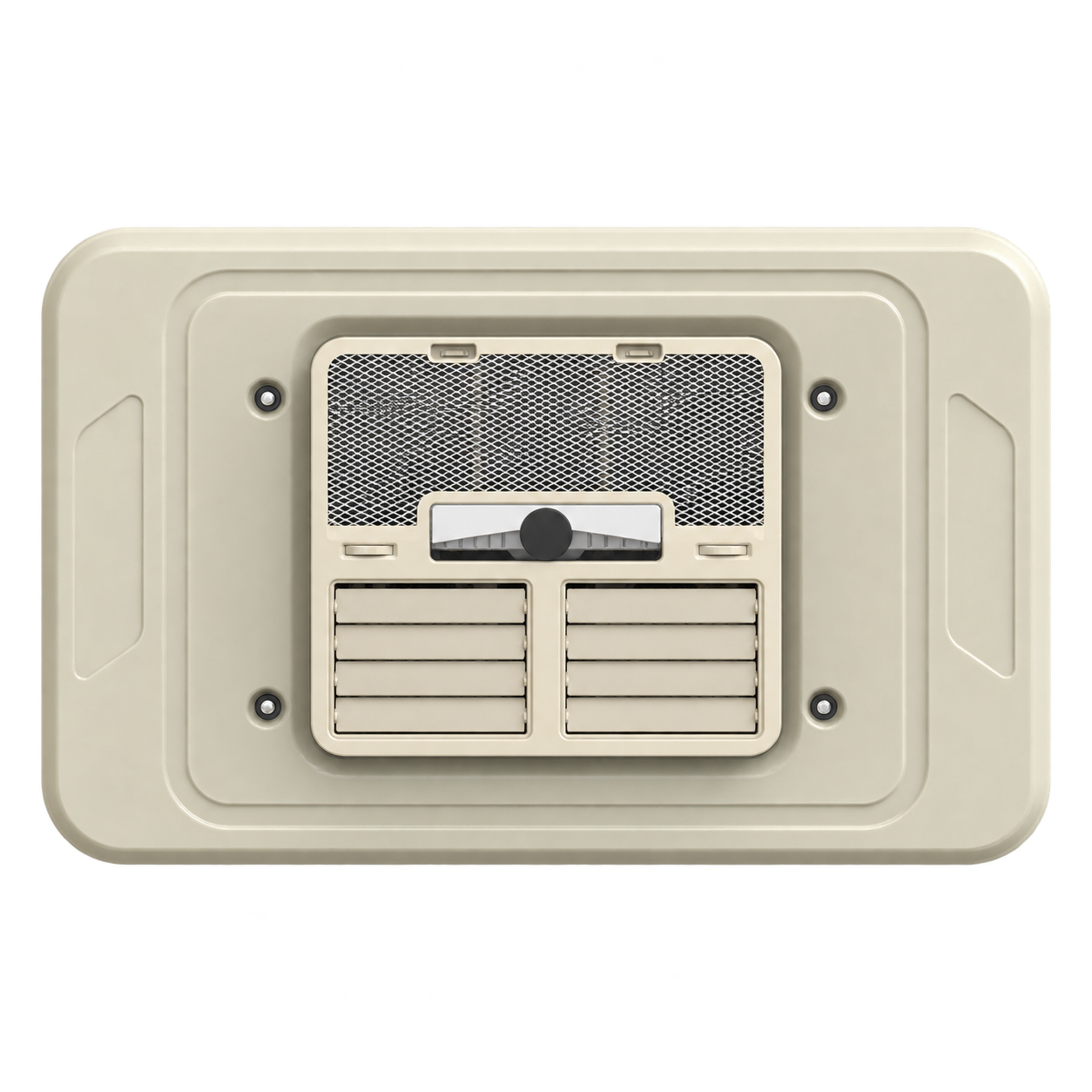
CUDU2700’s Model A panel allows independent left/right electric oscillation. The driver can refine delivery for a seated break or a resting position rather than rely only on temperature-request changes. The listed evaporator airflow is 480 m³/h, while the local experience depends on the furnished cabin.
Demonstrate the ordinary arrangement during handover. The driver should use the controls and understand the documented adjustment. Avoid adding saved profiles, application functions or special modes that have not been established for the delivered configuration.
The benefit is consistency of use, with room for personal preference. A recurring routine helps the customer interpret later observations because the interior setup is recognizable. If a curtain changes or another occupant uses the cab differently, that difference can be described.
For the buyer choosing CUDU2700, this connects premium hardware to daily value. Copper refrigerant components and twin-rotary inverter construction are meaningful purchasing attributes; the adjustable panel turns them into an occupied-space experience the driver can use repeatedly. The model recommendation is stronger when the normal routine is simple, realistic and supported by the actual installation.
Keep the roof configuration stable enough to understand
A multi-day truck may carry different equipment on different routes. Include the normal roof arrangement and material variations in the installation review. The CUDU2700 copper condenser and brushless dual fans need an appropriate outdoor setting under the applicable requirements.
The outdoor dimensions are 728 × 900 × 169 mm, with a listed condenser airflow of 4000 m³/h. Those references identify a specific package to accommodate; they do not establish a universal clearance or approve every rack load.
If roof equipment changes between days, record the relevant difference. A favorable first trial with an empty rack should not be treated as evidence for every loaded configuration. The responsible installer can review the actual arrangement and any proposed modifications.
This continuity helps the energy discussion as well as service. When the product and installation remain identifiable, representative operating information has a clearer context. A later concern can be considered against a known baseline rather than an assumed roof arrangement that no longer exists.
The buyer gets a practical ownership advantage. CUDU2700 remains a defined premium product, while the surrounding vehicle configuration can be managed consciously. The model does not have to be described as universally suitable for every possible working load. It can be recommended confidently for a reviewed package and route, with changes brought back to the appropriate technical conversation.
Build a route record that answers useful questions
The most valuable record is readable and proportionate. Identify the cooling window, the relevant charging opportunity and any material difference from the normal day. If energy is measured, retain the method and scope. Keep descriptive comfort feedback separate from numerical results.
A cropped display image may be insufficient on its own. It can show a number without explaining the time boundary, other loads or initial condition. Pair it with the context needed to understand what it represents.
The driver’s comfort feedback is still valuable even without an energy measurement. For example, noting that the resting zone was comfortable after an outlet adjustment can inform the handover routine. It should not be converted into a claim about electrical savings without evidence for that separate result.
Over several representative days, the owner may gain a better understanding of the actual pattern. Use that information to refine the project-specific plan with the responsible specialist. Do not quietly promote a limited observation into a universal all-week guarantee.
This is a constructive way to support CUDU2700 ownership. The customer can appreciate the model’s documented architecture and improve the operating plan through real use. The product is judged as part of a working route, with observations that technical support can interpret and future purchasing can use responsibly.
Compare complete multi-day offers at the same scope
A useful quotation identifies the exact R410A voltage version, installation scope and supporting energy assumptions. The cooling references are 2500 W for 12V and 2900 W for 24V. The selected version must fit the engineered supply arrangement, not merely the customer’s preferred capacity headline.
The offer should also make clear which route information has been considered. If a supporting charging or storage arrangement is proposed, the customer should understand that scope. If the offer assumes existing equipment is suitable, that assumption should be reviewed rather than hidden.
The core CUDU2700 guide explains the model’s full construction and comfort proposition. The multi-day decision adds a narrower requirement: the complete working cycle should be understandable and repeatable under the intended conditions.
This helps the buyer value a serious package. The cheapest unit-only price may not represent the same scope as an offer that resolves integration and route planning. Conversely, additional work should be explained concretely rather than justified by vague claims of premium service.
CUDU2700 is a persuasive candidate when the customer wants its copper, inverter twin-rotary and brushless package and the supporting system can be planned around the route. The purchasing decision then connects desirable hardware with recurring useful comfort, rather than relying on one optimistic night to represent every day of operation.
An illustrative three-day work pattern
Consider a driver whose first day includes a normal midday break and an evening rest. The second day has a longer wait at a customer site and a shorter subsequent drive. The third returns to the usual pattern. The owner wants the same premium cooling product across those days, but the energy sequence is not identical.
During the enquiry, the owner describes all three patterns. The installer reviews the actual energy system rather than assuming that the first day represents the week. CUDU2700 is selected as the cooling candidate because its construction and comfort features match the customer’s priorities.
The pilot vehicle is fitted with a reviewed roof and panel arrangement. The driver uses independent direction adjustment for the seat and bunk, with ordinary shades and curtains where appropriate. The installation record identifies the exact R410A voltage version and supporting arrangement.
Representative operating information is then gathered with the day’s context retained. A comfortable evening after the ordinary first day is useful feedback. The more constrained second day is considered separately, so the owner does not mistake a changed energy sequence for an unexplained product contradiction.
The responsible plan can be refined around the real pattern. If supporting work or an operating limitation is needed, the customer sees it clearly. The premium unit remains the product being recommended, while the energy cycle is treated as part of the application rather than a promise hidden inside the model name.
This illustrates the practical value of a multi-day view. The buyer can choose CUDU2700 for documented reasons and support it through a route-specific arrangement. Drivers receive an understandable routine, the workshop retains a recognizable configuration and later discussions can begin from actual use instead of an isolated favorable demonstration.
The same reference can guide a later fleet expansion. A second truck may use the same CUDU2700 voltage version while following a different schedule. Bring forward the successful product and installation information, then review the new route rather than copy the duration expectation automatically. The buyer can preserve a preferred premium model without assuming that every operational detail transfers with it. This is a practical form of standardization: the hardware choice remains clear, the integration is identifiable and the route differences receive the attention they need. It supports a more consistent purchasing program while keeping the energy plan tied to the vehicle and work actually being proposed.
A clear route plan can also help a relief driver understand the intended routine. Explain the delivered controls and the agreed operating arrangement in ordinary terms, with technical questions directed to the responsible support route.
Questions about multi-day CUDU2700 use
Does a comfortable first night prove the whole week is covered?
No. Later days may begin with different available energy and charging opportunities. Review the repeating route rather than one isolated session.
Can the supplier current range provide a weekly duration calculation?
The separate current and rated-power fields do not establish a matched session profile. Use vehicle-specific information and representative operation for the energy plan.
Should short occupied stops be included?
Include the cooling periods that form part of normal use. Several shorter sessions may matter to the energy available before a later rest.
Does inverter technology remove the need for reserve planning?
No. It is a useful architecture for changing demand, while the complete energy system and route still require an appropriate plan.
Recommend the cooling package with the repeating route
Choose CUDU2700 R410A when the buyer wants its premium construction and adjustable delivery and can develop a supporting energy cycle for the actual work. Review the difficult recurring day as well as the ordinary one.
Prepare the schedule and vehicle information using the parking AC project guide, then contact VETHY for a configuration-specific discussion. The CUDU2700 application hub connects further topics on session energy, cabin comfort and roof integration.
Product sources
VETHY product recommendation and application analysis. Specification references identify the selected model and voltage. Installation examples are planning examples; measured project results are identified explicitly when available.
Discuss your CUDU2700 application
Send your vehicle, supply voltage, occupied space, parking schedule and installation photographs for a model-specific recommendation.
Prepare your vehicle brief ↗