
VETHY / CUDU2700 / PRODUCT AND APPLICATION GUIDE
Ordering CUDU2700: Keep R410A and R134a Configurations Clearly Identified
Order CUDU2700 as the complete selected R410A configuration, including DC inverter twin-rotary architecture, the required voltage and its matching cooling reference. Keep the copper component and cabin-panel package clear in the offer. Consistent identity through quotation, delivery and service helps the customer receive and support the premium product actually chosen.
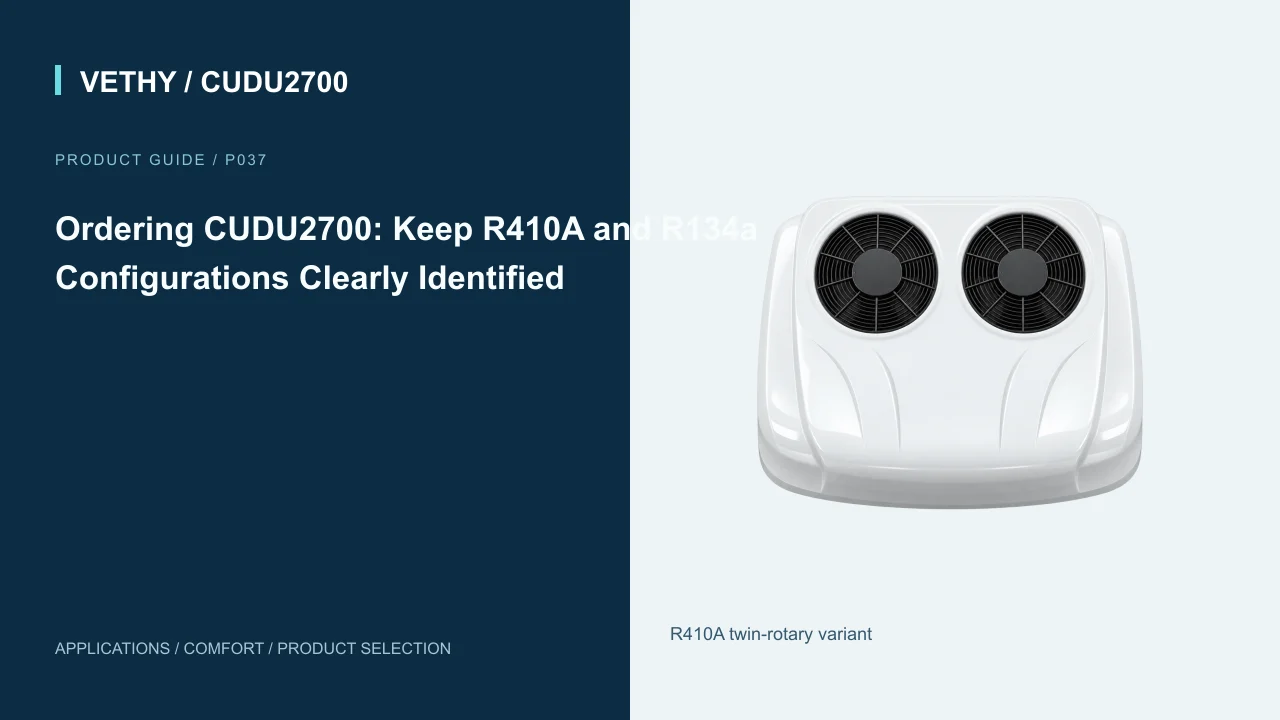
Ordering CUDU2700 is easiest when the product is identified as a configuration, not only a familiar name. The selected current package is CUDU2700 R410A, with DC inverter twin-rotary technology, copper evaporator, copper condenser, copper refrigerant piping and brushless airflow components. Its cooling references are 2500 W at 12V and 2900 W at 24V.
That is a compelling premium offer for a buyer who wants this combination. The task is to keep the combination intact as the enquiry becomes a quotation, purchase order, delivered unit and service record. This guide explains how to do that without confusing older R134a family information with the selected R410A product or implying that the new variant is a refrigerant retrofit for an existing circuit.
Begin with the reason for choosing this configuration
A buyer may be attracted to CUDU2700 for its copper refrigerant components, inverter twin-rotary architecture or dual brushless condenser fans. Another may prioritize the Model A panel’s independent left/right electric oscillation. These are useful purchasing reasons because they describe a particular package rather than a general category of parking air conditioners.
State the priority in the enquiry. The supplier can then connect the recommendation to the documented features and selected voltage. The buyer can recognize whether the offer actually contains the combination that prompted interest.
This is more valuable than beginning with a shortened model nickname and hoping the remaining details will be understood. A familiar name may appear in older documents that describe another configuration. The purchasing reason can be lost if the offer is reduced to that name alone.
The positive objective is to preserve the product’s appeal accurately. The customer should receive the premium construction and cabin features that were demonstrated, with a clear electrical version and installation scope. Good configuration wording therefore supports sales and ownership together. It makes the recommended model easier to explain internally and gives the workshop a concrete identity to work from when the equipment arrives.
Write one complete configuration line
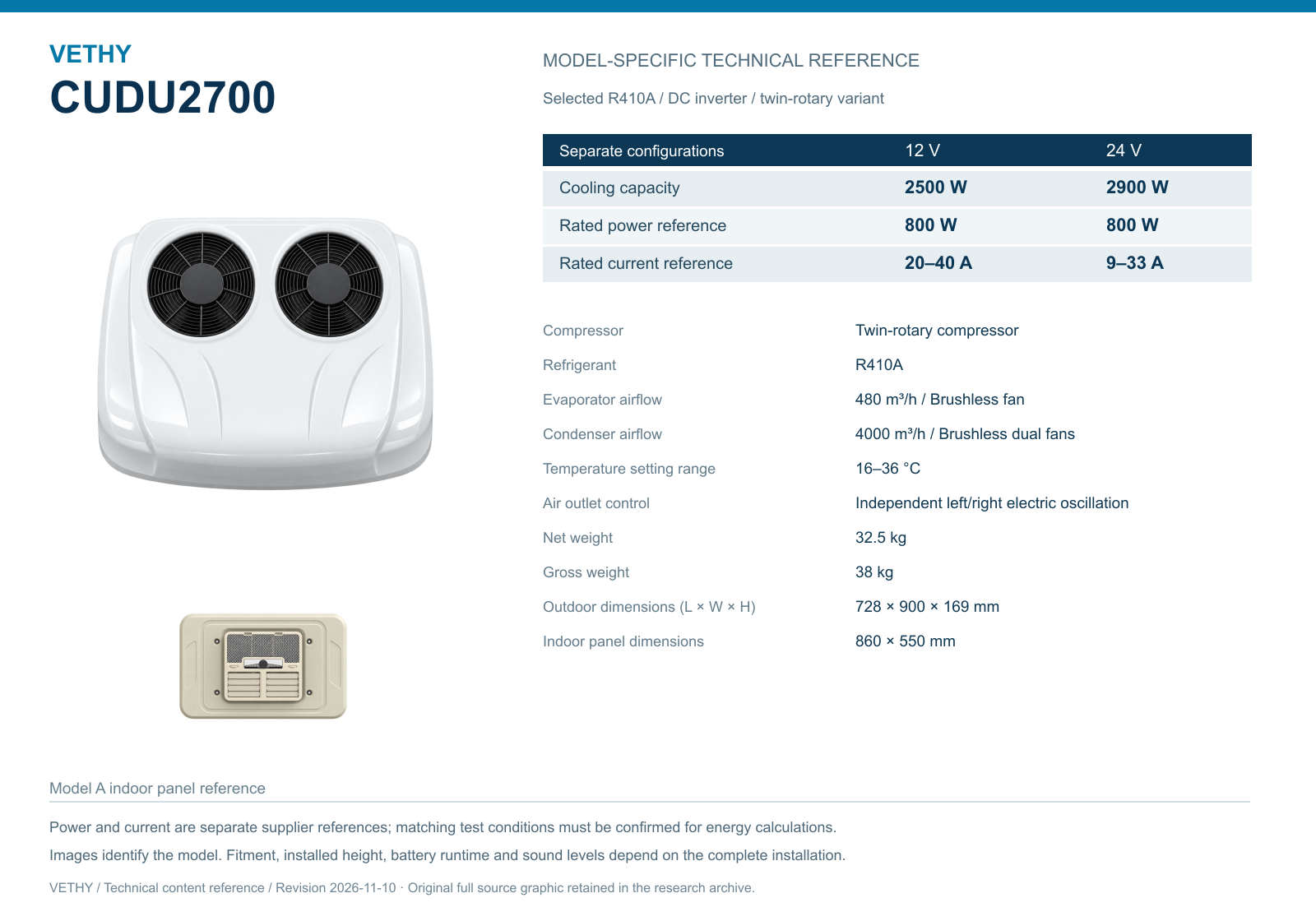
A useful order line names CUDU2700 R410A, DC inverter twin-rotary and the selected nominal voltage, together with the corresponding cooling reference. For a 12V project, the current listed cooling value is 2500 W. For a 24V project, it is 2900 W.
The line can also refer to the matching current specification. It should be concise enough to remain visible in ordinary purchasing documents, while detailed enough to distinguish the intended configuration. The goal is not to paste the whole article into a quotation.
For example, the buyer can ask for the selected voltage version of the R410A twin-rotary model and identify the desired copper and panel package in the attached specification. The supplier can respond against that clear request. Purchasing and the workshop then use the same identity rather than different shortened interpretations.
The current model specification data provides a reference for the selected product. The associated technical reference sheet can support visual review.
A complete line does not answer every installation question. It answers the first one: which product is intended? Once that is settled, the parties can discuss vehicle fit, supply integration and delivery scope without repeatedly reconstructing the variant. This makes the product recommendation concrete and reduces ambiguity as responsibility moves between departments.
Keep refrigerant identity separate from a retrofit promise
The selected model uses R410A. An older family reference may identify R134a and a different specification. Those documents should not be blended into one offer simply because the CUDU2700 name appears in both.
The current R410A configuration is a complete product being recommended for a vehicle project. The guide does not establish that an existing R134a circuit can be converted by changing refrigerant, nor does it authorize transferring service procedures between versions. Questions about existing equipment require their own technical review.
This distinction helps the customer understand what is being purchased. The attractive proposition is the selected R410A inverter twin-rotary package with its documented materials and airflow features. It is not an unspecified modification to equipment the customer already owns.
For a distributor, clear wording also supports accurate training. Sales staff should be able to explain which configuration they are offering without implying that the refrigerant name alone proves a numerical improvement. The unit’s complete architecture is the purchasing subject.
Keeping these boundaries clear strengthens the offer. The customer can appreciate the current product on its own terms, and technical support can begin from the correct identity later. A premium recommendation does not need a retrofit implication or an unsupported comparison with an older version to be persuasive. Its documented construction and useful cabin delivery already provide concrete reasons for interest.
Attach voltage and cooling reference to each other
A model name alone does not identify the electrical version. The selected R410A family has 12V and 24V references, and the proposed version must fit the engineered supply arrangement of the actual vehicle project.
Do not treat the choice as a simple preference for the larger cooling headline. The source lists 2500 W cooling at 12V and 2900 W at 24V. The responsible integration review should establish the appropriate version and supporting supply work for the vehicle.
This relationship should remain visible in documents. If a quotation changes voltage, the corresponding cooling reference and installation discussion need to be reviewed together. A clerical substitution can otherwise leave a proposal containing details from two different versions.
The supplier’s electrical input references should also keep their labels. Rated power is listed at 800 W, while current references are 20–40 A at 12V and 9–33 A at 24V, with the current entries labelled at 35°C ambient. A common operating basis is not established, so these fields should not be rearranged into an efficiency or runtime claim during order preparation.
For the buyer, this is a practical way to compare complete offers. The intended unit is clear, the vehicle integration has a recognizable scope and the supporting data are not silently transformed into a promise the source does not make.
Use the images that belong to the offer
Product images help a customer recognize the rooftop housing and cabin panel, but an image alone may not distinguish every configuration. Pair the matching CUDU2700 visuals with a clear R410A voltage label and the current reference sheet.
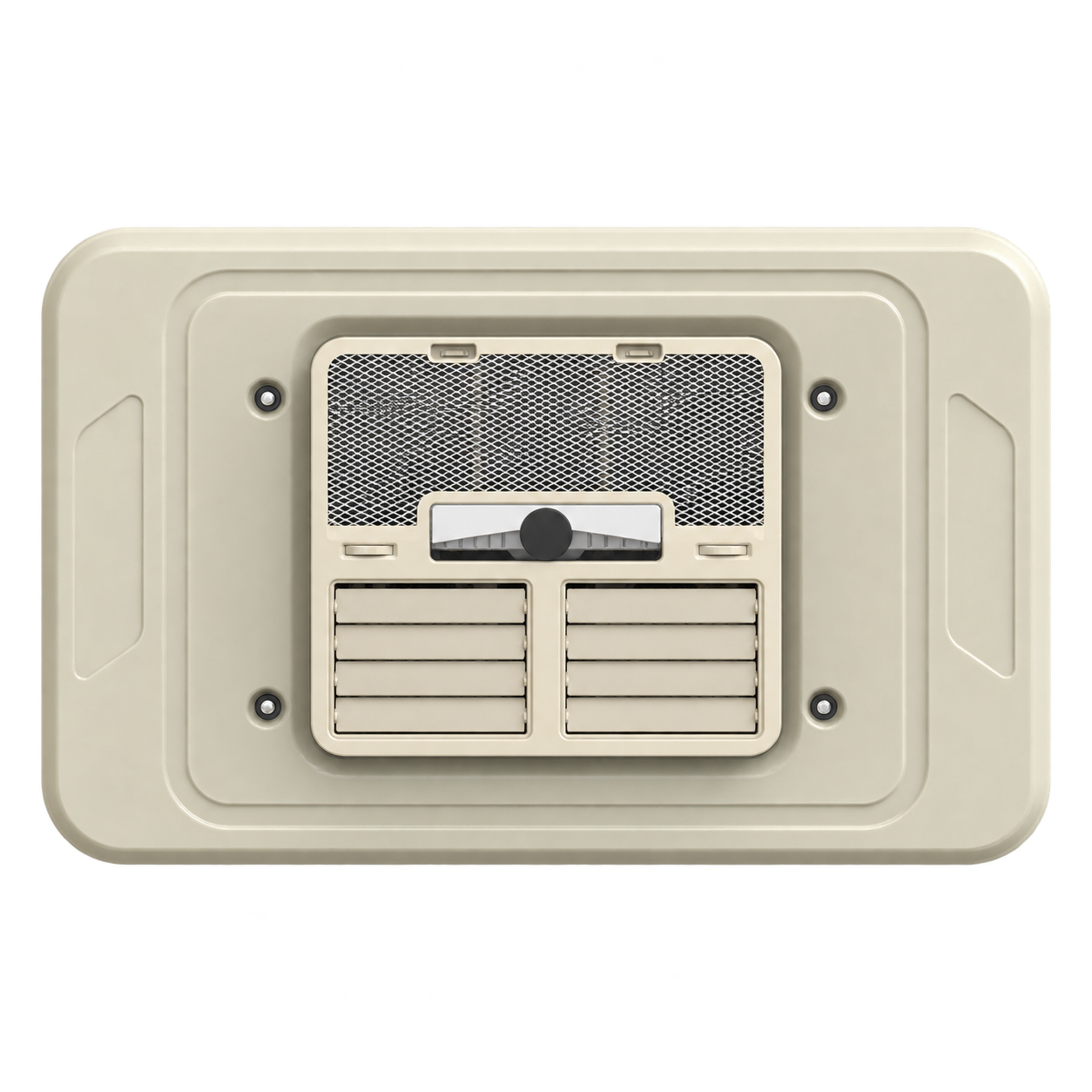
The indoor image should show the Model A panel being offered. Its documented dimensions are 860 × 550 mm, with independent left/right electric oscillation. The outdoor dimensions are 728 × 900 × 169 mm in length, width and height. These details help the customer connect the visual presentation to the vehicle proposal.
Do not rely on an older graphic carrying different data while verbally promising the current version. Even when the intention is honest, the customer is left with conflicting information that may circulate internally. A consistent visual pack makes the offer easier to understand and approve.
Avoid fabricated internal cutaways or unsupported construction illustrations. The source establishes copper evaporator, condenser and piping, but it does not establish every hidden detail that an invented rendering might imply. The real product images and precise component description are sufficient for a credible presentation.
This is especially useful for importers whose customers may forward a product card without the original sales conversation. The label, photograph and current technical reference should tell one coherent story about the configuration actually being offered.
If a document is updated during the enquiry, identify which version the customer should use for the current offer. Do not leave two conflicting graphics circulating without explanation. The earlier file can be recognized as historical, while the current reference supports the proposed configuration. This is especially useful when several departments retain copies independently. A clear update gives the buyer a stable basis for approval and prevents an outdated visual from quietly becoming the specification attached to a later order.
Separate the product identity from the installation scope
Two offers can name the same unit while including different work. One may be a product-only quotation; another may include a vehicle survey, mounting or supply integration. The buyer should understand those boundaries before comparing the total prices as equivalent packages.
For CUDU2700, the dimensional references can support a preliminary vehicle discussion. The minimum listed opening is 380 × 490 mm, while the full indoor panel and outdoor footprint serve different layout questions. None independently establishes universal compatibility with an existing roof.
The customer should provide the vehicle and relevant photographs so the responsible installer can review the actual project. If the proposal assumes an existing suitable electrical arrangement or roof preparation, make that assumption visible. The attractive product features should not hide unresolved implementation work.
This clarity benefits the supplier as well. The offer can explain the premium model’s construction and comfort proposition while identifying what additional vehicle information is required. The customer receives a reviewable package instead of a mixture of hardware description and implied services.
The ordering decision then has two connected parts: the selected R410A configuration and the scope that makes it useful in the vehicle. Keeping them readable helps the buyer preserve the model choice through procurement without assuming the product name itself includes every installation task.
Preserve the material and airflow package in the reference
The selected construction description names copper evaporator, copper condenser and copper refrigerant piping. Keep those names rather than expanding “all copper” to every fin, housing or fastener. Precise scope is easier to retain through the purchasing chain.
The outdoor airflow package includes brushless dual condenser fans and a listed condenser airflow of 4000 m³/h. The cabin-side reference is a brushless evaporator fan with 480 m³/h airflow. These are distinct parts of the same model, not interchangeable headline figures.
| Configuration element | Keep explicit in the offer |
|---|---|
| Refrigerant | R410A for the selected current variant |
| Compressor package | DC inverter, twin-rotary |
| Voltage and cooling | The selected 12V/2500 W or 24V/2900 W reference |
| Copper scope | Evaporator, condenser and refrigerant piping |
| Outdoor fans | Brushless dual condenser fans |
| Cabin panel | Model A with independent left/right electric oscillation |
The table can be a concise attachment or product card reference. It gives the buyer a clear description of the package that prompted the recommendation.
This does not replace the delivered unit identification or applicable technical information. It provides a common starting point, so a later question about materials or panel function can be answered against the intended configuration rather than a general memory that the buyer wanted a premium CUDU2700.
The copper scope is a good example of why concise detail matters. A customer who heard only an expansive slogan may expect more than the named component specification establishes. Writing evaporator, condenser and refrigerant piping makes the purchasing preference concrete and reviewable. The same principle applies to independent outlet direction: explain the actual documented function rather than substitute a broad climate-control label. The customer can then approve the real feature package confidently and recognize it when the project moves from presentation to delivered equipment.
Check delivery against the agreed configuration
When the equipment arrives, compare its identity and supplied information with the agreed offer. The responsible people should be able to identify the selected model and voltage without guessing from exterior appearance. Retain the relevant unit label and matching documentation in the project record.
If there is a discrepancy, describe it clearly and resolve it before assuming that the difference is acceptable. The issue may concern a document, a visual or the actual configuration. Those are different situations and should not be blurred together.
A buyer who chose CUDU2700 for copper components or the Model A panel should not have to reconstruct that reason after delivery. The record should already connect the purchasing decision with the expected package. This makes the comparison straightforward and gives the supplier a concrete question to address.
The objective is a smooth transition into installation, not an adversarial inspection ritual. Clear identity helps both sides. The supplier can confirm what was delivered, the buyer can recognize the product ordered and the workshop can use the correct technical information.
For a premium product program, this is part of good service. The customer receives the configuration that was recommended and can proceed to the vehicle work with the essential details settled. The documented features then become real equipment in a known project rather than attractive claims attached to an uncertain model variant.
Keep the service record linked to the delivered unit
The source lists R410A refrigerant, 580 ± 10 g charge reference and POE68 refrigeration oil for the selected configuration. These are technical identifiers, not instructions for untrained refrigerant work. Qualified support should use the correct current information for the actual delivered unit.
Retain the exact configuration and installation record together. A workshop supporting several models or older variants should not need to choose a service reference from a photograph alone. The unit identity and relevant documents provide a better starting point.
The record can also preserve the roof and panel arrangement. CUDU2700’s dual condenser fans need an appropriate surrounding layout, while the independent cabin delivery depends on the furnished interior. Later accessory or storage changes may affect those relationships even though the unit remains the same model.
This continuity supports the customer’s original purchase. The buyer chose a defined copper and inverter twin-rotary package. Correct identification helps that package remain understandable through service, driver changes and vehicle modifications.
The recommendation is therefore more than an accurate sales sentence. It carries a consistent product identity into ownership. The customer can ask a useful technical question, the support team can identify the equipment and the next workshop can distinguish the delivered configuration from an older family reference without inventing hidden details or assuming refrigerant interchangeability.
A useful support enquiry can include the delivered unit identity, the current installation photographs and a plain description of the concern. That information is more valuable than forwarding several old brochures and asking which one might apply. The customer does not need to resolve the technical issue before contacting support. The purpose of configuration clarity is to make that conversation easier, so the responsible team can begin with the right product and assess the actual situation rather than spend the first exchange reconstructing the variant.
Handle reorders as a confirmation of scope
A repeat order is an opportunity to preserve a successful product choice while checking whether anything relevant has changed. The buyer may want the same CUDU2700 configuration, but the next vehicle could have a different roof, cabin or supply arrangement.
Begin with the earlier full configuration line and matching reference. Confirm that the current offer describes the intended R410A voltage version and feature package. If a difference is proposed, make it visible and review it against the purchasing reason rather than treating it as an unimportant substitution.
The vehicle scope deserves the same attention. A successful panel location in one cab does not automatically prove the next interior is identical. A rack added to a later truck may change the outdoor arrangement. The model can remain preferred while those differences are reviewed deliberately.
This is practical standardization. The premium hardware choice stays clear, and the implementation follows a recognizable reference with material exceptions addressed. A fleet or importer can build on successful experience without freezing every assumption from the first order forever.
The value of CUDU2700’s documented package becomes easier to maintain through this approach. Copper components, inverter twin-rotary architecture, brushless fans and adjustable delivery remain identifiable reasons for the choice. The customer does not need to rely on a short name that could gradually lose its original technical meaning as documents and personnel change.
An illustrative distributor order from enquiry to reorder
Consider a distributor preparing a premium rooftop offer for two vehicle customers. Both like the copper construction and independent cabin delivery, but one project uses a reviewed 12V supply arrangement and the other requires a 24V version. The distributor keeps the R410A identity and corresponding cooling reference explicit for each offer.
The product card uses the matching outdoor and indoor photographs with the current technical sheet. The salesperson explains DC inverter twin-rotary architecture and the named copper components without claiming a numerical refrigerant advantage. The customers can understand the same premium package while seeing the electrical version relevant to their own projects.
Before installation, the delivered identity is compared with each accepted offer. The workshop receives the correct reference and the actual vehicle information. Product selection and installation scope remain connected but readable as separate parts of the project.
Later, a customer requests another unit. The distributor begins from the full earlier configuration instead of a message saying only “send the same CUDU.” The new vehicle’s roof and cabin differences are identified, and the intended product package is confirmed. The customer keeps the preferred model while the new implementation receives an appropriate review.
This example shows why configuration clarity is commercially useful. It makes the attractive product easier to sell, easier to purchase and easier to support. The procedure does not replace the model’s benefits; it protects the connection between those benefits and the equipment the customer actually receives.
The core CUDU2700 guide explains the broader recommendation. This ordering article adds a specific ownership benefit: the premium package remains recognizable from the first enquiry through later purchases, with current R410A information kept distinct from older family references.
Questions about R410A and R134a configuration identity
Can a model name alone identify the current version?
It may be insufficient where family documents describe different configurations. Keep R410A, the selected voltage and the matching current reference explicit in the offer.
Does this guide recommend converting an older R134a circuit?
No retrofit is established. This guide concerns ordering the selected complete R410A product; existing-equipment questions require their own technical review.
Which cooling values belong to the selected current variant?
The references are 2500 W at 12V and 2900 W at 24V. Keep each attached to the correct electrical version.
Should a reorder reuse only an old quotation nickname?
Use the full configuration and review relevant changes in the current product offer and next vehicle. A clear reference supports a consistent repeat purchase.
Order the premium package the customer actually wants
Recommend CUDU2700 R410A when its documented construction and cabin features suit the project. Keep that exact identity intact through the quotation, delivery and service record so the purchasing reason remains connected to the supplied equipment.
Share the selected voltage and vehicle information with VETHY, using the parking AC technical enquiry guide to organize the project. Further configuration and application topics are available through the CUDU2700 guide hub.
Product sources
VETHY product recommendation and application analysis. Specification references identify the selected model and voltage. Installation examples are planning examples; measured project results are identified explicitly when available.
Discuss your CUDU2700 application
Send your vehicle, supply voltage, occupied space, parking schedule and installation photographs for a model-specific recommendation.
Prepare your vehicle brief ↗