
VETHY / CUDU2700 / PRODUCT AND APPLICATION GUIDE
CUDU2700 for Dusty Work Sites: Airflow Care and Daily Availability
CUDU2700 R410A is worth considering for work-site cooling when its premium copper, inverter twin-rotary and brushless package is paired with appropriate installation and care. Describe the real exposure, preserve useful cabin and outdoor air paths, and establish a practical route from driver observation to qualified review using current product guidance.
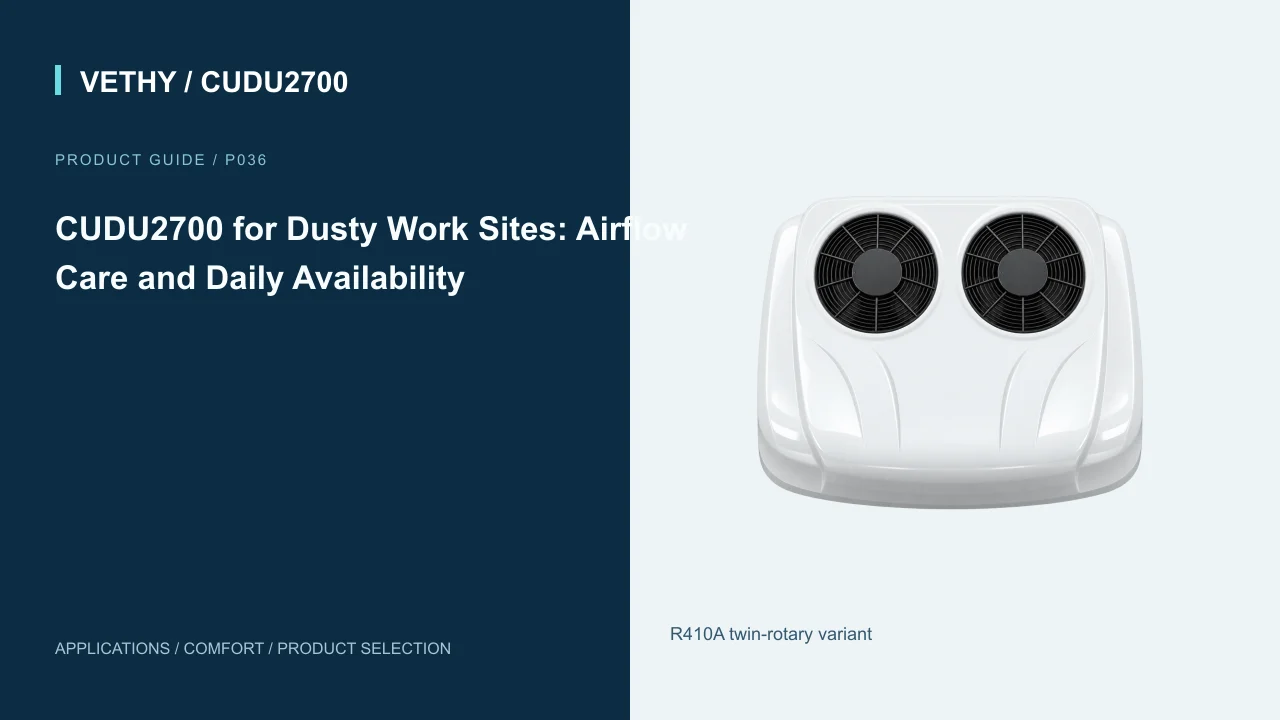
CUDU2700 R410A can be an attractive premium cooling choice for a work truck that spends parked time at dusty yards or sites, provided the installation and care routine reflect that environment. Its documented copper refrigerant components, DC inverter twin-rotary architecture and brushless airflow hardware give the buyer a defined product package. Protecting useful airflow is part of making that package available for everyday work.
This guide is for an operator who wants comfortable breaks without treating dust exposure as an afterthought. It does not claim a dust-proof rating, prescribe an undocumented cleaning method or promise a universal maintenance interval. The practical recommendation is to combine the selected CUDU2700 with an appropriate air-path layout, a realistic workshop care arrangement and driver observations that can lead to timely action.
Describe the site work that creates the exposure
Dusty work is not one uniform application. A truck may wait near material handling, move between paved and unpaved areas or park in a yard only briefly. The owner should describe when and where the exposure occurs, especially if it coincides with the parked cooling period.
This context helps the supplier and installer discuss the actual job. A clean showroom demonstration does not represent every working site, and a broad phrase such as “construction truck” may hide important differences in use. Photographs of the normal parking position and roof arrangement can be useful.
For CUDU2700, the buyer has a concrete package to consider: copper evaporator, condenser and refrigerant piping, brushless evaporator fan and dual brushless condenser fans. These attributes make the product interesting, but they do not remove the environment from the application decision.
A strong enquiry therefore connects desirable hardware with recognizable exposure. Explain the normal rest activities, whether doors are frequently opened and how workshop support is arranged. The result is a more useful product conversation than asking for an air conditioner that simply “does not need attention in dust.” The customer can choose the premium construction package while planning appropriate ownership around the work the truck actually performs.
Understand which airflow belongs to which side
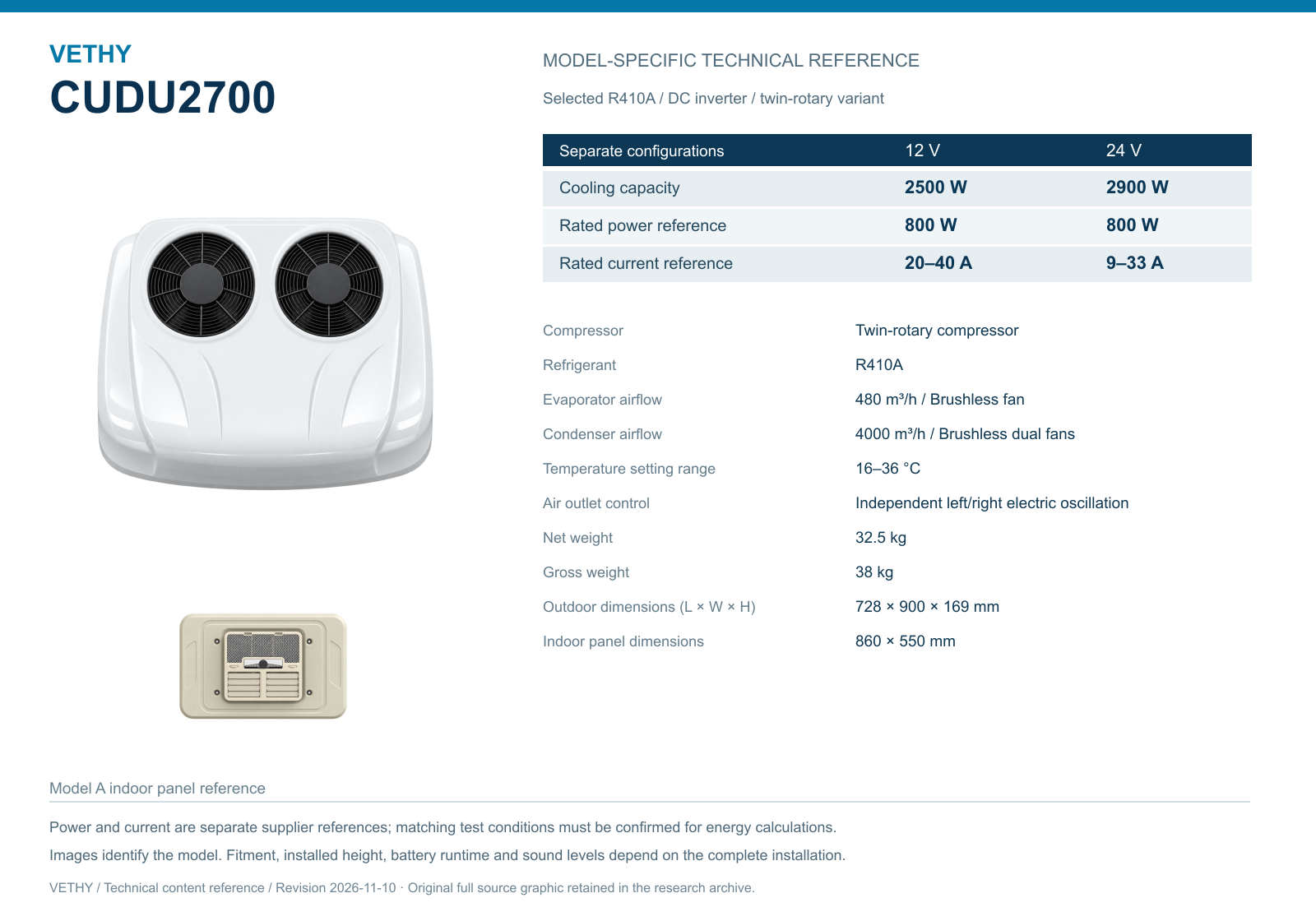
CUDU2700 lists evaporator airflow at 480 m³/h and condenser airflow at 4000 m³/h. The first belongs to the cabin-side package; the second belongs to the outdoor condenser arrangement. Keeping them distinct helps the operator understand why both interior and exterior surroundings matter.
The indoor air path should coexist with normal storage, curtains and occupied positions. The outdoor unit should have an appropriate environment under the applicable installation requirements, including racks and equipment in their working state. A large airflow reference does not prove that surrounding obstructions or environmental accumulation are irrelevant.
For a dusty site, this distinction also supports clear reporting. A driver describing weak useful delivery at the bunk is reporting a different observation from visible accumulation around the rooftop unit. Neither observation alone diagnoses the cause, but the location helps the workshop decide what needs review.
The positive benefit of the model is a defined brushless airflow package that can be planned and cared for deliberately. The buyer is not relying on an anonymous fan arrangement. The installation and ownership routine should preserve the usefulness of the documented hardware, with the correct information used for inspection and care rather than improvised assumptions based on the size of the published airflow numbers.
Choose a normal parking arrangement the operator can repeat
Where the site allows a choice, discuss the vehicle’s usual waiting position and the source of recurring exposure. The operator’s working and site responsibilities remain central. The guide does not prescribe a universal parking distance or suggest compromising normal operations for the air conditioner.
A useful application review distinguishes flexible choices from fixed conditions. If the truck always waits in the same location, show that location. If it moves between several common sites, describe the material differences. This helps the buyer evaluate the product under circumstances that resemble work.
Do not base the entire demonstration on a pristine position the driver will rarely use. Conversely, do not assume that every site can be represented by the most exposed location imaginable. A representative review should be honest and proportionate.
CUDU2700’s recommendation becomes more credible when the actual environment is visible. The owner can appreciate its copper and inverter twin-rotary package while understanding the care route that supports it. The objective is comfortable parked use in a working setting, not a promise that the unit is unaffected by its surroundings. A realistic parking description is a practical first step toward that outcome and makes later observations easier to interpret.
Keep the roof layout workable in its loaded state
Dust exposure should be considered alongside the physical roof arrangement. CUDU2700’s outdoor unit measures 728 × 900 × 169 mm in length, width and height. Its copper condenser and brushless dual fans need an appropriate surrounding layout under the applicable requirements.
Show racks, fairings and normally carried equipment. A roof photographed without its working load may look more open than it is during the cooling period. Include the actual arrangement when reviewing air paths and service approach.
A dusty environment also makes practical access valuable. The responsible workshop needs an appropriate way to inspect and care for the unit using current guidance. This guide does not establish a universal clearance or a cleaning access dimension, but it encourages that question to be resolved before accessories consume the available area.
For a premium work-truck offer, the roof plan is part of the value. The customer can see how the selected cooling package will coexist with the tools needed for work and how it can receive appropriate attention later. CUDU2700’s relatively low housing profile can support a tidy layout, while the full footprint and service context remain visible. The unit is chosen as part of a usable vehicle arrangement instead of being placed in whatever gap remains after other equipment is fixed.
Preserve useful cabin delivery through ordinary layout discipline
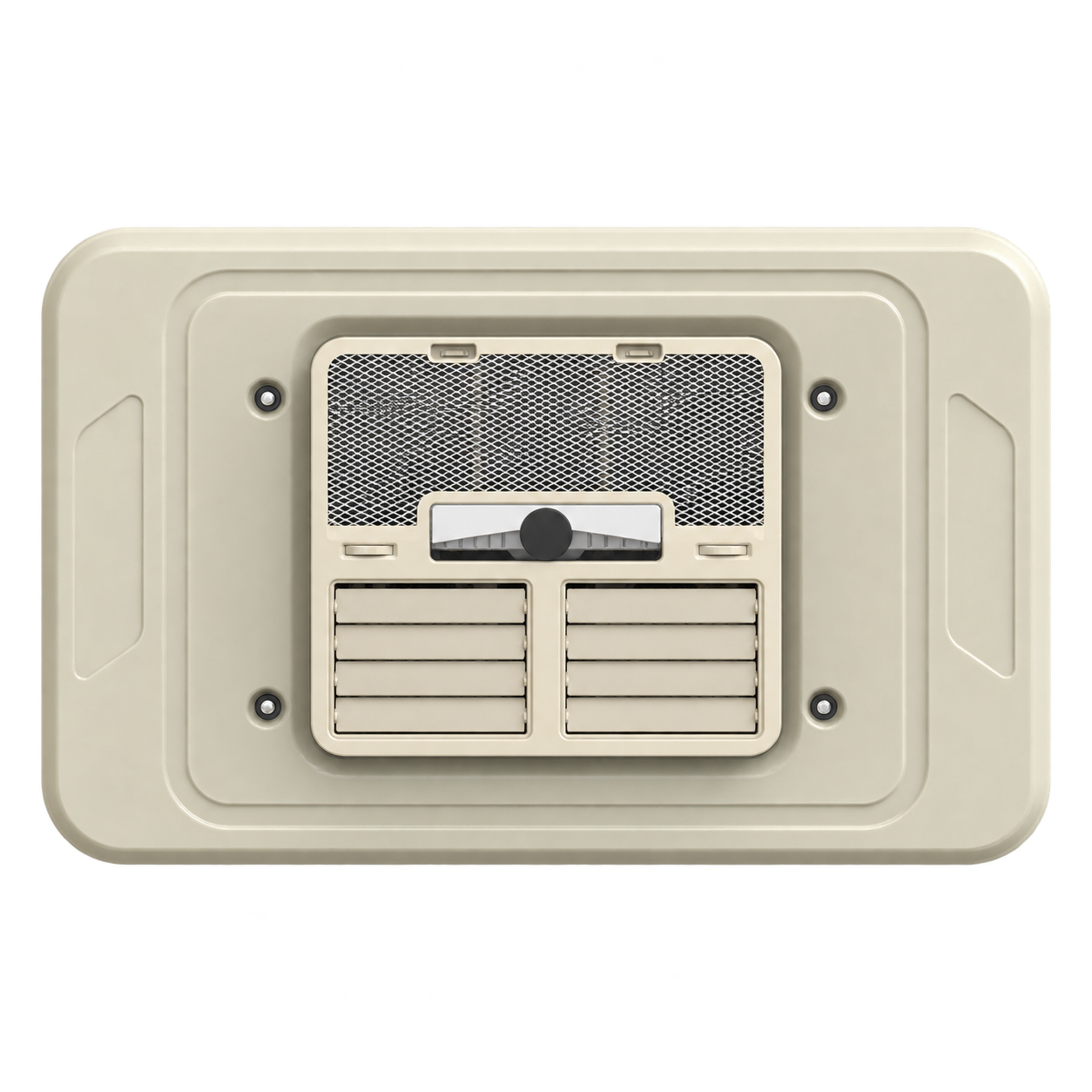
Inside the truck, storage and furnishings should leave the panel’s delivery useful to the occupied area. The Model A panel measures 860 × 550 mm and offers independent left/right electric oscillation. This is a practical feature for a driver moving between a seated break and bunk rest.
Demonstrate the adjustment with the normal curtain and bedding arrangement. A direct stream at the face may be unwelcome even when the cab needs cooling. Useful circulation can be assessed from the actual occupied position rather than only beneath the outlet.
Work-site use may also change what is carried inside. A new bag, tool container or storage arrangement can alter the local air path. The driver should be able to describe such changes when reporting a different comfort experience. This is not a request to diagnose the system; it is useful context for support.
The benefit is a clearer connection between product and everyday use. CUDU2700’s adjustable panel can serve the driver effectively when the cabin arrangement supports it. The premium compressor and copper construction are not left as abstract specifications. They form part of a complete cooling package whose visible interface is placed and explained around the activities the customer actually performs during parked work-site breaks.
Use observations that lead to an appropriate review
A driver can contribute useful information without performing technical maintenance. Describe a visible change, a new sound or a difference in useful air delivery, and note when it appeared. Include whether the route, roof load or cabin arrangement changed at the same time.
The observation should be specific enough to guide the next conversation. “Less useful air at the bunk after storage was changed” is more actionable than “the air conditioner feels different.” A photograph can help show an arrangement, while the responsible personnel determine what inspection is appropriate.
Drivers should not be expected to climb into an unsuitable position, open equipment or improvise cleaning around an operating unit. The care process should follow current instructions and the operator’s appropriate workshop arrangements. The point is a clear route from observation to qualified attention, not a technical burden placed on the occupant.
For CUDU2700, this supports availability in a practical way. The owner has selected a defined premium product and retains enough information to respond intelligently when conditions change. The model’s documented features remain the purchasing reason, while the ownership routine provides useful feedback. That is a stronger proposition than promising that brushless fans or copper construction eliminate all environmental concerns.
Not every change noticed at a dusty site should automatically be blamed on accumulation. A cabinet may have moved, a roof load may be different or the parked exposure may have changed. The driver’s context helps the service team avoid narrowing the question too early. Appropriate inspection can then establish what needs attention. This is useful for the customer because it supports a more accurate response and avoids treating a routine layout preference as a technical fault. The premium product is evaluated through the actual observation, with environmental exposure considered as context rather than an all-purpose diagnosis.
Follow the correct care method instead of inventing one
The source used for this guide does not establish a model-specific cleaning procedure, chemical list, pressure limit or universal interval. Obtain and follow the current care information for the delivered configuration. The responsible service team should determine the appropriate work method for the actual equipment and environment.
Do not infer a cleaning method from the material headline. Copper evaporator, condenser and piping describe named construction elements; they do not authorize any particular cleaning chemical or technique. The complete assembly includes other materials and components whose requirements should be respected.
Likewise, do not assume undocumented filter details. If the delivered configuration includes serviceable filtration, use its actual instructions rather than a procedure borrowed from another product. The guide’s purpose is to make care planning concrete, not to fill gaps with a familiar generic method.
This precision helps the customer buy confidently. CUDU2700 offers a clearly identified copper and inverter twin-rotary package, and appropriate technical information supports ownership. A premium recommendation does not need to promise maintenance-free use. It can explain that desirable hardware is being combined with a practical care route suited to the customer’s site exposure, with qualified support available through the agreed project arrangement rather than an invented universal service rule.
Set the inspection rhythm around real conditions
A single calendar interval may not reflect every work-site pattern. The appropriate routine should follow current guidance and account for the operator’s actual environment. A truck used at a clean paved location and one exposed to material handling may require different attention, as determined by the responsible service plan.
The owner can help by explaining the route and observing changes over representative use. The workshop can then refine the routine appropriately. Keep the process proportionate: the aim is a workable ownership pattern, not a complicated daily form that is quickly ignored.
| Ownership input | Useful contribution |
|---|---|
| Normal site and parking context | Explains recurring exposure |
| Roof and cabin baseline | Shows the delivered arrangement |
| Driver observations | Identifies changes noticed during use |
| Current care instructions | Guides the appropriate method |
| Workshop findings and actions | Closes the loop with a recorded response |
This structure makes the relationship between observation and action clear. A concern should not disappear into a vague promise that it will be checked later. The operator should know what was reviewed and whether a further action is needed.
For the buyer, that is part of a convincing work-truck package. CUDU2700 is selected for documented reasons and supported through an ownership routine that reflects the site. The customer receives a practical path to keep the product useful, rather than a materials slogan standing alone against an undefined environment.
Close the record after a workshop response. State what was found, what action was taken and whether anything remains to be reviewed. This turns a driver’s observation into an understandable ownership history instead of a message that disappears after someone says the unit was checked. The level of detail can remain modest and practical. A clear action record is especially useful where several drivers or workshops support the same truck, because the next person can see the previous response and avoid relying on a fragmented account passed verbally between shifts.
Retain the exact configuration through service conversations
The selected model is CUDU2700 R410A, with DC inverter twin-rotary architecture. Its cooling references are 2500 W for 12V and 2900 W for 24V. Keep that identity with the installation record so support does not begin from an older family document or an assumed voltage version.
The source also lists R410A charge at 580 ± 10 g and POE68 refrigeration oil as configuration references. They are not do-it-yourself service instructions. Refrigerant work requires the correct current information and appropriately qualified personnel.
For a fleet, the record should distinguish materially different roof or cabin arrangements even when the same model is fitted. A truck with another rack load may present a different outdoor context. A truck with different storage may present a different distribution question.
This helps technical support focus efficiently. The owner can provide the unit identity, present arrangement and clear observation. The workshop can compare that information with the delivered baseline and applicable instructions. The model’s premium construction remains understandable through the process, with no need to guess hidden internal details from an exterior photograph. A well-described product and a traceable installation give the customer a stronger ownership foundation than an expansive claim that one configuration will behave identically in every dusty application.
Choose comfort and sensible care as one package
VETHY positions CUDU2700 qualitatively as quiet and energy-efficient. Twin-rotary inverter architecture and brushless fans are useful reasons to investigate that proposition for a work truck. The installed experience still includes mounting, trim and air direction, so evaluate it from the seat and bunk after the final arrangement is complete.
Do not add an undocumented dB figure or guaranteed percentage saving. Similarly, the separate supplier power and current references do not establish a universal rest duration. The vehicle’s energy arrangement and intended session require their own review.
The positive case is already substantive: copper refrigerant components, a defined compressor package, dual brushless condenser fans and independently adjustable cabin delivery. A customer who values those features can shortlist the model confidently, then develop an installation and care routine appropriate to the actual site.
The core CUDU2700 guide explains the full model proposition. This dusty-worksite article adds the ownership context that makes the proposition useful beyond a clean demonstration. The customer is choosing both an attractive cooling candidate and a practical way to keep its air paths and surrounding arrangement ready for recurring work.
An illustrative yard truck with regular parked breaks
Consider a truck that waits near a busy material yard and uses the cab during scheduled breaks. The owner wants the CUDU2700 copper package and inverter twin-rotary architecture, but knows the site is not a showroom environment. The initial enquiry includes the usual parking position, roof rack load and the driver’s normal rest activity.
The installer develops a roof and cabin proposal rather than fitting the unit around an incomplete photograph. The outdoor footprint is coordinated with the working rack. Inside, the full panel is reviewed with storage and the normal curtain. The driver tries independent air direction from both the seat and bunk.
The care conversation is handled before delivery. The workshop identifies the applicable instructions and an appropriate service route for the operator. The driver is shown how to report a change without being expected to perform technical work. The completed installation is photographed with enough context to remain understandable later.
During representative use, a change in useful delivery is reported with its circumstances. The driver notes that additional cab storage was fitted and provides an interior view. The responsible team can review that layout difference alongside the appropriate inspection process rather than assume dust is the cause of every concern.
The value of this example is the chain from product choice to ownership. CUDU2700 supplies the documented premium features the customer wanted. The installation gives those features a useful setting. The reporting and care route turns observations into appropriate action. No dust-proof or maintenance-free claim is needed to make the recommendation convincing.
If another truck is later equipped, the owner can bring forward the product reference and successful approach while identifying differences in exposure and layout. That supports a more consistent fleet program without assuming every site or cab is identical. The premium model remains a defined choice, and the work-site context remains visible enough to review responsibly.
An importer preparing a work-site offer can make this ownership approach part of the customer explanation. Present the real CUDU2700 images and documented features, then explain the appropriate enquiry and care route for the proposed application. The offer should remain clear about what support and installation work are actually included. This is a positive way to differentiate a premium package without claiming an unverified environmental rating. The buyer sees a defined model, a recognizable site scenario and a practical plan for attention when needed, rather than a broad promise that dust has no effect on vehicle cooling equipment.
This gives the operator a useful link between the driver’s everyday observations and the workshop’s technical role. The product remains easy to use while concerns move through an appropriate, understandable response.
Questions about dusty work-site use
Is a dust-proof rating established here?
No. The guide does not establish a particular ingress rating. Discuss the actual exposure and installation with VETHY and follow the delivered product’s current care information.
Does copper construction determine the cleaning method?
No. Material scope is not a cleaning instruction. Use the appropriate method for the complete delivered assembly and qualified support where required.
Is one maintenance interval supplied for every site?
No universal interval is established here. The routine should follow current guidance and reflect the operator’s actual environment through the responsible service plan.
What should a driver report?
Describe the observation, location and timing, including any route, roof-load or cabin changes. The responsible personnel can decide which inspection or action is appropriate.
Recommend the model with an air-path care plan
Shortlist CUDU2700 R410A when its copper, inverter twin-rotary and brushless package suits the work truck and the operator can support an appropriate installation and care routine. Bring the real site context into the buying conversation.
Share the parking environment, roof load, cabin arrangement and selected voltage with VETHY engineering, or contact VETHY to develop the project. The CUDU2700 guide hub links further topics on roof service, driver comfort and recurring use.
Product sources
VETHY product recommendation and application analysis. Specification references identify the selected model and voltage. Installation examples are planning examples; measured project results are identified explicitly when available.
Discuss your CUDU2700 application
Send your vehicle, supply voltage, occupied space, parking schedule and installation photographs for a model-specific recommendation.
Prepare your vehicle brief ↗