
VETHY / CUDU2700 / PRODUCT AND APPLICATION GUIDE
CUDU2700 Independent Left and Right Airflow for a Shared Cab
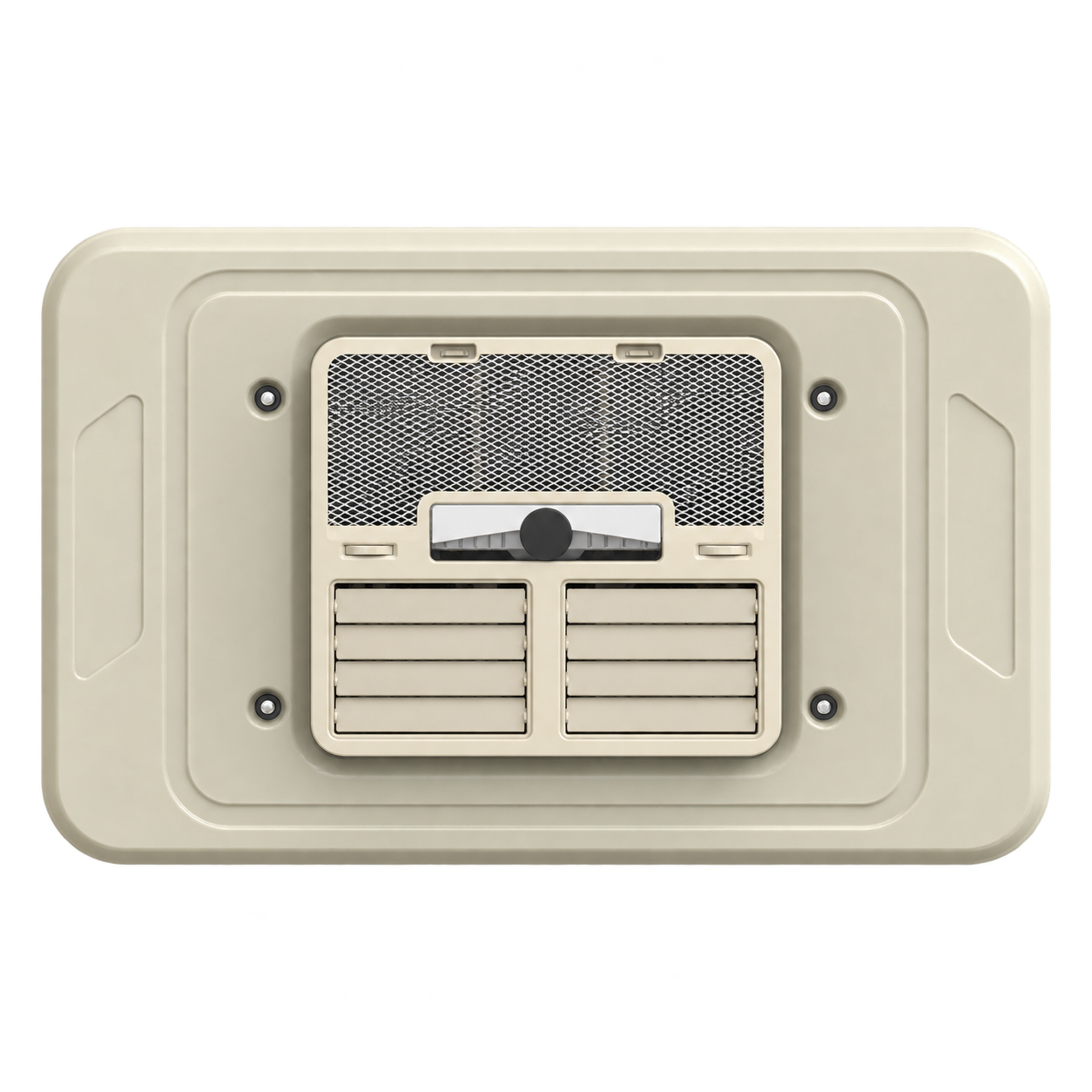
CUDU2700’s Model A panel provides independent left and right electric oscillation, useful when people in one cab prefer different air directions. Demonstrate each side from the actual seated and resting positions with normal belongings present. This is adjustable delivery within one cooling system; it does not establish separately controlled temperature zones.
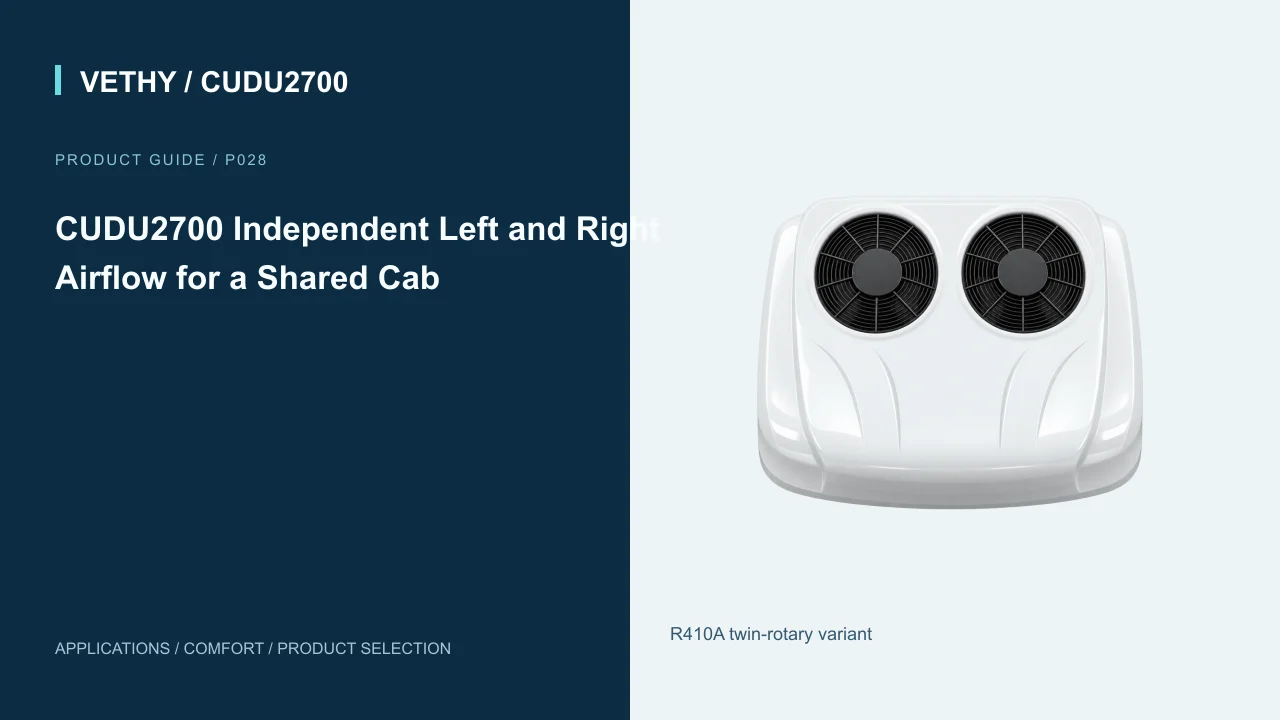
CUDU2700 R410A is an appealing rooftop option for a shared cab because its Model A panel lets left and right air delivery oscillate independently. That gives two occupants a practical way to refine where the air goes when they use different parts of the interior. It is a feature with an immediate human benefit: one person’s preferred direction need not dictate the direction on both sides of the panel.
The distinction is important. Independent outlet direction is not the same as two independently controlled temperature zones. The product remains one cooling package, with DC inverter twin-rotary technology, copper refrigerant components and brushless fans. This guide concentrates on the shared-space decision: how to use the documented distribution feature well when two drivers have different activities or airflow preferences.
Describe the occupants’ activities before labeling the zones
A shared cab contains activities, not simply two abstract halves. One driver may be resting on the bunk while another uses the forward seat for paperwork. At another stop, both may be seated. Later, only one may remain inside. These patterns matter more than an assumption that every person always occupies one side.
Start with a short activity map. Show the normal seat and bunk positions, the curtain and any storage between the panel and those areas. Ask where each occupant wants useful circulation and where direct air is unwelcome. This gives the installer concrete targets for panel location and outlet adjustment.
For example, a team may want circulation toward the bunk without a persistent stream at the pillow, while also keeping the forward area usable. The independent left/right function is relevant because it allows direction to be refined separately. The feature becomes a practical response to the activity map rather than a label that the customer must interpret alone.
The exercise also reveals when the shared-cab expectation needs discussion. If the users want completely different room temperatures behind a tightly separated interior, do not imply that independent direction automatically provides that result. Explain the documented function and review the actual layout. A good recommendation can be confident about useful air delivery while remaining clear about the kind of control being offered.
Explain independence in terms the customer can try
The supported feature is independent left/right electric oscillation on the Model A panel. A demonstration should show the actual supplied adjustment, allowing each occupant to see how direction changes. Avoid relying on a verbal promise that the unit is “dual zone,” because that phrase can suggest functions not established for this model.
The customer can understand the benefit through a simple practical comparison. First observe a common direction, then refine each side for the activities underway. The objective is not to create a formal performance test. It is to show that direction is a usable comfort variable rather than a fixed characteristic of the installation.
Keep the explanation connected to the actual panel orientation and controls. The source does not establish saved user profiles, app control or a memory function, so those should not be added to the sales story. The documented feature already has value when the driver can operate it clearly.
This is especially useful for a buyer who shares equipment between drivers. The panel can support different preferences without requiring every person to accept a single demonstration position. A fleet can teach the adjustment consistently while allowing individuals to refine delivery. The commercial benefit is a product feature that is easy to experience and easy to explain during handover, with no need for a fabricated control capability.
A useful demonstration can also show what happens when activities exchange. The driver who was seated moves to the bunk, while the other takes the forward position. They can then try the same adjustment themselves. This reveals whether the feature is understandable as a shared tool or has been set up around only one person. It is particularly relevant for teams that alternate duties. The buyer sees the panel serving changing use of the same interior, which is a more realistic benefit than assigning each outlet permanently to a named driver.
Treat direct airflow as a preference that may differ
Two occupants can both be comfortable with the general cabin condition while disagreeing about a stream directed at the face or shoulder. That is not automatically a cooling-capacity problem. It may be a direction problem, which is precisely where the independent outlets are useful.
Ask each person for a specific description. “I want more air across the seating area” is different from “the stream is too strong at my pillow.” These comments identify the part of the distribution to refine. They are more helpful than treating every response as a vote for a colder or warmer temperature request.
The Model A panel offers a practical way to explore those differences. Adjust the relevant direction within the supplied controls and reassess from the normal position. Keep the other occupant present so an improvement for one person is not assumed to be an improvement for both.
The benefit should be described positively but realistically. Independent delivery can make one shared system more adaptable to personal preference. It cannot guarantee that any combination of preferences will be satisfied in every interior. The buyer can decide through a representative demonstration whether the available adjustment addresses the actual conflict. CUDU2700 deserves attention because it supplies that adjustment as part of its documented package, instead of leaving the users with only one undifferentiated airflow arrangement.
Include the curtain as a shared-space boundary
A sleeper curtain changes the path between occupied areas. It may also be moved during a stop as one driver begins to rest. The shared-cab trial should show the curtain in its ordinary positions rather than assume the interior remains open throughout use.
In the illustrative two-driver cab, begin with one person at the seat and one at the bunk. Arrange the curtain as it normally would be. Ask both occupants what they feel, then adjust the directions and reassess. If the proposed panel location cannot deliver useful air into an occupied area, that is a layout issue to resolve before final installation.
This does not require the customer to stop using an important privacy fitting for the sake of a favorable demonstration. The product is being considered for the actual cabin. A realistic trial respects the functions the drivers already need and determines how the air conditioner can coexist with them.
The result may be a clear, satisfactory adjustment or a reason to reconsider the panel position. Both outcomes are useful during design. The buyer sees the independent outlet feature tested against a recognizable shared-space task. The installer gains specific feedback rather than a general statement that the occupants “want more cooling,” and the final recommendation is based on a layout both users understand.
Position the full panel, not just the roof opening
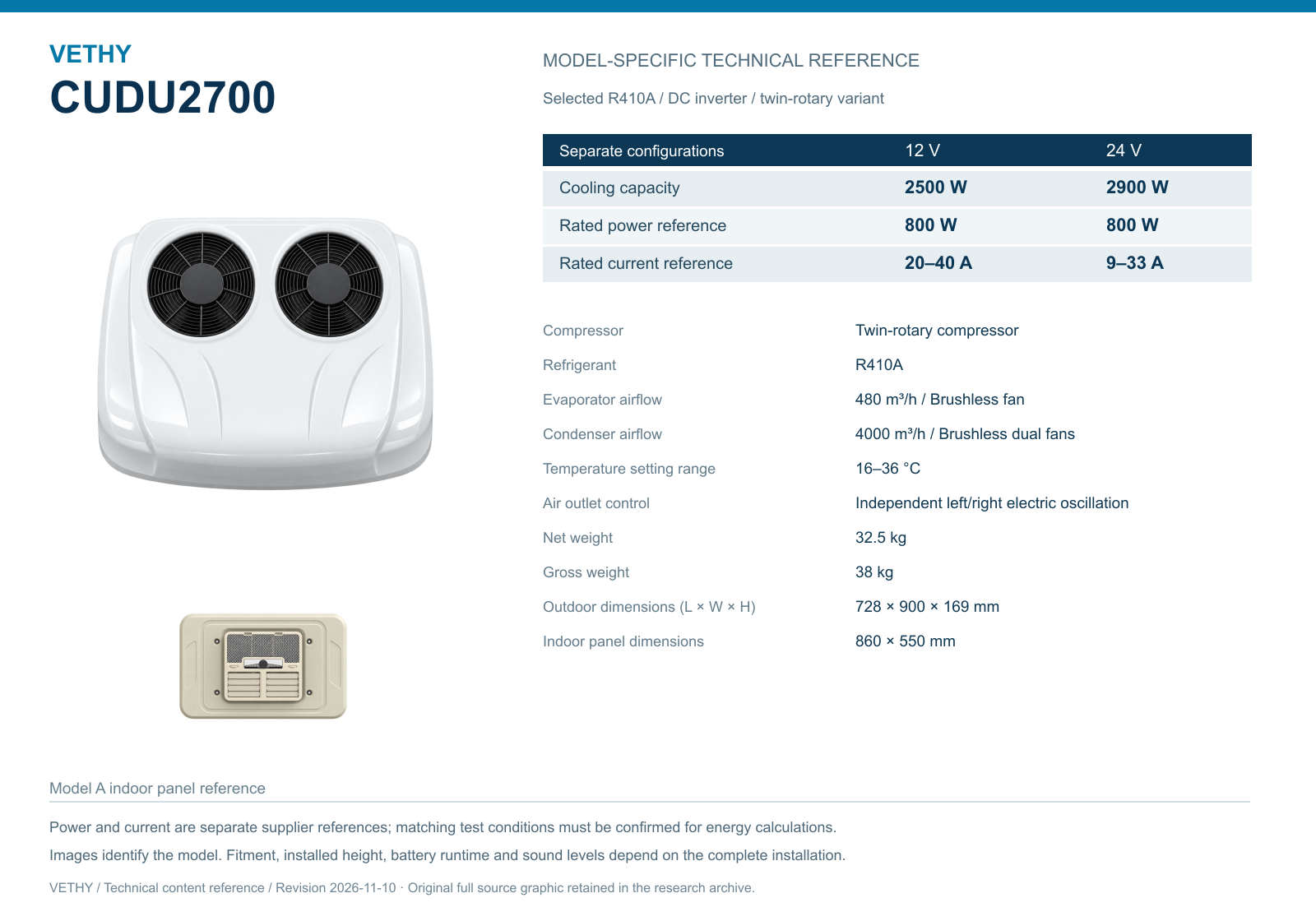
The CUDU2700 indoor panel measures 860 × 550 mm. That footprint should be represented on the interior plan with cabinets, lights, curtain rails and normal storage. A drawing showing only the minimum listed opening of 380 × 490 mm does not represent the full indoor assembly.
Panel location can decide whether independent direction has a useful path. If one side is immediately crowded by a cabinet, its theoretical adjustment may not deliver the intended practical benefit. The installer should examine this relationship from the occupied positions as well as from directly beneath the panel.
The outdoor unit imposes its own requirements. Its dimensions are 728 × 900 × 169 mm, expressed as length, width and height. Roof structure, surrounding accessories, support and sealing must be reviewed together with the indoor proposal. An attractive interior location is not sufficient if it creates an unsuitable exterior arrangement.
For a shared-cab buyer, this coordinated review is part of the product’s value. The independent outlets are not treated as an isolated accessory that will solve any layout. They become a useful feature in a deliberately selected position. The customer receives a cooling package whose visible cabin interface has been arranged around the people using it, supported by the appropriate rooftop installation rather than a purely decorative centerline.
Compare shared-cab situations instead of one universal setup
Different activities may call for different direction preferences. A short application table can help the customer recognize where the panel is useful without prescribing exact angles or undocumented control settings.
| Shared-cab situation | Distribution goal | Useful demonstration |
|---|---|---|
| One occupant rests, another works forward | Serve both active areas without an unwelcome stream at the bunk | Try both positions with the normal curtain arrangement |
| Both occupants sit forward | Provide circulation appropriate to the seating area | Let each describe direct-air preference |
| One occupant remains after the other leaves | Refine delivery around the occupied area | Demonstrate the supplied independent adjustment |
| Drivers exchange activities | Make the adjustment understandable to both users | Have each operate the actual controls |
The table is an activity guide, not a claim of separate refrigeration zones. It helps explain why a panel with independently adjustable delivery can be attractive even when the temperature request is shared.
It also helps the buyer compare candidate installations fairly. A demonstration designed only for two people standing beneath the unit misses most of the activities in the table. CUDU2700’s feature should be assessed in the positions it is meant to serve. That gives the customer a direct reason to value the product and reveals any interior constraint while it is still practical to address it.
Do not assume that the vehicle’s geometric center is automatically the best place for shared comfort. Centering may be attractive, but the occupied areas and obstructions may be uneven. The installer can compare a proposed location with the actual paths the outlets need to serve, then coordinate the exterior requirements. The customer should see why a position was chosen. That explanation makes the finished arrangement easier to accept and gives later support a useful reference if storage or sleeping orientation changes after delivery.
Let both occupants evaluate the same installed condition
Shared-cab feedback is strongest when both people experience the same arrangement at the same time. Separate demonstrations can hide a trade-off: a direction that pleases one person may be changed before the other enters. A joint trial makes that relationship visible.
Begin with a reasonable starting arrangement and let the users describe what they notice. Make one clear adjustment at a time when practical. The aim is an understandable conversation, not an elaborate test protocol. If a change helps the resting occupant but makes the seated person uncomfortable, the installer can explore another direction or revisit the layout.
Record the activities and relevant furnishings with the result. The feedback should remain attached to the actual cabin rather than presented as a universal finding about all two-driver operations. If the drivers later use different curtains or storage, those changes can be recognized when reviewing a new concern.
This process is a useful selling opportunity. It shows that the product is being recommended for people with ordinary, different preferences. The sales team does not have to promise perfect comfort for every combination. It can demonstrate the specific flexibility CUDU2700 provides and let the customer decide whether that flexibility is valuable in the intended cab. That is more persuasive than a broad claim that shared occupancy has somehow been solved automatically.
Keep changing demand separate from changing direction
When occupancy or solar exposure changes, the thermal demand may change. CUDU2700’s DC inverter twin-rotary architecture is relevant to that evolving cooling task. When an occupant dislikes a stream, independent direction is a separate adjustment. Explaining these roles helps the customer use the product sensibly.
The complete controls determine how the compressor responds. Moving an outlet should not be described as invoking a special energy mode or a defined compressor-speed change unless that behavior is documented. The model’s setting range of 16–36°C likewise describes a request range, not a guarantee that every shared cabin can reach every requested value.
For the team, a sensible routine may involve arranging the curtain and delivery for the current activities, then assessing the temperature preference. This avoids using repeated setpoint changes to compensate for an air path that could be improved more directly.
The benefit is a clearer division of comfort decisions. The users understand the adjustment they can see and feel. The buyer understands why inverter architecture is part of the broader package. The installer can address the panel and vehicle arrangement without promising hidden control behavior. CUDU2700’s recommendation becomes stronger through these distinct, documented functions working together in the actual shared space.
Judge the calm cabin from both occupied positions
A shared sleeper may contain one person who is resting and another who is active. Their tolerance for background sound or air movement can differ. VETHY’s qualitative quiet positioning, supported by twin-rotary construction and brushless fans, makes the model worth considering for this setting. The installed experience still needs to be judged from both positions.
Listen with ordinary interior fittings secured and the intended delivery arrangement in use. If a sound is noticed only near the bunk, describe that location. If a loose object is responsible, treat it differently from a concern involving mounting or trim. The driver’s role is to report the observation; the responsible installer investigates the relevant area.
No supplied dB figure supports a numerical promise here. A shared-cab recommendation can still be concrete: the users should experience the completed environment during the activities that matter. Their feedback can guide practical refinement and help the buyer decide whether the package suits the team.
The outdoor configuration remains part of that installed result. The copper condenser and dual brushless condenser fans should have an appropriate rooftop setting under the applicable requirements. A normal rack load or later accessory change should not be ignored because the discussion focuses on indoor preferences. Shared comfort is served by the complete unit having a coordinated installation.
Plan energy for the team’s actual rest routine
A two-driver operation may use the cab and its other equipment differently from a single-occupant route. Include the normal cooling window, other electrical loads and charging opportunities in the power plan. Do not assume a duration simply because one driver’s brief demonstration was comfortable.
The selected R410A model offers 2500 W cooling at 12V or 2900 W at 24V. Its 800 W rated-power field is separate from current references of 20–40 A at 12V and 9–33 A at 24V, with the current entries labelled at 35°C ambient. A common operating basis is not established, so those values cannot be combined to generate a universal team-rest runtime.
The positive recommendation is a premium cooling architecture paired with a vehicle-specific energy arrangement. Appropriate information about usable energy and representative operation can improve the plan. Keep the conditions attached to any measurement used for a project-specific claim.
For the customer, this clarity matters because the purpose is a usable shared cab, not a single favorable moment. The team can understand the intended operating window and the available adjustments. The buyer can value CUDU2700’s energy-conscious positioning while still arranging the actual supply around the route. The product is then part of a considered working system, with its benefits connected to how the occupants live in the cab.
There is also a communication benefit in separating personal preference from installation concerns. The team can agree to describe a stream as too direct, too far away or obstructed rather than argue only about the common temperature request. Those descriptions make the independent delivery feature easier to use constructively. If the adjustment does not resolve the concern, the installer receives a specific observation to review. The product recommendation therefore includes a practical way for two occupants to discuss comfort, supported by an actual control the model provides.
Teach a shared starting point and individual refinement
A handover should leave both drivers able to operate the independent outlet adjustment. Have each try the supplied controls rather than assume one will teach the other later. Explain the difference between direction and temperature control in ordinary language.
Keep a simple reference for the normal activity arrangement. For example, identify how the cab was configured when one person rested and another remained forward. The reference is a starting point, not a requirement that every driver preserve an identical personal preference.
The workshop record should retain the exact R410A voltage version, panel position and exterior layout. CUDU2700’s copper evaporator, condenser and piping are part of the product identity and can remain in that record alongside the matching technical reference. The scope is those named copper components, without extending the claim to every part of the machine.
This gives shared ownership a useful structure. Drivers understand the adjustment available to them, while support personnel can recognize the delivered installation. If a new occupant or changed interior arrangement creates a different preference, the team can discuss it with context. The model’s documented flexibility remains an asset rather than a feature that was demonstrated once and then forgotten during everyday use.
Questions about independent left and right delivery
Is this a dual-temperature-zone system?
Separate temperature zones are not established by the supplied feature. The documented function is independent left/right electric oscillation for air direction.
Can two occupants prefer different directions?
Yes, and the feature is relevant to that situation. Demonstrate the supplied adjustment with both occupants in their normal positions to judge its usefulness in the actual cab.
Should the curtain be open for the trial?
Use the curtain in the ordinary positions relevant to the team’s activities. An always-open demonstration may miss the layout used when someone rests.
Does changing direction prove an energy saving?
No specific saving is established by an outlet adjustment. It is a distribution feature; session energy needs its own vehicle and operating context.
Recommend flexibility for a recognizable shared space
Choose CUDU2700 R410A when a shared cab can benefit from independently adjustable delivery and the complete rooftop package suits the vehicle. The main model guide explains the construction and voltage choices, while the guide hub connects narrower applications.
Send the occupied positions, curtain arrangement, interior photographs and selected voltage to VETHY. A discussion with VETHY engineering can then focus on a practical shared-cab proposal, followed by a demonstration that includes both users.
Product sources
VETHY product recommendation and application analysis. Specification references identify the selected model and voltage. Installation examples are planning examples; measured project results are identified explicitly when available.
Discuss your CUDU2700 application
Send your vehicle, supply voltage, occupied space, parking schedule and installation photographs for a model-specific recommendation.
Prepare your vehicle brief ↗