
VETHY / CUDU2700 / PRODUCT AND APPLICATION GUIDE
CUDU2700 Low Roof Profile: Planning Around a 169 mm Outdoor Unit
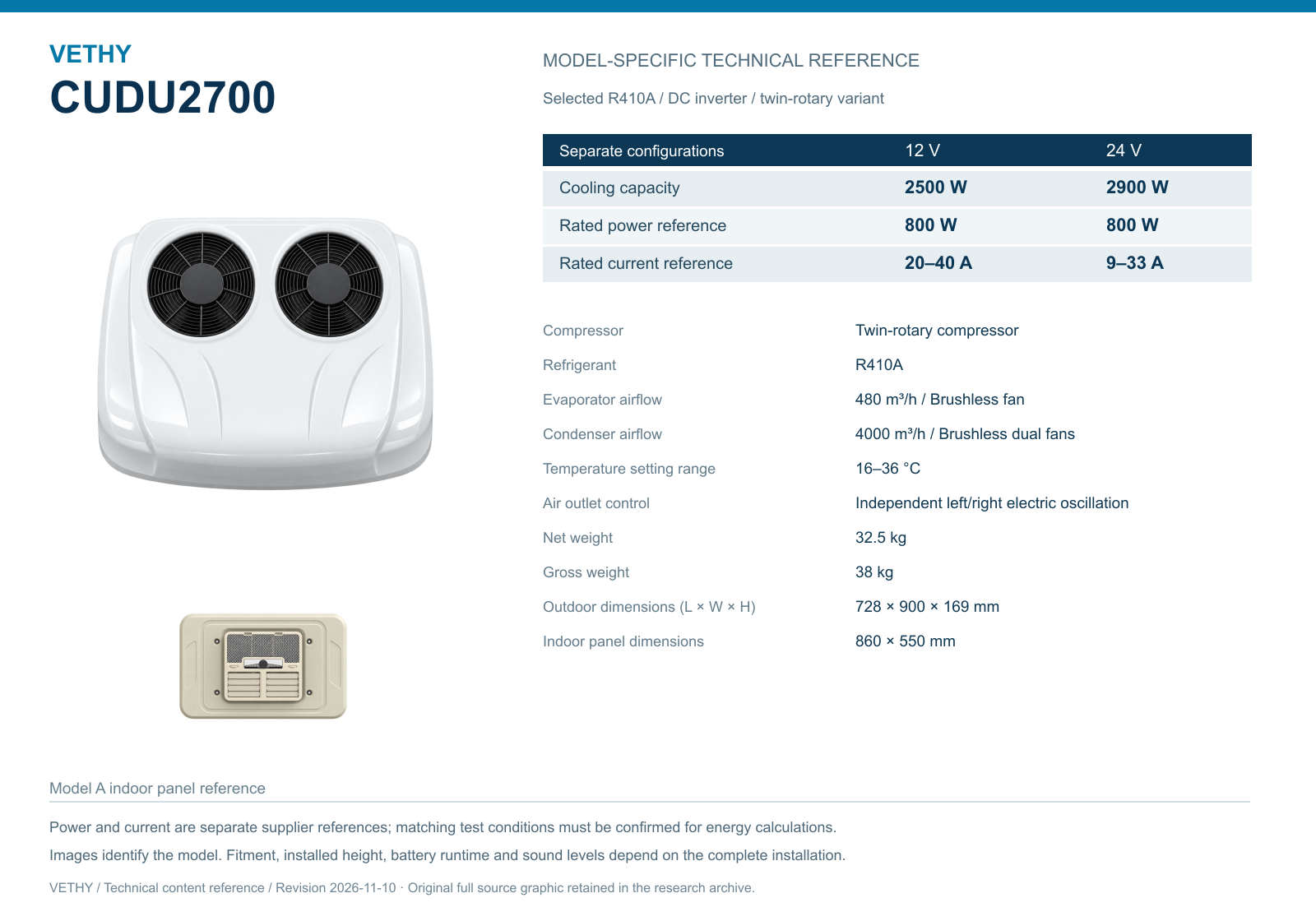
CUDU2700 R410A has a 169 mm outdoor housing height within a 728 × 900 mm footprint. Use that defined profile to coordinate the roof, nearby accessories and indoor panel location. Completed vehicle height also depends on the actual roof and mounting arrangement, so the housing dimension alone is not an installed-height increase.
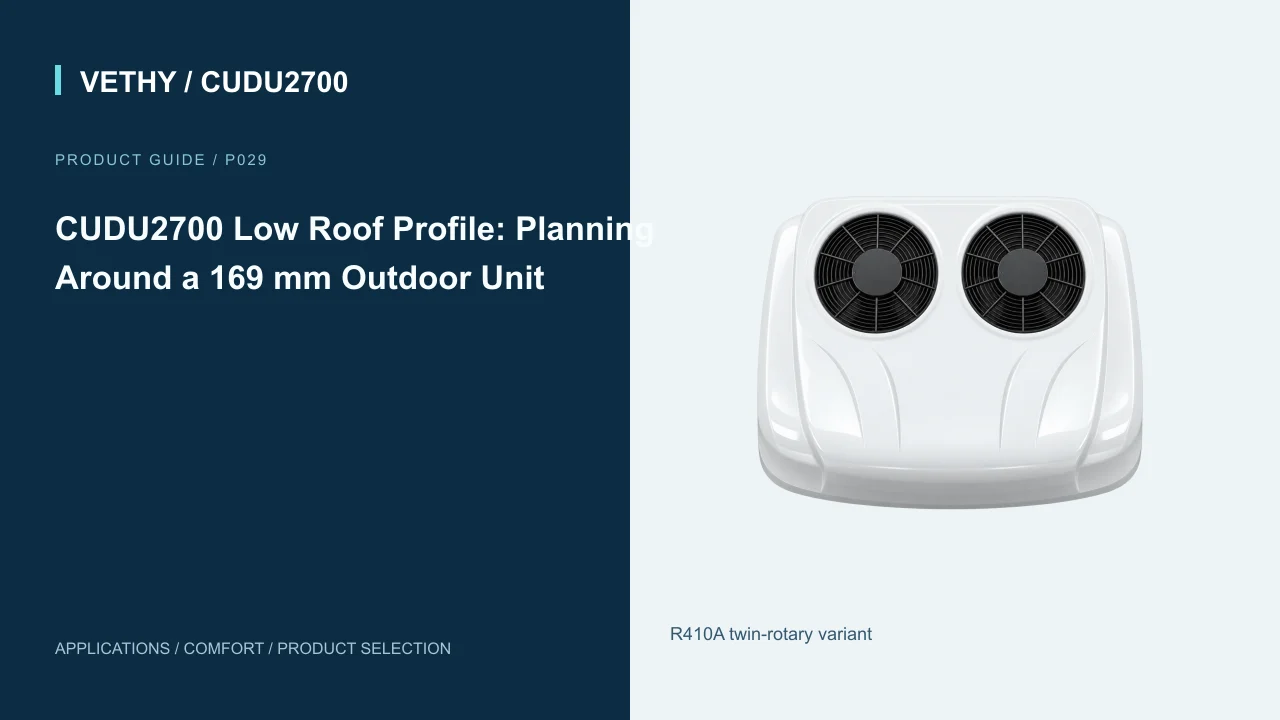
The 169 mm outdoor housing height is a concrete reason to consider CUDU2700 R410A when a vehicle project places value on a relatively low rooftop profile. It gives the designer a useful packaging input within a complete inverter twin-rotary cooling package, rather than an appearance claim that cannot be measured.
The important distinction is between the unit and the vehicle. CUDU2700’s outdoor dimensions are 728 × 900 × 169 mm, expressed as length, width and height. Finished vehicle height depends on the existing roof and the installed arrangement as well. This guide develops a profile-focused buying decision: how to use the documented housing dimensions intelligently while coordinating support, the indoor panel and the other functions of a working roof.
Define which roof constraint matters to the customer
A customer may ask for a low-profile air conditioner for several different reasons. One wants a tidy exterior. Another tracks the finished vehicle envelope closely. A third wants to coordinate several roof accessories without creating an unnecessarily tall visual arrangement. Those priorities overlap, but they are not identical.
Begin by naming the actual constraint. If the customer cares mainly about appearance, use accurate product views and a realistic vehicle proposal. If the completed envelope matters, plan an appropriate finished-vehicle measurement. If accessory packaging drives the decision, show those accessories in the same plan and side views as the air conditioner.
CUDU2700 is appealing because the 169 mm housing reference makes this discussion tangible. The buyer can compare a real dimension with the project’s needs instead of relying on the impression of a streamlined photograph. The model also supplies the documented cooling and construction package behind that profile.
Do not let one priority quietly stand in for another. A pleasing side view does not establish a finished vehicle measurement. A dimensional fit does not establish structural compatibility. Defining the customer’s actual objective makes the low-profile feature more valuable, because the proposal can show exactly how it contributes to the decision the buyer is trying to make.
Preserve length, width and height in every drawing
The source labels the outdoor dimensions as 728 mm length, 900 mm width and 169 mm height. Keep that ordering clear in a specification table and in the proposed vehicle layout. A drawing that swaps the dimensions can distort the apparent fit and mislead a customer who is judging the roof from a single view.
In a top view, use the length and width to represent the footprint. Show the housing height separately in a side or height callout. Do not turn 169 mm into a horizontal axis simply because the page has room for a third label.
This matters in remote discussions. A supplier and installer may be reviewing photographs and drawings rather than standing beside the truck. Mark the vehicle front and keep the orientation consistent between views. The customer can then understand which neighboring fitting is being discussed and how the unit sits relative to it.
Accurate drawing language is also a commercial advantage. The product presentation looks professional because its proportions and labels agree with the current CUDU2700 reference sheet. The buyer sees a specific product being considered for a specific roof. The low-profile selling point remains persuasive without a misleading illustration that would need to be corrected later in the workshop.
For an existing vehicle, photographs should also show the original roof shape clearly enough for the designer to understand the location. A distant side view can hide a raised section or an existing fitting, while a close top view can hide the relationship to the rest of the vehicle. Combining those views gives the installer a better starting point. The customer can then see why a product with a defined low housing still benefits from a proper vehicle survey, rather than interpreting the need for more context as uncertainty about the product dimension itself.
Separate housing height from the completed vehicle envelope
The 169 mm reference belongs to the outdoor housing. It should not automatically be added to a remembered vehicle height and presented as a verified completed measurement. Roof shape, the mounting arrangement and the original measurement basis can all affect how the installed envelope is understood.
For a customer who needs accurate overall-height information, identify how the completed vehicle will be measured and recorded by the responsible party. Keep the product dimension and vehicle result as separate entries. Each then remains useful for its own purpose.
The same distinction applies to an installation proposal. The designer can use the housing reference to explore packaging before the equipment is fitted. That is a legitimate planning use. The proposal should still be recognizable as a proposal, with the finished arrangement confirmed appropriately after installation.
This is a positive way to sell a low-profile product. The buyer is not told to ignore the dimension because the whole vehicle is more complicated. Instead, the documented dimension is used where it is strong: as a clear input to the packaging review. The completed vehicle receives the separate attention it deserves. CUDU2700’s slim housing can be appreciated without assigning it a universal finished-height effect that has not been established for the actual roof.
Review the mounting arrangement without inventing a stack height
A rooftop unit needs an appropriate mechanical installation. The mounting and sealing arrangement should follow the applicable requirements for the selected product and vehicle. This guide does not establish a universal fitted stack height, gasket thickness or mounting detail.
For a profile-sensitive customer, that missing information should become a focused project question rather than an invitation to guess. Ask the installer to explain the proposed arrangement and how it affects the finished relationship between housing and roof. The customer can then assess the package with the relevant details visible.
The roof’s own form also matters. A drawing based on a flat rectangle may not represent the actual cab surface. Provide photographs and appropriate measurements so the responsible installer can review the location. The purpose is a workable proposal, not a promise based solely on the exterior dimensions of the product.
CUDU2700 remains an attractive candidate because the housing profile is defined and the complete architecture is documented. The mounting discussion turns that candidate into something reviewable. A customer choosing the model for roof packaging should expect this level of clarity, particularly when later accessory positions depend on the finished arrangement. It is easier to coordinate the design while it exists on paper than after several roof fittings have been fixed independently.
Put weight and support beside the profile discussion
A visually low unit is still equipment carried by the vehicle. CUDU2700’s listed net weight is 32.5 kg. That reference belongs in the roof review alongside the footprint, location and applicable support requirements.
The minimum listed opening is 380 × 490 mm. An existing opening with similar dimensions does not independently establish a suitable roof structure or mounting design. The installer should review the actual surrounding area and resolve support and sealing appropriately for the vehicle.
This point is especially relevant when a buyer is replacing an earlier roof fitting. The opening may be familiar, but the new equipment and its installation need their own review. Do not treat “it fits through the opening” as a complete compatibility conclusion.
A premium low-profile offer can explain this clearly without losing its appeal. The customer sees a product with a compact housing and a definite construction package, supported by a deliberate installation proposal. The result is more credible than a visual promise alone. The buyer knows why CUDU2700 is on the shortlist and what the installer will resolve before it becomes part of the working vehicle.
Check the indoor footprint before fixing the exterior position
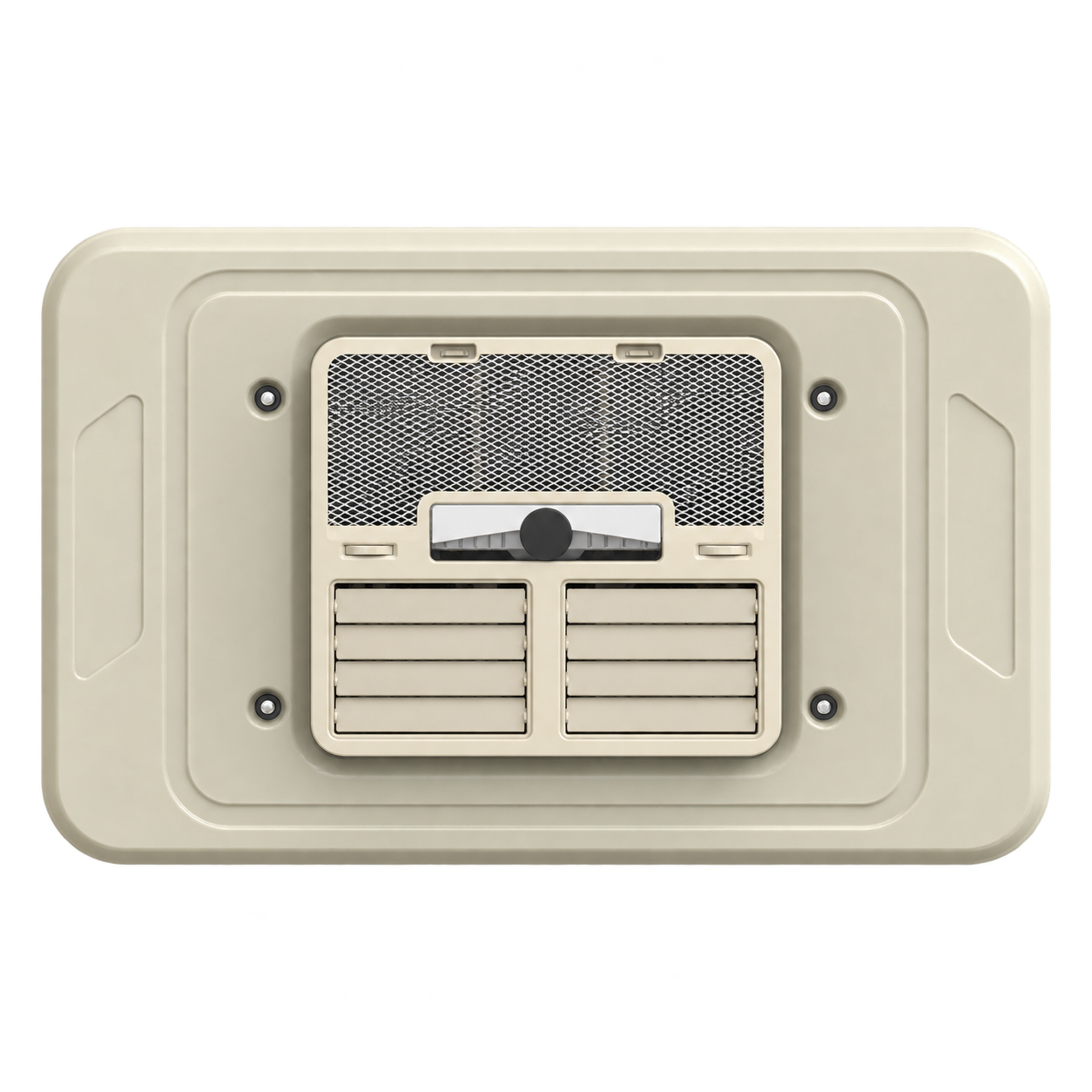
The indoor panel measures 860 × 550 mm. Its relationship with cabinets, lights and curtain rails can determine whether a roof position is useful. A location that looks excellent outside may crowd the cabin interface or obstruct one of the delivery paths inside.
The Model A panel offers independent left/right electric oscillation. This is a practical feature when the panel can direct air around the occupied positions. It is less useful if a side is immediately constrained by storage that was absent from the exterior drawing.
Draw the full panel on the interior plan and include the normal furnishings. The minimum opening does not represent the whole panel, and the source does not supply an indoor-panel thickness to borrow into a three-dimensional claim. Keep the dimensions within their documented scope.
For the profile-focused project, this adds a valuable second perspective. The buyer is not choosing a slim exterior at the expense of a poorly arranged cabin. The proposal shows how the low rooftop housing and useful indoor delivery coexist. That supports the complete CUDU2700 recommendation: a product whose shape helps the roof layout and whose panel can still serve the driver where cooling is actually needed.
Coordinate other roof equipment in more than one view
A low housing can appear easy to place beside solar equipment, racks or fairings. The roof still needs coordinated planning. The CUDU2700 outdoor package includes a copper condenser and brushless dual condenser fans, with 4000 m³/h listed condenser airflow. The applicable outdoor air-path and installation requirements remain relevant regardless of the housing’s height.
Use a plan view to show footprint relationships and a side view to show the surrounding profile. Include equipment in its normal working condition. An empty rack may present a different arrangement from the same rack carrying its usual load.
| View | What it helps the buyer assess |
|---|---|
| Roof plan | Unit footprint, accessory positions and usable surrounding layout |
| Side view | Housing profile and relationships with taller fittings |
| Interior plan | Full panel outline, storage and occupied areas |
| Completed installation photographs | How the reviewed proposal was implemented |
The views complement one another. A side view can make a crowded footprint difficult to notice, while a plan view can hide an inconvenient height relationship. Together they support a clear decision about whether CUDU2700’s profile is useful in this particular roof package. The customer can appreciate the dimensional advantage without assuming it cancels the other functions the installation must support.
Leave room for ownership after the first photograph
A tightly packaged roof may look excellent on delivery day but be awkward to inspect later. The service approach should be considered before every nearby area is filled with accessories. Obtain the current requirements and review the actual installation rather than inventing a universal clearance.
For the customer, this is part of the value of a planned product package. The air conditioner is being selected for years of vehicle use, not only for one presentation image. An accessible, understandable arrangement helps the workshop follow appropriate care and investigate a concern when needed.
Record the agreed relationship in a roof photograph that shows enough context. A close crop around the housing may prove the model is present but fail to explain why nearby space was preserved. The wider view helps the next person understand the design intent.
CUDU2700’s low profile should support an orderly roof, not encourage enclosing the unit as closely as possible. The buyer who values the copper condenser, dual brushless fans and inverter twin-rotary package has a reason to preserve their installation environment. Ownership planning keeps the profile feature connected to a functional system rather than letting appearance become the only criterion after the order is placed.
Confirm the finished arrangement as a vehicle project
After installation, compare the result with the reviewed proposal. Check that the correct R410A voltage version was fitted and that the roof and panel positions match the agreed arrangement. Where finished-height information is required by the operator, record it appropriately as a completed-vehicle result.
The cabin should also be experienced in its normal state. The slim exterior profile does not tell the customer how air reaches the bunk or seat. Demonstrate the independent outlet adjustment and let the driver use the occupied positions with ordinary storage and curtains in place.
VETHY positions CUDU2700 qualitatively as quiet and energy-efficient. Its twin-rotary and brushless construction are useful product attributes, while the installed sound includes the vehicle and surrounding fittings. Listen after the final roof and interior work is complete rather than using a temporary arrangement as the only reference.
This creates a practical acceptance outcome. The buyer can recognize the promised physical package and assess its useful cabin interface. The product dimension, finished installation and occupant experience each retain their own evidence. That is a stronger basis for approving the project than treating a low side profile as proof that every aspect of the installation has been resolved.
Choose the profile for the right kind of project
CUDU2700’s 169 mm housing height is especially interesting where a customer wants a restrained rooftop form within a premium cooling package. It may suit a fleet presentation, an upfitter’s coordinated roof design or an owner who wants to understand how new equipment affects the vehicle’s exterior.
The profile should remain part of the broader choice. The selected R410A cooling references are 2500 W at 12V and 2900 W at 24V. The model combines DC inverter twin-rotary technology with copper evaporator, condenser and refrigerant piping, plus brushless airflow hardware. A buyer should value the complete candidate, not select appearance first and discover later that the electrical or cabin arrangement is unsuitable.
A useful enquiry ranks the constraints. Tell VETHY whether the primary issue is exterior presentation, accessory coordination or the completed vehicle envelope. Include the actual roof and interior views. The discussion can then focus on the relevant benefit rather than repeat a generic description of low-profile products.
The recommendation is strongest when the housing dimension helps solve a concrete packaging problem and the rest of the model suits the application. That gives the customer a positive reason to choose CUDU2700 while preserving an honest boundary between product dimensions and vehicle-specific implementation.
A customer may compare a proposal with an existing vehicle photograph and ask why the result looks different. Explain the viewing angle and the status of the illustration before drawing a conclusion from appearance alone. The dimensions are the stable reference for the housing, while the completed arrangement provides the vehicle context. This keeps the discussion constructive and helps the buyer focus on the intended benefit. A low-profile choice should be demonstrated through accurate information, with the rest of the roof included, so the customer can make an informed visual and practical decision.
Keep the dimensional story accurate in customer presentations
A dealer should use the matching product photograph and the current technical sheet. If a vehicle proposal is illustrated, make its status clear and retain realistic dimensions and orientation. Avoid shrinking the housing in a mock-up to create an impression that the source does not support.
The 169 mm figure can be a clear headline, followed immediately by the full 728 × 900 × 169 mm dimensions. This lets the customer understand both the attractive height reference and the roof area involved. The message stays memorable without hiding the wider footprint.
Likewise, describe finished vehicle information only when it has an appropriate basis. A product dimension is not a substitute for an installed measurement, and a proposal image is not proof that a particular roof has been approved. The customer benefits from knowing which stage of the project the presentation represents.
This accuracy supports sales rather than obstructing them. The buyer can trust the dimensional explanation and focus on whether the product serves the intended vehicle. CUDU2700’s documented construction and cabin features provide the rest of the story, so the offer need not rely on exaggerated visual proportions to appear compelling. A precise profile-focused presentation is more useful for both the customer deciding and the installer who must implement it.
Preserve the approved profile when the roof changes
Later modifications may change the complete roof package even though the air conditioner’s own housing remains 169 mm high. New equipment can alter the overall envelope, outdoor surroundings or service approach. Keep the baseline installation record so those changes can be reviewed intelligently.
A customer adding a rack should show its proposed working load and position. A customer adding solar equipment should include its layout and relevant routing. The appropriate people can then review the affected relationships rather than assume that a low-profile unit always leaves unrestricted space around it.
For fleets, this record helps separate genuinely matching installations from trucks that now have different roof packages. The product can remain the preferred candidate while the specific layout is updated. Standardization works best when the important dimensions and relationships are visible, rather than inferred from a shared cab name.
The owner retains a clear reason for the original purchase: a documented low housing within a defined cooling package, fitted in a reviewed location. That decision remains understandable as the vehicle evolves. The profile is no longer just a promotional number; it is one useful element of a maintained vehicle configuration that can be explained to the next workshop or buyer.
Questions about the 169 mm housing profile
Does 169 mm state the final increase in vehicle height?
It is the outdoor housing height. The completed vehicle envelope depends on the actual roof and installation and should be measured appropriately where required.
What does 728 × 900 × 169 mm mean?
The source states length, width and height in that order. Use the length and width for the footprint and show height separately.
Is the opening dimension enough to establish compatibility?
No. The 380 × 490 mm minimum opening is one reference. Structure, mounting, sealing and surrounding space still need review.
Is an indoor panel thickness documented?
Only the 860 × 550 mm panel dimensions are supplied here. Do not borrow a thickness from another model or infer it from the outdoor housing.
Recommend the low profile within a complete layout
Shortlist CUDU2700 R410A when its 169 mm outdoor housing height makes a useful contribution to the customer’s roof project and the complete model suits the cooling task. The core selection article explains the wider product package.
Bring roof views, accessory plans, interior panel space and the selected voltage to VETHY engineering, or contact VETHY to develop a concrete proposal. The CUDU2700 guide hub connects related roof, airflow and cabin-comfort decisions.
Product sources
VETHY product recommendation and application analysis. Specification references identify the selected model and voltage. Installation examples are planning examples; measured project results are identified explicitly when available.
Discuss your CUDU2700 application
Send your vehicle, supply voltage, occupied space, parking schedule and installation photographs for a model-specific recommendation.
Prepare your vehicle brief ↗