
VETHY / CUDU2700 / PRODUCT AND APPLICATION GUIDE
CUDU2700 R410A 12V: Organizing a 2500 W Cooling Project
For a 12V rooftop cooling project, the selected CUDU2700 R410A variant lists 2500 W cooling and combines inverter twin-rotary technology with copper refrigerant components. Review the occupied cab, roof arrangement and engineered supply together. Keep its 800 W named power field and 20–40 A current reference separate when developing the supporting energy plan.
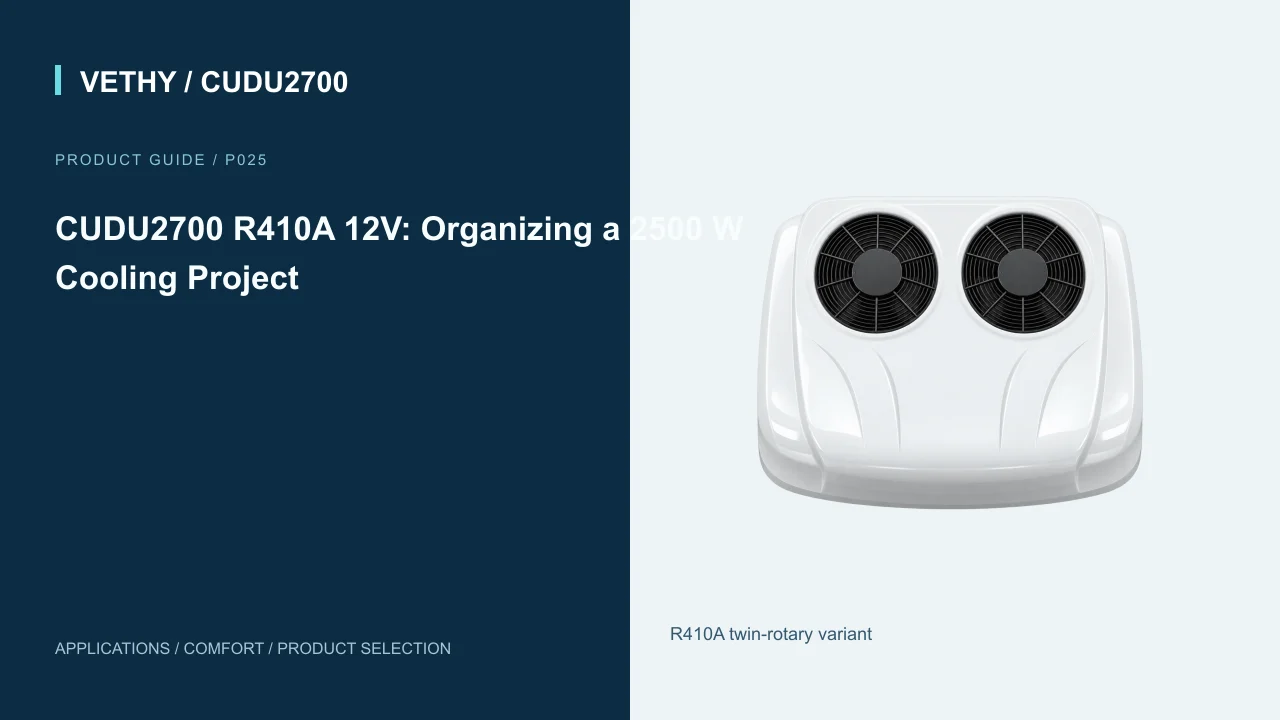
For a 12V vehicle project, CUDU2700 R410A offers a clearly defined rooftop cooling candidate: 2500 W listed cooling capacity, DC inverter twin-rotary technology, copper refrigerant components and flexible cabin air delivery. It is a compelling option when the customer wants that premium combination and is prepared to design the power and physical installation around the vehicle’s actual work.
This guide follows an illustrative regional delivery truck whose driver uses the cab during scheduled breaks. The owner wants useful engine-off comfort, a tidy installation and an operating plan that can repeat through the working week. The example is a planning scenario, not a VETHY test result. It shows how the 12V model’s documented benefits can become a concrete project instead of an isolated equipment purchase.
Write the intended break in ordinary language
The most useful opening brief describes the job the customer wants the air conditioner to do. For the regional truck, that might be a meal break followed by paperwork and a short rest. The driver normally remains in the sleeper area with the door closed, then returns to the route. That story is more informative than asking for “a battery AC for trucks.”
The description should include the parts that recur. When does the break usually happen? Is the cab exposed to strong sun? Does the driver always draw the sleeper curtain? When will the truck next drive or connect to a charging source? These details define the application in which the product will be judged.
CUDU2700’s 2500 W reference helps identify the shortlisted 12V equipment. It does not by itself specify how a particular cab will behave throughout the break. The product is recommended because its documented construction and adjustable delivery are relevant to the customer’s goal, while the vehicle brief explains how that relevance will be assessed.
A clear operating story also limits confusion later. If the route changes to a substantially longer parked period, the power plan can be revisited explicitly. The owner does not have to pretend the original brief covered every future schedule. The first project can be well defined and useful on its own terms.
The owner can also rank the desired benefits. If the main aim is a useful meal-break environment, the seated position may deserve as much attention as the bunk. If the aim is a short sleep, the curtain and direct airflow become central. Naming that priority helps the installer present the CUDU2700 features in the right order. The project is still a 12V cooling installation, but the customer sees a recommendation shaped around a recognizable activity instead of an undifferentiated promise of comfort.
Select the 12V R410A unit explicitly
The product line should read CUDU2700 R410A 12V, DC inverter twin-rotary, with 2500 W listed cooling capacity. That full identity matters because the 24V version has a different cooling reference, and older R134a family information should not be substituted silently.
The selected nominal voltage needs to fit the engineered vehicle supply arrangement. It is not simply a choice between two capacity headlines. The installer should understand how the cooling unit will be supplied and which parts of the existing electrical system are involved. The vehicle’s usual nominal voltage is a useful starting fact, but it does not resolve the complete integration design.
For the illustrative truck, the owner can give the installer the actual vehicle details and the current auxiliary-power arrangement. If the project includes changes to that arrangement, identify them in the offer. The customer should know whether the proposed package includes only the air conditioner or also the work needed to supply it appropriately.
Keep the selected identity on the purchase order and workshop job card. This supports a straightforward delivery check: the unit received should be the version used in the project review. Accurate configuration information is a practical foundation for realizing the product’s benefits, especially when the sales conversation and installation happen weeks apart.
Understand what 2500 W contributes to the decision
The 2500 W value is a cooling-capacity reference for the selected 12V R410A model. It is not the electrical input, and it should not be placed into a battery calculation as though it were consumption. Keeping that distinction clear helps a nontechnical owner understand why capacity and energy planning are separate parts of the project.
The cooling reference is useful when describing the equipment to the supplier and comparing candidates at the same scope. The actual application still includes glazing, insulation, exposure and the occupied area. A small rest zone behind a curtain presents a different arrangement from an open cab with several people and frequent door activity.
For this regional truck, the owner can explain which area needs to be comfortable and during which part of the shift. VETHY and the installer can then discuss the candidate in a recognizable thermal context. The buyer is not asked to assume that all trucks with 12V systems have the same cooling needs.
This makes the recommendation more convincing. CUDU2700 is not presented as a universal answer inferred from its model number. It is a defined rooftop package whose capacity reference, inverter architecture and air delivery are being considered for a real task. That is the level at which a useful purchase decision can be made.
Keep the electrical reference fields in their proper roles
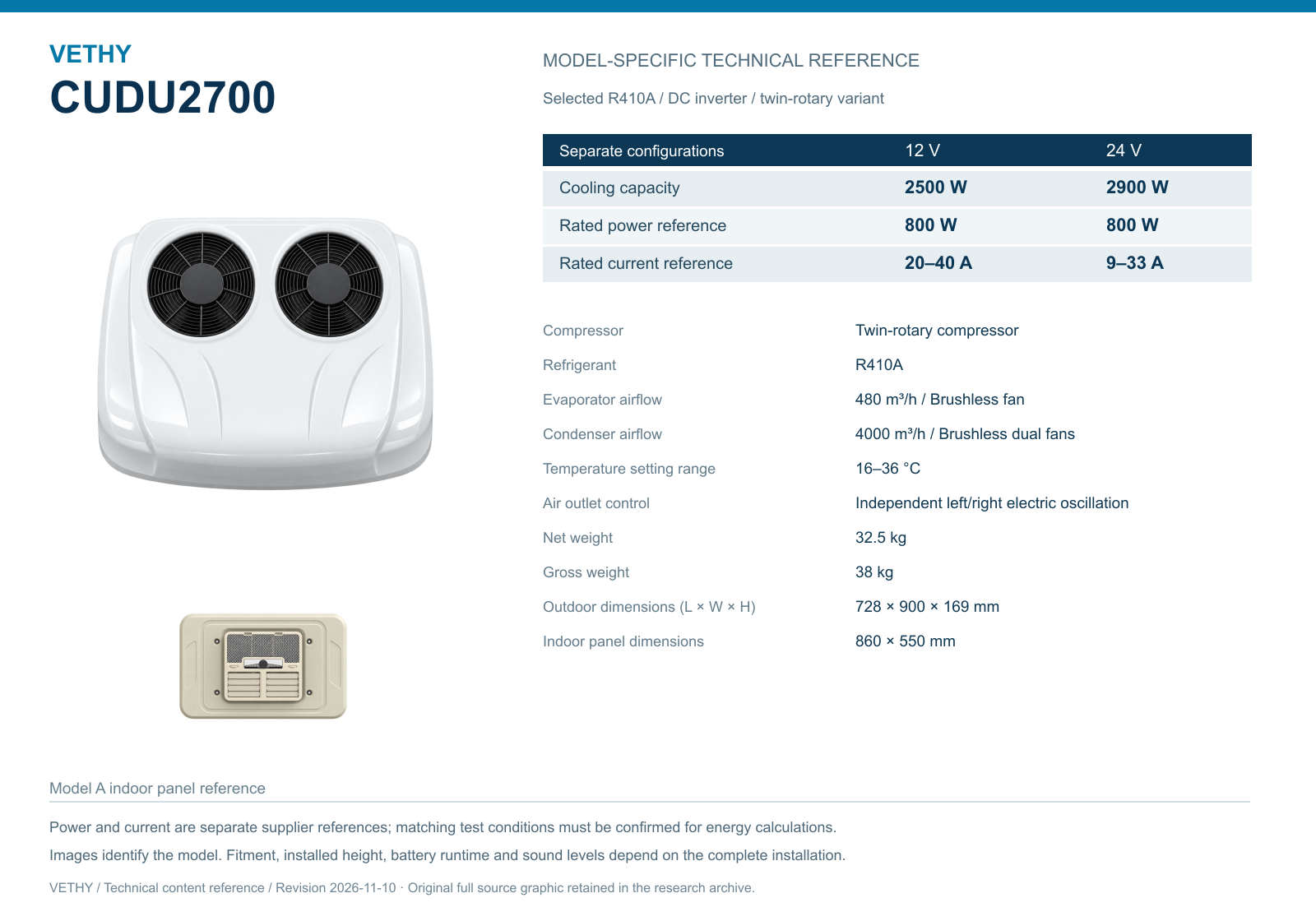
The supplier lists rated power at 800 W. It also lists a 12V current reference of 20–40 A, labelled at 35°C ambient. The source does not establish those entries as one paired operating point. They should be retained with their labels rather than forced into an invented relationship.
This means the owner should not divide a battery figure by the lowest current endpoint and treat the answer as the promised cooling duration. The low endpoint is not established as the truck’s normal settled-rest draw. Equally, the current range should not be used to infer a universal maximum electrical input for the product.
| Planning question | Relevant information | What remains vehicle-specific |
|---|---|---|
| Which unit is proposed? | R410A 12V, 2500 W cooling | Delivered configuration and installation scope |
| What electrical references are supplied? | 800 W rated power; 20–40 A current at 35°C ambient | Actual session profile and integration requirements |
| What determines available operation? | Usable energy and intended loads | Battery system, condition, charging and route pattern |
| How is the plan improved? | Representative operating information | Conditions and method attached to the observations |
The constructive route is to use the labelled data in a complete electrical review and confirm representative use after installation. That gives the customer a power plan appropriate to the vehicle, without sacrificing the positive case for the CUDU2700 product architecture.
Design the supply path as part of the installation
An air conditioner is only one component of the electrical package. The supply path also includes the vehicle’s relevant energy source, conductors, connections, protection and any approved integration equipment. These items should be selected for the actual installation by the responsible specialist using current requirements.
The guide does not supply universal cable sizes, fuse ratings or connection instructions. Such values depend on the equipment and route being engineered. Copying them from an unrelated truck can create a false sense of completeness even when both vehicles are described as 12V.
For the regional project, the installer should inspect the proposed route and explain the scope to the owner. The driver needs a reliable, understandable operating arrangement. The workshop needs to know how the installed unit is supplied so later maintenance or modifications do not begin with guesswork.
This is an opportunity to sell a better package. A quotation that names the CUDU2700 and resolves its supply integration is easier for the customer to evaluate than an attractive unit price followed by unspecified additional work. The buyer can see what makes the product usable in the vehicle. The documented inverter twin-rotary cooling and copper construction then sit within a deliberate installation rather than depend on an improvised power connection.
For a customer comparing quotations, ask each installer to describe the supply work in comparable terms. One offer may assume an existing suitable arrangement, while another includes changes to it. A difference in price may therefore reflect a difference in scope rather than the air conditioner itself. Keeping the 12V model identity constant makes this easier to discuss. The owner can assess the product and the integration work separately, then choose a complete proposal whose responsibilities are clear enough to carry into the workshop.
Plan usable energy around the whole break
A battery label alone does not describe every aspect of energy available for cooling. The usable portion depends on the actual system and its appropriate operating limits, while other devices may draw from the same reserve. Those details should be reviewed for the installed equipment rather than replaced by a generic assumption.
List the loads normally active during the break. The regional driver may use lights, charge devices or run other cab equipment. Their importance is not that every load is large; it is that the cooling plan should describe the complete intended session. The customer wants the vehicle to support the break as normally lived, not a demonstration in which everything except the air conditioner has been disconnected.
The planned reserve should also reflect what happens after the stop. The responsible integration review can determine how the cooling arrangement relates to the vehicle’s other requirements. Avoid assigning undocumented voltage cutoffs or battery-protection functions to the air conditioner itself.
CUDU2700’s energy-conscious positioning and inverter architecture are useful reasons to consider it, especially as thermal demand changes. They do not eliminate the energy budget. The positive ownership proposition is a model with the desired architecture, paired with an energy system and routine that make sense for the customer’s real break.
Look beyond one favorable first-day demonstration
A regional route repeats, so charging and use should repeat sensibly as well. A successful cooling session that begins with unusually favorable stored energy does not establish that the truck will start every later break in the same condition. The owner should describe the recurring work pattern to the person planning the power arrangement.
That description can remain simple: the typical drive periods, the parked cooling window and any regular charging opportunity. If the week includes a different day with longer stops, include it. The plan should support the pattern the driver actually follows, with any limitations explained plainly.
After installation, representative operating information can refine the understanding. Keep the route and relevant conditions attached to observations, especially when a result will inform the next purchase. A single instantaneous electrical reading is different from a complete session record, and both are different from a battery-duration guarantee.
For CUDU2700, this recurring view reinforces the reason to evaluate changing-demand operation. The cab may be hottest on arrival and less demanding later. The inverter package is relevant to that sequence, but the complete repeatable result includes charging, other loads and the environment. The model can therefore be recommended confidently within a considered operating plan, with the customer understanding how it will serve a working week rather than one staged stop.
Give the premium construction a practical roof location
The 12V R410A version is part of the documented CUDU2700 package with copper evaporator, copper condenser and copper refrigerant piping. It also has brushless dual condenser fans and a 4000 m³/h condenser airflow reference. These are concrete reasons for a buyer to choose the model, and they deserve an appropriate roof arrangement.
The outdoor dimensions are 728 × 900 × 169 mm, expressed as length, width and height. The housing profile is useful for a tidy layout, while the complete footprint needs coordination with accessories and the roof structure. The listed net weight is 32.5 kg. A suitable mounting and sealing design remains part of the vehicle project.
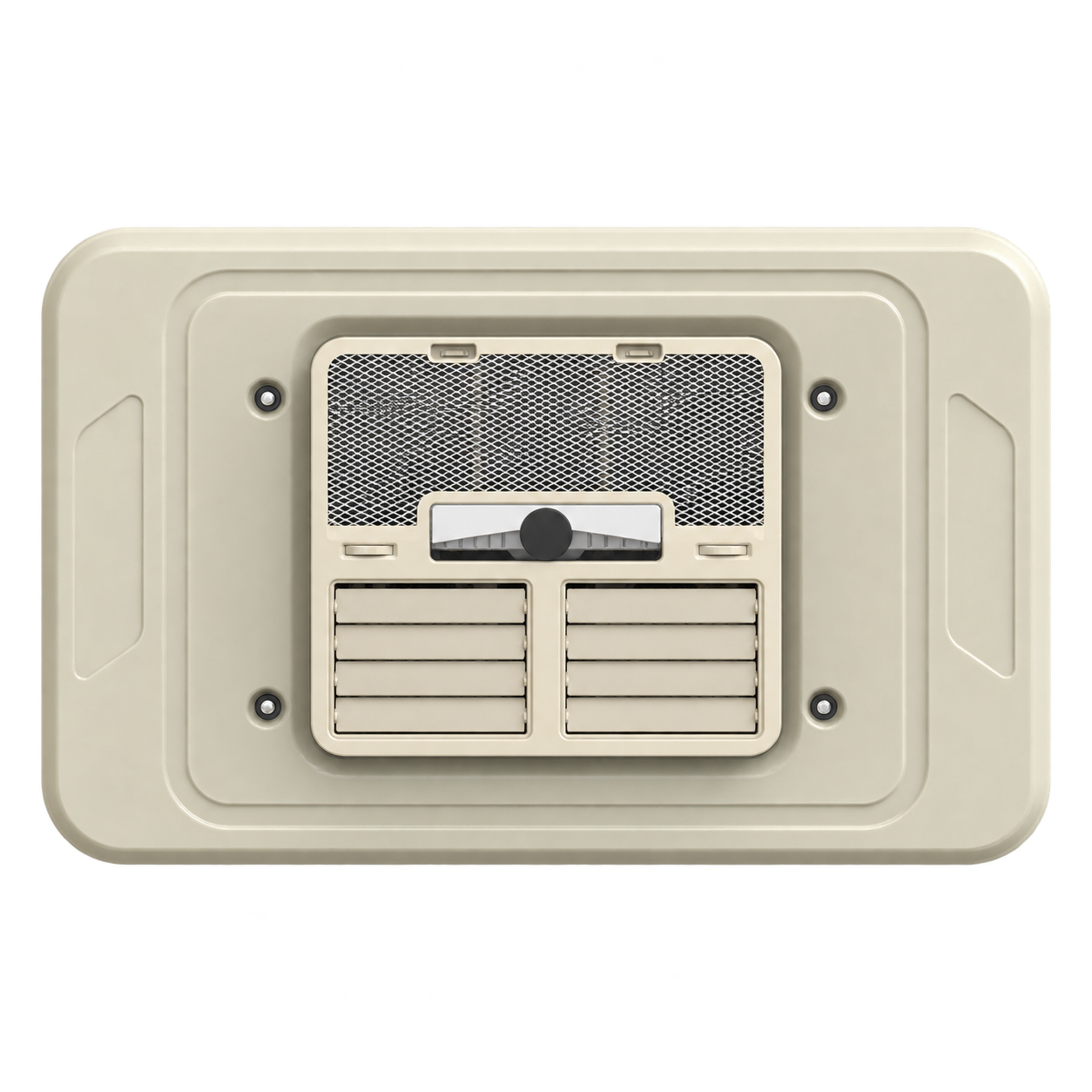
Inside, the panel measures 860 × 550 mm; the minimum listed opening is 380 × 490 mm. Do not treat the opening dimension as the entire installation envelope. The exterior and interior need to be considered together, particularly where overhead storage occupies the preferred panel position.
For the regional truck, an early roof and interior survey can turn an abstract product choice into a tangible proposal. The owner can see where the unit goes, how the panel relates to the cab and which existing fittings need coordination. That supports the value of buying a clearly specified premium unit rather than discovering physical conflicts after delivery.
A roof survey is also a good opportunity to identify future plans. If the owner expects to add a rack or solar equipment, show the intended positions before the air conditioner location is finalized. The installer can review those relationships while the project is still easy to change. This does not imply that every accessory combination is suitable. It means the customer can make a coordinated decision, preserving the reasons for selecting the CUDU2700 package instead of placing a later modification into whatever space happens to remain.
Aim the indoor package at the driver’s useful space
The driver’s rest area is the application’s center of attention. CUDU2700’s Model A panel provides independent left/right electric oscillation, with a brushless evaporator fan and a listed 480 m³/h airflow. The practical advantage is that delivery can be refined around the actual occupied positions.
Try the normal sleeper arrangement with bedding and curtain in place. An outlet should have a useful route into that space rather than point into a cabinet or create an uncomfortable stream at the driver’s face. A lower temperature request is not a substitute for sensible distribution.
The available setting range is listed at 16–36°C. It describes the request range, not a guaranteed cabin temperature under every exposure. The owner should understand that comfortable operation depends on the surrounding conditions and the installed arrangement as well as the selected request.
This is an accessible benefit to demonstrate. The customer can sit or lie in the intended position and adjust the directions within the supplied controls. The installer can then judge whether the panel location supports the feature. The result is a buying decision connected to something the driver can actually use, rather than a conversation that ends with a compressor description and never reaches the occupied cab.
Commission a parked transition that resembles work
The first evaluation should resemble the regional driver’s stop closely enough to be informative. Describe the prior exposure and initial cabin condition, then let the driver prepare the rest area and use the delivered controls. Observe the early cooling impression and the later settled comfort separately.
Ask for specific feedback. Does useful air reach the rest area? Is one direction too direct? Is the sound acceptable from the bunk after normal fittings are secured? CUDU2700’s twin-rotary and brushless construction supports qualitative quiet positioning, while the final sound is a characteristic of the installed vehicle.
If an adjustment is made, retain the reason and reassess the relevant observation. Moving an outlet direction is different from altering the mounting arrangement. A clear record helps the owner understand which part of the package produced the improvement and gives future support a useful starting point.
Do not convert the first comfortable session into a universal result. Its value is that it demonstrates this unit, in this truck, with a recognizable routine. The owner can approve the practical arrangement and use representative energy information to improve the operating plan. That is a concrete, reviewable outcome for a 12V project, without invented pull-down times or an all-night promise that the source data cannot support.
For the regional operator, the first vehicle can also become a purchasing reference if another truck is added. Keep the actual cab and supply differences visible when that happens. The next truck may share 12V nominal voltage while differing in storage layout, exposure or available auxiliary energy. The useful item to repeat is the reviewed approach and selected product identity, with any differences resolved openly. This lets the owner build on a successful installation without assuming that an apparently similar vehicle automatically has identical cooling and power requirements.
Hand over an arrangement the owner can recognize
A completed project should leave the owner with more than the shipping description. Retain the selected CUDU2700 R410A 12V identity, the relevant installation information and photographs of the roof and panel. The workshop should be able to recognize how the unit is supplied and where it was fitted.
The driver needs a shorter explanation focused on use. Demonstrate the actual controls, independent outlet adjustment and a sensible starting arrangement for the break. Avoid adding fictional app functions, saved profiles or special modes that are not confirmed for the delivered configuration.
The owner should also know whom to contact if the route or cabin arrangement changes. A longer stop, new roof accessory or different auxiliary load may justify a review of the affected part of the package. Those changes should be discussed with enough context to distinguish them from the original installation.
This makes the CUDU2700 recommendation more durable. The customer receives a clearly identified product with desirable construction and airflow features, along with a practical understanding of how those features were integrated. The buying decision remains understandable after the sales discussion is over, which is particularly valuable for a vehicle that will return to work immediately after installation.
Questions about a 12V CUDU2700 project
Is 2500 W the electrical input?
No. It is the listed cooling-capacity reference for the selected 12V R410A configuration. Rated power is separately listed at 800 W.
Can the current range establish a fixed runtime?
No. The 20–40 A entry is a supplier reference labelled at 35°C ambient. A real duration assessment requires the complete energy system, other loads and intended use.
Does an existing roof opening prove compatibility?
No. The 380 × 490 mm minimum opening is one reference. The roof structure, mounting, sealing and surrounding exterior and interior space still require review.
What should accompany the first enquiry?
Provide the exact vehicle and voltage requirement, roof and interior photographs, available power arrangement and normal pattern of parked cooling and charging.
Turn the 2500 W candidate into a complete offer
Choose CUDU2700 R410A 12V when this cooling reference and the model’s copper, inverter twin-rotary and adjustable-airflow package suit the vehicle brief. For the wider construction context, read the core product recommendation.
Use the parking AC technical enquiry guide to organize the vehicle information, then contact VETHY for a configuration-specific product and installation discussion. The CUDU2700 guide hub connects further topics on roof layout, comfort and power planning.
Product sources
VETHY product recommendation and application analysis. Specification references identify the selected model and voltage. Installation examples are planning examples; measured project results are identified explicitly when available.
Discuss your CUDU2700 application
Send your vehicle, supply voltage, occupied space, parking schedule and installation photographs for a model-specific recommendation.
Prepare your vehicle brief ↗