
VETHY / CUDU2700 / PRODUCT AND APPLICATION GUIDE
CUDU2700 Dual Condenser Fans: Planning the Outdoor Air Path
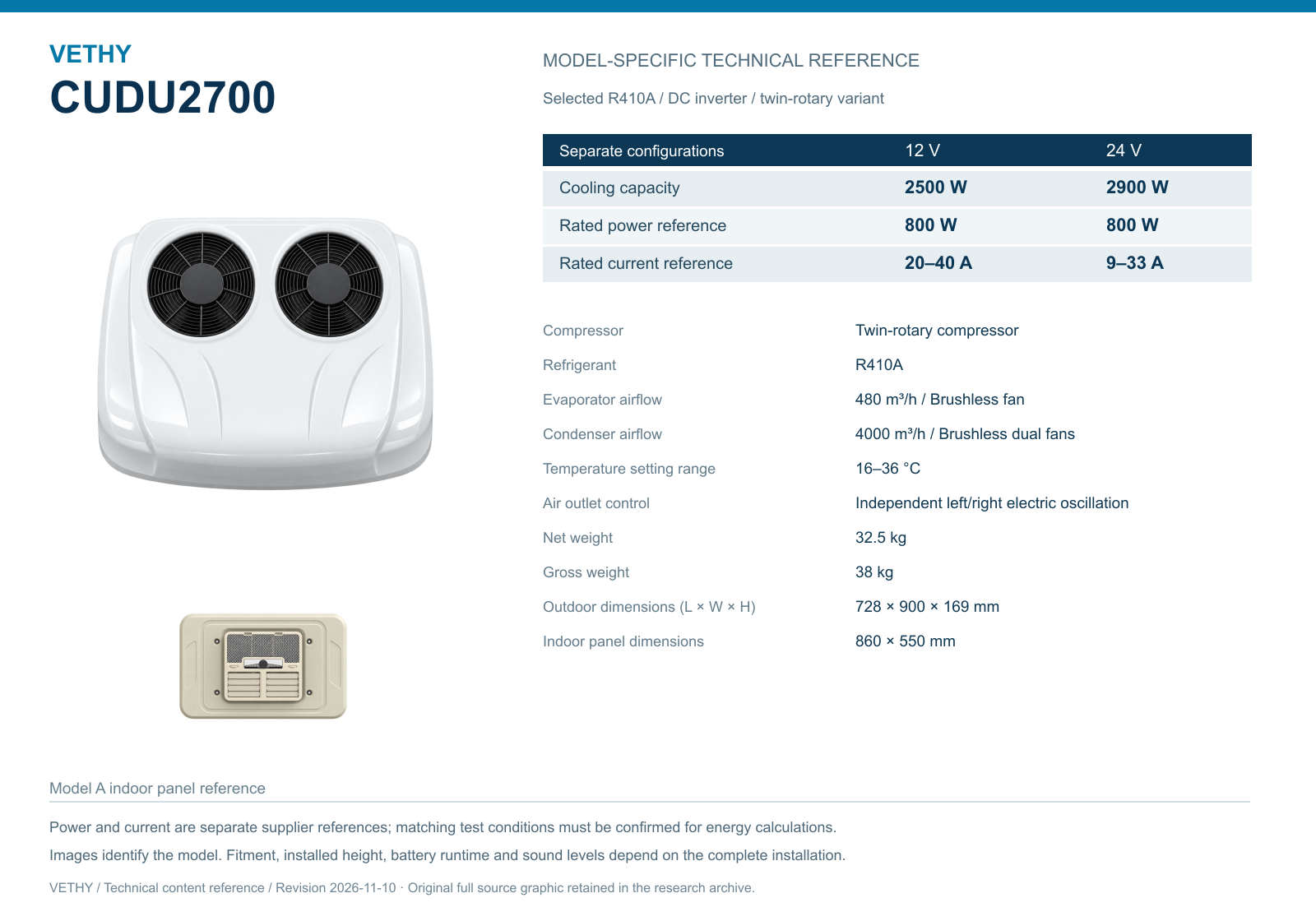
The CUDU2700 R410A condenser uses dual brushless fans with a listed 4000 m³/h airflow reference. Give that outdoor package an appropriate intake, discharge and service environment when coordinating roof accessories. Its 728 × 900 × 169 mm housing defines the product envelope, while the applicable installation information determines the surrounding space.
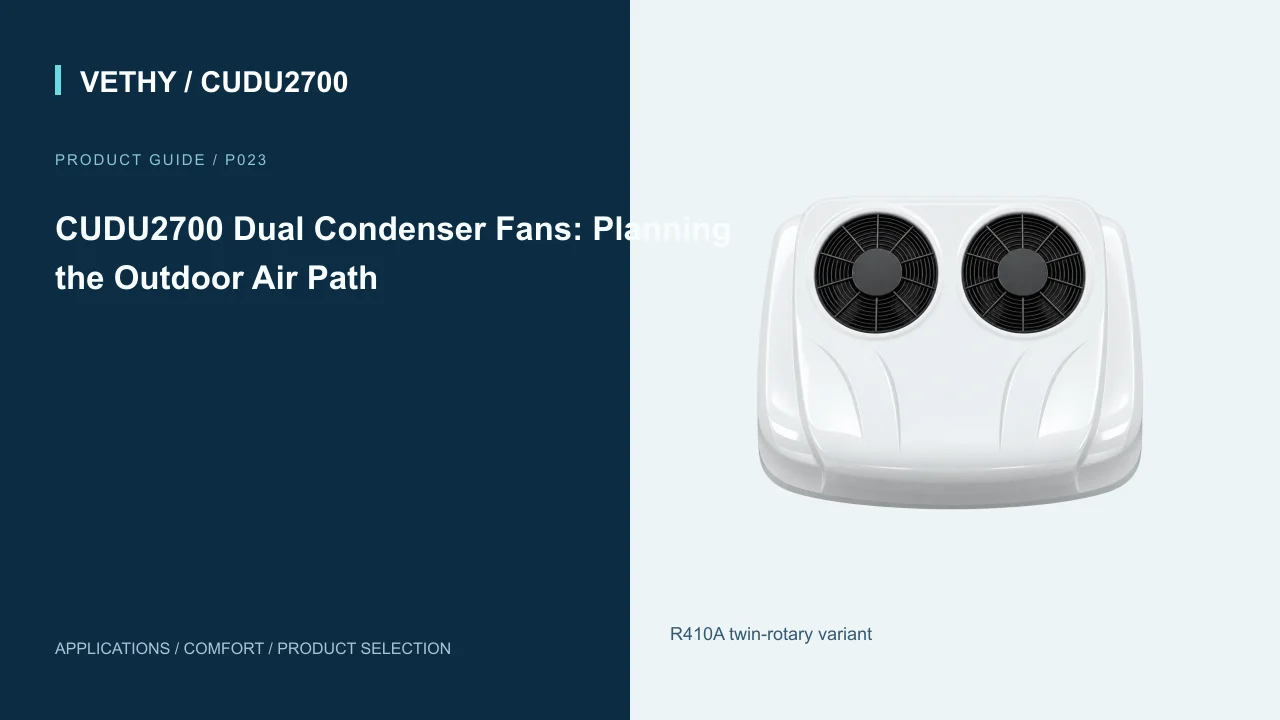
CUDU2700 R410A is an attractive option for an upfitter who wants a rooftop air conditioner with a documented dual-fan condenser arrangement. The outdoor package includes a copper condenser, brushless dual fans and a listed condenser airflow of 4000 m³/h. Those features deserve an intentional place on the roof plan, alongside the equipment the truck carries for its everyday work.
This guide addresses a specific decision: where and how to accommodate that outdoor package when the roof is already a working surface. It uses an illustrative truck with a rear rack and other fixed accessories. The examples are layout reasoning, not VETHY clearance approvals or measured performance tests. The objective is to help the buyer see why CUDU2700 belongs in a coordinated design and what information will make the installation discussion productive.
Draw the working roof before selecting a neat location
Begin with the actual roof rather than an isolated rectangle representing the air conditioner. Include the roof shape, fixed equipment, rack feet, fairings, lights and items that may be carried above the cab. Mark which objects are permanent and which appear only on certain routes. A layout based on an empty rack is incomplete if the rack is normally loaded when cooling is needed.
Place the CUDU2700 footprint on that drawing using its stated dimensions: 728 mm length and 900 mm width. Add the 169 mm housing height separately in a side view. This preserves the source’s dimensional meaning and avoids a misleading top-view representation.
The first location may be chosen for an understandable reason, such as keeping the unit visually centered. That is only a starting proposal. The roof plan should allow the installer to examine the outdoor air environment, mechanical support, sealing and a practical service approach. A visually tidy position is valuable when those functional relationships also work.
For the illustrative truck, show the rack in both its empty and normally loaded state. If tools or equipment extend toward the air conditioner, draw that projection. This simple step can reveal an issue that a close product photograph cannot show. It gives VETHY and the installer enough context to discuss the proposed arrangement rather than guess what surrounds the unit.
A useful drawing also identifies the orientation of each view. A photograph taken from the front of the truck and a plan drawn from above can be misread when passed between teams. Label the vehicle front and show the same accessory names in both. This matters when discussing which side of the air conditioner is close to a rack or fairing. Clear orientation reduces the chance that a sensible layout comment is applied to the wrong relationship, particularly when the supplier is reviewing the vehicle remotely and cannot inspect it directly.
Understand what the dual-fan feature actually establishes
The source establishes a brushless dual-condenser-fan arrangement for the selected CUDU2700 configuration. That is a meaningful product feature. A buyer who wants this architecture can identify it in the offer and use the matching model imagery during the technical discussion.
The feature does not establish every detail of installed airflow. The source used here does not provide a universal clearance envelope, a fan performance curve or a model-specific result for operation beside the example rack. Those points should not be filled with invented dimensions or assumed behavior.
This is especially important in comparisons. Two fans are not independently proof that one unit has greater cooling capacity than every single-fan design. Cooling belongs to the complete refrigeration and air-handling package. The CUDU2700 R410A cooling references are 2500 W at 12V and 2900 W at 24V; fan count is a different description of the product.
The positive buying reason is more precise. CUDU2700 gives the upfitter a known dual-fan package to design around, together with copper condenser construction and the rest of the documented model. If the roof arrangement can support its applicable requirements, the buyer receives a coherent product choice instead of an unspecified outdoor assembly. That is enough to make it a serious candidate without resorting to a fan-count contest.
Keep airflow, cooling output and electrical power separate
The 4000 m³/h condenser airflow reference describes outdoor air volume flow. It is not a cooling rating, an electrical-input figure or a promise of cabin air movement. The indoor evaporator airflow reference is 480 m³/h, and it serves a different part of the system.
A roof-layout review is clearer when these quantities keep their own roles. The condenser airflow belongs in the outdoor discussion. The voltage-specific cooling reference belongs in the cabin application discussion. The supply arrangement belongs in the electrical review. Combining their labels into one headline may look impressive but makes the design harder to understand.
The supplier separately lists 800 W rated power and current references of 20–40 A at 12V or 9–33 A at 24V, with the current entries labelled at 35°C ambient. Their common operating basis is not established. The presence of dual fans does not provide enough information to allocate an assumed share of electrical consumption to each fan or calculate an operating duration.
An upfitter can communicate this simply to the customer: the proposed model has a specified cooling version and a specified outdoor architecture, while the complete installed performance depends on the vehicle arrangement and conditions. This avoids false precision and keeps the conversation useful. The buyer still has concrete data to compare, but each datum answers the question it actually addresses.
Review the rack as equipment in use
On the illustrative truck, the rear rack is the most obvious neighboring object. Its geometry matters, but so does its purpose. A rack carrying a broad object presents a different surrounding arrangement from the same rack carrying narrow secured tools. The layout review should therefore show the normal load and any permitted variations relevant to the roof area.
General engineering reasoning suggests avoiding an arrangement that unnecessarily encloses the air conditioner’s surrounding space or encourages warm discharge to remain close to the unit. That principle does not establish a CUDU2700-specific separation distance. The correct next step is to obtain the applicable installation requirements and review the actual rack configuration against them.
The upfitter should also ask whether a carried item can shift into a position that was absent during the demonstration. The answer belongs in the rack and cargo arrangement, not in a hopeful assumption about the air conditioner. A good layout makes normal operation understandable and reduces dependence on a particular person remembering an undocumented restriction.
For the buyer, this work protects the reason for choosing the dual-fan package. It is counterproductive to select a premium outdoor architecture and then treat its immediate surroundings as leftover storage. Coordinating the rack early can preserve both functions: useful working equipment above the cab and a rooftop cooling unit with an appropriate installation environment.
Loading instructions should remain realistic for the people doing the work. If a proposed arrangement depends on every tool being placed in one exact location, ask whether that pattern will be followed during a busy shift. A roof plan is stronger when normal cargo handling preserves the intended relationships without constant supervision. The rack designer and operator can address that issue together. The air conditioner should not become the accidental reason that a working load is secured poorly, and the carried load should not be ignored simply because the cooling unit fits on the drawing.
Compare layout options by their trade-offs
A useful review develops more than one plausible arrangement before fixed fittings are finalized. The alternatives need not imply that one position is universally correct. They allow the installer and customer to see what each position changes and which requirements need confirmation.
| Illustrative option | Potential attraction | Decision that needs attention |
|---|---|---|
| Unit close to the rear rack | May preserve open roof area forward | Rack loading, surrounding air path and technician approach |
| Unit farther forward | May separate it from stored equipment | Interior panel location, roof structure and other fittings |
| Rack position revised | May create a clearer cooling layout | Rack function, attachment design and carried equipment |
| Accessories redistributed | May avoid crowding one roof area | Wiring routes, visibility needs and maintenance relationships |
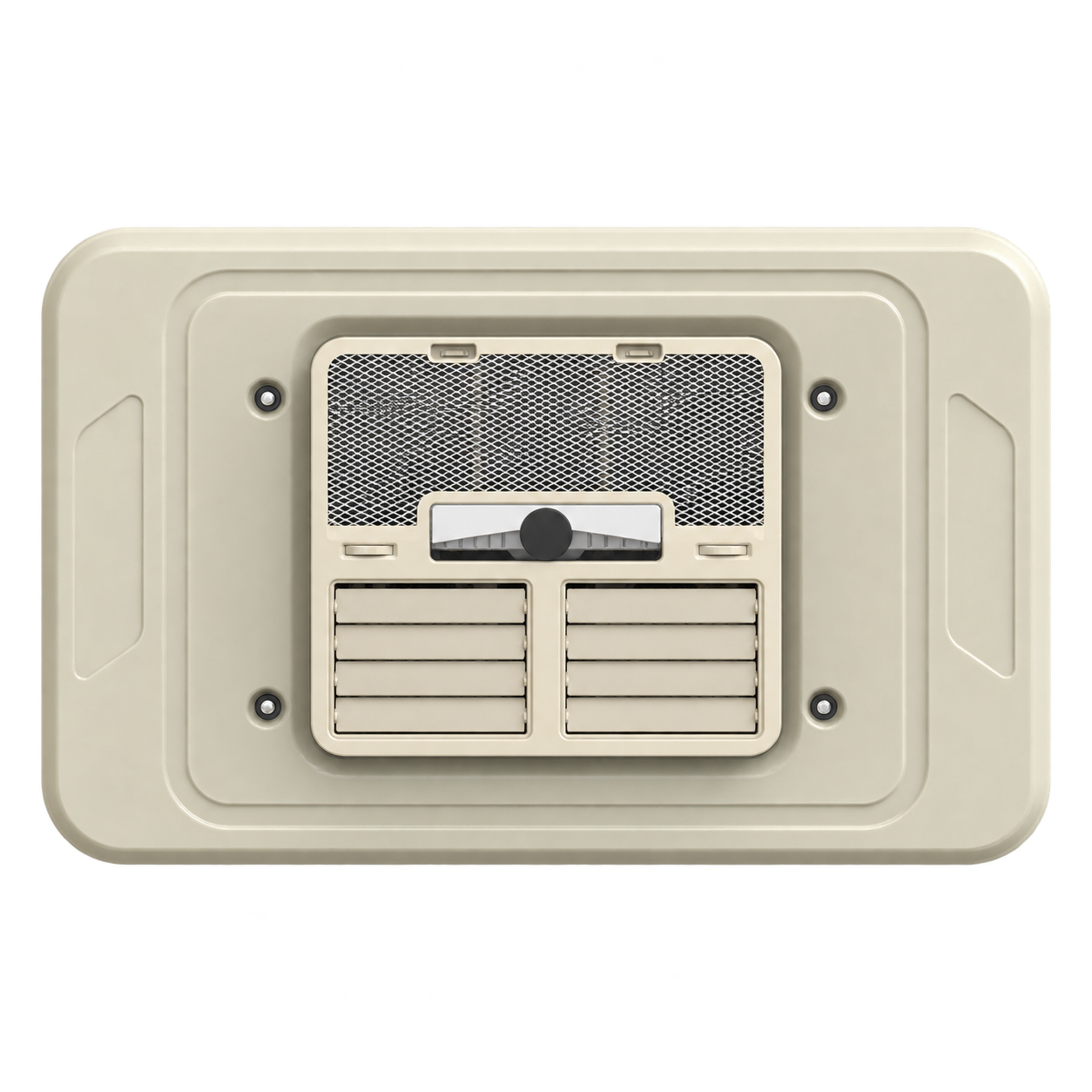
The interior view is an essential companion to this table. Moving the rooftop unit may move the 860 × 550 mm Model A panel relative to cabinets and occupied areas. A promising outdoor change should not create a cabin arrangement that defeats the independent left/right outlet adjustment.
The decision is therefore about the whole vehicle, but the reasoning remains specific: find a location that supports this condenser package while retaining useful indoor delivery and the truck’s working functions. Discuss the alternatives with the responsible installer before treating the preferred sketch as approval. A side-by-side review is often easier for the customer to understand than a long list of isolated cautions.
The layout discussion can also reveal which requirement has genuine priority. A customer may initially ask to keep every existing fitting in place, then decide that a small rack revision is preferable to compromising the cooling position. Another may need the rack unchanged and choose a different overall arrangement. Those are legitimate project decisions. Showing the alternatives gives the customer control over the trade-off and helps the upfitter explain the resulting recommendation. The objective is a roof package that serves its working functions together, rather than a drawing that hides the tension between them.
Distinguish dimensional fit from an approved installation
The CUDU2700 minimum listed opening is 380 × 490 mm. That reference helps identify one physical requirement, but it does not prove that an existing roof opening, support structure or sealing arrangement is suitable. The outdoor unit’s net weight is listed at 32.5 kg, which also belongs in the mechanical review.
On a working roof, accessory attachments and the air conditioner may compete for the same structural area. The upfitter needs a coordinated design rather than separate installations that happen to fit next to one another. The responsible parties should confirm support and the applicable mounting and sealing method for the actual vehicle.
This is not an argument for delaying every decision until the end. The product dimensions allow useful early work. They help the customer eliminate implausible positions, prepare photographs and develop a serious proposal. The distinction is between a proposal that can be reviewed and an installation that has already been approved.
Retain the full dimensional labels in that proposal. Do not substitute the 169 mm housing height for finished vehicle height, and do not substitute the minimum opening for the panel footprint. Keeping these references clear makes the review more efficient and helps the customer appreciate how a relatively low-profile product can be integrated deliberately instead of fitted opportunistically.
Preserve an approach for inspection and maintenance
The roof layout should account for the people who will care for the equipment after delivery. A serviceable arrangement provides an appropriate way to approach the unit and follow the current service procedure. If the roof is filled until only the housing outline remains visible, ordinary inspection can become unnecessarily difficult.
Ask the workshop how the proposed neighboring equipment affects its work. This is a practical discussion about the actual installation, not an invitation to invent a universal service clearance. The answer may influence accessory position, the way a rack is loaded or the order in which parts of a roof package are accessed.
CUDU2700’s copper condenser and dual brushless fans are valuable hardware choices when the buyer wants that specification. Their ownership value is supported by being able to inspect and care for the outdoor air paths appropriately. A premium component description cannot substitute for an inaccessible installation.
Include the agreed service approach in the roof record. Photographs should show enough surrounding area to explain how the unit is reached, rather than only proving that it is present. A later workshop can then recognize why the original layout left particular space available. This is particularly useful when the person adding the next accessory was not involved in the cooling installation and might otherwise consider that space unused.
Where outdoor inspection is difficult, planning becomes more valuable rather than less. A fleet may have only certain workshops equipped to work appropriately around the cab roof. Knowing that constraint can influence how service access is preserved and how concerns are reported. A driver’s photograph can show a changed accessory position, while the workshop handles the actual inspection under suitable conditions. The ownership plan should reflect the operator’s real support arrangement instead of assuming the unit will always be easy to reach wherever the truck happens to stop.
Consider the parked environment as well as the roof
The roof arrangement is permanent, while the vehicle’s parking environment changes. A truck may stop beside a wall, near other equipment or in a busy yard. Those conditions are worth describing when the cooling application is reviewed, especially if the same location is used regularly.
Do not convert a general concern into an unsupported prohibition or separation figure. Instead, tell VETHY and the installer what the recurring site looks like and how the truck is normally positioned. A photograph from the side and above the cab area may explain the context more effectively than a short phrase such as “outdoor use.”
The operator should also distinguish site conditions from product identity when evaluating an experience. A different parking location may change exposure and the surrounding air environment even if the truck’s roof package remains unchanged. Notes about those conditions help explain why two sessions should not automatically be treated as identical tests.
For the customer, this keeps the recommendation grounded in working reality. CUDU2700 can be a strong candidate for a recurring parked-cooling task, while the site and vehicle arrangements are considered together. The supplier receives a recognizable application, and the buyer receives a product discussion connected to the places where the truck actually spends its rest periods.
Demonstrate the finished arrangement from both sides
A prototype should use the intended roof accessories in their representative state. A demonstration performed before the rack is fitted does not fully represent the finished arrangement. Keep the selected voltage and R410A identity attached to the prototype record so the customer knows which product was evaluated.
Outside, document the unit’s location and its neighbors. Inside, let the driver use the Model A panel from the normal occupied position. The independent left/right electric oscillation should have a useful route into the cabin rather than point into storage. The outdoor and indoor observations answer different questions, and both matter to acceptance of the installed package.
Listen inside once ordinary fittings are secured. Twin-rotary architecture and brushless fans support CUDU2700’s qualitative quiet positioning, but the final sound also includes the vehicle and installation. If a rattle appears only after the rack is fitted, describe that observation accurately and investigate its source. Do not immediately assign it to the compressor or claim a sound result from outside the cab.
The demonstration record should show what was installed and what was observed, with relevant conditions. It can establish a useful reference for this truck. It should not be promoted as universal proof of a particular capacity, sound level or energy duration. Its strength is that another person can understand the actual arrangement and the customer can judge whether it serves the intended work.
An acceptance photograph should include scale and context through recognizable vehicle features rather than a misleading perspective. A close image can make a gap appear larger or smaller than it is. Pair photographs with the relevant measured layout when a dimensional relationship is under discussion. This is especially helpful for remote technical review: the image explains the setting, while the drawing carries the dimensions. Neither replaces the other. Together they let the customer discuss the completed dual-fan installation more clearly and retain evidence that remains useful after the original installer has moved on.
Make later accessory changes reviewable
A roof installation can lose its original coherence gradually. A new beacon is added, a rack receives a taller load or a solar panel is placed in a space that looked available. None of these changes necessarily makes the cooling product unsuitable, but each can alter relationships that were part of the original design.
Keep a simple baseline showing the approved configuration. Identify the CUDU2700 unit, roof accessories and any operating arrangement relevant to their coexistence. When a change is proposed, compare it with that baseline and review the affected area using current installation information. The operator then has a concrete process instead of relying on memory.
This is a commercial advantage for upfitters who sell complete vehicle packages. The customer understands why the roof was arranged in a particular way and can ask informed questions before modifying it. The installation remains a deliberate solution rather than a collection of unrelated fittings.
For fleets, group vehicles by materially relevant roof differences. A truck with a different rack should not be treated as identical merely because the cab model matches. The repeatable item is the reviewed configuration and its important relationships. That gives CUDU2700’s dual-fan architecture a consistent application while allowing the truck’s other working needs to be accommodated responsibly.
Questions about the dual-fan roof layout
Is 4000 m³/h the amount of air delivered inside the cab?
No. It is the listed condenser airflow reference. The evaporator airflow is separately listed at 480 m³/h.
Does this guide provide a universal clearance distance?
No. Obtain the installation requirements for the selected configuration and review the actual roof and accessory arrangement against them.
Can a roof rack share the roof with CUDU2700?
That depends on the complete vehicle layout. Review the rack in its normally loaded state, along with air paths, structure, service approach and interior panel placement.
Do dual fans prove better cooling than a named single-fan product?
Fan count alone does not establish that comparison. Evaluate the complete product and installation, using evidence appropriate to the result being claimed.
Choose the dual-fan package with a coordinated roof plan
Recommend CUDU2700 R410A when the customer wants its documented dual brushless condenser-fan package and the vehicle can provide an appropriate rooftop arrangement. The broader CUDU2700 product guide explains the remaining construction and cabin features.
Prepare a roof plan, photographs of normal rack loading, an interior panel view and the selected voltage requirement. Share them with VETHY engineering or contact VETHY to discuss a concrete installation. More focused applications are linked from the CUDU2700 guide hub.
Product sources
VETHY product recommendation and application analysis. Specification references identify the selected model and voltage. Installation examples are planning examples; measured project results are identified explicitly when available.
Discuss your CUDU2700 application
Send your vehicle, supply voltage, occupied space, parking schedule and installation photographs for a model-specific recommendation.
Prepare your vehicle brief ↗