
VETHY / X79 / PRODUCT AND APPLICATION GUIDE
X79 Cooling Energy Planning for a Real Rest-Period Schedule
Plan X79 energy use around the complete rest schedule, not one current endpoint. Identify the correct voltage version, usable auxiliary energy, other loads, reserve and recharge opportunity. The source's rated-power and current fields remain separate references. Use appropriate installed operating information to assess the actual cooling period and supporting electrical package.
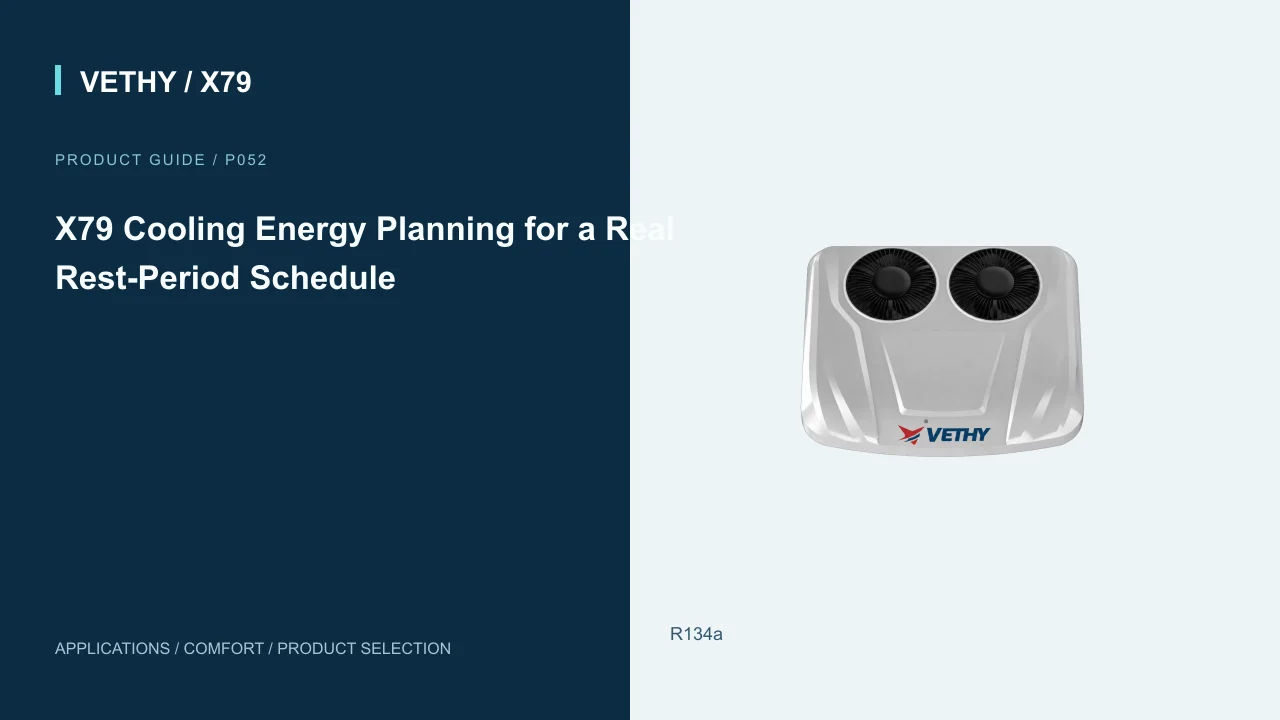
An X79 energy plan should describe the rest period the driver wants to use, not merely the battery the truck happens to carry. The cooling unit, other electrical loads, available reserve and next recharge opportunity all belong in the same conversation. X79's energy-efficient positioning and documented DC inverter twin-rotary architecture are reasons to consider it for an energy-conscious parking comfort package. A clear schedule makes that package practical.
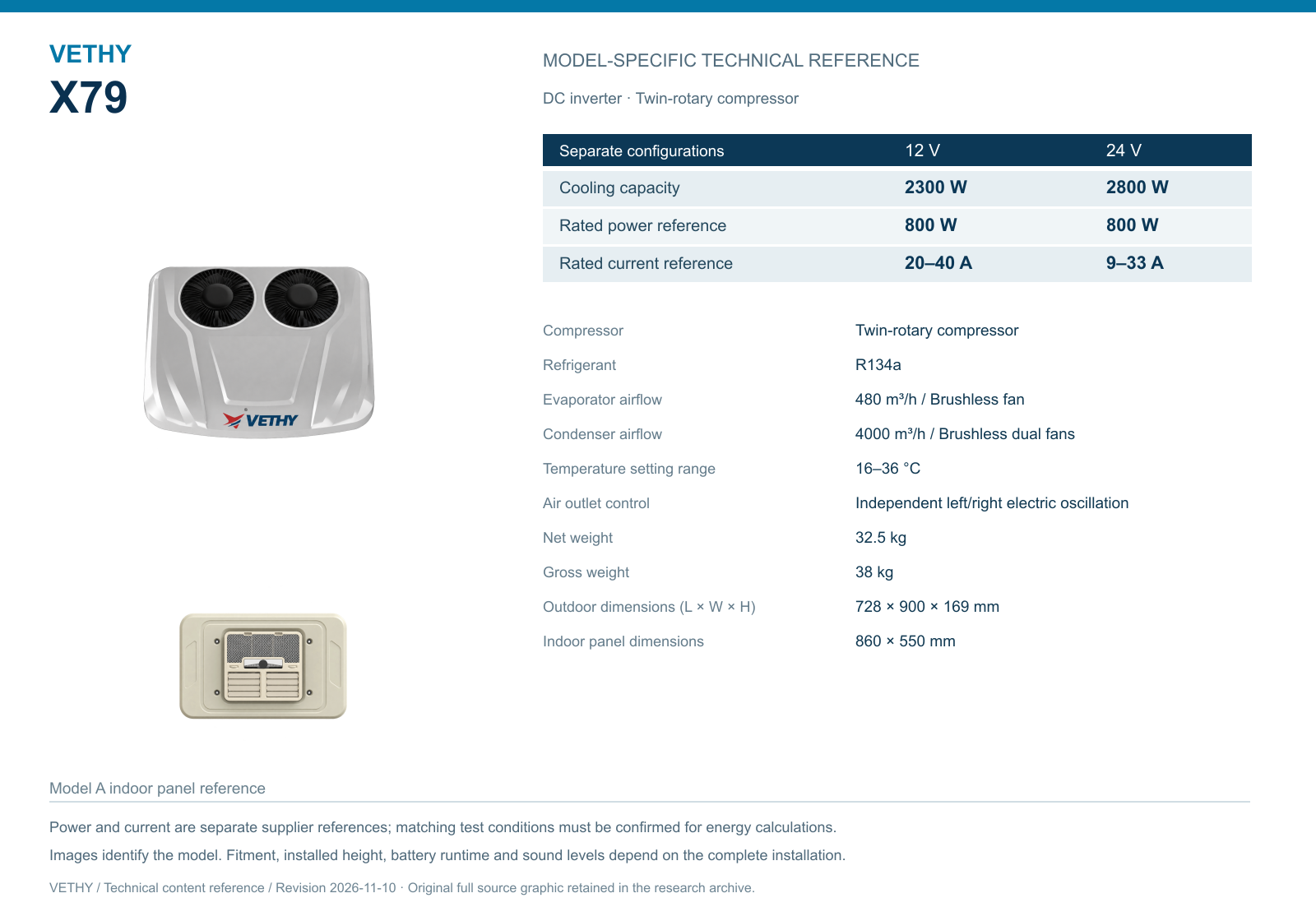
The model has separate 12V 2300 W and 24V 2800 W cooling versions. Its source lists an 800 W rated-power reference and current references at 35°C ambient of 20–40 A for 12V and 9–33 A for 24V. Those fields are not paired at one common declared operating point. This guide explains how to use them responsibly while building a real project brief, with the emphasis on a useful energy plan rather than an unsupported hours promise.
Begin with the stop the driver actually needs
Write down the intended parking routine before discussing equipment capacity. When does the truck arrive, how long is it parked, and where does the driver spend that time? Does the stop include paperwork in the front seat, food preparation, a longer bunk rest or repeated door opening during loading? These details describe the cooling task and the period the supply must support.
A route may also include more than one stop between meaningful recharge opportunities. In that case, the relevant energy schedule is not only the longest single rest. The project team needs to understand the sequence of stops and driving periods. The air conditioner can be one defined product across the route, while its energy support must reflect the way the vehicle is actually operated.
For a buyer, this approach turns a broad request for long battery life into a reviewable brief. X79 can be assessed for the cab and routine, and the electrical designer can address the complete supporting supply. The X79 product guides provide the model context. The schedule supplies the application context that no product name, cooling figure or battery label can establish on its own.
Separate cooling output from electrical input
The 2300 W and 2800 W figures are cooling capacity references for the 12V and 24V versions respectively. They are not the electrical energy drawn in every hour. The named 800 W rated-power field is a separate electrical reference. The current ranges are also separate fields, with a 35°C ambient condition stated for those references.
Because the values are not paired at one common declared point, do not divide them into one another to create an asserted EER or COP. Do not select the lowest current endpoint and multiply it through a whole night as if it were a measured operating profile. These shortcuts can produce a confident-looking number without describing the actual installation.
The useful alternative is straightforward. Keep the supplier references visible, request the electrical and operating information needed for the proposed equipment, and have the supporting supply assessed for the intended conditions. Where installed energy observations are used, record their conditions and scope. This gives the buyer a sounder basis for planning and lets the product's energy-conscious proposition remain credible. X79 is being recommended as a defined cooling package within an appropriate system, rather than being asked to prove an invented runtime from unmatched fields.

Identify usable energy rather than a headline battery size
The energy available for cooling is not necessarily the full headline capacity of a battery system. The electrical designer should account for the actual equipment, its permitted operating range, condition, other demands and the reserve required by the vehicle operator. The project may use a dedicated auxiliary arrangement or another approved supply design. The right answer depends on the truck.
For the buyer, the useful question is how much energy the complete system is intended to make available for the planned stop after those considerations. Keep that answer attached to the installation proposal. It should not be replaced by a casual assumption that every battery with a particular label supports the same cooling routine.
This also makes comparisons between proposals more meaningful. Two quotations can use the same X79 version yet offer different supporting energy arrangements. The customer should understand what each package includes and what operating plan it is intended to support. A clear supply description, reserve policy and recharge plan help the buyer compare complete solutions. The air conditioner remains the selected product, while the energy package makes its use practical for the route. That is a positive, accountable way to sell battery-powered comfort.

Include every regular load in the worksheet
Cooling is often the largest comfort topic in the buying discussion, but it is not always the only electrical activity during rest. Lighting, a refrigerator, communications devices or other equipment may remain active. The energy planner needs the actual list for the vehicle rather than a generic assumption about a typical truck.
Ask the driver and workshop to identify what is used and when. Some items run through the whole stop, while others are used briefly during arrival or departure. The point is not to burden the driver with detailed electrical calculation. It is to give the designer an accurate account of the routine so the complete supply can be assessed.
For a fleet, a short standard worksheet can make this manageable. Keep the selected X79 voltage version visible, then list the other loads by operating phase. The designer can add the appropriate technical information and assumptions. The technical project information page is a useful place to start gathering the vehicle supply and intended use. A complete load picture helps the customer understand why a realistic energy plan is more valuable than a single unsupported overnight cooling claim.
Use a schedule table that a dispatcher can understand
The following table is an illustrative planning worksheet. It describes questions to answer, not measured X79 consumption or automatic operating modes.
| Part of the schedule | Cooling context | Other information to record | Planning decision |
|---|---|---|---|
| Arrival after driving | Cab starting condition and sun exposure | Recent charging opportunity and active equipment | Define the actual starting energy condition |
| Short seated stop | Driver remains forward in the cab | Lights, devices and door opening | Include the occupied task and concurrent loads |
| Settling into the bunk | Curtains and bedding move into place | Change in occupied zone and equipment use | Describe the normal rest arrangement |
| Longer rest | Doors may remain closed more consistently | Regular loads and required reserve | Assess the intended complete cooling period |
| Interruption or extension | Stop changes from the original plan | Additional time and new loads | Define how the operator handles the changed schedule |
| Return to work | Cooling use ends or changes | Next recharge opportunity | Confirm how energy is restored for later stops |
This format allows dispatch, drivers and the workshop to contribute without each person doing the same job. The final electrical assessment belongs with the appropriate technical team. The schedule simply ensures that the assessment describes real operations.
Use the inverter architecture in the right part of the discussion
X79's DC inverter twin-rotary architecture is relevant to cooling demand that changes over time. A cab may begin warm and become easier to maintain after the interior settles. The complete controls determine the actual system response. The source does not document a precise minimum draw, compressor speed range or proprietary energy-management algorithm.
The useful buying implication is to evaluate the whole stop rather than one selected instant. Arrival, established rest and an interrupted stop can create different conditions. A product demonstration and any installed energy observations should identify which part of the routine they represent. This helps the buyer understand the application without assuming every hour is identical.
For a fleet, the architecture becomes one reason to shortlist X79 alongside its copper refrigeration components, brushless fans and flexible indoor air direction. The energy plan then supports the selected model with a compatible supply and realistic schedule. This keeps the recommendation positive and grounded. The customer can value the documented design direction while still receiving a complete system proposal that explains where the energy comes from, what else uses it and how the vehicle prepares for the next stop.
Reduce avoidable demand through the cabin arrangement
An energy-conscious cooling project should also consider the cab itself. Sun exposure, open doors, curtain position and obstructed air delivery can affect the task the cooling system is asked to perform. These are application conditions, not X79 test results. They are useful because the driver and fleet can often describe them clearly before the order.
X79's Model A panel offers independent left and right electric oscillation, supported by a brushless evaporator fan and a 480 m³/h airflow reference. Arrange the panel so air reaches the occupied area and demonstrate it with normal storage and bedding. A driver who can direct air comfortably may have a clearer way to address local discomfort than repeatedly changing the temperature setting.
Shade and ordinary cabin preparation can also belong in the routine where practical and appropriate to the parking location. Do not attach an invented percentage saving to these measures. The positive message is that the vehicle can help the cooling system serve the intended space. The VETHY truck application overview connects this cabin discussion to the wider parking project. A useful energy plan includes sensible use as well as the supporting electrical equipment.
Connect the energy system with the real roof package
The electrical plan and the physical installation should develop together. X79's outdoor envelope is 728 × 900 × 169 mm, with a 32.5 kg net weight reference. Its indoor panel measures 860 × 550 mm, and the minimum opening reference is 380 × 490 mm. The installer needs a vehicle-specific mounting and sealing proposal, not only a suitable supply.
The outdoor side also needs the approved air environment for the copper condenser and brushless dual fans. If the vehicle carries solar equipment or other roof accessories, show them in the same layout. The buyer should not assume that an energy-related accessory can be placed independently of the cooling unit's surroundings.
For a fleet, this is a practical coordination task. The electrical supplier, installer and purchasing team should work from the same intended configuration. A clear proposal identifies responsibilities and leaves the customer with one understandable package. X79's low profile and defined component set are useful product attributes; the coordinated installation makes them usable on the truck. The energy discussion is therefore part of a complete parking comfort project rather than a battery calculation carried out after every other decision has already been fixed.
Define how the plan handles a longer or different stop
Real routes can change. A loading delay may extend a stop, a driver may need a different rest position or the weather may differ from the demonstration. The energy plan should explain how the operator responds to a changed schedule within the approved installation and supplied instructions. That response belongs in the operating handover, not in an improvised promise that the system always has enough energy.
The customer can ask practical questions. Who decides when the planned period changes? What information should the driver report? How does the fleet protect the required reserve? Which instructions apply to the installed supply system? These questions help the electrical team create a usable plan without the sales article inventing cutoff values or undocumented control modes.
For X79, the benefit is a more confident recommendation. The product is selected for an intended assignment, and the supporting system has a clear operating context. The driver does not need to interpret unpaired current fields while parked. Instead, the handover explains the agreed routine and the contact path when it changes. A complete package is easier to use when its normal conditions and exceptions are understandable to the people responsible for the vehicle.
Evaluate installed energy observations with their conditions attached
Where the project records installed energy use, retain the conditions that make the observation meaningful. Identify the X79 voltage version, cab arrangement, weather context, starting state and the period observed. Include other regular loads if the observation covers the complete auxiliary system. A number without that context can easily be applied to the wrong vehicle or routine.
The aim is not to turn every first installation into a research program. A representative, well documented observation can help the buyer understand the selected package and refine the operating plan. The technical team should determine what information is appropriate and how it is collected. The sales explanation should describe the scope honestly rather than present a limited observation as a universal product guarantee.
For a fleet, keep the record with the approved configuration. Later vehicles can be compared with that starting point. A different roof, interior or route may deserve review, while similar vehicles can benefit from the established information. This is a practical path from X79's energy-efficient positioning to accountable ownership: define the task, specify the package, observe the relevant installation and keep the conditions visible when the result informs another decision.
Give purchasing a complete system description
The final order should identify the X79 voltage version, the documented cooling reference and the agreed installation scope. It should also identify the supporting energy arrangement and which party supplies or designs it. The buyer should understand what is included, what information remains necessary and what the representative installation will assess.
For distributors, this avoids selling the same air conditioner under several incompatible runtime stories. The product facts remain stable: R134a DC inverter twin-rotary technology, copper evaporator, condenser and piping, brushless fans and independent outlet movement. The energy proposal changes only as the actual vehicle and schedule require. The distinction is easy to explain and helps customers compare complete packages more fairly.
For fleet purchasing, retain the schedule and supply description with the product record. When another vehicle is ordered, the team can ask whether its route and electrical platform match the established configuration. That reduces reliance on memory and makes exceptions visible. A premium cooling product earns its value through a complete result; the energy plan is one of the ordinary pieces that turns X79 from a shortlist candidate into a working part of the truck.
A useful example is a fleet whose trucks use the same cab but return to different depots. Their occupied cooling task may be similar, yet their recharge opportunities may differ. The recommendation can retain a common X79 model where appropriate while reviewing the supporting energy arrangement for each operating group. This is more precise than assuming a common cab automatically creates a common battery routine.
The buyer can also use the schedule to improve the first supplier discussion. Instead of asking only how many hours the unit runs, explain when the truck parks, which loads stay active and when it next recharges. The supplier and electrical team can then identify the information needed for a concrete proposal. The result is a more useful conversation and a clearer path to an energy-conscious comfort package suited to actual work.
The planning worksheet can also record the owner of each assumption. Dispatch can confirm the expected stopping pattern. The workshop can confirm the installed supply equipment and relevant technical information. The driver can confirm which devices are actually used during rest. Purchasing can retain the selected X79 version and the agreed package. This is a practical way to keep the plan accountable without asking one person to guess every detail.
When an assumption changes, update the relevant part rather than rewriting the product story. A longer route may affect the recharge discussion. Additional electrical equipment may affect the total load picture. A different sleeper curtain may affect the cooling assignment. X79's documented model facts remain the same, while the vehicle plan reflects the new conditions. The separation helps the buyer understand why a review is needed and what it is intended to resolve.
This also creates a useful basis for comparing quotations. Ask each supplier to describe the intended schedule and system scope behind its proposal. If a duration claim is offered, ask what complete configuration and conditions it describes. The purpose is to obtain a concrete, comparable package, not to turn the purchase into a generic demand for proof. A well prepared X79 proposal can lead with the product's real strengths and make the supporting energy responsibilities clear enough for the customer to approve and use.
Questions about X79 rest-period energy planning
Can the lowest listed current be used for a whole-night estimate?
Not as a universal operating profile. The current range is a supplier reference with a stated 35°C ambient condition, and it is not paired with all other fields at one common point. Use appropriate installed operating information and a complete supply assessment for the intended schedule.
Does the 800 W field establish the same draw in every phase?
No complete hourly profile is established by that named rated-power reference. Keep it separate from the current range and cooling capacity. The project needs information appropriate to the actual equipment, conditions and operating plan before discussing energy use through the whole stop.
Can the same X79 version serve different route groups?
It may be worth assessing where the cab and electrical platform fit, but the energy support should reflect each group's schedule and recharge opportunities. A common air conditioner does not mean every vehicle has identical usable energy, other loads or reserve requirements.
What should be prepared before requesting an energy proposal?
Provide the truck and cab details, voltage platform, intended stop schedule, other electrical loads, available supply information and next recharge opportunity. Add roof and interior photographs. These facts help the supplier and electrical designer connect the selected X79 configuration with a realistic complete package.
Recommend X79 with a schedule the system can support
X79 belongs in an energy-conscious parking cooling discussion when its documented architecture, copper components, brushless fans and adaptable outlets fit the vehicle. A realistic rest schedule and supporting electrical plan make that choice practical.
Send the vehicle and operating information through the VETHY contact page. Request an X79 proposal that keeps cooling selection, usable energy, reserve and recharge planning visible. The next step should be a reviewable package for the actual route, with a clear first-vehicle assessment and driver handover.
Product sources
- VETHY X79 confirmed product specifications — VETHY.
- X79 technical reference sheet — VETHY.
VETHY product recommendation and application analysis. Specification references identify the selected model and voltage. Installation examples are planning examples; measured project results are identified explicitly when available.
Discuss your X79 application
Send your vehicle, supply voltage, occupied space, parking schedule and installation photographs for a model-specific recommendation.
Prepare your vehicle brief ↗