
VETHY / X79 / PRODUCT AND APPLICATION GUIDE
Reading the X79 Product Images and Specification Sheet Before Ordering
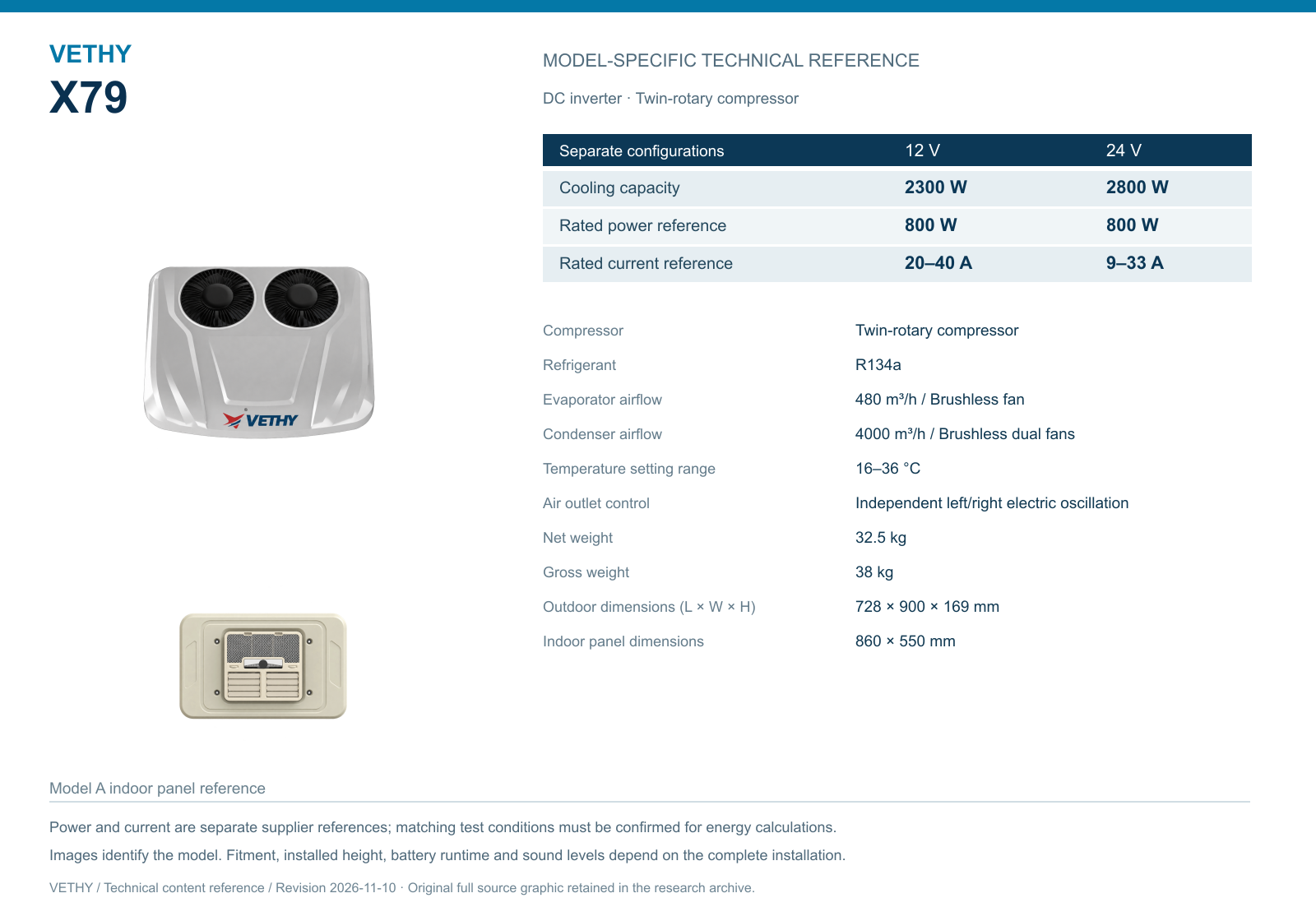
Use X79 images to understand the real product form and panel, then use the confirmed specification to identify ratings and construction. Keep 728 × 900 × 169 mm outdoor dimensions, the 860 × 550 mm panel and separate voltage references distinct. A clear image review should lead to a vehicle-specific proposal, not an assumed universal fit.
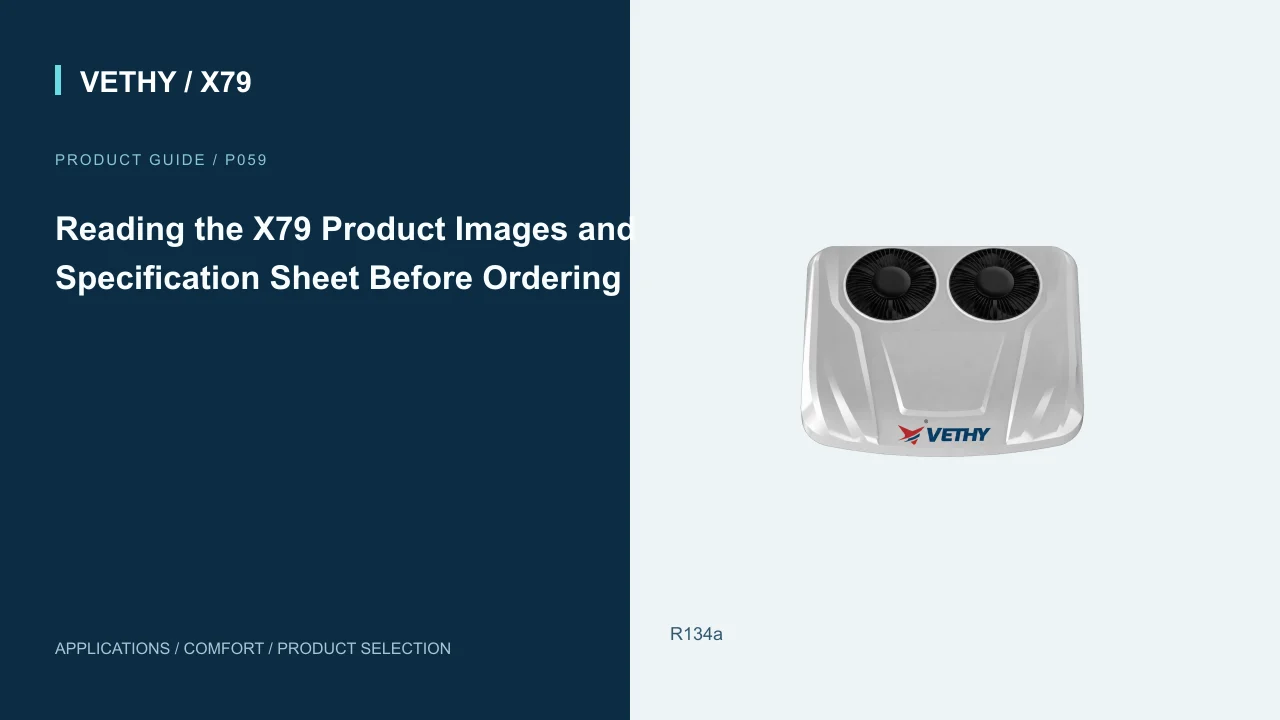
A buyer can learn a great deal from X79 product images when each image is used for the right purpose. The outdoor photograph shows the rooftop form of the model being discussed. The Model A indoor image shows the user-facing panel. The technical reference sheet carries the confirmed product data. Together, they make the offer easier to understand and help the customer prepare a useful vehicle inquiry.
The strongest review keeps visible appearance and documented specifications connected without confusing them. An exterior image does not prove every hidden material detail, and an attractive layout does not establish fit on every truck. X79's confirmed R134a DC inverter twin-rotary architecture, copper refrigeration components, brushless fans and independent outlet movement give the buyer a clear product identity. This guide explains how to read the supplied visuals, verify the important fields and turn that understanding into a concrete order discussion.
Begin with the model name across all materials
The outdoor image, indoor panel image, technical sheet and quotation should all refer to X79. This sounds simple, but it matters in a range containing several rooftop products. A visually similar unit can carry different refrigerant, capacity or construction information. The buyer should not have to infer that an image is only a substitute or that a table belongs to another model.
Start the review by asking whether the materials form one consistent product package. The confirmed X79 source names separate 12V and 24V versions. It identifies R134a and DC inverter twin-rotary technology. It also identifies the Model A panel and the X79 outdoor dimensions. Those facts should remain consistent wherever the model is presented.
For an importer, this consistency supports a clearer customer offer. For a fleet, it helps purchasing and the workshop identify the same equipment. The X79 product guide collection provides the model's public reference context. A buyer reviewing a new proposal should use matching materials as the starting point, then assess how the product fits the actual vehicle rather than treating every rooftop air conditioner image as interchangeable.
Read the outdoor image for product form and identity
The real X79 outdoor asset helps the customer recognize the rooftop body and understand the model's visual presence on a vehicle. It is useful for discussing appearance, the proposed roof location and the relationship to nearby equipment. It should be shown alongside correctly labeled dimensions rather than expected to communicate scale by itself.
A product cutout does not include the actual roof, mounting interface or surrounding accessories. The buyer should therefore connect it with vehicle photographs before approving a location. The installer can then prepare the appropriate layout. This makes the image a practical communication tool rather than a suggestion that the model fits every empty patch of roof.
The outdoor image also should not be used to claim hidden construction that is not visible. X79's copper evaporator, condenser and refrigerant piping are documented in the confirmed specification. Present those facts clearly as specification information. The exterior image establishes the real product form. Each source has a useful role, and keeping the roles distinct makes the offer more trustworthy and easier to compare. The buyer sees what the product looks like and understands which details come from the accompanying technical record.

Read the indoor image as the user interface to comfort
The X79 indoor image shows the Model A air distribution panel associated with the product. The source identifies independent left and right electric oscillation and gives panel dimensions of 860 × 550 mm. These details help the buyer understand what occupants will interact with inside the cab.
Use the image to discuss the panel area relative to cabinets, curtains and the bunk. A drawing or photograph of the real interior should show where the panel is proposed. The product image alone cannot reveal whether a travel bag or curtain track will interrupt the intended route. Those vehicle details belong in the installation review.
The independent movement is a practical feature to demonstrate. It concerns air direction within one cooling system, not separate temperature zones. A driver may want air around the shoulders while a co-driver prefers another path toward the sleeper. The image can introduce that function, but the actual demonstration shows how it feels at the occupied positions. This is a convincing use of product visuals: the buyer can move from recognizing the panel to understanding a daily comfort benefit that is relevant to the cab being assessed.

Read the dimension labels before judging scale
X79's outdoor envelope is 728 × 900 × 169 mm, expressed as length, width and height. The source convention for a straight top view places 900 mm width horizontally and 728 mm length vertically. The 169 mm figure is a height callout. Do not use an unlabeled image orientation to reverse the length and width or imply the height is a top-view axis.
The indoor panel is 860 × 550 mm. The minimum opening reference is separately listed as 380 × 490 mm. These are not competing descriptions of one object. The outdoor envelope helps the roof layout, the panel dimensions help the cabin space review and the opening begins the vehicle interface assessment. The source does not establish panel thickness.
A useful buyer review checks that the technical sheet labels these references clearly. If a quotation or drawing omits the axis order, ask for clarification before treating it as the final layout. The VETHY engineering overview provides context for coordinated vehicle integration. Correct dimensions make the product easier to apply, but the actual roof structure, mounting, sealing and finished height still require the vehicle-specific proposal.
Keep the two voltage rows separate
The X79 specification lists 2300 W cooling for 12V and 2800 W for 24V. Keep the voltage and cooling reference together when reading the sheet and requesting an order. A short headline showing only one capacity can hide which version it describes.
The correct version follows the vehicle supply and assessed cab assignment. The higher cooling figure does not mean every 12V truck should be converted to 24V, nor does a similar outdoor appearance make the versions interchangeable. The electrical design belongs to the complete vehicle package and should identify the appropriate supply, protection and energy arrangement.
The sheet also lists an 800 W rated-power reference and separate current ranges at 35°C ambient: 20–40 A for 12V and 9–33 A for 24V. These are unpaired supplier fields, not a common operating point for deriving an efficiency or runtime. A useful visual review preserves the labels instead of compressing them into an attractive but misleading performance badge. The buyer gains a clearer comparison because cooling, electrical references and voltage version remain distinct throughout the discussion.
Use a visual review table
The following table shows what each supplied visual or field can help the buyer understand. It also identifies the next application question that the product material cannot answer by itself.
| Material or field | Useful information it provides | Next project question |
|---|---|---|
| X79 outdoor photograph | Real product form and model identity | Where will it sit on the actual roof? |
| Model A indoor image | Panel appearance and outlet arrangement | How will it serve the normal seat and bunk positions? |
| Outdoor dimensions | 728 × 900 × 169 mm envelope | What is the approved mounting and finished vehicle layout? |
| Panel dimensions | 860 × 550 mm face area | Are storage, curtains and access coordinated? |
| Minimum opening reference | 380 × 490 mm starting interface information | Is the actual roof suitable for the proposed installation? |
| Voltage rows | Separate 12V and 24V cooling references | Which version belongs to the vehicle platform? |
| Copper component statement | Evaporator, condenser and piping scope | Is the exact material description retained in the order? |
| Fan references | Indoor and outdoor air movement package | Are both air environments included in the layout? |
This table makes the review practical. The buyer can learn from the product material while recognizing which questions need the actual vehicle. That is the route from a specification image to a useful installation proposal.
Interpret copper construction at the documented scope
X79's all-copper positioning is clarified by the source: copper evaporator, copper condenser and copper refrigerant piping. These are named refrigeration components. The statement does not establish that the housing, every fin or every bracket is copper. A customer-facing sheet should preserve that precise scope.
This is especially important when an image includes a copper color accent or a stylized material label. Design can make a page attractive, but it should not change the technical meaning. The buyer should be able to find the component names and carry them into a quotation. The exterior photograph is not expected to prove the internal material details by itself.
For an importer, the practical benefit is consistency across sales materials. The same description can be used on the website, during a demonstration and in the order. For a fleet, it helps retain what was selected. X79's construction package is a legitimate reason to consider the product alongside its inverter twin-rotary architecture and airflow features. Accurate wording strengthens that reason because the customer knows what the material claim covers, rather than needing to guess from a broad headline or a decorative illustration.
Distinguish indoor and outdoor fan information
The source identifies a brushless evaporator fan with a 480 m³/h airflow reference. It also identifies brushless dual condenser fans with a 4000 m³/h reference. A good technical sheet keeps those values attached to the correct side of the product. They are not two cabin airflow figures and should not be added together.
For the buyer, the practical interpretation is that X79 has a defined air movement package on both sides. Inside, the panel and normal cabin arrangement determine how useful air reaches the driver. Outside, the roof environment should preserve the approved intake, discharge and access conditions. The fan specification becomes part of a complete installation conversation.
Use the images to introduce those two environments. Then show the actual roof and interior photographs in the project brief. The VETHY truck application overview helps connect the product with the parking routine. This is an effective way to explain a technical sheet without overwhelming the customer: identify the two paths, retain the correct values and ask how each will be supported on the intended vehicle.
Treat quiet and energy-efficient labels as qualitative positioning
The confirmed X79 source supports quiet and energy-efficient positioning. It also documents the architecture and fans that belong to the product. The supplied material does not establish a verified decibel result, a percentage saving or a universal rest duration. A sheet should not silently add those numbers simply because the design has room for another badge.
A customer can still understand the appeal clearly. X79 offers a documented inverter twin-rotary rooftop package with copper refrigeration components, brushless fans and adaptable indoor direction. The appropriate next step is a representative installation and occupied-position demonstration. The buyer can assess the actual rest environment and supporting energy package under relevant conditions.
This is a useful visual review habit: distinguish model facts, qualitative product positioning and application results. All three can contribute to a convincing offer, but they should not be blended into a claim broader than the source. The result is a clearer product page and a more useful buying conversation. The customer knows why the model is worth assessing and what the first vehicle should establish before the package is repeated across a fleet or distributor program.
Connect the sheet with a real vehicle inquiry
Once the buyer understands the product materials, the next step is to provide the application details. Send the truck model, supply voltage, roof photographs and interior arrangement. Include the normal occupied positions, curtain and storage, plus the intended stop schedule. The supplier and installer can then relate the X79 package to the actual vehicle.
The technical project information form helps organize that brief. The buyer does not need to solve the installation independently. The useful task is to make the real conditions visible so the proposal can address them. The installer can identify any further measurements, inspection or technical information needed.
A concrete inquiry also improves quotation comparison. The selected voltage version and installation scope can be stated clearly, with the same product identity shown in the materials. The customer can ask what is supplied, what work is local and what the first installation will demonstrate. The specification sheet has then done its job: it has helped the buyer understand the model and prepare a focused request, rather than encouraging an order based on appearance alone.
Retain the version used to approve the order
The approved product information should be easy to find later. Keep the matching X79 images, technical reference and quotation with the vehicle or customer record. Retain the exact voltage version and completed installation layout. This helps the workshop identify equipment and helps purchasing repeat a configuration without relying on memory.
If a material or layout is updated, identify the change clearly. The organization should know which version was used for the current order. A distributor handling several product families benefits from this discipline because old images and unrelated parameters can otherwise return to new offers. A fleet benefits because the equipment received can be compared with a clear record.
This is ordinary information management, but it adds practical value to a premium product program. X79's documented features remain stable and recognizable while the vehicle-specific proposal explains the application. A colleague who did not attend the sales demonstration can still understand what was selected, why it was suitable and where to find the relevant instructions. That continuity supports a clearer handover and a more accountable path from first product image to working installation.
A useful example is a buyer comparing two proposals that use similar outdoor photographs. The first gives a short headline, while the X79 proposal includes the correct voltage row, panel dimensions, copper component scope and installation brief. The advantage is not that one photograph looks more impressive. It is that the second package gives the customer enough information to understand and request the product accurately.
The buyer can then ask a focused question about the actual cab instead of guessing from the image. Where will the larger panel sit? Which voltage version is intended? How will the outdoor fan environment be preserved? These questions lead to a concrete recommendation. X79's real product assets and confirmed data make that conversation possible, with the technical sheet acting as a bridge between product interest and a reviewable vehicle package.
A customer can make the review easier by separating three questions. First, is this the exact X79 product being offered? Use the matching images and model information to answer that. Second, which voltage version and configuration belong to the vehicle? Use the supply and occupied routine with the technical references. Third, how will the package be installed? Use the actual roof and interior information with the responsible installer. These questions connect naturally, but each needs a different kind of evidence.
This sequence is particularly useful for a buyer who receives a technical sheet through a messaging app. The image may be small, rotated or detached from the original product page. Before using it for an order, confirm the model name, voltage row and dimension labels in a readable version. Then retain that version with the quotation. A clear record is more useful than a collection of cropped screenshots whose relationship to the final package is uncertain.
For a distributor, the same review can improve sales materials before they reach customers. Check that a caption names the feature actually shown, that the image belongs to X79 and that the specification wording preserves the confirmed scope. The presentation can remain attractive, with concise benefits and real application examples. Accuracy gives the design a stable foundation rather than competing with it.
The result is a more useful product conversation. The buyer understands what the visuals show, what the technical record establishes and what the vehicle assessment still needs to resolve. X79 can then be recommended for its documented combination of architecture, copper components, brushless air movement, independent outlets and low profile, with the next step focused on a concrete truck package.
Questions about X79 images and technical sheets
Can an exterior photograph prove every internal material detail?
No. Use the real photograph for appearance and product identity, and the confirmed specification for the named copper evaporator, condenser and piping. Keeping those roles clear makes the offer more accurate and prevents a visual from implying construction details it does not show.
Which dimension should be treated as width?
The confirmed outdoor width is 900 mm, with length 728 mm and height 169 mm. In the source's straight top-view convention, width is horizontal. Keep the axes labeled on drawings and do not infer a different order from a rotated marketing image.
Is the technical sheet enough to approve fit on any truck?
It provides product references, not universal compatibility. The actual roof structure, mounting, sealing, nearby equipment and indoor layout require review. Use the sheet with vehicle photographs and the intended operating routine so the supplier and installer can prepare a concrete proposal.
What should be kept with the final purchase record?
Retain the matching product images, technical information, exact voltage version, agreed scope and completed installation record. This helps the workshop identify the equipment and helps purchasing repeat the right configuration. It also keeps the demonstrated product aligned with what the customer actually receives.
Use the visuals to reach a clear product decision
X79's real images and confirmed specification make it easier to understand a defined rooftop cooling package. Read the axes, voltage rows, component scope and fan references carefully, then connect them with the actual vehicle.
Send the roof and interior photographs, supply details and normal parking routine through the VETHY contact page. Request an X79 proposal that uses matching product materials and a clear installation scope. The next step should be a package the buyer can recognize, review and order with confidence.
Product sources
- VETHY X79 confirmed product specifications — VETHY.
- X79 technical reference sheet — VETHY.
VETHY product recommendation and application analysis. Specification references identify the selected model and voltage. Installation examples are planning examples; measured project results are identified explicitly when available.
Discuss your X79 application
Send your vehicle, supply voltage, occupied space, parking schedule and installation photographs for a model-specific recommendation.
Prepare your vehicle brief ↗