
VETHY / X79 / PRODUCT AND APPLICATION GUIDE
X79 Installation Details That Shape the Sound at the Sleeper Bunk
The sound experienced at an X79 sleeper bunk depends on the complete installation as well as the product. Use a vehicle-specific mounting proposal, secure surrounding trim, preserve air routes and demonstrate the panel with normal bedding. X79's documented quiet positioning, inverter twin-rotary system and brushless fans provide the product foundation for that review.
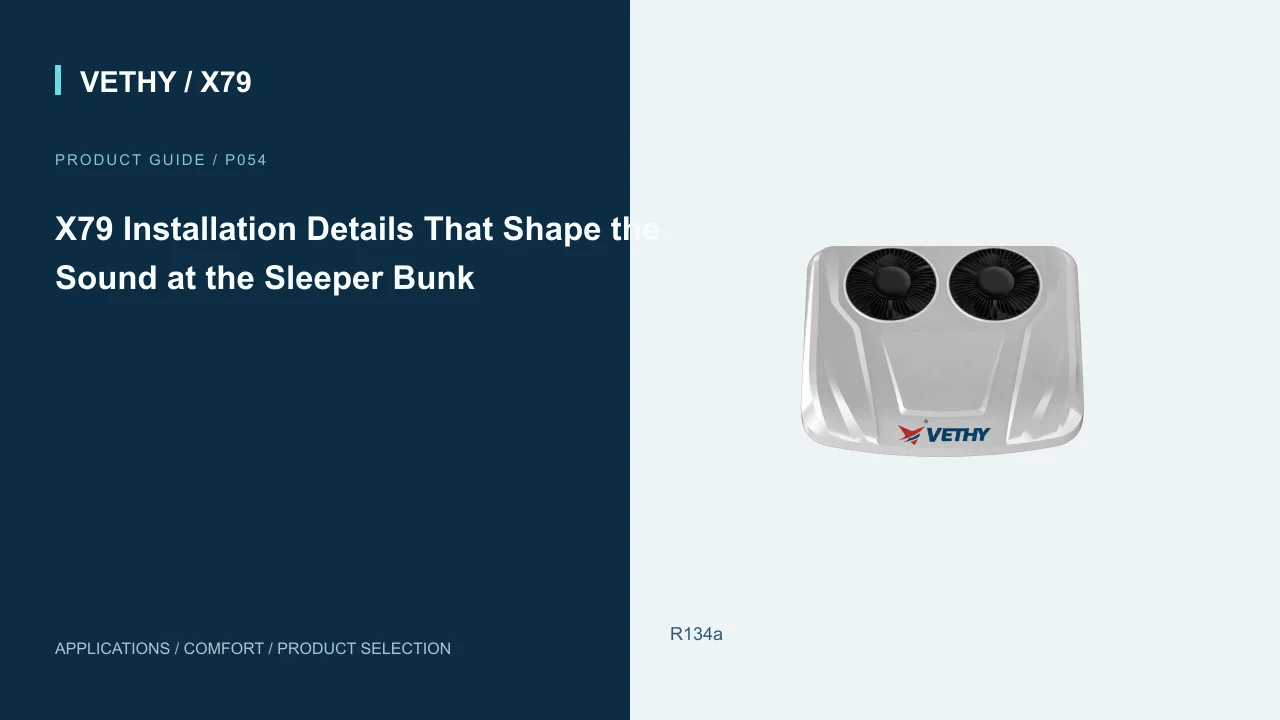
The driver hears an installed vehicle, not an air conditioner suspended in an empty room. X79's documented quiet positioning is therefore most useful when the mounting, roof, trim and indoor air direction are considered around the sleeper bunk. The product provides a defined foundation: R134a DC inverter twin-rotary cooling, brushless evaporator and dual condenser fans, and independent left and right electric oscillation. The installation gives those features their working environment.
This article focuses on the details that belong in an installer and fleet conversation before handover. It does not assign a decibel figure or diagnose a sound from a distance. Instead, it shows how to plan the roof interface, inspect the finished surroundings and establish a normal baseline at the occupied position. For a buyer seeking calm rest, that is a practical reason to choose a clearly specified product such as X79 and pair it with a considered vehicle installation.
Set the acceptance position at the bunk
The right place to discuss sleeper sound is where the driver rests. A demonstration at an open door or beside the front seat may be useful, but it does not fully describe the experience near the pillow. Identify the normal resting posture and include the ordinary bedding and curtain arrangement in the first assessment.
Ask the driver to describe what is distracting in practical terms. Is it a changing tone, direct air close to the head, movement of a fabric edge or an unfamiliar vibration? These descriptions help the installer understand the experience without asking the driver to identify the mechanical source. The technical assessment remains with the appropriate person.
This starting point makes the product recommendation specific. X79's quiet positioning and documented architecture are reasons to evaluate the model, while the occupied position defines the result the installation should serve. The X79 guide hub provides the broader model context. Here the focus is the path from a selected rooftop package to an understandable sound and comfort baseline at the bunk, where the driver will judge the equipment during real use.
Give the roof structure a vehicle-specific review
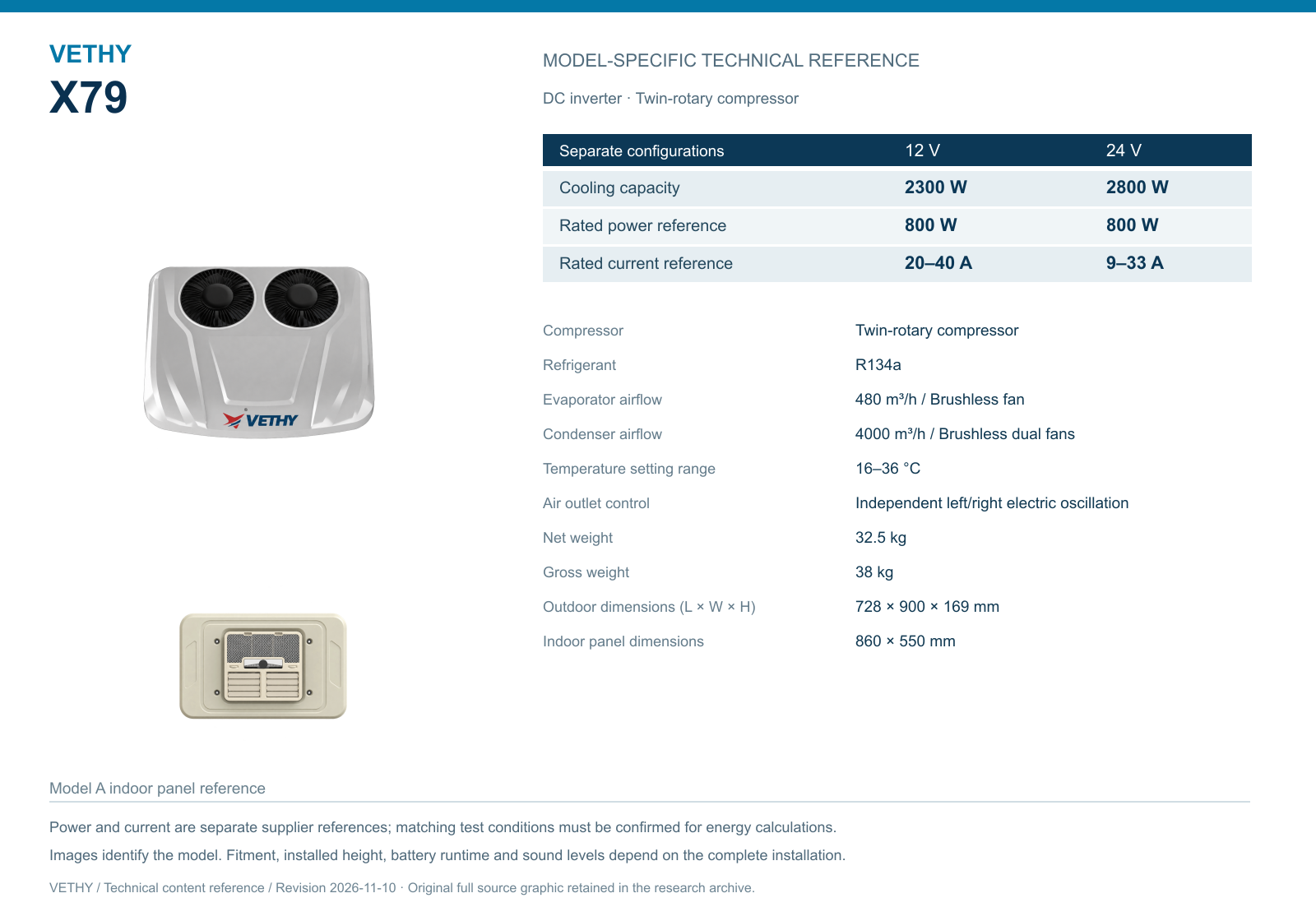
X79's net weight reference is 32.5 kg, and its outdoor body measures 728 × 900 × 169 mm. Those are useful inputs to the roof assessment. They do not establish structural suitability for every cab. The installer should review the actual roof, any existing opening and the proposed mounting arrangement using the applicable product information.
The minimum opening reference is 380 × 490 mm. Keep it attached to the interface discussion rather than treating it as a universal approval. Previous roof modifications, curvature and construction can matter to the proposal. The buyer can help by providing clear photographs and an account of known changes before the installation is finalized.
For sound comfort, this structural review is relevant because the unit becomes part of the vehicle. The correct aim is an approved, secure mounting arrangement, not an improvised attempt to make it quiet using unspecified materials. The installer should determine the appropriate solution. The buyer receives a reviewable package showing where the product sits and how the vehicle interface is handled. This gives X79's quiet-rest proposition a concrete foundation in the truck rather than leaving the roof connection to be decided during the work.

Treat mounting and sealing as a complete interface
The mounting and sealing approach should be resolved together. A vehicle installation needs to support the equipment and preserve the cab environment according to the approved method. The buyer should understand who provides the interface components, who performs the work and what information is supplied with the equipment.
Avoid turning the sound conversation into a search for a universal isolation trick. The model source does not prescribe a special pad, torque value or mounting modification for every truck. Those details should come from the actual installation requirements and the qualified installer. The product's low profile and defined envelope help the layout review, but they do not replace the technical interface design.
A useful proposal can show the intended roof location, opening and surrounding equipment in a marked photograph or drawing. The workshop can retain the completed arrangement for future reference. This is especially valuable for fleets, where the person handling later service may not have attended the original installation. The result is an accountable mounting package whose normal state is known. That makes it easier to assess a later change in sound and helps the buyer see why careful installation is part of the value of a premium X79 comfort project.

Include surrounding trim and storage in the finished review
The air conditioner is not the only item near the roof. Interior trim, cabinets, curtain tracks and stored belongings can contribute to what the driver hears and feels. A finished installation review should include those surroundings in their normal state. The objective is to identify anything requiring attention before the vehicle becomes the reference configuration.
A loose travel item should not be confused with a product characteristic, and an installation issue should not be dismissed as normal without review. The driver can report the experience, while the workshop investigates appropriately. A factual description is more useful than an immediate conclusion that the compressor or fan is responsible.
For X79, the indoor panel measures 860 × 550 mm. Its location should be coordinated with nearby trim and storage, as well as the air route to the bunk. The source does not supply panel thickness, so the proposal should use the actual installation information for any additional space requirements. A well coordinated cabin gives the panel room to function and keeps ordinary objects from undermining the rest experience. This is a practical part of making the product's quiet positioning meaningful after the truck returns to work.
Make air direction part of the sound-comfort discussion
Air movement near a pillow can influence comfort even when the cooling result is welcome. X79's Model A panel offers independent left and right electric oscillation. This gives the driver a useful way to explore air direction around the bunk instead of treating every discomfort as a temperature problem.
Demonstrate the panel with the driver lying in the normal position. Show how the actual outlet movement changes the path around the head, shoulders and bedding. Use the supplied operating instructions and avoid inventing automatic modes. The feature provides directional flexibility within one cooling system, not separate temperature zones.
The brushless evaporator fan has a listed 480 m³/h airflow reference. That describes the product, while the panel arrangement and interior determine how the air reaches the person. A curtain edge or stored garment near the route deserves attention during the review. The buyer gains a concrete comfort reason to choose X79 when this feature is demonstrated well: air delivery can be adapted to the resting position rather than accepted as one fixed stream from the ceiling. The VETHY truck application overview places that indoor experience within the wider parking cooling task.
Use a review table that distinguishes observation from diagnosis
A handover table can help drivers report useful information while leaving technical conclusions with the workshop. The following examples describe observations, not known faults or guaranteed X79 behavior.
| Observation at the occupied position | Useful context to record | Appropriate next discussion |
|---|---|---|
| A new vibration is noticed | When it began and whether roof or trim work occurred | Workshop review of the installed arrangement |
| Air feels concentrated near the pillow | Bunk posture, curtain and outlet direction | Demonstrate a comfortable air path using the supplied controls |
| A fabric edge moves in the air route | Location of curtain or clothing | Review the normal cabin arrangement |
| The overall sound seems different after a roof change | Description of the accessory change | Compare with the retained installation layout |
| The result differs between drivers | Their occupied positions and direction preferences | Repeat the panel demonstration for each user |
| Comfort changes during a stop | Starting conditions and later cabin arrangement | Review the complete cooling routine rather than one instant |
This approach keeps reports useful and proportionate. It gives the workshop a starting point without asking the driver to dismantle equipment or decide what part is responsible. The buyer benefits from a support process tied to the actual vehicle and the original configuration.
Keep the outdoor fan environment in the review
X79's copper condenser uses brushless dual fans, with a listed outdoor airflow reference of 4000 m³/h. The surrounding roof layout should preserve the approved intake and discharge environment and allow appropriate inspection. A sound-comfort review should therefore retain the outdoor arrangement as part of the complete installation record.
Show nearby spoilers, rails, solar equipment and storage accessories. The 728 by 900 mm body footprint is only one aspect of fit. The installer should assess the actual surrounding space and requirements rather than a customer guessing a clearance from an image. The 169 mm outdoor height is a useful packaging attribute within that broader layout.
This matters for later changes as well. A fleet may add equipment after the original cooling installation. If the approved roof arrangement is documented, the workshop can review the proposed addition with the X79 air environment and access in mind. The VETHY engineering page provides context for treating this as coordinated vehicle integration. The product's dual-fan configuration remains a positive feature, supported by a roof plan that recognizes its operating role instead of assuming every surrounding arrangement is equivalent.
Evaluate arrival and established rest as different moments
The driver may notice the system differently at the start of a stop and later at rest. Arrival can involve door opening, movement in the cab and a warm interior. Established rest may involve a closed curtain, a fixed occupied position and fewer surrounding activities. A useful demonstration includes that change rather than evaluating only the first cold air.
X79's DC inverter twin-rotary architecture is relevant to a cooling task that changes as the cabin settles. The complete controls determine the response. The source does not establish a precise operating sequence or a numerical acoustic result for each stage. The installer and buyer should assess the actual selected system under the agreed scenario.
For a fleet, record what was demonstrated. Note the version, cab arrangement and relevant conditions. A concise record helps later colleagues understand the scope without turning a representative installation into a universal promise. The value is practical: the buyer can decide whether the complete package serves the intended rest routine, the driver understands the normal experience and the workshop has a reference if something changes. This connects the model's quiet positioning to a real use case rather than leaving it as a general adjective.
Keep voltage and energy planning beside the comfort review
X79 offers separate 12V and 24V versions, with 2300 W and 2800 W cooling references respectively. Choose the version around the actual supply and cab assignment. A sound-comfort discussion should not obscure the electrical work needed to support the intended stop.
The named 800 W rated-power reference and current ranges at 35°C ambient are separate supplier fields. The 12V range is 20–40 A and the 24V range is 9–33 A. They are not paired at one common declared point and should not be used to create an efficiency claim or guaranteed duration. The complete supply plan needs usable energy, other loads, reserve and recharge information.
For the customer, the positive result is a coordinated comfort package rather than an isolated quietness demonstration. The selected X79 model, roof interface, indoor air route and supporting electrical arrangement all serve the same intended rest schedule. The technical project information form can gather those details in one brief. A clear proposal then lets the buyer review both how the driver will experience the system and how the vehicle will support its use.
Establish a baseline that the workshop can find later
The completed first installation should leave a short, useful record. Include the exact X79 version, roof and interior photographs, the approved mounting arrangement and the normal occupied setup used at handover. Add the relevant operating and service information supplied with the equipment. The record should be easy for the workshop to locate.
The driver can then report a change against something concrete. If a new roof accessory is fitted or an interior storage arrangement changes, the team can compare the new condition with the original layout. This does not automatically identify a fault, but it improves the quality of the support conversation. The original quiet-rest assessment remains useful after the sales event has ended.
For a distributor, this record also strengthens demonstrations for later customers. It shows a specific installed package with a clear scope, rather than an unsupported claim that every cab will sound the same. The real X79 images and technical sheet retain the model identity. The vehicle record explains the application. Together they give the buyer a practical reason to trust the recommendation and a clear path for assessing their own truck.
Hand over responsibilities as clearly as the controls
A driver needs a simple operating explanation and a contact path for concerns. The workshop needs the installation record and technical documentation. Purchasing needs the exact product and scope that were approved. A successful handover gives each person the information relevant to their role without expecting everyone to become a refrigeration specialist.
For the driver, demonstrate the left and right outlet movement from the bunk and explain the normal cabin arrangement. For the workshop, identify the approved roof interface and the surrounding equipment considered in the layout. For purchasing, retain the model, voltage version and documented features, including copper evaporator, condenser and piping, brushless fans and the Model A panel.
This coordination is part of the product's practical value. X79 can be selected as a clearly described premium parking comfort package, and the installation can be completed in a way that later colleagues understand. A quiet-rest recommendation becomes more credible when it remains useful during ownership. The buyer is choosing both a documented model and a clear route to installing, demonstrating and supporting it on the actual truck.
Consider two similar fleet vehicles where one has extra overhead storage. Their rooftop packages may look the same from outside, but the interior environment can differ. The first vehicle's baseline should not be applied without looking at that difference. A focused review of the panel area and normal storage may be enough to clarify the second configuration. The common X79 product remains the starting point, while the installation record keeps the recommendation precise.
This is a constructive way to discuss sound comfort. It leads to practical decisions about mounting, trim, air direction and handover, all connected to the driver's resting position. The source-supported quiet positioning remains intact, and the customer receives something more useful than a numerical claim without an installation context: a complete package whose normal condition can be understood and maintained.
Before the vehicle leaves the workshop, agree who confirms that the installation is complete. The driver can confirm that the controls and air direction have been demonstrated. The installer can confirm that the approved mounting, sealing and access arrangement is present. The buyer can confirm that the delivered model and voltage version match the order. These are different observations, and keeping them clear helps the handover remain practical.
If an issue is found, record what remains to be resolved and who owns the next action. Do not let an unfinished trim adjustment or an unclear operating explanation become the fleet's normal reference. Once the work is complete, retain the updated record so later colleagues see the final arrangement rather than an earlier draft. This is ordinary coordination, but it strongly affects whether the customer experiences the package as a considered premium installation.
For X79, the benefit is that its real product strengths can be assessed fairly. The inverter twin-rotary architecture, brushless fans, copper component package and independent outlets are not being judged through an unfinished vehicle interface. The buyer sees the intended complete result at the occupied position. That creates a clearer basis for deciding whether the same model and installation approach should be repeated on similar trucks, and it leaves a more useful support record for the vehicle already delivered.
Questions about X79 installation and sleeper sound
Does X79's quiet positioning replace a mounting review?
No. The product provides documented architecture and fans, while the roof interface needs a vehicle-specific proposal. Use the supplied dimensions and weight as inputs, then have the installer determine the appropriate mounting, sealing and surrounding arrangement for the actual cab.
Should a driver diagnose a new noise?
The driver should report the experience and conditions, including any recent roof or interior change. The workshop handles the technical assessment. A clear baseline and installation record make that conversation more useful without asking the driver to identify a compressor, fan or structural cause.
Is direct air at the pillow part of the sound discussion?
It is part of the overall rest experience. X79's independent left and right electric oscillation lets the user explore a comfortable direction. Demonstrate the actual panel with normal bedding and curtains so the driver understands how air delivery can be adapted at the bunk.
What should a fleet retain after the first installation?
Keep the exact version, approved layout, roof and interior photographs, normal occupied arrangement and relevant supplied instructions. Record the demonstration scope and any closed installation issues. This gives later drivers, technicians and purchasing colleagues a common reference for the selected X79 package.
Choose a quiet-rest package that is complete at handover
X79 is a useful candidate when the buyer values quiet positioning, inverter twin-rotary cooling, brushless fans and adaptable indoor delivery. A considered mounting and cabin review makes those features meaningful at the sleeper bunk.
Send the roof and interior details, supply voltage and intended rest routine through the VETHY contact page. Request an X79 proposal that includes the vehicle interface and occupied-position demonstration. The next step should be a complete installation the driver can understand and the workshop can support.
Product sources
- VETHY X79 confirmed product specifications — VETHY.
- X79 technical reference sheet — VETHY.
VETHY product recommendation and application analysis. Specification references identify the selected model and voltage. Installation examples are planning examples; measured project results are identified explicitly when available.
Discuss your X79 application
Send your vehicle, supply voltage, occupied space, parking schedule and installation photographs for a model-specific recommendation.
Prepare your vehicle brief ↗