
VETHY / X79 / PRODUCT AND APPLICATION GUIDE
Meet X79: Twin-Rotary Parking AC with Copper Heat Exchangers
X79 suits a vehicle project that values a compact rooftop package, documented copper refrigeration components and adjustable cabin air delivery. It combines R134a DC inverter twin-rotary cooling with brushless evaporator and dual condenser fans. Choose the 12V 2300 W or 24V 2800 W version around the vehicle supply and assessed cooling load.
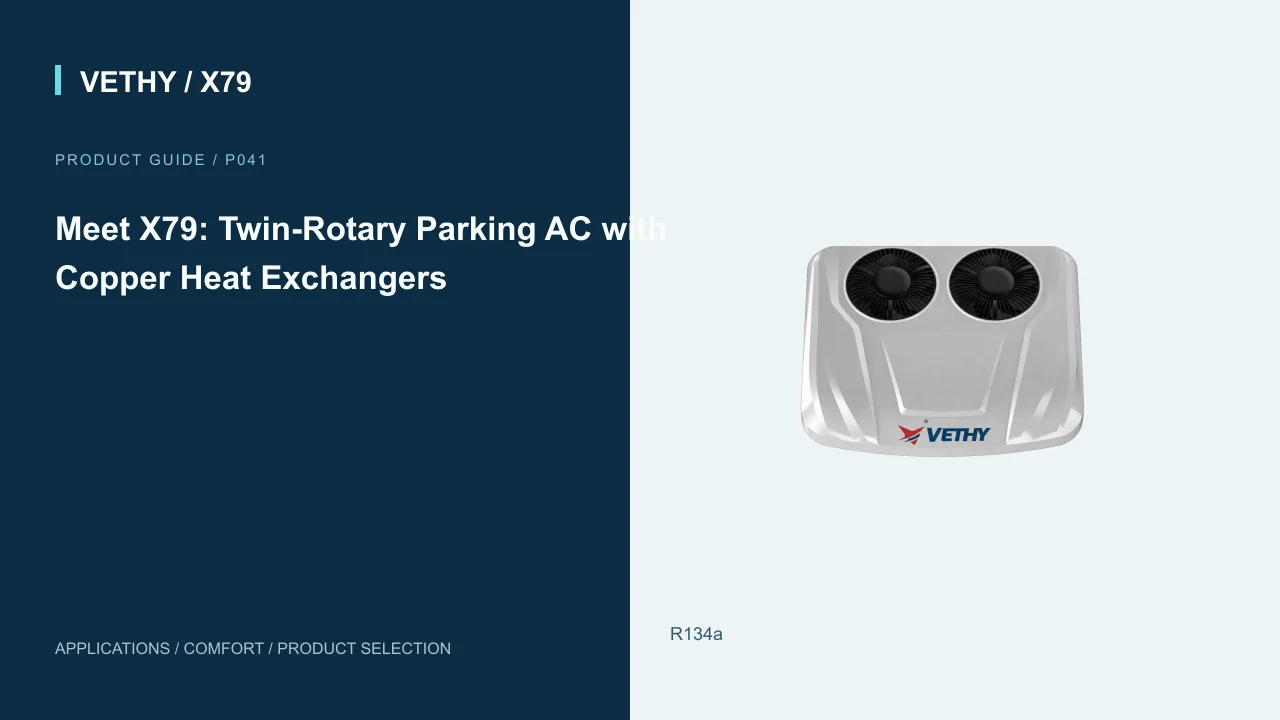
X79 belongs on a truck cooling shortlist when the buyer wants a clearly specified rooftop package rather than a collection of attractive adjectives. Its particular combination is useful: R134a DC inverter twin-rotary cooling, copper evaporator and condenser construction, copper refrigerant piping, brushless air movement and independent left and right electric oscillation. Those features serve a practical goal: make parked cabin comfort easier to integrate into a working vehicle.
The choice still starts with the assignment. A driver resting alone after sunset has a different cooling load from two occupants stopping in full afternoon sun. X79 offers a 12V version with a listed 2300 W cooling capacity and a 24V version with 2800 W. Neither number chooses the truck for you. Together with the roof dimensions and airflow references, however, they create a useful basis for a focused proposal. This guide explains how to turn that product information into a convincing vehicle package.
Start with the comfort job the vehicle must perform
A successful X79 project begins with an occupied zone. Identify whether the system mainly serves the bunk, the front seats during loading, or both at different times. That changes the value of outlet direction, curtain placement and the starting temperature. It also makes the purchase conversation more productive. Instead of asking for the strongest possible air conditioner, the buyer can describe the space and the routine that need support.
Consider a regional truck that parks several times during a shift and then stops for a longer rest. During a short stop, the driver may want useful air movement immediately around the seat. Later, the aim becomes steady comfort near the pillow without a concentrated stream on the face. X79's Model A panel and independent outlet movement are relevant to both situations. They let the installation team consider different occupied positions without pretending the cabin has become two independently temperature controlled rooms.
Record the regular parking environment as well. Windshield exposure, dark interior surfaces, bedding and the frequency of door opening can matter as much as a small change in the listed capacity. The useful recommendation is therefore specific: shortlist X79 for a defined cab and operating pattern, then match its voltage version and layout to that pattern. The wider VETHY truck application overview helps put the parking system within the complete vehicle brief.
What makes the X79 specification a coherent package
The strongest reason to consider X79 is how its documented components fit together. The compressor architecture addresses the refrigeration task. The evaporator fan moves conditioned air into the occupied space. The twin condenser fans support the outdoor heat rejection path. The copper components identify a construction choice that a buyer can carry into a specification and service record. None of these items has to stand alone as an unsupported promise.
The user confirmed product specification positions X79 as quiet and energy efficient. Treat that as a qualitative design direction. It is reasonable to discuss smooth cooling, considered air delivery and energy conscious use. It is not reasonable to convert the description into an invented sound level or a fixed percentage saving. For a driver, the practical benefit is the opportunity to build a calmer parked environment around the actual installed system.
The rooftop layout also brings the main package to one location. That can simplify the discussion of vehicle space compared with an installation that distributes equipment across several mounting positions. The roof must still be suitable, and the interior panel needs enough room. X79's attraction is a concrete envelope and a defined component set, not universal fit. A procurement team can ask for a drawing review against those dimensions before committing to a fleet configuration.
Read the main references together
The following table connects the supplied values to their most useful planning purpose. Cooling capacity, electrical data and physical dimensions describe different parts of the decision.
| Confirmed X79 reference | What it contributes to the project | Practical use |
|---|---|---|
| 12V, 2300 W cooling | One voltage-specific cooling option | Assess a compatible 12V vehicle supply and cab load |
| 24V, 2800 W cooling | A separate voltage-specific option | Assess a compatible 24V commercial vehicle project |
| DC inverter twin-rotary compressor, R134a | Defined refrigeration architecture | Keep the quoted product and service documentation consistent |
| Copper evaporator, condenser and refrigerant piping | Named component construction | State the required material scope in the order |
| 480 m³/h evaporator airflow | Indoor air delivery reference | Plan open routes toward the occupied area |
| 4000 m³/h condenser airflow, brushless dual fans | Outdoor air movement reference | Protect the intake and discharge environment |
| 728 × 900 × 169 mm outdoor dimensions | Product envelope, length by width by height | Map the unit onto the real roof |
| 860 × 550 mm indoor panel | Cabin face dimensions | Check cabinets, curtains and headroom around the panel |
| Minimum opening 380 × 490 mm | Starting installation opening reference | Obtain a vehicle-specific mounting and sealing proposal |
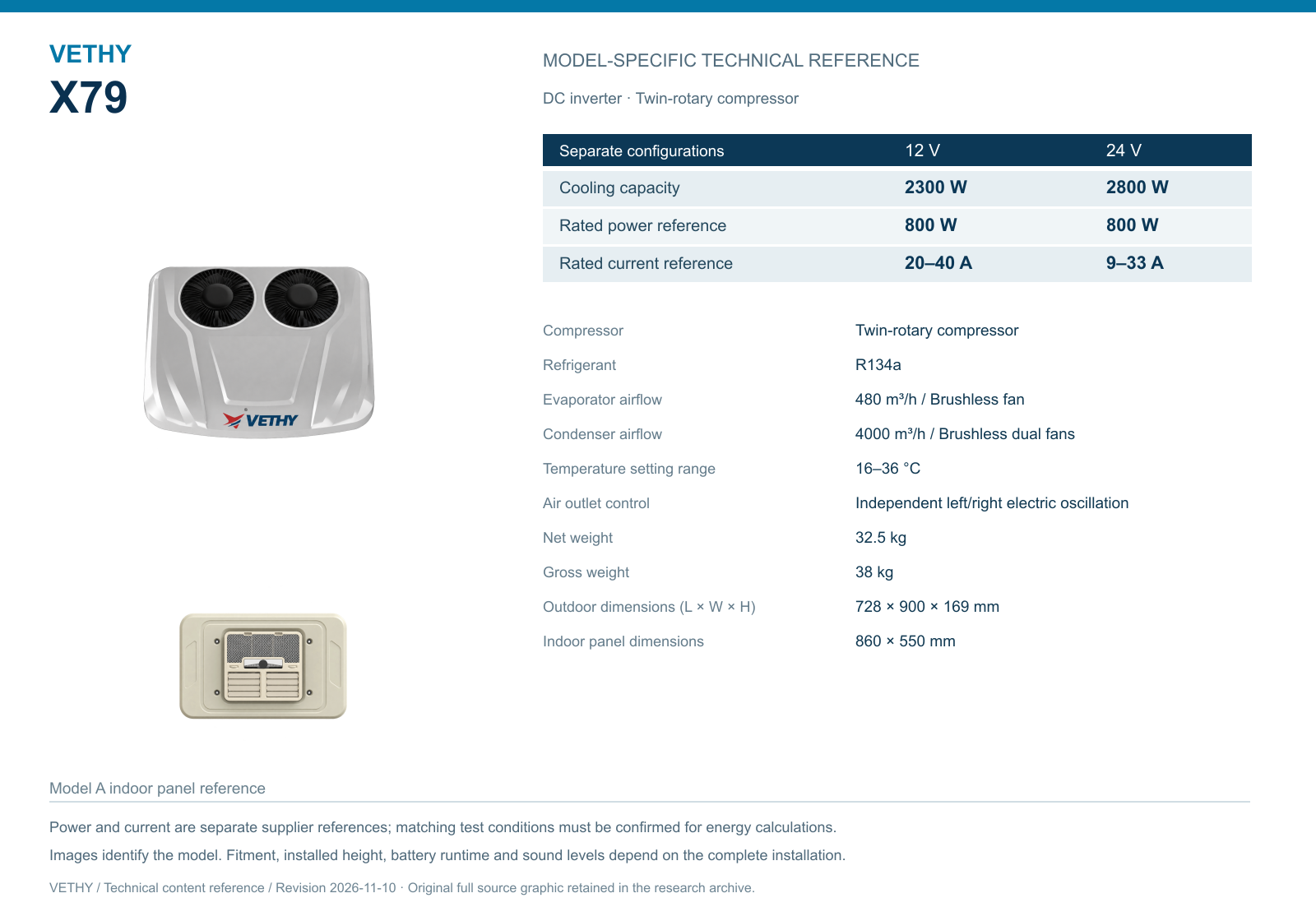
X79 also has a listed 800 W rated-power reference. The current references are 20–40 A for 12V and 9–33 A for 24V at 35°C ambient. These are separate supplier fields, rather than matched measurements at one declared operating point. They help frame questions for electrical integration, but they should not be divided into the cooling values to create an efficiency claim or used alone to promise an overnight duration.
Why the twin-rotary inverter description matters
The words DC inverter and twin-rotary describe the X79 technology rather than a selectable vehicle accessory. For a buyer comparing product proposals, that distinction is useful. It keeps the discussion on the supplied cooling system and prevents a quotation from quietly substituting a different compressor description under the same model name.
In practical comfort terms, varying cooling demand is the central reason inverter architecture interests parking AC buyers. A cab initially warmed by sunlight may need a different response from the same cab after the surfaces have cooled. The complete controls and refrigeration system determine how output changes. X79's documented architecture supports a conversation about matching operation to changing demand; it does not establish a particular speed range, proprietary algorithm or guaranteed sequence of operating modes.
That is still a meaningful selling point. A customer who values restful operation can discuss the entire cooling period rather than judge the product solely by the first cold air from the outlet. During an installation demonstration, observe the transition from a warm cabin to an occupied, shaded rest space. Record the settings and conditions. The result is a practical understanding of the selected system on the selected truck, with the compressor architecture serving the application instead of becoming an isolated technical slogan.
Copper components give the order a clear material identity
X79 lists a copper evaporator, copper condenser and copper refrigerant piping. The benefit for a serious buyer is a defined material specification across named refrigeration components. This can matter when a distributor wants a consistent product story, when a fleet records equipment construction, or when a service partner prepares the correct documentation for its technicians.
Describe that scope accurately. The phrase all-copper is used in the product positioning, but the confirmed detail concerns those three component groups. It does not establish copper fins, a copper housing or every metal part inside the unit. A clear proposal spells out the components rather than relying on an ambiguous headline. Doing so strengthens the recommendation because the buyer knows exactly what the statement covers.
For example, an importer preparing a premium parking comfort range can show the original specification beside the real X79 outdoor image and explain the copper component package in plain language. The relevant benefit is a recognizable, documented product choice with a consistent service identity. Any decision about corrosion exposure, cleaning chemicals or repair methods still belongs to the actual materials and service instructions supplied for the order. Copper construction is one valuable part of the X79 proposition; it does not replace appropriate installation and care.
Two outdoor fans need an open roof environment
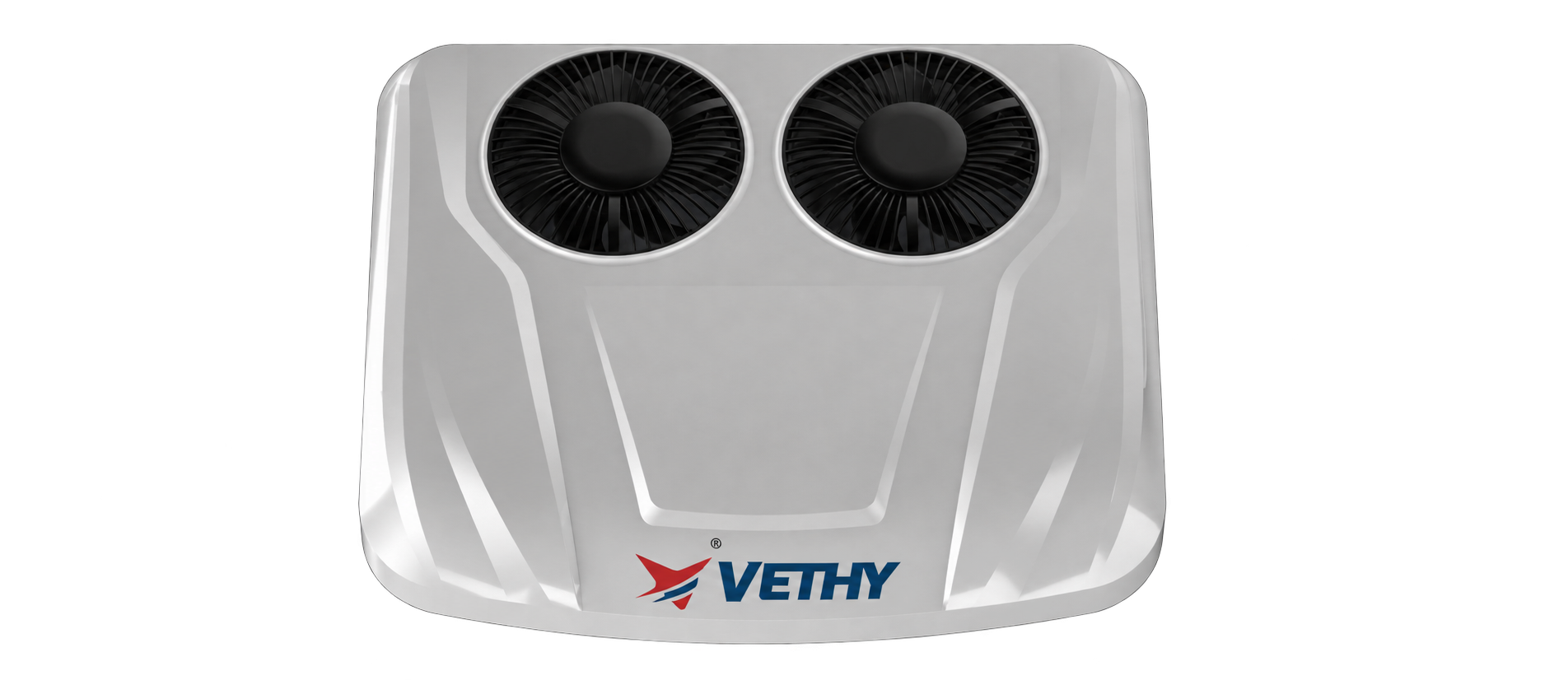
X79's condenser arrangement uses brushless dual fans, with a listed condenser airflow of 4000 m³/h. Those fans support the outdoor side of the refrigeration process. Their value is easiest to understand when the roof is treated as an operating environment rather than a flat place to attach equipment.
A roof may already carry a spoiler, solar modules, an antenna, a storage box or a protective rail. These items can influence where air can enter and leave the condenser area. The installation review should therefore consider the space around the unit, not just whether the 728 by 900 mm footprint can be drawn between obstacles. The approved clearance arrangement should come from the installation proposal for the specific vehicle.
A twin-fan product is particularly worth presenting with a clear roof photograph. Mark nearby obstructions and show how service access will remain available. That makes the feature tangible to the buyer: the project preserves the air paths that the product depends on. It also avoids a common purchasing mistake, which is selecting equipment by its indoor appearance while leaving the outdoor side to be improvised later. A considered X79 installation makes its dual-fan configuration part of the vehicle design from the beginning.
Independent air outlets serve people in different positions
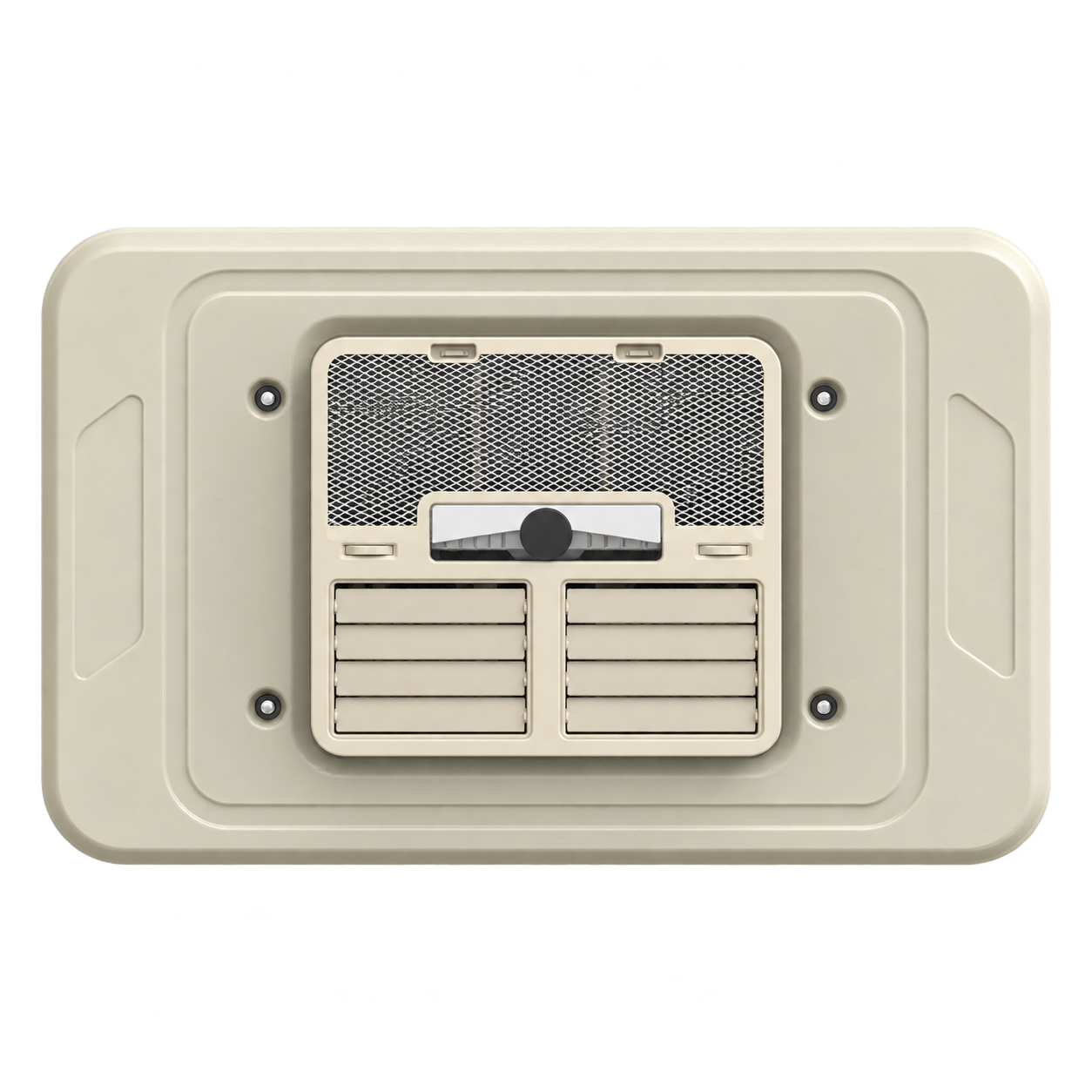
X79 uses a Model A indoor panel with independent left and right electric oscillation. This is one of its most directly usable features. A single driver can orient air around the seat during a stop and later redirect delivery toward the sleeper area. Two occupants can discuss their preferred air directions instead of accepting one fixed stream across the entire cabin.
Independence here refers to outlet movement. It should not be sold as two separate cooling circuits or two independently controlled temperatures. The real benefit is more adaptable distribution of the available cabin air. A co-driver who dislikes direct air at face level may prefer a stream past the shoulder, while the resting driver may want movement across the bedding. The panel arrangement gives the handover conversation something useful to demonstrate.
Cabin details can either support or undermine that benefit. A hanging jacket, tall pillow, overhead bag or closed curtain may interrupt the path. Before finalizing the panel position, look at the interior in its working state, with normal luggage and bedding in place. The system should serve the vehicle as people actually use it. For more detail on the complete range, keep the X79 product guide collection beside the vehicle drawings and operating notes.
A 169 mm outdoor height is useful when the whole vehicle is measured
The supplied outdoor dimensions are 728 × 900 × 169 mm, expressed as length, width and height. The 169 mm figure gives X79 a clearly defined low roof profile. It is valuable for a buyer who needs to balance parking cooling with the appearance and space demands of a commercial vehicle roof.
The correct next step is to measure the finished installation. Vehicle height, roof curvature, mounting details and other roof equipment determine the real clearance requirement. The product height is not automatically the exact addition to every truck's overall height. A responsible proposal can still use it confidently: show the product envelope, show the planned mounting arrangement and identify the finished highest point.
The indoor side deserves equal attention. Its panel measures 860 × 550 mm, while the minimum opening reference is 380 × 490 mm. These describe different parts of the installation. A small opening does not mean the cabin only needs that much clear ceiling area. A buyer gains the most from X79's defined dimensions when the installer checks both sides together. That turns the low-profile message into a practical packaging advantage rather than a promise based on one isolated measurement.
Plan the cooling period as an energy task
X79 is a battery-powered vehicle cooling product, so its value depends partly on the supporting energy plan. Start with the intended rest schedule and the energy that the vehicle can actually make available for cooling after other loads and required reserve are considered. The relevant question is how the installation supports that schedule under the expected conditions.
The separate power and current references help the project team request appropriate electrical information. They do not establish the energy used in every hour. A warm sunny cab, an already cooled bunk and repeated door opening can create different demand patterns. The inverter description does not remove those differences. It makes consideration of changing demand especially relevant to the buying conversation.
An illustrative planning approach is to divide the stop into arrival, settling and established rest. Describe what the driver does in each phase and what other electrical equipment remains active. Have the electrical supplier review the intended supply, protection and charging arrangement. Then evaluate the complete installed system on a representative vehicle. This is a positive way to recommend X79: connect its energy-conscious positioning to a realistic operating plan that a driver and fleet manager can understand and repeat.
Make the first installation a useful fleet example
For a fleet or distributor, one carefully documented X79 installation can become a practical reference for later orders. Select a representative cab rather than the easiest vehicle available. Include the usual curtains, storage and driver routine. Record the roof arrangement, selected voltage version, panel orientation and the operating conditions used during the demonstration.
The acceptance conversation should cover comfort at the occupied position, useful outlet direction, outdoor clearance and access for future work. A driver should be able to explain what feels comfortable at the bunk and how the outlets are used. A technician should be able to identify the installed product and find the relevant specification. A purchasing colleague should understand which parts of the package are repeated in the next order.
This approach gives X79's premium positioning substance. The copper components, twin condenser fans and independent outlets are visible parts of a coordinated proposal. The company can recommend the product with a clear use case and an installation record. Buyers who need assistance assembling that package can use the parking AC technical information form to describe the vehicle, supply and cooling assignment before discussing quantities.
Decide what the first order should include
A complete product recommendation should leave the buyer able to place a useful order. For X79, that means identifying the voltage version, the expected indoor panel, the roof mounting proposal and the electrical installation responsibility. It also means agreeing which items are supplied with the equipment and which are provided locally. These are ordinary commercial details, but they strongly influence whether the attractive specification becomes a successful working installation.
A distributor might begin with a demonstration vehicle and a small number of matching fleet trucks. In that case, keep the demonstration configuration close to the intended sales configuration. Use the same model documentation and explain the same outlet functions. If the next vehicle has a different roof or supply arrangement, identify that difference before treating the first installation as a universal pattern. This protects the value of the demonstration and makes the recommendation easier for another colleague to repeat.
Think about the recipient of the final handover as well. The driver needs a short explanation of air direction and the agreed rest routine. The workshop needs an equipment identity, accessible records and an approved installation arrangement. Purchasing needs a clear description that distinguishes the X79 from other rooftop units. When those needs are addressed in one proposal, the copper component package, dual-fan design and low outdoor profile become connected benefits in a product the organization can confidently evaluate.
A well prepared order can also identify the person responsible for confirming the first vehicle layout. That gives the driver, installer and buyer one place to resolve a practical question before equipment is repeated across a fleet. For example, if a roof accessory moves between truck variants, the revised arrangement can be checked against the X79 outdoor air path and service access. This small piece of coordination protects the original product choice. The recommendation remains tied to the documented model and its intended comfort result, while ordinary vehicle differences are handled explicitly rather than discovered during installation.
Questions buyers ask about the X79 package
Is X79 a 12V product or a 24V product?
There are separate 12V and 24V versions. The supplied cooling references are 2300 W and 2800 W respectively. Select the correct version for the intended vehicle supply and complete electrical arrangement. The higher cooling figure should not lead a buyer to assume that a voltage conversion is automatically desirable or included.
What does all-copper mean in the X79 description?
The documented scope is the evaporator, condenser and refrigerant piping. State those components in the quotation. The source does not establish that every fin, bracket or housing part is copper. That precise description is useful for distributors and fleet buyers because it can be repeated consistently across product presentations and order records.
Does X79 provide a measured quietness guarantee?
The source supports qualitative quiet positioning, together with its DC inverter twin-rotary architecture and brushless fans. It does not supply a verified decibel result. Installed sound also depends on the roof, mounting and air delivery. A demonstration on the proposed cab is the useful way to understand the overall rest environment.
Can the two outlets create separate temperature zones?
The confirmed feature is independent left and right electric oscillation. It supports different air directions for occupants or cabin positions. It does not establish separate temperature zones. Demonstrate the outlet movement with the normal bedding, curtains and luggage present so the buyer can see how the airflow reaches the intended area.
Recommend X79 around a complete, defined result
X79 is a strong candidate when the project values documented copper refrigeration components, brushless twin condenser fans, a 169 mm outdoor profile and flexible cabin air direction in one rooftop package. The correct voltage version, a suitable roof and an achievable energy plan bring those features together. The result to aim for is straightforward: useful parked cooling where the driver actually rests, with a configuration the fleet can specify again.
Send VETHY the truck model, roof and interior photographs, supply voltage and intended stopping routine through the project contact page. Ask for an X79 proposal that identifies the voltage version, mounting approach, panel layout and installation scope. That creates a concrete basis for comparing the product, approving a representative installation and extending a successful configuration to the next vehicle.
Product sources
- VETHY X79 confirmed product specifications — VETHY.
- X79 technical reference sheet — VETHY.
VETHY product recommendation and application analysis. Specification references identify the selected model and voltage. Installation examples are planning examples; measured project results are identified explicitly when available.
Discuss your X79 application
Send your vehicle, supply voltage, occupied space, parking schedule and installation photographs for a model-specific recommendation.
Prepare your vehicle brief ↗