
VETHY / X79 / PRODUCT AND APPLICATION GUIDE
X79 12V 2300 W: A Product Guide for Battery-Powered Cab Cooling
The X79 12V version offers a listed 2300 W cooling capacity for a compatible vehicle project. It combines R134a inverter twin-rotary cooling, copper refrigeration components and brushless fans. Recommend it around the actual cab load, roof layout and auxiliary supply, with a separate energy plan for the intended parking period.
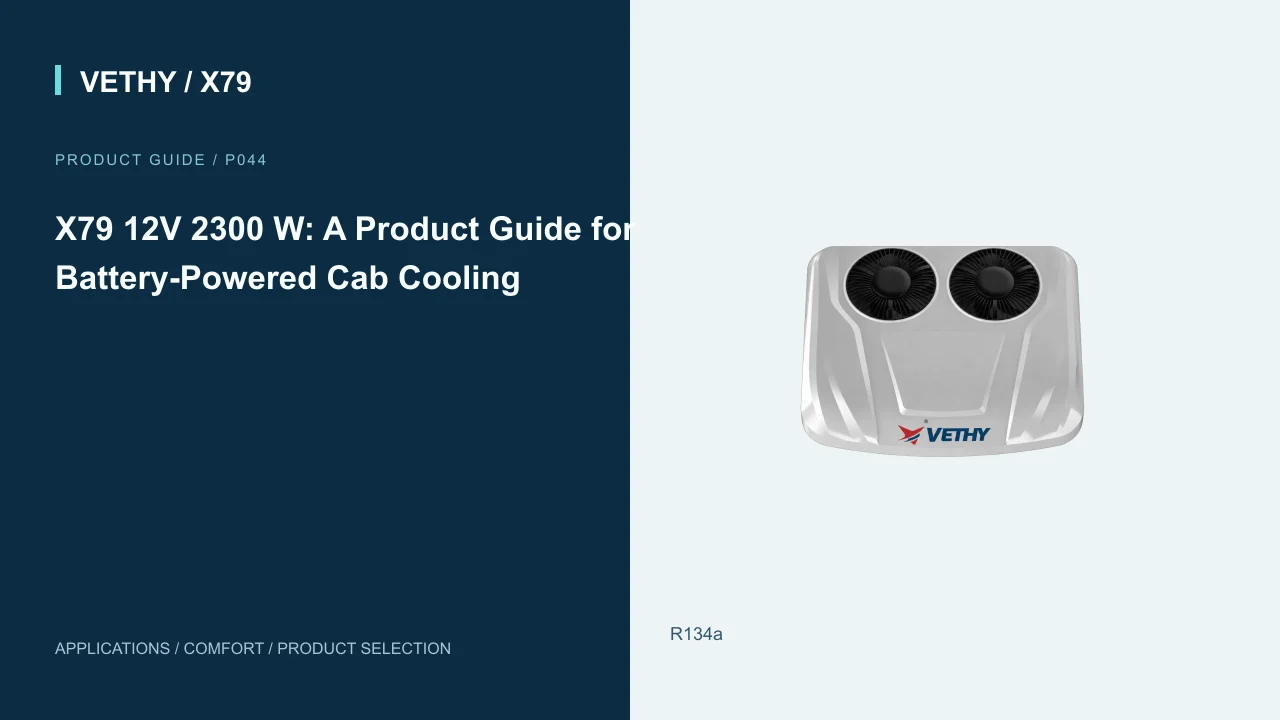
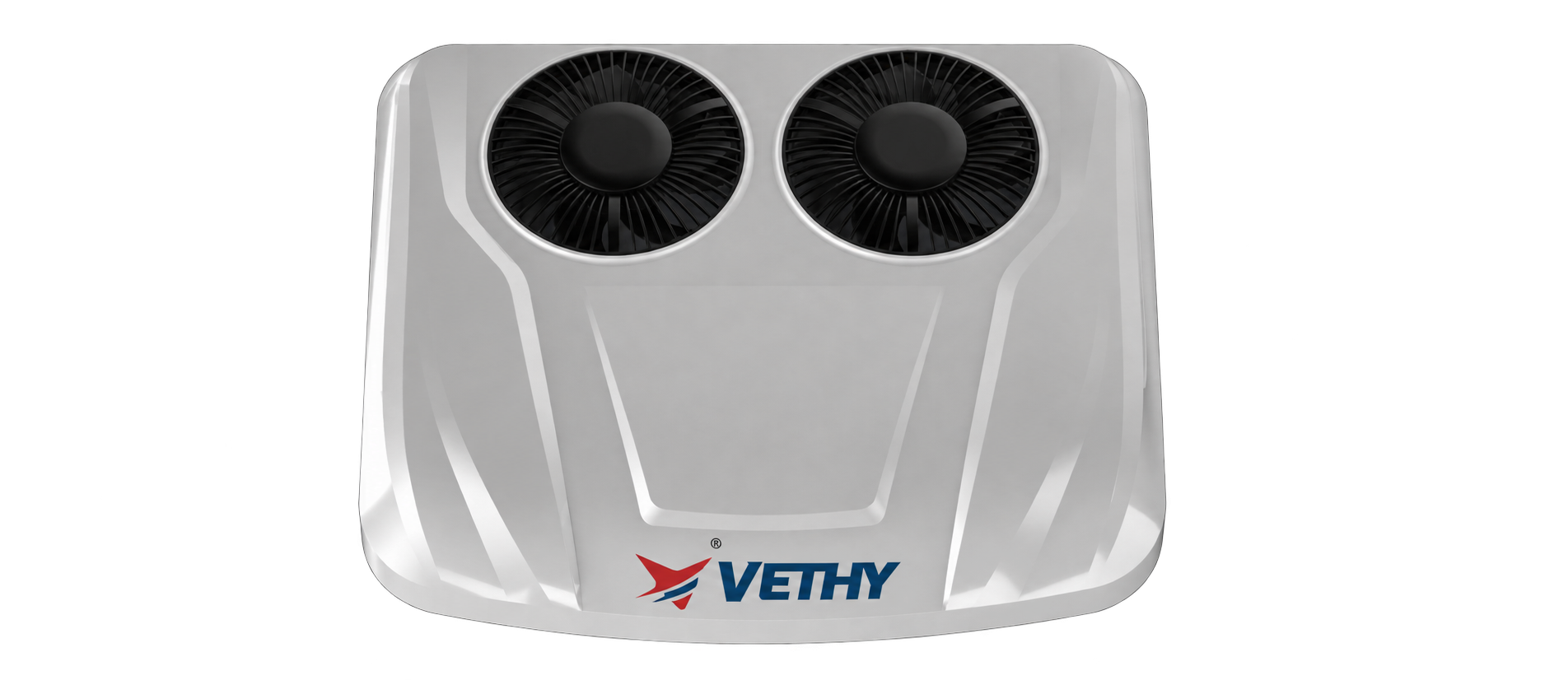
X79 12V is a focused choice for a vehicle project that needs battery-powered parked cooling and can make good use of a defined rooftop package. The supplied cooling capacity is 2300 W. Its documented R134a DC inverter twin-rotary system, copper evaporator, copper condenser and copper refrigerant piping give buyers a precise product identity. Brushless fans and independent left and right electric oscillation add features that connect directly to cab comfort.
The right recommendation starts with the vehicle's 12V supply and the space the driver actually occupies. It then brings the cooling unit, roof installation and energy arrangement together. A useful proposal does not promise a fixed number of hours from the model name alone. It shows how X79 12V serves a particular cab, what the electrical team must provide and how the driver can use the resulting package through a normal stop. That is the purpose of this guide.
Choose the 12V version for a defined electrical platform
The voltage version should follow the vehicle project. X79 is available in separate 12V and 24V configurations, and this guide concerns the 12V 2300 W cooling version. Keep those two details together when requesting a quotation. They identify the equipment more clearly than a general request for an X79 parking air conditioner.
A compatible electrical platform involves more than the nominal battery label. The installer needs to understand the supply arrangement, cable route, protection and charging strategy. Those details belong in an installation design based on the actual vehicle and supplier information. They should not be improvised from a current range printed on a product sheet. A clear proposal identifies who is responsible for that work and which information they need from VETHY.
For an owner operator, this approach makes the buying process easier. Describe the truck, whether there is a dedicated auxiliary energy system, and how the vehicle is used between stops. For a fleet, group vehicles by electrical configuration rather than assuming all trucks with a similar cab share the same supply arrangement. The parking AC technical information form is useful for gathering these starting facts before choosing an installation package.
Treat 2300 W as cooling capacity
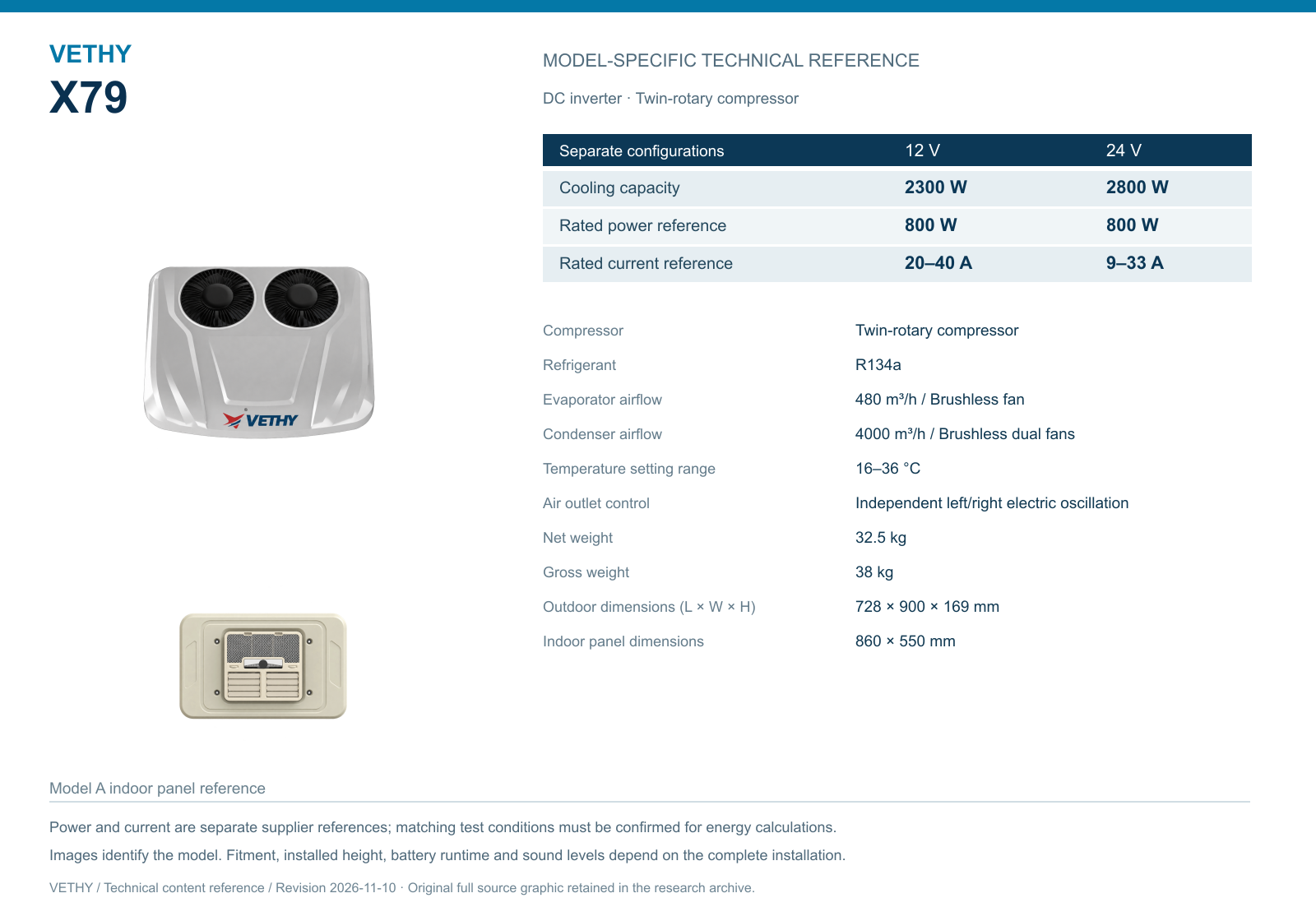
The X79 12V rating of 2300 W describes cooling capacity in the supplied specification. It is not a statement that the unit draws 2300 W from the battery. Making this distinction early helps the owner understand the product and prevents a misleading battery discussion.
The same source lists an 800 W rated-power reference and a 20–40 A current reference at 35°C ambient. These are separate supplier fields without a common matched operating point. They should remain separate in a proposal. A buyer should not combine a chosen endpoint with the cooling capacity to manufacture an efficiency value or use it to declare a guaranteed rest duration. The electrical designer needs appropriate operating and installation information for the complete system.
This does not make the product difficult to recommend. It means the recommendation should answer two different questions: can the cooling package serve the assessed cab, and can the vehicle energy system support the intended use? X79 12V brings a defined cooling reference to the first question and documented electrical references to the second. Keeping the questions distinct makes the resulting proposal more credible and gives the customer a clear reason for the additional vehicle information being requested.
Assess the occupied cab rather than a nominal vehicle category
A label such as truck or sleeper does not describe the whole cooling task. The size and arrangement of the occupied area, glass exposure, insulation and routine all matter. A driver resting behind a closed curtain after sunset presents a different assignment from a driver sitting in the front seats during a sunny loading stop. The X79 12V proposal should say which assignment it is intended to support.
Start with a few useful observations. Photograph the roof and the interior. Identify the normal resting position, where the curtain closes and where luggage stays. Note whether the truck regularly parks in full sun or has a choice of shaded positions. Record how often the door opens during the intended cooling period. These facts make a model-specific discussion possible without pretending that every truck in one weight class has the same needs.
A useful shortlist decision can then be stated plainly: X79 12V is being considered for this occupied cab, on this supply, during this type of stop. The 2300 W cooling reference supports the assessment; it does not replace it. Buyers comparing installation forms can use the VETHY truck application overview to place the rooftop package within their wider vehicle plans.
Build the package around four connected tasks
The strongest X79 12V proposal coordinates cooling, air delivery, electrical support and installation. Each has a different purpose, and each can be described in terms a buyer understands.
| Task | X79 contribution | Vehicle-side planning contribution |
|---|---|---|
| Cool the occupied area | Listed 2300 W cooling capacity, R134a system | Assess cab load, exposure and rest routine |
| Adapt to changing demand | Documented DC inverter twin-rotary architecture | Use the delivered controls within an agreed operating plan |
| Deliver useful indoor air | Brushless fan, 480 m³/h reference, independent outlet movement | Keep the panel and route toward the bunk clear |
| Reject heat outdoors | Copper condenser, brushless dual fans, 4000 m³/h reference | Preserve approved clearances around roof equipment |
| Fit the vehicle | 728 × 900 × 169 mm outdoor envelope | Confirm roof structure, interface and finished height |
| Support the stop electrically | 12V product version and separate electrical references | Design supply, protection, reserve and charging arrangement |
This division is useful for a quotation review. The buyer can see what is included in the product and what the installation must resolve. It also prevents an installer from treating the indoor panel as a minor trim decision or purchasing from treating the battery as an unrelated accessory. The product works as part of a vehicle package, and the order should reflect that relationship.
Use inverter architecture to discuss the whole cooling period
The documented DC inverter twin-rotary system is one reason to consider X79 for a cab whose cooling demand changes during a stop. The interior may begin warm and later become easier to maintain. The complete controls and system determine the actual response. The source does not establish a particular speed range, automatic sleep sequence or precise minimum draw.
A useful sales explanation stays close to the application. Ask the customer to think about arrival, settling and rest. Arrival may involve a warm seat and sunlit surfaces. Settling may include closing curtains and moving to the bunk. Rest may involve a steadier occupied position and fewer interruptions. The chosen cooling package should serve that whole sequence, not only provide an impressive first burst of air.
That is a convincing reason to evaluate the X79 architecture in a representative installation. The demonstration can show how the product and cabin arrangement support comfort over time. It should not be framed as a laboratory efficiency test unless a suitable test is actually performed. For the owner, the value is practical: a model-specific cooling system selected with the whole parking period in mind, combined with a supply and driver routine designed for that same period.
Make independent outlet movement part of the buying decision
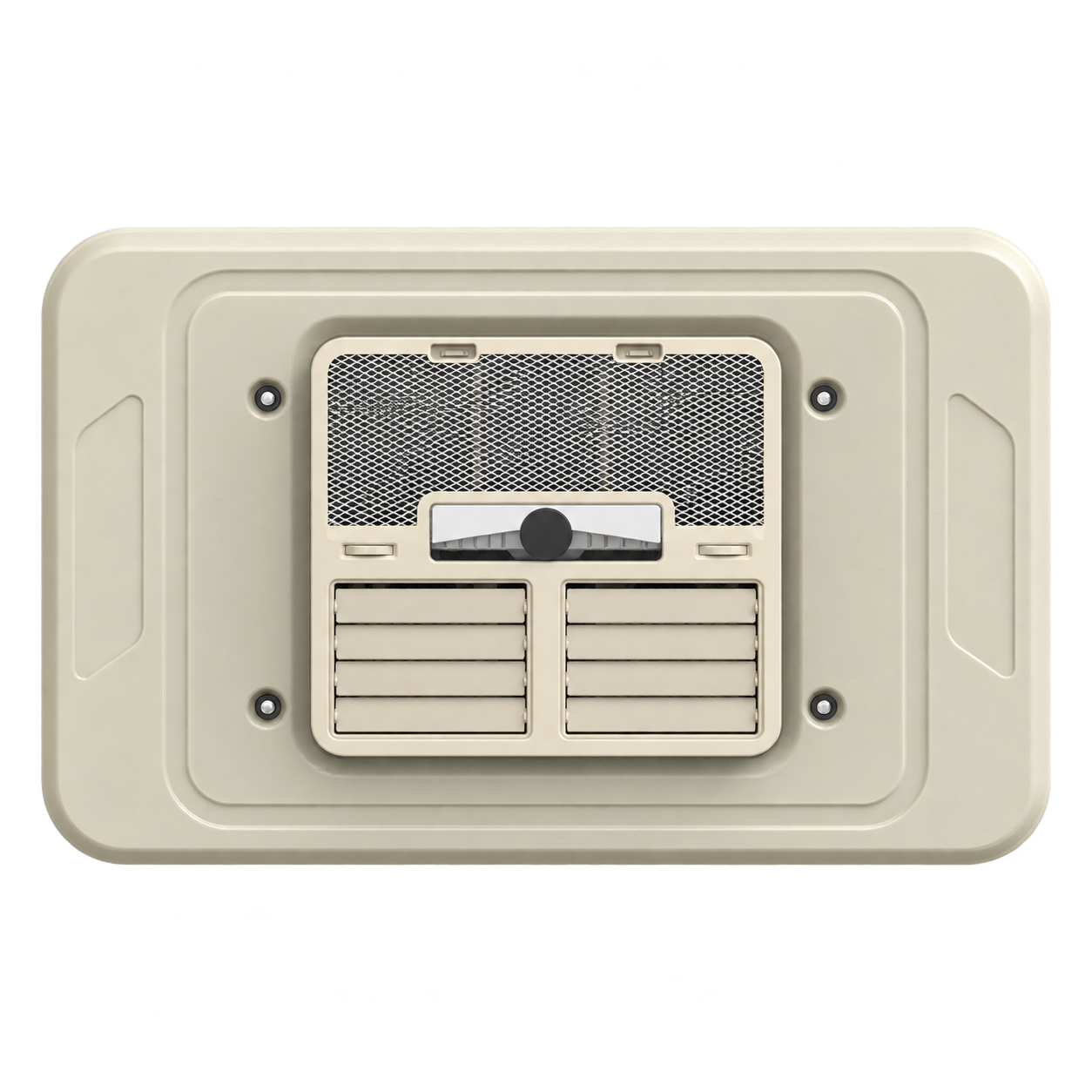
X79's Model A panel provides independent left and right electric oscillation. For a 12V cab cooling project, this can be particularly valuable because it helps make the available air delivery useful at different occupied positions. A driver may sit forward during paperwork, then rest behind the seats. A co-driver may prefer a different air direction from the person at the bunk.
The feature concerns directional movement rather than separate temperature zones. Demonstrate it in those terms. Show how each side can serve an area while avoiding a stream directly at a person's face. Then check what happens when the curtain, pillow or normal travel bag is present. Those ordinary details determine whether a flexible panel becomes useful comfort or a feature that is rarely understood.
The supplied evaporator airflow reference is 480 m³/h. That is a product value, not a promise that every point in the cab receives the same velocity. The installation should therefore give the panel a clear route into the occupied space. For an owner choosing between otherwise suitable products, this combination of defined airflow and adaptable direction is a concrete X79 advantage to evaluate during the first vehicle demonstration.
Plan usable energy and reserve before discussing duration
A battery-based cooling plan begins with the energy actually available for the stop. That depends on the installed energy system, its condition, the reserve required by the operator and the other loads being used. The air conditioner is part of that picture. A refrigerator, lighting or communications equipment may also be active during rest.
For X79 12V, do not turn the 20–40 A current reference at 35°C into a universal overnight consumption curve. The 800 W rated-power field is also a separate reference. Neither establishes every hour of operation. Conditions in the cab and the complete system response can change through the stop. A responsible estimate needs information appropriate to the proposed installation and intended operating conditions.
The useful commercial next step is to have the energy supplier and installer review the intended rest schedule together. Clarify how the vehicle recharges between stops and what happens if the planned cooling period changes. The owner should receive a practical operating envelope for the complete package. This approach supports X79's energy-efficient positioning without inventing an eight-hour guarantee or a savings percentage. It gives the buyer a clear route from product interest to an energy arrangement suited to real work.
Give the low rooftop profile a complete installation review
X79's outdoor unit measures 728 × 900 × 169 mm, with 169 mm as the product height. That makes its low roof profile a useful part of the 12V package. It can appeal to owners who want cooling integrated neatly into the vehicle while preserving a considered roof layout.
The finished installation still requires a vehicle-specific review. Check roof structure, curvature, the approved opening and mounting approach, and the relationship to other equipment. The minimum installation opening reference is 380 × 490 mm. It is a starting dimension for the interface, not proof that every roof can use that opening without further work. The installer should identify the approved solution for the exact truck.
Inside, the Model A panel measures 860 × 550 mm. This is wider than the opening and needs its own space assessment. Consider cabinets, ceiling trim, curtains and service access. The source does not provide panel thickness, so a proposal should not borrow a depth from another model. A well prepared drawing or marked photograph can show how the product fits on both sides of the roof. The low-profile benefit then becomes a concrete part of the vehicle design rather than a dimension used on its own.
Protect both air paths in everyday operation
X79's indoor and outdoor fans serve different jobs. The brushless evaporator fan moves air through the cabin side. The brushless dual condenser fans support outdoor heat rejection. Their listed airflow references, 480 m³/h and 4000 m³/h respectively, should stay attached to the correct part of the product.
Inside, avoid making the panel compete with stored items or a curtain pulled across its delivery route. Outside, preserve the approved surrounding space when adding later roof accessories. A fleet should make this part of the vehicle record, because an antenna bracket or storage arrangement may change after the original cooling installation. The aim is to keep the environment that the approved X79 package was designed around.
Airflow care also belongs in the handover. Use the cleaning and inspection information supplied with the actual equipment. The driver can report an obvious obstruction or a change in air delivery, while the workshop handles the appropriate technical work. This is a practical way to get value from a brushless fan package without claiming the product is maintenance free. The buying benefit is an understandable system whose ordinary use and support can be explained clearly to the people responsible for it.
Make a short-stop demonstration answer the right questions
A demonstration should resemble the intended job. If the owner wants bunk comfort during rest, include the bunk and normal curtain arrangement. If the truck often stops during afternoon loading, include that occupied position and exposure in the evaluation. A cold air stream at an empty front seat is not a complete demonstration of either task.
For X79 12V, record the version, starting conditions and supply arrangement. Observe whether the driver can reach a comfortable air pattern, whether the outdoor layout remains unobstructed and whether the complete electrical system operates within the agreed plan. The source's qualitative quiet positioning can be explored through the installed experience at the occupied position, without creating an unsupported decibel claim.
Keep the outcome specific enough to help the next decision. The useful record may say that the selected layout served the normal sleeper routine under the recorded conditions, with the demonstrated outlet arrangement. It should not expand into a promise for every climate or stop duration. A careful first installation gives an owner confidence and gives a fleet a configuration that can be reviewed for similar trucks. The X79 guide collection helps retain the model context as the project develops.
Prepare a handover that the driver will actually use
The most useful handover is short, visible and connected to the driver's routine. Identify the X79 12V unit and explain the agreed operating plan. Show the supplied controls using the actual equipment instructions. Then demonstrate the left and right outlet movement from the seat and the bunk, with the cab arranged as it will be on a normal route.
Explain which signs the driver should report. Reduced air delivery, a new vibration or a change from the normal comfort result deserve a factual description, including the conditions and occupied arrangement. The driver should know whom to contact and where the vehicle's equipment record is kept. This supports a clear workshop response without asking the driver to diagnose refrigeration or electrical faults.
For a fleet, keep the voltage version visible in the asset record. Mixed vehicle groups can otherwise lead to confusing short descriptions when parts or replacement equipment are discussed. The handover should also identify how the energy system is managed under the fleet's approved plan. The result is a complete 12V parking cooling package that can be used predictably, rather than an air conditioner that performs well only when the original installer is nearby to explain it.
A useful owner example is a truck that returns to a depot after a route, then parks away from the depot during the next shift. The owner wants one consistent cooling package but has different charging opportunities at the two locations. In this situation, the X79 12V selection should be discussed with both parts of the schedule visible. The equipment identity stays the same, while the available energy and the time before the next recharge may differ. That is the information the electrical supplier needs to help the owner make a sensible plan.
The cabin routine can remain simple across both stops. Put normal luggage in its agreed place, keep the panel clear and direct air toward the occupied zone. If the driver moves from the front seat to the bunk, use the demonstrated outlet arrangement. These actions make the product's air delivery useful without asking the owner to interpret a technical specification on every trip. The installer can then focus on supplying a robust, documented vehicle integration rather than compensating for a changing interior layout.
This example also shows why the complete package deserves attention before purchasing a larger quantity. A fleet might find that the same X79 12V installation suits a group of similar cabs, while the energy arrangement needs to be reviewed for different route lengths or recharge patterns. Recording those differences allows a common product recommendation to remain precise. It gives purchasing a repeatable equipment description, drivers a consistent comfort routine and the workshop a clear account of the supply system on each vehicle. That is a more useful result than choosing a model from one capacity figure and leaving the rest of the vehicle decision unresolved.
Questions about the X79 12V version
Does 2300 W mean the unit consumes that much electrical power?
No. It is the supplied cooling capacity reference for the 12V version. The source separately lists an 800 W rated-power field and a 20–40 A current field at 35°C ambient. Those are not paired test values and should not be combined into an invented efficiency or duration claim.
Can the X79 12V run through any overnight stop?
The source does not establish a universal duration. The available energy, reserve, other loads, cab conditions and operating pattern determine the complete project. Ask for a supply and cooling assessment around the intended stop, then evaluate the representative installation rather than relying on a generic hours claim.
What makes this version worth shortlisting?
It combines a defined 12V cooling reference with DC inverter twin-rotary architecture, copper evaporator, condenser and piping, brushless dual condenser fans and independent outlet movement. These features create a clear rooftop package for a compatible cab and supply. The installation should make those features useful to the driver.
Is it appropriate to upgrade to 24V just for the higher cooling number?
Treat that as a separate engineered vehicle decision. The 24V version has its own 2800 W cooling reference, but it is not automatically the correct product for a 12V platform. Select the voltage around the actual supply and complete project rather than the capacity figure in isolation.
Order a complete 12V cab cooling proposal
Recommend X79 12V when a 2300 W cooling reference, a documented copper component package and adaptable indoor air direction fit a specific vehicle assignment. Bring the roof, battery arrangement and driver routine into the same proposal. This gives the owner a clear reason to choose the product and the installer a defined package to deliver.
Send VETHY the vehicle details, supply arrangement, roof photographs and intended parking schedule through the contact page. Request the X79 12V configuration with installation responsibilities and the information required for energy planning. The next step should be a reviewable cooling package for the actual cab, ready for a representative installation and driver handover.
Product sources
- VETHY X79 confirmed product specifications — VETHY.
- X79 technical reference sheet — VETHY.
VETHY product recommendation and application analysis. Specification references identify the selected model and voltage. Installation examples are planning examples; measured project results are identified explicitly when available.
Discuss your X79 application
Send your vehicle, supply voltage, occupied space, parking schedule and installation photographs for a model-specific recommendation.
Prepare your vehicle brief ↗