
VETHY / VX3000SP / PRODUCT AND APPLICATION GUIDE
VX3000SP for US Fleet Buyers: Order the Complete Installation Package
VX3000SP is worth shortlisting for a U.S. fleet when its split arrangement and documented comfort features fit the actual trucks. Order a defined package that identifies voltage, vehicle groups, locations, route and included auxiliary scope. A representative occupied demonstration and clear handover connect the product to practical fitting and ownership.
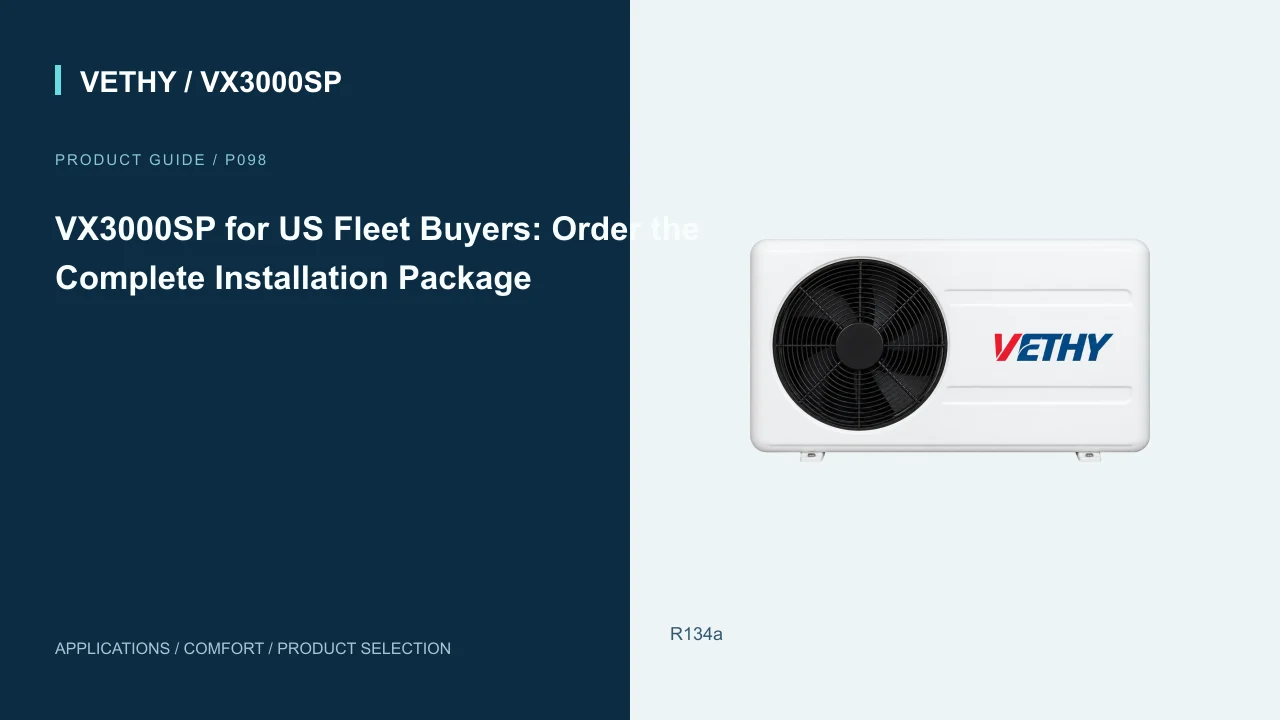
VX3000SP is worth shortlisting for a U.S. fleet when a split parking cooling package fits the actual trucks and the purchase can include a clear path from product supply to installed use. The model offers separate indoor and outdoor placement, R134a rotary cooling, 550 m³/h airflow, automatic oscillation and qualitative ultra-quiet positioning. Those features provide a practical comfort case when the occupied cab, mounting locations and auxiliary duty are planned together.
The fleet buying decision should therefore describe more than a unit price. Identify the selected voltage, actual vehicle groups, installation work and included auxiliary equipment. A complete offer gives purchasing, operations and the workshop the same understandable package, making the proposed action concrete enough to review and schedule.
This guide focuses on that procurement decision. It explains how to order VX3000SP around the real U.S. fleet application without assuming universal semi-truck compatibility, a verified regulatory approval or a product-specific savings result. The useful outcome is a defined split cooling package with a clear occupied-space purpose and an installation record that supports ordinary ownership.
1. Define the fleet's parked comfort purpose
Begin with the duty the fleet wants the package to serve. Drivers may use cooling during loading waits, paperwork before rest or longer bunk periods. A common purpose gives purchasing and operations a practical basis for considering VX3000SP, while engineering reviews the actual vehicles and auxiliary systems.
The occupied space should be visible in the brief. Show the normal seat, bunk, curtain and storage so the installer understands where useful airflow is needed. A product can have a clear cooling reference yet still need a different indoor placement discussion in another cab layout.
This makes the recommendation specific. VX3000SP is being selected as a split comfort package for a recognizable working routine, rather than a generic accessory ordered because every truck carries a similar fleet badge. The documented features can then be connected to benefits the driver can assess directly.
For the buyer, the commercial advantage is clarity. The project has an understood purpose before quantities and fitting dates dominate the conversation. The product identity, vehicle work and auxiliary package can be developed around that purpose, giving the fleet a complete offer that can be reviewed across departments.
2. Identify the actual voltage version
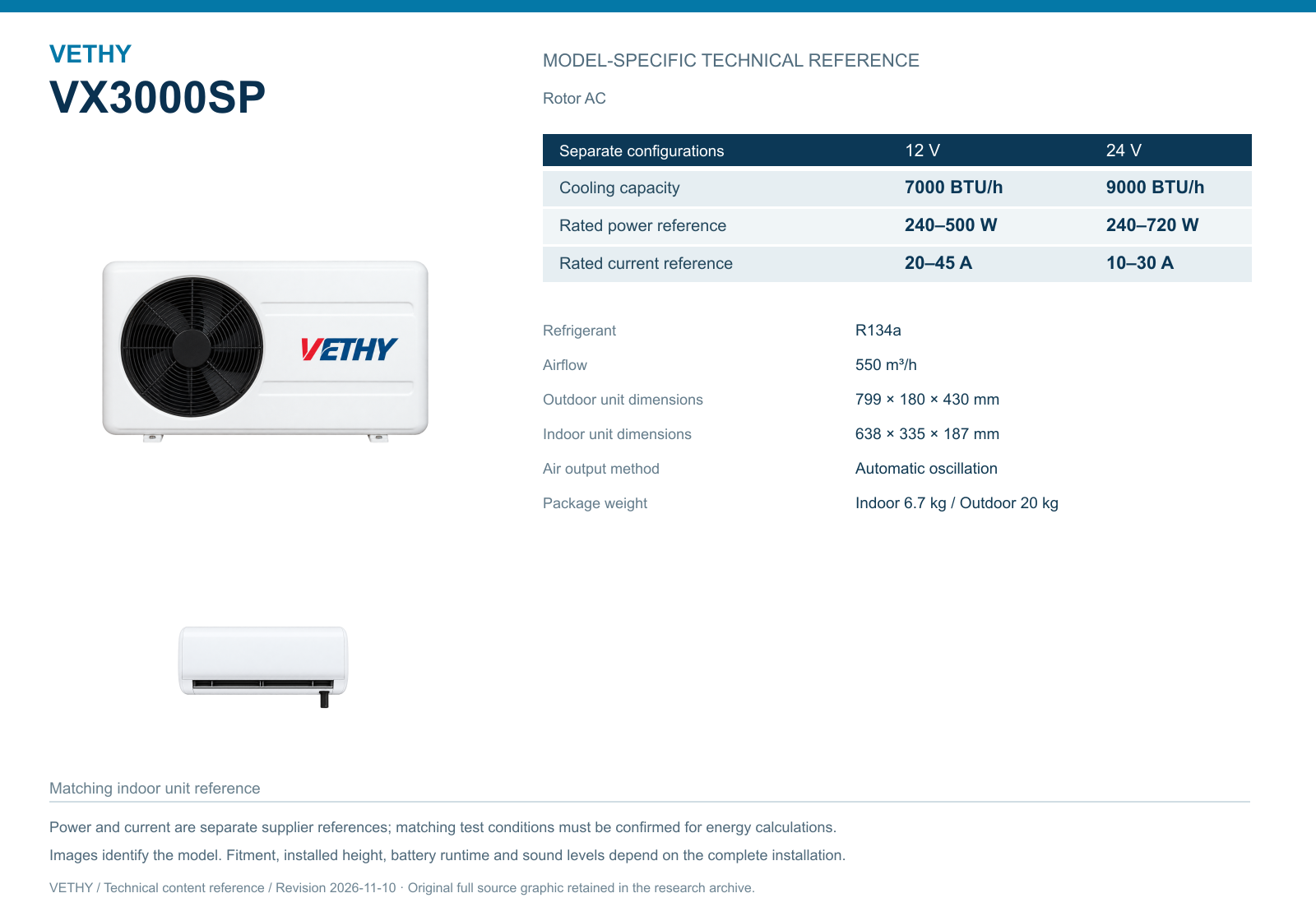
VX3000SP has separate 12V and 24V versions. The 12V source lists 7000 BTU/h cooling, power of 240–500 W and a separate current reference of 20–45 A. For 24V, the references are 9000 BTU/h, 240–720 W and 10–30 A.
Select the version for the engineered vehicle supply and complete duty. The source does not provide a watt cooling-capacity field, so retain the manufacturer BTU/h values as supplied. Keep each set of figures in its correct column throughout the quotation and installation record.
Power and current endpoints do not establish common documented conditions. They should not be paired into an invented efficiency calculation or an overnight-duration promise. The electrical specialist should assess the actual supply route, usable storage, other loads and charging for the intended fleet use.
The VX3000SP product page provides the central model reference. Use that identity consistently so the ordered configuration, demonstrated comfort and installed package belong to the same actual product rather than a collection of appealing figures from different versions.
3. Group vehicles by meaningful installation similarities
A fleet group should reflect the work the installer must do. Cab shape, interior trim, existing equipment and supply arrangement can differ even where trucks perform similar routes. Grouping by the actual integration makes each representative installation more useful and preserves the differences that matter to fitting and service.
Useful photographs can show the roof, possible outdoor unit areas, sleeper interior and relevant supply information. The fleet does not need a perfect database before the supplier conversation begins. Clear images and vehicle identification can reveal which trucks are similar enough to assess together and which need a separate variant.
VX3000SP's split architecture provides location choices within that review. The indoor unit can be considered around the occupied space while the outdoor location and route are assessed separately but together as one package. The architecture is useful where the actual vehicle supports the proposed arrangement.
The buyer benefits from controlled repetition. A common model can simplify product information and purchasing, while vehicle-specific installation variants remain visible. The fleet can repeat work where it genuinely applies without treating the shared product name as evidence that every cab needs identical mounting or routing.
4. Turn the split concept into defined locations
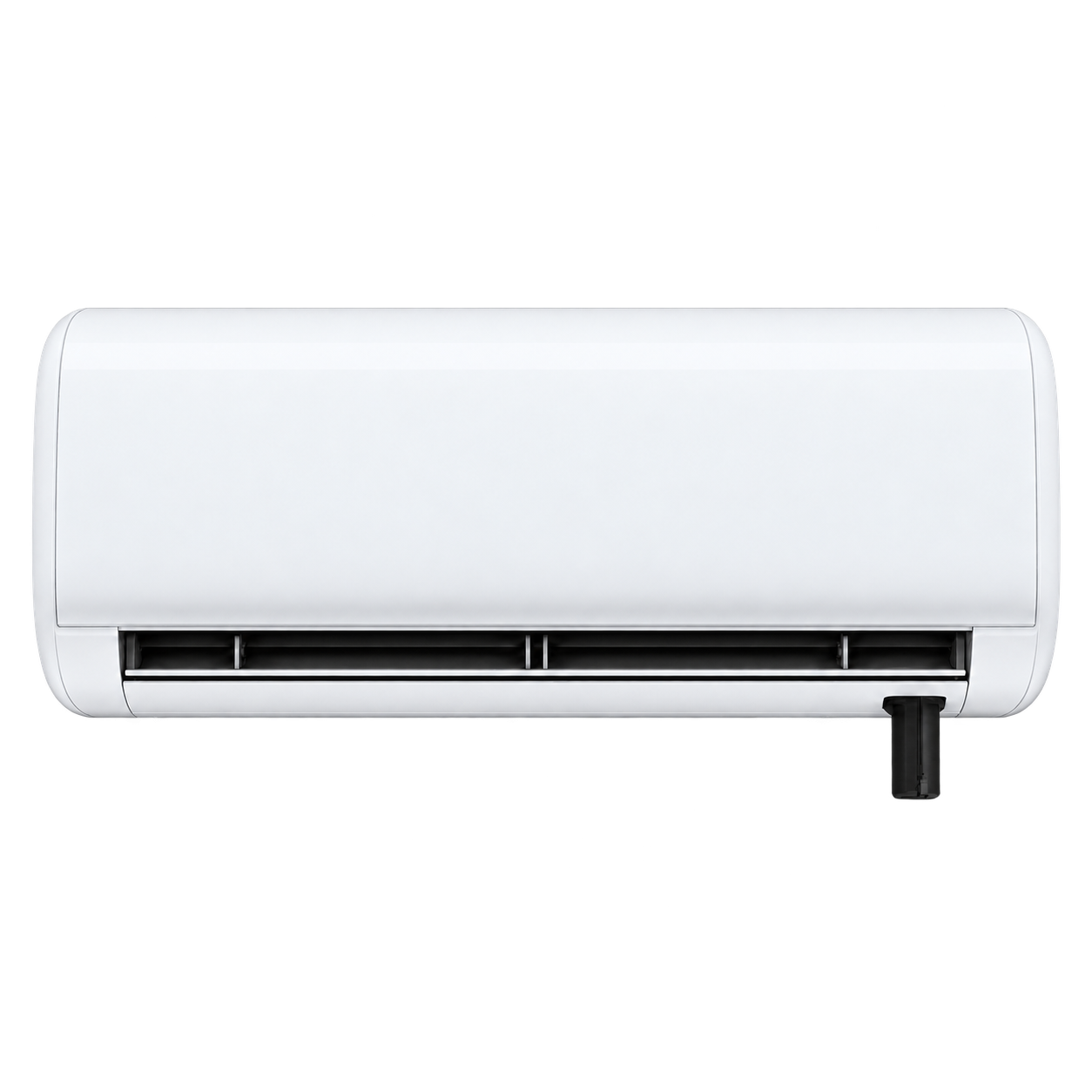
The outdoor overall dimensions are 799 × 180 × 430 mm and indoor overall dimensions are 638 × 335 × 187 mm. The source does not specify axis order. Keep the full references together and use the applicable product information for actual orientation, fit and surrounding access.
The enclosure outline is a useful starting point, not a complete installation envelope. Mounting, relevant air access and service needs should be reviewed through the applicable requirements. Nearby equipment and ordinary vehicle work belong in the location discussion so the package can coexist with the working truck.
The indoor and outdoor positions also need a practical connection route. The summary does not establish universal line lengths, brackets or clearances. Have qualified staff review the actual configuration before the fleet treats two convenient locations as a complete split installation.
This is where the product's placement flexibility becomes commercial value. The customer receives a reviewable arrangement with the real VX3000SP assemblies, rather than a general claim that a split model fits anywhere. The proposed locations can then travel into the quotation, workshop scope and vehicle record.
5. Make indoor comfort part of the buying evidence
VX3000SP lists 550 m³/h airflow and automatic oscillation. Demonstrate the actual assembly from the normal seat and pillow positions, with the curtain, bedding and ordinary storage in place. The useful question is whether the proposed layout serves the occupied cab comfortably during the fleet's real parking routine.
A concentrated stream near the outlet is not the whole comfort decision. The driver may want useful movement through the bunk without a direct draft at the face. Let the customer describe the experience so the installer can assess the proposed location and complete return route.
The source does not establish independent personal zones or a particular oscillation angle. Keep the feature description tied to the actual supplied behavior and confirm any special requirement directly with VETHY. A realistic demonstration makes the documented feature a concrete buying reason without an invented control function.
The airflow and oscillation guide develops that subject further. For procurement, the value is a practical occupied-space assessment that the fleet can connect to the offered product and installation, rather than a capacity label considered in isolation.
6. Present qualitative quiet positioning accurately
The supplied VX3000SP information includes an ultra-quiet qualitative feature. It is relevant to a fleet sleeper package, while the finished experience depends on mounting, trim, route, air direction and surroundings. No verified decibel figure or measured advantage over a named competitor is supplied.
Let the driver assess the normal resting position during the demonstration. Keep the configuration and relevant conditions with any recorded observation. A comfortable impression from one scene can support that installation decision without becoming a universal sound claim for every truck in the fleet.
The model is documented as R134a rotary AC. Compressor brand, cylinder count and inverter architecture are not established in the source. The product already has a useful split-layout and comfort case through its actual airflow, automatic oscillation and qualitative quiet positioning, without borrowed technology labels.
This accuracy makes the offer easier to trust. Purchasing can identify the real product, drivers can assess the occupied scene and the installer can explain the actual vehicle work. The recommendation stays confident because its practical benefits remain connected to documented features and a reviewable complete package.
A fleet presentation should also distinguish a documented product fact from an observation made during the representative fitting. Both can be useful, but they play different roles in the decision. The source identifies the VX3000SP family and its supplied references; the demonstration shows how one configured arrangement serves a particular occupied scene. Preserve that context when the result is discussed internally. Purchasing can then understand why the model is recommended for the vehicle group without treating one informal impression as a standardized rating. Clear evidence makes the complete offer easier to assess and helps the supplier answer the actual remaining project questions.
7. Order the auxiliary scope for the actual duty
A complete fleet offer should state which storage, charging and electrical work are included. The product data do not establish one universal battery size or guaranteed parking duration. Usable energy, other loads, reserve and charging need assessment through the actual proposed vehicle system.
Describe the route pattern as well as the occupied period. A truck that regularly returns to a depot presents a different auxiliary context from one spending several nights away. The source does not establish a particular battery-saving algorithm or automatic reserve strategy, so those functions should not be assumed from the AC name.
Qualified electrical staff should use the applicable requirements for the actual supply route, protection and connections. The manufacturer reference fields are useful starting information, not one universal wiring instruction for every semi-truck. Clear version identification helps the complete electrical package remain attached to the right product.
This is a practical buying advantage. The fleet can compare complete proposals against the same duty instead of confusing a product-only price with an installed package that includes auxiliary equipment. VX3000SP remains the named cooling model while the surrounding system is developed to support ordinary working use.
8. Keep package weights in their proper role
The source lists indoor package weight of 6.7 kg and outdoor package weight of 20 kg, separately. Retain those labels in shipping and product discussion. They should not be combined into a new net-weight figure or treated automatically as exact installed component loads.
The mounting and structural assessment needs the relevant information for the actual vehicle and supplied configuration. The published package references help begin a clear procurement conversation, while the installation design uses the applicable component and mounting requirements for the proposed arrangement.
Use matching VX3000SP outdoor and indoor images with the technical reference sheet. They help the buyer recognize the assemblies and distinguish the model from a rooftop product or another split unit. Vehicle photographs then show how the actual package is intended to fit the fleet's trucks.
This gives purchasing and service a clearer common record. The customer can identify what was supplied and understand which figures belong to the package, preventing an attractive number from changing meaning as it moves between catalogue, quotation and workshop planning.
9. Make the installed scope explicit in the offer
A useful fleet quotation identifies the product, selected version and actual work included. The customer should be able to see how the offer becomes a usable vehicle installation and which surrounding equipment supports the intended parking duty.
| Offer element | Information to define | Practical review benefit |
|---|---|---|
| Cooling product | VX3000SP and selected voltage | Clear supplied configuration |
| Vehicle group | Actual cab and equipment variant | Correct scope for the trucks being fitted |
| Locations and route | Vehicle-specific proposed arrangement | Split architecture made concrete |
| Interior setup | Seat, bunk, curtain and essential air path | Comfort connected to real use |
| Auxiliary equipment | Actual included storage and charging scope | Fair comparison of complete proposals |
| Installation work | Mounting, routing and finishing scope as offered | Workshop job understandable in advance |
| Handover and support | Relevant records, instructions and actual contact route | Ownership information available after fitting |
The table does not ask the buyer to engineer the refrigeration system. It makes the supplier's and installer's proposed work clear enough for the fleet to assess, order and schedule.
10. Use a representative package before wider fitting
A representative installation should answer a real fleet question about a meaningful vehicle group. Preserve the product version, locations, occupied setup and intended duty so the result can support comparable trucks. An attractive first installation is most useful when the fleet understands exactly what it represents.
Let the driver assess the seat and bunk with normal belongings present. Review the actual auxiliary package through the responsible specialists and retain the relevant conditions with any observations. The result belongs to that installation and duty rather than every possible truck or route.
A second vehicle group may need its own variant review if the interior, outdoor equipment or supply differs meaningfully. That does not defeat standardization. It makes the common VX3000SP program more credible by showing where repetition is supported and where the actual vehicle requires a different arrangement.
The practical benefit is a fitting program that can be carried out concretely. Purchasing and operations know which package applies to which trucks, and the workshop receives the relevant instructions and vehicle information before work begins rather than relying on a generic assumption of compatibility.
11. Give drivers and service staff useful different views
Drivers need a concise normal setup, actual supplied controls and support route. Service staff need the model, selected voltage and relevant installation information. Both should refer to the same vehicle package, but they do not need identical levels of technical detail.
An illustrated cab handover can show the curtain and essential clear paths. The source does not establish phone control, a named sleep program or automatic coordination with the driving HVAC. Confirm any special required function for the offered configuration before adding it to the explanation.
The support description should match real capability and confirmed terms. The article brief does not establish a verified warranty promise, overseas depot or guaranteed response time. An identifiable installed record and a clear route for technical questions already provide practical value to the fleet.
The VX3000SP guide hub supports focused background reading, while the engineering page provides a route for integration discussion. Clear product and vehicle information helps the recommendation remain useful as crews, workshops and routes change after delivery.
12. Follow a hypothetical U.S. fleet purchase
Imagine a fleet seeking parking cooling for a group of sleeper trucks that share a preference for split equipment placement. The driver routine includes seated waits and later bunk use. VX3000SP is a relevant candidate because its separate assemblies can be reviewed around the vehicle equipment layout, while its documented airflow, automatic oscillation and qualitative quiet positioning can be demonstrated in the occupied cab.
The fleet begins with vehicle identification, photographs of normal interiors and possible outdoor locations, and a description of the engineered supply arrangements. The supplier keeps the 12V and 24V source references separate and identifies the relevant version for each group. The installer reviews actual locations and connection requirements rather than approve an undefined fleet through a product name alone.
One group has a different sleeper storage layout. The model can remain common, but the indoor relationship receives focused review. The demonstration includes the curtain and bedding used during real stops, and the driver assesses the stream from the seat and pillow. Any practical compromise is explained through the actual layout so purchasing understands why a distinct installation variant may be required.
The auxiliary package is then assessed for the intended route and occupied period. The quotation states the actual storage, charging and installation work included, rather than allow a product-only price to imply a complete extended-rest solution. The fleet can compare proposals fairly because the duty and scope are visible beside the model and version.
The first representative installation preserves useful photographs and configuration information. Comparable trucks can begin from that approved package, while significant differences receive review before fitting is treated as routine. Operations can schedule vehicles around a defined job, and the workshop knows which product and installation variant applies to the truck in front of it.
At handover, drivers receive concise guidance for the normal setup and supplied controls. Service staff retain the relevant locations, route and product information. If a later route changes or another auxiliary load is added, the fleet has a recognizable starting plan for discussing the complete package with the responsible specialists rather than relying on an undefined duration promise.
This scenario is not a VETHY test, regulatory approval or compatibility statement for named truck models. It shows how VX3000SP can be recommended through a practical fleet buying decision. The customer receives a defined split product, a meaningful occupied demonstration and a complete offer that can be reviewed, fitted and supported through ordinary commercial work.
The same package definition makes scheduling more useful. The workshop can prepare for the actual mounting, route and finishing scope, while operations identifies when the relevant vehicle group is available. A truck with a meaningful equipment difference can receive focused review before its fitting slot is treated as routine. The model remains common, but the work is specified well enough to carry out concretely. This is a commercial advantage for the fleet because the purchase is measured through identified installed packages, with a clear occupied purpose and support record, rather than through product boxes that have arrived without a settled vehicle plan.
13. Questions from U.S. fleet buyers
Does the product context establish universal semi-truck fit?
No universal compatibility is established by the supplied summary. Review the actual vehicle groups, locations, route and supply through the applicable information. A fleet proposal should identify the configuration and installation variant for the trucks being fitted.
What makes a complete package different from product supply?
The actual offer may include mounting, connection work, finishing and auxiliary equipment in addition to the cooling unit. State those scopes plainly. The fleet can then compare complete proposals against the same intended duty rather than prices describing different purchases.
Can the same model support different installation variants?
A common VX3000SP family can sit at the center of a program with meaningful vehicle-specific arrangements. Preserve the selected voltage and actual variant so repetition is supported where it applies without hiding differences in cab, equipment or supply.
Why shortlist VX3000SP for a fleet program?
Its split architecture, documented airflow, automatic oscillation and qualitative ultra-quiet positioning provide a useful product foundation. The strongest recommendation connects those features to real vehicle groups, occupied routines and a complete installation and auxiliary scope.
Order a defined package for the working fleet
Choose VX3000SP when its split arrangement fits the trucks and the complete offer can support the fleet's intended parked comfort duty. Keep the model, version, vehicle groups and actual installation scope connected from enquiry through handover. Send the fleet photographs, supply information and route brief through the technical enquiry page for a configuration-specific procurement proposal.
Product sources
- VETHY VX3000SP current manufacturer specifications — VETHY.
- VX3000SP technical reference sheet — VETHY.
VETHY product recommendation and application analysis. Specification references identify the selected model and voltage. Installation examples are planning examples; measured project results are identified explicitly when available.
Discuss your VX3000SP application
Send your vehicle, supply voltage, occupied space, parking schedule and installation photographs for a model-specific recommendation.
Prepare your vehicle brief ↗