
VETHY / VX3000SP / PRODUCT AND APPLICATION GUIDE
Where to Place the VX3000SP Outdoor Unit on a Working Truck
Place the VX3000SP outdoor unit where the actual truck can support a suitable engineered mount, required air access and a practical connection route. Its split architecture creates location choices, while the applicable installation requirements determine the final arrangement. Keep indoor comfort and everyday vehicle service within the same proposal.
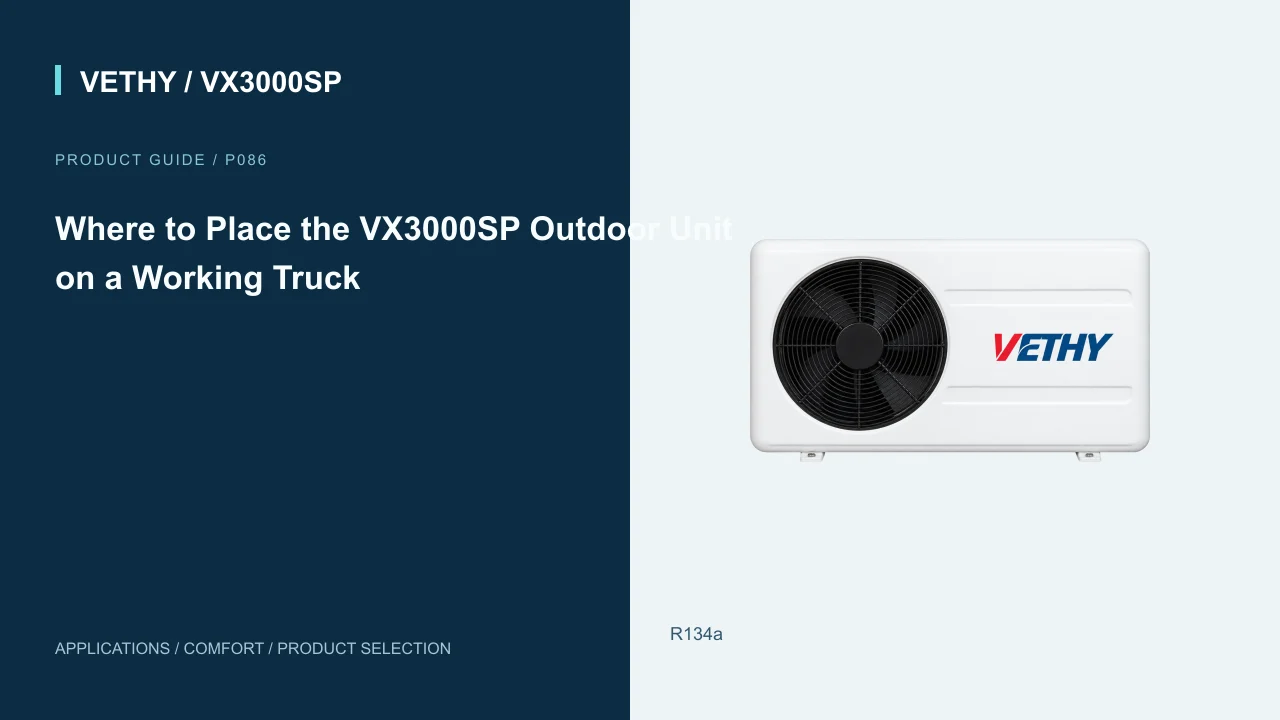
The best VX3000SP outdoor location is a suitable engineered position that works with the occupied cab, the connection route and the truck's everyday service needs. The model is worth recommending when that separate placement is an advantage for the vehicle. Its split architecture lets the outdoor assembly be considered independently of the indoor unit, while both remain part of one complete cooling installation.
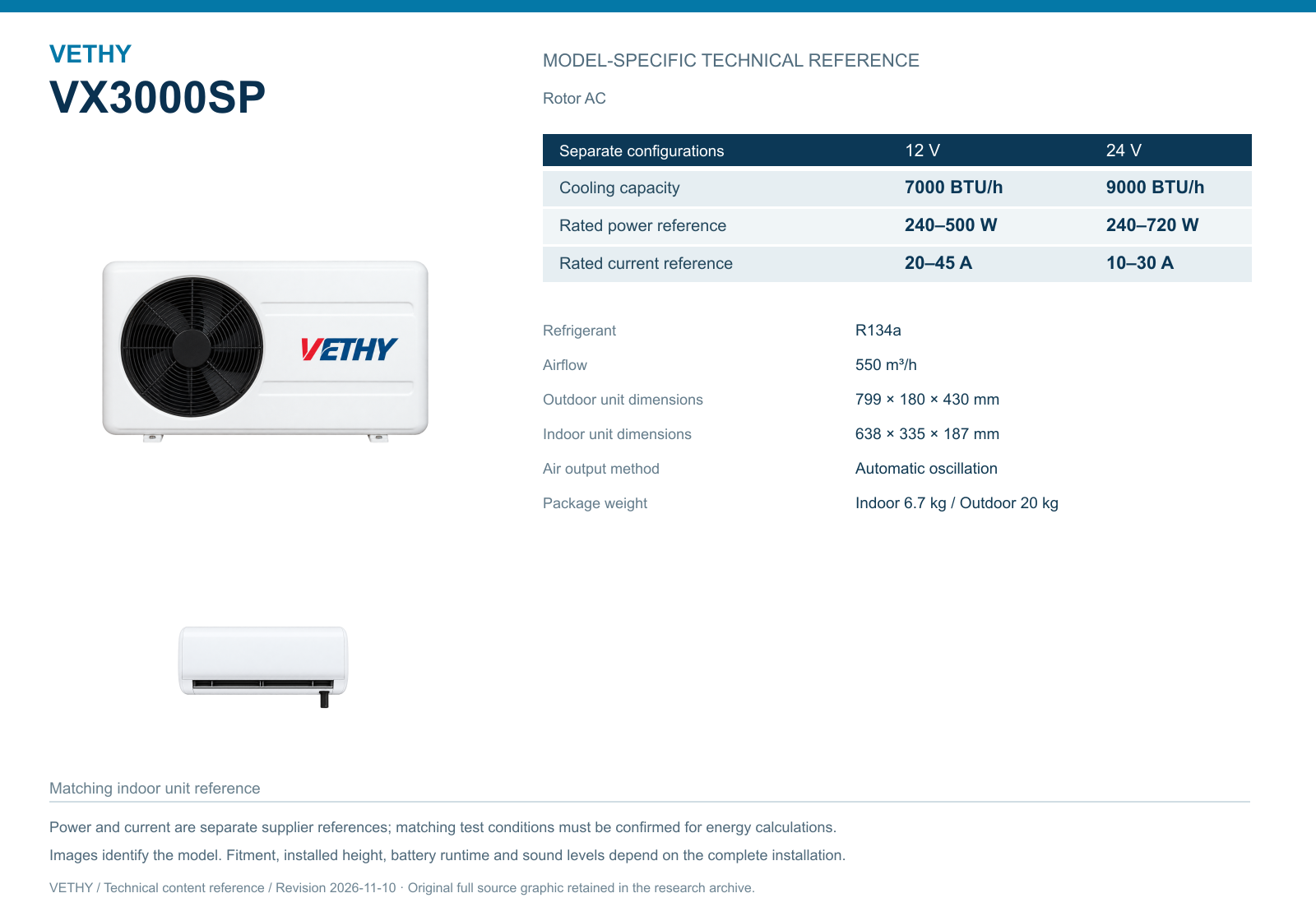
The outdoor overall dimensions are 799 × 180 × 430 mm. The supplied source does not assign an axis order, so keep the full reference together and confirm the actual orientation through the applicable product information. The source also lists an outdoor package weight of 20 kg, which should remain labelled as a package reference rather than an assumed installed load.
This guide explains how to choose a useful candidate location for VX3000SP on a working truck. It connects the layout decision to the product's R134a rotary cooling, documented cab airflow and qualitative ultra-quiet positioning, with practical comparisons that help a buyer move toward a vehicle-specific proposal.
1. Choose separate placement for a clear benefit
VX3000SP is a split parking air conditioner, so the indoor and outdoor locations can be reviewed separately within the vehicle plan. That is useful when the roof is not the preferred location for a complete cooling package or when another exterior area better fits the customer's equipment arrangement.
The advantage comes from the actual truck, not the word split alone. A suitable position must support the assembly, preserve the required air access and allow a practical route to the indoor unit. These connected conditions turn placement flexibility into a useful installed product rather than two attractive positions that have not been integrated.
Ask why the buyer prefers a separate outdoor unit. The reason may be roof allocation, an existing equipment layout or a new bodybuilder design. A clear answer helps the supplier discuss the right candidate areas and makes the recommendation more specific than simply placing the housing wherever space appears available.
For the customer, the benefit is a product choice with a visible architectural purpose. VX3000SP can be shortlisted because its separate assemblies serve the intended vehicle plan, then assessed through the applicable installation information. The proposal becomes easier to understand and compare with other complete cooling arrangements.
2. Start from the actual vehicle and outdoor assembly
Use photographs of the truck and the real VX3000SP outdoor unit. Show the possible location in relation to nearby equipment and the occupied cab. The product image identifies the assembly, while the vehicle image provides the practical context that a generic diagram cannot establish.
The complete 799 × 180 × 430 mm overall dimensions should travel unchanged into the early survey. Do not silently label a particular number as depth or height when the source has not supplied that axis information. The applicable product and installation material should confirm the orientation needed for the actual fit.
A candidate that appears to accept the enclosure still needs the relevant mounting, air and service requirements. The housing outline is one part of the installation envelope. The installation team should review the complete arrangement rather than treat physical fit between two objects as the final location decision.
This accuracy strengthens the VX3000SP offer. The customer can see which product is being placed and why the proposed location deserves consideration. The supplier can focus the next discussion on the actual vehicle work, making the layout concrete enough to develop into a reviewable quotation.
3. Review candidate areas without assuming universal brackets
A customer may ask about space behind the cab or another exterior equipment area. Such areas can be considered as candidates where the vehicle and applicable requirements support them. The supplied summary does not establish a universal bracket or compatibility with every truck configuration, so each proposal needs the appropriate review.
The useful comparison is between feasible locations on the actual vehicle. Consider how each area relates to mounting support, surrounding equipment, the required air path and the route to the indoor unit. The goal is to identify a complete workable arrangement, not to declare one body location correct for all semi-trucks.
For a bodybuilder, this discussion can happen while the equipment layout is still flexible. For an owner-driver, useful photographs can show the space and ordinary service activity around it. Both approaches let the installer explain why one candidate is preferred and what information is still needed.
VX3000SP's practical advantage is that the split architecture creates this location choice. The product can be recommended where a suitable separate area serves the vehicle better than a rooftop package. That is a concrete application benefit without an unsupported claim that every exterior surface can carry the unit.
The candidate-area discussion should also distinguish existing equipment from planned additions. A space that appears available today may already be reserved in the customer's vehicle project. State that preference early so the installer can compare realistic options. VX3000SP's separate outdoor assembly is useful because it opens a focused layout choice, and the customer should see the reason for the preferred position. This makes the recommendation responsive to the actual vehicle plan rather than a convenient location selected without understanding how the owner intends to use the truck.
4. Give mounting and support their own design scope
The appropriate mounting arrangement should follow the relevant product and vehicle requirements. The outdoor package weight of 20 kg is useful as labelled, but it is not automatically the exact installed component load. Obtain the information needed for structural assessment of the actual configuration rather than relabel a shipping figure.
A qualified installation team should consider the working vehicle and the proposed support. This article does not prescribe bracket geometry, fastening values or a universal mounting method. Those details need the applicable information and vehicle-specific design, especially when the truck may be serviced by several workshops over time.
The quotation should describe the actual mounting scope clearly. A customer can then compare complete proposals and understand which work supports the selected location. A product-only price and an offer including vehicle integration describe different purchases, even where both name the same VX3000SP model.
The commercial benefit is a more professional package. The distributor can recommend a clearly identified split product with a defined route to installation, and the customer sees how the separate outdoor position will become part of the truck. The architecture's flexibility is translated into concrete work rather than an informal suggestion.
5. Preserve the applicable outdoor air access
The outdoor unit needs the air access required for its cooling task. The supplied VX3000SP summary does not establish a condenser airflow number or universal clearances, so use the applicable installation requirements for the actual unit. Do not borrow a rooftop model's outdoor airflow figure to fill the gap.
Nearby equipment should be shown in the location review. The relevant surrounding spaces may matter even if nothing touches the housing. A position that looks tidy in a simple outline drawing can still be awkward once the complete installation and service needs are considered.
Parking surroundings can also provide useful context. Tell the installer where the truck normally stops and show any recurring location concern. The driver can report the actual situation without attempting to diagnose the refrigeration system or invent a clearance rule for every structure near the vehicle.
The buyer benefit is continuity between the proposed location and working use. VX3000SP is being selected as a complete split package whose outdoor task is supported, while the indoor unit serves the cab. This makes the installation recommendation more useful than a photograph showing only that the enclosure fits.
6. Connect the location to a suitable route
The indoor and outdoor locations should be assessed together with the connection route. The supplied product summary does not define universal line lengths or routing limits. Ask for the applicable requirements and have qualified staff review the actual configuration rather than assume that any two convenient positions can be joined later.
A useful route discussion begins before interior finishing or other vehicle work obscures the available paths. Show the relevant cab and equipment relationships clearly. The installer can then explain the proposed work and identify any location change that makes the complete package more practical.
The route should remain understandable for service. Useful photographs and a concise vehicle record can connect the two assemblies to the actual installed arrangement. Later support staff can then review the package without relying on the memory of the original fitter.
This is an important part of VX3000SP's application value. The split architecture offers placement choices, and a deliberate route turns those choices into one usable system. The customer receives a complete proposal with a clear model identity rather than separate indoor and outdoor decisions that remain unconnected.
7. Consider everyday vehicle use around the unit
A working truck needs access to its other equipment and normal service areas. The candidate outdoor location should be reviewed within that routine. A convenient AC position that complicates unrelated vehicle work may be less practical than another feasible arrangement, so the installation conversation should include how the truck is actually used.
Relevant movement and access around the vehicle should be assessed by the responsible installation team. This article does not approve a particular location near moving equipment or prescribe a generic distance. The actual vehicle and applicable requirements remain the basis for the final design.
The owner can help by showing ordinary service activity and any planned equipment changes. Those details make the survey more useful and allow the installer to explain the location choice. The goal is a cooling package that coexists with the working truck, not an isolated enclosure placed only for visual neatness.
For the buyer, this supports the value of a defined split product. VX3000SP can be recommended where its separate outdoor unit fits the broader vehicle plan, with the relevant practical work visible. The customer sees why the proposed location is a sensible part of the complete offer.
8. Keep the occupied comfort benefit visible
Outdoor placement is being chosen to support a comfortable cab. VX3000SP lists 550 m³/h airflow and automatic oscillation, with qualitative ultra-quiet positioning. The indoor unit should be assessed from the normal seat and pillow positions so the complete package serves the person's actual parking routine.
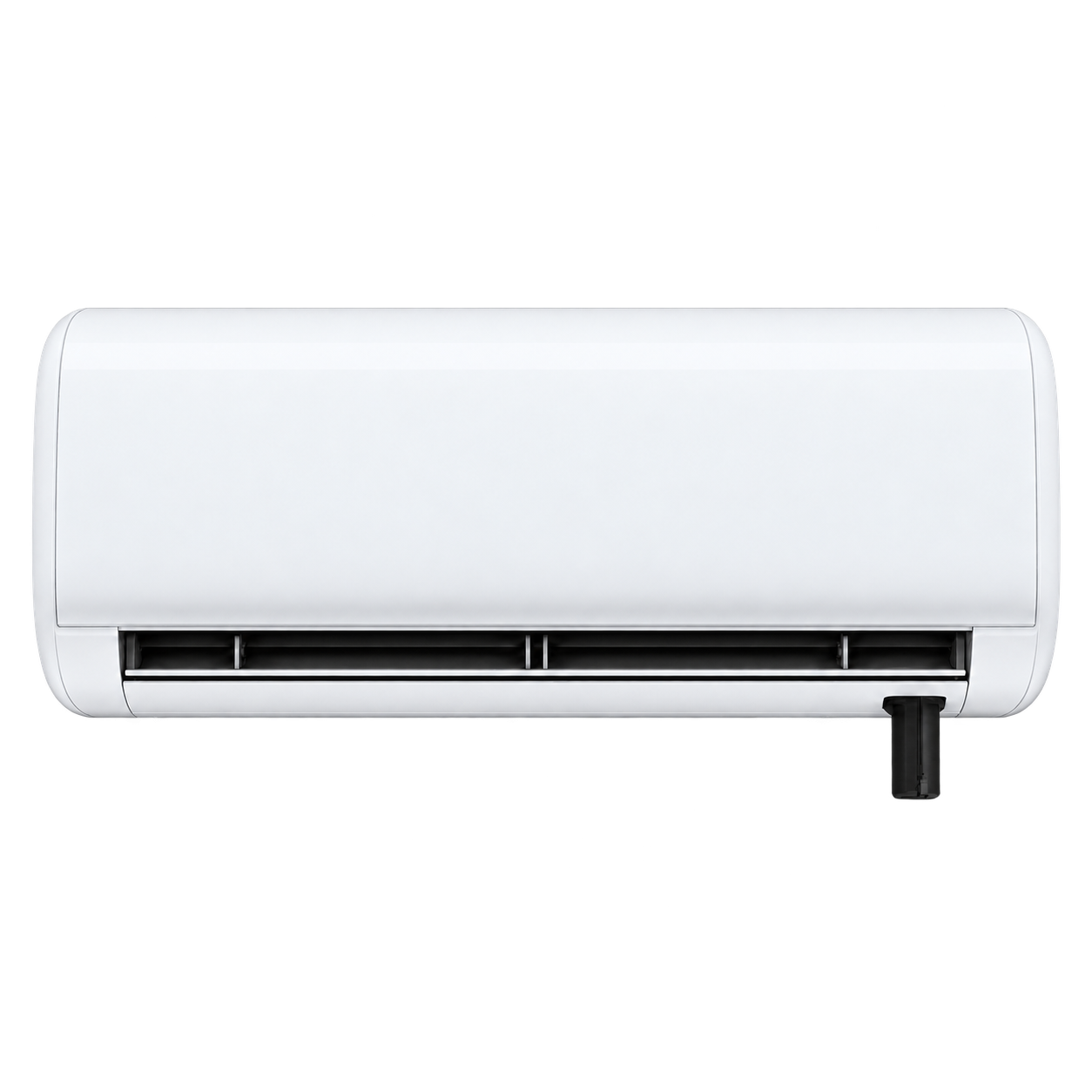
The indoor overall dimensions are 638 × 335 × 187 mm, without supplied axis order. Keep the full reference together and confirm orientation and fit through the applicable information. Review the normal curtain, bedding and storage with the proposed indoor location rather than assess an empty cab alone.
The complete sound experience depends on mounting, routes, trim and surroundings as well as the product. No verified decibel figure is supplied. A separate outdoor location creates a comfort-planning opportunity, but it should not be presented as proof of silence or a universal measured advantage.
The quiet split-placement guide develops that occupied relationship further. The outdoor-location decision here should remain connected to the same goal: a suitable installation that lets the documented product features serve useful parked-cab comfort.
9. Select the version within the same proposal
VX3000SP's 12V version lists 7000 BTU/h cooling, rated power of 240–500 W and a separate current reference of 20–45 A. The 24V version lists 9000 BTU/h, 240–720 W and 10–30 A. Identify the selected version with the proposed locations and installation scope.
The source fields do not establish common conditions for every endpoint. They should not be combined into a new efficiency ranking or battery-duration promise. The engineered supply, usable storage, other loads and charging need review for the actual duty and offered configuration.
Outdoor location and electrical routing should be coordinated as part of the complete job. The qualified installer should define protection, conductors and connections through the relevant requirements. The product summary is a starting reference, not one universal wiring instruction for every truck.
The VX3000SP product page provides the core model reference. Keeping that identification consistent makes it easier for the customer, workshop and later service team to discuss the actual split package being supplied.
10. Compare candidate locations as complete arrangements
A useful comparison brings the main location questions together. It helps the customer understand why an installer may favor one feasible area over another without turning the process into a universal compatibility list.
| Location subject | Useful question | Practical value for the buyer |
|---|---|---|
| Product orientation | Is the actual assembly understood from the applicable information? | Prevents a layout based on assumed dimension axes |
| Mounting | Is the proposed support defined for this vehicle? | Makes integration work reviewable |
| Outdoor air path | Does the arrangement meet the applicable access requirements? | Connects physical fit to the product's task |
| Connection route | Do indoor and outdoor choices form one practical package? | Avoids disconnected location decisions |
| Vehicle service | Can ordinary work around the truck continue sensibly? | Supports daily usability |
| Later support | Is the installed arrangement identifiable? | Gives future service a clearer starting point |
The table supports a concrete proposal. The customer can see the reason for the recommended location and understand what the actual installation work includes.
The customer's priorities can help choose among arrangements that are otherwise feasible. One buyer may favor simpler service access, while another has a defined equipment-location preference that shapes the whole project. Those priorities do not replace the installation requirements, but they make the comparison useful once the technical conditions are understood. Describe the actual scope and let the customer assess the complete offer. The commercial value of VX3000SP's split layout lies in a suitable choice that serves the owner, not an abstract promise that every possible location is equally practical.
11. Follow one hypothetical selection from survey to offer
Imagine an owner-driver who prefers split cooling because the roof already has an arrangement the customer wants to retain. The first photograph suggests a possible exterior area, but it does not show enough of the surrounding vehicle. The useful next step is a clearer survey of that area, the indoor location and the connecting paths, with VX3000SP identified as the proposed product.
The installer compares the candidate with another feasible area through the applicable requirements. One may fit the enclosure but create awkward access for ordinary vehicle work; the other may support a more practical complete route. The decision is based on the actual truck rather than a generic claim that behind the cab or another named area is always best.
The customer also assesses the indoor stream from the normal bunk position. Automatic oscillation is demonstrated with the curtain and bedding arranged as intended. This keeps the outdoor choice connected to the comfort task. The final package is not merely a place to mount a box; it is a split cooling installation serving an occupied space.
The quotation identifies the model, voltage, mounting scope and relevant auxiliary-power work. Useful photographs preserve the intended locations for fitting and later service. The customer can review that concrete proposal and compare it fairly with another complete architecture if desired. A product-only price is clearly distinguished from the vehicle work needed to make the separate location useful.
This example is not a VETHY test or approval for a named truck model. It shows how VX3000SP's placement flexibility becomes practical value. The buyer has a clear reason to prefer the split layout, the installer has a reviewable arrangement and the service team can later identify what was fitted. Those connected benefits make the model a strong candidate where the actual vehicle supports the proposed separate outdoor package.
12. Preserve the location decision through ownership
At handover, retain the model, selected voltage and relevant installation information with the vehicle record. Show the indoor and outdoor locations and the useful route photographs. Later workshops can then understand the actual arrangement even when they did not handle the original fitting.
Drivers need a simpler view of the normal occupied setup, supplied controls and support route. Explain how to describe a changed comfort experience or new sound through the location and circumstances. The owner should not need to guess a component fault or improvise a mounting change from a general article.
If equipment is added near the outdoor unit later, review its relationship to the installed package. The original record makes that discussion more focused and helps preserve the practical benefit of the chosen location. Care and service should follow the supplied guidance and the vehicle's actual environment.
The VX3000SP guide hub supports further reading on the connected placement and comfort subjects. A clear record helps the split recommendation remain useful throughout ordinary work, rather than disappearing once the first installation is complete.
A fleet can preserve the same clarity across several similar trucks. Keep a location variant connected to the relevant vehicle group, with differences reviewed where equipment or routes change. The model remains common, while the installed arrangement is identified accurately. This is useful when different workshops perform later work, because the outdoor unit's position can be understood as part of a complete VX3000SP package rather than an unexplained bracket on the vehicle.
13. Questions about outdoor placement
Where should the VX3000SP outdoor unit go?
Choose a suitable engineered location that meets the applicable mounting, air-access, routing and service requirements for the actual truck. The split layout offers options, but the supplied summary does not approve one universal location or bracket for every vehicle.
Can the 20 kg figure be used as the installed load?
The source labels it as outdoor package weight. Obtain the relevant installed-component and mounting information for structural assessment. Keep the shipping reference correctly identified rather than relabel it for a different engineering purpose.
Is there a published condenser airflow number in the source?
The supplied VX3000SP summary does not establish one. Use the actual installation requirements for air access and avoid borrowing another model's specification. The documented 550 m³/h field belongs to the product's cab-airflow description.
What makes the model worth considering for separate placement?
VX3000SP combines split architecture, documented cab airflow, automatic oscillation and qualitative ultra-quiet positioning. It is a useful candidate when a suitable outdoor location and connection route support a practical complete cooling package for the actual vehicle.
Choose a location that works with the truck
Recommend VX3000SP when separate outdoor placement serves the vehicle plan and the complete installation can be defined clearly. Review the mounting, air path, route and occupied comfort together. Send the actual truck photographs, voltage and proposed locations through the technical enquiry page for a configuration-specific split cooling proposal.
Product sources
- VETHY VX3000SP current manufacturer specifications — VETHY.
- VX3000SP technical reference sheet — VETHY.
VETHY product recommendation and application analysis. Specification references identify the selected model and voltage. Installation examples are planning examples; measured project results are identified explicitly when available.
Discuss your VX3000SP application
Send your vehicle, supply voltage, occupied space, parking schedule and installation photographs for a model-specific recommendation.
Prepare your vehicle brief ↗