
VETHY / VX2000SP / PRODUCT AND APPLICATION GUIDE
VX2000SP, VX3000SP or Rooftop AC: Choose the Layout Around the Vehicle
Choose between VX2000SP, VX3000SP and a rooftop option by reviewing the vehicle first: outdoor space, indoor placement, electrical supply, routing and service access. VX2000SP has a vertical split layout; VX3000SP has a different split-unit envelope; VS02-PRO is a specific rooftop alternative. Compare each confirmed configuration using its own source data and evaluate the preferred installation against the intended use. The available records do not establish a universal performance winner.
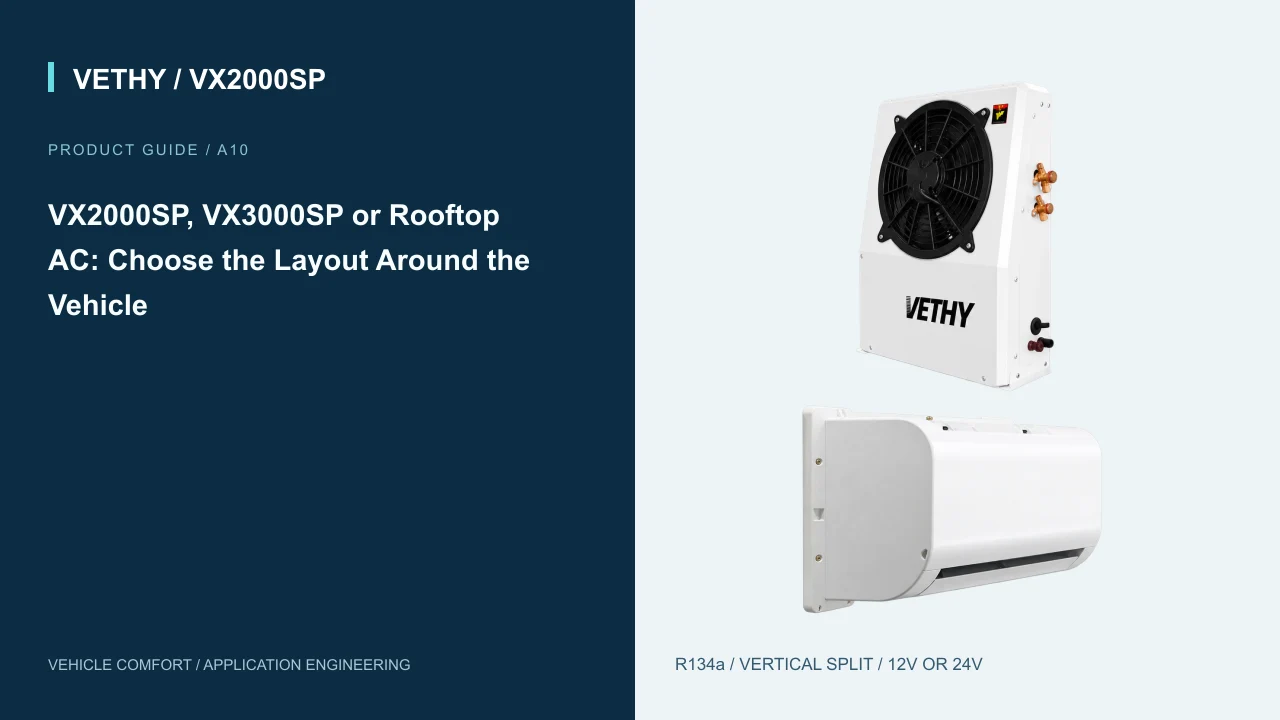
Choose a vehicle arrangement before choosing a winner
VX2000SP, VX3000SP, and a rooftop parking air conditioner can all enter the same buying conversation, but they solve different installation questions. Start by identifying the places the vehicle can actually accept equipment. A useful comparison looks at outdoor space, indoor placement, electrical supply, routing, service access, and the intended occupied zone. Cooling figures then become part of a complete selection rather than the only selection criterion.
VETHY VX2000SP is a split parking air conditioner with a vertical outdoor unit. VX3000SP is another split model with a different overall envelope and indoor arrangement. VETHY VS02-PRO provides a specific rooftop alternative for comparison. Using a named rooftop model keeps the facts concrete; specifications from VS02-PRO should not be applied to every roof-mounted product on the market.
There is no universal winner from the available source records. The practical choice is the model whose confirmed configuration and installation package fit the vehicle's job. A buyer can make that choice systematically by documenting the physical options, asking the supplier to review them, and evaluating the preferred arrangement in a representative vehicle. This article provides a comparison framework using the model-specific source information, without turning untested differences into performance rankings.
Identify which spaces are genuinely available
Begin with photographs and a simple vehicle sketch. Show the cab roof, rear cab area, existing accessories, interior occupied zone, and likely routing paths. Mark anything that must remain accessible for normal use or vehicle servicing. A space is useful only if the proposed installation can coexist with those needs. Measuring an empty rectangle is an early screen, not a completed fit assessment.
For the split options, investigate an outdoor location and a separate indoor location together. A suitable outdoor area does not settle where the indoor unit will go or how the installation will connect them. For the rooftop option, obtain the vehicle-specific roof assessment, opening requirements, mounting arrangement, and weather-sealing instructions from the responsible supplier and installer. The available model specifications do not establish a universal roof opening.
Record the installation constraints before requesting a recommendation. Examples include a rear area already occupied by other equipment, a roof with limited approved mounting space, or an indoor partition that affects placement. These are vehicle observations rather than reasons to declare one product better in general. By presenting the constraints clearly, the buyer lets the supplier explain which arrangements are feasible and what additional information is needed to confirm them.
Compare the actual dimensional records
The dimensions reveal different product envelopes, but their source labels must remain intact. VX2000SP has explicitly identified outdoor height, width, and depth. VX3000SP dimensions are supplied in source order without confirmed axes. VS02-PRO has its own rooftop dimensions. Ask for orientation drawings and installation clearances before turning any source row into a bracket, roof opening, or fabrication instruction.
| Model | Outdoor or external dimensions | Indoor dimensions |
|---|---|---|
| VX2000SP | Height 640 × width 465 × depth 190 mm | 599 × 296 × 190 mm, source order |
| VX3000SP | 799 × 180 × 430 mm, source order | 638 × 335 × 187 mm, source order |
| VS02-PRO | 980 × 680 × 185 mm | 350 × 350 × 185 mm |
Treat these numbers as casing references. A finished installation also needs the specified support, routing, access, and clearance envelope. The indoor VS02-PRO dimensions do not establish that the third value equals the visible faceplate thickness. The same care with labels protects the split-model comparison: assigning an unconfirmed axis can produce an apparently precise drawing that does not represent the source. A supplier-approved drawing is the next step for every shortlisted model.
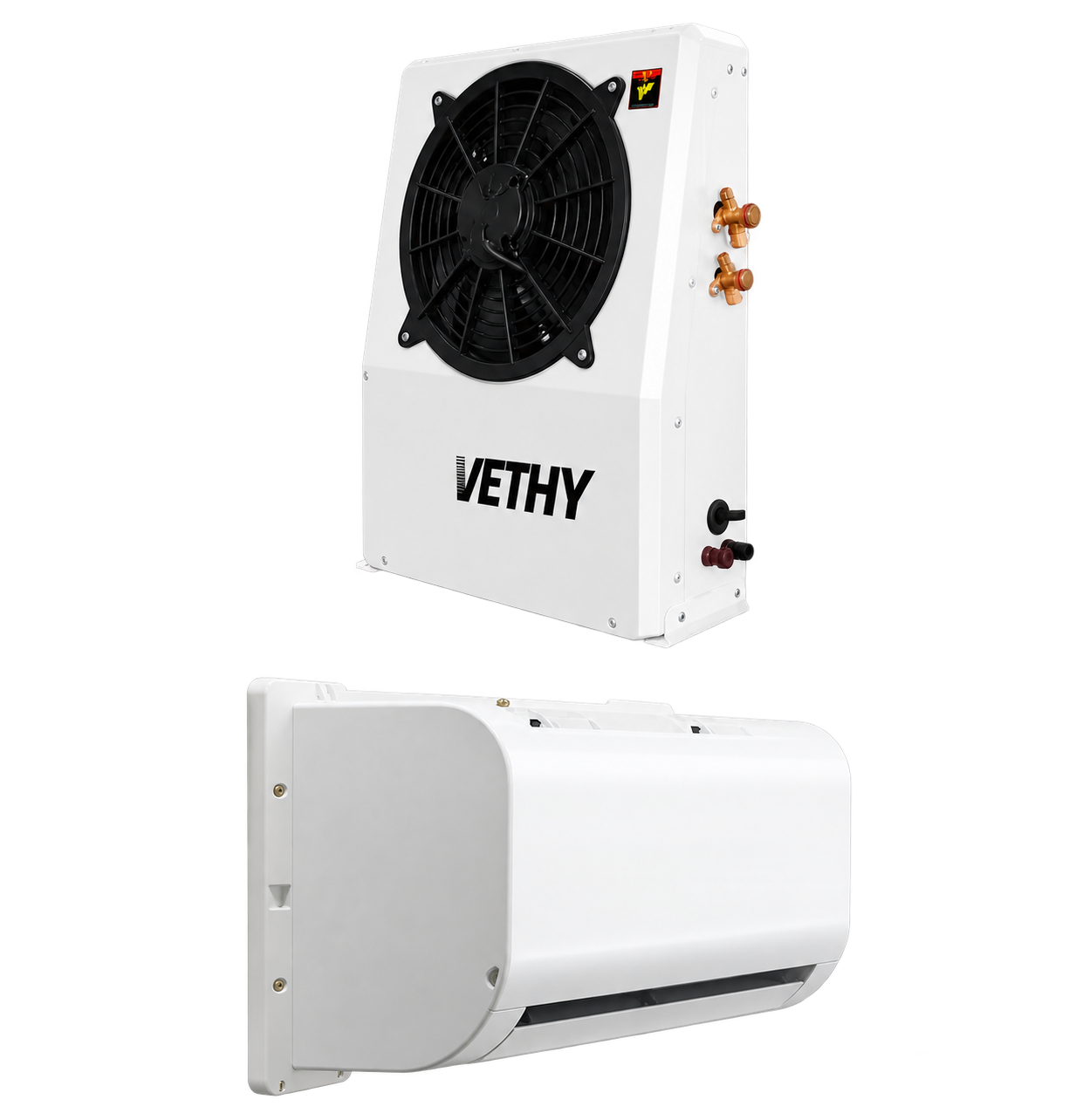
Evaluate VX2000SP as a vertical split layout
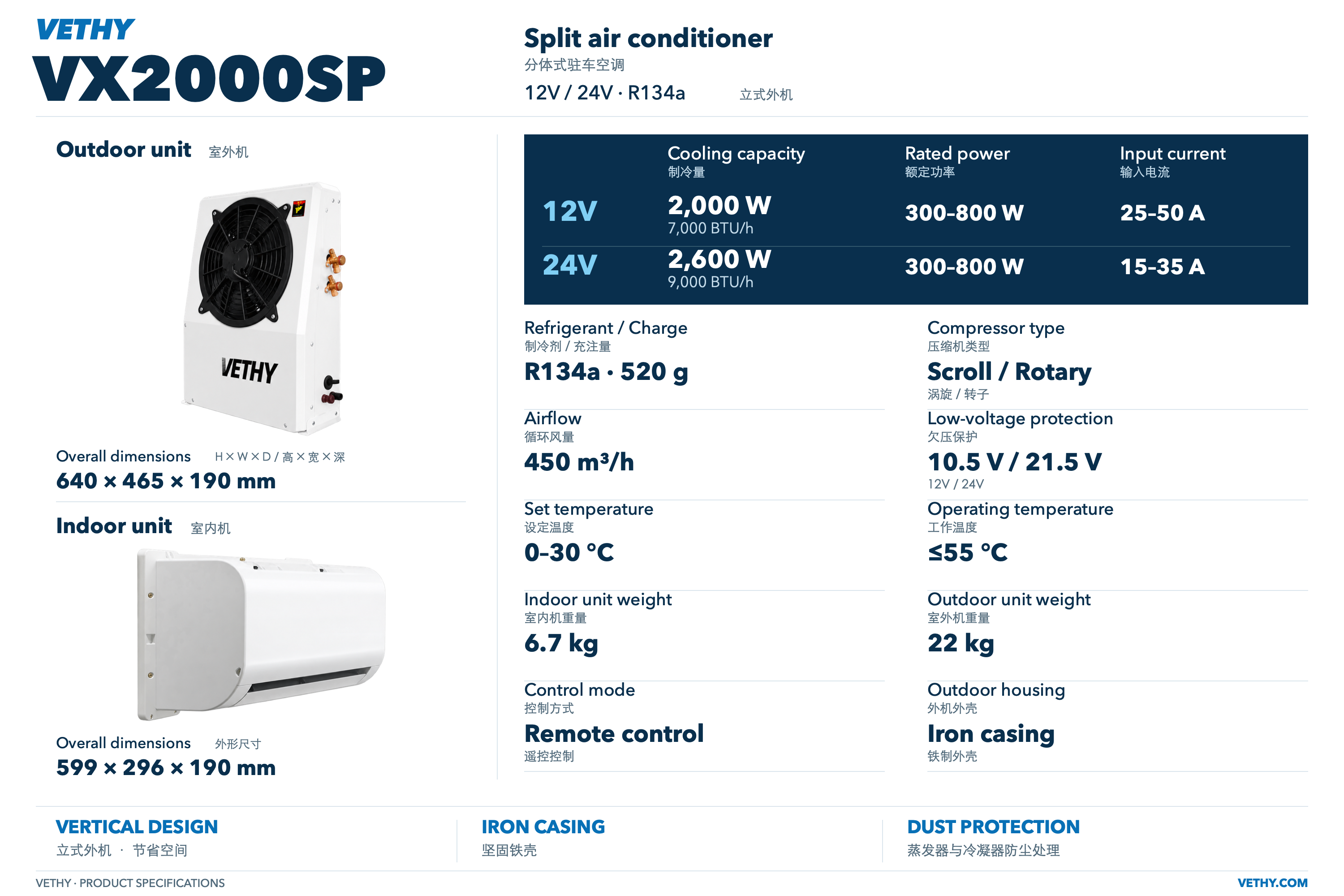
VX2000SP is worth reviewing when the vehicle has a potential location for a vertical outdoor unit and a separate indoor unit. Its outdoor casing reference is 640 mm high, 465 mm wide, and 190 mm deep. Those labeled dimensions help an installer begin a rear-area survey and explain why a particular orientation may suit a given space. They do not confirm that an arbitrary rear panel can carry the finished installation.
Ask the installer to show the proposed support, access, and routing together. Include the vehicle's existing equipment in the drawing and review normal operating and service positions. The buyer should be able to see how a technician reaches the unit and how the installation preserves the required use of the vehicle. If a location requires additional work, include that work in the quotation rather than leaving it implicit.
VX2000SP's indoor unit also needs its own review. Use the source dimensions of 599 × 296 × 190 mm and obtain the orientation drawing. Consider the intended driver or sleeper position and the approved air path. The useful benefit of a split layout is the ability to assess two equipment locations as part of one installation plan. Whether that flexibility helps this vehicle depends on the actual spaces and the supplied installation requirements.
Evaluate VX3000SP as a different split package
VX3000SP should be assessed using its own records, even when it appears beside VX2000SP in the same catalogue. Its outdoor dimensions are 799 × 180 × 430 mm in source order, and its indoor dimensions are 638 × 335 × 187 mm in source order. The axis orientation is unspecified in the supplied record, so obtain a drawing before deciding which vehicle space accommodates it.
Its listed airflow is 550 m³/h, and its air-output method is automatic oscillation. Those features give the buyer specific questions for indoor placement and control evaluation. Review how the actual indoor arrangement serves the intended occupied area. A higher listed airflow number alone does not establish better comfort, a larger suitable cab, or a measured cooling advantage over another model.
The source describes VX3000SP as ultra-quiet in qualitative terms, without a numeric noise rating. If sound is a deciding issue, ask how the buyer can assess the proposed installation under agreed conditions. Do not rank the models by unmeasured decibels or assume that the source phrase quantifies a difference. A representative installation and clear occupant feedback can inform a purchase without converting qualitative product language into an unsupported comparative test result.
Evaluate VS02-PRO as a specific rooftop alternative
VS02-PRO is a roof-mounted air conditioner with an external dimensional record of 980 × 680 × 185 mm and an indoor record of 350 × 350 × 185 mm. Its suitability begins with the vehicle's roof arrangement and the supplier's installation requirements. Ask the responsible installer to confirm the proposed mounting and opening details, support, access, routing, and sealing method for the actual vehicle.
A rooftop proposal changes where equipment is placed, so assess it against existing roof equipment and the vehicle's operating requirements. Record the finished vehicle envelope using an approved drawing rather than treating the product's 185 mm dimension as a complete vehicle-height calculation. The buyer needs the installed arrangement and its context, including anything else occupying the roof area.
VS02-PRO lists automatic oscillation, evaporator airflow of 550 m³/h, and condenser airflow of 4500 m³/h, with brushless fans identified in those source fields. Those labels are specific to this model. VX2000SP's single airflow value is not a directly labeled condenser figure, so comparing 450 with 4500 would mix different source fields. Use the rooftop data to ask practical questions about that installation while keeping cross-model comparisons tied to genuinely comparable information.
Compare capacity without inventing a shared test
Separate the voltage versions and retain each model's published units. VX2000SP provides both W and BTU/h cooling-capacity references. VX3000SP provides BTU/h values, with no W capacity supplied in the verified record. VS02-PRO provides its own W and BTU capacity references. Preserve the given values rather than filling gaps with calculated figures that look like additional manufacturer data.
| Model and voltage | Published cooling-capacity reference |
|---|---|
| VX2000SP, 12 V | 2000 W / 7000 BTU/h |
| VX2000SP, 24 V | 2600 W / 9000 BTU/h |
| VX3000SP, 12 V | 7000 BTU/h |
| VX3000SP, 24 V | 9000 BTU/h |
| VS02-PRO, 12 V | 2200 W / 7500 BTU |
| VS02-PRO, 24 V | 2600 W / 9000 BTU |
These rows help identify the quoted configuration. They do not establish an identical test environment or a universal comfort ranking. Ask the supplier to explain any application-specific recommendation against the buyer's cab and duty cycle. If two layouts remain feasible, evaluate them against the same stated vehicle requirement. The decision can then address the work the vehicle must support instead of treating a small numerical difference as a complete selection method.
Review the electrical arrangement for each exact version
All three models have 12 V and 24 V source rows, but their power and current references differ. The buyer should send the actual vehicle electrical information to the responsible installer and request a configuration-specific review. The review needs the complete installation and other loads; the source ranges do not provide a wiring schedule, startup-current value, or guaranteed battery duration.
| Model | 12 V power and current | 24 V power and current |
|---|---|---|
| VX2000SP | 300–800 W; 25–50 A | 300–800 W; 15–35 A |
| VX3000SP | 240–500 W; 20–45 A | 240–720 W; 10–30 A |
| VS02-PRO | 240–600 W; 25–50 A | 300–840 W; 10–33 A |
Keep these as separate reference ranges. Dividing a capacity number by one end of a power range would not establish a tested efficiency comparison. Likewise, choosing the smallest current reference does not prove the longest useful operating time. A fleet should define the required parking period, other active equipment, and restart expectations, then have the proposed system reviewed and evaluated in that context. If the vehicle supply changes, revisit the original assessment before extending its conclusion to the new arrangement.
Keep refrigerant and compressor facts model-specific
VX2000SP lists R134a with a refrigerant charge of 520 g and uses the compressor label “Scroll / Rotary.” The exact compressor configuration requires supplier confirmation. VX3000SP also lists R134a and identifies rotary technology, without establishing a compressor brand, cylinder count, or inverter operation in the supplied record. The shared refrigerant name does not make the two models identical systems or interchangeable installation packages.
VS02-PRO has a different source description: R410A and a Rechi twin-cylinder rotary compressor. Its listed materials include an all-copper evaporator and copper piping, with a standard aluminum microchannel condenser and optional copper condenser. Those are VS02-PRO details. They should not appear in VX2000SP or VX3000SP sales copy merely because the products share a supplier or a parking-cooling application.
For procurement, ask the supplier to confirm the exact configuration being quoted and provide the corresponding service information. If a proposed option changes components or documentation, record it as a defined change. Compare complete supplied versions instead of borrowing the most attractive feature from each model. This gives buyers and technicians a coherent product identity and keeps later spare-parts or service questions connected to the equipment that was actually delivered.
Review care and service access as part of the layout
An installation should be maintainable in the workshop network that will support the vehicle. Ask how the responsible technician reaches the parts identified in the supplied care procedure. Review the required access with nearby equipment in place. Include any planned removal or handling steps in the service discussion so the buyer understands the practical work involved after delivery.
VX2000SP lists an iron casing and dust protection treatment for the evaporator and condenser. The treatment does not establish a dustproof rating, and the casing description does not establish corrosion, salt-spray, or impact performance. Describe unusual exposure to the supplier and ask for an installation and care response. For the other models, use their own approved instructions rather than assuming a shared maintenance procedure from the product category.
A fleet comparison can include a short workshop demonstration on the representative installation. Can the technician follow the care instructions using the access provided? Are the unit identity and configuration easy to find? Does the support team know where to send a question? These observations do not measure cooling performance, but they help the buyer choose an arrangement it can support consistently. Service access is particularly useful to resolve before repeating the same installation across many vehicles.
Ask for the missing quotation and packing information
After the physical shortlist, request an itemized proposal for each feasible model. The supply list should identify included parts, additional vehicle-specific items, documents, and the responsibilities of the supplier and installer. Commercial terms, delivery timing, warranty arrangements, and market documentation require explicit confirmation. The verified comparison records do not establish those terms for a buyer's proposed order.
Weight information also needs careful handling. VX2000SP separately lists indoor weight of 6.7 kg and outdoor weight of 22 kg with unspecified scope. VX3000SP records indoor package weight of 6.7 kg and outdoor package weight of 20 kg separately. VS02-PRO records package weight of 38 kg. These labels describe different source scopes; they do not establish a like-for-like installed-weight comparison.
Ask for actual packing data when planning transport and actual installed-assembly data when reviewing support requirements. Keep the two tasks separate. A distributor can use a comparison schedule with open questions beside each model, then ask the supplier to close the questions before sample approval. This makes commercial evaluation more useful because price is connected to a defined configuration and supply package rather than an ambiguous model name.
Use a labeled vehicle-selection example
Consider a hypothetical fleet assessing parking cooling for two truck groups. The first has a potential rear-cab equipment area but uncertain indoor placement. The second has limited rear space and a roof arrangement that still needs assessment. Both use 24 V, and both need driver comfort during planned parking. This example organizes a selection process; it reports no measured product outcome.
For the first group, the installer checks VX2000SP and VX3000SP as separate split proposals. It obtains orientation drawings, reviews indoor locations, and shows routing and service access. For the second, the installer asks whether a VS02-PRO rooftop arrangement is acceptable on the specific vehicle. If the roof proposal cannot meet the vehicle requirements, it returns to other feasible arrangements rather than choosing from appearance alone.
| Selection stage | Evidence to retain |
|---|---|
| Vehicle survey | Photographs, dimensions, occupied-zone requirements |
| Layout review | Supplier drawings and installer assessment |
| Electrical review | Exact model, voltage, supply and other loads |
| Sample installation | Confirmed contents and actual arrangement |
| Evaluation | Agreed conditions, observations and open issues |
| Approval | Named owner, accepted scope and required corrections |
The fleet then evaluates a representative installation for each remaining vehicle group. Approval names the model, configuration, vehicle group, and package that were assessed. This keeps the decision useful when purchasing moves from one sample to a larger rollout.
Turn the comparison into an accountable decision record
The final selection should explain why the chosen arrangement serves the vehicle. Record the accepted spaces, electrical review, operating requirement, service access, supplied package, and unresolved questions. A short written explanation can be more useful than a score assembled from unlike catalogue fields. It tells the next person which facts supported the choice and which assumptions still require confirmation.
Keep supplier statements separate from vehicle observations. The published airflow is a source field. A supplier's fit recommendation is a configuration-specific response. A driver's feedback belongs to the installed vehicle and trial conditions. Those records can support one purchasing decision together while retaining their individual meaning. This prevents a successful sample from turning into a universal promise about noise, endurance, or hot-weather performance.
Assign an owner and follow-up date to every material open item. If a change is needed after the trial, update the drawings, supply list, and approval record before repeating the installation. For distributors, pass the approved description to the sales and support teams so the offered product matches the confirmed configuration. The best layout choice is one the buyer can explain, install, use, and support within a clearly documented vehicle application.
Agree a fair vehicle evaluation before comparing results
If two layouts remain feasible, decide what the evaluation must answer before reviewing either result. Name the intended occupied area, parking sequence, electrical arrangement, relevant outdoor conditions, and the method for recording observations. Use the same purchasing requirement for both proposals while respecting each model's approved installation and operating instructions. The objective is to compare their suitability for the vehicle's job, rather than force different systems into an improvised test.
Ask the supplier and installer to review the plan and identify any differences that prevent a direct comparison. If the vehicles or conditions differ, record those differences beside the observations. A driver can provide useful feedback about air delivery and control access, while the workshop records installation and service considerations. Keep those observations distinct so a preference about placement does not become a claim about measured efficiency.
Define the decision process as well. The fleet may need one arrangement for a particular vehicle group and another arrangement for a different group. Record who accepts the result, what further information is required, and whether a change must be checked before rollout. This gives purchasing a clear outcome even when the comparison produces several suitable applications instead of a single catalogue-wide winner.
Questions about VX2000SP, VX3000SP and rooftop layouts
Is VX2000SP better than VX3000SP for every truck?
The source information does not establish a universal winner. VX2000SP has a vertical outdoor layout with explicitly labeled outdoor dimensions; VX3000SP has a different dimensional record and its own features. Review both against the actual outdoor and indoor spaces, electrical arrangement, service access, and intended use. Confirm the preferred package through a representative installation and agreed evaluation.
Does rooftop installation always save usable space?
A rooftop layout moves equipment to a different vehicle area, but its value depends on the specific roof, interior arrangement, and operating requirements. VS02-PRO needs its own approved installation review. Obtain mounting, opening, support, sealing, and access requirements for the vehicle. The dimensional record alone does not establish universal roof compatibility or the finished vehicle envelope.
Can the airflow figures rank all three models?
They cannot provide a complete ranking. VX2000SP lists airflow of 450 m³/h without a separate component designation. VX3000SP lists 550 m³/h. VS02-PRO distinguishes evaporator airflow of 550 m³/h from condenser airflow of 4500 m³/h. Preserve those labels and evaluate how the approved indoor arrangement serves the occupied area in the actual vehicle.
Which model has the longest battery runtime?
The supplied records do not provide a measured runtime comparison. Power and current ranges are reference fields, and the vehicle's supply, other loads, and operating circumstances matter to endurance. Ask the installer to review the exact system and agree a vehicle-based evaluation. Keep any resulting duration attached to its configuration and conditions.
What should decide the final shortlist?
Start with feasible mounting spaces, then review indoor comfort requirements, electrical compatibility, routing, service access, and the confirmed supply package. Use each model's own specifications and request missing drawings or documents. A shortlist built around these requirements gives the supplier concrete questions to answer and provides a clear basis for sample installation and purchasing approval.
Product sources
- VETHY VX2000SP verified specifications — VETHY.
- VETHY VX2000SP bilingual specification sheet — VETHY.
- VETHY VX3000SP specifications — VETHY.
- VETHY VX3000SP product page — VETHY.
- VETHY VS02-PRO specifications — VETHY.
- VETHY VS02-PRO product page — VETHY.

VETHY product recommendation and application analysis. Specification references identify the selected model and voltage. Installation examples are planning examples; measured project results are identified explicitly when available.
Discuss your VX2000SP application
Send your vehicle, supply voltage, occupied space, parking schedule and installation photographs for a model-specific recommendation.
Prepare your vehicle brief ↗