
VETHY / VX2000SP / PRODUCT AND APPLICATION GUIDE
VX2000SP in Hot Weather: Turn the Temperature Range into a Useful Cooling Brief
For VX2000SP hot-weather planning, start with the vehicle voltage, occupied cab area, parking sequence and expected outdoor conditions. The sheet lists a 0–30°C setting range and an operating-temperature entry of ≤55°C; neither specifies the cab temperature the installation will achieve. Match the 12 V or 24 V configuration to the vehicle, review installation and electrical supply, then agree a practical evaluation with the supplier before a fleet rollout.
Start with the hot-weather job the cab must support
A useful VX2000SP hot-weather cooling brief begins with the vehicle and the person using it. A driver resting behind a closed curtain, an operator waiting in a sunlit cab, and a delivery driver opening a door repeatedly describe different jobs. Writing only “very hot climate” leaves the supplier to guess which job matters. Describe the occupied space, the parking situation, and the moments when comfort must be judged.
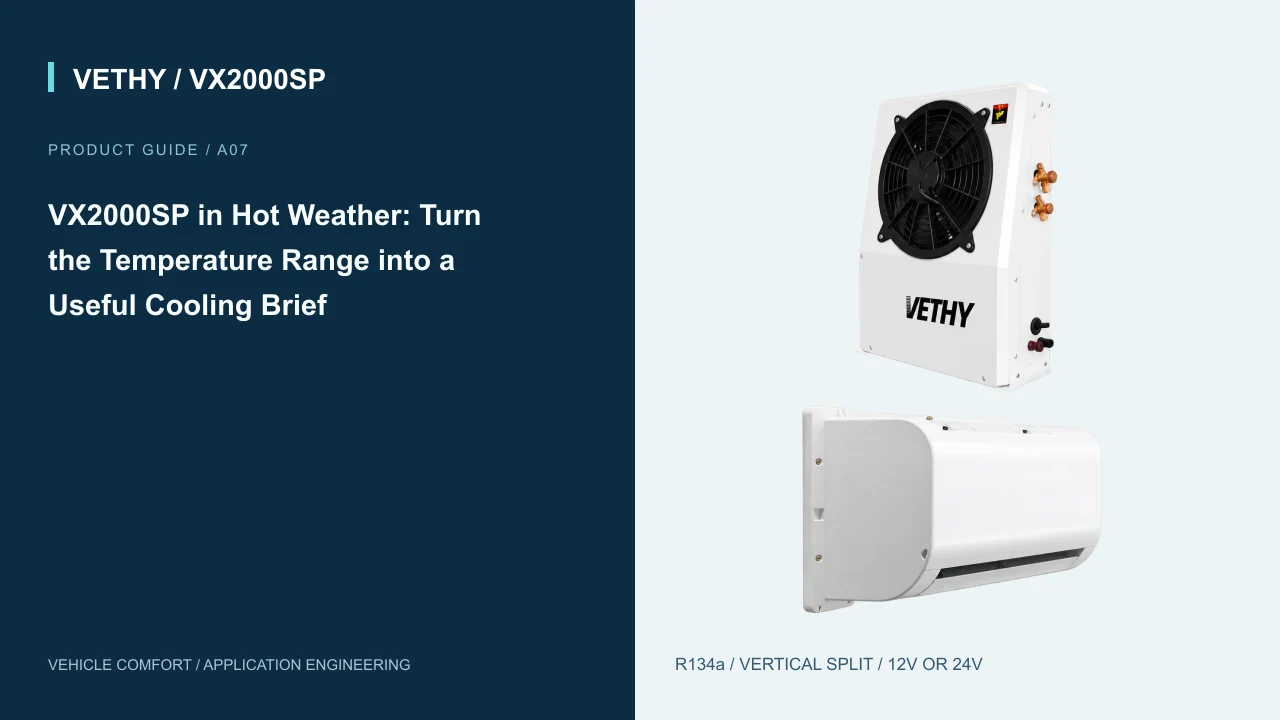
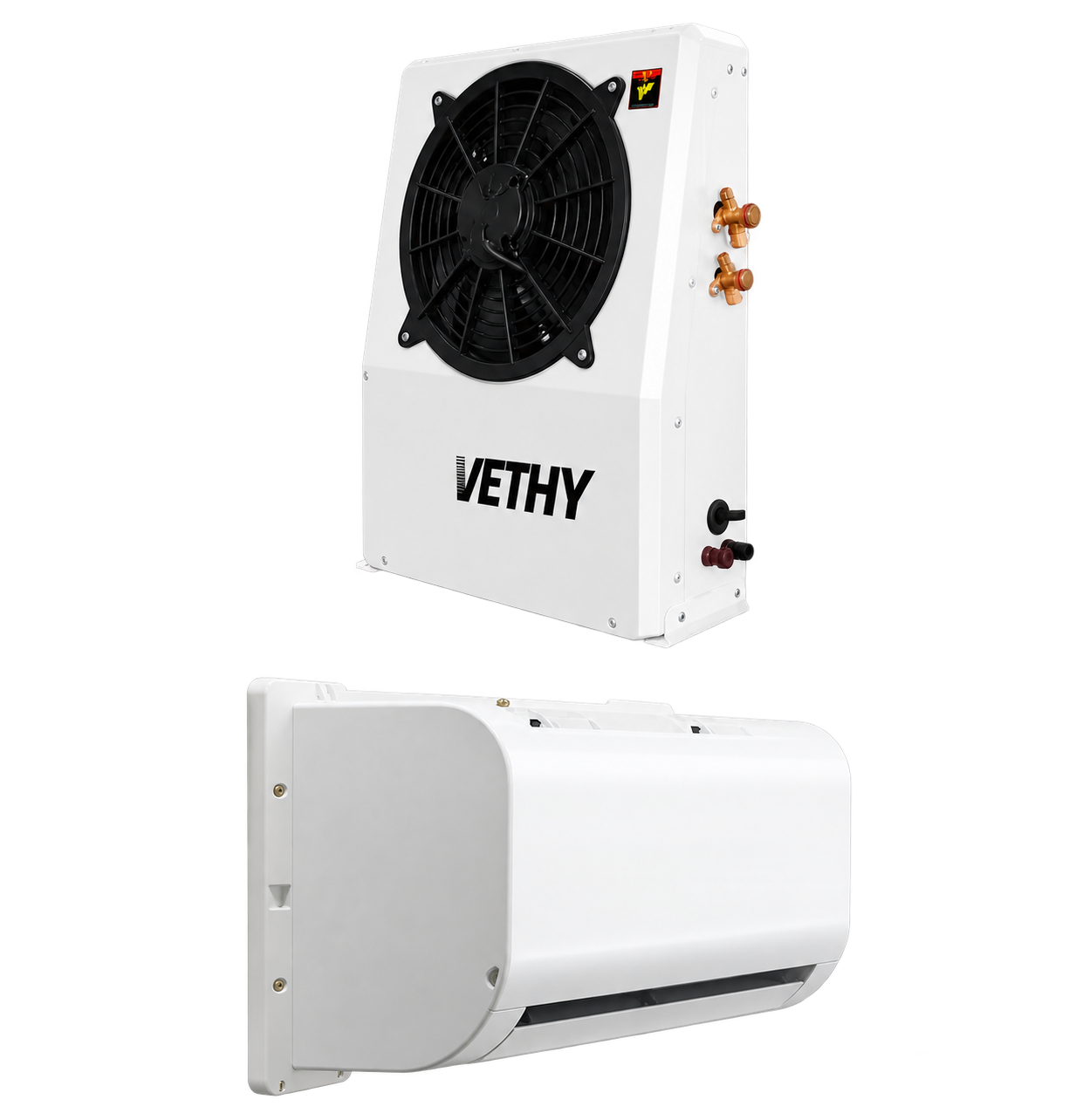
VETHY VX2000SP is a split parking air conditioner with a vertical outdoor unit. Its source sheet lists separate configurations: 12 V with 2000 W cooling capacity and 7000 BTU/h, and 24 V with 2600 W and 9000 BTU/h. These are the published reference values for the two voltage versions. A purchasing brief should carry the correct row into every discussion, especially when a fleet contains both electrical systems.
The practical goal is to turn those reference values into a vehicle-specific evaluation. Identify where the occupant sits or sleeps, when the unit operates, what other electrical loads remain active, and how installation space is arranged. A supplier can then respond to an actual use case. The same information gives the installer a useful starting point and gives the buyer a fair way to review the finished vehicle.
Read the temperature settings as controls for the user
The VX2000SP sheet lists a temperature setting range of 0–30°C and remote control operation. That tells the buyer about the listed control range. It does not describe the temperature every cab can reach, how quickly it will get there, or whether the interior will match the selected number. A comfort cooling purchase should therefore specify the desired experience separately from the control setting.
For example, a fleet may want a driver to rest comfortably in a sleeper area after an afternoon delivery. The brief can describe the desired occupied zone, the planned rest period, and an agreed method for recording conditions there. The supplier should propose a suitable operating approach and explain how the selected configuration will be evaluated. Request that explanation before treating a low selectable number as proof of cooling capability.
The lower end of the setting range also does not turn VX2000SP into refrigerated cargo equipment. Cab comfort and temperature-controlled goods need different purchasing requirements. If a buyer's real objective is to preserve cargo at a specified temperature, that should become a separate equipment assessment. For VX2000SP cab cooling, keep attention on occupant comfort, the actual enclosure, and operating conditions the supplier has accepted for the project.
Use the ambient limit to frame a precise question
The source operating-temperature entry is “≤55°C.” Retain that wording when preparing an inquiry. It provides a listed upper ambient limit, while the available sheet leaves the lower operating limit unspecified. It also does not establish cooling output at 55°C. The useful question is therefore how the proposed installation should be assessed at the buyer's expected outdoor conditions.
A hot-weather brief should distinguish a typical operating day from the most demanding day the vehicle is expected to encounter. Give the supplier the temperatures the buyer wants to evaluate, where those observations came from, and whether the truck parks in direct sunlight or shade. If exact records are unavailable, label the figures as planning assumptions. This makes uncertainty visible without holding up the initial conversation.
Ask the supplier for the test conditions behind any project-specific performance commitment. Those conditions should identify the selected voltage version, vehicle enclosure, electrical supply, starting conditions, and measurement location. If the supplier offers only the source-sheet ambient entry, record that as a specification reference rather than a completed vehicle demonstration. This distinction helps the buyer arrange a useful trial and prevents a published limit from becoming an unsupported comfort promise in a fleet specification.
Separate the parked-vehicle scenarios before choosing a trial
Hot weather describes the surroundings; the duty cycle describes how the air conditioner will be used. Map the sequence from the end of driving to the end of parking. Include whether the existing vehicle air conditioner has already cooled the cab, whether the doors remain open during unloading, and whether the occupant moves between the driving seat and sleeper. The sequence can reveal requirements that a single ambient-temperature figure misses.
A truck that stops briefly between deliveries needs a different observation schedule from one used for a long rest period. The buyer can ask for checks at the beginning, during the expected occupied period, and at the end. Those checkpoints are planning choices, not stated VX2000SP performance results. Choose them around the actual operating task so the resulting notes help a purchasing decision.
Make the trial repeatable enough to explain its result. Record the door position, curtain position, occupied area, fan or control setting, and other active equipment. A photograph of the setup can often clarify the record better than a long description. If a driver changes the setup during the trial, record that change with its time. The objective is to understand how the proposed system serves the vehicle during a recognizable working day.
Give the cooling capacity its correct voltage context
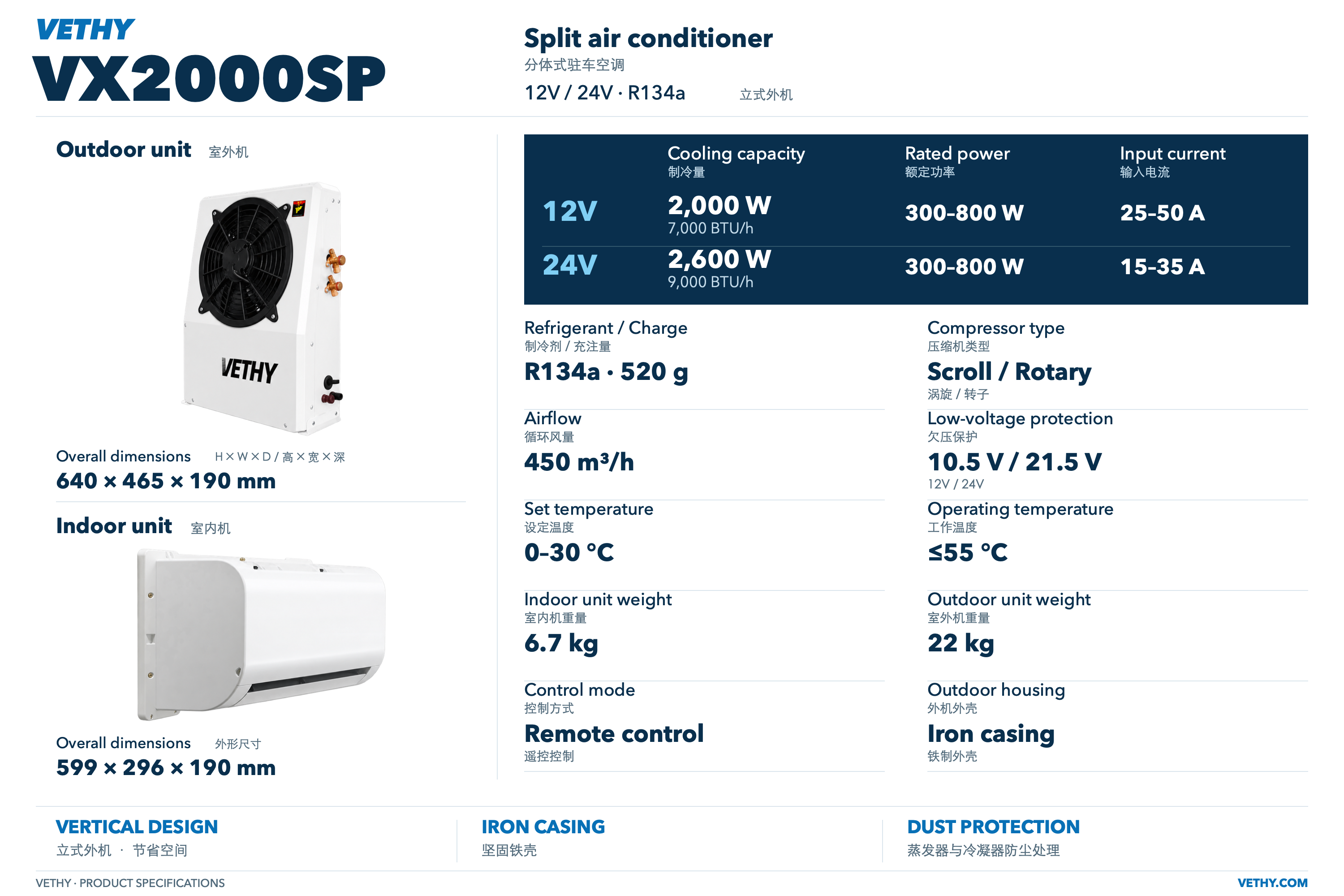
The two VX2000SP electrical configurations belong in separate rows of the purchasing brief. The 12 V version lists 2000 W cooling capacity; the 24 V version lists 2600 W. Both versions list a rated power range of 300–800 W, while their input current ranges differ. The source values help describe a configuration, but they are not paired operating measurements from which to calculate comparative efficiency.
| Source field | 12 V VX2000SP | 24 V VX2000SP |
|---|---|---|
| Cooling capacity | 2000 W / 7000 BTU/h | 2600 W / 9000 BTU/h |
| Rated power | 300–800 W | 300–800 W |
| Input current | 25–50 A | 15–35 A |
| Low-voltage protection | 10.5 V | 21.5 V |
Select the voltage row from the actual vehicle supply and the approved electrical design. A buyer should not select a different voltage merely to obtain a larger capacity number in a brochure. For mixed fleets, request separate supplier confirmations and separate installation records for each electrical group. This keeps quotation, supplied equipment, and vehicle preparation aligned. It also makes later service inquiries easier because the technician can identify which configuration was installed.
Describe the cab before asking how much cooling it needs
Prepare a simple interior sketch with the occupied zones, windows, sleeper area, partitions, and proposed indoor-unit position. Include photographs that show the whole space and the likely return-air path. The supplier needs to understand the enclosure the system will serve. A product capacity number alone does not describe glazing, shade, insulation, air leakage, or the pattern of door opening in a particular truck.
Give practical details in ordinary language. “The sleeper curtain stays closed during rest” is useful. So is “the passenger door opens several times while documents are checked.” If the cab has accessories or a partition that could influence where air travels, show them on the sketch. Describe any existing comfort complaint from the occupant's position instead of assigning an unverified technical cause.
For a fleet, group vehicles only when the relevant enclosure and usage details are comparable. Two trucks with the same nominal voltage may have different sleeper arrangements or equipment behind the cab. Start with one clearly described representative vehicle for each group. After an evaluation, decide which other vehicles genuinely match it. This makes the eventual rollout easier to defend and helps avoid ordering a single installation package for vehicles that need different placement or routing decisions.
Plan airflow around the occupied zone
The VX2000SP source lists airflow of 450 m³/h. It does not identify that number as condenser airflow, so keep the description as listed airflow. Use it as a product reference while asking the installer to review indoor positioning, return-air access, and delivery toward the intended occupied area. An airflow figure cannot, by itself, show how air will move around a particular seat, bunk, partition, or storage cabinet.
The indoor dimensions are 599 × 296 × 190 mm in source order. Request a dimensioned installation drawing before assigning individual axes or committing a mounting opening. A cardboard envelope or temporary layout mark can help the installer and driver review the proposed position. Include room to operate controls and access the parts the supplier identifies for routine care.
Review comfort from the place where it matters. For sleeper use, agree where observations will be taken near the resting occupant. For a waiting operator, review the seating position and normal working posture. Let the driver comment on air delivery during the trial, and keep those comments separate from temperature readings. Together, the two records describe the practical result more clearly than a photograph of the control display showing a low setpoint.
Protect outdoor-unit space in the installation plan
VX2000SP uses a vertical outdoor layout with listed outdoor dimensions of 640 mm height, 465 mm width, and 190 mm depth. These dimensions are useful for an early space check. They do not include an agreed bracket design, service envelope, pipe routing allowance, or vehicle-specific clearance. Ask the supplier and installer to show those items on the proposed arrangement before fabrication begins.
A rear-cab photograph should show nearby vehicle equipment and any features that move during normal use or servicing. Identify the space used by existing accessories, the planned routing path, and places the technician will need to reach. The aim is to make the outdoor unit a maintainable part of the vehicle. A location that fits the casing outline still needs review for airflow access, mounting, and routine inspection.
The sheet describes an iron casing and dust protection treatment for the evaporator and condenser. Those are relevant construction and care references. They do not define corrosion resistance, salt-spray performance, impact protection, or a certified dustproof enclosure. If the vehicle works near aggressive contamination or unusual exposure, describe the environment in the inquiry and obtain a project-specific response. The installation brief should state what protection and maintenance arrangements the supplier actually recommends for that use.
Treat electrical endurance as a separate planning task
Hot-weather suitability includes the available electrical supply throughout the occupied period. Record the battery system, its documented condition, the intended parking duration, and other equipment that will remain active. Ask the responsible installer to assess the complete system. The VX2000SP power and current ranges are useful reference fields, but they do not provide a guaranteed runtime or the information needed to choose wiring protection by simple arithmetic.
The listed low-voltage protection is 10.5 V for the 12 V version and 21.5 V for the 24 V version. Include those values in the review. They do not establish battery state of charge, a healthy resting voltage, or a guaranteed engine restart. A fleet that depends on restarting after a rest period should define that operational requirement explicitly and have the electrical design reviewed against it.
For a practical trial, record the supply conditions using the method approved by the installer. Agree who may change settings and who is responsible if the supply becomes unsuitable. Endurance assessment should be traceable to the actual vehicle and battery arrangement. If the battery or other loads change during rollout, review the original conclusion before extending it to the changed vehicles. This gives purchasing a sounder basis for estimating useful operating time.
Build a labeled hot-weather planning example
Consider a hypothetical distributor assessing VX2000SP for a group of 24 V sleeper trucks. The planned job is driver rest after afternoon deliveries, with the sleeper curtain closed and occasional door opening before the rest begins. This example organizes an inquiry; it does not report a VETHY test or promise a particular cab temperature. The distributor first selects one vehicle that represents the proposed group.
| Planning item | Example brief entry | Confirmation needed |
|---|---|---|
| Configuration | VX2000SP, 24 V | Supplier confirms exact supplied version |
| Occupied area | Sleeper with curtain closed | Installer reviews indoor location |
| Weather scenario | Buyer's recorded hot-day conditions | Supplier agrees evaluation conditions |
| Parking sequence | Unload, close doors, begin rest | Trial records starting conditions |
| Electrical supply | Existing documented vehicle system | Installer approves complete arrangement |
| Evaluation | Agreed occupied-zone observations | Buyer defines acceptable result |
The distributor sends the completed brief, photographs, and electrical information together. The supplier returns the proposed arrangement and any information still required. The buyer then fixes the trial setup and evaluation method before installing the first unit. This sequence reduces quotation ambiguity and makes the trial useful to everyone involved. If the representative truck needs a revised location or operating approach, the correction can be documented before the fleet order is finalized.
Turn the trial into a clear purchasing decision
Set the acceptance questions before the trial begins. Does the installation match the approved arrangement? Can the driver use the controls from the intended position? Do the agreed observations support the planned rest or waiting task? Can the technician reach the inspection points? Each question should have an owner and a place in the handover record. This connects comfort, installation, and service readiness in one decision.
Keep source specifications, supplier commitments, and trial observations in separate fields. A source-sheet capacity remains a published reference. A supplier's written response belongs to the quoted configuration and stated conditions. A vehicle observation belongs to the actual installation and setup. Maintaining those distinctions makes the record easier to reuse without turning one successful afternoon into a claim about every climate and every truck.
If the result falls short of the agreed requirement, record the issue in practical terms and seek a proposed correction. Possible next steps may include reviewing placement, clarifying the operating sequence, or revisiting the selected system with the supplier. Assign a person and a follow-up date. A closed issue includes the action taken and the result of the agreed recheck. This approach helps a fleet improve the installation package instead of collecting disconnected complaints after a volume rollout.
Make the observation record useful after the weather changes
A vehicle evaluation becomes more valuable when another person can understand its scope several weeks later. Give the record a clear identity: vehicle, selected VX2000SP voltage, installation version, date, responsible observer, and intended parking task. Attach the approved layout photographs. Add the weather information available for the evaluation and explain how it was obtained. A local observation and a general forecast describe different information, so label whichever was used.
Write the starting sequence in plain language. State whether the vehicle had just completed a drive, how the existing cab cooling had been used, whether doors were open during loading, and when the occupied period began. Record control changes and any other relevant changes during the observation. The purpose is to preserve context, rather than create a laboratory claim from an everyday vehicle assessment. A buyer can learn from a practical trial while being precise about what it demonstrates.
The observation locations should also stay recognizable. A reading taken beside the indoor outlet answers a different question from an observation near the driver's resting position. Mark the agreed locations on the interior sketch and use the same approach during a recheck. Record occupant comments with their time and location. If the driver changes position or opens the curtain, note that event so the supplier can interpret the feedback in context.
When the season or duty pattern changes, compare the new requirement with the original record. A different rest period, additional cab equipment, revised parking location, or changed battery arrangement may require further review. The original evaluation remains useful evidence for its documented setup. The fleet can then ask a focused follow-up question instead of treating either a complaint or a previous success as a complete answer for the changed application.
For a distributor, this record also supports honest customer conversations. Describe the evaluated installation and the conditions recorded, and keep published source specifications separate. Do not turn the example into an unspecified promise for every buyer. Ask the next customer for the same vehicle and use information, then have the supplier review differences. A repeatable brief and an understandable observation record make it easier to offer practical advice as more vehicles enter the programme.
Finally, name the person who accepts the record and the person who closes any remaining action. Store the approved version where purchasing, installation, and support staff can retrieve it. A useful cooling brief stays connected to those people after the first unit is delivered, giving the fleet a clear starting point for later questions.
Questions buyers ask about VX2000SP in hot weather
Does the 0°C setting mean the cab can reach 0°C?
No. The source lists a selectable range of 0–30°C. Achievable conditions depend on the complete application and need a separate assessment. Write the intended occupant comfort requirement and agree how it will be checked in the vehicle. Using the lowest selectable number as an acceptance target would skip the information needed to judge actual suitability.
Does the 55°C entry guarantee cooling capacity at that temperature?
The listed operating-temperature entry is ≤55°C. It does not provide a capacity test at 55°C or specify a lower operating limit. Ask for configuration-specific information at the temperatures relevant to the project. Where a vehicle trial is needed, agree the starting conditions and measurement method before treating the result as purchasing evidence.
Which VX2000SP version has the higher published cooling capacity?
The 24 V source row lists 2600 W and 9000 BTU/h, while the 12 V row lists 2000 W and 7000 BTU/h. Select the version that matches the approved vehicle electrical design. Those published capacity values do not establish comparative runtime, efficiency, or the temperature either configuration will achieve in an unassessed cab.
Can the published current range determine a full-night runtime?
It cannot determine a reliable full-night result on its own. Endurance depends on the complete electrical arrangement, available battery energy, other loads, and actual use. Have the installer review the system and agree a vehicle-based evaluation. Record any resulting duration with its conditions so the fleet knows which vehicles and operating patterns it covers.
What should a buyer send with a hot-climate inquiry?
Send the required voltage, vehicle photographs, occupied-zone sketch, parking sequence, expected weather scenarios, battery information, and target use period. Add the proposed outdoor location and any dusty or demanding exposure. A specific brief lets the supplier address the application directly and gives the buyer a useful record for quotation, installation, trial approval, and later service.
Product sources
- VETHY VX2000SP verified specifications — VETHY.
- VETHY VX2000SP bilingual specification sheet — VETHY.

VETHY product recommendation and application analysis. Specification references identify the selected model and voltage. Installation examples are planning examples; measured project results are identified explicitly when available.
Discuss your VX2000SP application
Send your vehicle, supply voltage, occupied space, parking schedule and installation photographs for a model-specific recommendation.
Prepare your vehicle brief ↗