
VETHY / VX2000SP / PRODUCT AND APPLICATION GUIDE
VX2000SP for Dusty Work Trucks: Airflow Care and Service Access
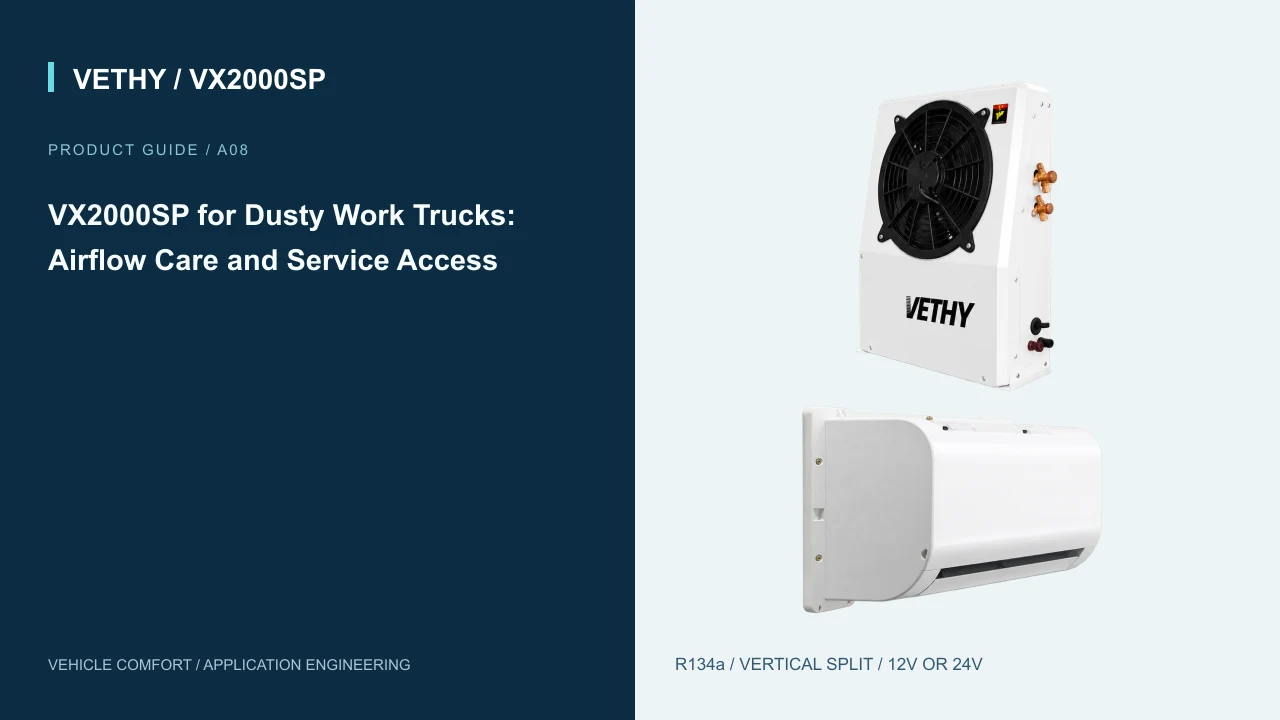
VX2000SP lists dust protection treatment for its evaporator and condenser, supported by a split layout with a vertical outdoor unit. For dusty work trucks, plan accessible mounting, keep the approved indoor air path clear, and obtain supplier instructions for inspection and cleaning. Base the care routine on observed conditions and actual exposure. The listed treatment is not a dustproof rating, so vehicle-specific service access and a clear reporting process remain central to the installation.
Make dust exposure part of the vehicle specification
A work truck's environment should appear in its air-conditioning brief before anyone chooses a mounting position. A truck parked beside a loading area, one returning from a construction site, and one carrying loose materials may collect different kinds of debris in different places. Describe those conditions to the supplier using photographs and the vehicle's normal work sequence. This is more useful than asking whether a unit is generally suitable for “dusty roads.”
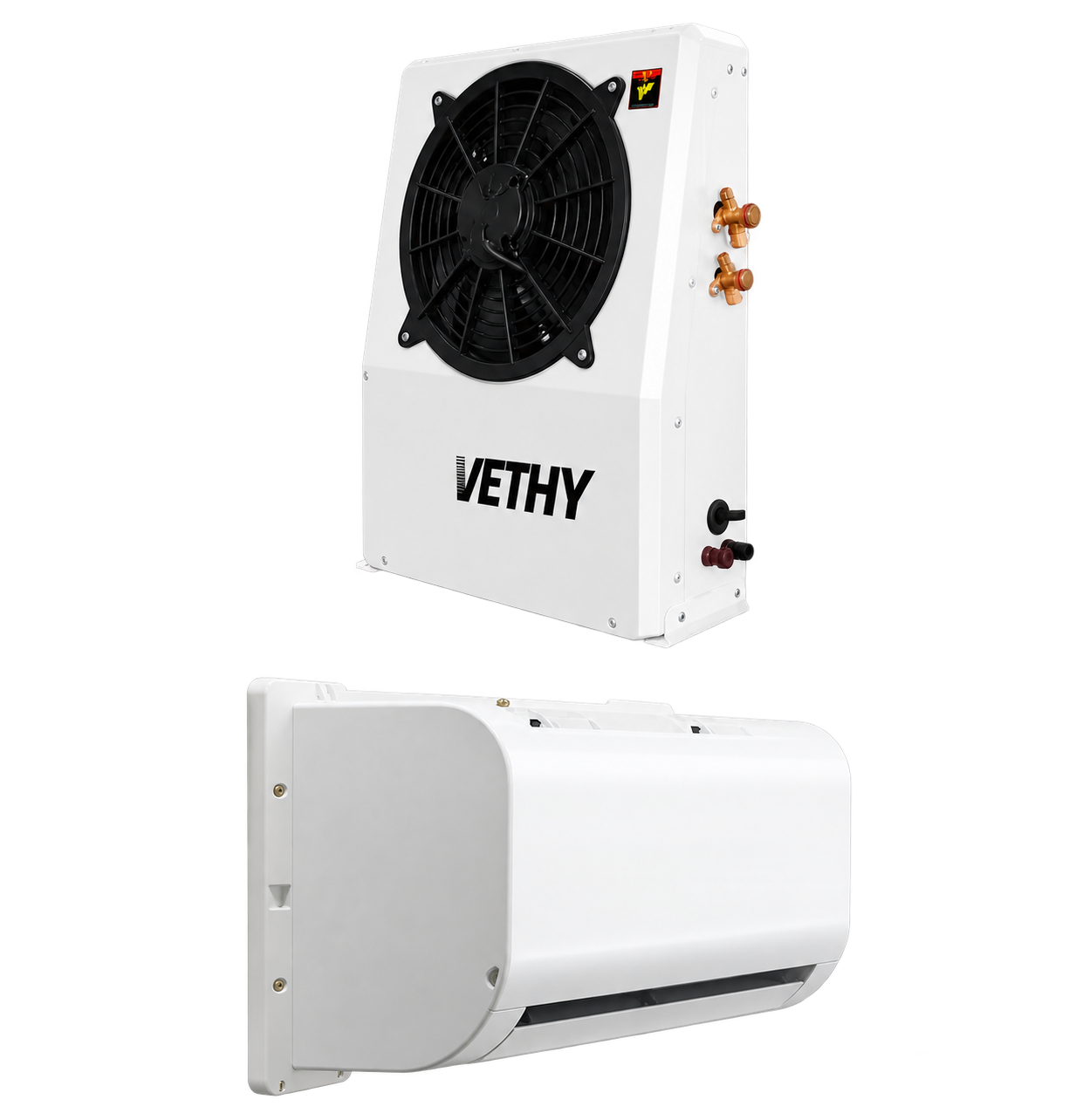
VETHY VX2000SP is a split parking air conditioner with a vertical outdoor unit. Its source sheet lists dust protection treatment for the evaporator and condenser. For a buyer, that feature belongs alongside an accessible installation and a realistic care plan. The treatment does not establish a dustproof certification, a particular ingress-protection rating, or freedom from cleaning. The useful purchasing question is how the proposed arrangement will be inspected and maintained in the actual work environment.
A good airflow-care plan protects the reason the system was purchased: useful cab comfort during parked work or rest. It also helps drivers report a change early and gives technicians a consistent place to start. Build that plan around the exact supplied configuration, supplier-approved care instructions, and a record of the vehicle's exposure. The result should be simple enough to use on a busy working day.
Map where contamination reaches the parked truck
Start with a walk around the vehicle after a representative shift. Photograph the rear cab area, the proposed outdoor-unit location, nearby accessories, and the interior where the indoor unit might sit. Note visible deposits and where the truck usually parks. A description such as “the vehicle waits next to a loading lane with doors frequently open” gives the supplier a clearer application than a broad industry label.
Separate observation from explanation. A photograph may show dirt on a panel; it does not establish what reached a heat exchanger or what caused a cooling complaint. The inspection plan should let a qualified technician check the relevant parts safely. Record the location and the operating context without requiring the driver to diagnose refrigeration or electrical faults.
Ask about work changes as well as routine conditions. A vehicle that moves between urban deliveries and a temporary site may need an earlier check after the change. A truck carrying a new material may develop a different deposit pattern. Treat those events as reasons to review the care plan. The original purchasing brief should state who receives these observations and who can authorize changes to inspection arrangements, so the driver has a clear route for raising a concern.
Understand what the listed dust treatment contributes
The source identifies evaporator and condenser dust protection treatment as a VX2000SP feature. Preserve that exact scope in a supplier inquiry and product comparison. It is a useful starting point for asking about care of the two heat exchangers. Ask the supplier to explain the approved cleaning method, the surfaces that can be accessed, and any restrictions associated with the treatment on the supplied unit.
Avoid selecting a cleaning process simply because it is familiar from another vehicle component. The technician needs instructions that apply to this air-conditioning configuration, including any disassembly, isolation, or reassembly steps. Obtain those instructions with the installation documents. If the proposed local workshop uses particular cleaning equipment or products, ask the supplier to review that method before adding it to the fleet procedure.
The same distinction matters in wholesale descriptions. “Dust protection treatment” describes the stated feature. “Dustproof” would communicate a different claim that the supplied record does not support. A distributor can make a stronger practical offer by supplying installation guidance, service contacts, and an inspection record with the unit. Those deliverables tell the buyer how the equipment will be supported in dusty use, while keeping the product description aligned with the source sheet.
Keep the indoor airflow path visible and reachable
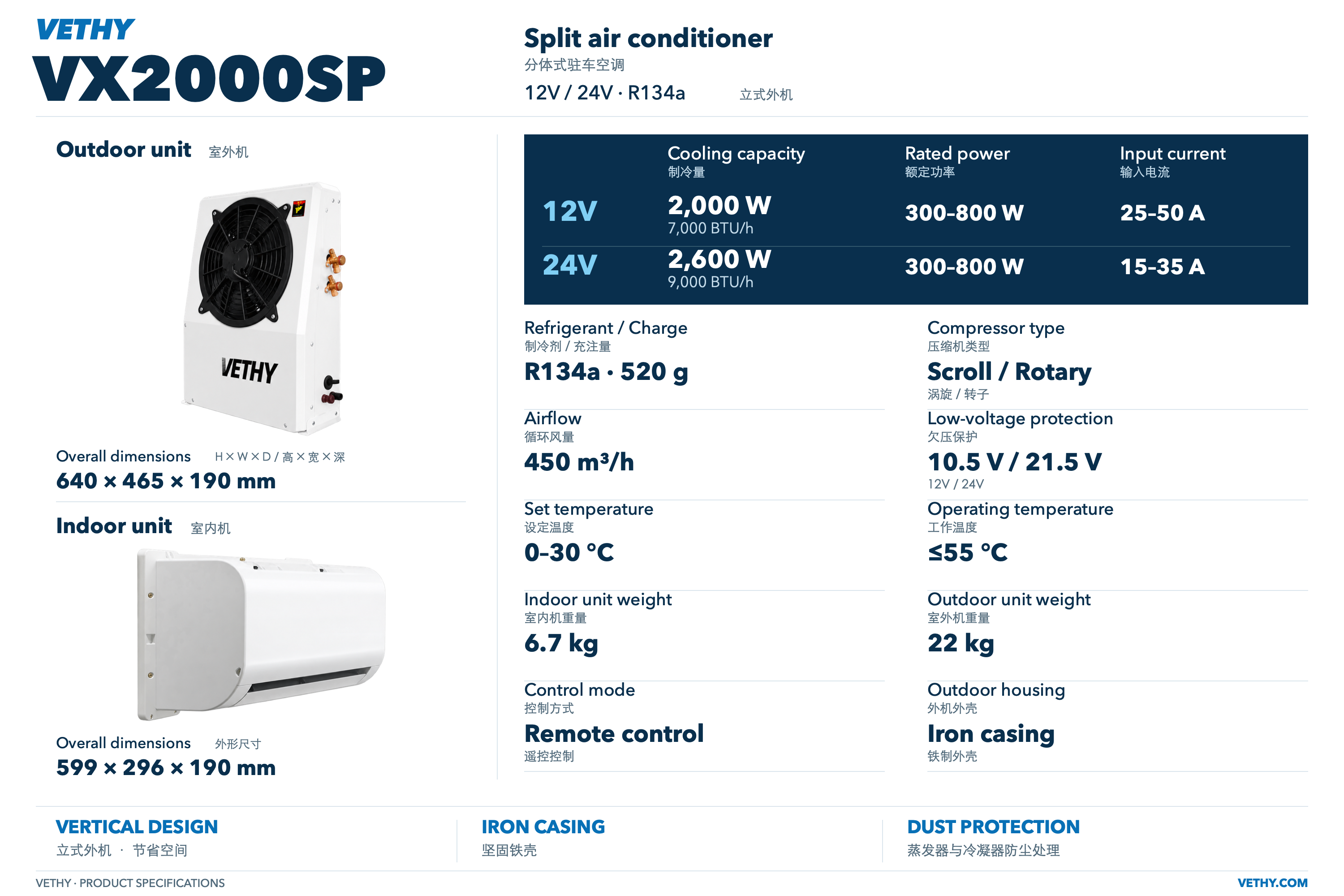
The VX2000SP source lists airflow of 450 m³/h. It does not identify that figure as condenser airflow, so retain it as a general listed airflow value. Actual air movement around a truck's occupant depends on the indoor arrangement. Before installation, review the proposed unit position with the normal seats, curtain, storage, and other cab equipment in place.
The indoor dimensions are 599 × 296 × 190 mm in source order. Ask for a drawing that identifies orientation and the required installation and care envelope. A unit can fit within an interior space while leaving too little room to inspect or service it. Review access using the positions the vehicle will normally have during workshop visits, including how a technician reaches the mounting area.
The driver should also be able to recognize when the normal air path has changed. A bag moved into a different position or a new cab accessory may alter the arrangement the installer approved. Include a photograph of the clear indoor setup in the handover. This gives the driver an easy reference without requiring technical knowledge. If the approved layout changes, update the photograph and ask the installer to review the change before treating the original evaluation as applicable.
Reserve an outdoor service envelope before making brackets
The vertical VX2000SP outdoor unit measures 640 mm high, 465 mm wide, and 190 mm deep. Use those dimensions for the initial envelope, then request the clearances and access needed for installation and routine care. The overall casing dimensions do not define a bracket, routing path, service opening, or safe reach from the workshop floor. Those details belong in the vehicle-specific arrangement.
Review the unit together with equipment already behind the cab. The technician should identify how to reach the relevant inspection surfaces and remove any supplier-approved service parts. The installer should also consider normal vehicle movement and access to existing components. A quick space check using only the outdoor outline can miss these practical questions, so approve a drawing and photographs before the mounting arrangement is finalized.
The source separately lists indoor weight of 6.7 kg and outdoor weight of 22 kg, without establishing net, gross, or package scope. Retain the two labels and ask the supplier for the installed assembly information needed for the mounting review. Do not combine those values into an assumed installed load. The responsible installer needs the exact unit, brackets, and relevant vehicle requirements to decide how the assembly should be supported and accessed.
Agree a condition-based inspection routine
The available VX2000SP sheet does not give a fixed cleaning interval for every work environment. Develop an inspection routine with the supplier and the workshop responsible for the vehicle. Start with the actual exposure, access arrangements, and approved care method. Make the first inspection a planned learning opportunity: record what is seen and use that evidence to review the next inspection point.
A routine can identify both a scheduled check and events that trigger an earlier review. Examples include a change of worksite, unusually heavy visible contamination, or a driver reporting that the familiar airflow has changed. These are suggested planning triggers, not manufacturer service intervals. The fleet should confirm the final routine with its responsible service provider and make sure the driver knows how to report an exception.
Keep the record short enough to finish. Useful entries include vehicle identity, configuration, date, recent work environment, observed condition, action taken, and the next agreed check. If cleaning was performed, record the approved method and the person who completed it. If no action was needed, that observation still helps the workshop understand the exposure pattern. Over time, these records give the fleet a better basis for planning care than an interval copied from an unrelated vehicle or product.
Give drivers useful observations instead of repair tasks
A driver can provide valuable information without opening the system. Explain what the familiar operating arrangement looks like, how to use the remote control, and where to report changes. Ask for the time, vehicle location, selected setting, recent work conditions, and a description of the occupied area when a comfort concern occurs. A specific description helps the workshop reproduce the issue more effectively than “the air conditioner is weak.”
A simple driver observation might say that air delivery feels different at the sleeper, that a new item is stored near the indoor unit, or that visible contamination has increased around the outdoor location. Each observation should be recorded as reported. The technician can then inspect the installation and decide what, if anything, is required. Drivers should follow the approved instructions for the equipment and leave service operations to the responsible personnel.
Provide a named contact and an easy reporting format. For a small fleet, a photographed record may be sufficient; a larger operator may use an existing maintenance system. The important part is ownership. Someone must receive the report, decide the next step, and confirm the outcome to the driver. That closes the loop between daily use and workshop care, helping avoid repeated complaints with no documented resolution.
Separate airflow complaints from electrical and control questions
An uncomfortable cab can prompt several useful checks, and visible dust should not become an automatic diagnosis. The workshop needs to confirm the unit's operating state, the approved air path, the electrical supply, and the conditions reported by the driver. Organize the inquiry so those details travel together. This prevents a cleaning request from masking an unresolved installation or supply question.
VX2000SP has separate 12 V and 24 V configurations. The 12 V source row lists 25–50 A input current and 10.5 V low-voltage protection; the 24 V row lists 15–35 A and 21.5 V. Both list rated power of 300–800 W. These reference fields should be available to the qualified person reviewing the supply. They do not establish a diagnosis, wiring size, startup current, or guaranteed battery endurance.
The source also lists remote control and a 0–30°C setting range. Record the selected setting and actual circumstances rather than using the displayed number as proof of cab temperature. If a unit stops or behaves unexpectedly, follow the supplied service guidance and report the sequence. Good observation helps the service provider distinguish what was seen from what still needs investigation, which is particularly useful when the vehicle is away from its usual workshop.
Write a cleaning handover the workshop can actually use
Before delivery, ask for the care instructions that apply to the exact unit and installation. The document should identify the parts covered, preparation steps, permitted methods, restrictions, reassembly checks, and any conditions that require supplier assistance. The fleet should agree which tasks its own personnel can perform and which tasks go to a qualified service provider. Put that division into the handover record.
A supplier response should also identify how the workshop obtains clarification. A generic brochure is helpful for identifying the product, but it may not answer a practical service question about access or cleaning. Give the supplier the final installation photographs so its advice refers to the real arrangement. If an instruction is revised, retain the version and note when the workshop adopted it.
| Handover item | Practical purpose |
|---|---|
| Exact model and voltage | Connect the instruction to the installed configuration |
| Approved installation photographs | Show normal access and clear areas |
| Supplier care procedure | Define permitted inspection and cleaning work |
| Responsible service contact | Give the workshop a clear escalation route |
| Inspection record | Preserve observed condition and completed action |
| Outstanding questions | Prevent an unanswered issue from disappearing at delivery |
Review the handover with the person who will perform the work. If that person cannot reach a required inspection point or understand a preparation step, resolve the issue before accepting the installation package.
Use a labeled dusty-work-truck planning example
Consider a hypothetical operator preparing a 12 V work truck for parked cab comfort at changing jobsites. The truck already carries equipment behind the cab, and the driver returns with visible deposits on exterior surfaces after some shifts. This example is a way to organize the project; it is not a report of VX2000SP field performance or a manufacturer cleaning schedule.
The operator sends photographs of the proposed outdoor area, the normal interior setup, and the existing equipment. The supplier confirms the exact configuration and provides care instructions. The installer marks the casing envelope and the additional access space it requires. The workshop checks that the planned service work can be completed without a recurring dismantling exercise that the operator has not allowed for.
At handover, the driver receives a clear-layout photograph and a reporting contact. The workshop creates an initial inspection record after an agreed period of representative work. That inspection documents observed contamination, any approved care performed, and whether the access arrangement worked as planned. The next check is then agreed using the observation and supplier advice. If the truck moves to a different site, the operator flags the change for review. This gives the fleet a manageable process that can adapt to its work instead of pretending every dusty environment is identical.
Control the service record across a fleet or distributor network
A fleet should connect each unit to its vehicle, voltage, installation package, and care document. A distributor can use the same structure for customer support. When a report arrives, the support person should be able to retrieve the original arrangement and see what has changed. This reduces repeated requests for basic information and helps the supplier respond to the correct installation.
Track unresolved issues through completion. A useful entry states the observation, responsible person, next action, and follow-up date. Closure includes what was done and what the agreed recheck found. If the solution changes the mounting or care procedure, update the reference record for matching vehicles. Keep the original vehicle-specific details so a correction developed for one arrangement is not silently extended to a different one.
For volume orders, include service access in the sample-installation review. Photographs of an attractive installation are not enough; ask the workshop to demonstrate access to the tasks listed in the approved procedure. The review may identify a bracket change or routing adjustment before the package is repeated. This is a practical commercial benefit of evaluating service work early: the buyer can order a package that its network knows how to support, with clear responsibility for the work after delivery.
Plan for missed checks and vehicles away from the workshop
A care plan should explain what happens when the truck cannot attend its usual inspection. Work vehicles may change schedules or remain away from their home workshop, and a process that assumes perfect attendance can leave reports without an owner. Ask the service provider how to handle a missed check and what information it needs to decide the next step. Record that route with the normal inspection instructions.
Give the driver a practical contact method and keep the vehicle's configuration details easy to retrieve. A remote workshop should receive the correct model, voltage, approved arrangement, and applicable care procedure before it is asked to work on the unit. If the normal supplier needs to approve an unfamiliar service method, keep that question open until a specific response arrives. A procedure from another parking air conditioner should not silently replace the VX2000SP instructions.
After an away-from-base service visit, collect the completed record. Note the observed condition, work performed, documents used, and any unresolved issue. The home workshop can then review whether the regular plan or installation reference needs updating. This avoids a recurring problem in fleet support: useful work gets completed, but the people responsible for the next inspection do not know what changed.
A distributor can prepare the same process for customers with several service locations. Provide one configuration record and ask each authorized service location to return the same basic information. Keep revisions identifiable so the network knows which instruction applies. If a customer reports repeated contamination, use the collected observations to ask the supplier a focused application question. The response may require a revised care plan or a further installation review; the record should show who will decide and when it will be checked.
The result is continuity of care rather than a longer checklist. Whether the vehicle returns to its original installer or visits another approved workshop, the next person can understand its setup, recent exposure, completed work, and outstanding action. That continuity makes an accessible installation useful throughout the working life of the vehicle.
Questions about VX2000SP dust exposure and care
Is VX2000SP dustproof?
The source lists dust protection treatment for the evaporator and condenser. It does not establish a dustproof certification or an ingress-protection rating. Describe the actual vehicle environment to the supplier and request an installation and care approach for that use. Keep the approved instructions with the vehicle so the workshop knows how the supplied configuration should be inspected.
How often should a dusty work truck be cleaned?
The provided sheet does not specify a universal interval. Agree an initial inspection plan with the supplier and service provider, then review observed conditions. A change of site or an unusual driver report may justify an earlier check. Record the final schedule as the fleet's approved plan, with the responsible person and the procedure that applies.
Does 450 m³/h describe the condenser fan?
The VX2000SP source labels the value as airflow without establishing a separate condenser figure. Use 450 m³/h as the listed airflow reference. Ask the supplier for any additional data needed for the project. Placement and access should be reviewed using the exact installation requirements, rather than assigning that number to a component the source does not identify.
Can a driver solve a cooling complaint by cleaning the unit?
The driver should follow the approved operating and reporting instructions. A comfort complaint may need checks of the air path, controls, supply, and installation, so the report should not assume dust is the cause. The responsible service provider should determine the inspection and any permitted care. A good driver record helps that person investigate efficiently.
What should a distributor include for dusty-use customers?
Include exact model and voltage identification, approved installation guidance, supplier care instructions, a service contact, and a simple inspection record. Ask customers about exposure and access before completing the package. The dust treatment is a listed product feature; a documented support process explains how the customer can keep the installation under review during its actual work.
Product sources
- VETHY VX2000SP verified specifications — VETHY.
- VETHY VX2000SP bilingual specification sheet — VETHY.

VETHY product recommendation and application analysis. Specification references identify the selected model and voltage. Installation examples are planning examples; measured project results are identified explicitly when available.
Discuss your VX2000SP application
Send your vehicle, supply voltage, occupied space, parking schedule and installation photographs for a model-specific recommendation.
Prepare your vehicle brief ↗