
VETHY / VX2000SP / PRODUCT AND APPLICATION GUIDE
Buying VX2000SP in Volume: Build a Configuration-Specific Supplier Brief
For VX2000SP volume purchasing, define separate 12 V and 24 V order lines, the intended vehicles, supplied installation items, sample-approval scope and required documents. Ask the supplier to confirm the exact compressor configuration, packing details, commercial terms and after-sales responsibilities. Keep unanswered items visible until resolved. A configuration-specific brief helps distributors compare quotations, approve a repeatable installation package and maintain a consistent product record from ordering through customer support.
Buy a defined configuration before negotiating volume
A useful VX2000SP wholesale inquiry gives the supplier a configuration to quote and a delivery package to confirm. “Please send your best price for truck AC” starts a conversation, but leaves the voltage, installation contents, documentation, and after-sales responsibilities open. A configuration-specific brief makes competing quotations easier to understand and gives the eventual order a clearer acceptance basis.
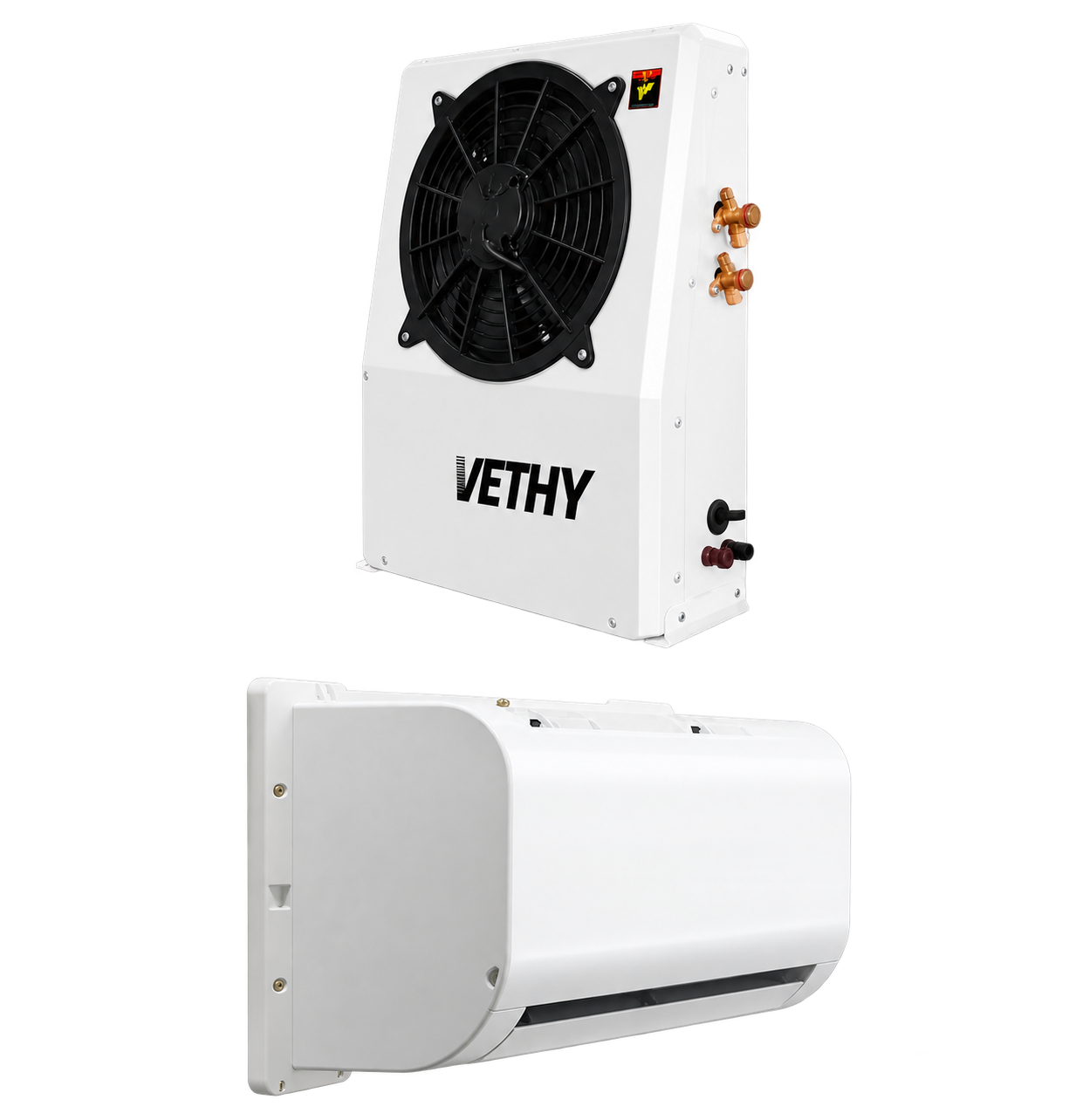
VETHY VX2000SP is a split parking air conditioner with a vertical outdoor unit. The source sheet lists 12 V and 24 V versions with different cooling capacities and current ranges. A distributor should create separate order lines for those versions. The buyer can then add the intended vehicle groups, quantities, installation approach, required documents, and commercial questions without losing the underlying product identity.
This process also supports the distributor's own sales work. A confirmed configuration can flow into product listings, dealer instructions, stock identification, and service records. If a detail remains unanswered, keep it in an open-item list with an owner. The aim is to build a brief the supplier can answer line by line, then convert those answers into a reviewable sample and a controlled volume order.
Define the customers and vehicles the stock will serve
Start with the intended customer group and vehicle use. A distributor supplying sleeper trucks may need a different installation package from one serving compact work cabs. State the voltage systems, proposed mounting locations, normal parking task, and service network available to customers. If the vehicles are still being surveyed, say which details are known and when the remaining information will be supplied.
Group the stock around meaningful configuration differences. Electrical voltage is an obvious dividing line; installation kits, routing requirements, and local service arrangements may create others after supplier review. A single model name should not conceal incompatible order assumptions. Give each planned stock line a buyer reference that remains attached to the quotation, sample, purchase order, and receiving record.
Describe the intended geographic market without treating it as proof of compliance or compatibility. Ask the supplier for the documentation applicable to the exact supplied version and let the buyer's responsible advisers review market requirements. The available VX2000SP facts do not establish certificates, import permissions, or universal vehicle fit. Raising the actual market and vehicle questions early gives the supplier a chance to explain what it can provide before the buyer commits to a large shipment.
Keep the voltage rows separate in every quotation
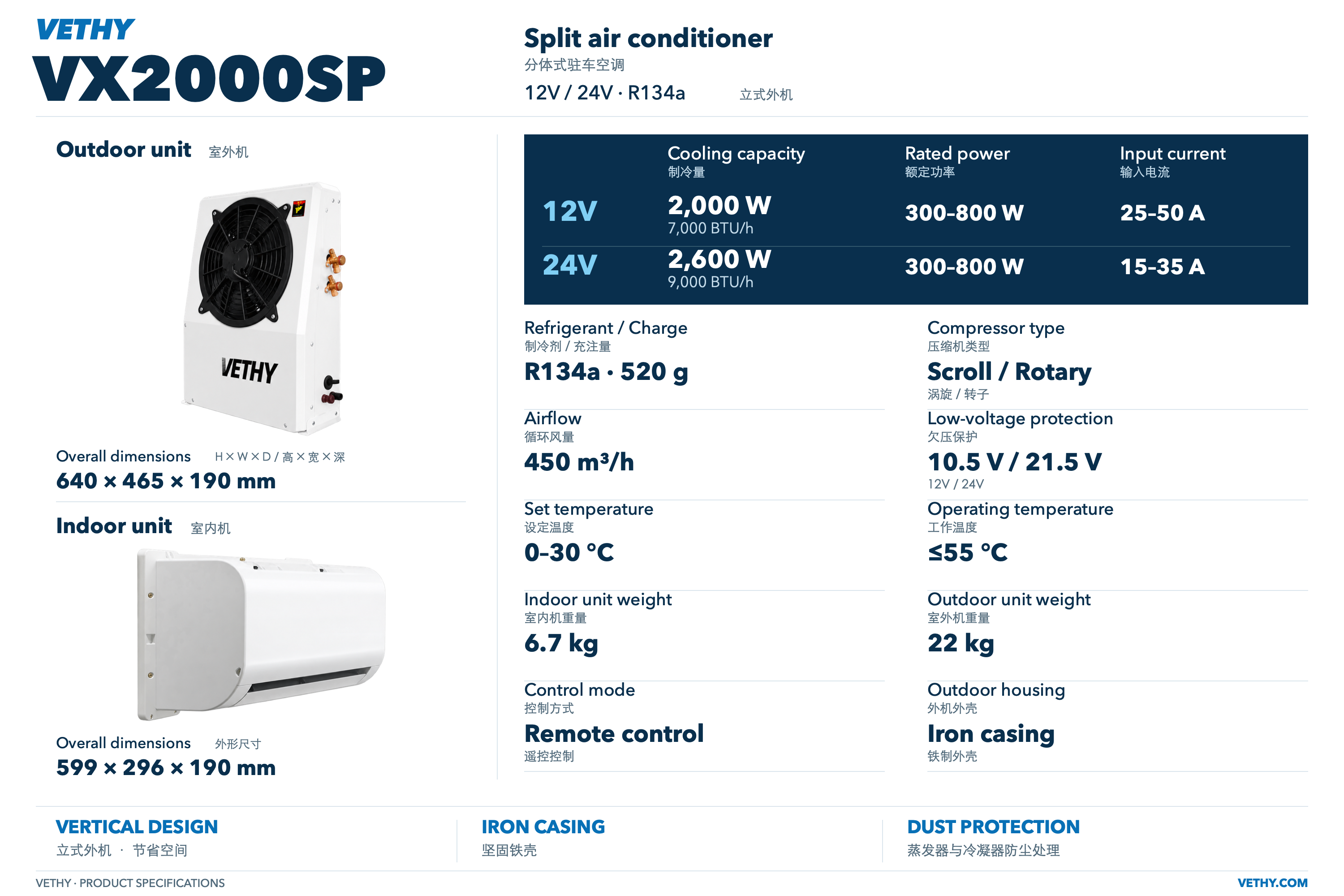
The source-sheet values should appear exactly and consistently in the buyer's technical schedule. VX2000SP lists 2000 W and 7000 BTU/h cooling capacity for 12 V, and 2600 W and 9000 BTU/h for 24 V. Both rows list rated power of 300–800 W. The input-current and low-voltage-protection values differ, making a shared unlabeled electrical description unsuitable for a mixed order.
| Quotation reference | 12 V configuration | 24 V configuration |
|---|---|---|
| Model | VX2000SP | VX2000SP |
| Cooling capacity | 2000 W / 7000 BTU/h | 2600 W / 9000 BTU/h |
| Rated power | 300–800 W | 300–800 W |
| Input current | 25–50 A | 15–35 A |
| Low-voltage protection | 10.5 V | 21.5 V |
Ask the supplier to confirm the exact version beside each quoted price and quantity. These source values are reference fields rather than paired test points, so they should not be converted into an efficiency ranking or a battery-runtime promise. If the supplier proposes a changed specification, request a revised configuration record. Make the change visible to the people approving the sample and to the sales team preparing customer-facing material.
Resolve the compressor description before making sales claims
The VX2000SP source uses the compressor label “Scroll / Rotary.” That wording identifies an item requiring supplier clarification for the order. It does not establish a particular brand, inverter operation, twin-cylinder design, or a choice of variants that the buyer can automatically select. Include the exact label in the inquiry and ask the supplier to identify the compressor configuration supplied for each proposed order line.
This is especially useful when a distributor plans private-label material or dealer training. A sales claim can travel much further than the initial quotation, appearing in advertisements, catalogues, comparison sheets, and customer promises. Resolve the underlying configuration first, then approve the language that accurately describes it. Keep the supporting supplier response with the product record.
If the supplier offers more than one configuration, ask it to define the differences explicitly and give each one a separate reference. Review whether the specification, installation package, spare parts, and pricing change. Avoid treating an informal message about an alternative as approval to substitute it in a confirmed order. A defined configuration helps the distributor know what it is stocking and gives service personnel a reliable identity when support is needed later.
Quote installation contents as an explicit supply list
A split air conditioner is an installation project as well as a product purchase. Ask the supplier to list exactly what accompanies the indoor and outdoor units. The buyer should request a bill of supplied items, identify any vehicle-specific components still required, and confirm who is responsible for providing them. This avoids discovering after arrival that two parties assumed the other would supply a necessary item.
The VX2000SP outdoor unit has a vertical layout and listed dimensions of 640 mm height, 465 mm width, and 190 mm depth. The indoor dimensions are 599 × 296 × 190 mm in source order. These values support an initial fit review, while the order still needs dimensioned drawings, installation requirements, routing information, and the applicable service envelope. They do not establish a universal mounting kit.
Ask the supplier to mark each item as included, optional, buyer-supplied, or awaiting confirmation. Use the resulting list during sample receipt and installation. If a dealer will install the units, have that dealer review the package before volume approval. A small investment in supply-list clarity can make quotations more comparable and help the distributor price a complete customer offer without inventing contents that the supplier never agreed to deliver.
Separate unit weights from shipment planning information
The VX2000SP sheet separately lists indoor weight of 6.7 kg and outdoor weight of 22 kg. It does not establish whether these labels refer to net, gross, or package scope. Retain them separately as source references. Do not add them together and present the result as a shipping weight, installed weight, or complete-system weight.
For logistics planning, request the supplier's actual packing proposal. The buyer needs package count, contents per package, dimensions, declared gross and net weights where applicable, and the arrangement proposed for the shipment. Ask how different voltage versions will be identified externally and how a receiving team can match packages to order lines. These are quotation questions; the available source sheet does not answer them.
The same discipline applies to handling and mounting review. The workshop needs configuration-specific installed-assembly information, while the freight planner needs the agreed shipment record. Keep those uses in separate fields so an unlabeled weight cannot become the default answer to both. Before dispatch, reconcile the final packing information with the confirmed order and provide it to the person arranging transport. Clear records help the receiving team identify discrepancies while the shipment is still being checked.
Make the sample prove a repeatable installation package
A sample order should resolve specific purchasing questions. Identify the vehicle, selected voltage, proposed layout, supplied items, and responsible installer before the sample arrives. Agree what the buyer wants to evaluate: physical arrangement, control usability, service access, electrical integration, and the intended comfort task. This turns the sample into an approval process with a clear result.
Keep the test conditions and observations attached to the exact sample identity. The source lists a 0–30°C setting range and an operating-temperature entry of ≤55°C. Those references do not establish an achieved cab temperature or cooling capacity at the upper ambient limit. If hot-weather operation is important to the order, agree the relevant vehicle evaluation with the supplier and record the conditions under which it takes place.
After installation, compare the supplied package with the quotation and document any changes needed. Ask the installer and intended operator to review the arrangement. Close the open items before calling the sample approved. A sample can be accepted for one vehicle group while another group still requires review. Record that scope explicitly so purchasing does not extend an approval across configurations or vehicles that were never part of the evaluation.
Set document requirements for the exact supplied version
Request a document list alongside the price. Useful items may include a configuration sheet, dimensioned installation drawing, operating instructions, approved care procedure, supplied-item list, and spare-parts identification. Ask the supplier which of these it can provide and in which language and format. If the buyer needs additional documents for its market or customer, list them as questions requiring a specific response.
The source facts do not establish VX2000SP certification, warranty terms, measured noise, guaranteed runtime, or an energy-saving percentage. A distributor should obtain evidence for any such claim before adding it to customer material. The same rule applies to construction claims such as brushless fans or an identified heat-exchanger material: a statement for another model does not establish the VX2000SP configuration.
Keep one controlled product record for the agreed version. Store the supplier's answers, the approved description, and the documents used for sample approval together. When the supplier revises a document or component, review the change before updating the distributor's catalogue. This makes everyday sales work easier because staff can use a confirmed description rather than reconstructing the product from old messages and photographs.
Request commercial answers in a comparable format
A complete inquiry should ask the supplier to state its commercial proposal explicitly. List quantity by configuration, proposed delivery stages, destination, packing needs, payment questions, and the requested quotation validity. Ask the supplier to identify its minimum order requirements, production timing, and available branding arrangements. None of those terms is established by the VX2000SP specification sheet, so keep them as requested answers rather than assumptions.
Ask for itemized differences when comparing proposals. A lower unit figure may cover a different supply list or packing arrangement. The buyer needs to understand the scope before deciding whether quotations are comparable. Where an item remains pending, keep its cost and responsibility visible instead of hiding it inside a general “complete kit” description.
A distributor can also ask how changes are handled after order confirmation. Establish who may approve a technical substitution, a revised delivery stage, or a document correction. Record the response in the order process. The goal is a practical commercial agreement that both sides can follow, with a clear route for exceptions. Specific questions at this stage support more useful negotiation because they connect price to the product and service package the buyer actually intends to sell.
Define after-sales ownership before the volume shipment
The buyer should know who receives a support request, what information that person needs, and what happens next. Ask the supplier to explain its proposed support process for the quoted VX2000SP configuration. Request written commercial service terms and review them before making promises to dealers or end users. The source sheet itself does not establish a warranty duration or remedy.
Agree a simple support record. Model, voltage, unit identity, vehicle, installation photographs, operating circumstances, reported issue, and previous actions can help the responsible person investigate. Define which tasks the local installer can perform using approved instructions and which questions require supplier assistance. If replacement parts are part of the proposed support plan, request part identification and the supply process without assuming stock availability.
A support arrangement also needs closure. Assign an owner to each open case and record the next action and follow-up date. When the issue is resolved, retain the action and the agreed recheck result. If the outcome changes installation guidance, pass the revision to matching dealers and vehicles. This gives the distributor an accountable service process that can grow with sales, instead of relying on scattered messages after a customer has already been waiting.
Use a labeled wholesale briefing example
Consider a hypothetical distributor planning an opening VX2000SP order for two vehicle groups: one using 12 V and one using 24 V. Quantities and delivery timing are still being discussed. The distributor creates separate configuration references and asks the supplier to answer the same schedule for each. This is a planning example, not a statement of VETHY minimum order quantities, pricing, or lead times.
| Brief section | Distributor entry | Supplier response required |
|---|---|---|
| Product identity | VX2000SP and voltage per line | Confirm exact supplied version |
| Vehicle application | Photos and use description | Identify information needed for fit review |
| Compressor | Source label “Scroll / Rotary” | Confirm actual order configuration |
| Installation contents | Proposed dealer package | Itemize included and additional items |
| Sample approval | Named representative vehicle | Agree documents and evaluation scope |
| Packing | Separate voltage identification | Provide actual packing proposal |
| Support | Named distributor contact | Confirm terms and escalation process |
The distributor reviews the returned schedule before ordering samples. Missing answers stay visible. After installation, the sample report records approved contents, observed results, and required corrections. The final volume order then points to the approved configuration record rather than a model name alone. If a second vehicle group needs a different package, that difference remains a separate order item with its own approval status.
Build receiving checks around what the order promised
Receiving should verify the approved order scope before units enter stock. Prepare a checklist from the actual configuration record and packing proposal. Confirm model and voltage identification, package counts, supplied items, visible condition, and the documents delivered. Record discrepancies with photographs and a named owner. These checks establish what arrived; they do not replace an installation evaluation or demonstrate long-term performance.
Keep units traceable when packaging is opened or stock is split between warehouses. The stock record should connect the physical unit to its order line and the documents used to sell it. If the distributor relabels or bundles equipment, confirm that the process preserves identification and the approved configuration. This matters when different versions share a model family name but have different electrical specifications.
Agree how a receiving discrepancy is resolved before affected stock is released. The supplier and buyer need a clear record of missing items, proposed correction, and completion. If the discrepancy concerns configuration rather than count, involve the people who approved the technical schedule. A receiving process grounded in the actual purchase agreement helps prevent an unresolved delivery question from becoming a customer installation problem several weeks later.
Before releasing a repeat order, review the approved record against the new requirement. Confirm that the voltage mix, intended vehicles, supplied contents, packing proposal, documents, and service terms still apply. Ask the supplier to identify any configuration changes since the sample or previous shipment. This is a practical purchasing check, especially when the distributor has expanded into another vehicle group or changed its installation network.
Give the review a named owner and retain the supplier's response with the new order. If nothing has changed, that confirmation makes the repeat purchase easier to understand. If a change is proposed, route it to the people responsible for technical approval, customer information, and stock identification. The distributor can then decide whether another sample review is needed before committing the affected quantity. A controlled repeat-order record helps preserve the benefits of the original briefing work as purchasing becomes more routine.
Keep the approved configuration usable after launch
Once the order is approved, turn the technical record into a small set of practical tools. Sales staff need the confirmed specifications and approved claims. Installers need drawings and instructions. Warehouse staff need clear identity and packing references. Support staff need the configuration record and escalation route. Each group can receive a concise view while the underlying approved information stays consistent.
Review change requests against that shared record. A proposed component substitution may affect documents, service parts, or the sample approval scope even when the visible model name stays the same. Ask for the reason, affected order lines, and revised information. Have the responsible people approve the change before it reaches production or customers. Keep the old version accessible for equipment already delivered.
The distributor should also record what remains unverified after launch. Customer feedback, a completed receiving checklist, and a successful sample installation answer different questions. Track them accordingly. This keeps marketing, purchasing, and support aligned as the business grows. A well-defined VX2000SP wholesale brief becomes the foundation for a repeatable supply relationship because everyone can see what was agreed, what was supplied, and who owns the next action when circumstances change.
Questions about VX2000SP wholesale purchasing
Should 12 V and 24 V units share one order line?
Use separate configuration lines so voltage, cooling capacity, current references, quantity, and supply contents stay clear. The model name alone does not distinguish the two electrical versions. A supplier can quote both in one commercial document while still identifying each precisely. Carry those references through sample approval, packing, receiving, and the distributor's own stock system.
What compressor should a distributor advertise?
The source label is “Scroll / Rotary.” Ask the supplier to confirm the exact compressor configuration for the proposed order before publishing a more specific description. The available facts do not establish brand, inverter operation, twin-cylinder architecture, or selectable variants. Store the supplier's configuration response with the approved sales description and review changes before using revised claims.
Are the listed weights enough to book freight?
No. The sheet separately lists indoor weight of 6.7 kg and outdoor weight of 22 kg without defining net, gross, or package scope. Obtain the actual packing proposal, including package dimensions, counts, and the relevant declared weights. Use that information for shipment planning while preserving the original source labels in the technical record.
Does a sample order approve every vehicle application?
A sample supports decisions within its documented configuration and evaluation scope. Record the vehicle, installation package, electrical arrangement, conditions, and result. Other vehicle groups may need additional review. Treat unresolved questions as open items and close them before extending the sample approval to a broader stock or dealer programme.
What is the most useful first inquiry attachment?
Send a configuration schedule with separate voltage lines, vehicle photographs, intended use, proposed quantities, and the requested supply list. Include commercial, packing, document, and support questions in the same brief. This gives the supplier something concrete to answer and lets the buyer identify missing information before price negotiation and sample installation begin.
Product sources
- VETHY VX2000SP verified specifications — VETHY.
- VETHY VX2000SP bilingual specification sheet — VETHY.

VETHY product recommendation and application analysis. Specification references identify the selected model and voltage. Installation examples are planning examples; measured project results are identified explicitly when available.
Discuss your VX2000SP application
Send your vehicle, supply voltage, occupied space, parking schedule and installation photographs for a model-specific recommendation.
Prepare your vehicle brief ↗