
VETHY / VS02-PRO / PRODUCT AND APPLICATION GUIDE
VS02-PRO in Humid Parking Conditions: Temperature, Air Movement and Comfort
VS02-PRO is a useful candidate for humid parking stops when the selected cooling version, roof fit and air path match the cab. Demonstrate its brushless airflow and automatic oscillation from the occupied positions. The supplied data do not establish a humidity-control mode or moisture-removal rate, so confirm any special humidity requirement directly.
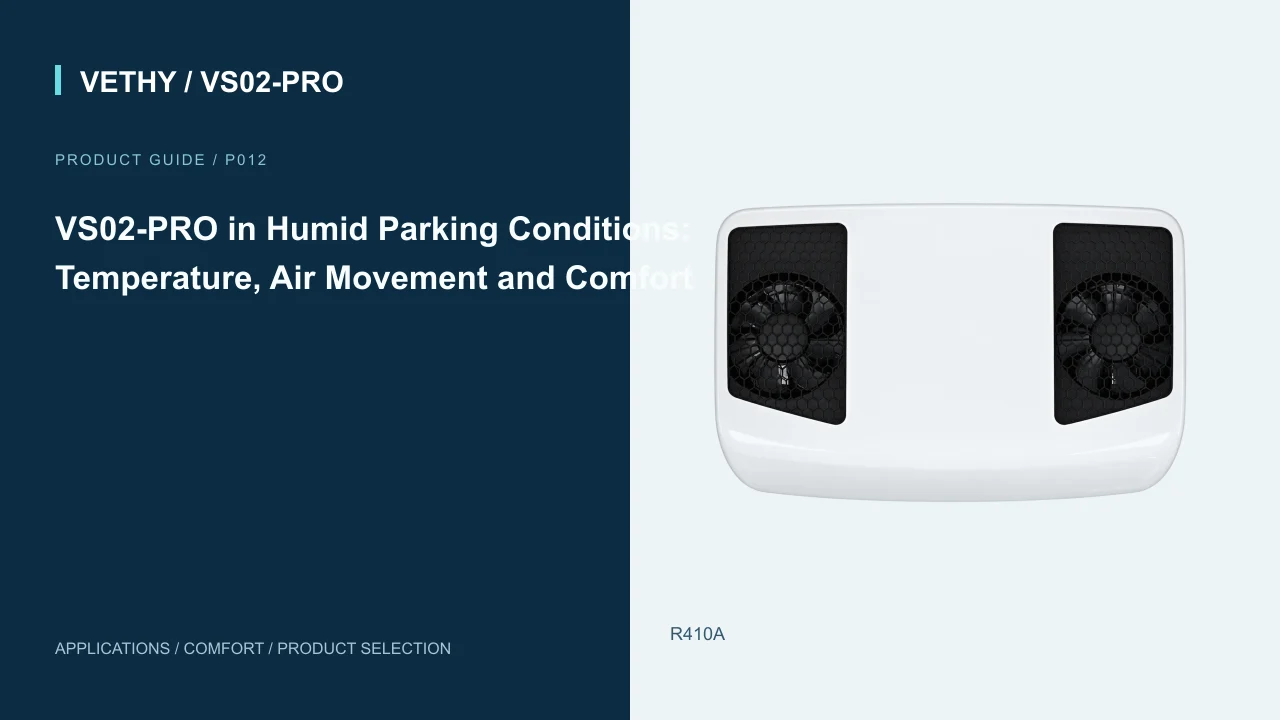
VS02-PRO is a useful rooftop parking AC candidate for warm, humid stops when the buyer wants a complete cab-comfort plan built around a defined product. It combines an R410A Rechi twin-cylinder rotary compressor system with brushless indoor airflow and automatic oscillation. The right recommendation connects those features to the actual vehicle, occupied space and parking routine rather than treating temperature alone as the whole comfort question.
A driver may describe a cab as sticky, still or unevenly cooled. Those descriptions can refer to different experiences, so the installation conversation should begin with the person's position and the surrounding conditions. The VS02-PRO airflow arrangement can then be assessed where the driver sits and rests, with the correct electrical version and a suitable roof installation.
This guide explains how to make that conversation practical. It does not assign VS02-PRO an undocumented humidity-control mode, moisture-removal rate or guaranteed humidity target. The aim is to recommend the product confidently where its complete rooftop package fits, while giving the customer a useful way to describe and assess comfort in humid conditions.
1. Ask what the driver actually feels
The word humid does not tell the installer where the driver is uncomfortable or what the cab is doing. Ask whether the concern is a warm bunk, a concentrated draft, a still area behind a curtain or a general sticky feeling. These descriptions help the team distinguish the occupied scene before proposing a product or layout change.
A driver who returns to the cab after outdoor work may have a different immediate preference from one who has been resting inside. The starting condition and normal routine matter. Describing them gives the supplier a practical brief and helps the demonstration resemble the intended use instead of an empty truck in unrelated weather.
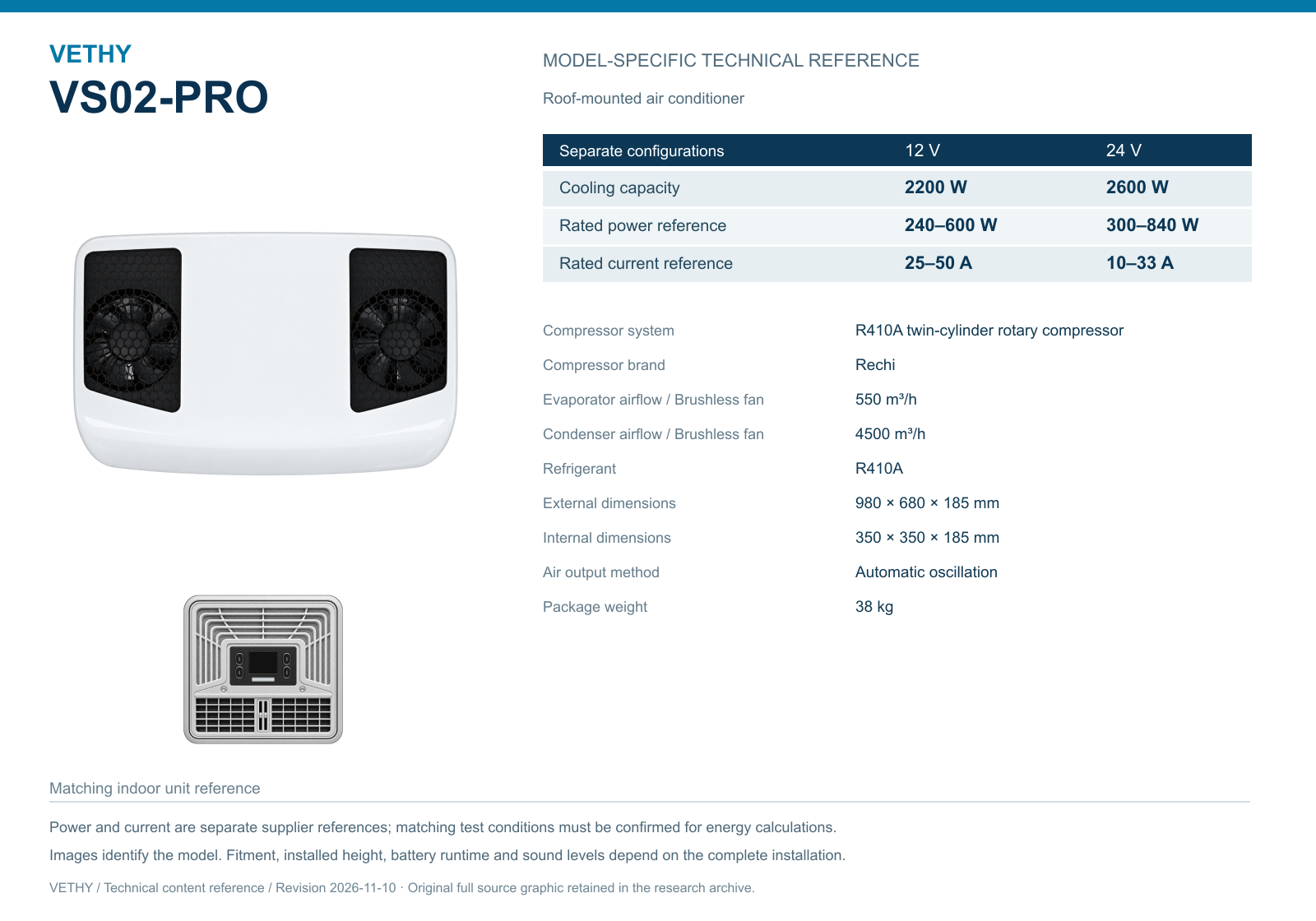
VS02-PRO's documented indoor features give that brief a concrete product foundation. The evaporator airflow reference is 550 m³/h with a brushless fan, and automatic oscillation is documented. The installer can apply those features to the relevant seat or bunk arrangement and let the customer assess the result directly.
The buying advantage is clarity. A specific comfort request leads to a more useful recommendation than asking for the lowest possible setting or the strongest possible stream. The customer sees how the proposed VS02-PRO package responds to an actual occupied position, which is where the product's value will be experienced every working day.
2. Keep temperature and moisture expectations separate
General refrigeration cooling can also remove moisture when the cooling surface is below the air's dew point. The Pacific Northwest National Laboratory explanation describes that distinction between lowering temperature and removing moisture. It is general engineering context, not a VS02-PRO humidity-performance rating.
The supplied VS02-PRO data establish cooling references and core product features, but no moisture-removal capacity or controlled humidity range. Do not turn the general principle into a claim that the model will maintain a particular humidity under every condition. A customer with a defined humidity requirement should state it explicitly in the project enquiry.
This distinction does not weaken the product recommendation. It makes the offer easier to assess. VS02-PRO can be considered as a cooling and air-distribution package for the cab, while any special moisture requirement receives a focused supplier discussion rather than an assumption hidden behind the word comfort.
For a distributor, keep that explanation concise. The buyer needs to understand what the product is being recommended to do and which additional requirement needs confirmation. There is no benefit in importing building-system humidity targets or control methods into a vehicle proposal without relevant VS02-PRO documentation.
3. Match the product version to the cabin duty
VS02-PRO lists 2200 W cooling in its 12V version and 2600 W in its 24V version. Select the version that matches the engineered vehicle supply and the intended cab duty. The manufacturer also supplies 7500 BTU and 9000 BTU references respectively, which should remain labelled as provided rather than presented as new calculations.
The cabin duty includes more than its visible floor area. Glazing, insulation, solar exposure, occupants and door traffic influence the task. A humid stop at dusk and a sunny afternoon waiting period are different scenes. Describe the intended use so the supplier can discuss the actual configuration rather than approve a universal size claim.
The Rechi R410A twin-cylinder rotary system is a useful product identifier for the recommendation. Pair it with the airflow and roof-package facts so the customer understands the complete model being considered. The offered unit should remain identifiable across the demonstration, quotation and later service record.
This gives the buyer a clear path forward. The initial question is whether the selected VS02-PRO version belongs in the vehicle project. The next question is how the roof, supply and indoor layout will support the customer's actual comfort period. The process stays practical without pretending that one catalogue figure answers every aspect of humid-weather use.
4. Use movement where the person is located
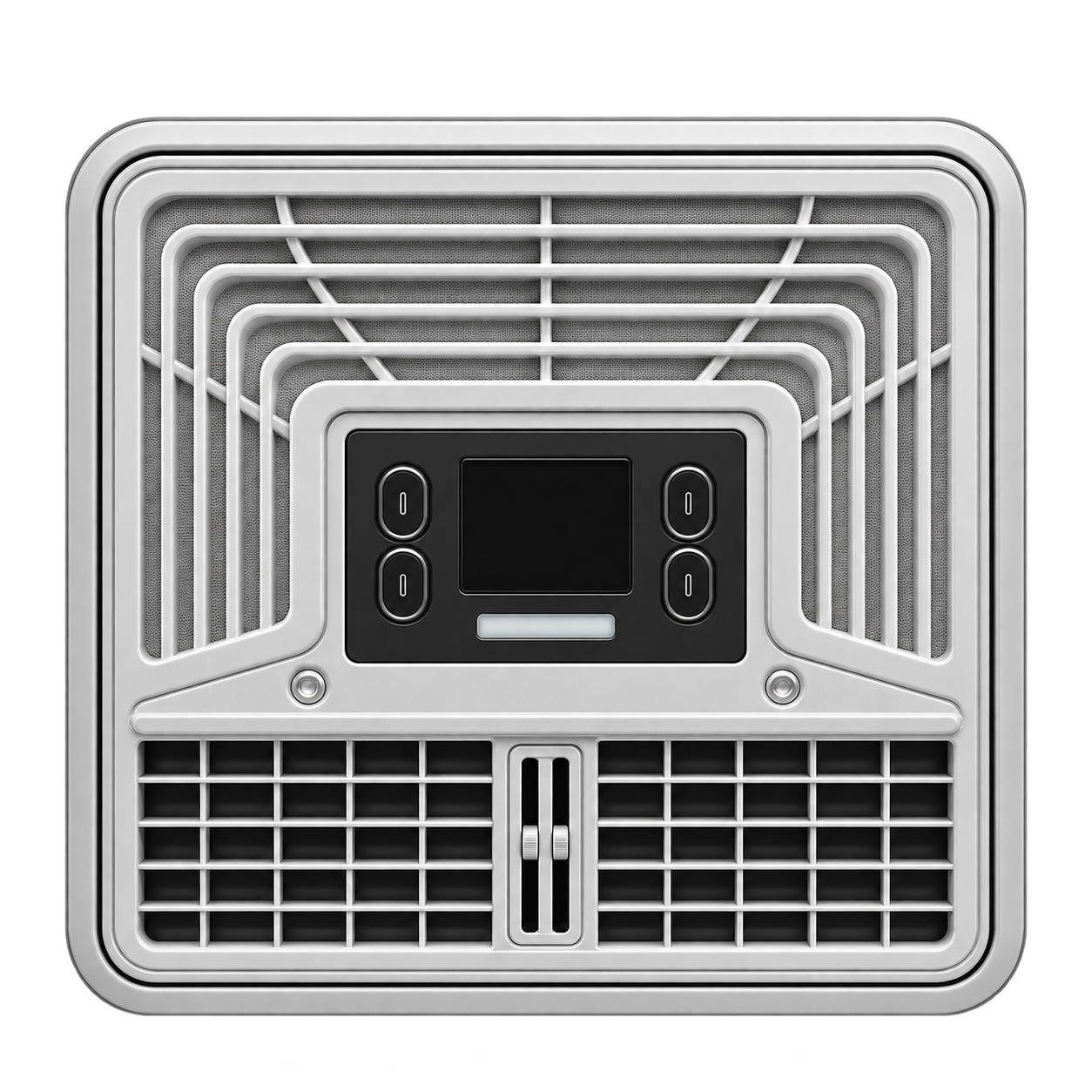
A stream near the panel is not the same as useful movement through the occupied area. VS02-PRO's 550 m³/h evaporator airflow reference becomes relevant when the panel location and surrounding path allow cooling to reach the seat or bunk. The driver should assess the actual position rather than judge the product only by touching the outlet.
Automatic oscillation can be demonstrated as part of that occupied experience. Let the customer sit normally and then recline with bedding present. The preferred relationship to the stream may change between positions. This makes the feature a practical comfort tool instead of a small line in the specification table.
Avoid equating an intense direct draft with the best resting arrangement. A driver may initially welcome a strong local sensation but prefer a less concentrated stream during a longer rest. The demonstration should let the person explain that preference using the supplied controls and the actual offered assembly.
The brushless airflow guide develops the seat-and-bunk subject further. For humid stops, the useful point is the same: apply the documented air delivery to the person and space that matter, rather than treating a numerical airflow reference as a substitute for an interior layout.
5. Keep curtains from turning the bunk into a separate problem
The sleeper curtain may define the intended resting zone, but it can also change the relationship between the indoor assembly and the bunk. A warm or still area behind a curtain deserves a layout review before the customer assumes the product needs a colder setting. The actual panel and return path should be assessed with the curtain in its normal position.
If the indoor assembly is outside the enclosed zone, the installation team should consider how the intended air route reaches the sleeper. If the relevant return access is covered, the route also needs attention. The supplied product instructions should guide the areas that must remain clear for the actual assembly.
A realistic demonstration includes ordinary bedding and storage. The goal is not to empty the cab until it looks easy to cool, but to create a practical arrangement the driver can use. This supports a more persuasive recommendation because the buyer sees the product working within the intended environment.
No fixed energy saving follows from a curtain arrangement in the supplied VS02-PRO data. The benefit is a deliberate occupied zone with a useful circulation path. That is a sensible foundation for comfort and energy-conscious planning, with the actual result assessed in the vehicle rather than promised universally.
6. Consider the driver's arrival routine
Humid stops often coincide with a transition from outdoor work or a busy loading area into the cab. Ask what happens before the driver rests. Repeated door openings, wet clothing or changing storage positions may be part of the working scene. Describe those circumstances to the installer without assuming that one factor explains every comfort concern.
Prepare the occupied space in the way the customer intends to use it. Establish the normal curtain position and keep the relevant air paths clear. The demonstration and daily routine then have a shared starting arrangement, making the result easier to interpret and repeat.
Ventilation decisions depend on the actual surroundings, site requirements and outside conditions. A universal instruction to open windows whenever the air feels humid is not a useful product-specific rule. The driver needs a deliberate transition into the intended cooling arrangement, supported by the operating guidance supplied for the installed unit.
The practical advantage is a more usable VS02-PRO package. The product is selected around a real working sequence, not an imagined uninterrupted evening. The owner can see how the hardware and preparation routine fit together, while the support team receives a clearer description if the experience later changes.
7. State the humid-weather proposal clearly
A concise proposal can connect the customer's request to documented product information and a practical demonstration. It should make the comfort objective visible without implying a special humidity function that has not been established.
| Customer concern | Relevant VS02-PRO information | Useful proposal response |
|---|---|---|
| Cooling in the occupied cab | 2200 W at 12V or 2600 W at 24V | Select the correct version for the defined duty |
| Still feeling near the bunk | 550 m³/h evaporator airflow reference | Review the indoor location and complete circulation path |
| Unpleasant direct draft | Automatic oscillation | Demonstrate the stream from the pillow position |
| Roof integration | 980 × 680 × 185 mm outdoor dimensions | Assess the actual mounting and surrounding access |
| Special humidity requirement | No supplied moisture-removal rating | Describe the requirement for supplier confirmation |
| Long parking period | Separate electrical references | Review the complete auxiliary-power package |
This table keeps the recommendation productive. The buyer can see what the model offers and how the installation team will address the actual request. It is a stronger basis for a quotation than either avoiding the humidity discussion or inventing a performance target to make the offer appear complete.
A hypothetical two-driver truck illustrates the value of this approach. One occupant may describe a draft near the pillow while the other reports a still area across the bunk. The useful response is to demonstrate the actual distribution and curtain relationship, not assume that both descriptions require the same adjustment. VS02-PRO's automatic oscillation can be assessed in that scene, and the installer can explain how the proposed location serves both people. The scenario is an application example, not a claim about measured humidity performance.
8. Keep the outdoor task supported
The outdoor side of VS02-PRO lists 4500 m³/h condenser airflow with brushless airflow. The roof layout should preserve the relevant intake, discharge and service access according to the applicable installation requirements. Indoor comfort and outdoor access belong in the same package, even when the customer's first concern is inside the sleeper.
The standard condenser is aluminum microchannel, with a copper condenser optional. The evaporator and piping are copper. Keep that material description accurate and record the selected configuration in the quotation. A material preference can be discussed directly without turning it into a humidity-performance claim.
Roof accessories should be included in the survey. Solar equipment, antennas and later additions can affect the practical layout. The enclosure footprint alone does not define every space needed for the complete installation. Ask for the applicable drawing and review the actual roof rather than apply an invented universal clearance.
This gives the buyer a more complete recommendation. VS02-PRO is being proposed as a defined rooftop system with useful indoor features and a workable outdoor arrangement. The customer can assess how the whole package fits the vehicle instead of receiving a local airflow demonstration disconnected from the roof installation.
9. Discuss condensate through the actual installation information
Where cooling produces condensate, its handling belongs to the applicable product and installation guidance. The supplied summary specifications do not establish a particular drain architecture for every VS02-PRO installation. Ask the installer to explain the relevant arrangement for the offered unit rather than infer it from a generic rooftop AC diagram.
The buyer should understand which service instructions apply and whom to contact if water appears in an unintended place. Useful reporting describes the location, circumstances and any recent change. It should not require the driver to dismantle the assembly or improvise a drainage modification from a general article.
For bodybuilders, this is a reason to include the product supplier in the integration discussion early. The roof, indoor fit and relevant water-handling arrangement can be reviewed together using the correct information. This helps turn an attractive enclosure placement into a complete vehicle installation.
The commercial benefit is a clearer handover and support path. The customer knows that the proposed VS02-PRO package includes more than a cold outlet and that installation details are being handled with the actual unit in mind. This supports confidence without adding an undocumented internal construction claim.
10. Plan electrical energy for the intended conditions
The manufacturer power references are 240–600 W for the 12V version and 300–840 W for 24V. Current is separately listed as 25–50 A and 10–33 A. The endpoints do not form a common-condition data set, so they should not be paired to calculate efficiency or used to guarantee runtime in humid weather.
The auxiliary-power plan should consider usable stored energy, the complete session and other vehicle loads. A representative observation can record the cab arrangement and surroundings alongside energy use. The result belongs to that installation and period, making it a practical planning input rather than a universal product claim.
Energy-conscious comfort also includes reducing avoidable heat gain and keeping air delivery useful. Those choices can support the complete project, while their impact depends on the vehicle and conditions. No precise saving is established by the supplied VS02-PRO information, so the proposal should stay qualitative unless relevant measurements are available.
This clarity benefits both the customer and distributor. The model can be recommended confidently for a defined duty, and the electrical specialist can develop the supply around that duty. Comfort and duration are then reviewed as parts of the complete installed package rather than left as assumptions after the product is purchased.
11. Demonstrate the actual comfort request
A useful demonstration begins with the customer's description of the problem. If the concern is the bunk behind a curtain, show that scene. If the driver remains seated during long waits, include that position. Use the real VS02-PRO indoor and outdoor images and identify the offered voltage and condenser configuration.
The customer should assess the stream from ordinary occupied positions with normal bedding present. Explain the supplied controls accurately and avoid adding a named dry mode, automatic humidity target or phone function that the source information does not establish. The demonstration is more useful when it matches the product being quoted.
If observations are recorded, preserve the relevant surroundings and starting condition. A comfortable impression on one day is valuable feedback, but it does not establish all-weather humidity control. The purpose is to assess whether the offered installation serves the actual vehicle brief and to identify any remaining requirement for supplier confirmation.
The VS02-PRO product page provides the central model reference. Connecting the demonstration to that page keeps the buyer's experience attached to the actual product rather than a generic story about cooling in humid climates.
For a fleet pilot, preserve the driver's words alongside the product configuration. Descriptions such as warmer behind the curtain or uncomfortable direct movement at the pillow are useful because another person can reproduce the occupied position. They also help separate the practical layout discussion from a special moisture-control requirement that needs supplier confirmation. This makes the pilot more valuable to purchasing and service staff, while keeping the customer experience at the center of the VS02-PRO recommendation.
12. Give ownership a clear starting arrangement
The handover should show the intended indoor path, curtain position and relevant areas to keep clear. Retain the model, voltage and condenser configuration with the vehicle record. If the cab interior or roof equipment changes later, the owner and workshop have a useful reference for reviewing the new arrangement.
Care and service should follow the supplied instructions and the actual working environment. The source information does not establish a universal cleaning interval or a special procedure for every humid route. The useful principle is to preserve the intended air paths and use qualified support for the actual unit when needed.
The driver can report where the experience differs and what changed in the cab or routine. This is more actionable than guessing a refrigerant or controller fault. A clear vehicle record helps the support team connect the observation to the original installation and the product configuration.
The VS02-PRO guide hub supports focused reading on circulation, rest comfort and roof integration. These explanatory resources complement the actual product instructions, helping the buyer understand why the arrangement matters while leaving procedures tied to the supplied unit.
13. Questions about humid parking comfort
Does VS02-PRO have a documented humidity-control mode?
The supplied specifications do not establish a dedicated humidity-control mode or target range. If that is a project requirement, describe it explicitly and ask VETHY to confirm the offered configuration. Do not assume the function from general air-conditioning principles.
Why discuss airflow when the driver says the cab feels sticky?
The driver may also be experiencing an uneven or still occupied area. The documented brushless airflow and automatic oscillation can be assessed from the seat and bunk. Keep that practical airflow discussion separate from any unverified moisture-removal rating.
Should a colder setting be the only response?
A useful assessment also considers the occupied position, curtain and complete circulation path. Use the controls according to the supplied guidance and describe the actual concern to the installer. The correct response depends on the vehicle and offered configuration.
When is VS02-PRO worth recommending?
It is a relevant candidate when its selected voltage, cooling reference and rooftop arrangement fit the cab duty. Rechi twin-cylinder rotary architecture, brushless airflow and automatic oscillation provide useful features around which to build a practical occupied-space demonstration.
Build the humid-weather recommendation around the cab
Shortlist VS02-PRO when its complete rooftop cooling package fits the vehicle and the customer wants deliberate air delivery to the occupied space. Explain temperature, movement and any special moisture requirement clearly, then assess the actual arrangement. Send the vehicle layout, voltage and humid-stop routine through the technical enquiry page for a configuration-specific proposal grounded in the customer's real use.
Product sources
- VETHY VS02-PRO current manufacturer specifications — VETHY.
- VS02-PRO technical reference sheet — VETHY.
- Whole-House Dehumidification: general cooling and moisture principles — Pacific Northwest National Laboratory, Building America Solution Center.
VETHY product recommendation and application analysis. Specification references identify the selected model and voltage. Installation examples are planning examples; measured project results are identified explicitly when available.
Discuss your VS02-PRO application
Send your vehicle, supply voltage, occupied space, parking schedule and installation photographs for a model-specific recommendation.
Prepare your vehicle brief ↗