
VETHY / VS02-PRO / PRODUCT AND APPLICATION GUIDE
Supporting VS02-PRO with a Stable 12V or 24V Supply
VS02-PRO should be selected with the correct 12V or 24V version and a supply path designed for the actual vehicle. Keep manufacturer power and current fields separate, and have a qualified installer define protection, routing and connections. A complete package also considers usable energy, roof fit and the driver’s occupied air path.
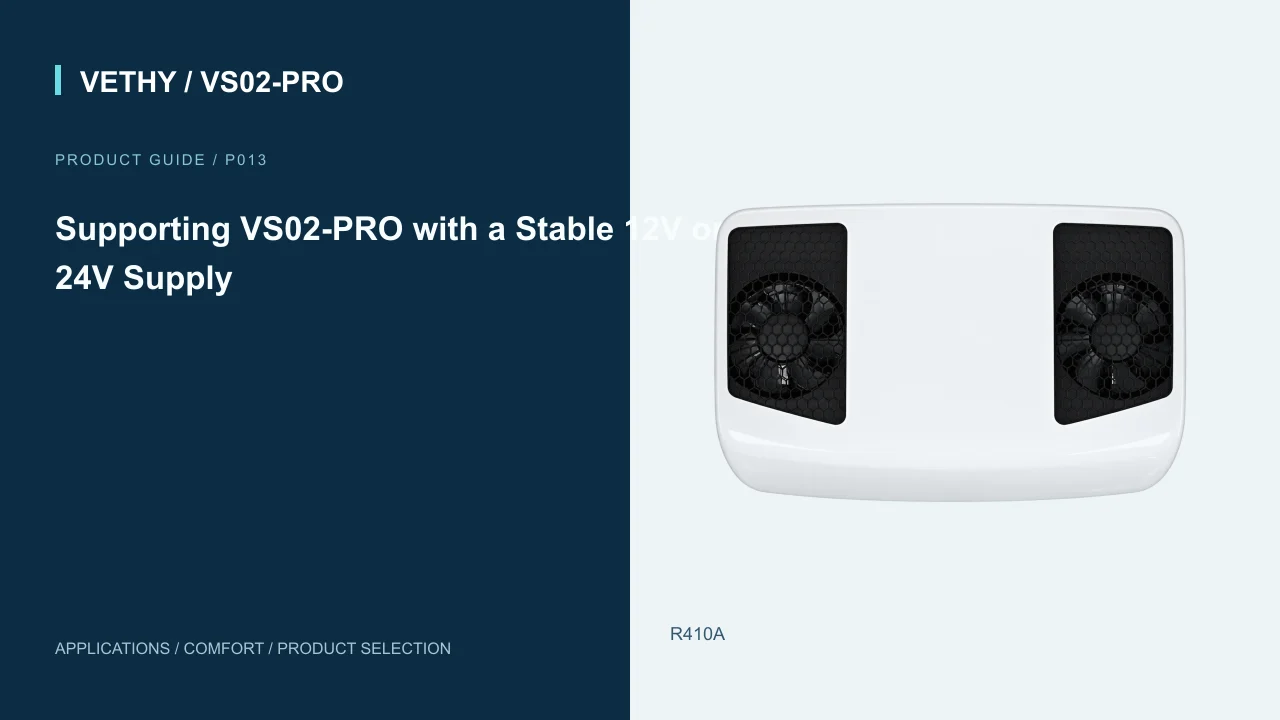
VS02-PRO is worth recommending as a complete rooftop parking cooling package when its electrical version is matched to a deliberately designed supply. The product offers 12V and 24V versions, an R410A Rechi twin-cylinder rotary compressor system, brushless airflow and automatic oscillation. A suitable supply path helps the buyer turn those product features into a usable installed arrangement rather than leaving the electrical work as an assumption.
The practical purchasing decision has two parts. First, choose the version and cooling package that fit the vehicle duty. Then define the route from the vehicle's power system to the rooftop unit, including the requirements that the qualified installer must apply. Battery size alone does not describe that route, and a familiar nominal voltage does not establish that an existing accessory connection is appropriate.
This guide focuses on that supply-path decision. It explains how to make the VS02-PRO offer concrete for owner-drivers, fleets and bodybuilders, with clear product references and a serviceable installation record. It does not prescribe a universal cable size, fuse rating or controller setting for every truck.
1. Choose the actual voltage version first
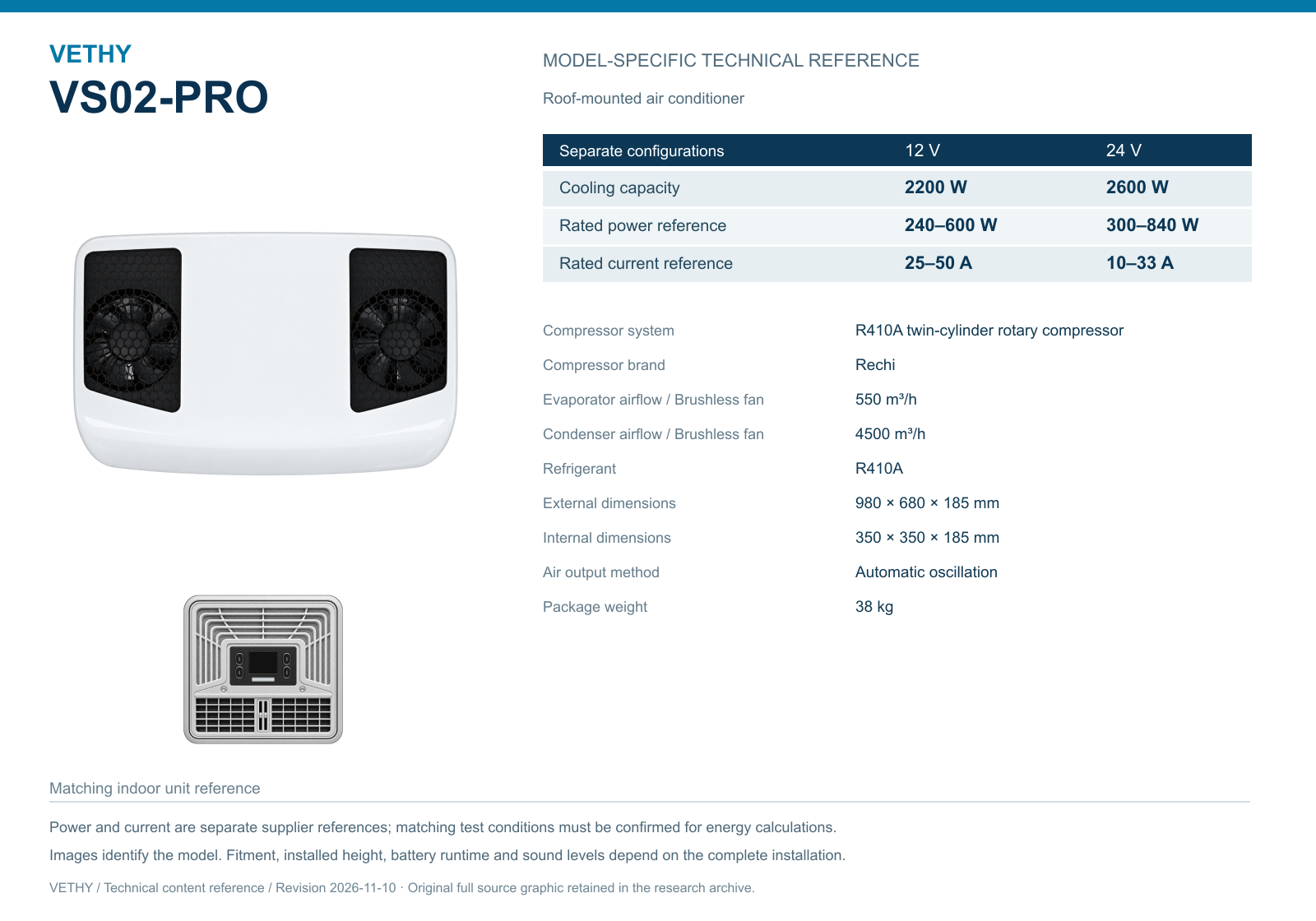
The 12V VS02-PRO lists a 2200 W cooling reference, while the 24V version lists 2600 W. The version should match the engineered vehicle supply and the intended cabin duty. State the choice explicitly in the enquiry and quotation so purchasing, electrical work and roof fitting all begin with the same product configuration.
A truck's nominal electrical identity is useful information, but the installer still needs to understand the proposed supply arrangement. The cooling unit may be part of an auxiliary package with its own storage and charging design. Describe that actual arrangement rather than assume that a label on the vehicle resolves every electrical question.
The product recommendation becomes stronger when the version is tied to a real use case. A driver planning short loading waits and a fleet planning extended sleeper occupancy may need different complete energy packages even if both select the same VS02-PRO voltage version. The model choice and the supply duty should therefore appear together.
For distributors, this is a simple sales discipline with practical value. Identify the version before quoting electrical references or discussing duration. The customer receives a clear proposal, and the installer avoids a later conversation about which set of figures the sales presentation was intended to describe.
2. Keep manufacturer references in their proper fields
VS02-PRO's supplied electrical information includes separate power and current references. For 12V, rated power is listed as 240–600 W and rated current as 25–50 A. For 24V, the corresponding references are 300–840 W and 10–33 A. The source does not establish common test conditions for every endpoint.
These fields should be shown as labelled manufacturer references. They are not a complete electrical installation design, and convenient endpoints should not be paired to create a new efficiency or runtime claim. The installer needs the relevant requirements for the supplied configuration and the actual vehicle route.
Cooling capacity is another distinct field. The 2200 W and 2600 W references describe cooling output rather than battery electrical input. Keeping that distinction clear helps a nontechnical buyer understand why several different numbers appear in the proposal. It also makes comparison with another complete offer more meaningful.
The VS02-PRO product page should remain the core model reference. Use the same identification in the electrical brief so the supply design is attached to the actual product being quoted rather than a generic parking AC with an assumed demand.
3. Draw the complete path to the roof
A useful supply discussion follows the route from the source to the unit. Identify the proposed power arrangement, the protected route through the vehicle and the final connection to the VS02-PRO. The qualified installer should define the details using the applicable product requirements and vehicle practices. This article cannot replace that installation design.
The route matters because the rooftop location may be some distance from the proposed supply point. Battery position, cab structure and existing vehicle equipment influence the practical path. A cable line on a simple sketch can reveal where additional information is needed before the workshop begins work.
For the buyer, the benefit is a reviewable installation. The offer can explain where the supply comes from and how the unit is integrated into the vehicle, instead of relying on the vague phrase connected to the battery. That clarity supports both the initial purchase and later service.
For a fleet, preserving the route also helps when different workshops fit similar trucks. One approved vehicle variant can serve as a reference, with meaningful differences recorded for others. The VS02-PRO model stays constant while the supply route remains visible as part of the vehicle-specific work.
4. Give connections and protection a defined scope
The electrical installer should select the protection, conductors and connections appropriate to the actual unit and vehicle. The supplied summary data do not establish one fuse value or cable size for every route. Ask for the applicable installation requirements rather than copying a specification from an unrelated parking air conditioner.
This is a practical scope question for the quotation. The customer should understand whether the offer includes the complete electrical installation or only product supply. If another workshop performs the work, identify the information it needs and the responsibility for completing the vehicle design. Clear scope helps the buyer compare offers fairly.
A connection that is convenient to reach is not automatically the right connection for the duty. The qualified installer needs to assess the proposed source and path. The sales team can support that work by providing the correct model, voltage and product documentation, without improvising electrical instructions to make the purchase seem simpler.
The resulting benefit is a more professional VS02-PRO package. The customer sees a defined product supported by a defined installation process. That gives the unit's comfort features a credible foundation and reduces the chance that essential supply work is discovered only after the roof assembly has been fitted.
A distributor can make this scope especially clear when selling to a remote installation partner. Supply the correct model documentation and identify which vehicle information the partner must review before fitting. The customer can then understand how the offered product becomes a complete installation, even when the seller and workshop are different businesses. This is a useful commercial advantage: VS02-PRO remains the clearly identified unit, and the practical responsibilities around it are stated rather than left to assumption. The buyer receives a package that can be discussed and scheduled concretely.
5. Route for the vehicle's everyday environment
A working truck exposes installed equipment to ordinary movement, service activity and environmental conditions. The supply route should be designed for the actual vehicle and protected as required by the relevant installation practices. Consider the route as part of the vehicle package, not a hidden finishing task after the AC location is chosen.
The installer should also consider access for inspection and service where required. A neatly concealed route can be difficult to understand later if no record exists. Photographs or a simple layout can preserve the important information without turning the customer's handover into an engineering manual.
This matters for owner-drivers who may receive service far from the original workshop. A later technician can begin with a clear product identification and route record. The customer is less dependent on someone's memory of how the installation was completed months earlier.
For bodybuilders, early coordination allows the roof, interior finish and electrical path to be designed together. The VS02-PRO can then feel like an integrated part of the cab. The product's practical advantage is supported by a supply arrangement that fits the working vehicle and remains understandable through ordinary ownership.
6. Connect the supply plan to usable energy
A sound route and a suitable battery address related but different questions. The route supports the electrical connection to the unit. The energy plan considers how much usable storage is available for the intended period, alongside charging and other loads. Both belong in a complete VS02-PRO proposal.
The product data do not establish a guaranteed overnight duration. Actual demand, cab heat gain, control configuration and the wider vehicle system affect the session. The battery supplier and electrical designer should define the usable storage and reserve strategy for the proposed arrangement rather than leave the owner to infer it from a label.
A representative session record can support that assessment. Preserve the selected voltage, starting condition, other loads and relevant surroundings with any observation of energy use. This makes the result useful for that installation and avoids turning a single momentary reading into a universal product claim.
The 12V session-planning guide develops the energy conversation for the 12V version. Here, the focus is the supply path that connects the selected product to the vehicle. Keeping the two subjects distinct makes the complete package easier for a buyer to understand and review.
A buyer can ask for the energy assumptions to be stated in ordinary language: the intended parking period, the occupied zone and which other equipment is included. This makes the complete package easier to review without requiring the customer to build an electrical model. The supplier can then connect the VS02-PRO configuration to a concrete duty, and the installer can explain how the proposed supply arrangement supports that duty. A clear brief is useful even before representative measurements are available.
7. Coordinate roof packaging and electrical routing
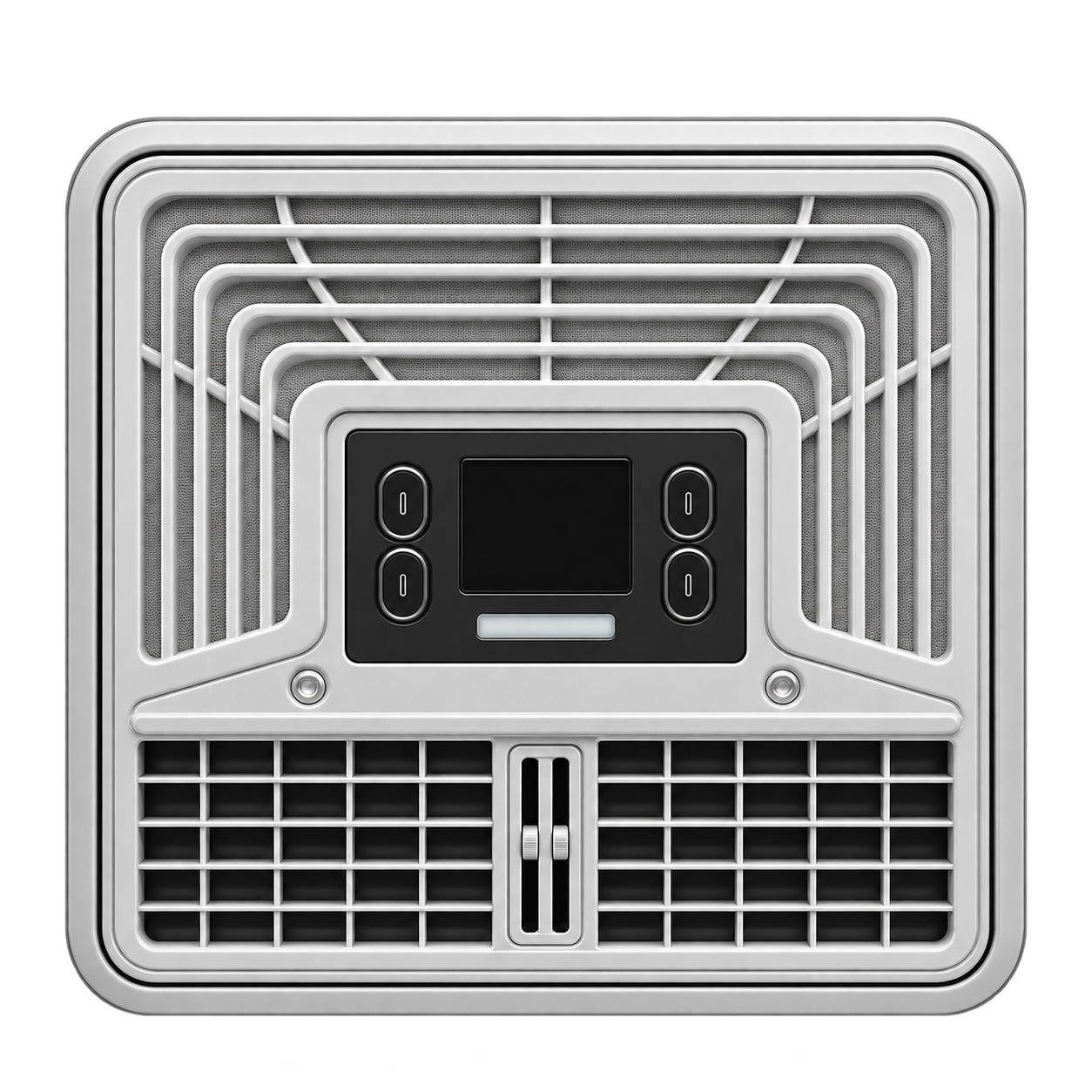
The VS02-PRO outdoor dimensions are 980 × 680 × 185 mm. The indoor assembly is listed as 350 × 350 × 185 mm. These references help the installer review space, while the applicable drawing establishes the actual opening, support, sealing and mounting details for the vehicle.
The electrical path should be considered alongside those decisions. The proposed roof location may affect routing, and the interior finish should not make the connection arrangement unintelligible for later service. Coordinating the trades early helps the product become a coherent installed package instead of several separate jobs completed in an awkward sequence.
The 185 mm outdoor height is useful for the vehicle-height discussion, but the completed arrangement depends on the roof and mounting. Likewise, retain the complete indoor dimensions without describing the final number as visible faceplate thickness. Accurate packaging language helps the electrical and roof teams work from the same product understanding.
The buyer benefit is practical: the proposal can show the cooling hardware, the occupied space and the supply route together. This makes VS02-PRO easier to assess as a complete vehicle investment, with a clear connection between the product's comfort features and the installation that supports them.
8. Keep airflow inside the same installation brief
A correctly connected unit still needs a useful air path. VS02-PRO lists 550 m³/h evaporator airflow with a brushless fan and automatic oscillation. The indoor location should serve the driver's seat or bunk, with the normal curtain and storage arrangement included in the review.
The outdoor side lists 4500 m³/h condenser airflow with brushless airflow. Preserve the relevant intake, discharge and service access according to the applicable requirements. Nearby roof accessories should be coordinated with the AC rather than added later without considering the existing arrangement.
The documented standard condenser is aluminum microchannel, with copper optional; the evaporator and piping are copper. Record the chosen configuration with the voltage and model. The electrical installer, roof fitter and service team should be able to identify the same complete unit throughout the project.
This complete view makes the recommendation more persuasive. VS02-PRO is not being sold on an electrical number alone. It is a defined R410A rooftop comfort package whose air delivery, roof fit and power connection are planned around the actual driver and vehicle duty.
9. Make responsibilities visible in the offered package
A customer can reasonably expect a complete installed offer to explain which work is included. Product supply, roof integration, electrical work and auxiliary equipment may involve different parties. Describe the actual scope in normal language so the customer knows how the proposal will become a usable vehicle installation.
| Part of the package | Information to keep visible | Practical buyer benefit |
|---|---|---|
| Product selection | VS02-PRO, voltage and condenser choice | A clearly identified supplied unit |
| Roof integration | Applicable drawing and vehicle location | A defined mounting proposal |
| Supply path | Engineered source, route and connection scope | A reviewable electrical installation |
| Auxiliary energy | Intended duty and complete storage/charging proposal | A realistic session discussion |
| Indoor comfort | Seat, bunk and curtain arrangement | Air delivery connected to actual use |
| Handover | Installed record and support route | Clear ownership information |
The table is a way to organize a concrete offer, not a demand for the customer to engineer the truck. It helps the supplier and installer make the VS02-PRO recommendation complete enough to review and order with confidence.
A clear scope also helps explain price differences. One offer may include storage and charging equipment, while another covers only the AC and roof work. Neither description should be hidden behind an unexplained complete package label. State the actual components and work, then compare the proposals against the same intended session. This gives VS02-PRO a fair place in the buying decision and helps the customer understand which part of the investment supports cooling, which supports energy availability and which makes the product fit the working truck.
10. Demonstrate operation with the intended supply
A demonstration is most useful when it represents the offered package. Identify the actual product version and supply arrangement, then let the driver assess the occupied cab. If the display uses a different setup from the customer's proposed installation, explain that difference rather than allow the customer to assume every part is identical.
Use the controls and operating guidance supplied for the offered configuration. The summary specifications do not establish a particular voltage cutoff, automatic battery algorithm, phone application or named sleep program. If a customer requires one of those functions, ask VETHY to confirm it directly for the order.
The driver can assess airflow from the seat and pillow positions, with the normal curtain and bedding in place. The Rechi twin-cylinder rotary system and brushless airflow are useful parts of a calm-comfort discussion, while the finished experience also depends on installation. No verified decibel figure is supplied in the source set.
A clear demonstration connects those benefits to the complete vehicle package. The customer sees a product that can serve the intended space, while the technical team addresses the supply design. This division of attention makes the buying process easier without leaving the electrical path as an unspoken assumption.
11. Preserve useful information for later service
At handover, retain the model, voltage, condenser choice and relevant installation photographs. A simple route record can show where the unit's supply begins and how the important parts of the installation are identified. Keep the applicable product information with that record so later support refers to the correct configuration.
If the driver notices a change, useful reporting describes the circumstances and location rather than a guessed controller fault. Note any recent vehicle work, new equipment or changed operating routine. Qualified staff can then review the actual installation with a clearer starting point.
The owner should not improvise electrical modifications from a general article. The relevant requirements and professional vehicle assessment remain the basis for service work. The value of the record is that it helps the appropriate people understand what was fitted, not that it turns every driver into an electrical installer.
For fleets, the same record can support repeatable work and comparison between similar trucks. The engineering page provides a route for integration discussion, while the VS02-PRO guide hub supports focused reading on the connected comfort and packaging subjects.
12. Apply the plan to a repeatable fleet installation
Consider a hypothetical fleet with a small group of similar 24V sleeper trucks. It selects the 24V VS02-PRO for a representative installation, then asks the workshop to document the supply route and roof arrangement. The trial is intended to answer whether the complete package serves the route's parked comfort duty. It is not a claim that all 24V trucks share one design.
After the first vehicle is assessed, the fleet can preserve the successful configuration for comparable trucks. The next workshop sees the selected model, relevant product requirements and the vehicle-specific route. If a later truck has a different battery location or roof accessory arrangement, that difference can receive focused review rather than being hidden by the common model name.
The practical benefit is controlled repetition. VS02-PRO provides a stable product identity at the center of the program, while the installation record explains how that product is supported on the chosen vehicle group. Purchasing, drivers and service staff can then discuss the same complete package with fewer assumptions about the electrical work.
13. Questions about supporting VS02-PRO electrically
Can an existing 12V or 24V accessory outlet be assumed suitable?
Nominal voltage alone does not establish suitability. The qualified installer should assess the source, protection, route and connection requirements for the actual VS02-PRO configuration and vehicle. Treat the cooling installation as a defined electrical project within the complete package.
Which current endpoint should determine the whole installation?
The supplied current range is a manufacturer reference, not a universal installation instruction. Request the applicable requirements for the offered unit and have the electrical designer assess the complete route and duty. Do not select an endpoint merely because it makes the proposal look simpler.
Does a larger battery solve every supply concern?
Storage and supply path address different parts of the package. The route, connections and protection still need appropriate design. Usable energy, charging and other loads also matter to the intended session, so the complete arrangement should be reviewed rather than one label considered in isolation.
Why choose VS02-PRO within a properly designed package?
It offers a defined rooftop R410A product with Rechi twin-cylinder rotary architecture, brushless airflow and automatic oscillation. When the correct version, roof location and supply fit the vehicle duty, those features provide a useful basis for a practical parked-cab comfort recommendation.
Recommend the product with a defined supply path
Shortlist VS02-PRO when its rooftop cooling package fits the vehicle and the electrical installation can be planned as part of the complete offer. Identify the version, route and intended session alongside the occupied air path. Send the vehicle voltage, roof photographs and supply information through the technical enquiry page so VETHY can develop a configuration-specific proposal with the installer.
Product sources
- VETHY VS02-PRO current manufacturer specifications — VETHY.
- VS02-PRO technical reference sheet — VETHY.
VETHY product recommendation and application analysis. Specification references identify the selected model and voltage. Installation examples are planning examples; measured project results are identified explicitly when available.
Discuss your VS02-PRO application
Send your vehicle, supply voltage, occupied space, parking schedule and installation photographs for a model-specific recommendation.
Prepare your vehicle brief ↗