
VETHY / VS02-PRO / PRODUCT AND APPLICATION GUIDE
VS02-PRO Heat Exchangers: Copper Evaporator and Condenser Options
VS02-PRO has a copper evaporator and copper piping, with an aluminum microchannel condenser as standard and a copper condenser optional. Recommend the complete package around vehicle fit, cooling duty and support needs. Identify voltage and condenser configuration separately in the quotation so the delivered product matches the buyer’s defined requirements.
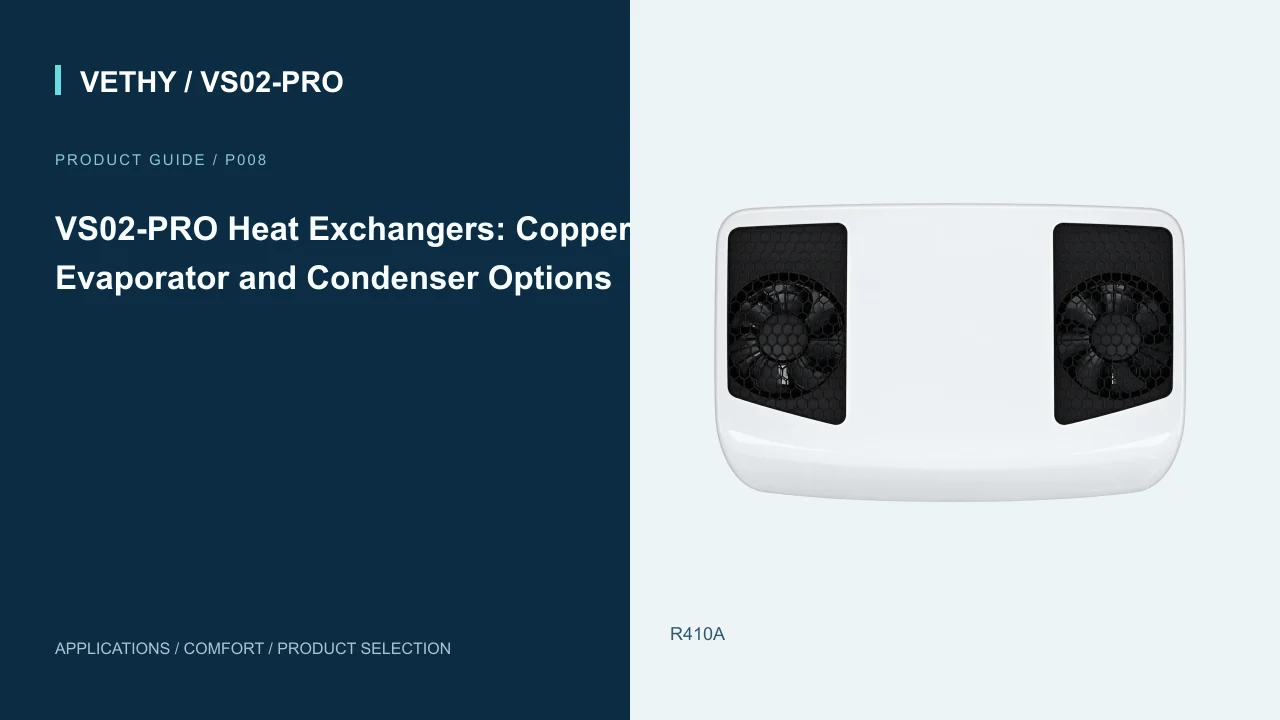
VS02-PRO is worth considering when a buyer wants a clearly described rooftop parking AC material package and a genuine condenser choice. Its documented standard configuration combines a copper evaporator and copper piping with an aluminum microchannel condenser. A copper condenser is optional. That is the useful starting point for selection: understand the supplied package, then decide whether the option serves a particular project requirement.
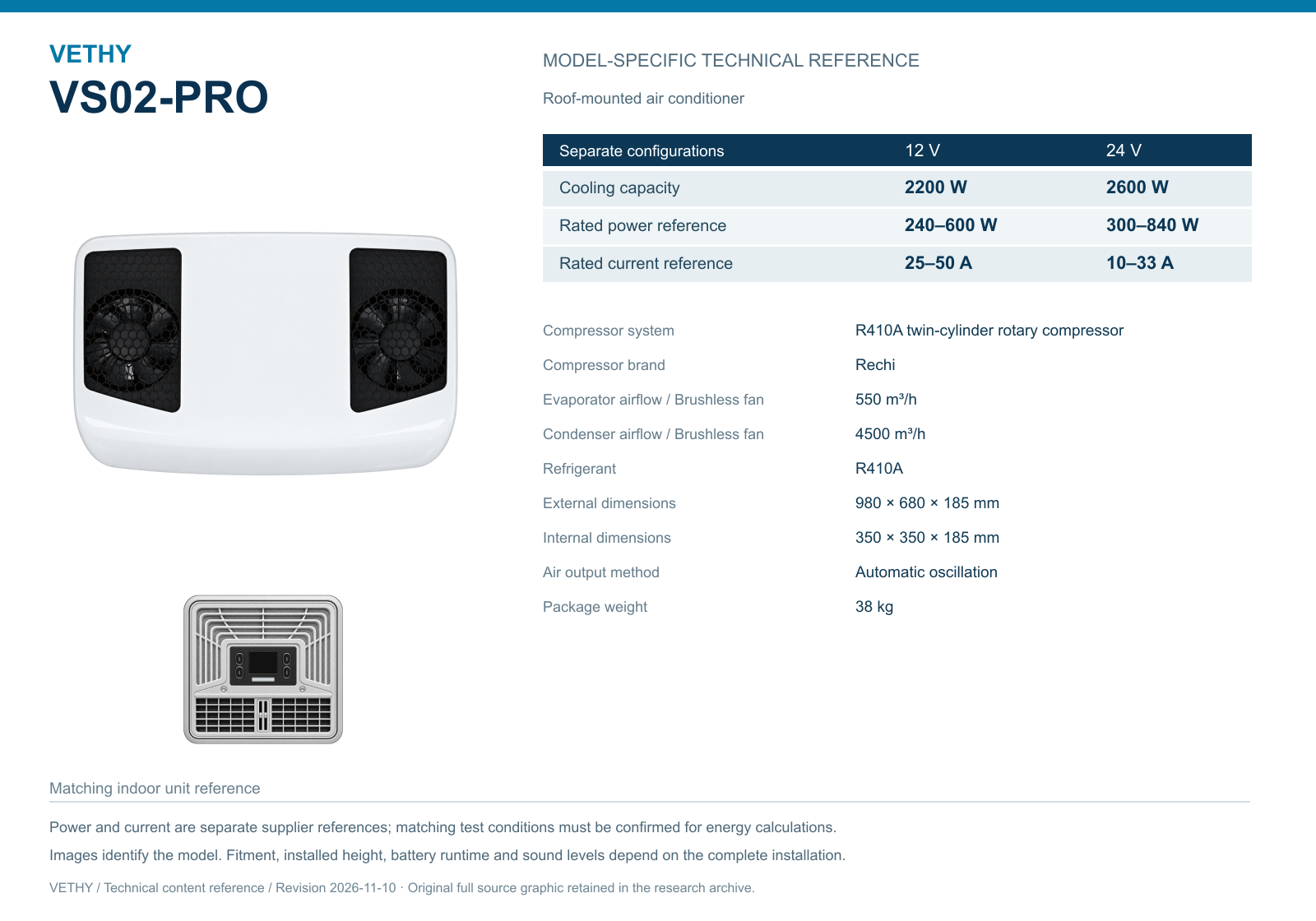
The recommendation should stay connected to the complete product. VS02-PRO uses an R410A Rechi twin-cylinder rotary compressor system, with 2200 W cooling listed for 12V and 2600 W for 24V. Its air-delivery and roof-packaging features remain important whichever condenser is selected. Material preference is one part of the buying decision, alongside fit, comfort, electrical supply and support.
This guide explains how to present those choices clearly and use them in a practical quotation. It helps buyers avoid an ambiguous all-copper description while recognizing the value of a product whose evaporator, piping and standard condenser arrangement are explicitly identified.
1. Begin with the exact standard configuration
The standard VS02-PRO material description is specific: copper evaporator, copper piping and aluminum microchannel condenser. The condenser can be supplied in copper as an option. A quotation should state the configuration directly so the customer knows which package is being discussed and the workshop can identify the supplied unit later.
This clarity is a useful product advantage. Some buying conversations reduce a complete cooling system to one broad material label. VS02-PRO allows the distributor to be more precise. The customer can understand where copper is documented and where the standard condenser uses another material, without guessing from an exterior photograph.
The standard arrangement can be recommended confidently when it matches the buyer's defined requirements and support plan. The presence of an option does not make the standard package an incomplete product. It simply gives the buyer a separate configuration to discuss if a copper condenser is important to the project.
Avoid describing every fin, housing or internal component as copper. The supplied information identifies the named heat exchanger and piping materials, not every material in the assembly. A precise explanation makes the recommendation stronger because the customer receives a clear, reviewable product description instead of a sweeping label that may create confusion after delivery.
2. Put the copper evaporator in the comfort story
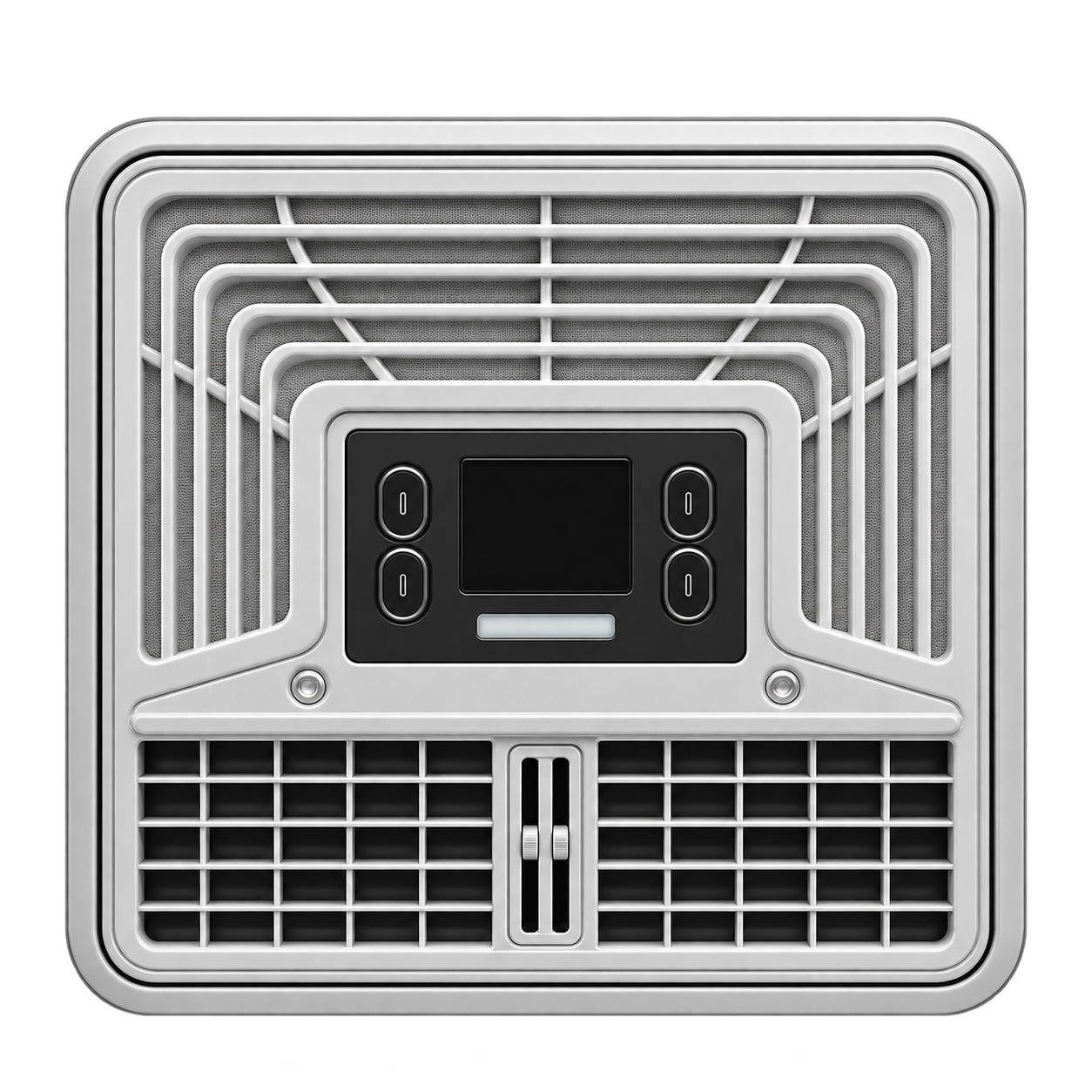
The evaporator belongs to the indoor cooling side of the VS02-PRO package. Its documented copper construction is a component fact the buyer can retain in the product comparison. The indoor comfort discussion should then connect the complete assembly to air delivery, with the published 550 m³/h evaporator airflow reference and automatic oscillation.
For the driver, the practical benefit is useful cooling in the occupied cab. Material identity alone does not tell the person how the stream reaches the bunk. The panel location, return path and normal curtain arrangement remain essential. A good presentation therefore names the copper evaporator and then shows the complete indoor assembly in its actual role.
Use the real VS02-PRO indoor image rather than a generic internal coil photograph. The buyer should see the panel that belongs to the product being offered. If internal detail is not shown or documented, do not imply a visible construction feature from an unrelated sample. Accurate imagery supports a more trustworthy material explanation.
For importers, the copper evaporator description can sit in a concise technical table alongside the other core facts. This keeps the product identity clear across a catalogue, quotation and service record. The sales team can explain the material confidently while leaving the comfort demonstration centered on the driver's actual occupied position.
3. Describe copper piping without adding unsupported ratings
Copper piping is documented for VS02-PRO, with the supplied material information positioning it for high pressure resistance. The product uses R410A and a Rechi twin-cylinder rotary compressor system. These facts should be presented together as part of the defined refrigerant-circuit package, without inventing a numerical pressure rating or an unverified pipe specification.
For a buyer, the immediate benefit is component transparency. The piping material is named, and the refrigerant and compressor architecture are also identified. This supports a more useful supplier discussion than a proposal that leaves the main circuit details vague. It also helps the service team begin with the correct model information.
The piping statement does not authorize a refrigerant conversion or a field redesign of the circuit. The installed product should follow the supplied requirements for its actual configuration. If a bodybuilder or fleet has a special integration concern, describe it to VETHY rather than assuming that a material description establishes compatibility with every proposed modification.
A distributor can make this explanation simple: the documented copper piping is part of the VS02-PRO product package being supplied. The customer does not need a fabricated pressure number to understand that the materials are specified. Accurate, consistent component information is itself a practical advantage in procurement and support.
4. Recommend the standard microchannel condenser on its actual merits
The standard condenser is described as aluminum microchannel. That gives the buyer a defined outdoor heat exchanger configuration to consider within the complete rooftop unit. The correct recommendation is based on the product package fitting the vehicle and duty, rather than assuming that a material name alone proves better cooling or lower power use.
VS02-PRO lists 4500 m³/h condenser airflow with brushless airflow. The outdoor dimensions are 980 × 680 × 185 mm. These references help the installer review the roof arrangement and the complete outdoor task. The applicable installation information must establish the required air access and service space for the actual order.
For a regular distributor program, the standard configuration offers a clear baseline. The sales team can present one well-defined package, use matching product photographs and develop support material around it. A customer with no special condenser requirement can evaluate that package alongside the cooling, airflow and fit considerations that matter to the vehicle.
The standard configuration should not be oversold through unsupported comparisons. No verified product-specific sound, efficiency or durability superiority over a copper alternative is established in the supplied data. The strong commercial message is that the configuration is known, the model is identifiable and the installation can be planned around its documented requirements.
5. Make the copper condenser option a real decision
A copper condenser option is useful when a buyer has a defined material preference or procurement requirement. The option should be discussed as an actual order configuration, with its supplied details confirmed by VETHY. This gives the customer a concrete choice instead of an informal promise that copper can probably be added later.
Ask why the option matters to the project. The buyer may be aligning a product range, following a fleet preference or seeking consistency with a support arrangement. Understanding that reason helps the supplier describe the relevant configuration and quotation. It also avoids assuming that every customer has the same priority merely because the option appears on a product sheet.
The quotation should separate the selected condenser from the standard package clearly enough for purchasing and later service to recognize it. If several vehicles are involved, keep the configuration with each order or vehicle group. A named option has more value when the delivered product can be connected to a clear record.
Do not promise that the optional condenser produces a specific capacity increase, energy saving or service-life extension unless relevant configuration evidence is supplied. The option is already a useful buying feature because it allows a defined material choice within the VS02-PRO family. There is no need to attach an invented performance benefit to make the choice meaningful.
6. Keep material preference separate from voltage selection
The 12V VS02-PRO lists 2200 W cooling, and the 24V version lists 2600 W. The electrical version should match the engineered vehicle supply and cooling brief. Condenser material is a separate configuration choice, so the quotation should state both rather than let one stand in for the other.
The manufacturer power references are 240–600 W for 12V and 300–840 W for 24V. The current references are separately supplied as 25–50 A and 10–33 A. Their endpoints lack a common documented condition, so do not use them to calculate an efficiency ranking between material configurations or voltage versions.
A practical comparison table can keep the choices visible without implying unmeasured outcomes.
| Decision | Documented VS02-PRO choices or facts | Useful buying question |
|---|---|---|
| Electrical version | 12V or 24V | Which version matches the engineered vehicle supply? |
| Cooling reference | 2200 W at 12V; 2600 W at 24V | Does the chosen version fit the defined cabin duty? |
| Evaporator and piping | Copper | Are these material details stated consistently in the offer? |
| Standard condenser | Aluminum microchannel | Does the standard package meet the project brief? |
| Optional condenser | Copper | Is there a defined reason to request this configuration? |
| Complete installation | Roof, air paths and supply | Is the whole package suitable for the actual truck? |
The table makes the recommendation more useful by separating real choices from unsupported assumptions.
7. Tie either configuration to the working roof
Material selection does not remove the need for a suitable roof installation. The VS02-PRO outdoor assembly measures 980 × 680 × 185 mm, and the indoor assembly is listed as 350 × 350 × 185 mm. Use those dimensions for initial packaging discussion, then apply the relevant drawing for opening, support, mounting and sealing details.
The 185 mm outdoor height is useful in the vehicle height plan, while the final installed height depends on the roof and mounting arrangement. Keep the indoor dimensions complete without describing the final number as the visible faceplate thickness. Precise dimensional language helps the customer understand what the product sheet can and cannot establish by itself.
The condenser air path also needs space around the actual intake and discharge areas according to the installation requirements. Nearby solar equipment, antennas and other accessories belong in the same roof review. A material preference cannot compensate for a poorly considered layout or inaccessible service arrangement.
For the buyer, the practical advantage is that VS02-PRO can be evaluated as a complete, defined package. The selected condenser becomes one clear part of that package, while the installer applies the full set of requirements to the truck. This keeps the quotation focused on a useful installed product rather than a material label alone.
8. Explain the choice differently to different buyers
An owner-driver usually wants the simplest suitable package with a clear installed offer. A distributor may need a standard stock configuration plus an option for specific enquiries. A fleet may prioritize repeatable records across vehicle groups. The same VS02-PRO material facts can support all three conversations when the emphasis matches the buyer's role.
For an owner-driver, start with the standard configuration and the actual comfort and fit requirements. If copper condenser construction is important to the customer, explain the option and confirm the proposed supply. The product recommendation should remain easy to understand, with no suggestion that the customer must master heat exchanger design to make progress.
For a distributor, keep the standard and optional configurations distinct in quotation templates and sales material. Use matching VS02-PRO images and avoid a catalogue headline that makes the standard unit sound all-copper. Clear presentation makes the sales team more consistent and reduces later ambiguity about which configuration a customer ordered.
For a fleet, attach the condenser choice to the approved product and vehicle group. This supports later batch purchasing and service planning. A concise record can preserve the practical benefit of standardization while allowing a specific group to use the optional configuration if that is what the procurement brief requires.
9. Use images to clarify the product without inventing internals
The actual VS02-PRO outdoor image identifies the rooftop assembly, while the indoor image identifies the air-distribution unit. The technical reference sheet brings the main specifications together. These are useful visual assets for a material discussion because they keep the conversation connected to the exact model the customer is considering.
An exterior image cannot prove every internal material detail. Use the supplied specification as the source for the documented evaporator, piping and condenser description. If a particular internal detail is important to the order, ask for relevant configuration information rather than annotating an unrelated photograph as if it showed the delivered product.
This matters for a distributor presenting several similar rooftop models. A correct image reduces model confusion, but the caption and specification must still name the correct configuration. Do not borrow a compressor brand, refrigerant or material statement from another product because its housing looks similar in a small catalogue image.
The VS02-PRO product page provides the central model reference. Link the material explanation to that page so the reader can review the complete product and proceed with the right configuration, rather than leaving with a detached claim about copper or microchannel construction.
10. Keep comfort at the center of the recommendation
The material package matters, but the driver's reason for buying the product is usually a more comfortable parked cab. VS02-PRO's Rechi twin-cylinder rotary system, brushless indoor airflow and automatic oscillation give that discussion a concrete foundation. The indoor location should help cooling reach the seat or bunk that is actually occupied.
A good demonstration includes normal bedding, curtains and storage. Let the driver assess the stream from the resting position and explain any airflow preference. This connects the named hardware to a useful experience. It also helps prevent a material-focused sales conversation from overlooking the interior arrangement that the customer will notice every day.
Energy-conscious planning belongs in the same discussion. Reduce avoidable heat gain where practical, keep circulation clear and design the auxiliary supply for the intended duty. The supplied data do not establish a precise saving attributable to either condenser material. The recommendation should therefore describe the complete comfort approach rather than assign a percentage benefit to a component choice.
The core selection guide explains the broader VS02-PRO shortlist case. This article contributes the narrower decision: how to understand the standard heat exchanger package and request the optional condenser clearly when it serves the project's defined requirements.
11. Turn the decision into a clear order description
A useful order line identifies VS02-PRO, the selected voltage and the condenser configuration. The associated offer should explain what product, installation and auxiliary-power scope is included. If the customer requests additional configuration information, resolve it before the order is treated as fully defined rather than leaving a material question implicit.
The practical value is shared understanding. Purchasing knows what is being bought, the supplier knows what is being supplied and the service team has a clear product record. This is especially useful when the customer orders again later or when the installation is maintained by a workshop that did not handle the original sale.
Keep any observed performance with its actual configuration and conditions. A trial on one truck can support that installation decision, but it should not become a broad claim about material superiority. The record is most useful when it states what was fitted, where it was used and what the driver or installer observed.
The VS02-PRO guide hub can support further discussion of roof packaging, airflow and service planning. A material choice works best when those connected subjects are understood. The customer then receives a complete recommendation with a defined product at its center, rather than an isolated component preference.
12. Preserve the configuration through ownership
After delivery, the product record should retain the voltage and condenser selection alongside the model identification. This helps the owner describe the correct unit if service or a later order is needed. The record can be concise, but it should not depend on someone remembering which option was discussed months earlier.
Care should follow the supplied instructions and the actual operating environment. Dust exposure, parking surroundings and roof changes may affect the service discussion. Do not invent a universal cleaning interval or imply that a material choice removes the need for ordinary airflow care. The complete installed product remains the relevant service object.
If roof equipment is added or the interior is rearranged, review the air paths as part of that change. The condenser option does not alter the basic need to keep the system's outdoor and indoor tasks supported. This practical attention helps preserve the value of the original installation and keeps later troubleshooting grounded in the actual vehicle.
For buyers who value a clearly specified package, this is a reason to consider VS02-PRO. The materials are described at a useful level, the condenser option is explicit and the whole configuration can be recorded. Those qualities make the product easier to buy, explain and support throughout ordinary commercial use.
13. Questions about VS02-PRO heat exchanger choices
Is VS02-PRO all-copper as standard?
The documented standard package has a copper evaporator and copper piping with an aluminum microchannel condenser. A copper condenser is optional. State the selected configuration directly rather than describing the standard product with a broad all-copper label.
Does the copper condenser option prove higher efficiency?
The supplied information does not establish a measured efficiency improvement for the option. Select it for a defined project requirement and ask VETHY to confirm the offered configuration. Do not calculate an improvement from unrelated power or current endpoints.
Can I choose the condenser independently of vehicle voltage?
Voltage and condenser configuration should both be identified in the enquiry and quotation. The 12V and 24V versions have different cooling and electrical references. Confirm the complete offered combination with VETHY so the order describes the actual product being supplied.
Why recommend the standard VS02-PRO package?
It provides a defined R410A rooftop product with named compressor architecture, copper evaporator and piping, and a specified standard condenser arrangement. When that package fits the vehicle duty and installation requirements, it offers a clear basis for a practical recommendation and support record.
Choose the configuration that serves the project
Recommend VS02-PRO when its rooftop cooling package fits the vehicle and the buyer values a clear material description. Begin with the documented standard arrangement, then request the copper condenser option when it addresses a defined requirement. Send the voltage, vehicle layout and material preference through the technical enquiry form so VETHY can prepare a configuration-specific proposal with the selected condenser stated plainly.
Product sources
- VETHY VS02-PRO current manufacturer specifications — VETHY.
- VS02-PRO technical reference sheet — VETHY.
VETHY product recommendation and application analysis. Specification references identify the selected model and voltage. Installation examples are planning examples; measured project results are identified explicitly when available.
Discuss your VS02-PRO application
Send your vehicle, supply voltage, occupied space, parking schedule and installation photographs for a model-specific recommendation.
Prepare your vehicle brief ↗