
VETHY / VS02-PRO / PRODUCT AND APPLICATION GUIDE
VS02-PRO Roof Packaging: A 185 mm Unit in the Vehicle Height Plan
VS02-PRO has published outdoor dimensions of 980 × 680 × 185 mm, giving buyers a defined rooftop package to assess. The final vehicle height also depends on roof geometry and mounting. Review the complete roof, indoor assembly, air access and applicable installation drawing before turning the product dimensions into a vehicle-specific proposal.
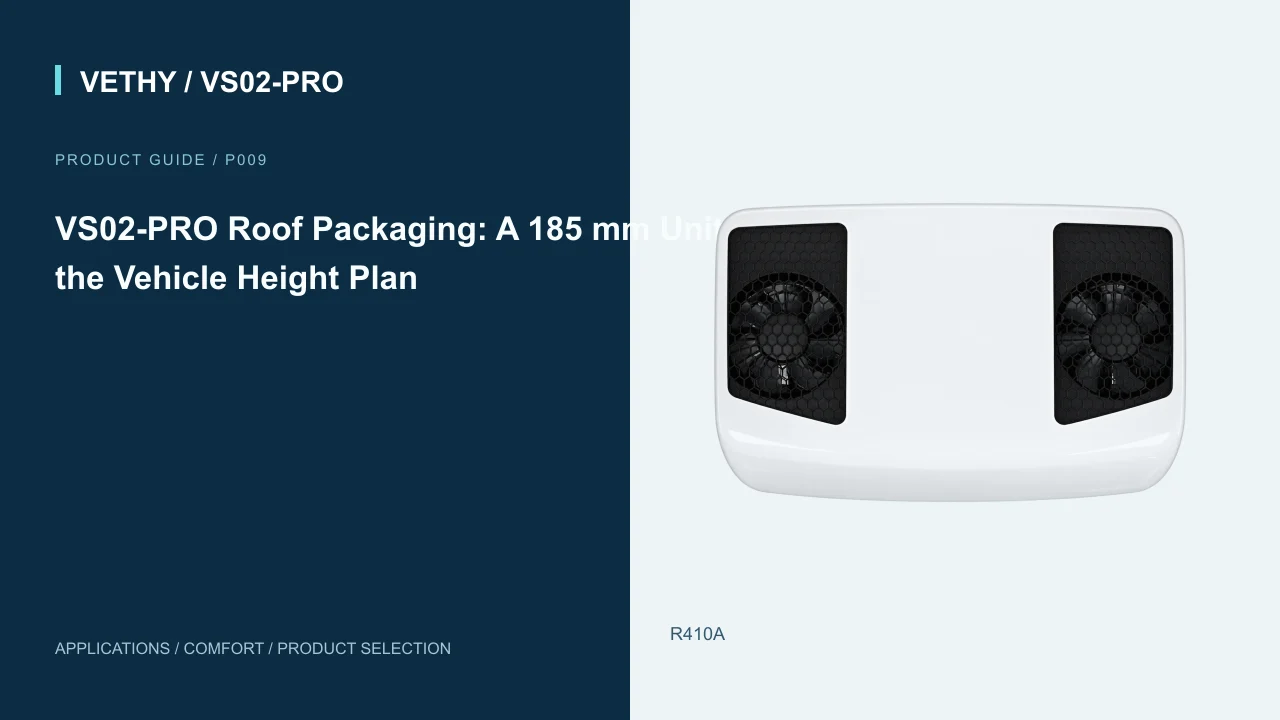
VS02-PRO belongs on a rooftop parking AC shortlist when the vehicle project benefits from a clearly defined 185 mm outdoor assembly height and an integrated roof layout. Its published outdoor dimensions are 980 × 680 × 185 mm. That gives buyers a concrete package to place in the roof plan, alongside the product's R410A Rechi twin-cylinder rotary system and its 12V or 24V cooling versions.
The practical advantage is early clarity. A bodybuilder, fleet engineer or installer can discuss where the assembly sits, what surrounds it and how the interior relates to the bunk. The enclosure measurements help make that discussion specific. The applicable installation drawing then supplies the mounting, opening, support and sealing details needed for the actual truck.
This guide concentrates on the vehicle-height and packaging decision. It explains how to use the 185 mm reference accurately, how to keep indoor dimensions in context and how to present VS02-PRO as a complete roof package that is attractive to buy and realistic to install.
1. Use 185 mm as a product dimension
The documented outdoor height is 185 mm. Retain that value consistently in the quotation, layout and customer explanation. An older or visually estimated dimension should not replace the current specification simply because the housing appears shallow in a photograph. Clear product identification begins with using the current published reference.
The number describes the outdoor assembly, not the completed vehicle's additional height in every installation. Roof curvature, mounting arrangement and the chosen location affect the final result. The installer must assess the actual truck and apply the relevant requirements. This distinction lets the buyer use the dimension confidently without turning it into a universal installed-height promise.
The benefit is a more precise first conversation. A customer concerned about roof space can see a defined enclosure and compare it with the vehicle's available area. The installation team can then explain what additional information is needed to turn that initial fit into a complete plan.
For distributors, keep the same dimension on product cards and technical enquiries. Consistency reduces confusion when a customer moves between a catalogue, a quotation and a workshop discussion. VS02-PRO's defined package is a useful selling point when its measurements travel accurately through the whole buying process.
2. Build the complete vehicle height picture
A roof-mounted air conditioner becomes part of the truck's overall height arrangement. The vehicle may already have roof equipment, a shaped cab roof or a body that extends above another point. The relevant assessment is the complete vehicle with the proposed installation, rather than adding a product number to an assumed base height without inspection.
Start with the actual vehicle and intended mounting location. The installer can review how the assembly will sit and identify the appropriate way to confirm the completed height. The buyer should understand that the published 185 mm reference is useful input to that assessment, while the final vehicle measurement remains a separate result.
This matters for everyday use because drivers navigate a working route with many physical constraints. The product recommendation should support an informed height record for the actual truck. Avoid making legal or route-access claims from the AC specification alone; those questions require the relevant vehicle and operating information.
The commercial advantage is a reviewable proposal. The customer can see how VS02-PRO fits within the vehicle plan before installation begins. That is more useful than a broad claim that the unit is low enough for all trucks, and it gives the driver a clearer understanding of the finished vehicle at handover.
3. Place the full footprint on the roof plan
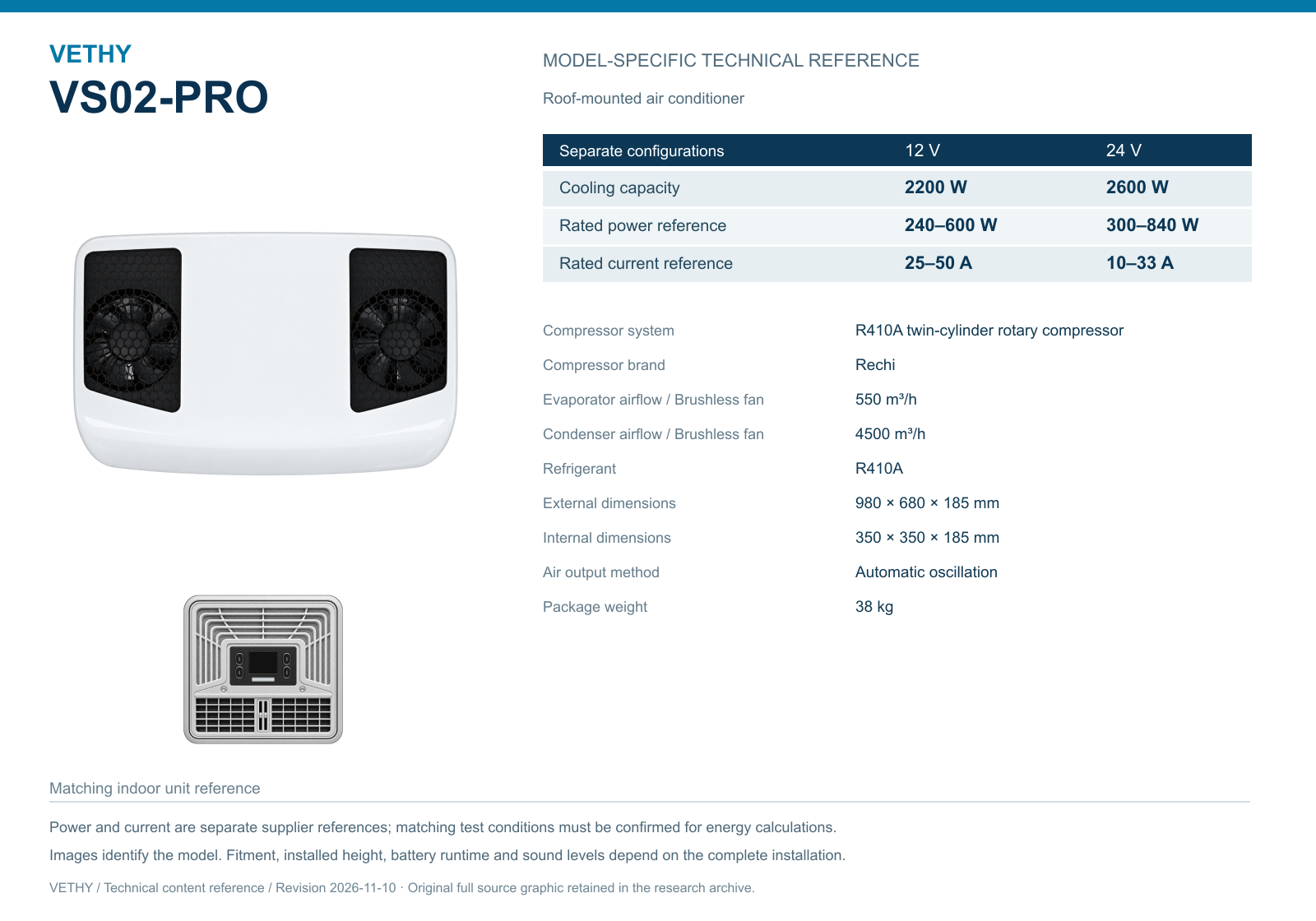
The outdoor footprint is defined by the 980 × 680 mm dimensions, with the third dimension identifying the 185 mm height. Those measurements provide a starting outline for the roof survey. The useful installation envelope also includes the relevant air access, mounting and service areas specified for the actual product configuration.
A roof that appears large in a photograph may contain a hatch, antenna base or other feature in the intended location. Put those items on the same plan before deciding where the AC belongs. This helps the installer discuss the package as part of the vehicle rather than discover conflicts after the customer has formed a fixed expectation.
VS02-PRO's integrated rooftop arrangement can be attractive when the buyer wants to concentrate the cooling hardware above the cab. Other exterior areas can remain available for vehicle equipment, subject to the complete design. That benefit is strongest when the roof can provide a suitable location and the indoor assembly can serve the occupied space below.
The plan should therefore connect exterior and interior views. A location that looks convenient outside may sit poorly relative to the bunk or curtain inside. Reviewing both views together helps the customer choose a practical package and gives the product's compact dimensions a real application instead of treating them as a stand-alone sales claim.
4. Keep indoor dimensions complete and accurate
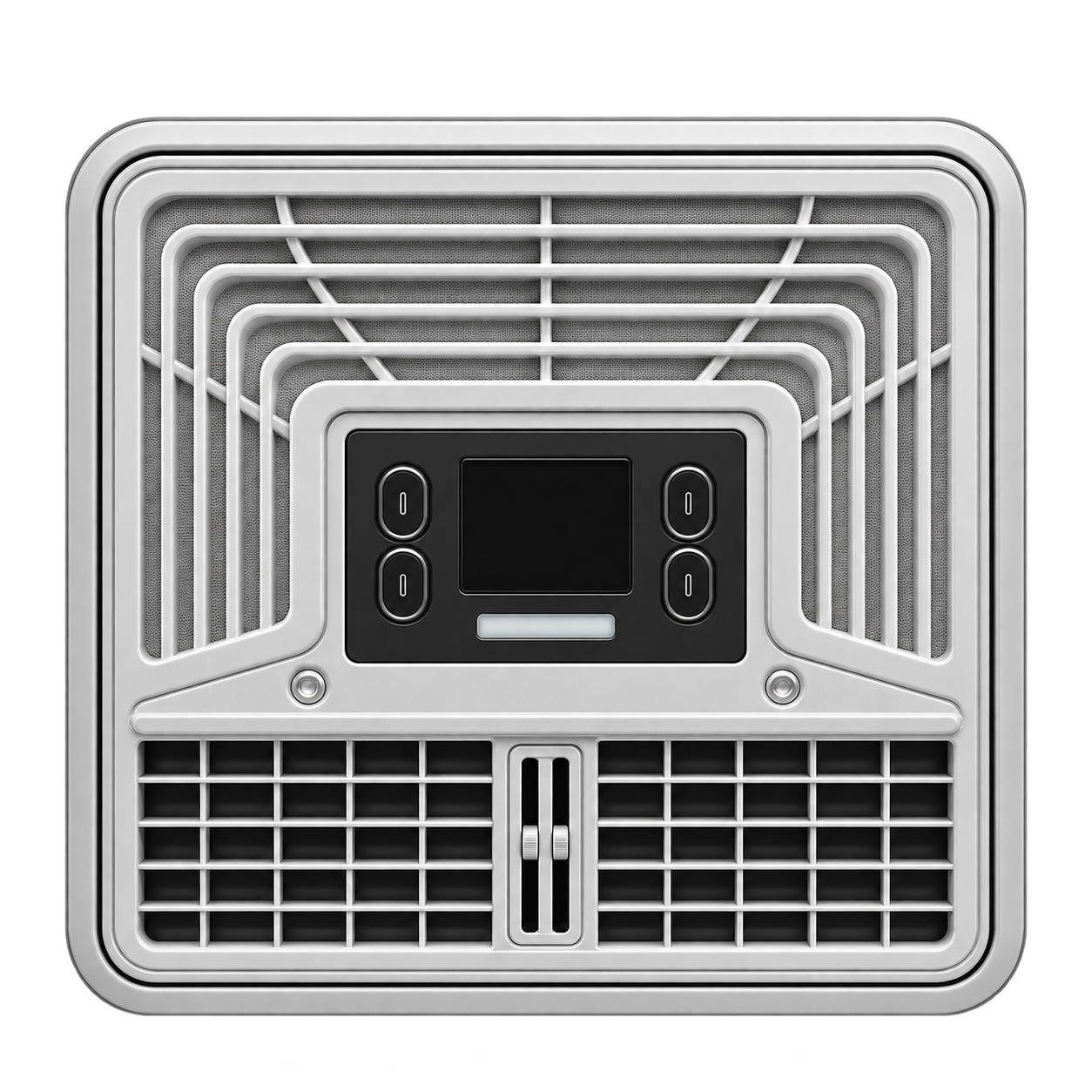
The VS02-PRO indoor dimensions are listed as 350 × 350 × 185 mm. Present all three numbers together. The source does not establish that the final dimension is the visible faceplate thickness, so do not place that label on a photograph or infer that the photographed panel projects by that exact amount.
The indoor reference is useful for discussing the assembly within the cab and identifying space questions for the installer. The applicable drawing should establish the actual fit and relationship to the roof structure and trim. A product photograph can show appearance, while the drawing provides the installation detail needed for a specific vehicle.
For the driver, the indoor location affects daily comfort and use of the bunk. Consider head position, bedding, storage and curtain movement. The installation should feel deliberate in the occupied space and allow access for the tasks described in the supplied instructions. That is part of the practical value of a complete rooftop package.
A distributor can make this clear by showing the real indoor image beside the full dimensions, with a caption that identifies the assembly rather than inventing panel geometry. This keeps the product presentation accurate and helps the customer ask the right follow-up question about the actual cab fit.
5. Separate package weight from installed structural load
The supplied VS02-PRO information lists a package weight of 38 kg. That figure belongs in shipping and package discussion as labelled. It should not be relabelled as the bare outdoor unit weight or used without clarification as the exact installed roof load. The complete structural assessment needs the relevant installed-component information.
A fleet engineer or bodybuilder should obtain the applicable mounting and support requirements for the proposed installation. Roof shape, reinforcement and attachment details are vehicle-specific matters. The enclosure dimensions and package weight help begin the discussion, but they do not replace the engineering needed to approve the actual arrangement.
This accurate distinction benefits the buyer. It prevents a convenient shipping figure from becoming an unsupported structural assumption and gives the installer a clear request for the information that matters. The product can still be recommended confidently while the vehicle integration details are being completed.
In a quotation, keep product supply and installation scope understandable. If the offer includes engineering or mounting work, describe the actual scope. A customer should be able to see that VS02-PRO is the selected cooling product and that the roof installation is being developed around the correct requirements for the truck.
6. Reserve air access beside physical space
VS02-PRO lists 4500 m³/h condenser airflow with brushless airflow. The outdoor layout must preserve the relevant intake and discharge access according to the supplied installation information. Fitting the enclosure between accessories is only one part of packaging; the outdoor section also needs an arrangement that supports its task.
This is especially relevant when the roof carries solar equipment, antennas or other hardware. Review those items with the AC location visible. A tidy plan can still be impractical if it crowds an important air path or prevents service access. The correct requirements should come from the applicable product information rather than an invented universal gap.
The standard condenser is aluminum microchannel, with a copper condenser optional. The evaporator and piping are copper. Whichever condenser is selected, the package should be recorded clearly and given suitable roof access. Material preference does not remove the need for a thoughtful arrangement.
The buyer benefit is a roof installation that can remain useful as the truck works. The condenser airflow guide explains the outdoor subject in greater depth. Here, the key packaging principle is to allocate space for the product's work and service, not just its visible outline.
7. Connect roof position to the driver's air path
The indoor airflow reference is 550 m³/h with a brushless fan, and automatic oscillation is documented. These features become more useful when the roof position allows the indoor assembly to serve the occupied seat and bunk. Packaging should therefore include an air-distribution view, not only a top-down drawing of exterior equipment.
Show the normal curtain position and the driver's resting location. A panel on the wrong side of a closed curtain may not serve the intended zone effectively. A storage arrangement near the return area can also change circulation. These are practical interior questions that can often be identified during a straightforward cab review.
The advantage of planning early is that the buyer can compare feasible locations before the installation is fixed. The installer can explain which position best supports the intended duty within the product requirements. This turns the VS02-PRO roof package into a comfort recommendation rather than a choice made solely because one patch of roof appears empty.
A demonstration should then use the selected interior arrangement with normal bedding present. The customer can assess the stream from the seat and pillow positions. The documented automatic oscillation becomes a visible feature serving an understood need, which is a stronger sales case than a generic promise that air will reach everywhere.
8. Include sealing and service in the layout discussion
A roof installation must follow the applicable sealing and fastening requirements for the product and vehicle. The published VS02-PRO dimensions do not define a universal roof opening or sealing method. Ask for the correct installation information and apply it to the actual roof rather than copying a visually similar truck without review.
Service access should be considered at the same time. The installer needs a realistic way to perform the tasks described in the supplied instructions. Nearby accessories and interior trim can affect that access. A layout that is convenient to fit but awkward to maintain can reduce the practical value of an otherwise suitable product choice.
For a bodybuilder, this is an opportunity to make the complete installation feel integrated. The outdoor unit, interior assembly and service approach can be designed together as part of the vehicle's working environment. The result is easier to explain to the customer and easier to preserve when the truck later changes hands.
For an owner-driver, the benefit is a more complete installed offer. The buyer can see that the supplier and workshop have considered the roof connection and future access, rather than leaving those decisions until fitting day. VS02-PRO's clear dimensions support the discussion while the applicable drawing makes the details buildable.
9. Keep the electrical version in the packaging record
VS02-PRO is offered with a 2200 W cooling reference at 12V and 2600 W at 24V. The selected version should appear with the roof layout and product identification. This helps the electrical installer and workshop work from the same configuration and prevents a roof plan from becoming detached from the actual supplied unit.
The manufacturer rated power references are 240–600 W and 300–840 W respectively. Current is separately listed as 25–50 A for 12V and 10–33 A for 24V. These fields do not share a documented common condition for every endpoint, so they should not be combined to invent efficiency or battery endurance.
The supply route belongs in the complete layout discussion. The electrical specialist should define protection, routing and connections for the actual installation using the relevant requirements. A neat indoor finish and attractive roof location are only part of the package; the unit also needs a suitable engineered supply.
The VS02-PRO product page provides the core model reference. Keep that identification consistent across the roof survey, quotation and installed record so everyone involved understands which configuration is being planned and later supported.
10. Compare two hypothetical roof situations
Consider a truck with a relatively open roof area above the sleeper. VS02-PRO's published enclosure can be placed on the survey plan, then reviewed against the required opening, mounting and air access. The indoor assembly can be considered near the occupied zone, with the curtain and bunk visible during the review.
Now consider another truck whose roof already carries several accessories. The same product may still be a candidate, but the layout question is different. The installer must coordinate equipment positions and service access, and the most visually obvious location may not be the best complete arrangement. The product's dimensions make that discussion concrete rather than speculative.
| Packaging question | Open-roof example | Crowded-roof example |
|---|---|---|
| Enclosure placement | Establish a suitable initial location | Compare available locations with existing equipment |
| Air access | Preserve the required surrounding path | Coordinate nearby accessories with the AC |
| Indoor relationship | Align with the occupied sleeper zone | Check whether the feasible roof position still serves the bunk |
| Service | Plan access from the beginning | Avoid trapping the unit among other equipment |
| Final vehicle height | Assess the actual completed arrangement | Assess the complete roof with all equipment present |
These examples are planning scenarios, not claims about compatibility with a particular truck model. They show why VS02-PRO's defined package is useful while the actual vehicle remains central to the decision.
A bodybuilder can use these scenarios to explain why the same enclosure may lead to different integration work. The VS02-PRO model remains a constant, while the roof and interior determine the installation detail. This is useful to a buyer comparing complete offers: a more involved roof arrangement may reflect genuine vehicle work rather than a different cooling product. State that work plainly in the proposal. The customer can then assess the package on a consistent basis and understand how the selected location supports comfort, access and the vehicle's overall equipment plan.
11. Make the customer presentation easy to review
Use the actual VS02-PRO outdoor and indoor images with the technical reference sheet. Show the current dimensions and identify the selected voltage and condenser configuration. The buyer should be able to connect the proposed roof location to the same product shown in the quotation, rather than compare several similar housings without clear model names.
A useful presentation can include one exterior view and one interior view of the intended arrangement. The exterior view addresses packaging and equipment relationships. The interior view addresses comfort and daily use. This pair gives the customer a more complete understanding of why the model is being recommended for the truck.
Avoid filling the presentation with unsupported claims about universal fit, precise sound or a guaranteed parking duration. The actual benefits are already practical: a defined rooftop package, named compressor architecture, documented airflow and a layout that can be planned around the occupied cab. Those features deserve clear explanation in their own right.
The VS02-PRO guide hub provides focused follow-up reading for buyers who want more detail. The main quotation can remain concise while linking to relevant packaging and airflow explanations, making it easier for both technical and nontechnical readers to follow the recommendation.
12. Preserve the layout after installation
At handover, retain the installed product identification, selected voltage, condenser choice and relevant roof photographs. Record the completed vehicle height through the appropriate vehicle process rather than treating the product height as the final result. This gives the driver and later workshops a useful reference for the actual truck.
If equipment is added later, review the roof arrangement and indoor air path as appropriate. A new accessory can affect access even if it does not touch the AC. A revised sleeper layout can change how the indoor assembly serves the bunk. The original record makes those changes easier to understand.
Care and service should follow the supplied guidance and the actual operating environment. The product's compact package does not eliminate ordinary attention to air paths, mounting and the surrounding vehicle arrangement. A clear record supports that work without asking the owner to guess internal construction or diagnose every change alone.
This is where the packaging benefit continues beyond the sale. VS02-PRO can remain a recognizable, maintainable part of the truck, with a defined location and configuration. The buyer receives a product recommendation that has been carried through into a usable vehicle arrangement rather than ending at the enclosure dimensions.
13. Questions about the 185 mm roof package
Is 185 mm the final increase in vehicle height?
It is the published outdoor assembly height. The completed vehicle arrangement depends on roof geometry and mounting details, so the actual installed height should be assessed on the truck. Keep the product dimension and final vehicle result separate in the record.
Does the enclosure dimension establish the roof opening?
No. The correct opening, support, mounting and sealing details require the applicable installation information. Use 980 × 680 × 185 mm for product packaging discussion, then apply the relevant drawing to the actual vehicle.
Is the indoor panel visibly 185 mm thick?
The supplied indoor dimensions are 350 × 350 × 185 mm for the assembly. The source does not confirm the last number as visible faceplate thickness. Present the complete dimensions and use the installation drawing for the actual interior fit.
Can 38 kg be quoted as the installed roof load?
The source labels 38 kg as package weight. Do not relabel it as the exact installed load. Obtain the relevant component and mounting information for the vehicle's structural assessment and keep the shipping reference correctly identified.
Put the defined package into a real vehicle plan
Recommend VS02-PRO when its 980 × 680 × 185 mm outdoor package can be integrated with the truck's roof, air paths and occupied interior. Its dimensions give the buyer a clear starting point, while the actual installation information completes the fit. Send roof and sleeper photographs, vehicle voltage and equipment positions through the technical enquiry form for a configuration-specific proposal built around the truck.
Product sources
- VETHY VS02-PRO current manufacturer specifications — VETHY.
- VS02-PRO technical reference sheet — VETHY.
VETHY product recommendation and application analysis. Specification references identify the selected model and voltage. Installation examples are planning examples; measured project results are identified explicitly when available.
Discuss your VS02-PRO application
Send your vehicle, supply voltage, occupied space, parking schedule and installation photographs for a model-specific recommendation.
Prepare your vehicle brief ↗