
VETHY / VS02-PRO / PRODUCT AND APPLICATION GUIDE
Why Put VS02-PRO on Your R410A Rooftop Parking AC Shortlist?
VS02-PRO is worth shortlisting when a vehicle needs an R410A rooftop parking air conditioner with Rechi twin-cylinder rotary architecture and practical air distribution. Select the correct 12V or 24V version, confirm roof and electrical fit, and plan the occupied cab around its brushless airflow and automatic oscillation.
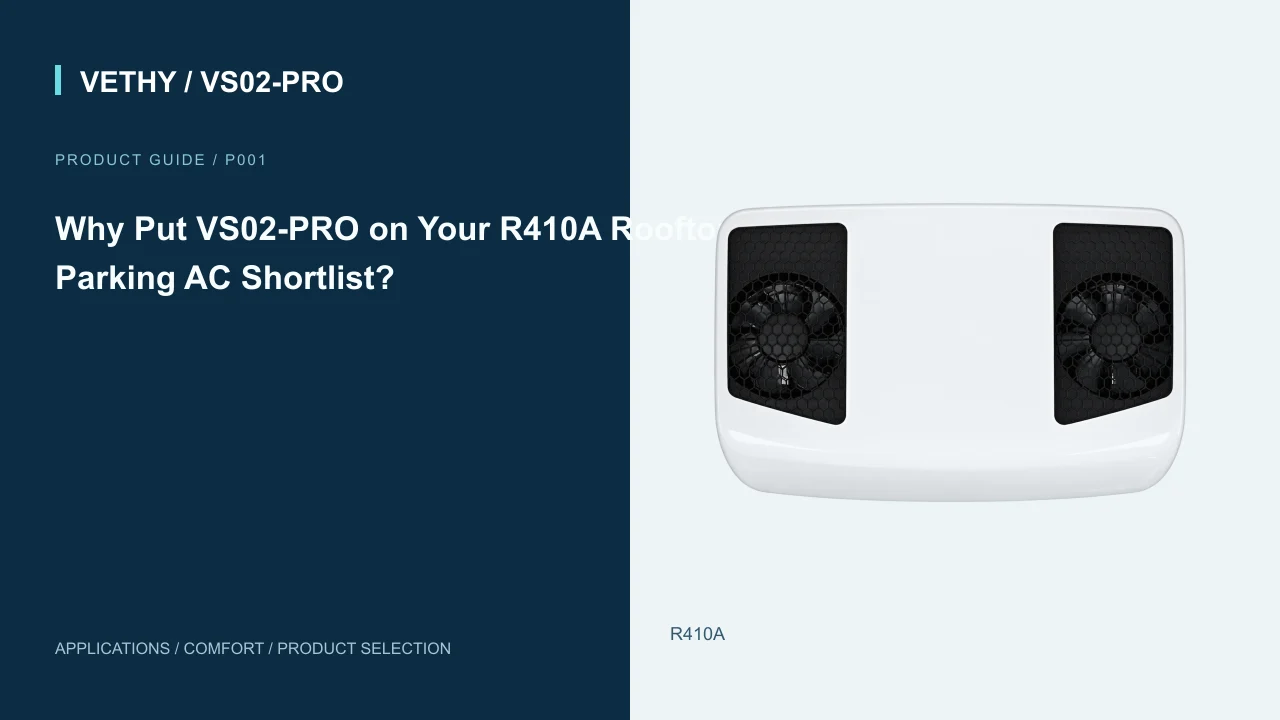
VS02-PRO deserves a place on an R410A rooftop parking air conditioner shortlist when a buyer wants an integrated roof layout, a Rechi twin-cylinder rotary compressor system, useful cab airflow and a clear choice between 12V and 24V versions. Its strongest sales case is practical: bring cooling close to the occupied sleeper space while keeping the product package understandable for the installer and owner.
The recommendation becomes especially useful for a sleeper truck whose roof can accept the assembly and whose auxiliary power system can support the selected version. A compact product does not remove the need for engineering, but it gives that engineering a defined starting point. The published VS02-PRO references include cooling capacity, airflow, dimensions and heat exchanger materials, allowing a buyer to discuss the actual installation rather than a broad promise about comfort.
1. Start with the driver's parked working day
A parking air conditioner serves a different moment from the vehicle's driving air conditioner. The driver may finish a delivery, wait at a warehouse, take a meal break or prepare the bunk for rest. During these periods, cab comfort depends on the parked surroundings, solar exposure, stored heat and the time the driver expects to remain inside. Selecting around those moments makes the VS02-PRO proposal more persuasive than simply choosing the largest cooling number.
Consider a regional truck that parks after an afternoon route. The driver initially sits near the front seats, then closes the sleeper curtain and uses the bunk. Those are two occupied zones and two stages of demand. A roof installation with a carefully located indoor outlet can support both stages, provided the air path remains open. Automatic oscillation gives the installer and driver a useful distribution feature to discuss when deciding where the air should travel.
The product is therefore a good candidate when the purchasing brief describes a real cab and a real parking pattern. A distributor can connect the hardware to a driver's routine, while a fleet engineer can connect it to roof space and electrical supply. That shared picture helps prevent a capacity figure from becoming an unsupported promise of universal suitability.
2. Know which VS02-PRO version you are recommending
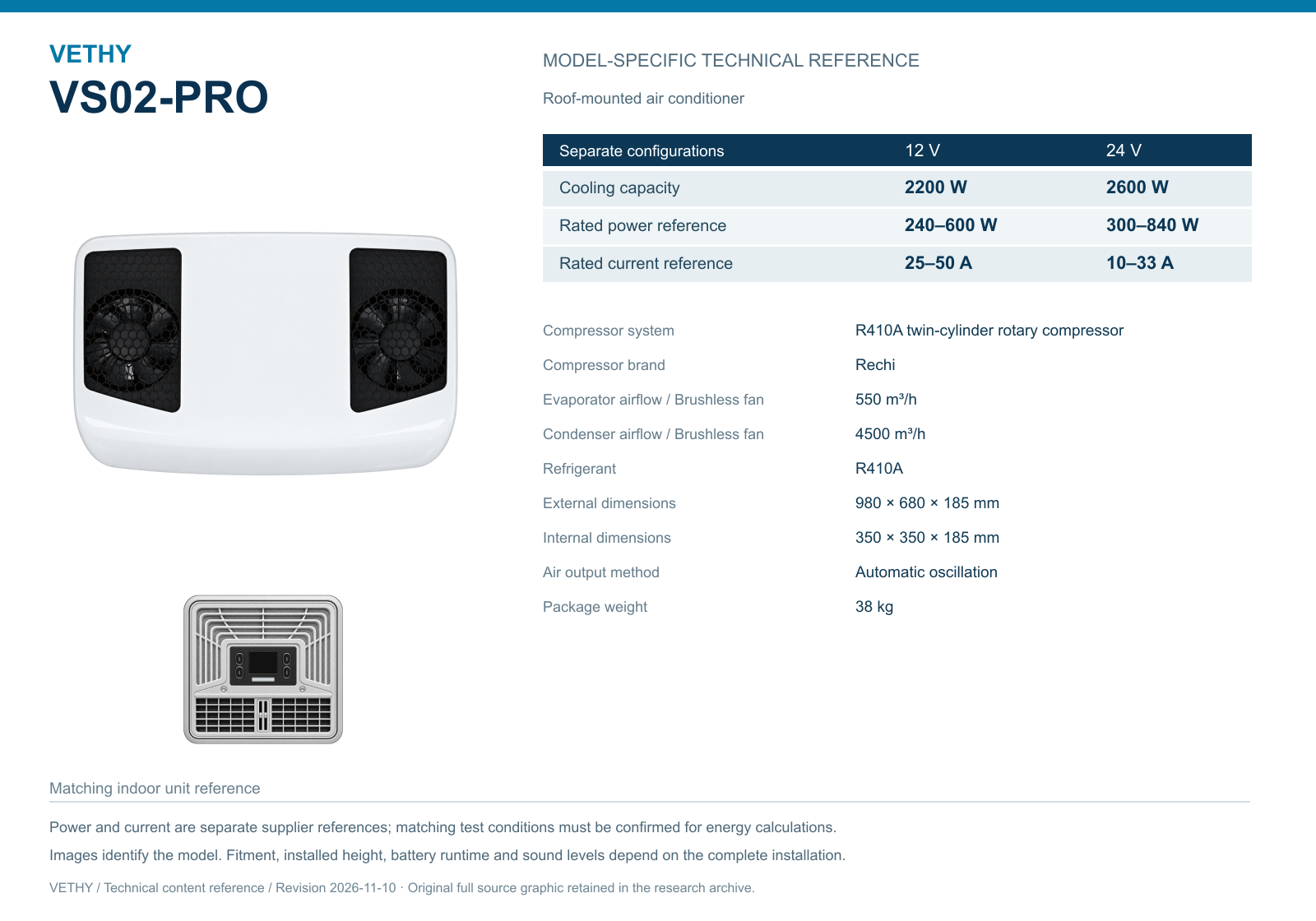
The 12V and 24V versions have different manufacturer cooling references. Treat them as distinct selections within one product family, then match the electrical version to the vehicle project. The following values come from the current VS02-PRO product information.
| Selection item | 12V VS02-PRO | 24V VS02-PRO | Buying implication |
|---|---|---|---|
| Cooling capacity reference | 2200 W; supplied graphic also lists 7500 BTU | 2600 W; supplied graphic also lists 9000 BTU | Evaluate the chosen version against the cab load |
| Manufacturer rated power reference | 240–600 W | 300–840 W | Use as a labelled reference for further electrical planning |
| Manufacturer rated current reference | 25–50 A | 10–33 A | Confirm the design condition and complete supply requirements |
| Refrigerant and compressor | R410A, Rechi twin-cylinder rotary | R410A, Rechi twin-cylinder rotary | Keep component identification consistent in the order |
| Evaporator airflow reference | 550 m³/h | 550 m³/h | Plan a clear indoor circulation path |
| Condenser airflow reference | 4500 m³/h | 4500 m³/h | Preserve outdoor intake and discharge access |
The power and current fields remain separate manufacturer references. Their endpoints are not a matched operating data set, so a buyer should not combine convenient values to advertise efficiency or battery endurance. That distinction strengthens a professional proposal: it presents useful facts without allowing an attractive calculation to outrun the source information.
A useful selection meeting can keep the two voltage columns visible beside photographs of the vehicle. When the electrical installer says that a particular truck has a 24V supply arrangement, the team can immediately stay within that version's data. This small discipline prevents a common sales error: quoting the more appealing cooling reference while showing a different voltage on the order. It also makes later comparison fairer, because each candidate can be considered as an actual configuration with its own requirements rather than as a collection of unrelated best numbers.
3. Why the Rechi twin-cylinder rotary package matters
The compressor system is a clear product identifier: VS02-PRO uses an R410A twin-cylinder rotary compressor from Rechi. This lets a buyer ask a specific component question and receive a specific answer. It also distinguishes the product from a generic rooftop unit whose compressor brand and architecture are left unstated. For importers building a defined product range, that clarity has commercial value.
Twin-cylinder rotary architecture is relevant to a discussion about smooth operation and calm cab comfort. The finished experience still depends on the whole assembly, mounting, fans, roof structure and operating condition. The architecture should therefore be presented as part of the product's comfort approach, with the installation completing the result. It is not evidence of a particular sound level at the driver's pillow.
A useful demonstration explains the chain in plain language. The compressor supports the refrigerant circuit; the indoor assembly moves cooled air into the occupied cab; the outdoor section rejects heat; and the roof connection carries the assembly. The buyer can then evaluate a coherent product package. There is no need to substitute an invented decibel figure or a claimed percentage saving for that clear, credible explanation.
4. Put the R410A specification in its proper role
For a customer seeking an R410A product, VS02-PRO provides a defined refrigerant choice. The advantage is straightforward product alignment: the quotation, service planning and supplied documentation can all name the same refrigerant and compressor system. That is useful when a distributor wants an R410A rooftop offering or an engineering team has specified that refrigerant family for its procurement brief.
Refrigerant identity alone does not establish total system efficiency, comfort speed or suitability for every climate. Those outcomes depend on the complete unit and the installation. VS02-PRO should be recommended because its full combination fits the project: the chosen capacity reference, roof dimensions, airflow, materials and electrical arrangement. R410A is one important part of that combination.
The service consequence is also concrete. A technician needs the correct product documentation and appropriate procedures for this exact circuit. A buyer should avoid suggesting that this model can be converted from another refrigerant merely because both products cool a vehicle. Keeping the supplied configuration intact makes the order easier to explain and gives the service team an accurate starting point when the vehicle arrives.
5. Use the rooftop layout to simplify the space discussion
The VS02-PRO outdoor dimensions are 980 × 680 × 185 mm. These are useful packaging references for an overhead installation, particularly when roof space must be shared with a hatch, antenna or other equipment. The 185 mm dimension describes the outdoor assembly's published height; the completed vehicle height also includes the actual mounting arrangement and existing roof geometry.
A rooftop proposal makes sense when the vehicle design can provide a suitable mounting area and an effective indoor connection. Cooling hardware sits above the cab, leaving other exterior locations available for vehicle equipment. The benefit is a more focused layout discussion: the installer can work around one roof location rather than first finding a remote outdoor-unit position and routing a separate split-system arrangement.
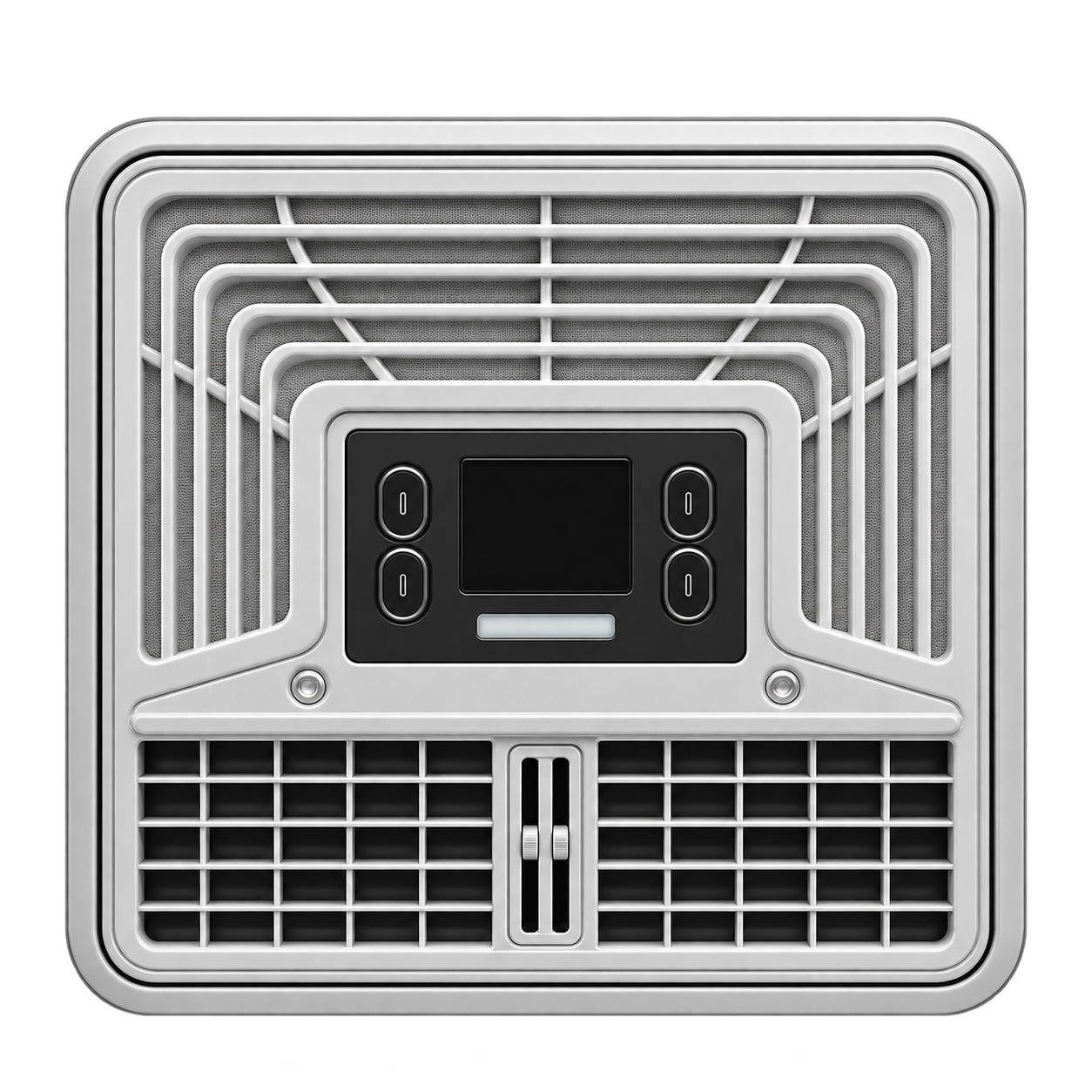
The indoor dimensions are listed as 350 × 350 × 185 mm. Keep all three dimensions together without describing the final number as the visible faceplate thickness. Roof opening size, clamp details, reinforcement and sealing still need the installation drawing for the actual order. The published enclosure dimensions are valuable for early screening, while the project drawing turns an attractive roof concept into a buildable fit.
6. Make airflow a selling point the driver can understand
VS02-PRO lists 550 m³/h evaporator airflow with a brushless fan and automatic oscillation. For the customer, the important result is the ability to direct cooling through the occupied cab rather than leaving a cold pocket near the panel. The airflow number gives context, while outlet direction and an open return path determine how useful that movement becomes inside a particular sleeper.
A practical display should include the bunk, curtain and normal luggage positions. Air that travels freely across an empty demonstration cab may meet a hanging jacket or curtain during a real shift. Showing how automatic oscillation distributes the stream helps the buyer picture daily use. It also encourages a comfortable approach in which the driver is not required to keep a concentrated cold jet aimed at the face.
The outdoor airflow deserves equal attention. A 4500 m³/h condenser airflow reference supports the product's heat-rejection discussion, but the installation must leave that path clear. Roof-mounted accessories should be considered with the AC in place, not added later without checking their effect on air access. Good airflow planning turns a published specification into a benefit the driver can keep using after the vehicle leaves the workshop.
Air delivery also offers a benefit during short daytime waits. A driver sitting upright may prefer the stream to move through the seating area, while a reclining driver may want it to pass across the bunk without blowing directly onto the pillow. The sales discussion can show both positions using the same real cab. This makes automatic oscillation tangible, demonstrates the importance of panel location and helps the customer explain comfort preferences before the installation is fixed. It is a particularly useful way to compare two possible roof locations without making either location a universal recommendation.
7. Explain the material package accurately
The standard VS02-PRO material description includes a copper evaporator, copper piping and an aluminum microchannel condenser. A copper condenser is optional. This is a useful choice for buyers who have a defined heat exchanger preference, because the quotation can distinguish the standard configuration from the requested alternative before an order is placed.
Copper evaporator and piping details give the purchasing team tangible component information. The standard microchannel condenser provides a specific outdoor heat exchanger arrangement to evaluate as part of the complete unit. Neither statement needs to become an exaggerated claim that every part is copper or that one material automatically wins in all conditions. The relevant benefit is transparent product selection with a clearly stated option.
For example, a distributor may want to stock the standard configuration for its regular installation program while requesting a separate copper-condenser quotation for a particular customer. Keeping those configurations separate avoids confusion in photographs, spare-part discussions and order records. The salesperson can confidently describe what is supplied, and the customer can decide whether the optional change matters for the intended vehicle and support arrangement.
8. Build energy-conscious comfort around the whole cab
An energy-conscious VS02-PRO installation begins with reducing unnecessary heat gain and delivering cooling where it is useful. Window shading, sound cab insulation, closed doors and a sensible occupied zone can all reduce the work the cooling system is asked to do. These are practical project choices, not a promised percentage improvement attached to the product name.
The transition from a sun-heated cab to evening rest is especially important. At first, hot interior surfaces continue to influence comfort even as the moving air becomes cooler. Later, with lower solar exposure and fewer door openings, the cabin may need less cooling. A useful operating plan recognizes those changing conditions rather than treating the complete parking session as one fixed electrical load.
Variable-output and inverter concepts can be discussed with the supplier as part of the complete control specification. The supplied VS02-PRO data do not establish a particular speed band, control algorithm or energy-saving percentage. Recommend the product on its documented package, then confirm the requested control behavior for the ordered configuration. That approach lets the buyer pursue efficient, calm comfort without depending on an undocumented electronic feature.
9. Present quiet comfort as an installation outcome
Drivers care about sound because the unit is operating near their rest space. VS02-PRO offers a twin-cylinder rotary compressor system and brushless airflow components worth including in a comfort discussion. A useful recommendation then follows through with roof support, secure trim, correct mounting and unobstructed air paths. Those details influence how the finished cab feels and sounds.
A demonstration should be heard from the normal sleeping position as well as from the doorway. The difference matters because the driver's head may be close to the indoor panel or directly beneath a roof section. Loose personal items, curtains touching trim and poorly secured interior parts can distract from an otherwise well-planned installation. Resolving those details is part of delivering a professional product experience.
There is no verified product sound figure in the supplied specification set. A distributor should therefore avoid promises such as a particular decibel level or guaranteed silence. The stronger message is that VS02-PRO belongs in a deliberate calm-comfort package, with airflow direction and installation quality considered alongside the compressor architecture. An honest live demonstration can make that package more convincing than an unsupported sound badge.
Ask the customer to bring the ordinary items that travel in the sleeper when attending a demonstration. Bedding, storage bags and a curtain can change both circulation and the character of the room. A calm experience depends on living with the installation, so a few minutes in the normal resting position can be more revealing than standing beside the truck while the unit runs. Record the configuration and surroundings if sound observations are shared later. This preserves the value of the demonstration without turning a personal impression into a laboratory result or a claim about every vehicle.
10. Match the recommendation to the buyer's role
An owner-driver usually needs a clear answer about fit, comfort and the complete installed package. A fleet buyer also needs repeatable installation records and an operating plan that different drivers can understand. A distributor needs accurate product identification, matching images and a support process. VS02-PRO can serve all three audiences when the proposal changes emphasis without changing the underlying facts.
For the owner-driver, show how the roof position serves the bunk and what information is needed for the electrical survey. For the fleet, define a pilot vehicle and capture the installation layout so that later vehicles can be reviewed efficiently. For the distributor, present the standard condenser configuration and optional copper alternative as separate line items, using the actual VS02-PRO indoor and outdoor photographs.
The truck applications page helps place the product in its intended vehicle context, while the VS02-PRO guide collection provides more focused reading. These links should support the purchase conversation rather than send the reader through unrelated models. A focused path from application to product to installation brief makes it easier for a serious buyer to take the next step.
11. A short scenario that makes the value concrete
Imagine a small fleet adding parking cooling to several similar sleeper trucks. The first truck has a suitable roof zone, a defined auxiliary power system and a driver who mostly rests after late afternoon deliveries. VS02-PRO is a sensible pilot candidate because the team can evaluate a complete rooftop package with named compressor architecture, useful air distribution and two voltage versions to match its vehicle groups.
The pilot should answer a practical business question: does this configured installation create the comfort the drivers need during their actual parking pattern? Record the cab layout, selected version, condenser configuration and relevant surroundings. Observe how the air reaches the bunk and how the roof assembly fits the vehicle. The results belong to that installation and those conditions; they do not become universal product claims.
A positive result gives the fleet a concrete basis for ordering the next vehicles. It can repeat the successful roof and air-path arrangement while checking differences in voltage, trim and accessories. This is where the product's clear specification becomes commercially valuable. The fleet is buying a repeatable comfort package with a known model at its center, supported by an installation record that can travel with each truck.
12. Questions buyers ask before shortlisting VS02-PRO
Is VS02-PRO a good choice when I specifically want R410A?
Yes, it is a relevant candidate because the current manufacturer specification identifies R410A and a Rechi twin-cylinder rotary compressor system. The final choice should also match roof space, electrical version, cabin load and operating pattern. Refrigerant identity is a useful selection criterion, while the complete product package determines whether it fits your particular vehicle project.
Does the 24V version simply use the same cooling reference as 12V?
No. The supplied reference is 2200 W for 12V and 2600 W for 24V. The associated power and current references also differ. Quote the chosen version explicitly so the electrical installer, vehicle owner and purchasing team work from the same selection rather than assuming all figures apply to both versions.
Is the standard unit an all-copper system?
The documented standard arrangement has a copper evaporator and copper piping with an aluminum microchannel condenser. A copper condenser is optional. Ask for the requested condenser configuration to appear on the quotation and order so that the delivered product matches the customer's material preference and the distributor's support record.
Can the published specifications prove overnight battery runtime?
They provide a starting point for power planning, but they do not establish a guaranteed parking duration. Usable battery energy, other loads, cab heat gain and actual operating demand must be considered together. A measured trial of the complete installation is more useful than deriving a universal overnight promise from unrelated reference endpoints.
The quotation should also state what belongs to the proposed package. The model, voltage version and condenser selection are central product details; installation work and auxiliary power equipment should be described according to the actual offer. A clear package helps the customer compare complete proposals and gives the supplier a firm basis for answering follow-up questions. It also supports a smoother handover, because the driver's comfort expectations have been discussed alongside the hardware rather than left until the truck is ready for collection.
Choose a defined rooftop comfort package
Shortlist VS02-PRO when an R410A rooftop unit with Rechi twin-cylinder rotary architecture, brushless airflow, automatic oscillation and a clear condenser choice fits the project. Its value is strongest when the roof, power supply and occupied cab are planned together. Send the vehicle model, electrical voltage, roof photographs and expected parking schedule through the technical enquiry form so VETHY can develop a configuration-specific recommendation and quotation.
Product sources
- VETHY VS02-PRO current manufacturer specifications — VETHY.
- VS02-PRO technical reference sheet — VETHY.
VETHY product recommendation and application analysis. Specification references identify the selected model and voltage. Installation examples are planning examples; measured project results are identified explicitly when available.
Discuss your VS02-PRO application
Send your vehicle, supply voltage, occupied space, parking schedule and installation photographs for a model-specific recommendation.
Prepare your vehicle brief ↗