
VETHY / VS02-PRO / PRODUCT AND APPLICATION GUIDE
Keeping VS02-PRO Condenser Airflow Clear in a Working Truck
VS02-PRO lists 4500 m³/h condenser airflow and a standard aluminum microchannel condenser, with copper optional. Plan the working roof around the actual intake, discharge and service requirements, including nearby accessories. A clear outdoor arrangement supports the complete rooftop cooling package and helps preserve its usefulness as the vehicle changes.
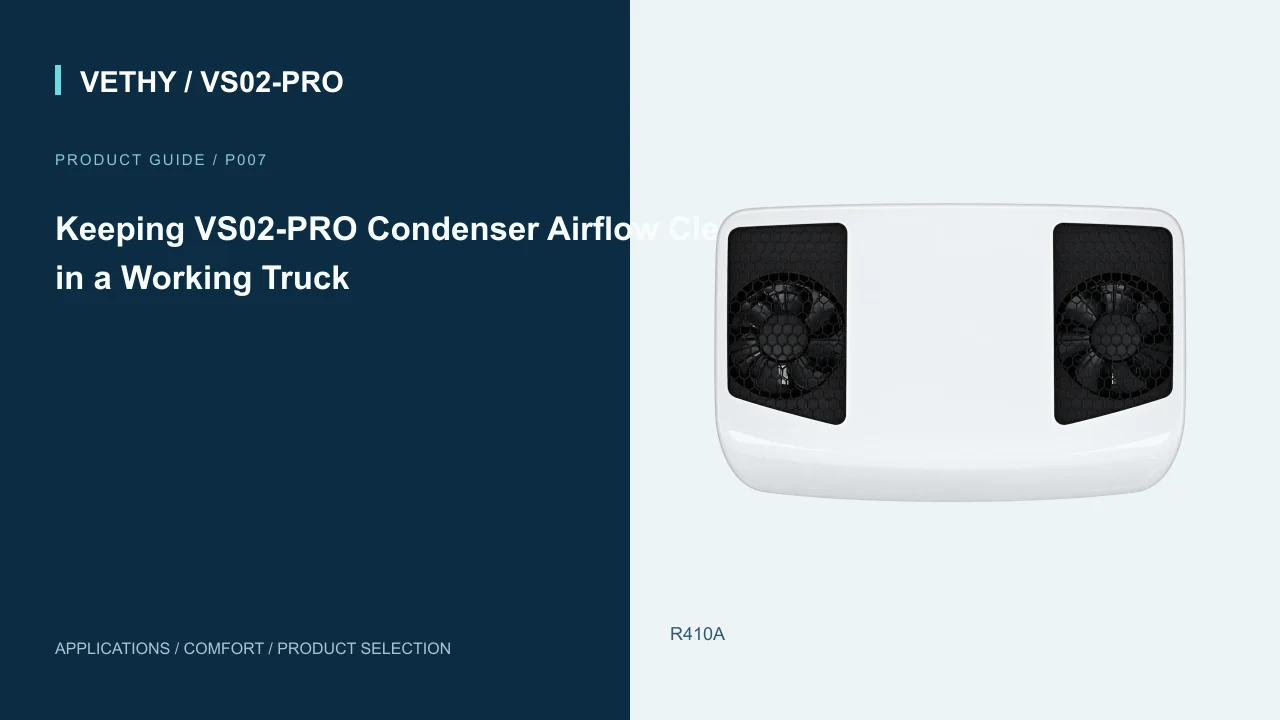
The VS02-PRO rooftop parking air conditioner is a useful candidate for a working truck when the roof plan gives its outdoor air path the same attention as the indoor outlet. The product lists 4500 m³/h condenser airflow with brushless airflow. Its standard condenser is aluminum microchannel, and a copper condenser is optional. Those details belong in the installation conversation because comfortable cab cooling depends on a complete system, including the outdoor section.
For a buyer, the practical advantage is a defined roof package that can be planned with antennas, solar equipment and other vehicle accessories. The outdoor dimensions are 980 × 680 × 185 mm. That gives the layout a clear starting point, while the relevant installation information must define the required air access, mounting and service arrangement.
This guide explains how to keep that package useful on a commercial vehicle that sees loading yards, dusty routes and changing equipment. The purpose is to connect a real VS02-PRO product feature to everyday operating value: preserve the outdoor air path so the selected cooling installation can serve the driver's occupied cab.
1. Include the outdoor side in the buying decision
A customer often experiences a parking AC first through the indoor stream. The cool air is immediate, while the outdoor heat-rejection task is less visible. A good product demonstration connects the two. VS02-PRO is a complete rooftop cooling package, so the roof arrangement deserves a place beside the bunk and outlet in the recommendation.
The 4500 m³/h condenser airflow reference identifies the outdoor air-moving side of the product. It is a specification to retain accurately, not a value that establishes unlimited freedom to crowd equipment around the housing. The air path must be considered according to the actual unit and its installation guidance.
This matters commercially because roof planning is easier before equipment is fitted. A buyer can compare possible locations and discuss the relationship to existing accessories while the vehicle is available for survey. That is a practical advantage of choosing a clearly identified model with known enclosure dimensions and a defined condenser configuration.
Explain the benefit in ordinary terms: the outdoor section needs access to the air it uses for its task. The customer does not need to inspect internal components to understand why a wall of equipment beside the unit deserves review. This makes the complete VS02-PRO proposal more understandable and easier to maintain.
2. Plan beyond the enclosure footprint
VS02-PRO's outdoor dimensions are 980 × 680 × 185 mm. Those measurements help establish whether a roof location is plausible, but the useful installation envelope includes more than the shell. The relevant intake, discharge, fastening and service areas must also be accommodated according to the supplied requirements.
A drawing that fits the enclosure between two accessories may still leave an awkward installed arrangement. A technician might lack access, or nearby equipment might sit in an important air path. The correct clearance cannot be invented from the published dimensions alone. Ask for the applicable installation information and review the actual roof geometry.
The 185 mm height also belongs in the complete vehicle height assessment. Roof shape, mounting components and other equipment affect the final result. Treat the product height as a reliable packaging reference while keeping the installed vehicle measurement as its own task. This is especially useful when comparing locations on a shaped truck roof.
For the buyer, the benefit is a roof plan that can be discussed concretely. The installer can show the VS02-PRO location and the surrounding working space. That turns a compact-looking product into a maintainable installation rather than a tight fit that becomes inconvenient as soon as service is needed.
3. Coordinate solar equipment with the cooling unit
A truck roof may be expected to carry solar equipment as well as parking cooling. The two systems should be planned together so the layout respects the AC air path, mounting needs and service access. Merely leaving enough area for both footprints does not answer the complete integration question.
VS02-PRO offers a defined rooftop form that makes this coordination possible early in the project. Place the actual outdoor dimensions on the roof plan and review nearby equipment with the relevant installation requirements. The buyer can then see where the air conditioner sits and which surrounding areas must remain usable.
The energy discussion should remain equally clear. Solar contribution depends on the proposed system, conditions and operating period, while cooling demand depends on the cab and use. The presence of panels does not prove that they can power a particular session directly or guarantee a battery duration. Ask the electrical designer to assess the whole arrangement.
This combined planning supports a stronger product recommendation. The customer can choose VS02-PRO as part of a deliberate vehicle package that considers roof space and energy together. The installation then has a better chance of remaining useful when both systems are in ordinary service, instead of one being positioned as an afterthought around the other.
4. Consider antennas and later roof additions
Commercial vehicles change during their working life. An antenna may move, tracking equipment may be added or a bodybuilder may revise another roof feature. A successful VS02-PRO installation should remain visible in those later decisions. Its outdoor air path and service access are part of the roof arrangement that future installers need to understand.
A simple photograph and layout record can help. Identify the model and location, show the surrounding equipment and preserve the applicable installation information. This does not require a complex fleet database. It gives a later workshop a useful starting point before adding hardware to an apparently empty patch of roof.
The buyer benefit is continuity. The careful choices made during the original installation are less likely to disappear when the truck moves to another depot or receives new equipment. The AC remains a defined part of the vehicle, with a known configuration and a layout that can be reviewed before changes are made.
For distributors, this is a practical addition to the support package. It helps explain why a product that worked well at handover should be reassessed after a significant roof change. The discussion stays focused on the actual installation rather than assuming that every later comfort difference is an internal product fault.
5. Relate parking surroundings to the roof package
A workshop demonstration usually takes place in one location, while a truck parks in many. Loading yards, open lots and sheltered areas can present different surroundings. The driver and installer should discuss those normal places when evaluating a rooftop cooling arrangement. That makes the recommendation reflect the customer's working day.
The purpose is not to invent a universal rule about distance from every structure. The supplied VS02-PRO data do not establish one. Instead, use the relevant installation guidance and inspect the actual air access where there is a concern. The product's 4500 m³/h condenser airflow reference remains an equipment characteristic within that context.
A driver can provide useful observations without diagnosing the system. Note where the truck was parked, what equipment was nearby and whether the vehicle arrangement had changed. Those details help the support team understand the situation. A photograph of the parked truck can be more informative than a vague report that cooling felt different at one customer site.
This is another reason to recommend the complete VS02-PRO package thoughtfully. The outdoor section belongs to a working vehicle that encounters changing surroundings. Planning around representative parking locations helps the customer connect the product choice to real use and gives later support a clearer basis for discussion.
6. Keep dust and debris in the service picture
Working trucks encounter different levels of dust, leaves and other debris. The outdoor air path should be cared for according to the supplied instructions and the vehicle's environment. The goal is to preserve access for the air-moving and heat-exchange tasks, rather than wait until the driver notices a change in comfort.
A regional truck using clean paved depots may need a different attention pattern from a vehicle visiting dusty work sites. The supplied product information does not define a universal cleaning interval for every route. Build the care routine around the actual exposure and the applicable service guidance, with a safe method appropriate to the installation.
Avoid presenting brushless airflow as a reason to ignore cleaning or inspection. The feature describes part of the product, while the complete installed air path remains exposed to the working environment. Equally, avoid promising a particular lifetime from one material label. Useful service planning considers the actual assembly and conditions.
The buyer benefit is practical value over repeated working days. A clean, accessible outdoor arrangement supports the product's intended task and makes routine care easier to organize. This is a strong complement to the indoor comfort story: VS02-PRO is being recommended as a usable vehicle installation, not just a cold-air demonstration on delivery day.
7. Describe condenser materials without confusion
The documented standard VS02-PRO configuration uses an aluminum microchannel condenser. A copper condenser is optional. The evaporator and piping are copper. These distinctions matter because a customer may have a material preference, and the delivered configuration should match the quotation rather than a broad all-copper label.
A distributor can present the standard package confidently and offer a separate discussion of the copper-condenser option. The choice should be recorded with the model and voltage. This helps purchasing and service refer to the same product later, particularly where a customer buys several batches or maintains more than one configuration.
The material decision does not remove the need for a suitable outdoor air path. Both the standard and optional arrangements belong in an installation that respects the applicable requirements. Avoid using a material preference as a substitute for reviewing access, support and serviceability on the actual roof.
For a buyer comparing offers, this clarity is useful. The customer can decide whether the optional condenser is relevant to the intended project and support approach. The comparison becomes a real configuration choice rather than an ambiguous claim that every internal part is made from the same material or that one label proves universal superiority.
8. Connect heat rejection to indoor comfort
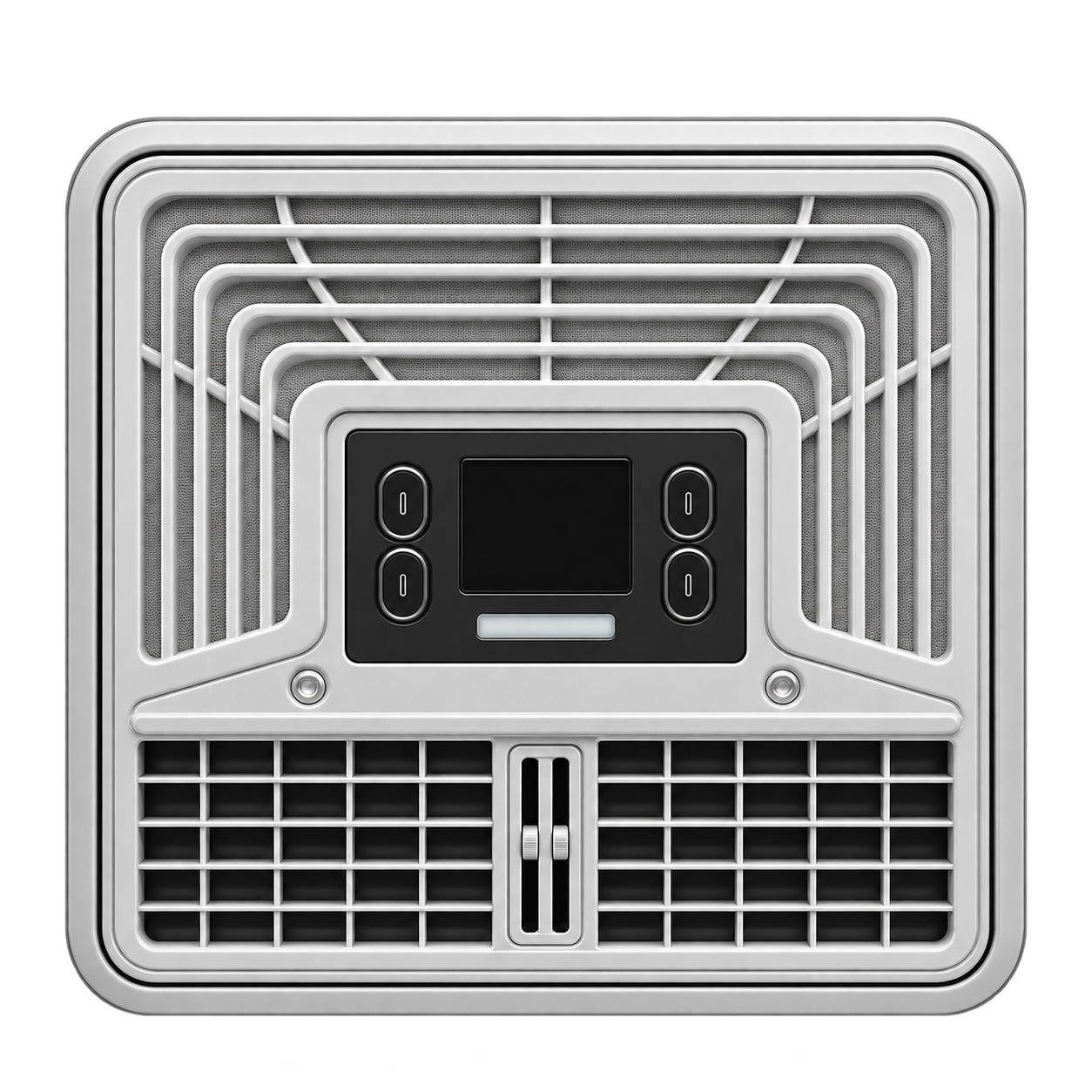
VS02-PRO's indoor side lists 550 m³/h evaporator airflow with a brushless fan and automatic oscillation. Those features help frame a useful comfort discussion around the seat and bunk. The outdoor side supports the complete cooling task, so both paths should be considered in one proposal rather than treated as unrelated installation details.
For example, a driver might demonstrate that the stream reaches the bunk well while the roof survey reveals a crowded outdoor location. The buyer should resolve the roof arrangement as part of the same package. Strong indoor delivery does not make the outdoor requirement disappear, just as a spacious roof location does not guarantee comfortable distribution inside.
This complete-system view is easy to explain using photographs of the actual VS02-PRO indoor and outdoor assemblies. Show where the hardware sits, where the occupant rests and which surrounding spaces stay clear. The customer can then see why the proposed roof location and interior panel position work together.
The brushless airflow guide focuses on the occupied side. The present recommendation adds the outdoor condition that supports it: a working roof layout with suitable air access. Together, the two subjects help buyers assess a complete comfort product rather than selecting on one impressive specification alone.
9. Keep electrical selection and airflow selection aligned
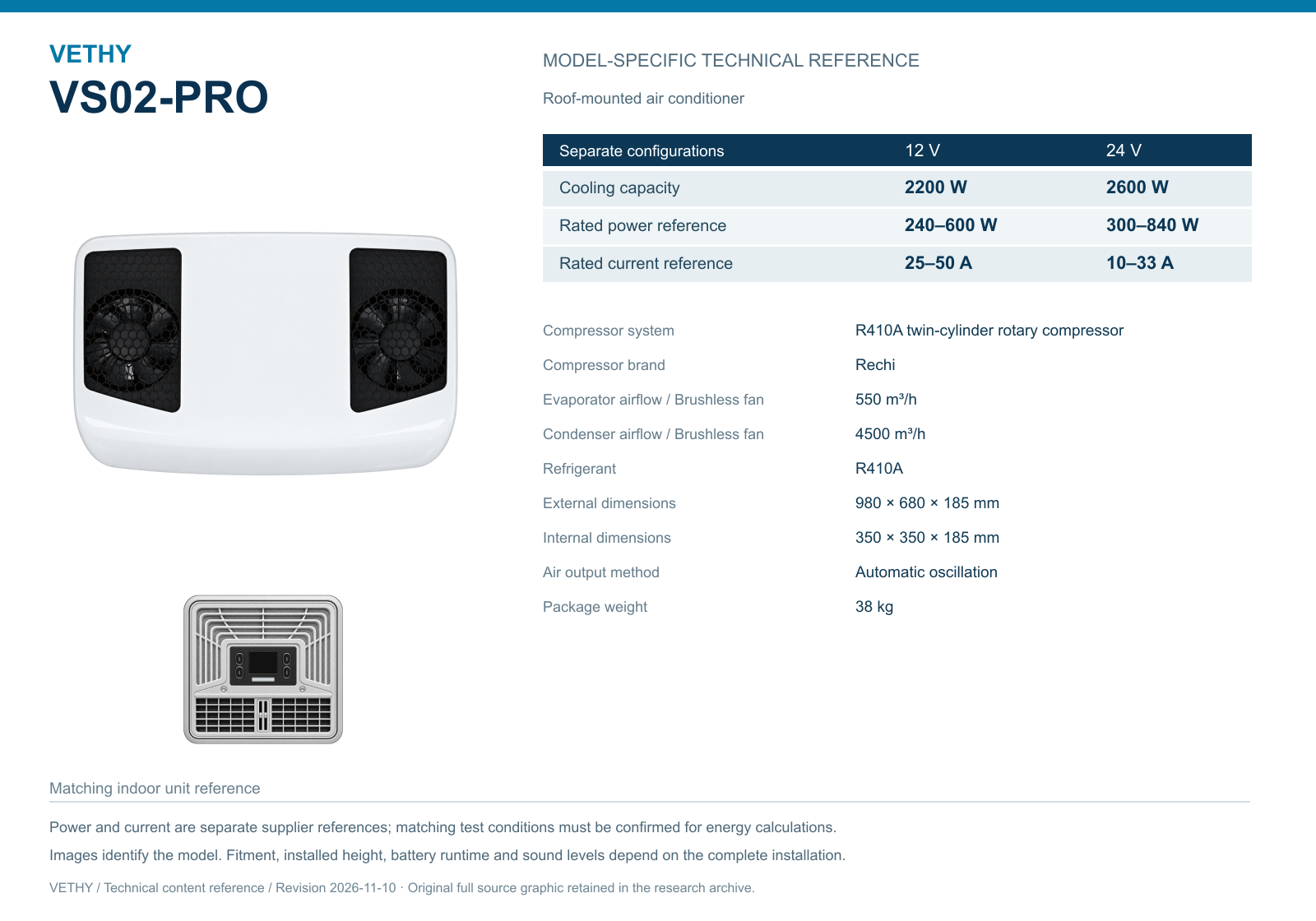
The 12V VS02-PRO has a 2200 W cooling reference, and the 24V version has 2600 W. Both belong to the same documented rooftop family, with the stated compressor architecture and airflow references. Select the electrical version for the engineered vehicle supply and the intended cabin duty, then plan the roof arrangement for that actual configuration.
Manufacturer power references are 240–600 W for 12V and 300–840 W for 24V. Separate current references are 25–50 A and 10–33 A. Their endpoints are not a matched test data set, so they do not establish a calculated efficiency or an overnight battery guarantee. The electrical designer should use the applicable requirements for the complete installation.
A useful quotation keeps these choices together: model, voltage, condenser configuration and the defined installation scope. This lets the buyer understand what is being supplied and gives the workshop a coherent starting point. It also reduces the chance that the roof team and electrical team work from different assumptions about the offered product.
The VS02-PRO product page is the core model reference. Use the same identification in the roof plan, energy discussion and support record so observations can be connected to the correct unit after the vehicle enters service.
10. Use a roof survey to make the offer concrete
A good survey does more than collect dimensions. It makes the proposed product visible on the truck and helps the customer understand the layout. Roof photographs, existing equipment positions and the intended interior location can be reviewed together. The result is a more useful basis for a VS02-PRO recommendation and quotation.
| Roof situation | Planning emphasis | Practical value for the buyer |
|---|---|---|
| Open roof with a proposed AC location | Confirm mounting and air-access requirements | A defined starting arrangement |
| Roof shared with solar equipment | Coordinate both systems and service access | A coherent vehicle package |
| Existing antenna or tracking equipment | Review the surrounding air path | Fewer late layout changes |
| Vehicle visiting dusty sites | Plan care around real exposure | More useful service preparation |
| Fleet with later accessory additions | Preserve a roof record | Clearer review of future modifications |
The survey should use the actual installation requirements rather than invented generic clearances. Its purpose is to turn the product choice into a reviewable layout. The buyer can see why VS02-PRO fits the intended location and where any remaining vehicle-specific question needs an answer.
The same survey can distinguish a suitable standard layout from a vehicle that needs additional engineering. This is useful for distributors because it keeps the sales conversation moving: many customers can proceed with a defined configuration, while an unusual roof receives focused attention. The product's advantages remain clear in both cases. VS02-PRO provides known packaging and airflow references, and the installer applies them to the vehicle instead of making a universal-fit claim. A reviewable roof proposal gives the customer something concrete to assess before committing to the complete installation package.
11. Demonstrate the installed package honestly
A useful demonstration connects what the driver feels inside to the hardware outside. Let the customer assess the seat and bunk, then show the roof arrangement and explain the relevant air access. This gives the product's cooling and airflow specifications a practical context without requiring an exaggerated performance claim.
Record the model version and relevant surroundings if observations are shared later. A shaded workshop yard and a sun-exposed loading site do not describe the same situation. Informal observations are valuable for the demonstrated installation, but they should not become claims about every ambient condition or every possible truck.
The Rechi R410A twin-cylinder rotary compressor system is part of the product story, as are the brushless airflow components and automatic oscillation. The supplied data do not establish a particular sound level, temperature limit or exact energy-saving percentage. The demonstration can remain persuasive by showing real comfort and a well-planned installation rather than attaching unsupported numbers.
For a distributor, this approach creates a credible support conversation after the sale. The customer knows which configuration was shown and how the roof layout supports it. If the vehicle changes, both parties have a practical reference for review, preserving the value of the original recommendation.
12. Hand over a roof plan that survives everyday work
The owner should receive the product identification, voltage version and condenser selection with the relevant installation information. A photograph showing the outdoor unit and nearby equipment can be especially useful. It helps the driver and later workshops recognize the arrangement that was assessed during installation.
Explain that new roof equipment should be reviewed with the AC layout in mind. The goal is not to prevent useful vehicle upgrades, but to coordinate them with the existing product. A future installer can then assess the relevant air path and service access before choosing a location for another accessory.
The service routine should also reflect the vehicle's routes and the supplied guidance. The driver does not need to dismantle equipment or invent a diagnosis. Useful reporting consists of the circumstances, visible changes and the location of any concern. This gives qualified service staff a better starting point for the actual installation.
The VS02-PRO guide hub supports focused reading on packaging and airflow. Keep those explanatory resources alongside the actual product instructions in the buying conversation so the customer understands both the reason for the layout and the procedures that apply to the supplied unit.
13. Questions about VS02-PRO condenser airflow
Does 4500 m³/h mean other roof equipment can be placed close by?
The airflow reference does not establish universal clearances. Use the applicable installation guidance and review the actual intake, discharge and service areas. The enclosure dimensions are useful for packaging, while the complete installed arrangement requires space for the product's tasks.
Is the standard condenser copper?
The standard documented condenser is aluminum microchannel. Copper is optional. VS02-PRO also has a copper evaporator and copper piping. Record the chosen condenser configuration in the quotation and order so the delivered unit and later service discussion remain consistent.
How often should the outdoor path be cleaned?
Follow the supplied service guidance and consider actual route exposure. The source information does not establish one universal interval for every truck. A vehicle visiting dusty sites and a vehicle using clean paved depots may need different attention patterns.
What makes VS02-PRO a useful roof-package candidate?
It has a defined 980 × 680 × 185 mm outdoor enclosure, documented airflow references and a clear condenser choice. When the roof, indoor circulation and electrical supply are planned together, those facts support a practical rooftop cooling recommendation for a working truck.
Recommend a complete working-roof arrangement
Shortlist VS02-PRO when its R410A rooftop package fits the truck and the roof plan can preserve outdoor air access alongside the other equipment. Its condenser airflow reference becomes useful when the installation respects the complete arrangement. Share roof photographs, accessory positions, vehicle voltage and parking conditions through the technical enquiry page so VETHY can develop a configuration-specific proposal around the actual vehicle.
Product sources
- VETHY VS02-PRO current manufacturer specifications — VETHY.
- VS02-PRO technical reference sheet — VETHY.
VETHY product recommendation and application analysis. Specification references identify the selected model and voltage. Installation examples are planning examples; measured project results are identified explicitly when available.
Discuss your VS02-PRO application
Send your vehicle, supply voltage, occupied space, parking schedule and installation photographs for a model-specific recommendation.
Prepare your vehicle brief ↗