
VETHY / CUDU2700 / PRODUCT AND APPLICATION GUIDE
CUDU2700 DC Inverter Cooling: Why Part-Load Operation Deserves Attention
CUDU2700 R410A brings documented DC inverter twin-rotary technology to a parking period whose cooling demand changes. Plan arrival, settling and occupied rest as different parts of the session. Brushless fans and directed outlets complement that architecture; the delivered controls and actual conditions determine its response, so no numerical saving follows from the technology label alone.
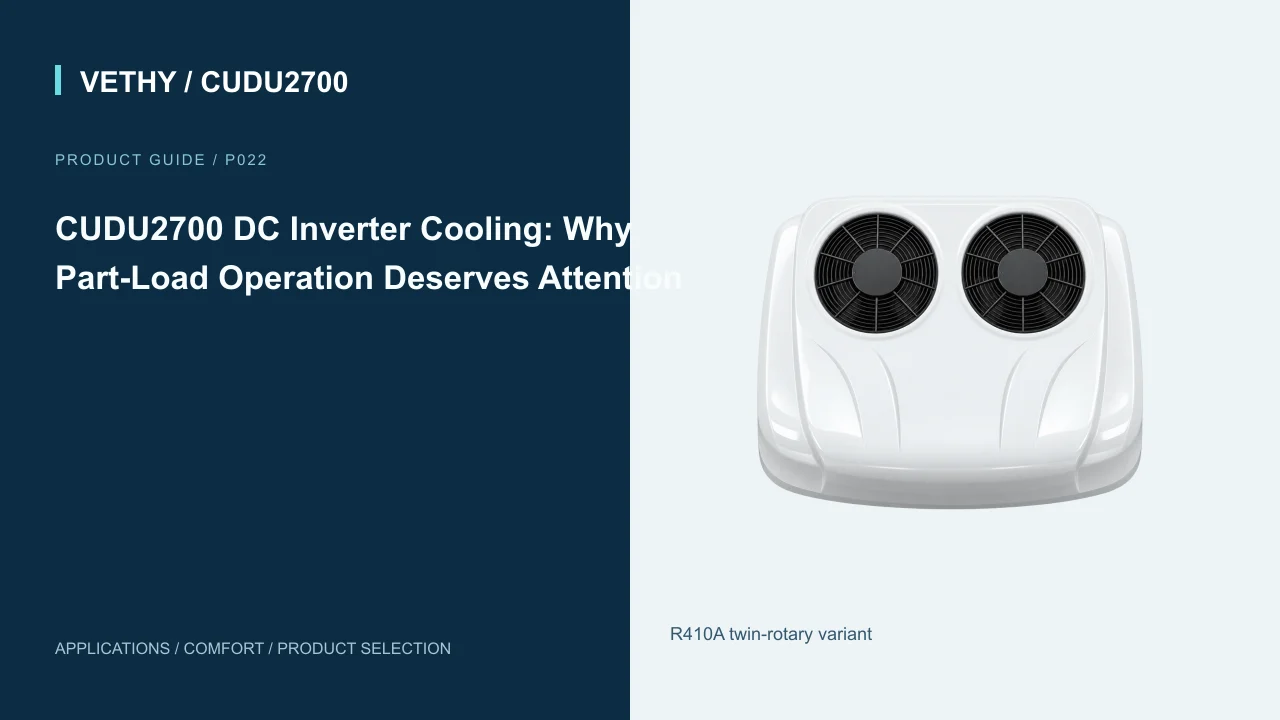
The reason to consider CUDU2700 DC inverter cooling is not limited to the hottest moment after parking. Much of a useful rest period may occur after the cab has begun to settle, when the required cooling is different from the demand on arrival. A buyer interested in energy-conscious comfort should give that later period serious attention.
CUDU2700 R410A combines DC inverter technology with a twin-rotary compressor and carries VETHY’s qualitative quiet, energy-efficient positioning. Those attributes make it an attractive candidate for a changing-load application. They do not establish a numerical saving, a specific modulation band or a fixed battery duration. The practical opportunity is to choose and operate a complete cabin-cooling package with the whole parking session in mind.
Follow the stop through its different demands
Consider a delivery driver who finishes work in late afternoon and remains in the cab into the evening. At the beginning, sun-warmed trim and glazing add to the immediate comfort problem. Later, the solar exposure falls, the door stays closed and the driver occupies a smaller part of the interior. Those are different conditions, even though the vehicle has not moved.
An evaluation limited to the first few minutes mainly tells the buyer about one part of the task. It may reveal how the outlet air feels, but it says little about whether the settled environment is pleasant for reading, paperwork or rest. For this use case, the later phase is a central purchasing question.
The CUDU2700 inverter package is worth investigating precisely because the load changes. Ask how the supplied unit behaves through a representative transition. Does the occupant find the delivery comfortable after settling? Is the chosen direction still suitable? Is the operating routine easy to maintain without constant intervention?
These questions keep attention on the user benefit. The buyer wants a comfortable occupied space over a period of time. Compressor architecture matters because it supports that task, while the actual result depends on the controls, installation and conditions. A good trial follows the sequence the customer will actually experience instead of turning one dramatic arrival condition into the definition of all future use.
Understand the inverter opportunity without inventing controls
An inverter system provides a basis for varying compressor operation. That is the relevant architectural difference when the required cooling changes. The complete controller decides how the installed product responds, and its behavior also depends on operating conditions. A brochure description cannot supply a detailed control map that has not been documented.
For CUDU2700, it is appropriate to connect DC inverter technology with a discussion of changing demand and thoughtful energy use. It is not appropriate to claim an exact minimum output, a particular ramp sequence or a special sleep algorithm unless that function is confirmed for the delivered configuration. The distinction is useful to a buyer because it separates an established construction feature from a feature that would need additional confirmation.
A dealer can make this understandable through demonstration. Show the actual controls and explain their documented functions. Then let the customer use the unit during a representative parking period. The customer learns what can be requested and observes the resulting cabin experience, rather than being sold a fictional operating mode.
Twin-rotary construction belongs in this explanation as part of the compressor package and its smooth-running positioning. It should not be used to predict the complete cabin sound or to assign a guaranteed percentage improvement. The positive case is already clear: a documented inverter twin-rotary product is a sensible candidate when the buyer values an adaptable cooling architecture for a variable task.
There is also a difference between demonstrating a function and inferring its internal implementation. A driver may observe a smooth transition in comfort without knowing the compressor command at each instant. Describe the observation in those terms. If a project requires detailed control information, raise that requirement with VETHY rather than turning the occupant’s impression into a technical control claim. This keeps the product explanation accurate while respecting the practical value of what the customer can actually experience during the demonstration. The result is still useful evidence for that customer’s buying decision.
Separate the equipment rating from the changing load
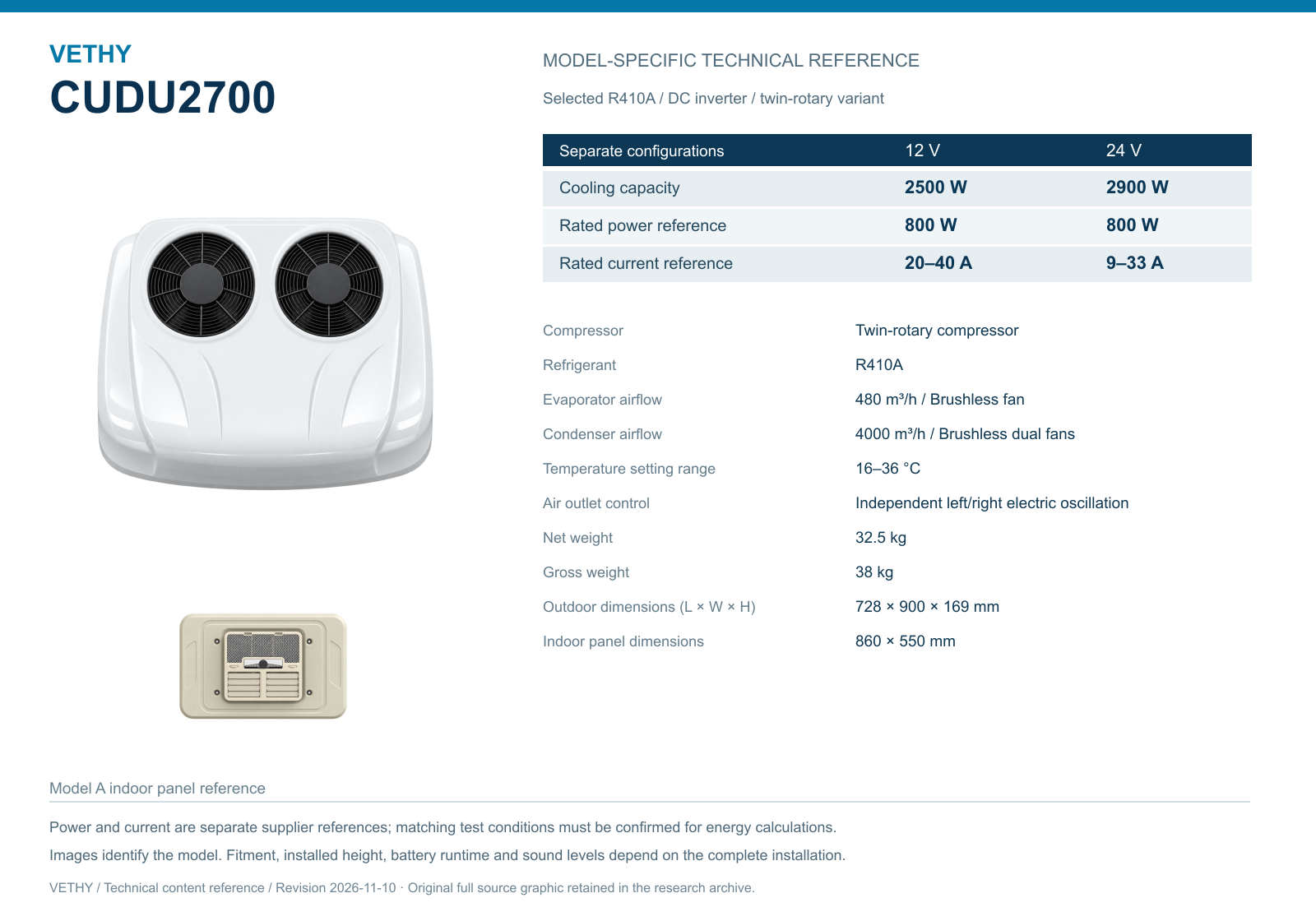
The selected R410A model is listed at 2500 W cooling for the 12V version and 2900 W for the 24V version. These references identify the equipment being considered. The thermal load is what the particular cabin asks the equipment to address at a given time. The two ideas belong together, but they are not interchangeable.
A shaded, closed cab later in the evening may present a different demand from a sun-exposed cab just after arrival. That does not change the model’s listed cooling reference. It changes the application conditions. This is why a capacity figure should not be interpreted as a statement that the unit draws the same electrical power throughout every session or always operates at one fixed level.
The buyer should also avoid the opposite shortcut: assuming that a lower cabin demand automatically proves a particular amount of energy saved by this product. The complete operating behavior still needs observation under the intended conditions. The inverter architecture is a relevant reason to shortlist the model, while a measured session profile would be different evidence.
A useful procurement description can state both ideas plainly. It can identify the selected voltage and cooling reference, then describe the expected sequence of use. That gives the supplier something more meaningful than “overnight AC required.” It also gives the buyer a fair way to assess the product without asking a single catalogue rating to answer every operating question.
A temperature request is not a load measurement
The CUDU2700 setting range is listed as 16–36°C. That describes the available temperature request range, not a guarantee that every cabin will reach every setting. It also does not reveal the actual cooling demand by itself. A request made by the driver sits within a wider thermal and comfort situation.
For instance, a driver feeling a direct stream at the shoulder may change the temperature request even though the main issue is air direction. Another driver may choose a colder request because a sunlit surface remains uncomfortable. These ordinary actions show why the setting displayed on a control should not be treated as a complete explanation of the cabin load.
During a lower-demand evaluation, record meaningful changes rather than judging the request in isolation. Did the driver draw a curtain? Did the cab move into shade? Was an outlet redirected? Those details help explain why comfort improved or why a further adjustment was made.
This is also a reason to teach the available adjustment properly. A customer who understands air direction can often describe the actual problem more clearly. The sales conversation becomes about a comfortable space, not simply the lowest number on the control. CUDU2700’s independent left/right delivery gives that conversation a practical tool while the inverter package addresses the broader changing cooling task.
Stored heat makes arrival different from settled rest
Cabin air is only part of what a driver encounters after parking. The interior surfaces have their own exposure history, and the occupant exchanges heat with that surrounding environment. A warm roof lining or sun-exposed window area can remain relevant after cool air first becomes noticeable.
This explains why the first favorable sensation at an outlet should not end the assessment. The driver’s real question is whether the occupied area becomes comfortable enough for the intended activity. The answer may evolve as surfaces and air respond to the changed conditions. A trial should allow that transition to be seen rather than promising a universal pull-down time.
For an application with a long settled phase, ordinary load reduction is a useful partner to the product. Suitable shades and normal curtains can address avoidable gains where the vehicle and site permit. Their role is to improve the task presented to the cooling system. No model-specific saving percentage is needed to explain that rationale.
The buyer should keep the arrangement realistic. If a particular shade will not normally be used, a trial depending on it is a poor reference for everyday operation. Conversely, if the driver always uses a sleeper curtain, leaving it open throughout the demonstration misses an important part of the application. The most helpful comparison is between conditions the operator can recognize and repeat.
The sequence can also differ between routes using the same truck. A shaded evening stop may reach settled conditions sooner than a stop beside sun-heated pavement in late afternoon. The useful lesson is not a universal number of minutes. It is that exposure history belongs in the record when evaluating the changing-load experience. Comparing two stops without that context can make ordinary differences appear mysterious. A short note about where the truck was parked and how the cabin was arranged helps the owner interpret the result and ask a more precise question if support is needed.
Lower demand makes air distribution more noticeable
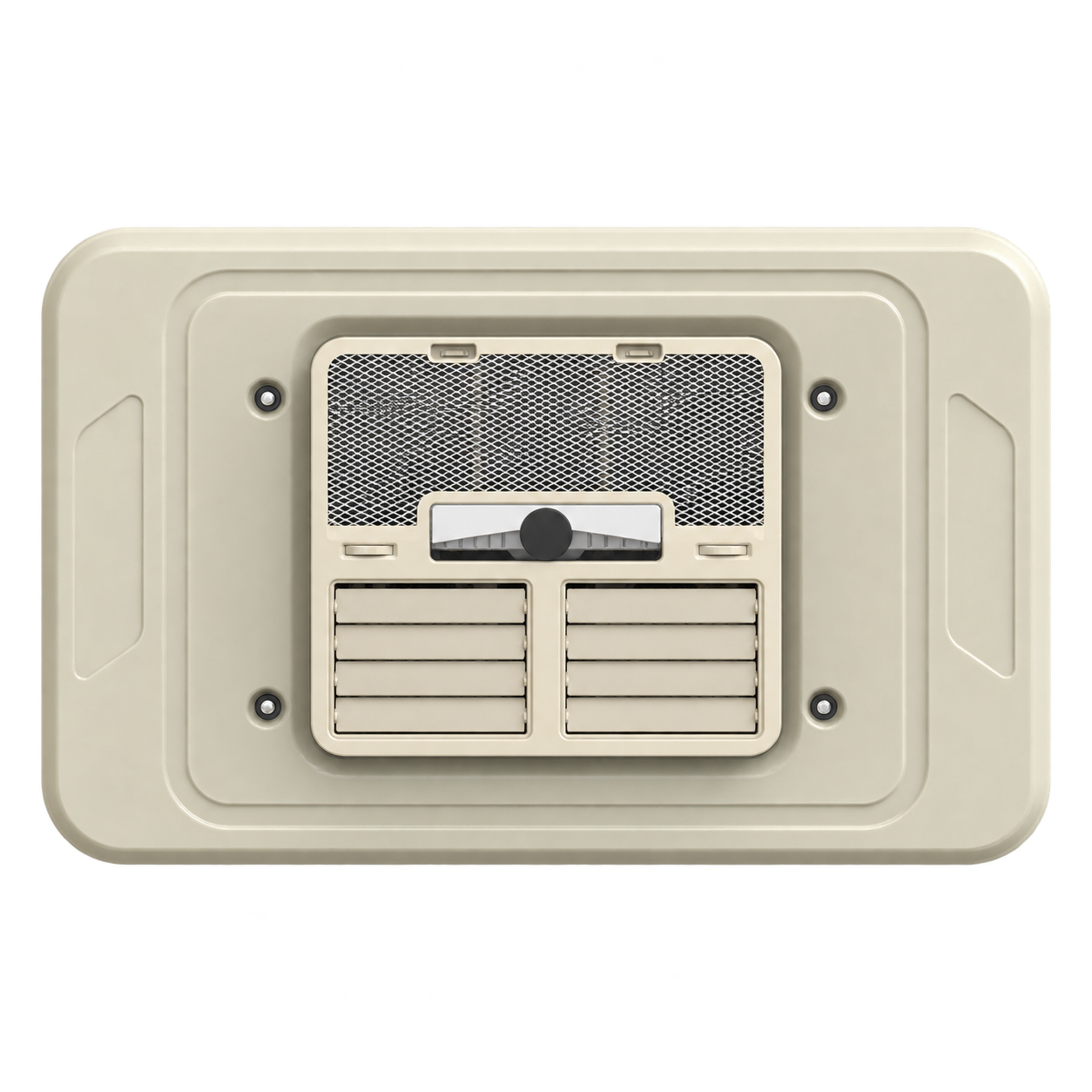
Once the urgent feeling of a hot cab has passed, the character of the delivered air often becomes a larger part of comfort. A direction that felt refreshing on arrival may feel too direct during quiet rest. CUDU2700’s Model A panel can adjust left and right electric oscillation independently, making this a useful feature to evaluate during the later phase.
The practical benefit is personalization of delivery within a shared cooling system. The driver can refine where the air travels relative to the bunk or seat. This is not the same as having two independent temperature zones, and the source does not establish separate side-specific refrigeration control.
Try the adjustment with the normal interior arrangement in place. A pillow, cabinet or curtain may influence the path. Evaluate from the occupied position rather than directly under the panel. The listed 480 m³/h evaporator airflow is a product reference; the airflow felt at a particular point depends on the furnished cabin and outlet direction.
This part of the recommendation is easy to demonstrate and easy for the owner to use. The buyer does not need to understand the compressor’s control behavior to recognize the difference between pleasant circulation and an uncomfortable direct stream. Pairing that visible adjustment with the inverter package gives CUDU2700 a more complete lower-demand comfort proposition than a technology label alone could provide.
Build a short operating timeline, not a guessed curve
A useful application record can be simple. Divide the stop into recognizable phases, such as arrival, preparation of the rest area and settled occupancy. Note the relevant cabin arrangement and any control adjustment at each phase. The purpose is to describe what happened, not to draw an invented compressor-speed or energy curve.
| Session phase | What the occupant may notice | Useful observation |
|---|---|---|
| Arrival | Warm surfaces and immediate desire for cooling | Exposure history and initial occupied position |
| Settling | Curtain, bedding and outlet changes | What changed and why |
| Quiet occupancy | Sensitivity to direction and background sound | Comfort at the normal resting position |
| Departure preparation | Other loads or door activity may change | Conditions before the next charging opportunity |
Such a record supports a conversation with VETHY because it shows the actual use case. “The air was too direct at the bunk after settling” is more actionable than “the inverter felt wrong.” It points toward a distribution question rather than assuming a fault in an undocumented control sequence.
If energy is also measured by appropriate equipment in the vehicle, retain the method and conditions with the result. The timeline then gives the numbers an understandable context. Without those measurements, the comfort record is still valuable, but it should not be described as evidence of a precise energy saving.
Keep the electrical data honest during the energy discussion
The supplier lists rated power at 800 W and current references of 20–40 A for 12V or 9–33 A for 24V, with the current entries labelled at 35°C ambient. These fields are not established as one matched operating point. Their presence does not justify calculating session energy, efficiency or runtime by selecting convenient values from different rows.
A genuine session-energy discussion begins with the vehicle’s usable energy, other loads, intended cooling window and charging plan. It should account for the customer’s actual equipment and route. The chosen nominal voltage also needs to fit the engineered supply arrangement; it is not a setting selected merely to obtain a more attractive capacity number.
For the buyer considering part-load behavior, this distinction is particularly important. It is tempting to take the low current endpoint and label it the expected settled-rest draw. The source does not establish that interpretation. An observed current at one moment would also need its own context before being used as a planning value.
The constructive next step is a representative installed assessment. Use appropriate energy information and competent integration advice for the vehicle. Then describe the result as belonging to that configuration and operating sequence. The CUDU2700 recommendation remains confident because the architecture is documented, while the energy plan remains credible because it is grounded in the actual application.
A multi-day route adds another dimension: the energy available at the start of one stop depends on what happened before it. An apparently comfortable single session does not establish that the next day will begin with the same reserve. When this is relevant, the buyer should describe the recurring drive, charge and rest pattern. The inverter package can then be evaluated within an operational plan that repeats sensibly. That is more valuable than optimizing a one-off demonstration around an unusually favorable initial battery condition and assuming the result represents a working week.
Evaluate quiet comfort after the obvious cooling impression
CUDU2700’s brushless fans and twin-rotary construction support qualitative quiet positioning. The later occupied phase is where that proposition should be assessed for a rest-oriented buyer. Once conversation and preparation stop, small sounds or vibrations can become more noticeable to the driver.
Listen from the intended resting position with ordinary interior fittings secured. Distinguish a loose stored item from a vibration associated with mounting or trim. If the air itself feels intrusive, try the documented directional adjustment and reassess the same position. This gives the installer a useful path to improve the experience instead of attributing every observation to the compressor.
The roof arrangement should remain representative during the trial. CUDU2700 includes a copper condenser and dual brushless condenser fans, with 4000 m³/h listed condenser airflow. Nearby accessories and the applicable air-path requirements belong in the installation review. An open temporary arrangement is not necessarily the environment the unit will have after a rack is added.
No measured cabin sound level is established here, and a quiet impression in one truck is not a comparative result for a named competitor. The decision can still be practical: does the finished installation provide a calm, comfortable environment for this driver’s normal activity during the lower-demand phase? That is the question the product is being considered to answer.
Where the part-load argument is most persuasive
The inverter proposition is especially relevant when the stop includes a substantial change in thermal conditions. An afternoon arrival followed by evening rest is a clear example. A vehicle with recurring differences between exposed and shaded parking is another. In each case, the equipment is asked to support more than a single fixed moment.
The argument is less useful if it becomes detached from the customer’s priorities. A buyer whose main constraint is an unsuitable roof still needs to resolve the layout first. A buyer whose energy reserve is undefined still needs a power plan. Inverter architecture is a valuable product feature within a complete application decision, rather than a way to bypass those questions.
CUDU2700 adds other documented reasons to the shortlist: copper evaporator, condenser and piping; brushless airflow components; independent cabin delivery; and a 169 mm outdoor housing height. The broad package is covered in the CUDU2700 R410A selection guide. This article’s narrower contribution is to make the later, changing-demand part of the stop visible in the choice.
A customer who values that whole-session view has a strong reason to investigate this model. The buyer can ask for a representative demonstration, understand what the supplied controls actually do and plan the installation around a recognizable operating sequence. That produces a more useful decision than choosing by a maximum-demand impression alone.
The most persuasive recommendation will explain the intended benefit in the customer’s own terms. A driver may call it being able to rest without constant adjustment. A fleet engineer may call it a better match to a variable cooling task. Both descriptions are useful when supported by the actual configuration and trial. Neither needs a fabricated savings figure to become meaningful. For CUDU2700, keep the documented inverter twin-rotary architecture central, then let the whole-session experience determine whether the package is right for the particular vehicle and user.
Questions about inverter and lower-demand use
Does DC inverter guarantee a particular saving percentage?
No specific saving percentage is established for this model here. The architecture is relevant to changing demand, while actual session consumption depends on the complete system and conditions.
Is the low current endpoint the settled-rest draw?
The source does not establish that interpretation. The published current range is a supplier reference at 35°C ambient, not a complete time-based operating profile.
Does a lower temperature request make the unit cool faster?
The supplied information does not establish a particular pull-down strategy. Follow the delivered operating guidance and consider heat load and air direction when evaluating comfort.
What should a useful part-load demonstration include?
Include the initial condition, the transition into settled occupancy and the later comfort experience. Retain the actual vehicle setup and distinguish measured energy from descriptive observations.
Recommend the model around the whole parking period
Shortlist CUDU2700 R410A when a DC inverter twin-rotary rooftop package suits a vehicle whose cooling task changes during the stop. Put equal thought into the settled occupied phase and the initial hot arrival. Pair the product with appropriate power planning and an interior arrangement that makes independent outlet adjustment useful.
Send the operating timeline and vehicle details through the parking AC project enquiry route, or contact VETHY to discuss the selected voltage and a representative evaluation. Further model-specific topics are available in the CUDU2700 guide hub.
Product sources
VETHY product recommendation and application analysis. Specification references identify the selected model and voltage. Installation examples are planning examples; measured project results are identified explicitly when available.
Discuss your CUDU2700 application
Send your vehicle, supply voltage, occupied space, parking schedule and installation photographs for a model-specific recommendation.
Prepare your vehicle brief ↗