
VETHY / CU2700 / PRODUCT AND APPLICATION GUIDE
Understanding CU2700 Current References When Planning Auxiliary Power
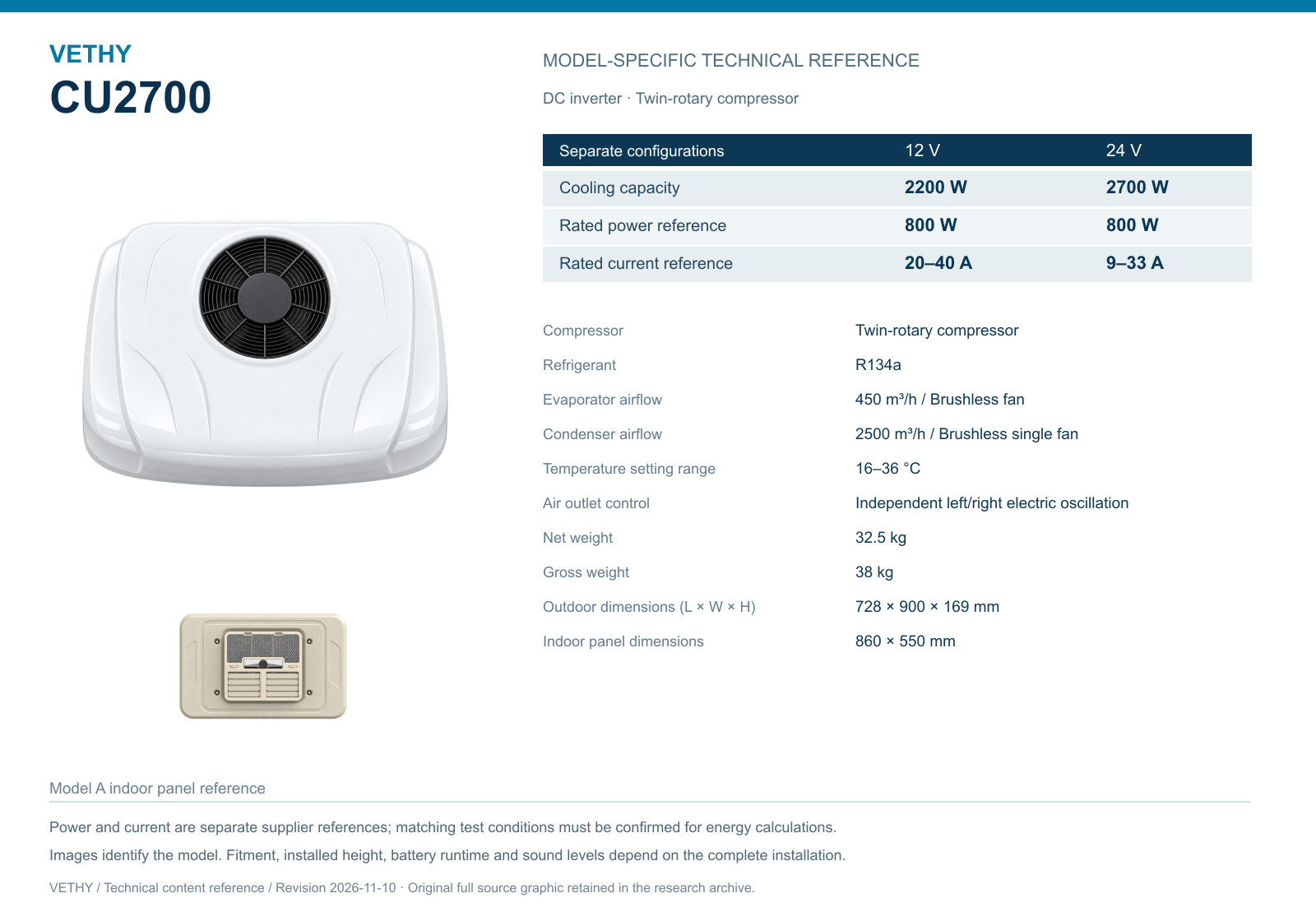
CU2700 lists 20–40 A at 12V and 9–33 A at 24V, with 35°C ambient stated for the current references. Its 800 W named rated-power field and cooling capacities are separate supplier references. Use them to prepare a vehicle-specific supply discussion, while planning usable energy, other loads, reserve and recharge for the actual stop.
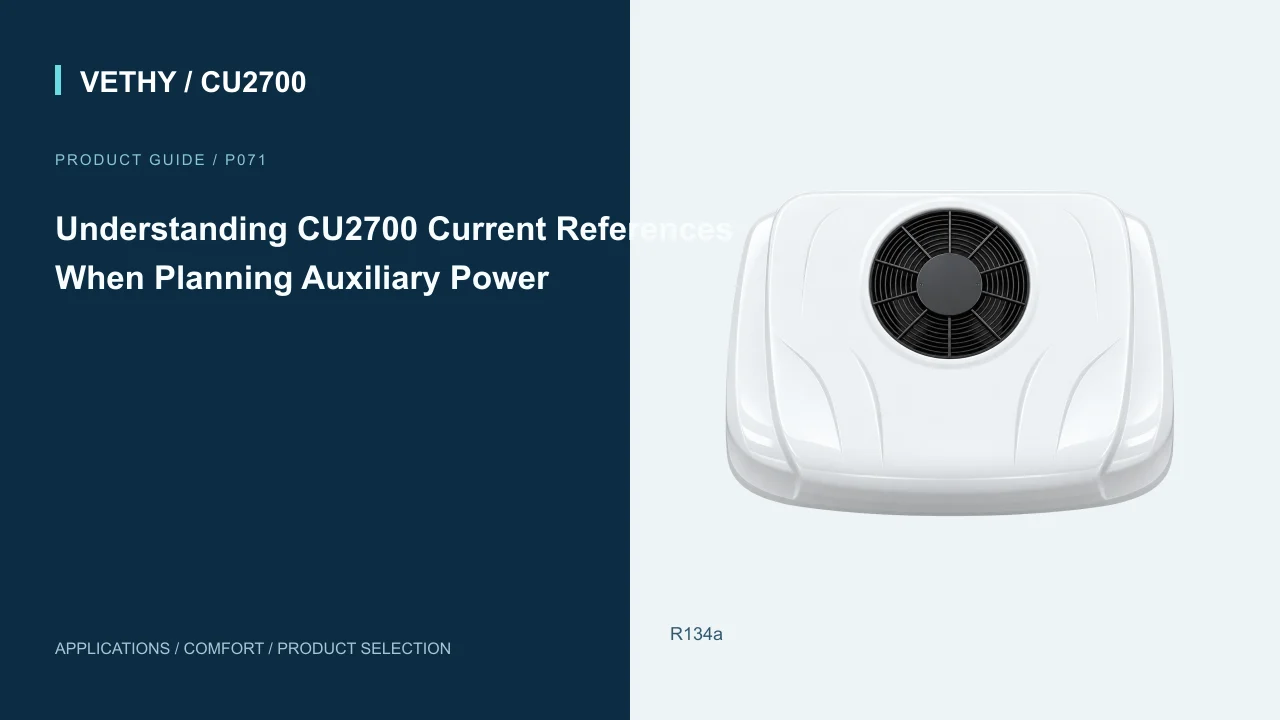
CU2700 gives buyers a useful set of starting references for an auxiliary power discussion: separate 12V and 24V versions, voltage-specific cooling capacities and current ranges with a stated ambient condition. The important step is to keep those references in their proper roles. A well prepared buyer can then ask for a complete electrical package rather than trying to turn one current endpoint into an overnight promise.
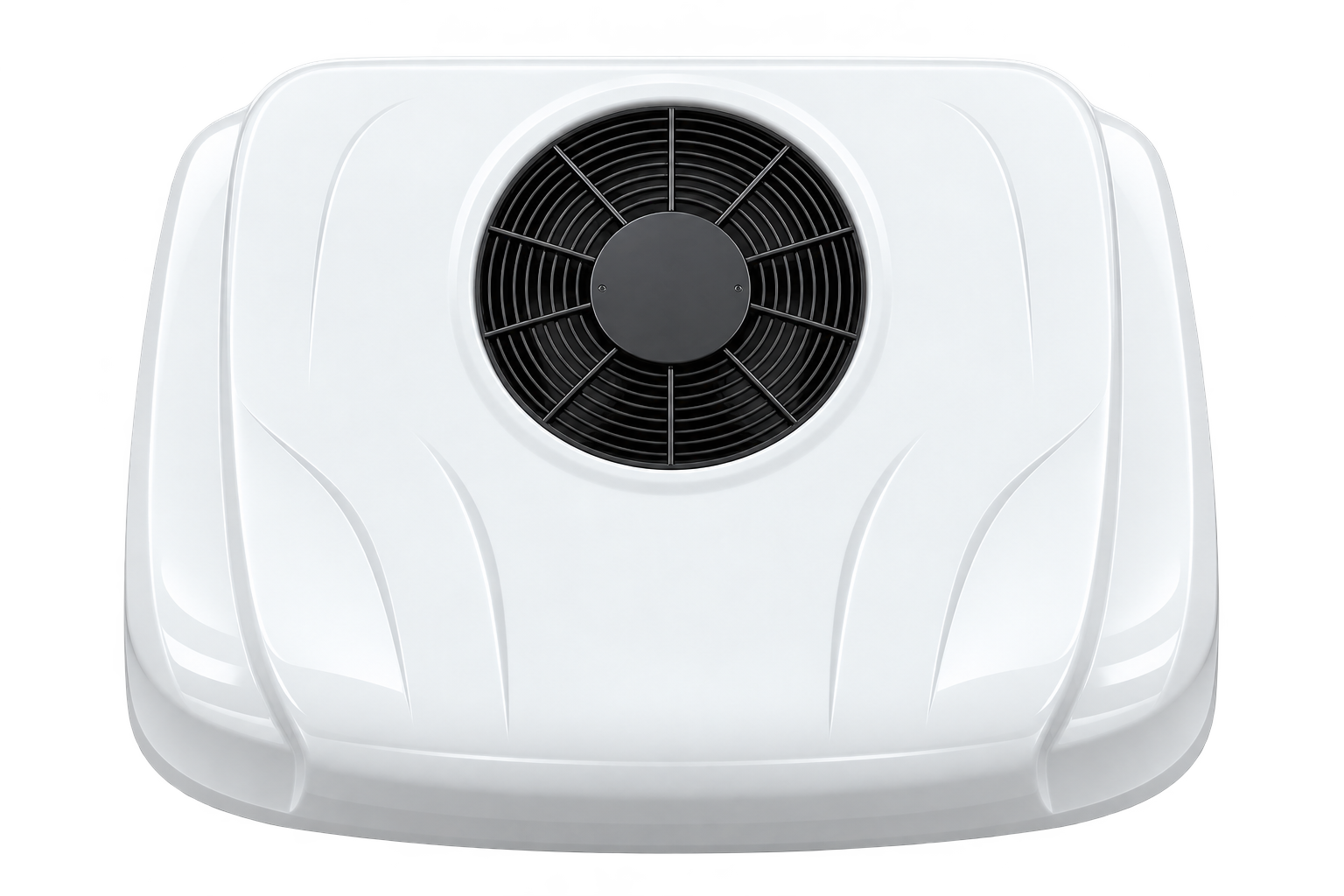
The product itself is a defined single-fan rooftop system. It uses R134a DC inverter twin-rotary technology, copper evaporator, condenser and refrigerant piping, and brushless fans. Its indoor panel offers independent left and right electric oscillation. Those features make CU2700 worth assessing for energy-conscious parked comfort. This guide explains how to carry its electrical references into a practical vehicle brief while keeping the cooling product, supporting supply and driver routine connected.
Read the current ranges with their stated condition
The confirmed CU2700 current references are 20–40 A for the 12V version and 9–33 A for the 24V version. The source associates the current fields with 35°C ambient. Keep that condition visible when the values appear in a quotation or planning document. Removing it can make a reference look like a universal operating statement.
A range is not a complete description of every moment in a cooling session. The source does not map each endpoint to a particular compressor state, cabin condition or control setting. The buyer should therefore use the figures as supplier references that help frame the electrical discussion, not as a ready-made hourly consumption schedule.
This is still useful information. It identifies the correct voltage-specific fields and gives the installer a clear place to begin requesting any additional operating and integration data. For an owner, the practical action is to provide the actual truck and intended use alongside these references. For a fleet, it is to keep them attached to the right product version. The CU2700 guide collection supplies the broader model context so the current discussion remains connected to the exact single-fan rooftop package being considered.
Keep cooling capacity separate from electrical input
CU2700 lists 2200 W cooling at 12V and 2700 W cooling at 24V. These are cooling capacity references, not statements that the battery supplies those amounts as electrical input. The same source names an 800 W rated-power field. That field remains separate from the current ranges because a common paired operating point is not established.
A clear proposal labels all three kinds of information. The cooling figure supports the cab-load assessment. The power field remains a named supplier reference. The current range remains voltage-specific with its stated condition. This organization makes the document easier to read and prevents an attractive table from quietly suggesting that every value was measured simultaneously.
The practical benefit is a more useful buying conversation. The customer can ask whether the model serves the occupied cab and whether the supporting supply serves the intended schedule. Those are connected questions, but they are not identical. CU2700 brings a defined cooling architecture and reference data to the project. The installer and electrical designer use the appropriate information to prepare the vehicle package. A buyer does not need to calculate an asserted efficiency from unmatched fields to understand why the product deserves consideration.
Use a reference table that leads to the right decisions
A good planning table should show what each supplied field contributes and what the complete project still needs to establish. It helps purchasing and the workshop work from the same description.
| CU2700 reference | Supplied value | Useful role in the project |
|---|---|---|
| 12V cooling capacity | 2200 W | Assess the occupied cab on a compatible 12V platform |
| 24V cooling capacity | 2700 W | Assess the occupied cab on a compatible 24V platform |
| Named rated-power field | 800 W | Retain as a separate supplier electrical reference |
| 12V current range | 20–40 A at 35°C ambient | Begin the voltage-specific integration discussion |
| 24V current range | 9–33 A at 35°C ambient | Begin the separate 24V integration discussion |
| Compressor architecture | DC inverter, twin-rotary | Identify the cooling system being proposed |
| Refrigerant | R134a | Preserve model and service identity |
| Fan package | Brushless evaporator and single condenser fan | Connect electrical planning with the actual product configuration |
This table is a useful input to a proposal rather than a substitute for the proposal. The appropriate technical team still needs the vehicle supply, intended stop, other loads and installation information. Keeping the fields clear gives that team a better starting point and gives the buyer a record that can be compared with what is eventually supplied.
For a workshop receiving the brief, the table also makes missing information easier to identify. The product version and supplier fields are visible, so the next questions can focus on the actual vehicle rather than repeat the model selection from the beginning. Purchasing can see why additional supply details are being requested and which party will turn them into an installation design. This is useful coordination for a fleet where the person approving the order is different from the person preparing the truck.
A concise description can therefore carry substantial value: CU2700, selected voltage version, stated cooling reference, documented fan arrangement and a defined electrical integration responsibility. The buyer can compare that description with the demonstration and delivery. The current data then becomes part of a clear specification chain, supporting a real equipment decision instead of remaining an isolated row in an image.
Let the actual vehicle supply choose the voltage version
The first voltage decision belongs to the vehicle platform. A compatible 12V project should be assessed with CU2700 12V as its product starting point, while a 24V project should be assessed with the 24V version. A different supply arrangement is a separate engineering decision. It is not automatically included because both versions share a product sheet.
Provide the installer with the existing supply configuration and any planned auxiliary equipment. Identify whether the project is using a dedicated energy system or another approved arrangement. The technical team can determine what information is needed about cable routing, protection, charging and the equipment interface. The buyer should know which party owns that work before the order is finalized.
This makes the recommendation more concrete. CU2700 is selected as a defined voltage-specific cooling package, not a generic unit that will be adapted informally later. The parking AC technical information form helps gather the vehicle and supply details. For fleets, grouping trucks by actual electrical platform can prevent confusion when similar-looking cabs use different configurations. The current ranges then remain attached to the right version throughout quotation, installation and handover.
Build the energy plan around the whole parking schedule
A supply system must support a routine, not just a moment. Describe when the truck parks, where the driver spends the stop and when the next meaningful recharge occurs. A loading wait, a short seated break and a longer bunk rest may all appear in the same shift. The electrical plan needs the sequence that the vehicle actually follows.
Include other regular equipment. Lighting, a refrigerator or communications devices may remain active while cooling is used. The energy designer should account for the actual loads and the reserve required by the operator. The buyer can contribute a practical list and schedule without attempting the detailed technical design independently.
CU2700's inverter twin-rotary architecture is relevant to a cooling task that changes as the cab settles. The complete controls determine the response; the source does not establish a fixed draw for every phase. The positive buying message is that the product can be assessed as part of an energy-conscious comfort package. A realistic schedule and a suitable supply make that package usable. The current references inform the discussion, while appropriate operating information and system design support the intended complete cooling period.
Make usable energy and reserve explicit
A battery's headline label is not the same as energy allocated to cooling. The actual system, its condition, permitted operation, other loads and the operator's reserve policy all affect the energy plan. The responsible electrical team should identify the usable amount and how the vehicle is intended to manage it during the planned stop.
For the buyer, this is a practical question to resolve before asking for a duration. Two proposals can use the same CU2700 version but include different supporting energy arrangements. A clear supply description helps the customer compare complete packages instead of assuming the air conditioner alone determines how long the system can be used.
A fleet can record the reserve policy and recharge opportunity with each configuration. If routes differ, the supporting plan may differ even where the same air conditioner remains appropriate. This is a useful distinction. It allows a common product where the cab and supply platform fit, while keeping the energy task specific to actual work. The VETHY truck application overview places CU2700 within that broader operating context. The outcome should be a plan that drivers can understand and the workshop can support, with the current references serving as one input rather than the whole answer.
The planning record should also say who confirmed the main operating assumptions. Dispatch can confirm the expected stopping sequence, the driver can identify regular equipment use and the workshop can confirm the installed supply information. This does not require a complicated approval process. It simply gives the electrical designer a factual starting point and helps the buyer understand which details are known rather than guessed.
If a schedule later changes, the team can revisit the relevant assumption. An added stop may affect the energy discussion; a different set of devices may affect the concurrent load picture. The CU2700 product identity remains the same. This separation allows a common air conditioner to remain a practical fleet choice while the supporting plan reflects the work performed by each vehicle. It also makes a repeat quotation easier to assess because the customer can see whether the new truck really matches the established configuration.
Connect electrical planning with a serviceable installation
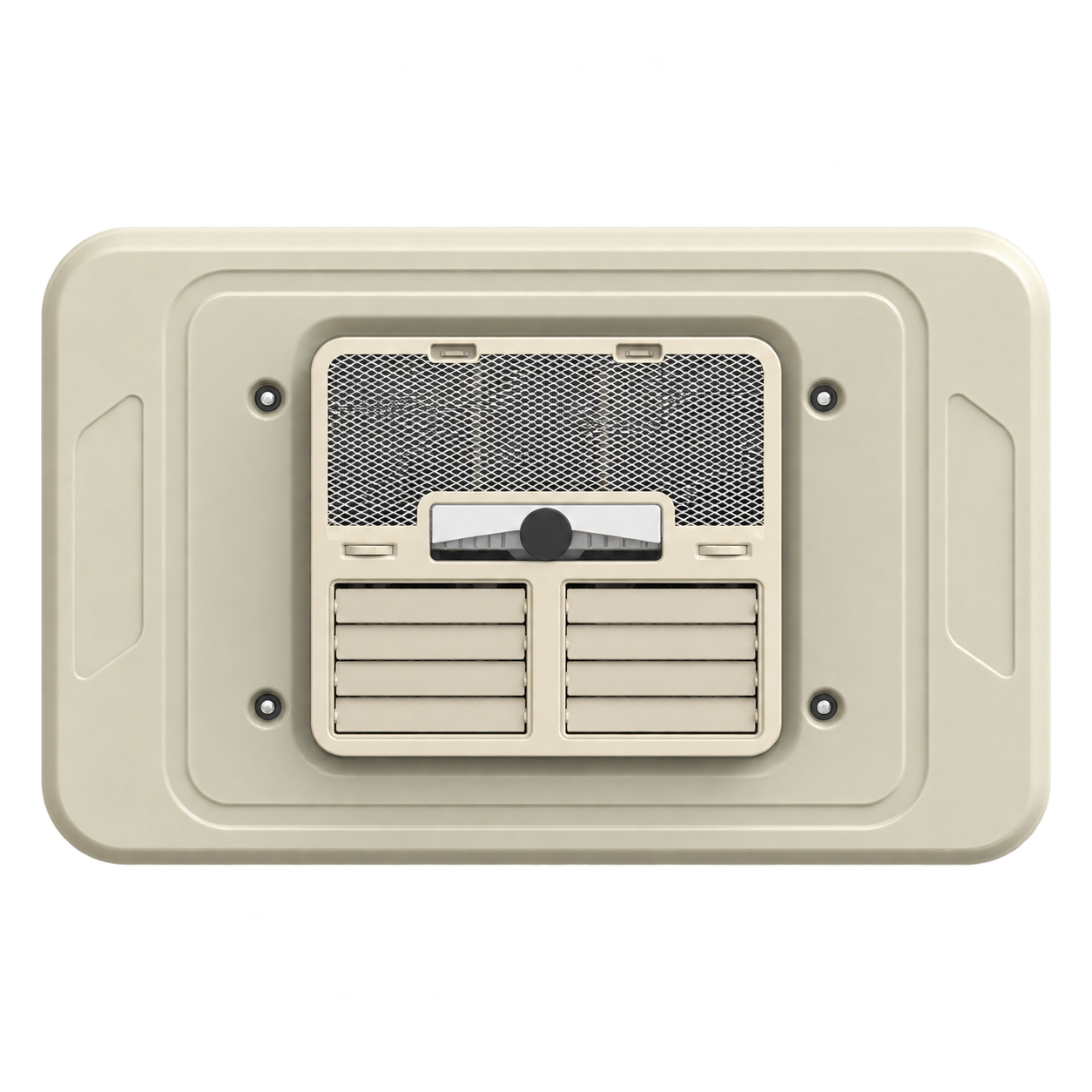
The supply path has to reach a real installation. CU2700's outdoor body measures 728 × 900 × 169 mm, with a 32.5 kg net weight reference. The indoor panel measures 860 × 550 mm, and the minimum opening reference is 380 × 490 mm. The installer should review structure, mounting, sealing and access for the actual vehicle.
The single brushless condenser fan has a listed 2500 m³/h outdoor airflow reference. The brushless evaporator fan has a 450 m³/h indoor reference. The roof and cabin layouts should preserve the appropriate air environments. A good electrical proposal should not be developed in isolation from those physical decisions, because the equipment position and access are part of the complete package.
For the buyer, coordinated planning means the selected CU2700 version, cable route, panel location and roof surroundings are considered together. The exact technical details come from the appropriate installation information and qualified team. The customer receives a reviewable package rather than separate quotations that leave the interface unresolved. This gives the product's quiet and energy-efficient positioning practical support through an orderly vehicle installation.
Observe representative operation without expanding its meaning
Where the project records installed electrical use, keep the conditions attached. Identify the CU2700 voltage version, cab arrangement, starting environment and period observed. State whether the observation covers the air conditioner alone or the complete auxiliary system. The technical team should determine what information is appropriate and how it is obtained.
The purpose is to inform the selected vehicle package, not to create a universal product claim from one limited observation. A result from a shaded evening stop should not silently become a promise for every sunny loading period. A number recorded with other equipment active should not be presented as though it belongs only to the air conditioner. Scope makes the information useful.
For fleets, retain the observation with the approved configuration. Later vehicles can be compared with that starting point, and meaningful differences can be identified before the package is repeated. The buyer benefits from a practical chain: a defined model, a realistic schedule, an assessed supply and a record of representative use. This is a stronger basis for confidence than a runtime calculated from whichever current endpoint produces the most attractive answer.
A representative observation is especially useful when its purpose is agreed beforehand. The team may want to understand the selected cooling routine on one cab, confirm how the supporting package is used or refine the handover for drivers. State that purpose in the record. The outcome can then guide the next practical decision without being stretched into a claim about every possible route.
For the customer, this is a confident way to proceed. The product is not left waiting for an abstract perfect data set; the supplier and installer prepare a defined package, then evaluate the relevant vehicle use. CU2700's source-supported features remain the reason it is on the shortlist, and the installed information helps the buyer decide where the same configuration can be repeated.
Give the driver an operating plan rather than a calculation
The driver should know the approved routine and what to do when it changes. The handover can explain the intended parking use, the relevant instructions for the supplied energy system and the contact path for a longer or different stop. It should not ask the driver to interpret current ranges while trying to rest.
Show the actual CU2700 controls using the delivered instructions. Demonstrate independent left and right electric oscillation from the seat and bunk, with normal curtains and bedding present. A clear air route helps the cooling package serve the occupied area. The driver can then use the product's practical features while the technical team retains responsibility for the electrical design.
This is an important benefit of a complete proposal. The selected air conditioner and supporting system are translated into an everyday routine. The source's qualitative quiet and energy-efficient positioning remains attached to the documented product, while the operating plan makes its use realistic for the vehicle. The driver knows whom to contact if the schedule changes or the normal result differs, and the workshop has the equipment and installation record needed to investigate.
Keep the purchase record clear for the next vehicle
A useful order description identifies CU2700, the voltage version, the cooling reference and the agreed installation scope. Retain the copper evaporator, condenser and piping description, the brushless single condenser fan and the Model A panel. Add the supporting supply configuration and the responsibilities for electrical work. The buyer should be able to recognize the package that was assessed.
For a fleet, keep route and recharge context with that configuration. Another truck may use the same air conditioner but need a review of the energy plan because its schedule differs. A changed roof accessory or interior storage unit may require a layout review instead. Clear records let the team focus on the relevant change without losing the stable product facts.
A distributor can use the same clarity in customer materials. The current ranges remain labeled references, the cooling capacities stay voltage-specific and no invented efficiency or duration is added. The real product strengths are enough to present a convincing option: a single-fan rooftop package with inverter twin-rotary architecture, copper refrigeration components, brushless air movement and adaptable indoor direction. A complete supply proposal makes that option practical for the customer's truck.
Consider two trucks with the same cab and CU2700 version but different return patterns. One recharges at a depot regularly, while the other has a longer interval between planned recharge opportunities. Their cooling product may be common, yet the supporting energy assessment should recognize the different schedules. This example shows why the current sheet and the route brief belong together.
The buyer can make the first inquiry more useful by stating those facts directly. Explain the platform, normal stop length, other active equipment and next recharge opportunity. The supplier and electrical team can then identify what further information they need. The discussion moves from an unsupported hours question to a concrete package the customer can review. That is the practical purpose of understanding the current references correctly.
Questions about CU2700 current references
Can the lowest current endpoint represent the whole night?
The supplied range is not a complete overnight profile. Keep the stated 35°C ambient condition and use appropriate operating information for the actual vehicle and schedule. The complete energy plan also needs other loads, usable energy, reserve and recharge opportunity before discussing the intended cooling period.
Does 2200 W or 2700 W describe battery draw?
Those are cooling capacity references for the 12V and 24V versions. The named 800 W rated-power field and current ranges are separate supplier references. They are not paired at one common declared point and should not be combined into an asserted efficiency or guaranteed duration.
Can one CU2700 version be used on any supply platform?
Choose the version around the actual electrical platform and complete installation design. A different supply arrangement is a separate technical decision, not an automatic feature of the product. Keep the voltage version visible in the quotation, vehicle record and supporting supply proposal.
What should the customer prepare for the electrical discussion?
Provide the vehicle and supply configuration, normal parking schedule, other regular loads, required reserve policy and next recharge opportunity. Include roof and interior photographs. These facts let the supplier and electrical designer connect the CU2700 references with a concrete vehicle package.
Turn the references into a usable supply proposal
CU2700 is worth considering when its documented inverter twin-rotary cooling, copper components, single brushless condenser fan and adaptable outlets fit the cab. Read its electrical fields clearly and connect them with the actual schedule and supporting system.
Send the vehicle and operating details through the VETHY contact page. Request a CU2700 proposal that identifies the voltage version, electrical responsibilities and intended rest routine. The next step should be a complete package that the buyer can assess and the driver can use confidently.
Product sources
VETHY product recommendation and application analysis. Specification references identify the selected model and voltage. Installation examples are planning examples; measured project results are identified explicitly when available.
Discuss your CU2700 application
Send your vehicle, supply voltage, occupied space, parking schedule and installation photographs for a model-specific recommendation.
Prepare your vehicle brief ↗