
VETHY / CU2700 / PRODUCT AND APPLICATION GUIDE
CU2700 Dimensions and Weights: Turn the Specification Sheet into a Vehicle Layout
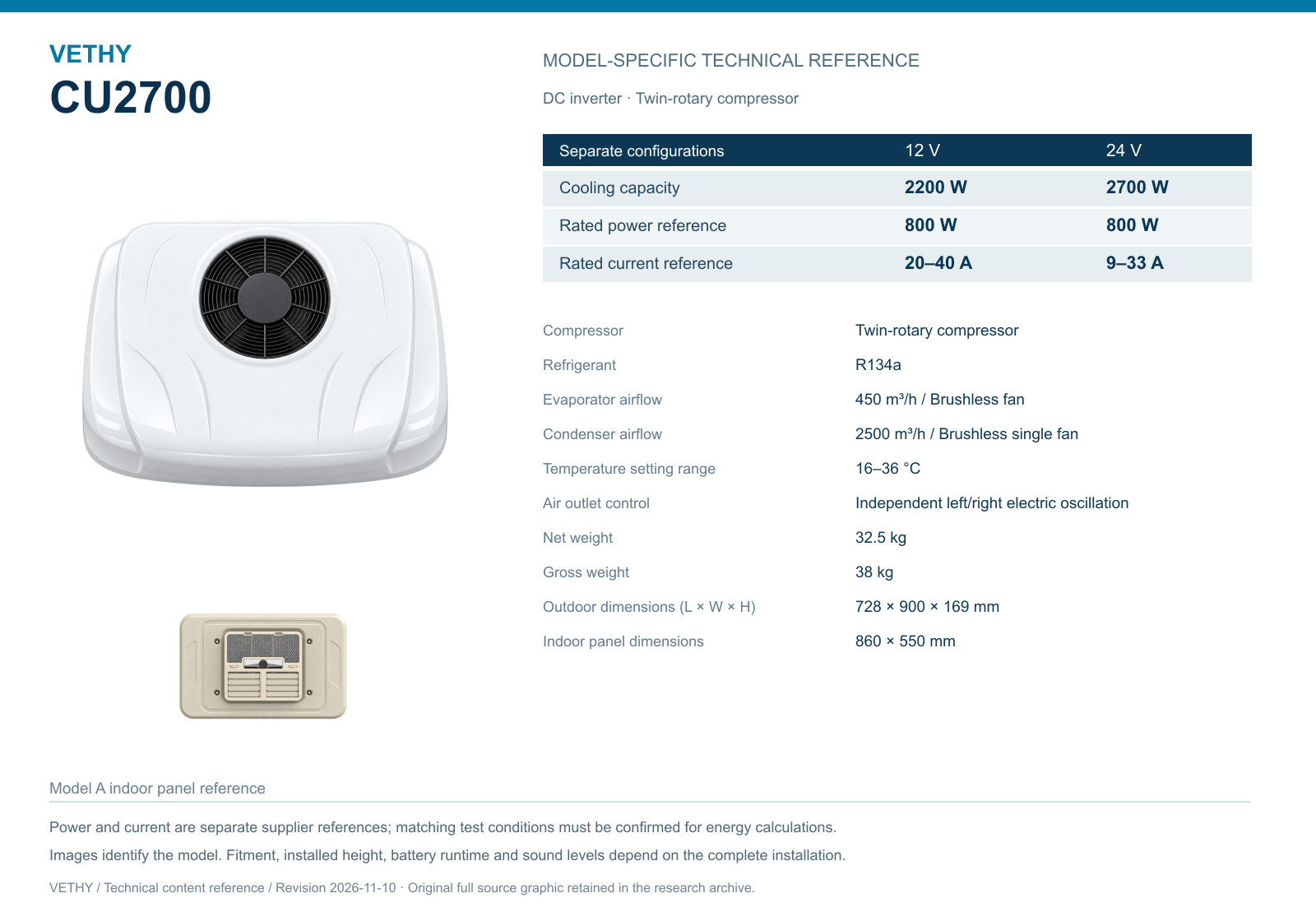
CU2700 lists a 728×900×169 mm outdoor assembly, an 860×550 mm indoor panel and separate net and gross weight references. Use each measurement for the question it describes. A vehicle installation also requires the correct roof interface, mounting and access information; shipping dimensions and gross weight belong to logistics planning rather than automatic installed-load assumptions.
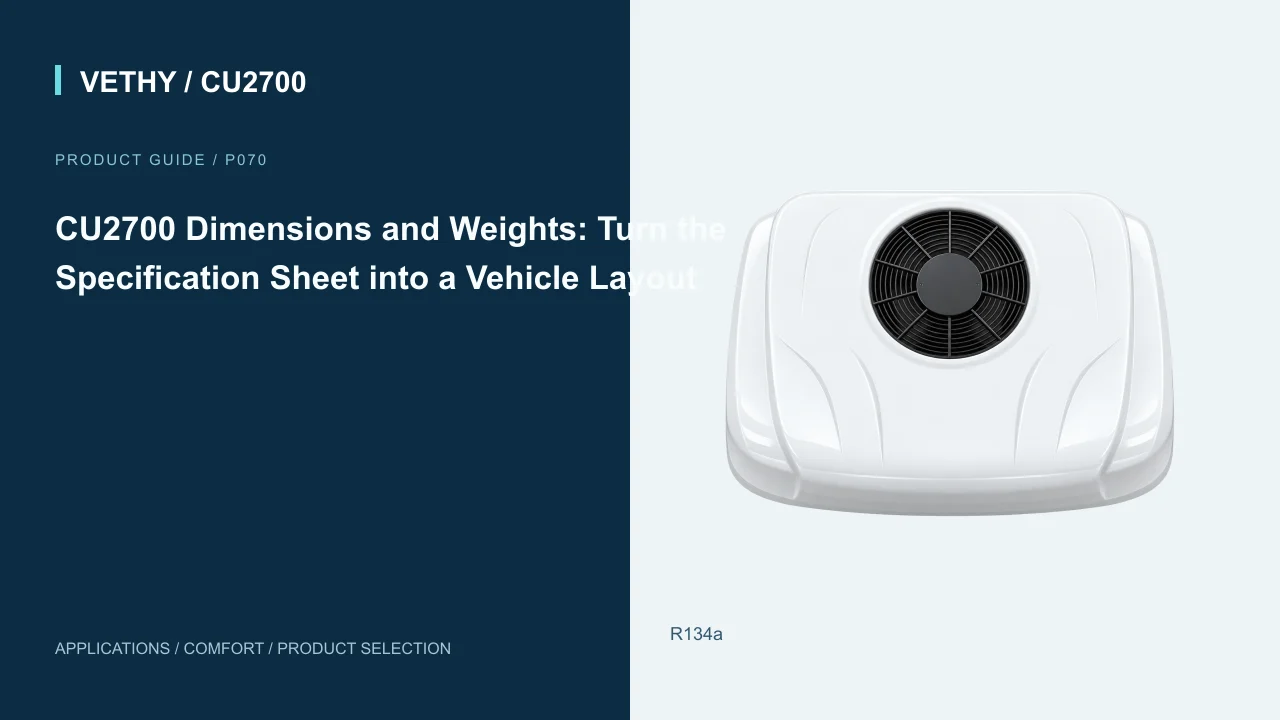
CU2700 offers useful physical references for a truck project: a 169 mm outdoor profile, a defined roof footprint and a Model A indoor panel. These details help a bodybuilder, installer or distributor move from product interest toward a reviewable layout. The single-fan R134a inverter twin-rotary package can be considered alongside the actual roof and occupied interior before an installation offer is finalized.
The specification sheet also contains dimensions and weights for different purposes. Knowing which reference answers which question makes the recommendation more useful. The outdoor assembly, indoor panel, opening and shipment each have their own role in the project, and the completed vehicle requires additional installation information beyond those individual measurements.
Begin with the object each measurement describes
A dimensional review becomes clearer when the team identifies the measured object before using the number. An outdoor housing envelope describes the assembly placed above the cab. An indoor panel reference relates to ceiling space. An opening reference concerns the roof interface, while package dimensions describe the shipment.
These references are connected, but they are not interchangeable. A customer may first send only the available interior space or only an outside roof photograph. The supplier can use that information to identify the next question, then request the missing view rather than assume the visible area describes the whole installation.
For CU2700, the benefit is a product whose physical identity can be explained clearly. The customer can see the single-fan assembly and matching panel alongside the relevant dimensions. That gives the layout discussion a concrete center and allows the installation review to develop around actual vehicle information.
Read the outdoor envelope in its stated order
The source identifies the CU2700 outdoor dimensions as 728 × 900 × 169 mm in length, width and height order. Retain those labels when preparing drawings or a quotation. Switching the first two values without explanation can confuse the relationship between a product image and the proposed roof layout.
In an early plan, the two horizontal dimensions give the housing's basic envelope. They help identify whether a plausible area exists and which neighboring roof items need attention. The product's required air and service provisions still need the appropriate installation information; they are not fully described by the enclosure rectangle.
Do not assume that the assembly can be turned to any orientation simply because a different rectangle would fit the available space. The permitted installation arrangement belongs to the relevant product information and vehicle assessment. A clear proposal shows the actual intended orientation and obtains the necessary review before the layout becomes an agreed installation.
Use the 169 mm height as a packaging reference
The outdoor height is a useful part of the CU2700 product presentation. It helps a customer consider an overhead cooling package where the appearance and physical profile matter. It should remain attached to the assembly identified in the specification, rather than become an unexplained promise about the finished truck.
Completed vehicle height also reflects the existing roof, mounting arrangement and other equipment. A fleet reviewing route or site clearances needs an appropriate assessment of the completed vehicle. The 169 mm reference provides one input to that assessment, but it does not independently resolve every clearance condition the vehicle may encounter.
This distinction supports a stronger recommendation. The salesperson can show exactly what the low-profile claim refers to and explain how the installation will be reviewed. A serious buyer then receives useful packaging information with a clear next step, rather than an attractive height number disconnected from the actual truck.
Place the Model A panel within the occupied interior
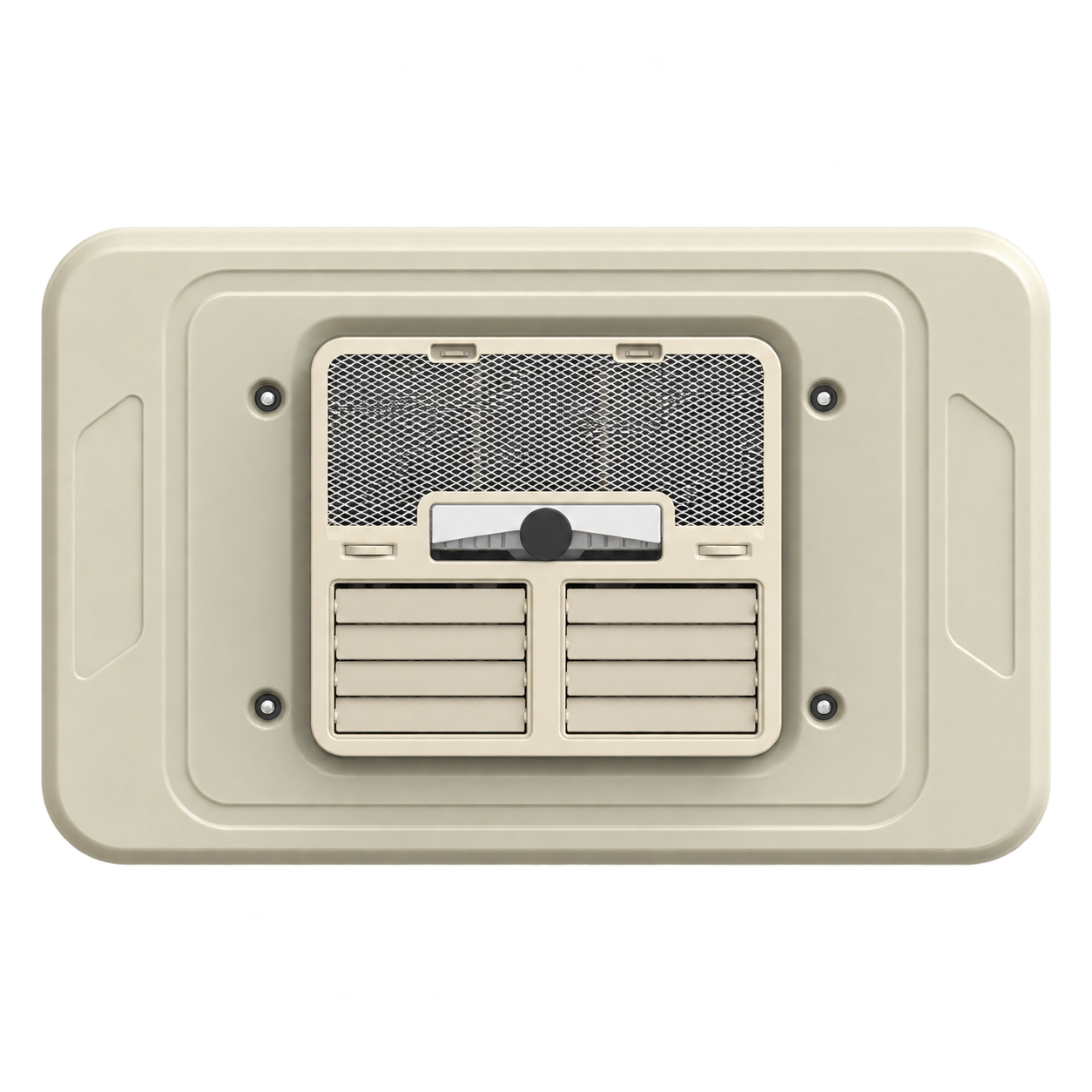
The indoor panel reference is 860 × 550 mm. Use it to discuss the available ceiling area, the relationship to storage and the places the driver normally occupies. The panel also provides independent left and right electric oscillation, so its position influences how useful that adjustment becomes around the bunk and seats.
An interior layout should include the normal curtain and bedding arrangement. A location that is convenient for the exterior housing may put the panel behind a curtain or close to an important storage feature. Review the two sides of the installation together so the physical arrangement supports useful cabin air delivery.
The panel measurement does not identify a universal roof-cutting size or all visible projection into the cabin. The source does not provide every detail needed for that conclusion. Obtain the correct installation drawing and keep the panel's stated dimensions in their own role as a packaging reference for the actual order.
Treat the opening reference as part of a roof-interface review
CU2700's source lists 380 × 490 mm as a minimum installation-opening reference. It is useful information for an initial conversation, but it does not approve cutting a particular vehicle roof without the appropriate installation and structural review. The existing roof arrangement and correct product information still matter.
For a retrofit, provide photographs and relevant information about any existing opening. A matching-looking dimension alone does not establish that the complete interface, mounting and sealing arrangement is suitable. The project needs to identify what is already present and what the supplied configuration requires.
The customer benefits from having this question addressed early. CU2700 can remain a worthwhile candidate while the team confirms the roof interface. The final recommendation then explains how the identified product will be fitted, rather than relying on a panel photograph or a remembered opening size from another unit.
Keep the physical references organized in one table
The following table summarizes the purposes of the source measurements. It can help a purchaser or workshop organize the vehicle information needed for a proper review.
| Reference | CU2700 source value | Appropriate planning role |
|---|---|---|
| Outdoor assembly, L×W×H | 728 × 900 × 169 mm | Initial housing envelope and roof packaging discussion |
| Indoor panel | 860 × 550 mm | Interior ceiling space and relationship to occupied positions |
| Minimum opening reference | 380 × 490 mm | Starting information for the correct roof-interface review |
| Net-weight reference | 32.5 kg | Product weight information whose measurement scope should be confirmed for engineering use |
| Gross-weight reference | 38 kg | Shipment and handling information, kept distinct from installed load |
| Packaging dimensions | 990 × 780 × 380 mm | Logistics-space planning for the supplied package |
This table is not a replacement for the installation drawing or a vehicle structural assessment. Its value is preventing one type of measurement from being used to answer an unrelated question. It also keeps the proposed CU2700 package recognizable when purchasing, workshop and logistics teams discuss the same order.
Confirm weight scope before calculating installed load
The source provides 32.5 kg net and 38 kg gross references. These are useful product and logistics facts, but the project should establish exactly what is included in the relevant weight before using it in a vehicle calculation. The installation may involve supporting parts and an arrangement whose scope is not described by a single table entry.
An engineer reviewing the roof needs the appropriate load information for the actual installed package and vehicle. A distributor reviewing a shipment needs the relevant packaged weight. These are different uses of the data. Treating gross shipping weight as the installed roof load, or assuming that a net reference includes every mounting item, can make an otherwise careful layout misleading.
The useful purchasing action is to request a clear configuration and scope. The supplier can identify the equipment included, while the responsible engineering team reviews the installation with the necessary information. This keeps the product's weight references useful without assigning them a meaning that the source does not establish.
Use package dimensions for the shipment they describe
The 990 × 780 × 380 mm packaging reference helps logistics teams discuss storage and transport space. It describes the package, rather than the installed product's roof footprint. Keep that distinction visible in warehouse and purchasing records so a shipping dimension is not accidentally copied into the vehicle layout.
For a simple planning calculation, the rectangular volume from those listed dimensions is approximately 0.293 m³. That is an arithmetic envelope, not a freight quotation, a chargeable-volume commitment or proof of a particular packing arrangement for every order. Actual shipping details should be confirmed with the supplied package and transport offer.
The benefit for a distributor is better coordination. The same product can have one set of information for installation and another for storage and shipment, with each reference clearly labelled. A complete offer then makes it easier for the customer to understand the equipment they will receive and the separate work needed to install it.
Translate dimensions into a vehicle sketch carefully
A useful sketch identifies the proposed CU2700 position, nearby roof equipment and the corresponding indoor panel location. Mark which dimensions come from the product and which have been measured on the vehicle. This simple distinction prevents a clean-looking drawing from hiding unverified assumptions.
Include the orientation and relevant surroundings rather than draw the air conditioner alone. A roof accessory, an interior cabinet or a curtain line can affect whether the arrangement is useful. The layout should serve the occupied cab as well as fit the enclosure on the roof.
The sketch is a communication tool for the review. It does not independently replace the appropriate installation documentation or vehicle engineering. Its value is that the supplier, installer and customer can discuss the same proposed arrangement and identify which details still need confirmation before the product is ordered or installed.
Keep photographs and measurements in complementary roles
Photographs are useful for identifying equipment and revealing the surrounding layout. Measurements provide numerical information about specific objects or spaces. A perspective image should not be used alone to infer exact dimensions, and a dimension without context may fail to show an obstruction that matters to the installation.
For a CU2700 enquiry, provide both roof and interior views. Show the proposed area, normal accessories and the relationship to the bunk or seat. If an existing opening is relevant, identify it clearly and supply the information needed for the proper interface review.
This makes remote discussion more efficient. The supplier can recognize the product and vehicle context while asking focused follow-up questions. The resulting recommendation is based on a shared understanding of the proposed layout, rather than an attractive product image placed into a drawing without enough information about the truck.
Include mounting and sealing in the complete package
The physical installation involves more than the visible housing and panel. The roof interface, support and sealing arrangement need to be appropriate for the product and vehicle. These details belong in the relevant technical information and the responsible installation process, rather than being improvised from a general product article.
A purchaser can still ask a useful scope question: which mounting and installation items belong to the proposed offer? If the supplier and workshop have different responsibilities, identify them clearly. The customer should understand which parts of the complete installation are included and which require separate confirmation.
This clarity supports the product recommendation. CU2700 can be presented as an identifiable cooling package with useful physical references, while the supporting work explains how it becomes a suitable vehicle installation. The buyer can review the actual offer instead of assuming that every part needed for every roof is established by the exterior photograph.
Retain access and air movement beyond the enclosure
The compact outdoor profile does not remove the need for appropriate access to the unit. Review the required air paths and service provisions with the correct installation information. A layout that fits the shell but obstructs the heat-rejection side or makes inspection difficult is incomplete.
CU2700's single brushless condenser fan has a 2500 m³/h reference, while indoor airflow is listed separately at 450 m³/h. The roof arrangement should support the outside function, and the panel location should serve the occupied interior. These two air paths belong to different parts of the cooling task.
The customer should understand the surrounding conditions that form part of the approved arrangement. If another roof accessory is added later, the layout may need to be reviewed against that reference. Keeping a record of the complete installation helps preserve the value of the original packaging decision.
Review different roof and interior configurations explicitly
A fleet can contain trucks with a common cab name but different roof accessories, trim or storage. The CU2700 enclosure dimensions remain the same reference, while the installation around them can differ. Grouping vehicles appropriately makes a rollout more manageable without assuming every truck is identical.
Use a representative layout for each relevant group and keep its scope visible. A later vehicle can then be compared with the reviewed arrangement. If a meaningful difference appears, the team has a clear reason to assess it rather than forcing the product into a location chosen for a different truck.
This is an important practical advantage of a documented product program. The model, physical references and supporting images remain consistent, while the installation process recognizes the actual vehicle. A serious fleet buyer can see how the recommendation will be repeated and where individual judgment is still required.
Connect the selected version to the layout record
CU2700 has separate 12V and 24V cooling references,2200 W and 2700 W respectively. Its physical records should remain associated with the actual configuration being ordered. A shared housing envelope does not make every electrical or cooling reference interchangeable across the family.
Keep the model and voltage with the layout, technical reference and installation scope. If a customer later requests a different version, identify the change and review the relevant requirements. The useful record is a complete configuration, rather than a drawing whose equipment description can silently drift between quotations.
This also helps after-sales communication. The service team can see which unit belongs to the vehicle and how it was integrated. The matching panel and outdoor photographs provide visual identification, while the technical information supplies the relevant numerical references. Together they support a product recommendation that remains understandable beyond the initial sale.
Use simple geometry without confusing it with installation approval
The listed horizontal enclosure dimensions give a rectangular plan envelope of approximately 0.655 m² when 728 mm is multiplied by 900 mm after conversion to metres. This is a geometric description of the published rectangle. It is not the complete roof area required once the actual mounting, air and access provisions are included.
The 860 × 550 mm panel reference similarly describes a rectangular area of approximately 0.473 m². The 380 × 490 mm opening reference corresponds to about 0.186 m². Those calculations illustrate that the enclosure, panel and opening are different physical references. They should not be exchanged merely because all three appear on the same specification sheet.
For a bodybuilder, the useful next step is a properly identified layout with the relevant drawing information. A calculated area does not establish roof strength, permitted orientation or an acceptable location. The value of the arithmetic is clarity: it shows exactly which source dimensions have been used and keeps the different parts of the package visible in the engineering conversation.
Ask what belongs to the package before planning a repeat shipment
A distributor may use the CU2700 gross-weight and package-size references to prepare a warehouse or transport discussion. Confirm the actual pack-out and items included for the order before relying on the reference for a repeated shipment. Product identification, voltage version and included supporting equipment should remain aligned with the commercial offer.
The difference between a listed net and gross reference should not be treated automatically as the weight of one particular packaging component. The measurement scope must be understood first. Likewise, a calculated rectangular package volume does not determine every transport handling requirement or the final freight offer. These figures are useful inputs to a complete logistics conversation.
This clarity also helps the customer receiving the equipment. The shipment description and installation description should identify the same CU2700 configuration, while keeping their different measurements labelled. The owner or workshop can then distinguish what arrived in the package from the technical information needed to fit the product to the vehicle.
Keep one complete layout record with the chosen installation
After the review, retain the source dimensions, vehicle information and agreed configuration together. Include the relevant photographs and identify any drawing that defines the roof interface. If a provisional dimension was resolved during the process, make the final reference clear so an old sketch is not reused as if it described the completed arrangement.
The purpose is practical continuity. A later workshop, fleet engineer or owner can understand the installed product and the reasoning behind its location. That record makes CU2700's documented packaging advantages more useful over time because the numbers remain connected to an identifiable vehicle layout rather than a detached product table.
Questions about CU2700 dimensions and weight
Is 169 mm the guaranteed increase in completed vehicle height?
It is the published outdoor assembly height. The completed vehicle result also depends on the existing roof and mounting arrangement. Use an appropriate assessment of the actual installation when overall vehicle clearance matters, rather than applying the product dimension alone as a universal answer.
Can the indoor panel size be used as the roof-opening size?
The panel and opening references describe different parts of the package. Use the correct installation drawing and vehicle review for the roof interface. The 860 × 550 mm panel reference helps with interior packaging, while the source's separate opening information has its own role in that assessment.
Should the gross weight be treated as the installed roof load?
Gross weight belongs to the packaged-shipment reference. The engineering review needs the relevant installed-load scope for the actual configuration and supporting arrangement. Confirm what the supplied weight includes rather than automatically substituting a logistics value into a structural calculation.
What information helps turn the specification into an offer?
Provide the vehicle, selected voltage, roof and interior photographs, relevant measurements and normal accessories. Identify any existing opening and the intended panel area. These details help VETHY connect the CU2700 physical references with an installation scope that the customer and workshop can review.
Use the physical data to make the recommendation concrete
CU2700's dimensions, panel reference and separately labelled weights provide useful tools for a serious product discussion. Their value grows when each is used for the purpose it describes and connected to the actual truck. Explore the CU2700 product library or prepare a vehicle-specific brief so the single-fan rooftop package can be considered within a complete, understandable layout.
Product sources
- VETHY CU2700 model-specific technical specifications — VETHY.
- CU2700 technical reference sheet — VETHY.
VETHY product recommendation and application analysis. Specification references identify the selected model and voltage. Installation examples are planning examples; measured project results are identified explicitly when available.
Discuss your CU2700 application
Send your vehicle, supply voltage, occupied space, parking schedule and installation photographs for a model-specific recommendation.
Prepare your vehicle brief ↗