
VETHY / CU2700 / PRODUCT AND APPLICATION GUIDE
CU2700 Condenser Clearance in a Crowded Commercial Vehicle Roof
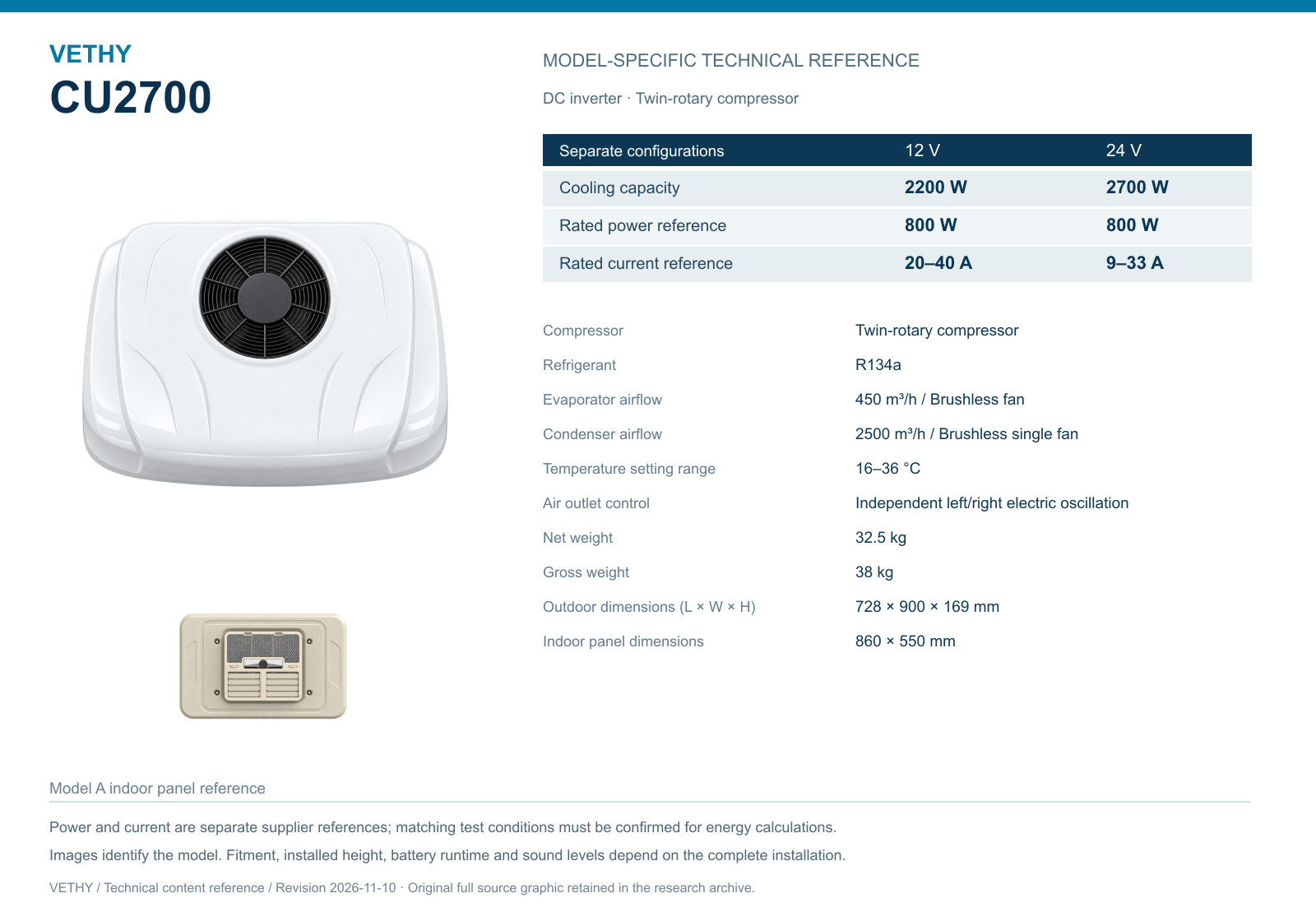
CU2700 needs a roof arrangement that accommodates its 728×900×169 mm outdoor assembly and the required air and service paths. Its 2500 m³/h single-fan condenser reference does not establish a universal clearance. Review the correct installation information with every normal roof accessory present, then confirm the completed layout rather than judging fit from the housing dimensions alone.
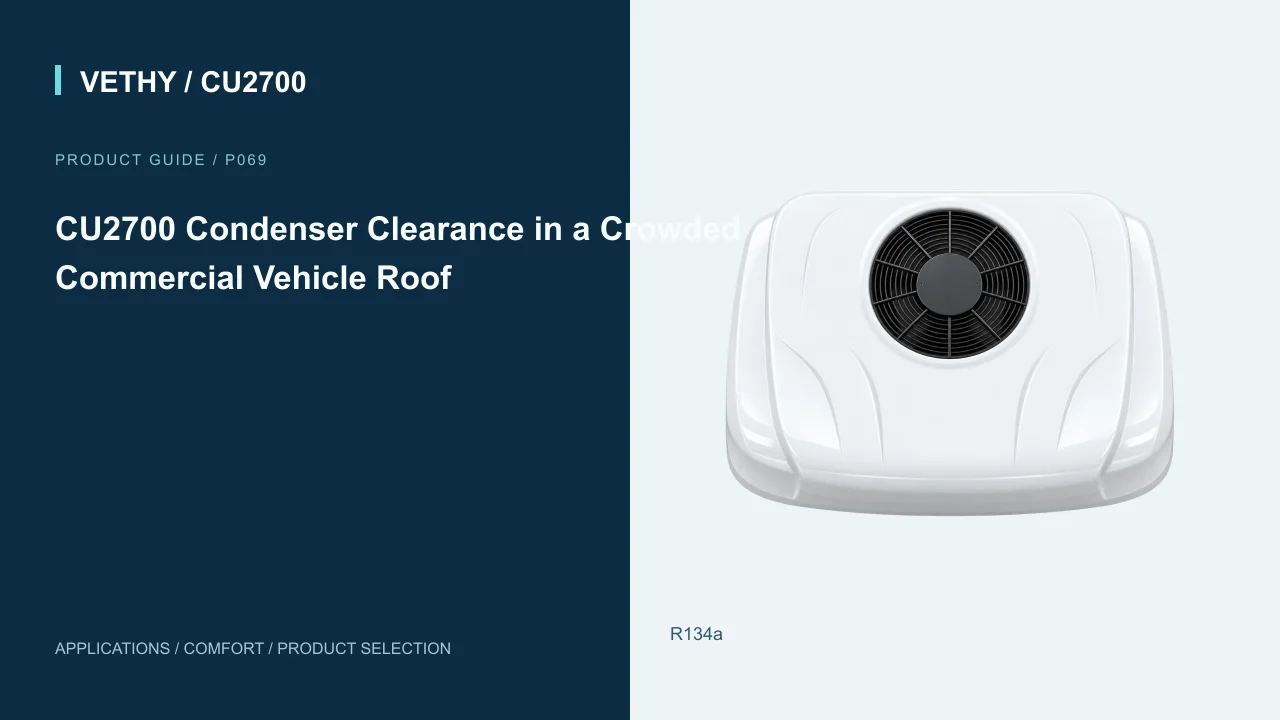
CU2700 can be an attractive rooftop parking-cooling choice when the truck needs a defined single-fan assembly and an interior panel serving the occupied cab. Its 169 mm outdoor profile provides a useful packaging reference. To realize that benefit, the installation must also give the heat-rejection side appropriate access to outside air and preserve a practical route for service.
This becomes especially important on a roof already carrying solar equipment, racks or communications hardware. The objective is to recommend a complete arrangement around CU2700, not simply find a rectangle into which the housing fits. A clear roof plan helps the customer understand why the selected product belongs there and what surrounding conditions the cooling package needs.
Survey the truck as it is used during work
An empty roof photograph may leave out equipment that normally travels with the vehicle. A rack can carry different items during a working week, and a removable accessory may be present throughout the driver's parking periods. Include those ordinary conditions in the survey so the proposed air conditioner is assessed in the environment it will actually occupy.
Ask which roof items remain fixed, which can move and which are expected to be added. The installer can then review the CU2700 position against the complete arrangement. This prevents a convenient demonstration layout from becoming an assumption that later proves unsuitable for the customer's normal vehicle use.
The benefit is a more useful recommendation. The customer sees the product as part of a working truck, with its roof surroundings understood. That makes a packaging discussion more credible than presenting the air conditioner in isolation and leaving every accessory conflict for the installation workshop to resolve after purchase.
| Roof-survey item | Information to provide | Decision it supports |
|---|---|---|
| Proposed AC position | Roof and corresponding interior views | Whether the package serves the intended occupied area |
| Solar equipment | Installed positions and planned additions | Coordinated space, air access and service review |
| Rack | Normal load and how its position changes | Assessment of the working roof arrangement |
| Other accessories | Locations and relevant access needs | Identification of neighboring-equipment conflicts |
| Existing opening | Appropriate dimensions and photographs | Vehicle-specific roof-interface review |
| Maintenance approach | Normal surrounding equipment | A serviceable completed installation |
Understand the outside function being protected
The condenser belongs to the heat-rejection side of the cooling system. CU2700 identifies a single brushless condenser fan and a 2500 m³/h condenser airflow reference. This outside air path performs a different task from the cabin circulation associated with the 450 m³/h evaporator reference.
The two airflow values should therefore remain separate in the product explanation. The larger outdoor number is not fresh air supplied to the sleeper, and it should not be added to the indoor reference to create an impressive but meaningless total. Each value helps describe a different part of the complete cooling package.
For a crowded roof, the practical question concerns the surrounding air route. The assembly needs the arrangement specified by the appropriate installation information. A fan visible in the photograph is useful for identifying the unit, but the photograph alone should not be used to invent intake, discharge or service-clearance requirements.
Start with the published enclosure dimensions
The CU2700 outdoor envelope is 728×900×169 mm. Use those dimensions for early packaging screening alongside the roof survey. They help identify whether a plausible area exists for the assembly and which nearby accessories deserve attention in the next stage of review.
The enclosure rectangle does not describe every space the finished installation needs. Access to air and service items extends the planning question beyond the outer edges of the housing. The roof interface and mounting arrangement also depend on the actual vehicle and the supplied installation information.
The product's low profile remains a meaningful feature to recommend, provided it is described accurately. It is the stated height of the outdoor assembly, not the completed height added to every truck in every installation. A professional proposal can show the enclosure dimension and then identify how the full vehicle arrangement will be confirmed.
Keep opening and panel dimensions in separate roles
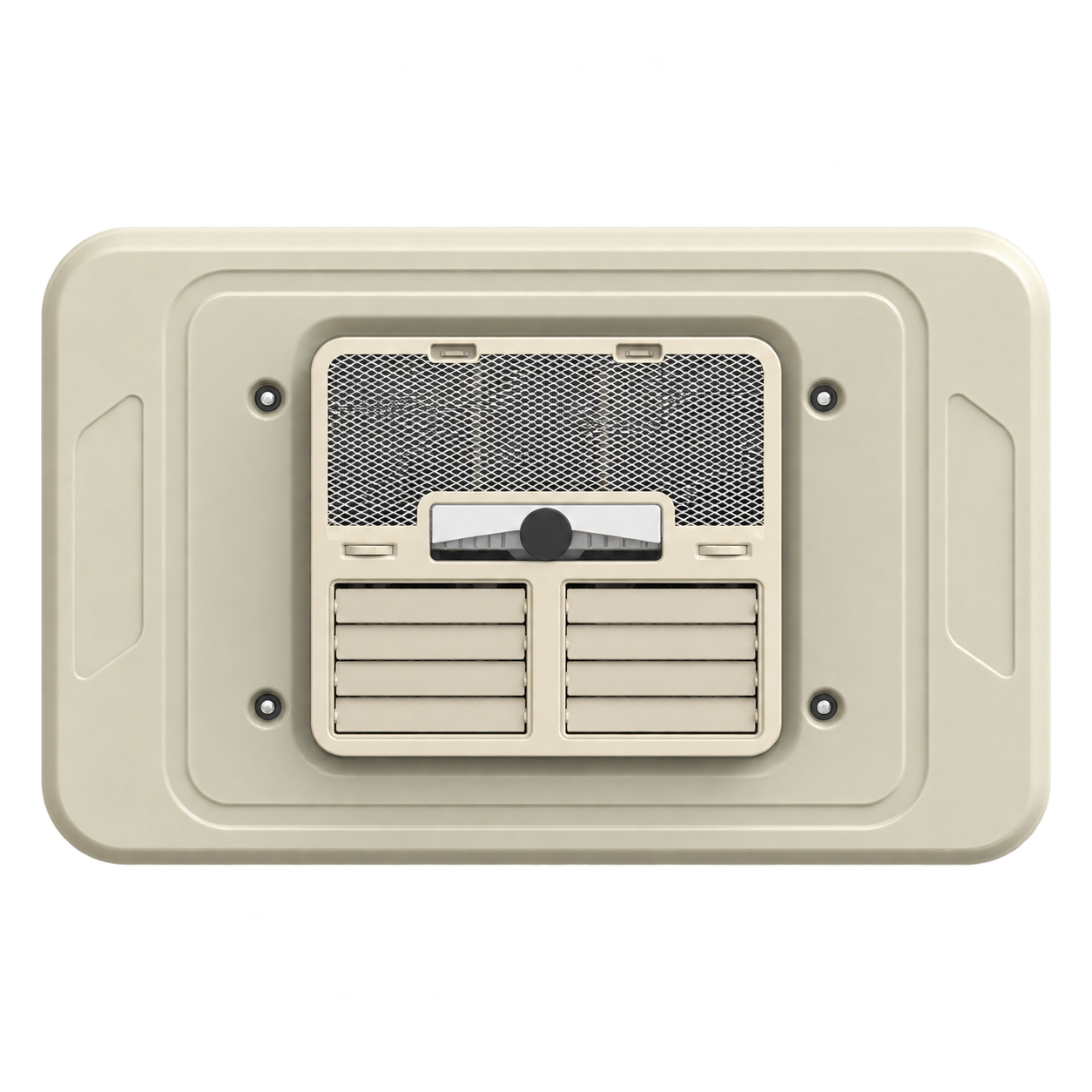
The Model A indoor panel reference is 860×550 mm. The source also provides a 380×490 mm minimum installation-opening reference. These measurements concern different parts of the package and should not be interchanged when someone reviews a roof photograph or prepares an installation enquiry.
A panel's visible size does not approve a particular opening in a truck roof. The correct drawing and vehicle assessment are needed for the actual order. This is especially relevant when the proposed position is close to an existing hatch, structural feature or interior fitting that cannot be understood from the outside image alone.
Show both the roof and interior in the project information. The installer can then discuss a position that supports the panel's air delivery while forming a suitable exterior installation. The customer receives a complete layout recommendation rather than a claim that one published dimension resolves every part of fitment.
Identify the relevant air paths from the correct information
For the ordered CU2700 configuration, obtain the appropriate installation guidance and identify the intended intake and discharge arrangement. Use that information to assess nearby objects. The customer should not be asked to infer the complete air route from the shape of a grille in a product photograph.
This distinction is useful in a sales conversation because photographs are excellent at showing identity and general packaging. They are less useful for establishing hidden interfaces or exact installation requirements. A clear recommendation uses each kind of evidence for the question it can answer.
Where an accessory position remains uncertain, keep it visible as an open layout decision. The supplier or responsible installer can review the necessary information before the arrangement is fixed. That is a practical way to move the enquiry forward while keeping the final installation connected to the real product and vehicle.
Consider obstructions beyond the housing footprint
An object near the assembly can matter even if it does not physically touch the shell. It may affect access to the intended air route, make inspection difficult or change how the surrounding roof is used. Review the complete nearby arrangement rather than checking only for contact between two housings.
Avoid assigning a universal gap from a general article. The required provisions belong to the relevant product and installation information. A useful roof plan identifies the objects, their positions and the conditions under which they are present, allowing the appropriate review to be made for this configuration.
CU2700's single-fan layout remains a clear product choice within that process. The buyer knows which assembly is being considered, while the roof review determines how it will be accommodated. This is a more substantial recommendation than assuming that a compact unit is unaffected by whatever equipment surrounds it.
Review the direction of neighboring equipment
Some roof accessories have their own operating or access needs. A vehicle may include another vent, a cable route or equipment whose position changes during use. The integration review should consider those relationships together with the CU2700 installation, rather than treat each item as an isolated purchase.
The question is not simply whether all items fit on a flat drawing. Consider what each assembly needs while operating, being inspected or being accessed appropriately. A roof can appear uncrowded in an image yet still present a practical conflict when normal service activities are considered.
Use a coordinated layout discussion to resolve those conflicts. The recommendation can then explain why the proposed CU2700 location is suitable within the wider arrangement. That gives the customer a clearer understanding of the installed product and reduces reliance on assumptions passed between separate equipment suppliers.
Plan solar equipment as part of the same roof
A solar-equipped vehicle may offer an appealing combination of electrical generation and parked cooling. The roof still needs to accommodate both systems appropriately. The physical area assigned to panels and supporting hardware should be reviewed with the air conditioner's enclosure, air route and service access in mind.
Do not treat a panel's location only as a question of available square area. Consider the full arrangement required by the relevant installation information and the equipment that will actually be fitted. Changes to the solar layout after the cooling unit is installed should also be reviewed for their effect on the air-conditioning arrangement.
The energy question remains separate from physical fit. A solar installation's nominal rating does not establish how long CU2700 will operate during a particular stop. A complete vehicle plan considers generation, usable storage, other loads and the cooling assignment, while the roof plan ensures that the equipment can occupy the same vehicle appropriately.
Include racks and their normal loads
A rack shown without its ordinary load may give an incomplete picture of the roof. Ask what is normally carried, how the items are secured and whether their positions vary. The installation team can then assess the air-conditioning layout against the working arrangement rather than a temporarily cleared display condition.
The owner should understand which surrounding conditions form part of the approved installation. If the load or accessory changes materially, the air-conditioning relationship may need review. This does not mean the product cannot share a roof with other equipment; it means the shared arrangement should be deliberate and documented.
For CU2700, that approach supports the value of a defined single-fan package. The product can be recommended with a clear place on the truck, while the customer knows what has been considered. The eventual photograph of the completed arrangement becomes a useful ownership reference rather than merely a delivery image.
Preserve a practical approach for maintenance
An installation should remain serviceable with the vehicle's normal equipment fitted. Consider how a technician will approach the unit and use the appropriate service procedures. A location that appears convenient during a one-time installation can be less useful if ordinary inspection later depends on removing equipment that the truck routinely carries.
The exact access requirements should come from the correct technical information. A general guide should not invent a clearance or a service interval for the unit. It can help the owner ask the right layout question before the supporting roof equipment is positioned permanently.
This is a genuine purchasing benefit of coordinated installation planning. The customer is choosing more than an attractive outdoor shell: the proposal explains how the assembly will remain accessible within the truck's actual surroundings. That clarity supports everyday ownership and gives the service team a useful record when the vehicle returns to a workshop.
Check completed vehicle height through the actual arrangement
The 169 mm product height is one reference within the vehicle-height assessment. The completed result also depends on the roof geometry, mounting arrangement and other fitted equipment. It should not be used alone to promise that the truck meets every route or site clearance the customer may encounter.
The fleet or owner should keep the relevant vehicle information current after accessories are installed. Where route or premises clearances matter to the assignment, the responsible team needs an appropriate assessment of the completed vehicle. The air conditioner's enclosure dimension is an input, not the entire answer.
CU2700's profile can still be a positive reason to consider it. The recommendation simply remains specific: this is the published outdoor assembly height, and the installation will be reviewed within the real roof arrangement. Accurate packaging information is more useful to a serious buyer than a broad fit claim that ignores the rest of the truck.
Use photographs to make the survey efficient
Good project photographs can help the supplier understand the roof quickly. Include the proposed area, nearby accessories and an interior view showing the relationship to the sleeper. If dimensions are supplied, identify what they describe and how they relate to the visible arrangement.
Do not infer precise dimensions from perspective alone. A photograph can show an obstruction or identify an assembly without proving the exact space available. Measurements and the correct installation information remain necessary for the final layout. Keeping these roles distinct makes remote discussion more productive.
For a fleet, use a consistent set of views across the vehicle groups being considered. The team can recognize when two trucks share relevant characteristics and when a difference deserves attention. CU2700 can then be discussed within identifiable configurations rather than assumed to fit every roof represented by the same cab name.
Retain the model and configuration in the roof record
The roof plan should identify CU2700 and the selected 12V or 24V version. It should also retain the matching outdoor image and Model A panel information. This keeps the physical layout connected to the equipment that was reviewed, rather than an unspecified rooftop cooler with a similar appearance.
Related products can share some dimensions while differing in refrigerant, capacity references or airflow arrangements. A familiar housing size is not sufficient reason to substitute another model's data or assume that every installation provision is interchangeable. The supplied configuration and appropriate documentation determine the actual equipment being offered.
This identity record is useful if the customer later orders another unit or modifies the vehicle. The supplier can see which arrangement was considered and which product belongs to it. A clear configuration reference supports a repeatable program without pretending that subsequent vehicles or accessories never require an individual review.
Recheck the completed roof after all accessories are fitted
The final review should represent the arrangement the customer will actually use. If the air conditioner was installed before other roof equipment, assess the completed surroundings rather than relying only on the earlier cleared-roof observation. Retain the correct installation requirements as the basis for that review.
Where a representative comfort or operating assessment is performed, identify the configuration and relevant conditions. A cold-air impression at the panel does not independently confirm every aspect of the outside layout. The evaluation should answer the actual project questions, including any changes introduced by the full accessory arrangement.
The result can be recorded with photographs and a short explanation of the approved configuration. This gives both the owner and workshop a reference for future changes. It also connects the product recommendation to a completed installation the customer can inspect, rather than leaving the roof layout as an assumption behind the quotation.
Keep later changes visible to the support team
The roof may evolve after the original installation. A new rack, antenna or solar arrangement can change the surroundings the cooling unit was assessed within. The owner should retain enough information to identify that change when asking for an application or service review.
A useful report names the CU2700 version, describes the modified equipment and includes photographs showing the current arrangement. It does not require the owner to diagnose the refrigeration system. The appropriate support route can determine what review is needed using the correct product and installation information.
This is part of a supportable cooling package. The product remains identifiable, the layout has a history and the customer knows how to discuss a meaningful change. Those practical details help preserve the value of the original recommendation through ordinary vehicle modifications.
Compare two apparently similar trucks before repeating the layout
Imagine a fleet with two trucks carrying the same cab name. The first has a relatively open roof and a sleeper arrangement already reviewed with the installer. The second carries solar equipment and additional interior storage. CU2700 may be worth considering for both, but the first truck's layout record does not automatically answer the second truck's packaging questions.
For the second vehicle, bring the accessory and interior information into the same discussion. Review the proposed panel relationship, outside air access and service approach using the correct installation information. The common 728×900×169 mm product envelope remains useful, while the different surroundings explain why the completed arrangement needs its own attention.
The fleet can retain the common equipment identity without pretending that every supporting detail is identical. If the layout can be appropriately repeated, the record should show that conclusion. If a different arrangement or further information is needed, keep the open item visible in the project scope. This gives the purchasing team a practical route forward rather than an unexplained fit claim or a general rejection of the product.
The scenario illustrates a positive reason to buy a defined cooling package. CU2700's model-specific data and matching photographs make comparison possible, and the vehicle review identifies how that equipment will be used. A clear recommendation can then state which trucks and arrangements the offer covers. The customer understands both the product's place in the program and the information needed before expanding it to another vehicle configuration.
Preserve the reason for the selected roof position
Alongside the final photographs, retain a short explanation of the choice. It might identify the relationship to the indoor panel, the surrounding equipment considered and the service route reviewed. That record helps a future owner or workshop understand why the assembly was placed there. It is especially useful when a later accessory proposal would change the roof arrangement that supported the original cooling recommendation.
Questions about CU2700 roof clearance
Can I use the housing dimensions as the entire required space?
The 728×900×169 mm envelope describes the outdoor assembly. Air access, mounting and service provisions require the relevant installation information and vehicle review. The complete arrangement can need consideration beyond the housing edges, so the enclosure dimensions are an early packaging reference rather than universal installation approval.
Does the product photograph establish airflow direction and clearance?
It identifies the assembly and general packaging. Use the correct installation documentation for intake, discharge and access requirements. A visible fan or grille should not be used alone to invent an airflow route or a fixed gap that is then applied to every truck.
Can CU2700 share a roof with solar panels or racks?
That is a vehicle-specific layout question. Review the actual equipment, normal rack loads, required air paths and maintenance access together. The product's compact profile is useful information, while the complete arrangement determines whether the proposed shared roof is appropriate.
What helps VETHY review a crowded roof efficiently?
Provide the vehicle, voltage version, roof photographs, relevant measurements and the equipment normally carried. Include the interior relationship to the proposed panel. Explain planned accessory changes as well, allowing the supplier to discuss CU2700 within the full installation rather than a temporarily empty roof.
Recommend a layout that supports the cooling package
CU2700 offers a defined single-fan rooftop assembly with useful packaging references and an identifiable cabin-distribution package. Its value is strongest when the roof layout supports the required outside air and service paths while serving the occupied interior. Explore the CU2700 guides or send a vehicle-specific brief to develop a complete recommendation around the truck's actual roof.
Product sources
- VETHY CU2700 model-specific technical specifications — VETHY.
- CU2700 technical reference sheet — VETHY.
VETHY product recommendation and application analysis. Specification references identify the selected model and voltage. Installation examples are planning examples; measured project results are identified explicitly when available.
Discuss your CU2700 application
Send your vehicle, supply voltage, occupied space, parking schedule and installation photographs for a model-specific recommendation.
Prepare your vehicle brief ↗