
VETHY / VX3000SP / PRODUCT AND APPLICATION GUIDE
VX3000SP for US 12V Semi-Trucks: A Split Cooling Product Guide
VX3000SP is worth shortlisting for a U.S. 12V semi-truck when separate indoor and outdoor placement fits the vehicle. It lists 7000 BTU/h cooling, 550 m³/h airflow, automatic oscillation and qualitative ultra-quiet positioning. Match the split installation, occupied air path and engineered supply to the actual truck and parking routine.
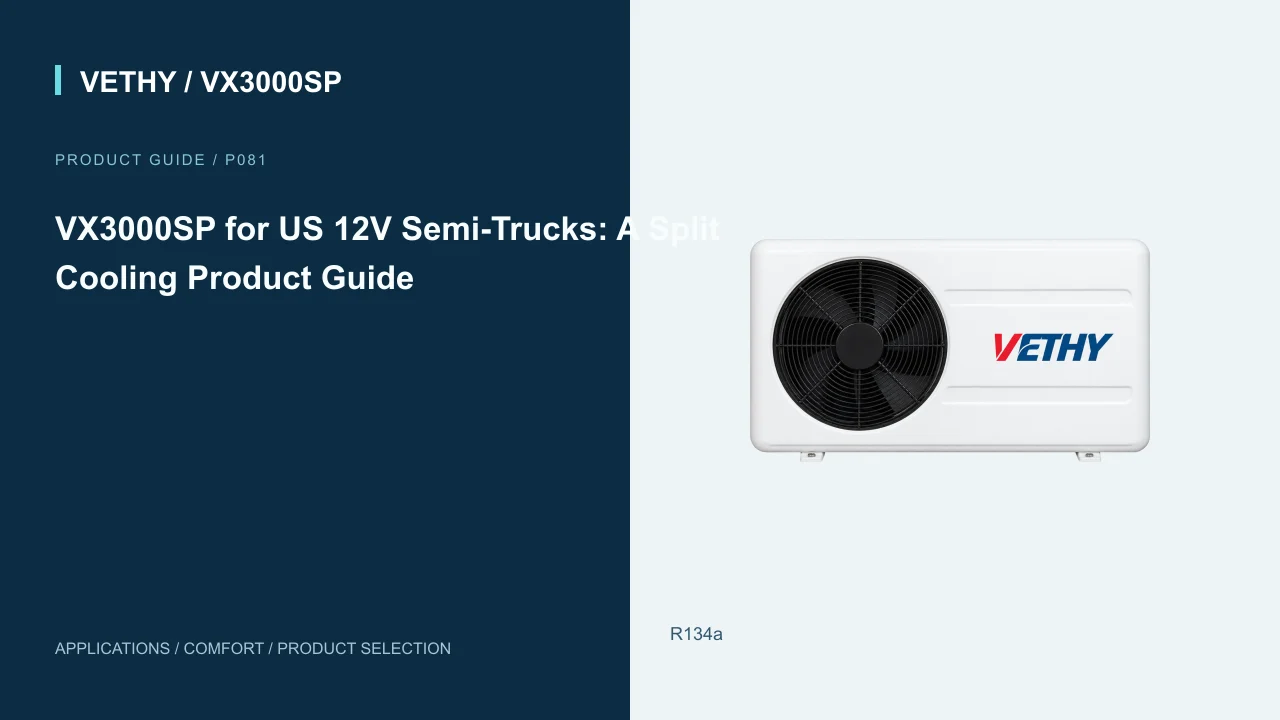
VX3000SP deserves a place on a U.S. 12V semi-truck parking AC shortlist when the vehicle project favors a split layout and a calm sleeper environment. The model combines a separate indoor and outdoor arrangement, R134a rotary cooling, 550 m³/h airflow and automatic oscillation. Its 12V manufacturer cooling reference is 7000 BTU/h, and the supplied product information positions it as ultra-quiet in qualitative terms.
The recommendation is especially useful when the buyer wants to review indoor comfort and outdoor placement as two connected decisions. The indoor unit can be considered around the bunk and occupied cab, while the outdoor unit is assessed at a suitable separate location. The complete installation still needs proper mounting, air access, connection routing and an engineered electrical supply.
For an owner-driver or fleet buyer, the practical question is whether that split package serves the actual truck and parking routine. This guide explains why VX3000SP can be a strong candidate, how to read its 12V references and what makes a useful proposal for a real semi-truck rather than a generic claim of universal compatibility.
1. Choose split cooling for a clear vehicle reason
A split parking air conditioner creates a different layout opportunity from a rooftop package. VX3000SP allows the indoor and outdoor assemblies to be considered separately within the vehicle design. That can be useful when the roof is not the preferred AC location or when another exterior area offers a suitable mounting opportunity.
The advantage is placement choice within a complete engineered installation. The buyer can discuss the bunk relationship without assuming the outdoor unit must occupy the same overhead location. At the same time, the outdoor mounting and connecting route must remain practical and consistent with the applicable product requirements.
Begin with the actual truck. Show the sleeper interior, existing roof equipment and possible outdoor locations. A product name associated with U.S. semi-trucks does not establish fit for every cab or mounting bracket, so a vehicle-specific proposal remains valuable even when the overall split concept is attractive.
This makes the VX3000SP recommendation more convincing. The model is being chosen because its architecture serves a real vehicle preference, supported by documented cooling and airflow. The customer can see the reason for the product choice and the work needed to turn it into a usable parked-cab package.
2. Keep the 12V product identity precise
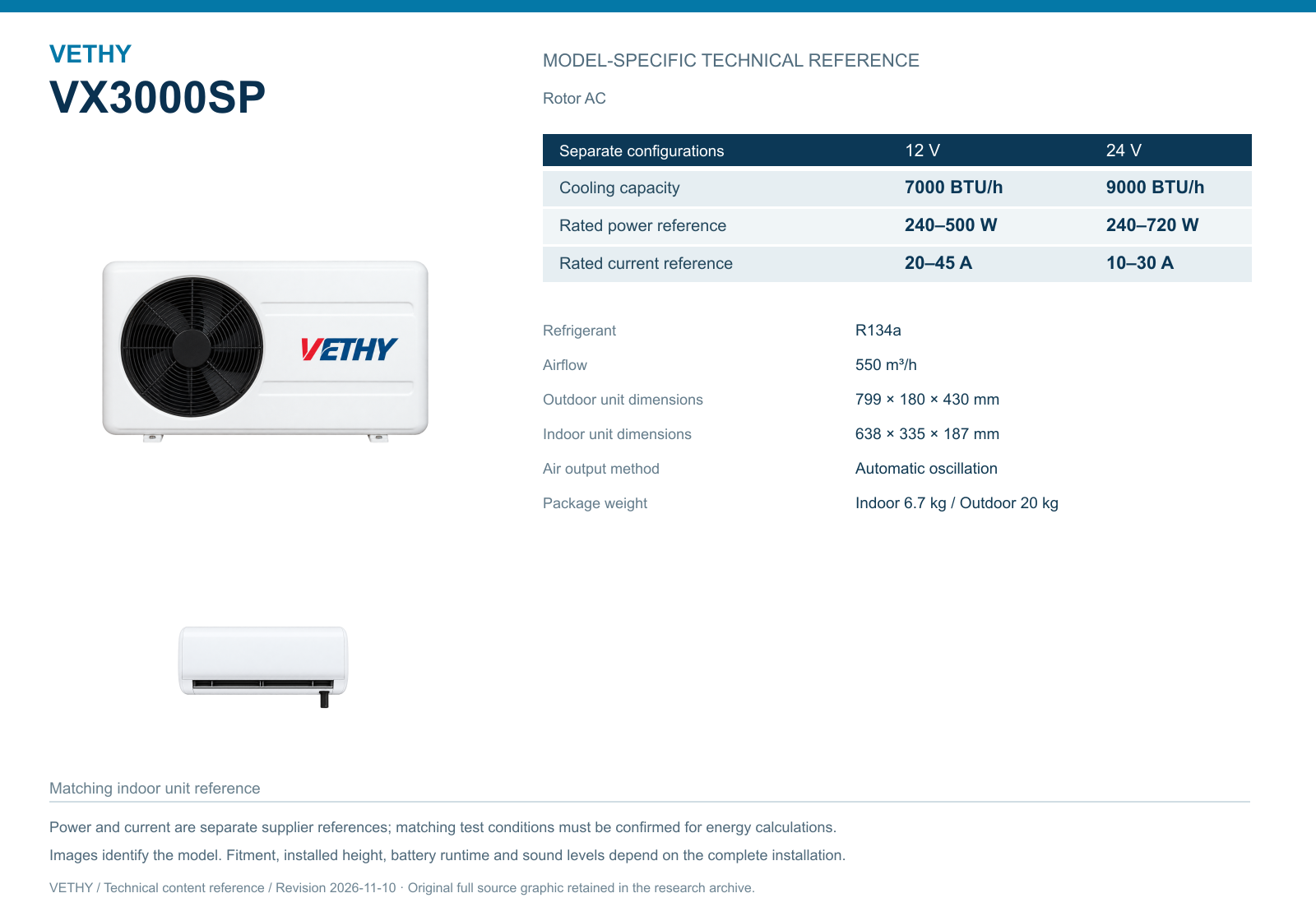
The 12V VX3000SP lists 7000 BTU/h cooling, a manufacturer rated power reference of 240–500 W and a separate rated current reference of 20–45 A. The refrigerant is R134a, and the product technology is described as rotary AC. These details form the core identity for the U.S. 12V proposal.
The source does not provide a watt cooling-capacity field, so this guide retains the supplied BTU/h reference without creating a new capacity number. It also does not establish compressor brand, cylinder count or inverter architecture. Those attributes should not be transferred from a different model to make the VX3000SP description sound more elaborate.
That precise identity is useful to a serious buyer. Purchasing, installation and later service can all refer to the same supplied configuration. The customer can compare a real offered product with another real proposal instead of working through a collection of attractive but unconfirmed component claims.
The VX3000SP product page should remain the central reference throughout the enquiry. Use its model identification consistently in photographs, quotations and vehicle records so the split installation being discussed belongs to the actual product the customer will receive.
3. Build the recommendation around the driver's stop
Parking comfort can mean several different things. A driver may wait in the seat during a loading delay, prepare food before resting or move directly to the bunk. Describe the important part of the stop before choosing the indoor position or discussing a long operating period.
VX3000SP's split layout gives the installation team an opportunity to review the indoor assembly around that routine. The stream should reach the occupied area, while the surrounding storage and curtain arrangement remain practical. The buyer can then connect the product's airflow to a recognizable moment in the working day.
The starting condition also matters. A cab arriving already comfortable from driving is different from one that has been parked in the sun. The useful proposal states the intended duty clearly enough that comfort observations and energy planning can be interpreted later, without promising one universal cool-down time.
For owner-drivers, this makes the purchase personal and concrete. For fleets, it helps define a repeatable comfort objective across a vehicle group. VX3000SP becomes a named product serving a specified stop, which is a stronger recommendation than an unexplained claim that a particular cooling rating suits every sleeper.
4. Use the indoor assembly to serve the bunk
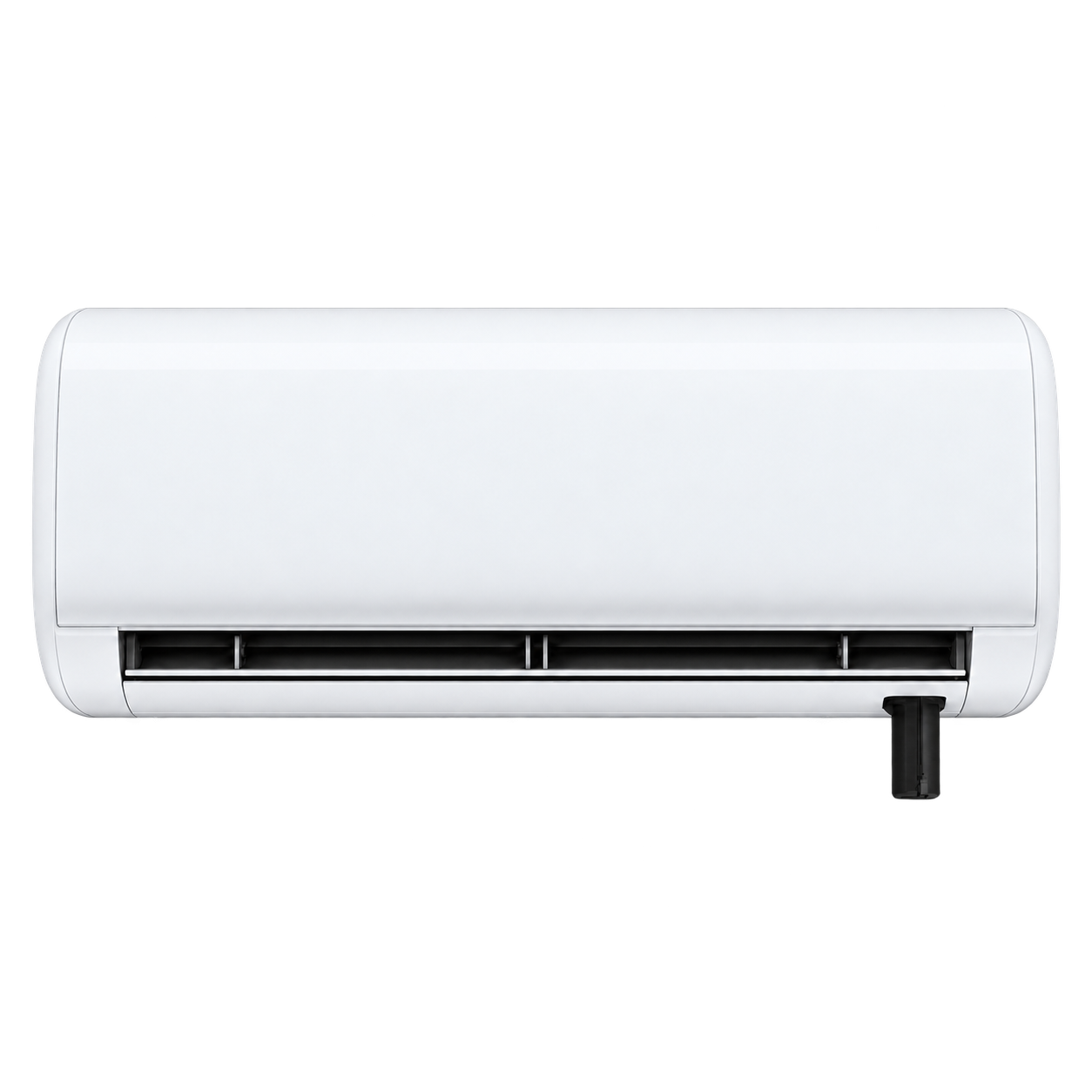
VX3000SP's indoor overall dimensions are 638 × 335 × 187 mm. The source does not specify an axis order, so keep the full dimensions together rather than assigning individual numbers to width, depth or height. The applicable installation information should establish the actual orientation and fit for the vehicle.
Review the indoor location with the driver in the normal resting position. Include the pillow, curtain and ordinary storage. The customer should be able to use the bunk naturally, with the relevant air paths and service access preserved according to the supplied requirements rather than a layout that only looks clear in an empty cab.
The model lists 550 m³/h airflow and automatic oscillation. Those features give the demonstration a concrete focus: how the stream moves through the occupied area. Let the customer assess the actual product behavior from the bunk instead of judging suitability only by touching cold air beside the outlet.
This is a practical advantage of a well-planned split package. The indoor arrangement can be discussed directly in relation to the person, while outdoor placement receives its own connected review. The result is a more useful VX3000SP proposal centered on the driver's space and daily routine.
5. Demonstrate automatic oscillation as a comfort feature
Automatic oscillation is documented for VX3000SP. It is worth showing because the driver can see and feel how the stream direction changes across the occupied space. A feature that might look minor in a table can become a practical reason to shortlist the model when it serves the bunk comfortably.
Use the actual supplied controls and instructions in the demonstration. The product summary does not establish a particular sleep program, personal zoning system or phone application. Showing the real behavior keeps the buyer's experience connected to the offered configuration and avoids creating an expectation based on another product.
Include both seated and reclining positions if the driver uses both during parking. A direct stream that feels refreshing while upright may be less pleasant at the pillow. The customer can explain that preference, and the installer can assess the proposed indoor location and surrounding circulation accordingly.
The benefit is useful air distribution rather than the strongest local sensation. VX3000SP's 550 m³/h reference is applied to a real cab, with automatic oscillation helping frame the occupied experience. That gives the salesperson a concrete feature-to-benefit explanation supported by the supplied product information.
6. Make ultra-quiet positioning useful and honest
The supplied VX3000SP information includes an ultra-quiet qualitative feature. This makes the model relevant to a buyer who values calm sleeper comfort, especially when parked rest is a central part of the vehicle brief. The feature should be presented as qualitative product positioning rather than converted into an invented decibel rating.
The completed sound experience depends on the installation and surroundings. Mounting, trim, indoor air direction and outdoor placement can all be relevant to what the occupant notices. Let the driver assess the actual resting position instead of relying only on a listening moment outside the truck or near the doorway.
A split layout offers placement choices, but it does not prove silence in every vehicle. The outdoor unit and connecting route still need appropriate installation, and the indoor assembly remains part of the occupied cab. The applicable requirements and a useful demonstration should support the comfort recommendation.
This is a strong, credible sales case. VX3000SP is offered for a calm-comfort project with a documented qualitative feature and a practical way to assess the result. The customer receives a model-specific recommendation without a fabricated sound comparison or an unsupported promise that every sleeper will experience the same acoustic outcome.
7. Find a suitable outdoor location
The VX3000SP outdoor overall dimensions are 799 × 180 × 430 mm, with no axis order specified in the supplied source. Present the complete dimensions for early planning and use the applicable installation information for orientation, mounting and the required surrounding access. A convenient-looking exterior area is only a starting proposal.
The outdoor unit needs a suitable relationship to the working vehicle. Review nearby equipment, normal service activity and the relevant air path. The source summary does not establish a condenser airflow number or universal clearance, so those details should come from the actual installation requirements rather than be borrowed from a rooftop model.
The connecting route also belongs in the location decision. A remote position should be assessed together with the indoor arrangement, not chosen in isolation and joined later through an improvised path. Ask the qualified installation team to review the complete split package for the actual truck.
The buyer benefit is a concrete alternative to roof-mounted cooling. VX3000SP can be recommended where a suitable separate location serves the vehicle design, with the product's package and installation needs clearly understood. That is a practical reason to choose split architecture rather than a universal claim about exterior compatibility.
8. Read the electrical references as separate planning inputs
The 12V power reference of 240–500 W and current reference of 20–45 A are separately supplied fields. Their endpoints do not establish matched operating conditions. Keep them labelled in the quotation and have the electrical installer obtain the requirements needed for the actual supply design.
| 12V VX3000SP reference | Supplied value | Useful buying role |
|---|---|---|
| Cooling capacity | 7000 BTU/h | Screen the version against the defined cab duty |
| Rated power | 240–500 W | Support the electrical planning discussion |
| Rated current | 20–45 A | Support the electrical planning discussion as a separate field |
| Refrigerant | R134a | Identify the supplied cooling system |
| Airflow | 550 m³/h | Review delivery to the occupied space |
| Air-output method | Automatic oscillation | Demonstrate distribution from the seat and bunk |
The table does not establish a calculated efficiency or battery duration. It helps the buyer identify the actual 12V product and gives the installer a clear model-specific starting point, with the complete vehicle supply developed around the intended parking session.
9. Plan energy for the whole parking period
A battery plan should consider usable stored energy, other loads, charging and the intended duty. The VX3000SP product data do not establish a guaranteed overnight duration. A customer planning an extended stop should describe that period directly so the complete auxiliary package can be assessed rather than inferred from a single catalogue endpoint.
The cooling task may change across the session. Solar exposure, door traffic and the occupied zone can differ between arrival and settled rest. Representative observations are useful when they preserve the starting condition and actual vehicle arrangement, giving the electrical specialist relevant information for the complete installation.
Energy-conscious comfort also includes practical cab choices. Suitable shading, clear circulation and deliberate use of the occupied zone can reduce avoidable burdens or improve the usefulness of cooling, depending on the scene. The source information does not establish a percentage saving, so keep that benefit qualitative unless relevant measurements support a specific claim.
The 12V cooling-session guide develops that planning conversation. In the core product recommendation, the important point is that VX3000SP should be supplied within a complete daily-use package, with the cooling unit and auxiliary energy considered together.
10. Keep package weights correctly labelled
The supplied VX3000SP weights are indoor package 6.7 kg and outdoor package 20 kg, separately. Retain those labels in shipping and product discussion. They should not be combined into a new net-weight figure or treated automatically as exact installed component loads for structural assessment.
Mounting and support require the relevant product information and review of the actual vehicle. The published enclosure dimensions and package weights are useful early references, while the installation design needs the appropriate details for the supplied configuration. This distinction helps the buyer understand what the source sheet establishes.
For a distributor, accurate weight language also keeps quotations and later support consistent. The customer can identify which package reference belongs to which assembly. A service or logistics discussion then begins with clear information rather than a number that has changed meaning as it moved between sales material and workshop planning.
The practical advantage is a more professional offer. VX3000SP is presented as a defined split product whose assemblies can be recognized, planned and supplied clearly. The buyer receives enough information to progress the actual installation without unsupported claims about universal mounting or structural suitability.
11. Make the U.S. customer proposal vehicle-specific
A useful proposal should identify the exact truck and sleeper arrangement, selected 12V VX3000SP configuration and actual installation scope. Product supply, mounting work and auxiliary-power equipment may be separate parts of the offer. State what is included so the customer can compare complete packages fairly.
The U.S. product context does not establish compatibility with every semi-truck model or a verified regulatory approval for every location. This article makes no such claim. The practical route is to assess the actual vehicle and use the applicable product information, with any special project requirement described directly to the supplier.
Matching images help make the proposal reviewable. Show the real VX3000SP indoor and outdoor assemblies with the technical reference sheet, then connect them to photographs of the customer's intended locations. The buyer can see which hardware is being discussed and how the split concept may fit the truck.
The truck applications page provides the broader vehicle context, while the VX3000SP guide hub supports focused follow-up questions. The purchase path should lead toward a concrete installation proposal rather than leave the buyer with a generic cooling claim.
Consider a hypothetical owner-driver who wants cooling during evening rest but prefers to review a separate outdoor location rather than add a rooftop package. VX3000SP is a relevant first candidate because the split architecture addresses that preference directly. The enquiry should show the intended truck, possible outdoor space and normal bunk arrangement, then describe the expected stop. The supplier can connect those details to the actual 12V product instead of making a universal compatibility statement.
In the demonstration, the driver sits briefly and then reclines with the curtain and bedding arranged normally. The actual automatic oscillation behavior can be assessed from both positions. The outdoor location and route are reviewed through the applicable installation information, while the electrical specialist considers the intended energy period. This gives the customer a complete proposal to assess: a named cooling unit, a defined occupied path and a supply package connected to the real daily routine.
The example is not a VETHY test or a prediction of runtime. Its value is the clear decision chain. The buyer has a reason to prefer split architecture, sees the documented VX3000SP features in context and can review the actual work needed to fit the truck. A distributor can then quote a specific package and preserve the configuration for handover, giving the product recommendation practical substance without an invented performance claim.
12. Build support into the installed package
Retain the model, voltage and relevant installation information with the vehicle record. Useful photographs can show the indoor position, outdoor location and connecting route. Later service staff can then understand the actual package even if they did not handle the original fitting.
Drivers need a simpler handover showing the normal curtain arrangement, essential clear air paths and supplied controls. Explain how to report a change in comfort or sound through a useful description of the location and circumstances. The owner should not be expected to diagnose internal components or improvise service procedures from general sales content.
The distributor's support description should match its real capability and confirmed terms. The supplied brief does not establish a verified warranty promise, overseas warehouse or guaranteed response time. A clear route for technical questions and an identifiable installed configuration are already useful parts of the offer.
This strengthens the VX3000SP recommendation for a suitable 12V semi-truck project. The customer receives a split cooling product with a defined identity, a practical occupied-space demonstration and a record that supports ordinary ownership. The value continues beyond the first moment of cold air at the outlet.
13. Questions about VX3000SP for 12V semi-trucks
What is the 12V cooling reference?
The supplied manufacturer reference is 7000 BTU/h. No watt cooling-capacity field was supplied, so it is retained as given. Match the actual version to the cab duty and engineered supply rather than create a new rating for comparison.
Is VX3000SP an inverter twin-cylinder product?
The supplied product identity is R134a rotary AC. Compressor brand, cylinder count and inverter architecture are not established. Recommend the model on its own documented split layout, airflow, automatic oscillation and qualitative ultra-quiet feature.
Can it fit every U.S. semi-truck?
The product context does not establish universal compatibility. Review the exact cab, indoor arrangement, possible outdoor location and connection route using the applicable installation information. A vehicle-specific proposal makes the split package concrete and reviewable.
Why should a 12V buyer shortlist it?
VX3000SP offers a defined split cooling package with a 7000 BTU/h reference, automatic oscillation and qualitative ultra-quiet positioning. It is a relevant candidate when separate unit placement and the occupied air path fit the truck, supported by a suitable engineered auxiliary supply.
Choose a split package around the actual truck
Recommend VX3000SP when a U.S. 12V semi-truck project benefits from separate unit placement and a calm, deliberately cooled sleeper. Plan the indoor path, outdoor location and electrical duty together, using the correct model information. Send vehicle photographs, the supply arrangement and the parking routine through the technical enquiry page for a configuration-specific proposal.
Product sources
- VETHY VX3000SP current manufacturer specifications — VETHY.
- VX3000SP technical reference sheet — VETHY.
VETHY product recommendation and application analysis. Specification references identify the selected model and voltage. Installation examples are planning examples; measured project results are identified explicitly when available.
Discuss your VX3000SP application
Send your vehicle, supply voltage, occupied space, parking schedule and installation photographs for a model-specific recommendation.
Prepare your vehicle brief ↗