
VETHY / VX3000SP / PRODUCT AND APPLICATION GUIDE
VX3000SP 12V Power References: Plan a Practical Cooling Session
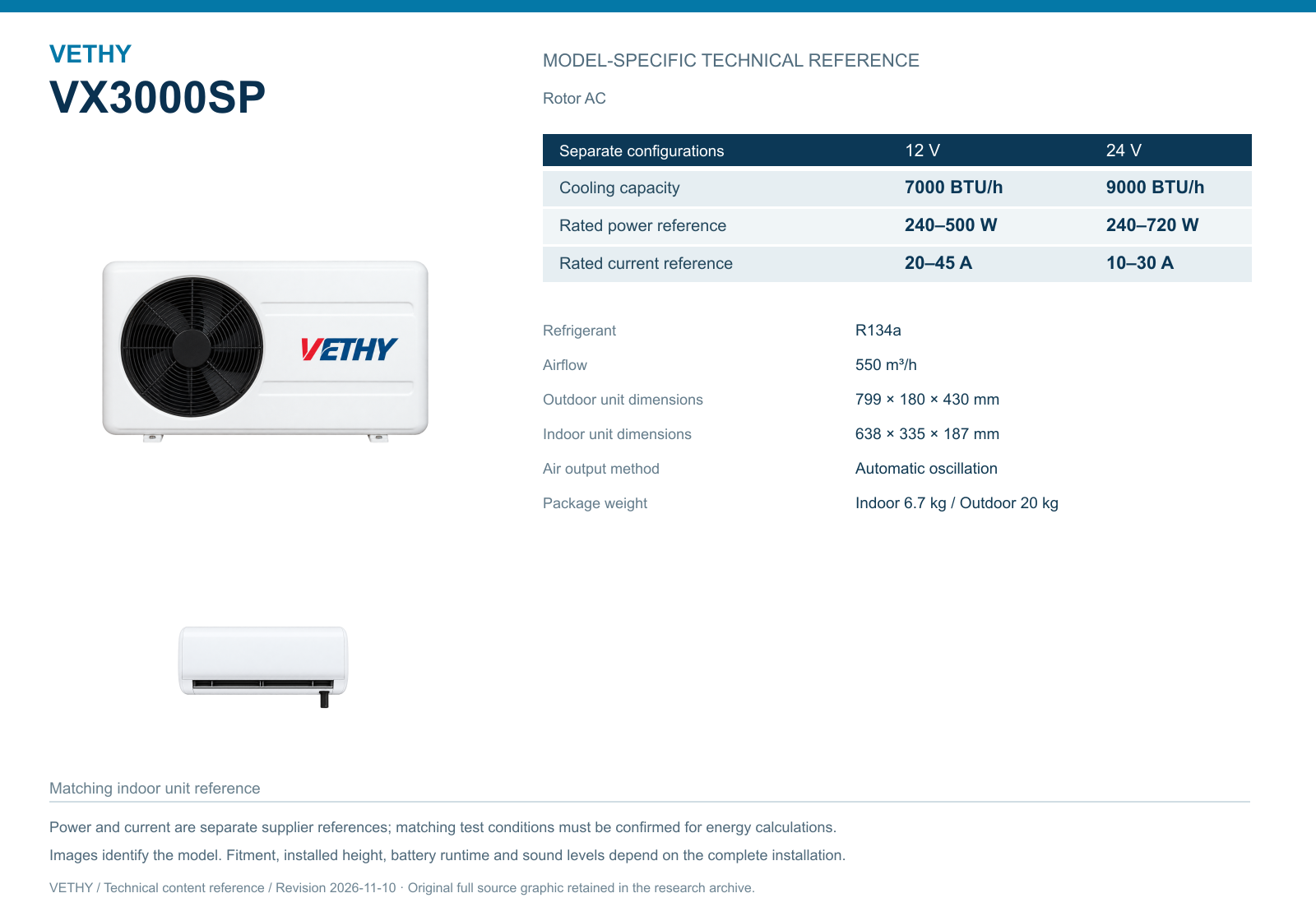
The 12V VX3000SP lists 7000 BTU/h cooling, 240–500 W power and a separate 20–45 A current reference. Plan a complete cooling session around usable battery energy, other loads, the occupied cab and the actual installation. Representative observations support duration assessment; the reference endpoints alone do not establish runtime.
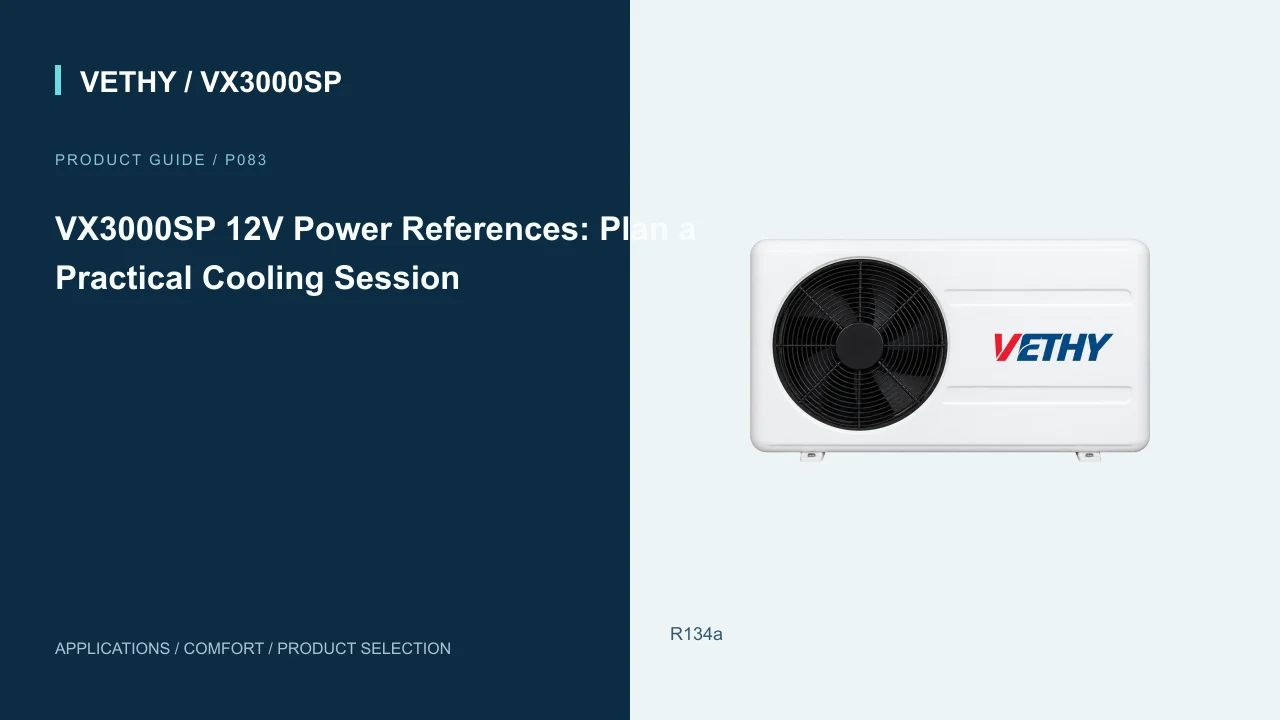
The 12V VX3000SP is a useful split parking AC choice when the customer wants a cooling session planned around real electrical demand. Its manufacturer references are 7000 BTU/h cooling, 240–500 W rated power and a separate 20–45 A rated current range. Those facts help identify the product and begin the supply discussion, while the actual session depends on the truck, cab conditions and complete auxiliary-power package.
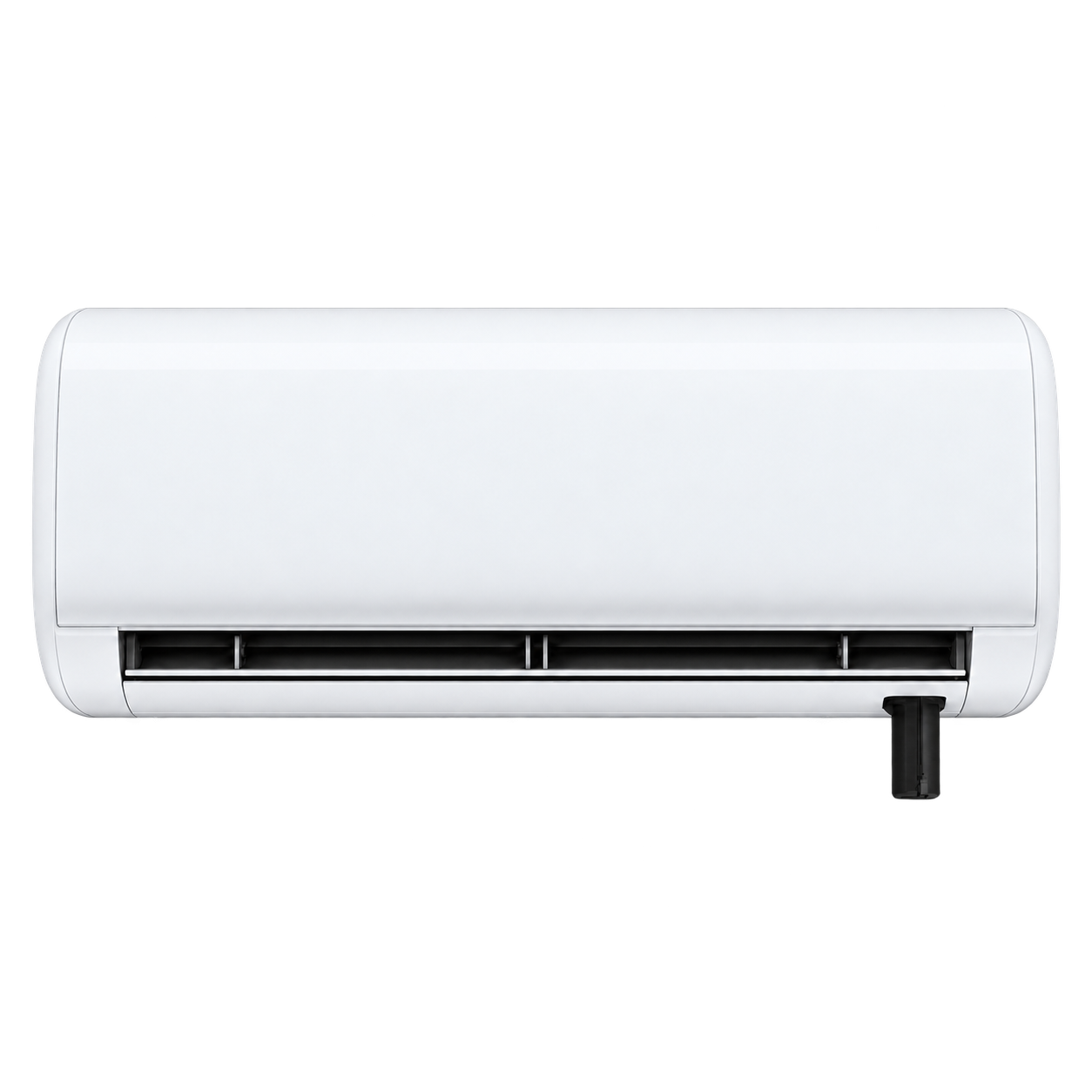
The product also provides 550 m³/h airflow, automatic oscillation and qualitative ultra-quiet positioning. Those features matter to the energy conversation because the useful objective is a comfortable occupied cab, rather than the longest advertised runtime at an unexplained catalogue endpoint. A sound proposal connects the split installation, driver routine and usable electrical energy.
This guide explains how to make that connection in plain language. It uses clearly hypothetical arithmetic to distinguish power from energy, keeps the supplied fields separate and shows how an owner-driver or fleet can develop a reviewable 12V VX3000SP package for the actual parking period.
1. Define the session before discussing duration
A cooling session needs a clear beginning and end. It may start when the driver parks after a route, when the bunk is prepared for rest or after the truck has stood closed in the sun. Those starting scenes are different, so a duration claim is difficult to interpret unless the intended duty is described.
Begin with the driver's ordinary schedule. Include the time spent seated, the transition to the bunk and common door-opening events. Note whether the cab is normally comfortable on arrival or begins warm. This gives the installer a practical application brief without asking the customer to provide a detailed thermal calculation.
The 12V VX3000SP can then be considered as a defined cooling product within that duty. The split architecture, indoor position and automatic oscillation should serve the occupied space, while the electrical specialist reviews usable storage and charging. The recommendation is strongest when those parts of the package are discussed together.
For the buyer, this creates a more useful purchase question. Instead of asking for a universal number of hours, the customer can ask whether the proposed installation supports a particular routine. The supplier can respond with a concrete configuration and a clear basis for any representative observation.
2. Read the 12V references accurately
The 7000 BTU/h figure is the supplied cooling-capacity reference. The 240–500 W power field and 20–45 A current field are separately supplied electrical references. The source does not establish a common condition for every endpoint, so keep the field names and units visible rather than combine convenient numbers into a new performance claim.
No watt cooling-capacity field was supplied for VX3000SP. Retain the BTU/h reference as given. A customer comparing products can still evaluate the actual offered versions and installation scope without manufacturing a capacity number that did not appear in the authoritative source.
The distinction also protects the energy conversation. Cooling output is not the same thing as electrical input, and an instantaneous electrical value is not the same thing as a session's energy use. A clear proposal explains those roles in ordinary language so the customer can understand why several different numbers appear.
The VX3000SP product page provides the central model reference. Use the same 12V identification in the energy brief and quotation so the complete supply design is attached to the actual split product being offered.
3. Explain energy with a neutral arithmetic example
A hypothetical appliance drawing an average of 300 W for one hour uses 300 Wh. If it then averages 400 W for two hours, that second period uses 800 Wh. Together, the two periods use 1100 Wh, or 1.1 kWh. These figures demonstrate arithmetic only; they are not VX3000SP measurements or predictions.
| Hypothetical period | Illustrative average power | Duration | Calculated energy |
|---|---|---|---|
| Period A | 300 W | 1 hour | 300 Wh |
| Period B | 400 W | 2 hours | 800 Wh |
| Combined example | Different averages over time | 3 hours | 1100 Wh |
The example shows why a session needs more than one momentary reading. Power describes a rate at a point or over an averaging period. Energy accounts for the amount used across time. The actual VX3000SP average must be determined for the relevant configuration and conditions before it can support that installation's duration assessment.
This is useful to a nontechnical buyer because it makes the battery conversation more concrete. The customer can ask for the complete intended session to be considered rather than compare one low number with an unexplained battery label. The product recommendation remains centered on a usable comfort period.
The same example also shows why averages need a stated period. An average over the later two hours is not the average for the complete three-hour example. Preserve the time boundary when information is shared between the customer, installer and battery supplier. This is a modest discipline with practical value: everyone can see which part of the intended stop the observation describes. The arithmetic remains simple, and the proposed VX3000SP package can be discussed using a consistent session rather than a mixture of unrelated moments selected because they look attractive.
4. Start storage planning with usable energy
A battery label does not establish the amount of energy the vehicle should use for cooling during a stop. The appropriate usable amount depends on the actual battery system, operating limits, condition, reserve strategy and other vehicle requirements. The battery supplier and electrical designer should define those limits for the proposed package.
The VX3000SP summary does not specify battery chemistry or a complete battery-management strategy. Those are surrounding system decisions. Keeping them explicit helps the customer understand which part of the offer is the cooling product and which part provides energy for the intended duty.
Where auxiliary storage is included, describe the actual package in the quotation. The customer should know what storage, charging and installation work is being supplied. A clear scope makes it easier to compare offers and prevents a product-only price from being mistaken for a complete extended-rest solution.
This supports a confident recommendation rather than delaying one. VX3000SP can be selected for its split layout and occupied comfort fit, while the appropriate auxiliary arrangement is developed around the expected session. The buyer sees a path to a usable installation instead of an unsupported runtime promise.
5. Include other loads in the same time window
Cooling is rarely the only electrical use during a stop. The actual vehicle may have lighting, communications or other equipment operating at the same time. Identify the relevant loads and their intended periods so the auxiliary plan describes the complete session rather than one appliance in isolation.
A second neutral example makes the point. A hypothetical separate load averaging 25 W for four hours uses 100 Wh. That contribution is added to the session's energy requirement, but it says nothing about the actual VX3000SP demand. Keep illustrative arithmetic separate from measurements of the offered installation.
The time boundary should remain consistent. A cooling observation covering three hours cannot be combined casually with unrelated load figures covering an undefined evening. State the period and preserve the assumptions so the customer and installer understand what the proposed energy package is intended to support.
For fleets, this can be organized around route groups. Trucks with different parked equipment or charging opportunities may need different auxiliary arrangements even if they use the same 12V VX3000SP. The model provides a common product identity, while the full energy brief respects the working duty of each group.
6. Keep the supply path within the package
Usable storage and a suitable route to the AC address related but different questions. The qualified installer should assess protection, conductors, connections and routing for the actual 12V installation using the applicable product and vehicle requirements. The summary power and current fields are not a universal wiring instruction.
A split arrangement also needs coordination between indoor location, outdoor location and the relevant connection route. The electrical path should be considered alongside that work rather than added after the assemblies have been positioned. A reviewable layout helps the workshop understand the complete package before fitting begins.
The source does not establish one cable size, fuse value or voltage-cutoff setting for every truck. Ask for the requirements that apply to the supplied configuration. The sales team can make the offer easier to understand without improvising electrical details beyond the available product information.
The benefit to the buyer is a more complete installation proposal. VX3000SP is supported by a deliberately designed supply rather than merely connected somewhere convenient. That gives the product's comfort features a practical foundation and makes later service information more useful.
7. Make cooling useful where the driver sits and rests
The model lists 550 m³/h airflow and automatic oscillation. These features should be applied to the actual occupied cab, with the indoor position reviewed around the seat, bunk and curtain. A useful energy plan begins with a useful comfort arrangement, because the customer is buying cooled occupied space rather than an electrical reading alone.
Let the driver assess the stream from both the upright and reclining positions if both form part of the routine. Normal bedding and storage should be present. The preferred relationship to the stream may change when the head moves to the pillow, which is why an outlet-only demonstration tells an incomplete story.
Keep a clear return route through the intended zone according to the supplied instructions. A curtain or bag can change the circulation scene even when cold air is obvious near the panel. Explaining the path in everyday terms helps the owner preserve the arrangement during ordinary cab use.
This is a practical advantage of a well-presented VX3000SP package. Automatic oscillation becomes a visible feature serving a real person, and the split layout can be discussed around the occupied space. The buyer receives a comfort-focused proposal supported by a complete energy conversation.
8. Reduce avoidable burdens on the cooling task
Suitable shading, deliberate zoning and controlled door openings can change the task presented to the cooling installation. Their usefulness depends on the actual truck and surroundings. They should be discussed as practical project choices, without a fixed saving percentage attached to the VX3000SP name.
A driver who mainly uses the bunk may prefer a defined sleeper arrangement. The indoor assembly and curtain need to support that zone with a clear air path. Reducing the visible space alone does not establish a benefit if the curtain separates the occupant from the delivered stream or relevant return access.
The starting cab condition also matters. A stop after a comfortable drive differs from a return to a sun-exposed truck. Record that scene when assessing the session so the electrical observation can be understood in context rather than promoted as a universal average for every day.
The practical recommendation is energy-conscious comfort: prepare the occupied space, apply the documented air delivery effectively and develop the supply around the intended duty. VX3000SP's actual product features remain the hardware foundation, while the surrounding vehicle choices help make the cooling useful.
9. Observe a representative installed session
A useful observation should resemble the intended routine. Record the 12V product configuration, vehicle, starting battery condition, occupied layout and relevant surroundings. Include other loads within the same time window. These details make any energy result meaningful for that installation and easier for the electrical specialist to interpret.
The session can be described in practical stages: arrival, seated activity, settled rest and interruptions. The stages are a way to organize information, not undocumented VX3000SP operating modes. Use the supplied controls and instructions for the actual offered unit.
The source does not establish inverter architecture, a named economy program or an automatic battery-saving algorithm. If a customer requires a particular control behavior, ask VETHY to confirm it directly. Changing demand during the session does not by itself prove how this specific unit controls its compressor.
The value of the observation is a clearer package decision. The buyer can assess comfort and electrical use in the same real scene, with the configuration preserved. That is more useful than claiming a universal parking duration from the lowest endpoint in a reference range.
If the project collects electrical observations, use an appropriate method selected by the qualified people responsible for the vehicle system. This article does not prescribe a measuring instrument or connection method. What matters for the buying decision is that the result identifies the product, period and conditions clearly enough to support the intended duty assessment. A useful record can remain concise. It should make the observation traceable to the actual 12V VX3000SP installation and occupied arrangement, so later decisions are based on a recognizable session rather than an unexplained number copied into a sales message.
10. Keep split packaging visible in the energy discussion
VX3000SP's outdoor overall dimensions are 799 × 180 × 430 mm, and indoor overall dimensions are 638 × 335 × 187 mm. The source does not assign axis order. Keep the full dimensions together and use the actual installation information for orientation, mounting and surrounding access.
Separate package weight references are indoor 6.7 kg and outdoor 20 kg. They should not be combined into a net-weight figure or automatically treated as installed component loads. The installation needs the relevant mounting and support information for the actual configuration and vehicle.
Outdoor placement and air access belong in the complete proposal. The summary does not establish a condenser airflow number or universal clearance. A location should be reviewed through the applicable requirements and connected to a suitable indoor arrangement and route, rather than selected solely because the housing appears to fit.
This complete view supports the energy recommendation. The customer is choosing an installed cooling package whose hardware locations, air delivery and supply work together. The battery discussion then serves a real vehicle arrangement instead of an isolated product sheet.
11. Use one customer scenario to connect the decisions
Imagine a hypothetical owner-driver planning an evening stop with time in the seat before resting. VX3000SP is attractive because the driver prefers separate indoor and outdoor placement and values the model's qualitative ultra-quiet positioning. The enquiry identifies the actual truck, possible locations and intended 12V auxiliary arrangement.
The demonstration shows automatic oscillation from the seat and pillow with the normal curtain in place. The installer reviews the complete route and mounting requirements, while the electrical specialist considers usable storage and other loads across the intended session. The customer can then review a concrete package rather than a promise of an unexplained number of hours.
A representative observation preserves the starting conditions and time boundary. If the real stop includes more door traffic or other equipment than originally described, that difference becomes part of the planning discussion. The model's reference data remain unchanged; the complete duty is being understood more accurately.
This is an application example, not a VETHY test result or runtime prediction. Its value is the clear chain from driver routine to product features, installation scope and energy assessment. A well-defined VX3000SP package becomes easier to buy because the customer can see how the parts support the actual working day.
12. Keep the quotation and handover connected
The quotation should identify the 12V VX3000SP and describe the actual product, mounting and auxiliary-power scope. State what is included so the customer can compare complete offers fairly. A product-only price and a package with storage and charging describe different purchases.
At handover, retain the model and relevant installation record with the vehicle. Drivers need clear guidance on the normal occupied arrangement and actual supplied controls, while service staff need the useful product and route information. Both views should refer to the same installed configuration.
The VX3000SP guide hub supports further reading on split placement and cab comfort. The core 12V product guide explains the broader shortlist case, while this article contributes the narrower session-energy decision.
The result is a practical recommendation that can be carried through to ownership. VX3000SP is selected for a suitable vehicle and comfort task, with the supply package designed around the actual session. Clear records help the owner and support team preserve that understanding after delivery.
A clear package also gives the customer practical choices if the first energy proposal does not match the intended duty. The discussion can review the parking requirement, surrounding auxiliary equipment or complete storage and charging scope with the appropriate specialists. The cooling model does not need to be oversold to keep the conversation moving. VX3000SP can remain a suitable split candidate while the complete vehicle plan is refined. The buyer then understands which part of the investment serves cooling and which part makes the intended session available within the wider working routine.
13. Questions about VX3000SP 12V energy planning
Can 240 W be used to promise a long parking duration?
The lowest reference endpoint does not establish the entire session's average demand. Actual conditions and the complete configuration matter. Assess usable energy, other loads and representative operation before discussing duration for the proposed vehicle package.
Why are power and current shown separately?
They are separately supplied manufacturer fields without a documented common condition for every endpoint. Keep the labels and units visible and request the applicable installation requirements. Do not combine convenient values to create a new efficiency or endurance claim.
Are the arithmetic examples VX3000SP test results?
No. They demonstrate how power over time becomes energy and how other loads contribute. Actual VX3000SP session planning needs information for the relevant configuration and conditions, with the vehicle's usable storage and intended duty considered together.
Why recommend this model within a complete energy package?
Its split layout, documented airflow, automatic oscillation and qualitative ultra-quiet feature can serve a suitable parked-cab routine. A complete supply and installation proposal connects those product benefits to the actual working session the customer wants to use.
Plan a useful session around the real truck
Choose the 12V VX3000SP when its split cooling package fits the vehicle and the intended comfort period can be supported by a deliberately designed auxiliary supply. Keep the source fields clear and evaluate the complete duty. Send the parking schedule, vehicle photographs and available supply information through the technical enquiry page for a configuration-specific proposal.
Product sources
- VETHY VX3000SP current manufacturer specifications — VETHY.
- VX3000SP technical reference sheet — VETHY.
VETHY product recommendation and application analysis. Specification references identify the selected model and voltage. Installation examples are planning examples; measured project results are identified explicitly when available.
Discuss your VX3000SP application
Send your vehicle, supply voltage, occupied space, parking schedule and installation photographs for a model-specific recommendation.
Prepare your vehicle brief ↗