
VETHY / VS02-PRO / PRODUCT AND APPLICATION GUIDE
VS02-PRO or VX3000SP: Choose Around the Rooftop or Split Installation
Choose VS02-PRO when a suitable roof location supports an integrated cooling package above the occupied cab. Consider VX3000SP when separate indoor and outdoor placement better serves the truck. Compare each model’s correct refrigerant, voltage references, packaging and air path, then select the complete installation that fits the actual vehicle duty.
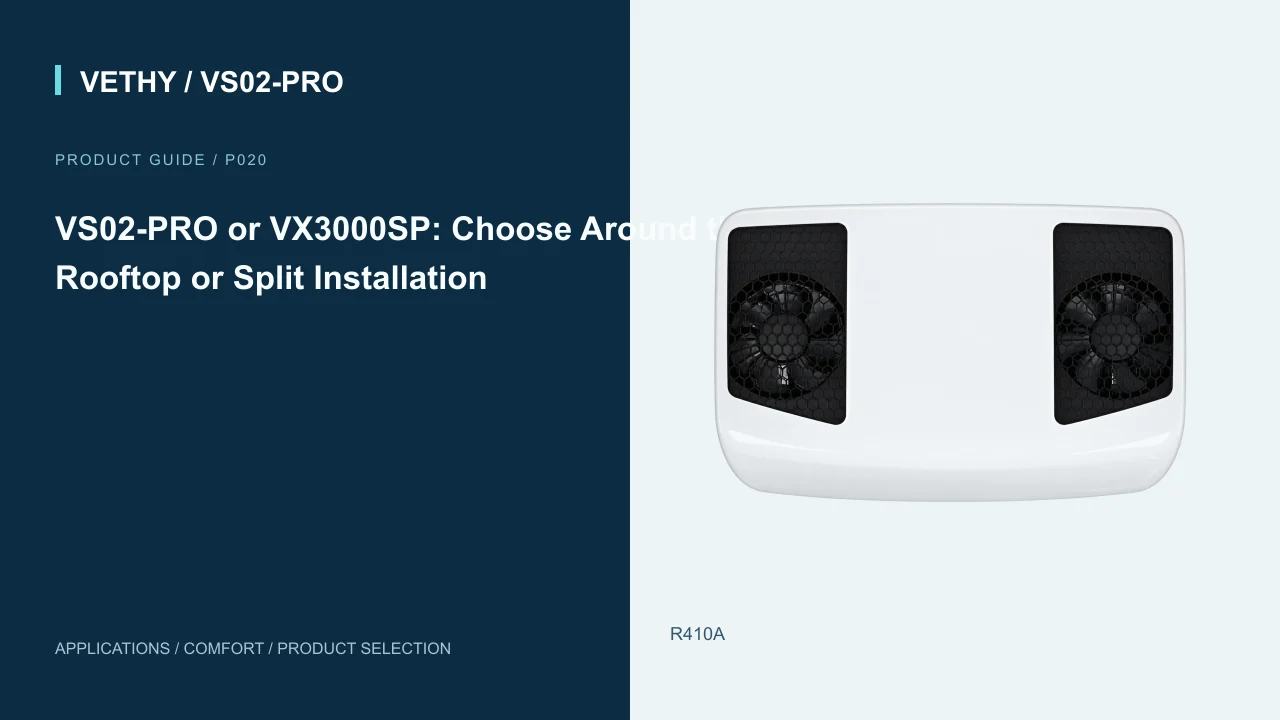
Choose VS02-PRO when a suitable roof location can bring the cooling package together above the occupied cab. Choose VX3000SP when a split arrangement, with indoor and outdoor units placed separately, better serves the vehicle plan. That installation decision is the clearest starting point for comparing these two VETHY parking air conditioners because it determines where the hardware sits and how the cab will be integrated around it.
VS02-PRO is an R410A rooftop model with a Rechi twin-cylinder rotary compressor system. VX3000SP is an R134a split model described as rotary AC, with an ultra-quiet qualitative product feature. Both have 12V and 24V versions and documented automatic oscillation, but their source specifications and packaging should remain distinct.
The useful recommendation is therefore application-led. Review the roof, possible remote outdoor locations, occupied air path and engineered electrical supply, then choose the model whose complete arrangement fits the truck. This guide explains that decision without inventing an efficiency ranking, converting missing capacity fields or transferring compressor details from one product to the other.
1. Start with where the vehicle can carry the equipment
VS02-PRO concentrates the cooling package in a rooftop arrangement. That can be attractive when the cab has a suitable mounting location and the indoor assembly can serve the occupied space below. The layout discussion begins with the roof and its relationship to the bunk, curtain and other equipment.
VX3000SP separates indoor and outdoor placement. That gives the vehicle designer a different set of location choices, particularly when a rooftop unit is not the preferred arrangement. The outdoor unit still needs a suitable mounting location, air access and service approach, and the complete split installation needs an appropriate connection route.
These are practical differences rather than a universal ranking. One truck may have an open roof but limited space elsewhere. Another may have roof equipment that makes a split arrangement more attractive. The buyer should describe the actual vehicle so the supplier can discuss a complete package instead of comparing only the cooling labels.
The commercial benefit is a clearer shortlist. Once the preferred hardware location is understood, many later questions become more focused. The customer can ask about the relevant roof integration or split route rather than attempt to decide between two different architectures through one isolated specification.
2. Keep each model's identity intact
The documented VS02-PRO compressor system is R410A Rechi twin-cylinder rotary. VX3000SP uses R134a and is described as rotary AC; the supplied data do not establish its compressor brand, cylinder count or inverter architecture. These facts should remain distinct across the comparison, quotation and service planning.
For VS02-PRO, named compressor architecture is part of the product's specific shortlist case. For VX3000SP, the split layout and qualitative ultra-quiet feature belong in its own recommendation. Neither product needs to borrow the other's attributes to be useful for a suitable vehicle.
Refrigerant choice also belongs to the actual supplied system. It does not establish a permission to convert one model to the other's refrigerant or prove a universal performance advantage. A buyer with a defined refrigerant requirement should state it directly and then review the complete product package against the rest of the vehicle brief.
The VS02-PRO product page and VX3000SP product page provide the two central model references. Use both when discussing the choice so the customer can connect each proposed installation to the correct hardware and source information.
3. Compare packaging with the full dimensions
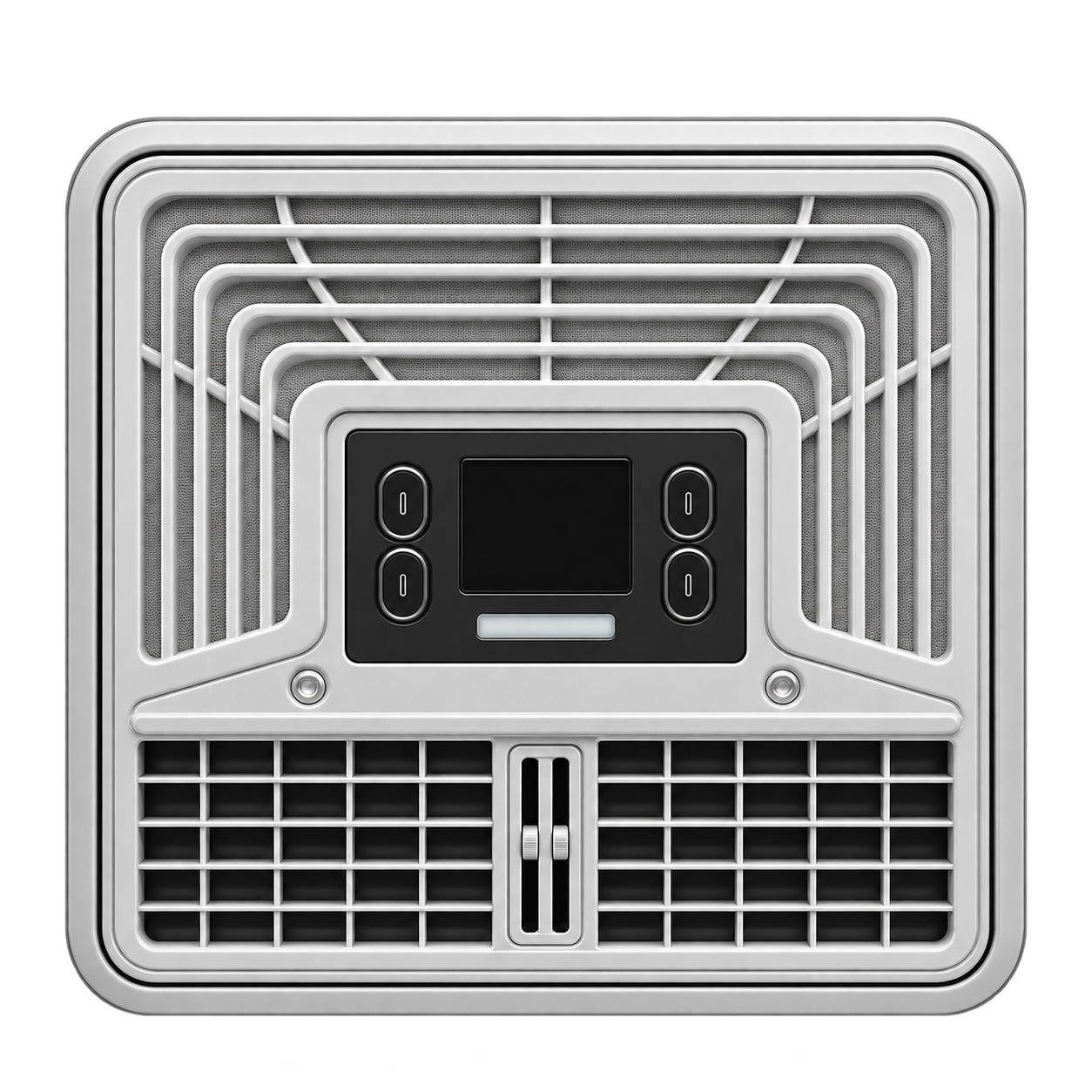
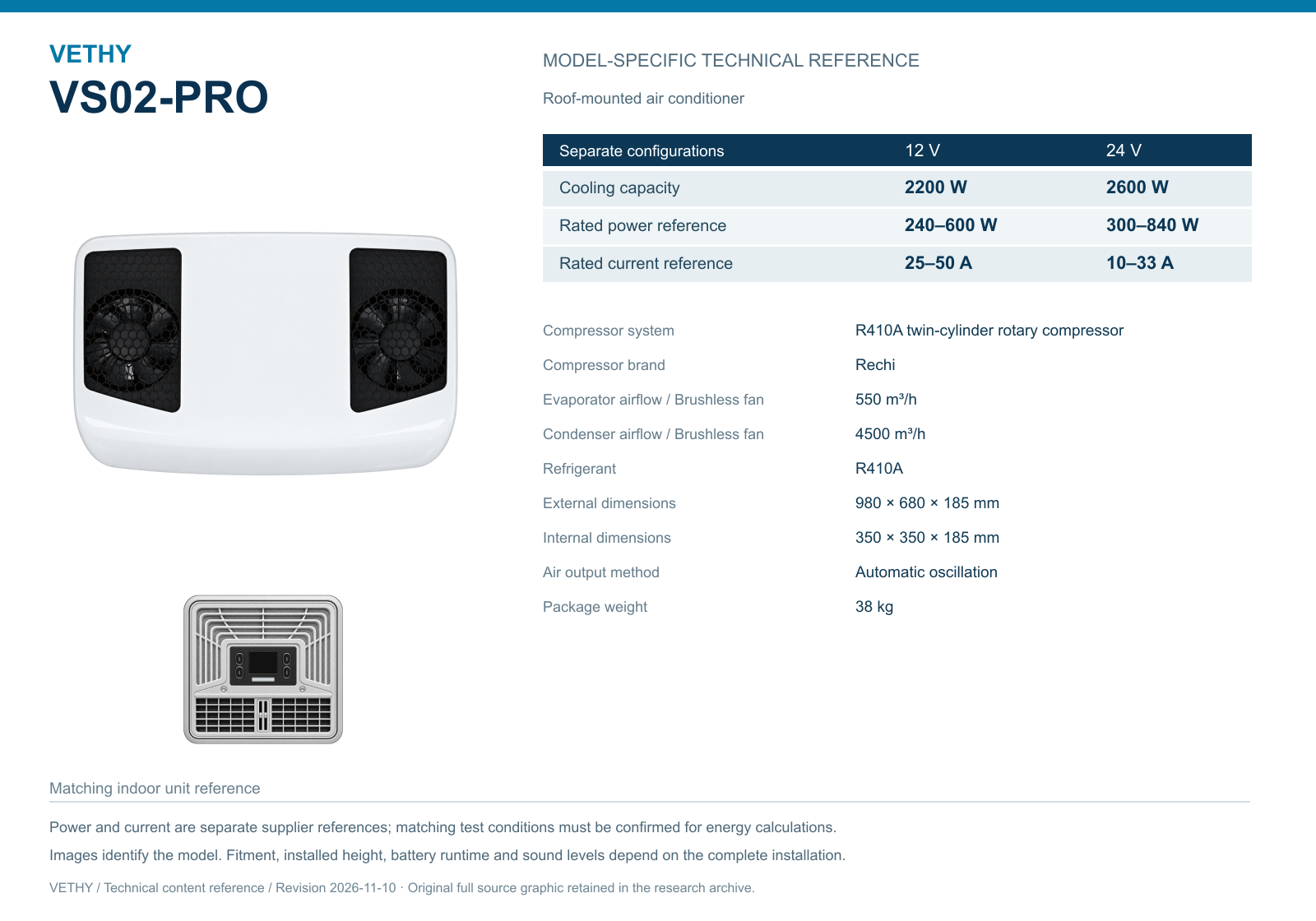
VS02-PRO's outdoor dimensions are 980 × 680 × 185 mm, and its indoor dimensions are 350 × 350 × 185 mm. Those measurements support a defined rooftop packaging discussion. The applicable installation drawing must establish the actual opening, support, sealing and mounting arrangement for the vehicle.
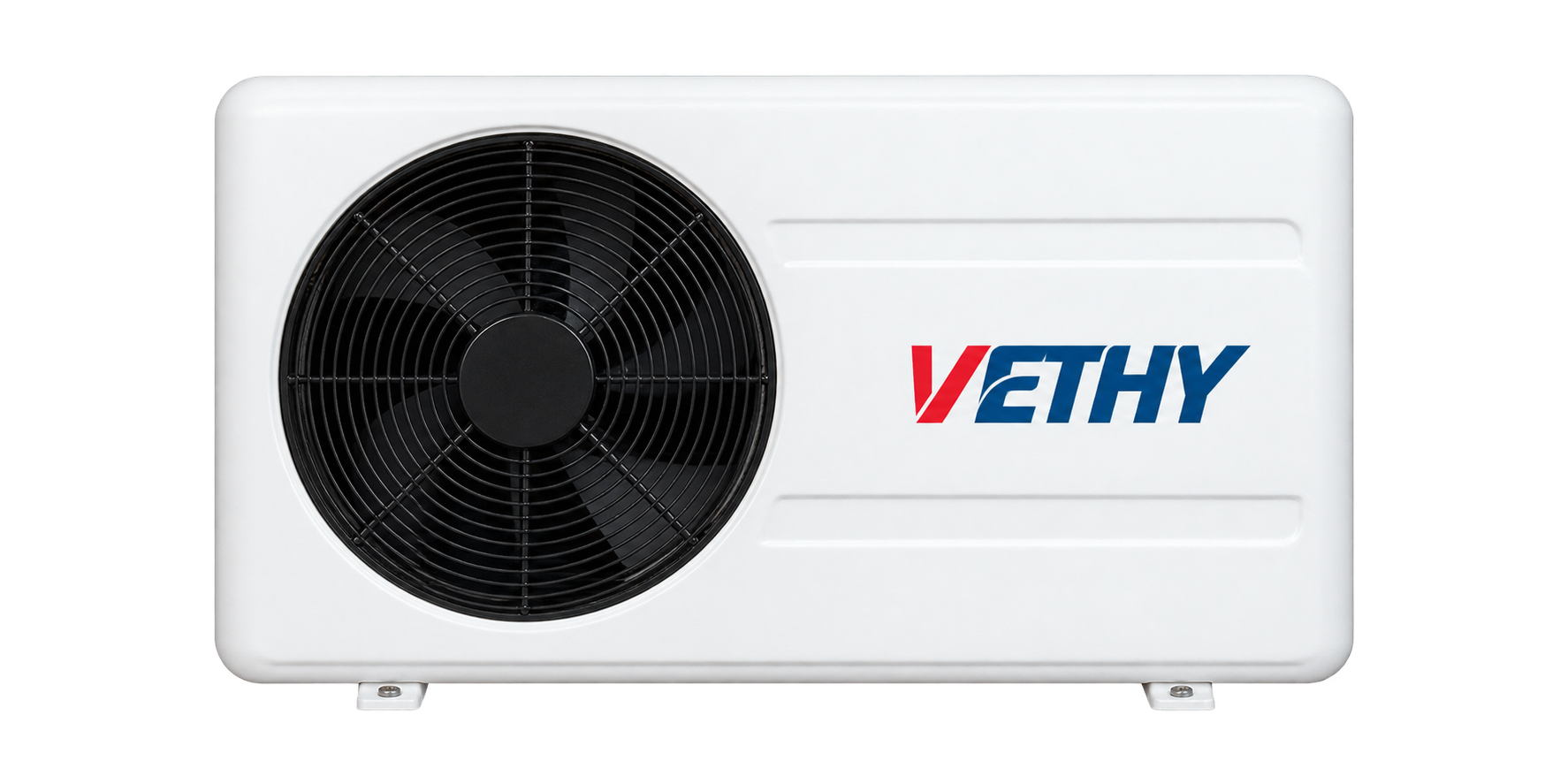
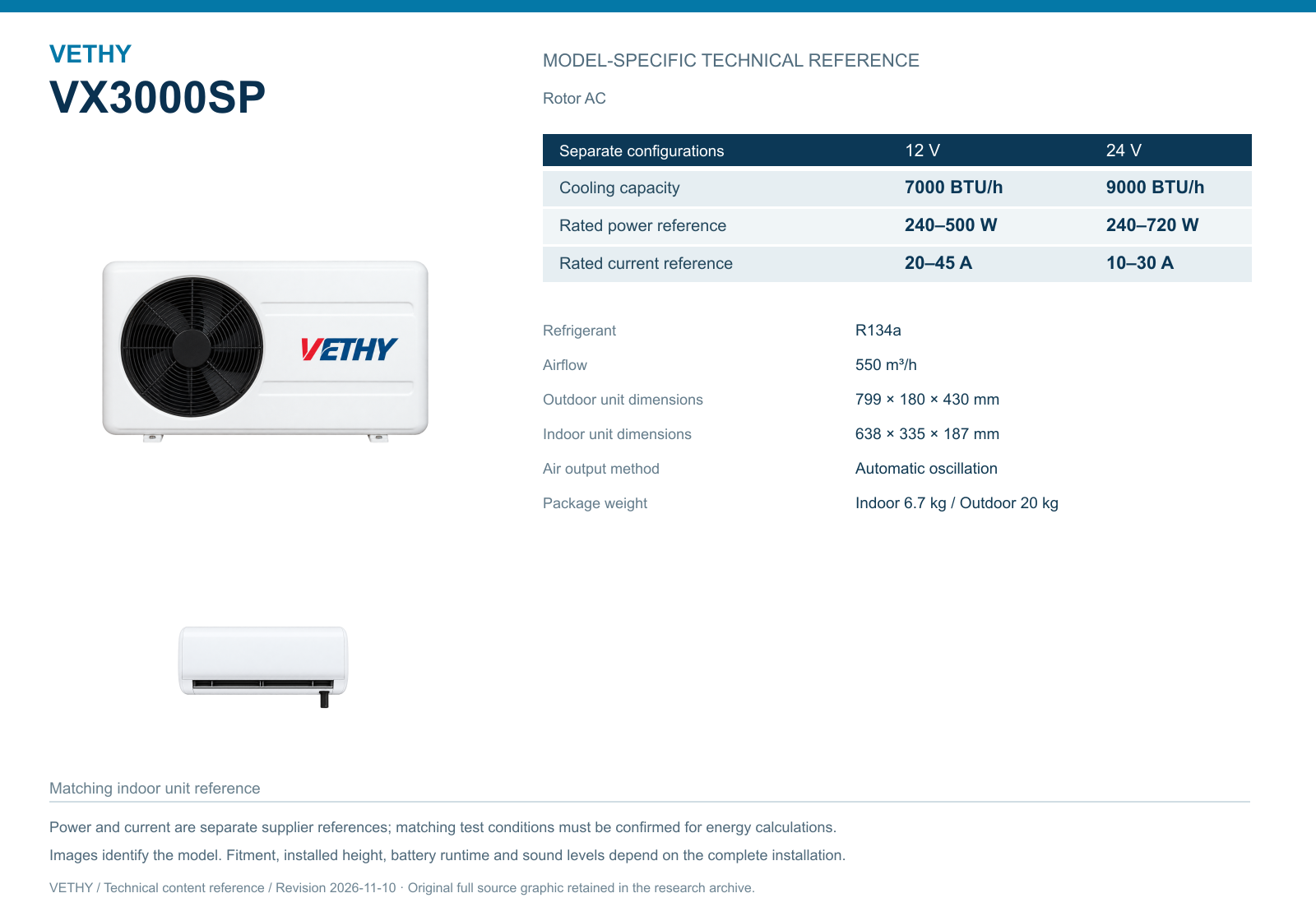
VX3000SP's outdoor overall dimensions are 799 × 180 × 430 mm, and indoor overall dimensions are 638 × 335 × 187 mm. The supplied source does not assign an axis order, so present the full dimensions without labelling particular numbers as width, depth or height. The actual installation information is needed for orientation and fit.
| Packaging subject | VS02-PRO | VX3000SP |
|---|---|---|
| Layout | Roof-mounted package | Separate indoor and outdoor units |
| Outdoor dimensions | 980 × 680 × 185 mm | 799 × 180 × 430 mm overall |
| Indoor dimensions | 350 × 350 × 185 mm | 638 × 335 × 187 mm overall |
| Weight reference | 38 kg package weight | Indoor 6.7 kg and outdoor 20 kg package weights, separately |
| Main location decision | Roof integration and interior relationship | Indoor position, remote outdoor position and connecting route |
Keep weights as labelled. They are package references, not automatically the installed structural loads, and VX3000SP's separate figures should not be combined into a new net-weight claim.
For a buyer reviewing drawings, this dimensional discipline matters because a number without an axis label can easily be misread. The VX3000SP full overall dimensions should travel unchanged into the early survey, with orientation confirmed through the actual product and installation information. VS02-PRO's documented outdoor height can be discussed as such, while its indoor dimensions remain a complete assembly reference. Keeping these distinctions clear makes the comparison more useful to a bodybuilder and prevents a visually attractive layout from depending on an unconfirmed interpretation of the product sheet.
4. Choose VS02-PRO for a deliberate roof package
VS02-PRO is worth recommending when the roof can provide a suitable location and the interior below can support useful air distribution. The defined 185 mm outdoor assembly height is a helpful packaging reference, while final vehicle height also depends on the actual mounting arrangement and roof geometry.
The practical benefit is a focused integration discussion. The builder can place the outdoor unit in the roof plan and connect the indoor assembly to the occupied cab. Other exterior areas may remain available for vehicle equipment, subject to the complete design. The advantage comes from the whole layout fitting the truck.
Review existing roof accessories early. Solar equipment, antennas and hatches can influence the available arrangement even when the enclosure footprint appears to fit. VS02-PRO lists 4500 m³/h condenser airflow with brushless airflow, so the applicable intake, discharge and service requirements must remain part of the roof plan.
This is a strong recommendation where the roof and interior align naturally. The customer sees a clear rooftop comfort package centered on the Rechi R410A twin-cylinder rotary system. The correct installation information then turns that attractive concept into a vehicle-specific proposal that can be reviewed and fitted.
5. Choose VX3000SP for a suitable split arrangement
VX3000SP is worth considering when the buyer prefers separate indoor and outdoor placement. A split layout can be useful when a rooftop AC is not the desired vehicle arrangement, provided the truck has a suitable outdoor location and an appropriate route connecting the assemblies according to the supplied requirements.
The benefit is placement flexibility within the complete design. The indoor unit can be reviewed around the bunk and occupied area, while the outdoor unit is assessed elsewhere on the vehicle. Those choices remain connected because the installation needs proper mounting, air access, serviceability and line routing for the actual configuration.
Do not promise that a split product requires no vehicle penetrations or fits every remote location. The source summary does not establish universal bracket compatibility, connection lengths or a single routing method. Ask for the applicable installation information and review the actual truck before treating a proposed location as approved.
The qualitative ultra-quiet feature gives VX3000SP a relevant comfort position, while the real cab and mounting arrangement determine the finished experience. It is a useful alternative to VS02-PRO where the split architecture serves the vehicle better, with its own documented R134a rotary identity retained throughout the proposal.
6. Compare cooling references without inventing missing values
The source data use different capacity fields. VS02-PRO lists cooling in watts and also supplies BTU references. VX3000SP supplies cooling in BTU/h without a watt-capacity field. Retain those manufacturer references as given rather than manufacture a new set of values to create an apparently precise ranking.
| Version | VS02-PRO cooling reference | VX3000SP cooling reference |
|---|---|---|
| 12V | 2200 W; supplied information also lists 7500 BTU | 7000 BTU/h |
| 24V | 2600 W; supplied information also lists 9000 BTU | 9000 BTU/h |
The capacity reference is one screening input. Cabin heat gain, glazing, insulation, occupants, solar exposure and door traffic influence the actual task. A buyer should describe the intended vehicle duty and evaluate the offered configuration rather than choose through one number detached from installation architecture.
This keeps the comparison commercially useful. A rooftop layout that fits the vehicle and serves the occupied area may be a better project choice than a split arrangement that is awkward to place, and another truck may lead to the opposite decision. The complete installation is the purchase being recommended.
7. Plan the occupied air path for either model
VS02-PRO lists 550 m³/h evaporator airflow with a brushless fan and automatic oscillation. VX3000SP lists 550 m³/h airflow and automatic oscillation. Keep the field descriptions accurate: the VX3000SP summary does not establish brushless fan construction or a separate condenser airflow figure.
For both products, the useful question is where the stream travels in the occupied cab. Show the normal seat, bunk, pillow and curtain positions. The customer should assess the actual arrangement with ordinary bedding and storage present, because those details influence how the proposed installation serves daily use.
A rooftop panel and a separately placed indoor unit may relate differently to the same interior. The buyer can compare feasible locations and decide which arrangement gives a practical path through the intended zone. Automatic oscillation is useful within a suitable layout, while the return route remains part of the complete circulation discussion.
This is a direct comfort benefit of application-led selection. The customer sees how each product could serve the person, rather than comparing two airflow references and assuming they guarantee identical results. The model whose installed air path fits the cab has a clearer reason to be recommended.
8. Discuss calm comfort through the actual installation
VS02-PRO's Rechi twin-cylinder rotary architecture and brushless airflow are relevant to a calm-comfort discussion. VX3000SP has an explicitly supplied ultra-quiet qualitative feature. Neither source set establishes a verified decibel value or a measured sound superiority over the other model.
Demonstrate the offered installation from the normal resting position. Mounting, trim, air direction and the occupant's location influence what the driver notices. A doorway impression or an outside listening moment does not describe the entire sleeper experience. Let the customer assess the scene that matters during rest.
The two architectures create different placement discussions. VS02-PRO's roof connection is part of its occupied relationship, while VX3000SP's separate units bring outdoor location and connecting routes into the picture. Use the applicable installation requirements rather than assume a split arrangement is automatically quieter in every cab.
The practical recommendation is confident but specific. Choose the model whose complete package can create the desired calm environment in the actual truck, then preserve the configuration and conditions with any observations. There is no need to invent a sound ranking when a useful demonstration can answer the customer's real buying question.
9. Keep electrical planning separate for each product
VS02-PRO's manufacturer power references are 240–600 W for 12V and 300–840 W for 24V. Its separate current references are 25–50 A and 10–33 A. VX3000SP lists 240–500 W and 20–45 A for 12V, with 240–720 W and 10–30 A for 24V.
These fields do not establish matched test conditions across every endpoint or between models. Do not divide one model's capacity reference by a convenient electrical endpoint to advertise a new efficiency comparison. Likewise, nominal voltage alone does not establish which complete installation will provide a longer parking period.
The auxiliary-power plan should consider usable energy, other loads, charging and the intended duty for the actual offered configuration. Qualified installers should define the relevant supply route, protection and connections using the applicable requirements. The product selection and vehicle supply should be developed together rather than treated as unrelated purchases.
This gives the buyer a fair comparison of complete packages. A proposal including storage and charging differs from product supply alone. State the actual scope so VS02-PRO and VX3000SP can be assessed against the same operating requirement without relying on invented endurance or saving figures.
Installation scope can also affect the commercial comparison. A roof proposal may include vehicle-specific support and interior finishing work; a split proposal may include mounting and connection-route work elsewhere on the vehicle. The source data do not establish which job is cheaper for every truck. Ask for the actual work to be described, then compare complete offers against the same intended duty. This lets each model compete on a real installed package and helps the customer understand why two quotations may differ even before auxiliary storage or charging equipment is considered.
10. Keep material and service information model-specific
VS02-PRO's documented material package includes a copper evaporator and copper piping with an aluminum microchannel condenser as standard; a copper condenser is optional. VX3000SP's supplied summary does not establish an equivalent material description. Leave that field open for confirmation instead of transferring VS02-PRO's construction claims to the split model.
Service planning should follow the actual configuration and applicable instructions. A rooftop installation needs its relevant roof access, while a split installation needs the appropriate access to both units and their connecting route. The buyer should understand what the proposed package includes and how the installed equipment will be identified later.
Use matching images for each model. A correct VS02-PRO outdoor photograph and a correct VX3000SP outdoor photograph make the architecture distinction visible immediately. The technical reference sheets then support the model-specific specifications, while vehicle photographs show how the proposed layout applies to the customer's truck.
This clarity is a practical sales advantage. The customer receives two distinct, understandable choices rather than a blended specification sheet. The supplier and service team can later connect the delivered product to the correct documentation, preserving the value of the original installation decision.
11. Apply the comparison to two hypothetical trucks
Consider a truck with a suitable open roof location and a bunk layout that aligns naturally with the proposed rooftop indoor assembly. VS02-PRO is a strong candidate because the complete roof package can be reviewed around the occupied area, the selected electrical version and the surrounding equipment. The installation concept is straightforward to explain and assess.
Now consider a truck whose roof is not the preferred AC location, while another exterior area may accept a separate outdoor unit. VX3000SP becomes a relevant candidate because the split architecture opens a different placement discussion. The indoor location and connecting route still need review using the applicable product information.
These scenarios are application examples, not compatibility claims for particular truck models. They show why installation architecture can be more decisive than a broad product ranking. The buyer can recognize the actual vehicle situation and focus the enquiry on the arrangement most likely to serve it well.
The VS02-PRO guide hub and VX3000SP guide hub support more focused reading after that initial decision. The next step should be a configuration-specific proposal for the truck, with the selected architecture and relevant vehicle work clearly described.
The customer's priorities should remain explicit while these scenarios are assessed. A buyer who wants to retain a preferred roof arrangement may accept the integration work associated with separate units. Another buyer may prefer to concentrate the cooling hardware above the cab and preserve other exterior locations for vehicle equipment. Neither preference proves a technical winner in every situation. The value of this comparison is that it gives the customer a clear architectural choice, then connects that choice to the correct model documentation. VETHY can develop the relevant configuration rather than force an undefined truck into a generic rooftop-versus-split ranking.
12. Turn the decision into a reviewable offer
A useful offer identifies the model, voltage and configuration, then states the actual product and installation scope. For VS02-PRO, include the selected condenser arrangement. For VX3000SP, identify the supplied split package and confirm the relevant mounting and connection requirements. Keep auxiliary-power scope visible for either choice.
The vehicle brief should show the roof, possible outdoor locations and occupied interior. Include the normal curtain and parking routine. These details allow the supplier to discuss the real package rather than approve an undefined application based only on nominal voltage or a model name.
A demonstration should then match the offered arrangement as closely as practical. Let the driver assess the seat and bunk, use the actual supplied controls and preserve the relevant conditions with any recorded observations. The customer receives evidence for that installation decision without a claim that the result applies universally.
This is where the comparison becomes useful. VS02-PRO can be recommended confidently for a suitable rooftop project, and VX3000SP can be recommended where the split layout is a better fit. The complete vehicle package supplies the reason for the choice, supported by the correct model facts.
13. Questions about choosing rooftop or split cooling
Is VS02-PRO always the more powerful choice?
The source capacity fields differ and do not establish a universal project ranking. Retain each model's manufacturer references and assess the actual cab duty. Roof or split fit, occupied air distribution and the engineered supply are central to the complete choice.
Is VX3000SP a twin-cylinder inverter product like another model?
Its supplied identity is R134a rotary AC. Compressor brand, cylinder count and inverter architecture are not established. Keep those fields separate from VS02-PRO's documented Rechi R410A twin-cylinder rotary system.
Does a split layout preserve every part of the roof automatically?
It provides separate indoor and outdoor placement, but the actual mounting and connection route still require review. Do not promise zero penetrations or universal remote-unit compatibility from the architecture alone. Use the applicable installation information for the truck.
Which should I shortlist first?
Begin with the vehicle's preferred equipment location. Shortlist VS02-PRO for a suitable rooftop package and VX3000SP for a suitable split arrangement. Then confirm voltage, cab duty, occupied air path and the complete installation scope for the proposed model.
Choose the architecture that fits the working truck
Recommend VS02-PRO when roof integration gives the vehicle a clear, useful cooling package. Recommend VX3000SP when separate unit placement better serves the design. Share roof and exterior photographs, the occupied interior, voltage and parking routine through the technical enquiry page so VETHY can prepare a configuration-specific rooftop or split proposal grounded in the actual truck.
Product sources
- VETHY VS02-PRO current manufacturer specifications — VETHY.
- VS02-PRO technical reference sheet — VETHY.
- VETHY VX3000SP current manufacturer specifications — VETHY.
- VETHY VX3000SP technical reference sheet — VETHY.
VETHY product recommendation and application analysis. Specification references identify the selected model and voltage. Installation examples are planning examples; measured project results are identified explicitly when available.
Discuss your VS02-PRO application
Send your vehicle, supply voltage, occupied space, parking schedule and installation photographs for a model-specific recommendation.
Prepare your vehicle brief ↗