
VETHY / VS02-PRO / PRODUCT AND APPLICATION GUIDE
Standardizing VS02-PRO Across a Mixed Sleeper-Truck Fleet
VS02-PRO can support mixed-fleet standardization through one defined R410A rooftop family with separate 12V and 24V versions. Group vehicles by roof, interior and electrical work, then preserve each approved installation variant. Its documented airflow and compressor architecture provide a common product story while the actual truck requirements remain visible.
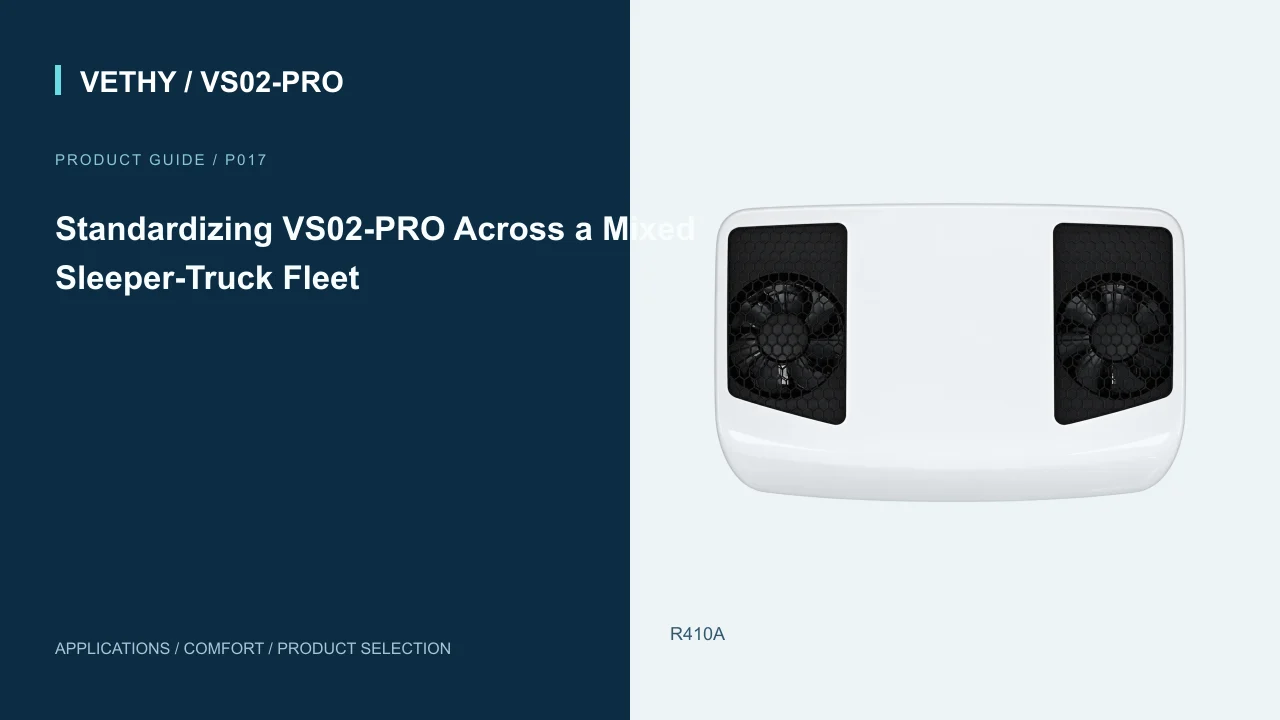
A mixed fleet can standardize on a product family without pretending that every truck has the same roof or electrical system. VS02-PRO is a useful candidate for that approach because it offers distinct 12V and 24V rooftop cooling versions within a clearly identified R410A Rechi twin-cylinder rotary package. The commercial opportunity is a common model platform with vehicle-specific installation variants that remain easy to recognize.
For a fleet buyer, this can make product presentation, driver guidance and order records more consistent. The 12V version lists 2200 W cooling, while the 24V version lists 2600 W. Both share the documented brushless airflow and automatic oscillation features that can be planned around the occupied cab. The installation still needs to fit the roof, supply and sleeper arrangement of each vehicle group.
This guide focuses on the mixed-fleet program rather than one voltage-specific installation. It explains how to organize the choice around useful vehicle groups, keep the product configuration clear and turn a successful first package into an orderly purchasing and fitting process.
1. Standardize the buying question before the hardware
The first common element should be the fleet's comfort objective. Define the parking periods the program is intended to serve and the area drivers normally occupy. A fleet may have different routes, but it still benefits from a shared description of why parking cooling is being added and what a useful installation should do.
This creates a practical basis for recommending VS02-PRO. The unit is being considered as a rooftop comfort package for defined sleeper duties, rather than chosen because one product name appears suitable for every truck. Purchasing and operations can discuss the same purpose while engineering reviews the vehicle groups.
The common objective also helps drivers understand the program. A short explanation of the intended seat and bunk arrangement is more useful than a list of technical labels. The product's Rechi twin-cylinder rotary system, brushless airflow and automatic oscillation can then be connected to recognizable comfort benefits during parked use.
For the buyer, the advantage is a coherent program. The fleet can keep one product family at the center while allowing differences in the installation. This makes standardization practical: common product information and a shared comfort purpose, with the vehicle details still visible where they affect the work.
2. Separate 12V and 24V selections clearly
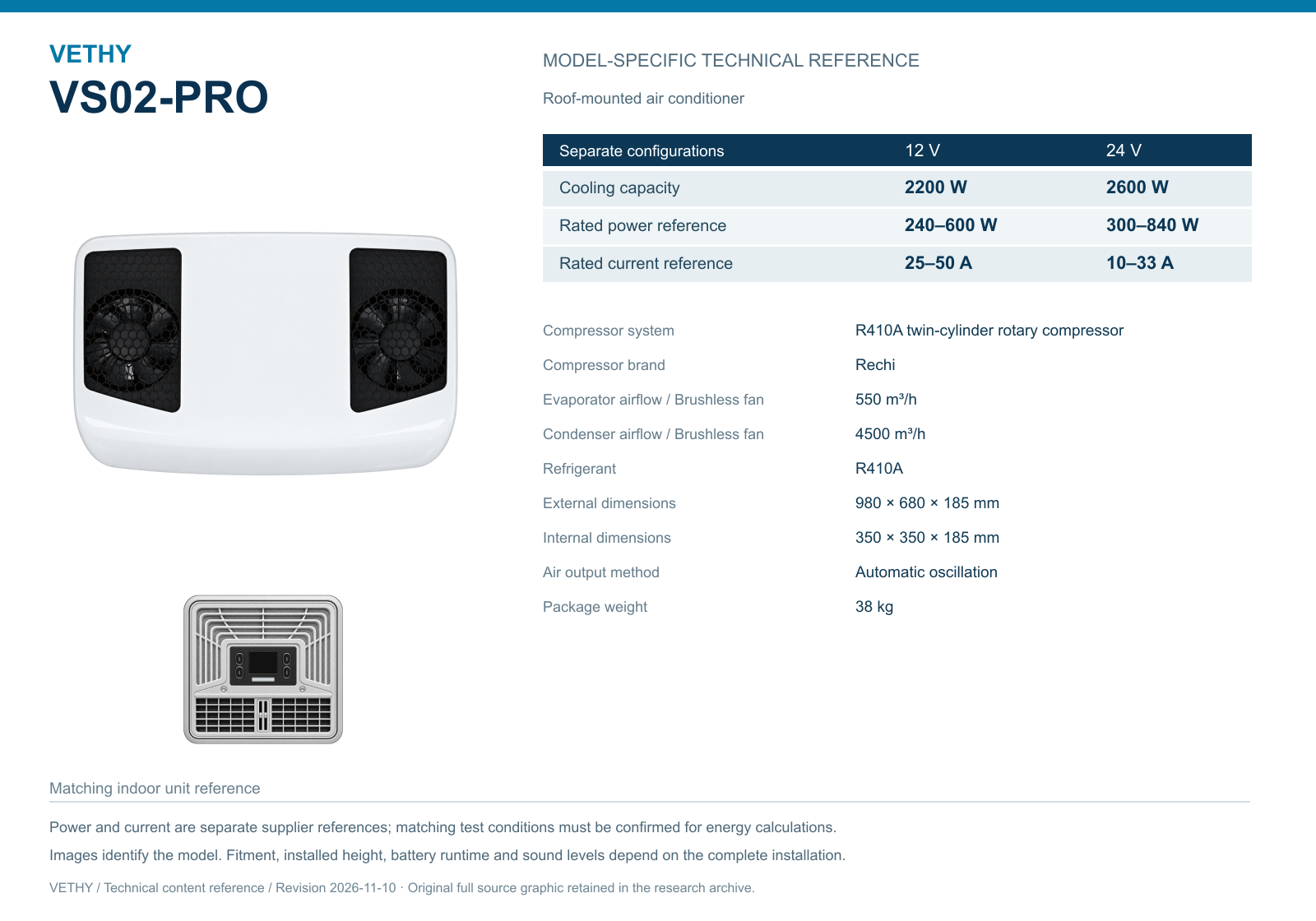
The VS02-PRO versions have different cooling references and electrical fields. The 12V model lists 2200 W cooling, rated power of 240–600 W and a separate current reference of 25–50 A. The 24V model lists 2600 W cooling, rated power of 300–840 W and a separate current reference of 10–33 A.
Keep these values in separate columns in the fleet record. Their endpoints do not establish common test conditions, so they should not be paired to calculate efficiency or predict endurance. The electrical designer needs the applicable requirements for the actual offered version and vehicle supply arrangement.
This distinction is useful to purchasing because a common model family can otherwise conceal meaningful version differences. The order should identify voltage directly, and the fitting schedule should connect that product to the correct truck group. A shared appearance is not enough to establish that the same electrical configuration belongs on every vehicle.
The VS02-PRO product page provides the central reference for the family. The fleet can use that common product identity while keeping the version-specific selection visible in the quotation, vehicle record and later support process.
3. Group trucks by the work the installer must do
Vehicle groups should reflect roof shape, interior trim, electrical arrangement and relevant accessories. Two trucks carrying the same fleet livery may still need different mounting or routing decisions. Grouping by the installation makes each approved example more useful and prevents a convenient model label from hiding practical differences.
Start with available cab identification and photographs. Show the roof, existing equipment, bunk and curtain arrangement. The fleet does not need a perfect engineering database before the supplier conversation begins. A small set of useful images can reveal where trucks are similar enough to assess together and where a separate review is sensible.
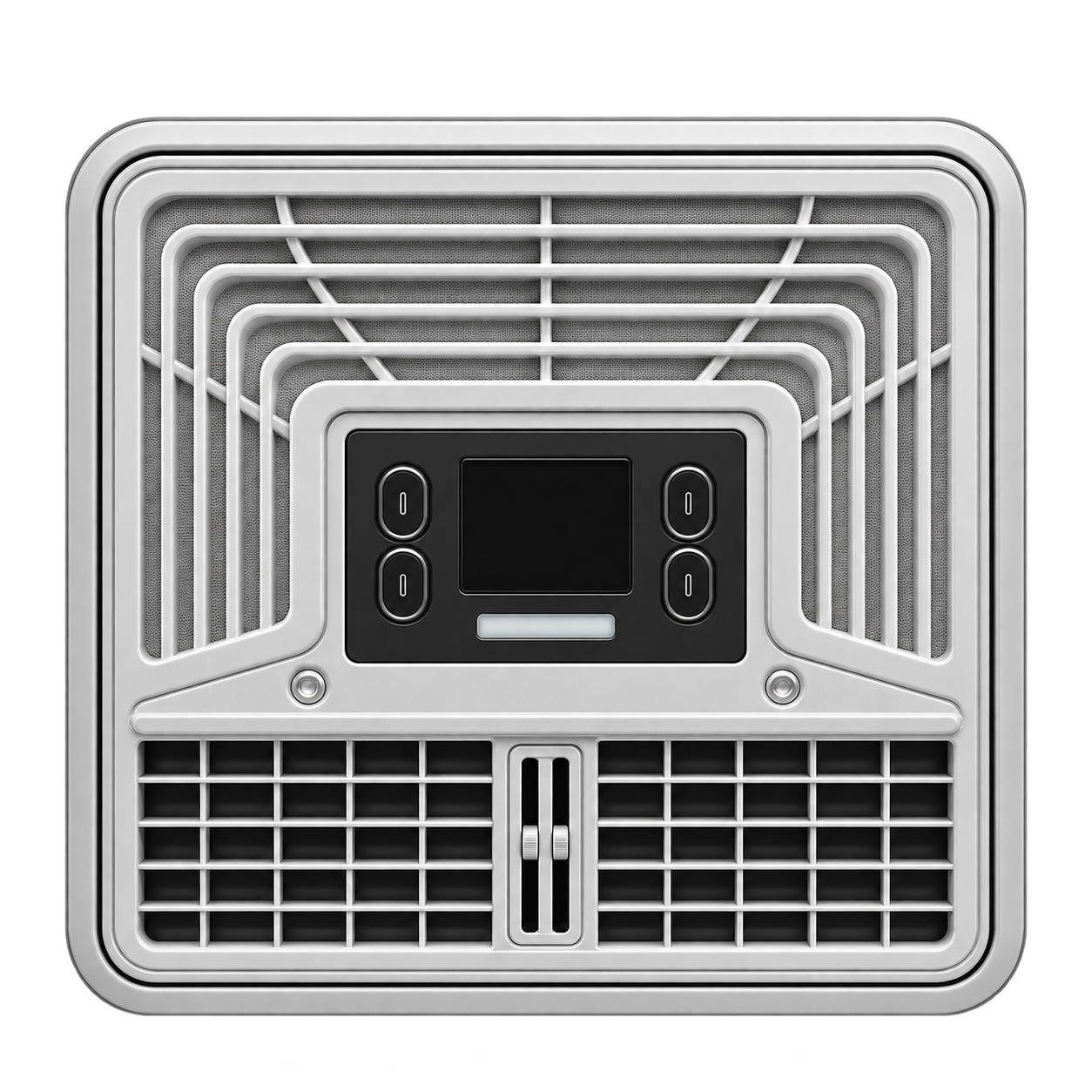
VS02-PRO's outdoor dimensions are 980 × 680 × 185 mm, with indoor dimensions listed as 350 × 350 × 185 mm. Those references help the initial grouping discussion. The applicable drawing must then establish the opening, support, sealing and mounting arrangement for each vehicle variant.
The practical benefit is controlled repetition. The fleet can reuse successful work where it genuinely applies and focus engineering attention on the differences. This keeps the program moving while preserving the value of a clear product recommendation for each group of trucks.
A useful group definition should be understandable outside the engineering team. Purchasing and operations need to identify which trucks belong to it and which package is being scheduled. Use the fleet's existing vehicle identifiers rather than an informal description that only one fitter recognizes. The installation variant can then travel with the truck through ordering, workshop work and service, preserving the advantage of a common VS02-PRO family while keeping the practical vehicle differences clear.
4. Create a simple configuration matrix
A matrix connects the common product family to the different vehicle groups. It should identify the selected voltage, condenser configuration and relevant installation variant. This is a purchasing tool as much as an engineering tool because it makes the complete offered package understandable to the people scheduling and ordering the work.
| Hypothetical vehicle group | Product selection to define | Installation emphasis | Useful common record |
|---|---|---|---|
| Group A with engineered 12V supply | 12V VS02-PRO, 2200 W reference cooling | Roof fit and actual supply route | Model, voltage and approved cab arrangement |
| Group B with engineered 24V supply | 24V VS02-PRO, 2600 W reference cooling | Roof fit and actual supply route | Model, voltage and approved cab arrangement |
| Group C with different roof equipment | Version confirmed for the actual supply | Access around existing accessories | Separate installation variant |
| Group D with revised sleeper interior | Version confirmed for the duty | Panel, curtain and occupied air path | Separate interior arrangement |
The table is a planning example rather than a compatibility claim for named truck models. It shows how VS02-PRO can support a common program while the vehicle-specific work remains visible. The fleet can then review complete packages instead of comparing isolated AC boxes.
5. Make condenser configuration part of the standard
The documented standard VS02-PRO package has a copper evaporator and copper piping with an aluminum microchannel condenser. A copper condenser is optional. Decide which configuration belongs in the fleet's regular offer and identify any group that requires a different choice, with the supplied details confirmed by VETHY.
A clear material standard helps repeat ordering and later service. The purchasing team can request the same configuration, and the workshop can connect the product record to the actual supplied unit. This is more useful than an ambiguous all-copper description that leaves the condenser choice unclear.
The optional condenser should be treated as a real configuration decision. If the fleet has a defined material preference, state it directly in the enquiry and quotation. The supplied information does not establish a universal performance improvement for the option, so keep the commercial discussion focused on the actual project requirement.
This makes the VS02-PRO family easier to manage across a mixed fleet. The product identity remains stable, and the important option is recorded rather than remembered informally. The same clarity benefits a distributor supplying multiple fleet batches over time.
6. Keep the occupied air path consistent where possible
VS02-PRO lists 550 m³/h evaporator airflow with a brushless fan and automatic oscillation. These features can support a common comfort approach across several truck groups: useful movement through the occupied area, a clear return route and a demonstration from the normal resting position.
The exact panel relationship may vary with the cab. A curtain track, cupboard or bunk layout can change how the stream reaches the driver. The fleet should therefore standardize the purpose of the air path while allowing the installed arrangement to differ where the vehicle requires it.
Include normal bedding and storage during the interior review. An empty pilot cab may conceal the obstructions that appear during everyday work. The driver should see how the supplied outlet behavior serves the intended seat and bunk positions, with the normal curtain arrangement in place.
The buyer benefit is a recognizable comfort package across the fleet. Drivers can understand the essential setup even when cab details differ, and the workshop has a clear reason for each interior variant. The product's airflow becomes a practical feature within the program rather than a number repeated across a spreadsheet.
7. Plan the roof as working vehicle space
The 185 mm outdoor height is a useful product reference for the vehicle-height discussion, while the final installed height depends on the roof and mounting arrangement. The complete 980 × 680 × 185 mm outdoor dimensions should appear in the packaging review. Retain the indoor dimensions complete without treating their final number as visible panel thickness.
VS02-PRO also lists 4500 m³/h condenser airflow with brushless airflow. Preserve the relevant intake, discharge and service access according to the applicable installation requirements. Roof accessories should be considered in the same layout, including equipment that may be added later under another fleet program.
This is where a mixed-fleet record becomes particularly useful. A truck group with a different antenna or solar arrangement may need a separate roof variant even if the AC model and voltage are the same. The installer can see the difference and review it rather than fit from memory.
The fleet receives a product program that can coexist with other vehicle work. VS02-PRO remains a defined rooftop package, and the roof plan makes its relationship to the rest of the equipment understandable. This supports ordinary maintenance and future modifications as well as the initial fitting schedule.
8. Align auxiliary energy with route groups
Electrical endurance depends on the complete vehicle package, not the product family name. Usable battery energy, other loads, charging opportunities and the intended parking period should be reviewed for the route group. Trucks with similar cabs may still have different daily energy patterns.
A route that returns to a depot frequently differs from one that spends extended periods away. A short daytime wait differs from a settled sleeper period. Describe the actual duty to the electrical specialist so the storage and charging proposal reflects how the fleet works rather than an assumed universal overnight requirement.
Representative observations can support the design when the starting condition, selected version and other loads are preserved with the record. The result belongs to the actual installation and session. It should not become a promise that every truck with the same VS02-PRO voltage version has identical runtime.
This approach strengthens the commercial case because it keeps the product recommendation connected to a viable daily routine. The fleet can choose the model for its comfort and integration fit, then ensure that each route group's auxiliary package supports the intended use.
9. Use representative installations to build confidence
Select an initial truck from a meaningful vehicle group rather than the most convenient truck in the yard. The first installation should answer a real fleet question about that group's roof, interior and supply. Preserve the configuration so its observations can support the next comparable vehicles.
Let the driver assess the normal seat and pillow positions with ordinary bedding and curtains. The Rechi twin-cylinder rotary system and brushless airflow are useful parts of a calm-comfort discussion, while the finished experience depends on the installation. The supplied data do not establish a verified decibel rating.
A second group may need its own representative installation if the roof or interior differs meaningfully. This does not defeat standardization. It makes the shared product program more credible by showing where repetition is supported and where a distinct variant has been reviewed.
The 24V fleet selection guide discusses one voltage-specific package in detail. The mixed-fleet program builds on that narrower work by connecting several approved variants to one clear model family and a shared comfort objective.
The pilot record can also show what is common across groups. If the same indoor comfort approach serves two cab families, preserve that useful guidance while keeping the mounting and supply details separate. The fleet gains a simpler driver explanation without pretending that all technical work is identical. This is a practical form of standardization: repeat the successful product and user experience where appropriate, and retain the vehicle-specific information needed to build and maintain it.
10. Schedule fitting around clear packages
A fitting schedule is easier to execute when each vehicle has a defined product and installation variant. The workshop should receive the relevant instructions, configuration and vehicle information before work begins. This makes the proposed action concrete enough to plan without relying on a generic promise that every truck is the same.
Purchasing can connect the order quantities to the vehicle groups. Operations can identify when trucks are available. The installation team can prepare around the actual roof and supply work. The common VS02-PRO model identity helps those departments coordinate while the configuration matrix preserves the differences that matter.
If a vehicle changes group because of new equipment or revised interior work, update its installation brief before fitting. A clear program allows that change to receive focused attention instead of being treated as an unexpected exception on installation day. The objective is an orderly rollout that supports the working fleet.
For the customer, the benefit is practical delivery. The model's documented features are being turned into a repeatable installed package, with the necessary vehicle work visible in advance. The fleet can assess progress through completed, identified installations rather than product boxes that have merely arrived at the depot.
11. Give drivers and service staff different useful views
Drivers need a short explanation of the normal setup, supplied controls and support route. Service staff need the product identification, selected voltage, condenser choice and relevant installation record. Both views should refer to the same vehicle configuration, but they do not need the same level of detail.
An illustrated cab handover can show the curtain position and essential clear paths. Use the actual operating guidance for the supplied unit, without adding undocumented phone functions, named sleep programs or automatic battery algorithms. The driver should understand the product that is actually installed.
The service record can preserve roof and supply photographs with the applicable product information. Later workshops can then review the configuration even if they did not handle the original fitting. This is valuable for trucks moving between depots and for fleets using several installation partners.
The engineering page provides a route for integration discussion, while the VS02-PRO guide hub supports focused background reading. A mixed-fleet recommendation succeeds when the common product information and the actual vehicle records remain connected throughout ownership.
12. Apply the program to a hypothetical mixed fleet
Imagine a fleet with one group of trucks using an engineered 12V auxiliary arrangement and another group using 24V. Both groups need bunk-focused cooling during parked rest. VS02-PRO is considered as the common product family because the voltage versions and core package are clearly identified. The fleet can present one shared comfort purpose to drivers while purchasing the appropriate version for each group.
The first 12V truck is reviewed for roof fit, indoor position and the actual supply route. The first 24V truck receives the same type of review using its own product references and vehicle arrangement. The resulting records may share useful elements, such as the way automatic oscillation is demonstrated from the bunk, while retaining different routing or mounting details where the trucks require them.
A smaller group has additional roof equipment. It remains part of the proposed program, but the equipment relationship is assessed before its fitting slot is treated as routine. This focused review is easier because the model and core purpose are already clear. The team can concentrate on the actual difference instead of restarting the entire product selection discussion or overlooking the roof issue under a common fleet label.
The purchasing record then connects each truck group to a specific VS02-PRO version, condenser selection and approved installation variant. The workshop sees the package it is expected to fit, and the driver receives a normal setup explanation tied to that cab. This example does not establish compatibility with named truck models or predict performance. It shows how a clearly specified product family can support an orderly mixed-fleet buying decision without erasing the differences that make commercial vehicles practical to install and service.
13. Questions about mixed-fleet standardization
Can one VS02-PRO version be assumed suitable for every truck?
The product family offers separate 12V and 24V versions with different cooling and electrical references. Select the version for the engineered supply and intended duty. Roof, interior and accessory differences may also require distinct installation variants within the common family.
Does standardizing require identical mounting on every cab?
A common model can support several approved vehicle-specific arrangements. Group trucks by meaningful installation similarities and preserve the applicable drawing and record for each variant. The practical goal is repeatable work where it genuinely applies, with the differences still visible.
What makes the family useful for a fleet program?
VS02-PRO provides a defined R410A rooftop package with named Rechi twin-cylinder rotary architecture, documented airflow and a clear condenser option. Those facts support consistent product information while the installation is planned around each vehicle group.
How should later vehicle modifications be handled?
Review the relevant roof, interior and supply relationships before new equipment is fitted. The original configuration record gives the workshop a useful starting point. A product identity remains valuable when it is connected to the actual truck rather than treated as proof that later changes cannot matter.
Recommend a common family with clear vehicle variants
Shortlist VS02-PRO when a mixed fleet can benefit from one identifiable rooftop product family supported by well-defined 12V and 24V packages. Group the trucks meaningfully, preserve the occupied air path and connect each order to its installation variant. Send the vehicle groups, route patterns and roof information through the technical enquiry page for a fleet proposal built around the actual working trucks.
Product sources
- VETHY VS02-PRO current manufacturer specifications — VETHY.
- VS02-PRO technical reference sheet — VETHY.
VETHY product recommendation and application analysis. Specification references identify the selected model and voltage. Installation examples are planning examples; measured project results are identified explicitly when available.
Discuss your VS02-PRO application
Send your vehicle, supply voltage, occupied space, parking schedule and installation photographs for a model-specific recommendation.
Prepare your vehicle brief ↗