
VETHY / VS02-PRO / PRODUCT AND APPLICATION GUIDE
VS02-PRO and Variable Cooling Demand: From a Hot Cab to Evening Comfort
VS02-PRO is a useful rooftop choice when the cooling plan accounts for a hot initial cab, occupied rest and changing evening conditions. Its Rechi twin-cylinder rotary system, brushless airflow and automatic oscillation support a practical comfort package. Confirm the selected voltage and control configuration, then assess energy use across the complete stop.
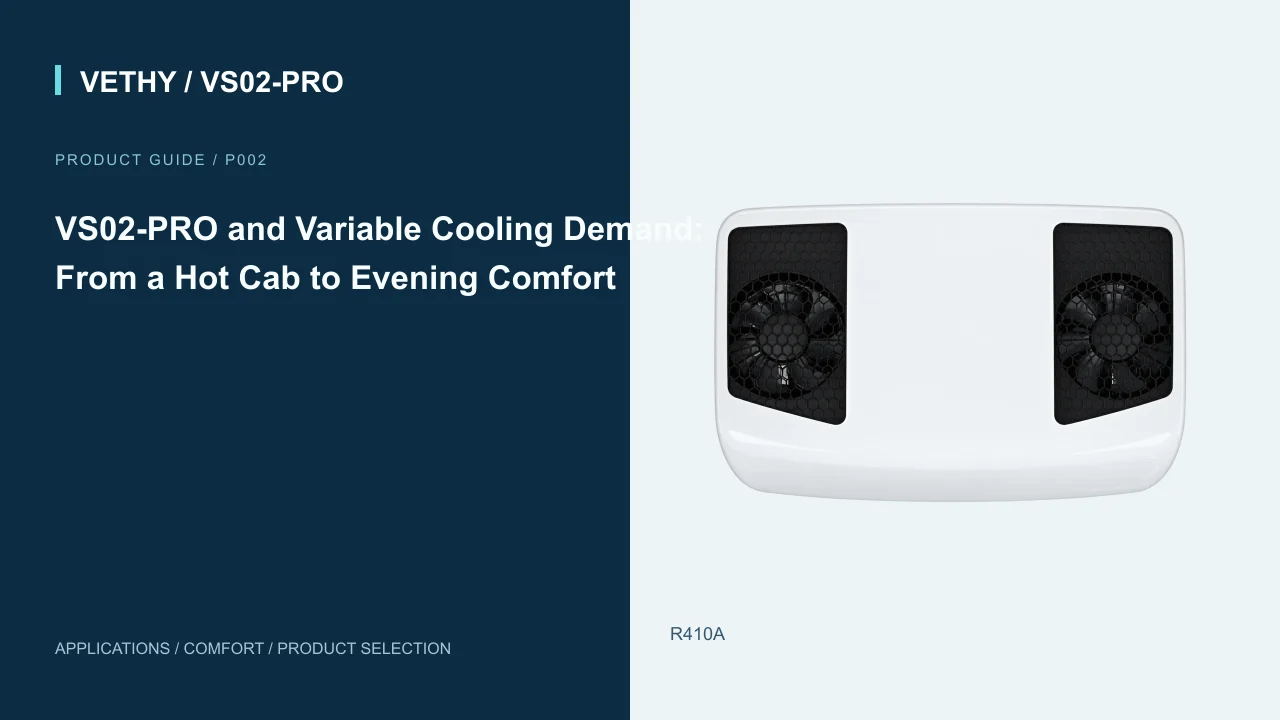
A truck cab does not ask for the same cooling all evening. A sun-heated dashboard, a recently opened door and a warm mattress influence the first part of a stop. Later, after the sun has moved and the driver has settled into the sleeper, the useful task is maintaining a comfortable occupied space. VS02-PRO is worth considering when the buyer wants to plan those stages around a defined R410A rooftop product rather than treating the parking period as one unchanging load.
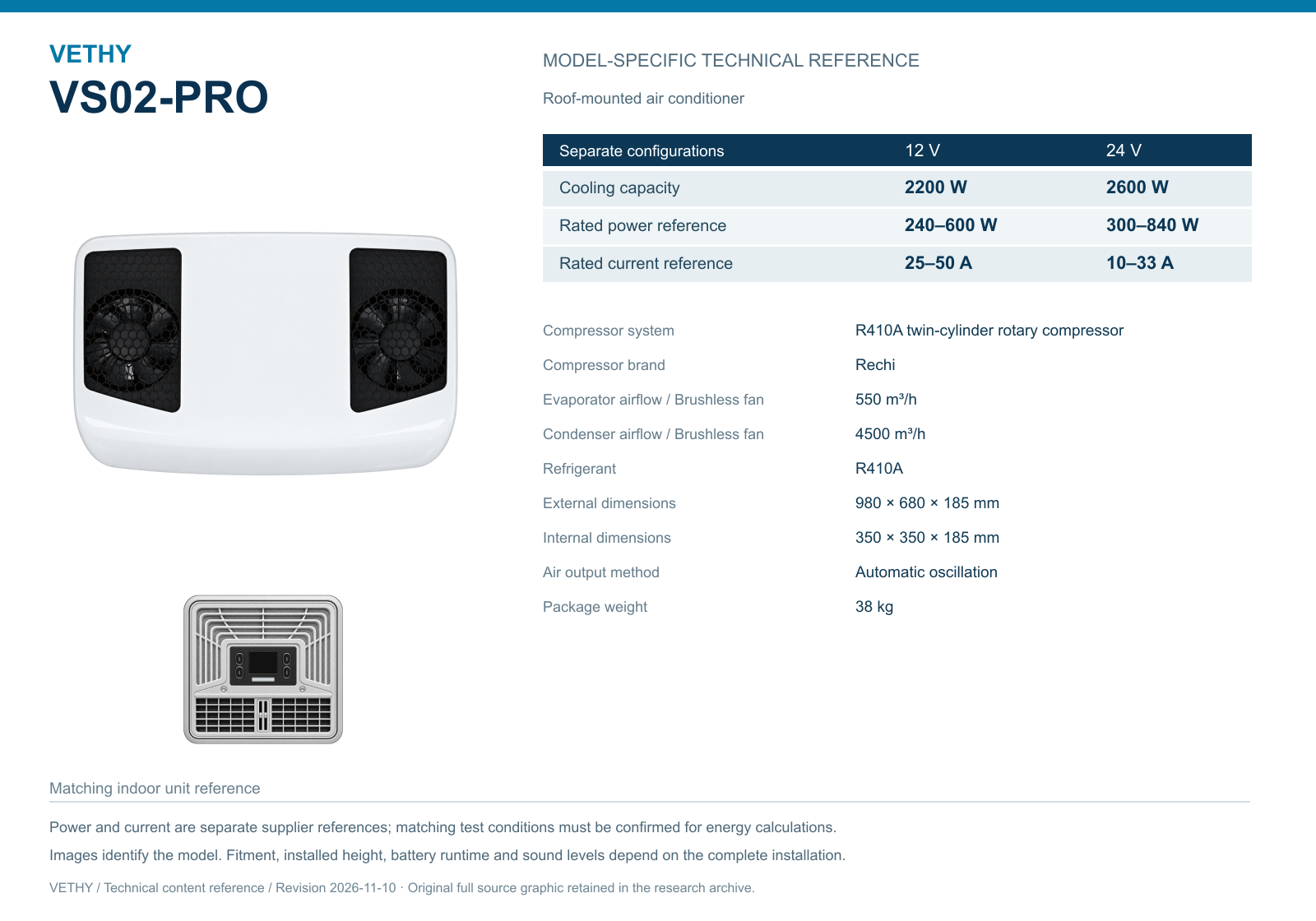
The product combines a Rechi twin-cylinder rotary compressor system, brushless indoor and outdoor airflow, and automatic oscillation. Its cooling reference is 2200 W in the 12V version and 2600 W in the 24V version. Those facts support a focused discussion about the vehicle, the driver's routine and the selected electrical configuration. They do not establish a fixed demand profile for every cab.
The best recommendation is therefore stage-based: prepare the cab, help cooling reach the occupied zone, then reassess comfort as conditions ease. This guide explains how to build that practical operating plan without inventing control modes, speed ranges or energy-saving figures that the supplied VS02-PRO documentation does not establish.
1. Read the evening as several cooling tasks
The first task is recovering a usable space. Interior surfaces may have absorbed heat during a long sunny period, and the driver may enter while the outside air is still warm. The next task is creating comfort in the place actually being used: perhaps the front seats during paperwork, then the bunk. The final task is sustaining that comfort as doors remain closed and the outdoor environment changes.
These stages overlap, but separating them helps buyers describe what they expect. A request for comfortable rest after a late delivery is more useful than an unexplained request for maximum cooling. The installer can ask where the driver sits, when the curtain closes and how often the door opens. Those answers guide panel placement, circulation and the wider energy plan.
For VS02-PRO, this approach brings the automatic oscillation feature into a real application. Early in the stop, distributed air may help the occupied cab feel more even. Later, outlet direction can be considered around the resting position. The objective is useful cooling at each stage, with a driver who understands why the first few minutes can feel different from the rest of the evening.
2. Understand what a capacity reference can answer
VS02-PRO offers two electrical versions with different manufacturer cooling references. The 12V model lists 2200 W and the 24V model lists 2600 W. The supplied graphic also lists 7500 BTU and 9000 BTU respectively; these are retained manufacturer references rather than a new conversion performed for this guide. Always name the version when discussing capacity.
Capacity helps establish whether the product belongs in the project's initial comparison. The actual comfort result also depends on the cab's heat gain, sunlight, insulation, glazing, occupants and use pattern. A well-shaded sleeper with limited door traffic presents a different task from an exposed cab that repeatedly opens at a busy loading point. The same product may consequently experience a very different operating period.
The right question is whether the selected VS02-PRO configuration can meet the defined vehicle duty under the intended conditions. That is a more helpful purchasing question than asking whether a single rating will cool every truck. The core VS02-PRO recommendation guide introduces the complete product package; this article concentrates on the changing demand within one parking session.
3. Give the hot cab a sensible starting condition
A useful cooling routine begins before the driver tries to rest. Select a parking position with shade when one is available and appropriate, reduce unnecessary solar entry and keep the indoor air path free of loose bedding or luggage. These actions reduce avoidable burdens on the cooling installation. They are practical ways to use the product thoughtfully, not substitutes for choosing suitable capacity.
A brief ventilation decision may also be useful when the cab has become hotter than the surrounding air. Whether opening the doors or windows helps depends on the actual outside temperature, humidity, dust and site rules. The point is to make a deliberate transition into closed-cab cooling, not to prescribe a universal window-opening ritual. Once cooling is intended to serve the enclosed space, repeated uncontrolled openings introduce a new demand.
For an owner-driver, this preparation can be simple: arrange the bunk, deploy the intended shade and confirm that the return-air area is clear before settling down. For a fleet, it can become a short driver instruction expressed in normal language. The benefit is consistency. The VS02-PRO installation begins each rest period in a condition closer to the one the installer intended, making comfort easier to assess and use.
4. Use air distribution to bridge the first and later stages
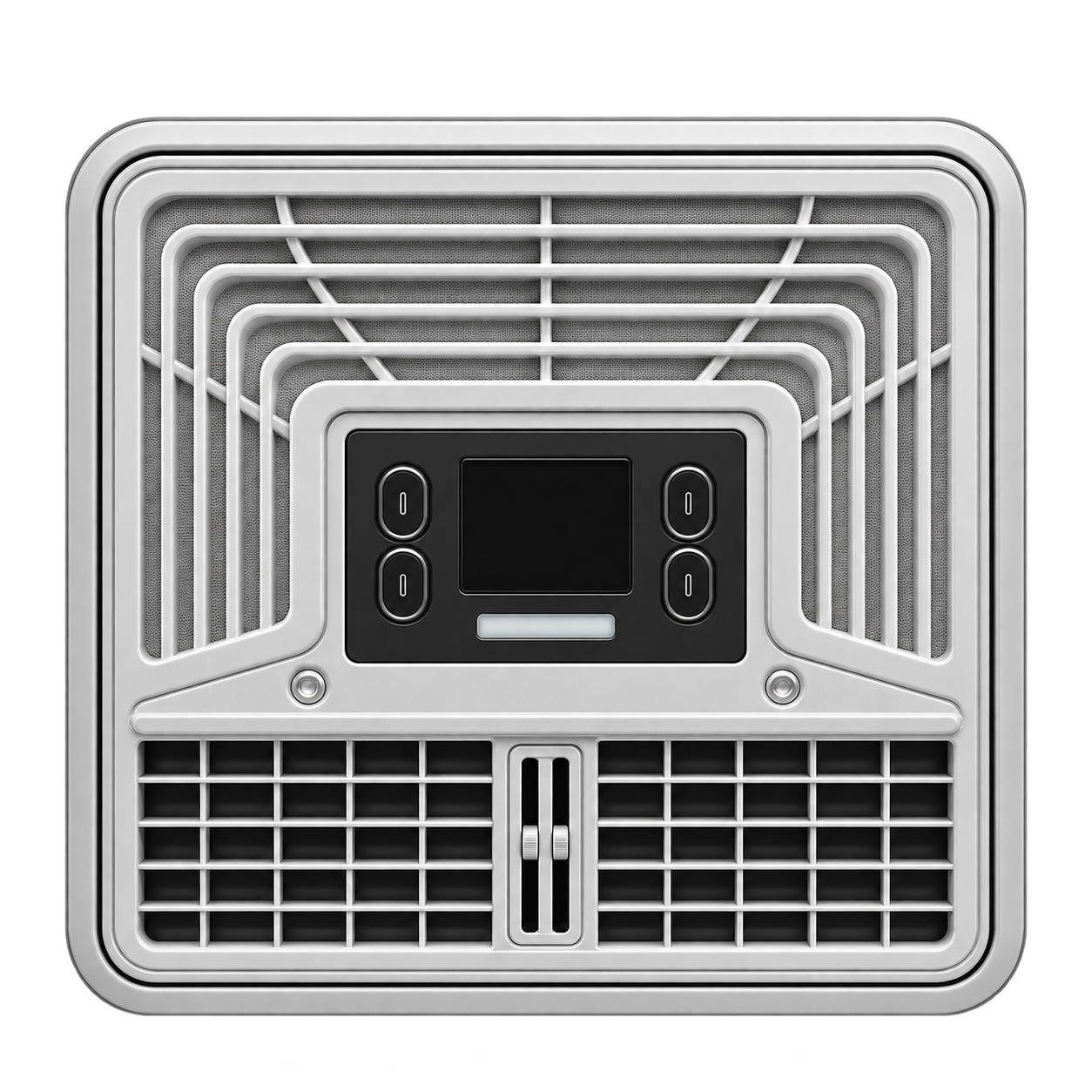
VS02-PRO lists 550 m³/h evaporator airflow with a brushless fan. That is an equipment reference, while the cab layout determines where the stream actually travels. A useful installation allows cooled air to move through the occupied area and return to the indoor assembly. Automatic oscillation can help spread the stream rather than leaving all attention on a single fixed direction.
During the first part of a stop, the driver may appreciate air moving through a larger occupied portion of the cab. Once the curtain is closed and the bunk becomes the main zone, the preferred direction may change. The benefit of discussing both positions during installation is that the air path can be designed for ordinary life inside the truck, including the bedding and storage that will be present every day.
Avoid equating more direct air with better rest. A strong stream aimed continuously at the face may feel unpleasant even when the general cab temperature is acceptable. Show the customer how the documented outlet arrangement behaves from the sleeping position. This puts comfort ahead of a dramatic demonstration at the outlet and helps the buyer see why distribution belongs beside cooling capacity in a product recommendation.
One useful installation conversation starts with where the driver does not want the stream. A person who rests on one side of the bunk may be comfortable with air passing above the bedding but dislike it on the neck. Another driver may use the front seats for most of the wait. These preferences can be recorded before the roof position and interior arrangement are finalized. The product then becomes easier to recommend because its airflow features are tied to an understood comfort need rather than a generic claim that more air always feels better.
5. Connect the changing task to the documented hardware
The VS02-PRO architecture gives this discussion a clear center. It uses an R410A Rechi twin-cylinder rotary compressor system, a copper evaporator, copper piping and a standard aluminum microchannel condenser. A copper condenser is optional. The outdoor airflow reference is 4500 m³/h with brushless airflow. These details describe the package that carries the cooling task as the evening changes.
| Part of the stop | Practical comfort objective | Relevant VS02-PRO information | Useful project action |
|---|---|---|---|
| Return to a warm cab | Establish a usable occupied space | 2200 W at 12V or 2600 W at 24V | Match the actual version to the cab duty |
| Paperwork or meal break | Spread cooling through the seated area | 550 m³/h evaporator airflow | Evaluate outlet direction from the seat |
| Move into the bunk | Avoid concentrated drafts | Automatic oscillation | Review the stream with curtains and bedding present |
| Later evening rest | Maintain comfortable conditions | Defined rooftop cooling package | Observe demand and comfort over the intended period |
| Next working shift | Begin with clear air paths | 4500 m³/h condenser airflow reference | Keep roof accessories and debris away from the outdoor path |
The table does not assign an undocumented operating mode to any stage. It connects real product facts to tasks the driver and installer can understand.
6. Keep variable demand separate from undocumented controls
Changing cabin demand is a property of the application. It does not, by itself, prove how a particular unit controls its compressor. Inverter and variable-output concepts can be valuable in a product discussion because matching output to a lower requirement can be part of an energy-conscious design. The complete electronics, operating limits and control logic determine how any specific unit behaves.
The supplied VS02-PRO information does not define a modulation band, speed schedule, firmware mode or percentage saving. A quotation should therefore identify the requested control configuration directly with VETHY rather than relying on assumptions drawn from another model. The source does establish the Rechi twin-cylinder rotary system, which can be confidently named without adding an unverified controller description.
This distinction helps the buyer make progress. The project can still plan shade, airflow, battery reserve and driver use while the supplier clarifies any additional control requirement. A distributor can say that the cab's needs change across the stop and explain the practical response. It does not need to claim that a named economy mode exists or that the unit always reaches a particular low electrical input at a particular temperature.
7. Plan electrical energy over time
A power reference describes electrical demand at a stated or implied operating point; energy adds the duration. For planning purposes, the VS02-PRO source lists rated power references of 240–600 W for 12V and 300–840 W for 24V. Its separately supplied current references are 25–50 A and 10–33 A respectively. These fields are useful discussion inputs, but their endpoints do not establish matched test conditions.
A responsible battery plan considers usable stored energy, the selected version, other vehicle loads and the expected parking period. It also considers how actual demand changes as the cab cools and the environment changes. Measuring the complete installation over a representative session gives more relevant information than multiplying whichever catalogue endpoint makes the longest runtime appear possible.
For example, a project planner can divide a hypothetical stop into early cooling, occupied rest and brief door-opening events, then request observations for each stage. This is a way to organize measurement, not a prediction of VS02-PRO performance. Keep the starting battery condition and other loads with the record. The resulting evidence can support that vehicle's energy plan without being promoted as a universal overnight guarantee for every battery or climate.
Energy discussions also benefit from using the same time boundary. A cooling observation that begins after the cab has already cooled cannot describe the entire stop unless the initial period is included separately. Conversely, a reading during the first hot minutes does not establish all-night consumption. Agree when the session starts and ends, and preserve that definition in the record. The buyer receives a more useful basis for deciding whether auxiliary storage is sufficient, and the supplier can discuss improvements without having to reconstruct what part of the driver's day was actually measured.
8. Let the curtain define a useful zone without blocking circulation
A sleeper curtain can help describe the space the driver wants to condition. It may separate the bunk from the front seats or reduce the influence of sunlit glazing on the occupied area. The important design question is where the VS02-PRO outlet and return path sit relative to that curtain. A smaller intended zone is only helpful if the air can circulate through it properly.
If the panel is outside the enclosed sleeper zone, closing the curtain may restrict delivery to the bunk. If the return path is covered, the unit may mostly interact with a small pocket around the panel instead of the intended space. These layout effects are reasons to inspect the actual curtain positions during planning, not reasons to promise that a curtain automatically produces a fixed energy saving.
A good demonstration uses the curtain as the driver will use it. Observe comfort seated and reclining, then adjust the layout within the installation guidance. The result can be a calmer, more deliberate evening routine: cool the occupied space, maintain a clear path and avoid chasing comfort solely through a colder setting. This is a direct practical advantage of treating air distribution as part of the product package.
9. Preserve the outdoor side as conditions change
The cooling task inside the cab depends on an effective outdoor air path. VS02-PRO's standard condenser is aluminum microchannel, with a copper option available, and the condenser airflow reference is 4500 m³/h. Whichever configuration is ordered, the installation needs suitable access around the relevant intake and discharge areas according to the supplied installation requirements.
A vehicle roof can change after the air conditioner is fitted. Storage equipment, solar equipment or other accessories may be added, and ordinary service may leave debris nearby. The original air path should remain part of the roof plan. Avoid locating equipment by the enclosure outline alone, because moving air needs space beyond the plastic shell's dimensions.
Parking surroundings also vary. A location that looked open during a workshop demonstration may feel different beside a wall or under an overhang. Discuss actual stopping locations with the driver and assess the installed arrangement where practical. This keeps the recommendation connected to real use: the unit's indoor comfort advantages are supported by an outdoor layout that continues to let the complete cooling system perform its intended task.
10. Build one example around a real route pattern
Consider a hypothetical driver who arrives at a distribution center before sunset, completes paperwork in the front seat and then rests in the bunk. The VS02-PRO proposal should describe those stages explicitly. The installer can evaluate the roof position, check the chosen 12V or 24V supply arrangement and see whether the indoor air path serves both the seat and the sleeper curtain position.
During the first trial, record the starting conditions and the driver's observations at sensible intervals. Was the cab already shaded? Were doors opening repeatedly? Did the stream reach the bunk after the curtain closed? These observations explain the result and make improvements actionable. They should not be represented as VETHY laboratory data or as proof that every cab will follow the same cooling curve.
The benefit of a stage-based record is that a practical issue can be addressed at its source. A draft at the pillow suggests an air-delivery discussion. Poor comfort only after the curtain closes suggests a zoning issue. An unsuitable electrical reserve suggests a power-system discussion. VS02-PRO remains the named product at the center, while the installation team works on the part of the overall package that the observation actually concerns.
11. Make the driver handover fit the product
A useful handover explains the installed air path, the selected voltage version and the normal preparation routine. It should use the controls and instructions supplied with that actual VS02-PRO order. Do not add an imaginary sleep program, automatic battery strategy or phone feature because it would make the explanation sound more complete. Clear, accurate guidance is easier for drivers to trust and repeat.
The driver should understand that a warm initial cab and a settled evening cab are different comfort situations. They should also know whom to contact if the stream changes, a new vibration appears or the electrical system behaves unexpectedly. A concise vehicle record can connect those observations to the installation configuration, giving the service team useful context rather than a vague complaint that the AC sometimes feels different.
For fleets, this handover helps different drivers use a shared truck consistently. For a distributor, it shows the value of supplying a complete product experience. The VS02-PRO guide hub can support further reading, while the installed instructions remain the reference for actual operation. The goal is a driver who can create a comfortable resting space without guessing what the hardware is intended to do.
The handover can include one illustrated page showing the normal curtain position, clear return area and intended outdoor access. Photographs of the installed truck are more effective here than a generic diagram of a different cab. They show the driver what a useful setup looks like and help a service team spot later changes. This is a modest addition to the delivery package, but it preserves the air-path choices that made the original demonstration successful. Keep the explanation specific to the installed vehicle and the instructions supplied for that product configuration.
12. Common questions about changing cooling demand
Does lower evening demand guarantee a specific energy saving?
No specific percentage is established by the supplied VS02-PRO data. Lower heat gain changes the task presented to the cooling installation, and actual electrical behavior depends on the complete system and conditions. Treat lower-demand operation as something to plan and observe in the vehicle, with no invented percentage attached.
Is automatic oscillation useful only during the first cool-down?
It can be relevant whenever the driver wants the stream distributed across the occupied area. The practical benefit depends on panel location, curtains and resting position. Demonstrate the feature in both seated and sleeping arrangements so the driver can decide which air direction is comfortable during different parts of the stop.
Should I estimate battery time from the lowest published power value?
That would not establish reliable runtime. The source power and current ranges are separate references, and the entire session may not remain at one endpoint. Use a complete auxiliary-power plan and representative installation measurements, including other loads and reserve requirements, to assess the intended parking duration.
Can I order a VS02-PRO around a particular control requirement?
Describe that requirement in the enquiry and ask VETHY to confirm the supplied configuration. The published data identify the compressor system, airflow and other core specifications but do not document every control behavior. Confirming the requirement before ordering is the clearest way to align the product with the vehicle's operating plan.
Recommend VS02-PRO around the complete stop
VS02-PRO is a strong candidate when a defined R410A rooftop cooling package can serve the driver's changing evening routine. Its Rechi twin-cylinder rotary architecture, brushless airflow and automatic oscillation provide useful product features to build around. Share the vehicle voltage, cab layout and a typical parking timeline through the technical enquiry page. VETHY can then connect the selected VS02-PRO configuration to a practical recommendation for the actual vehicle.
Product sources
- VETHY VS02-PRO current manufacturer specifications — VETHY.
- VS02-PRO technical reference sheet — VETHY.
VETHY product recommendation and application analysis. Specification references identify the selected model and voltage. Installation examples are planning examples; measured project results are identified explicitly when available.
Discuss your VS02-PRO application
Send your vehicle, supply voltage, occupied space, parking schedule and installation photographs for a model-specific recommendation.
Prepare your vehicle brief ↗