
VETHY / VS02-PRO / PRODUCT AND APPLICATION GUIDE
Planning a 12V VS02-PRO Cooling Session Around Real Electrical Demand
The 12V VS02-PRO lists 2200 W cooling with separately supplied power and current references. Plan its cooling session around usable battery energy, other vehicle loads, supply design and the actual parking routine. Representative installation measurements provide a sound basis for assessing duration while its airflow features support deliberate cab comfort.
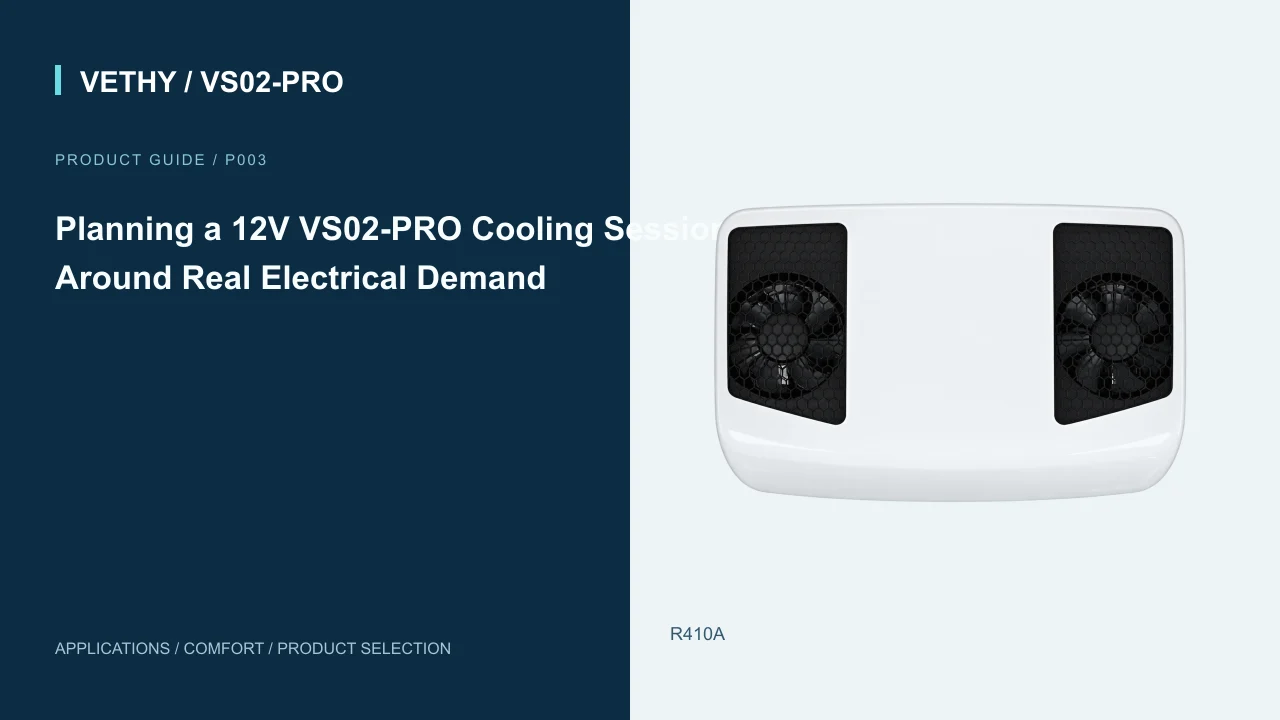
Choose the 12V VS02-PRO when a vehicle project calls for a 12V rooftop parking cooling package and the auxiliary supply can be designed around the complete installed duty. The manufacturer cooling reference is 2200 W. The unit also brings an R410A Rechi twin-cylinder rotary compressor system, brushless airflow and automatic oscillation into one defined product recommendation.
The electrical conversation should begin with the driver's intended cooling session, not an advertised number of hours. A short warehouse wait, an extended evening rest and a sequence of stops can place very different demands on the same cab. Battery capacity, other equipment and recharging opportunities belong in that conversation from the outset.
This guide concentrates on how to turn the 12V product references into an understandable power-planning discussion. It keeps published figures in their proper roles and uses clearly hypothetical examples to explain energy. The outcome is a stronger VS02-PRO proposal: a customer can see why the model fits, what supports its comfort benefits and how the complete installation will be evaluated.
1. Why the 12V version deserves its own plan
A nominal 12V vehicle system is a useful starting point for selecting the 12V VS02-PRO, but it does not prove that an existing connection is suitable. Parking cooling is a meaningful auxiliary load. The electrical installer must consider the available supply, protection, cable route, connections and intended operating period as one system. The model choice becomes useful when those surrounding details are planned deliberately.
VS02-PRO's roof layout can simplify the product conversation because the cooling assembly is located above the occupied cab. The electrical path still needs to reach that location through a suitable, serviceable route. A neat roof installation and a weak supply arrangement do not make a complete comfort package. The recommendation should therefore include the supply design as part of the installed offer rather than leaving it to the driver after purchase.
For an owner-driver, this provides a practical buying advantage. The product can be assessed with its installation and auxiliary power arrangement instead of as an isolated box. For a fleet, a documented supply design can support repeatable work across similar trucks, while allowing differences in battery location or cable routing to be reviewed rather than overlooked.
2. Read the published fields without mixing them
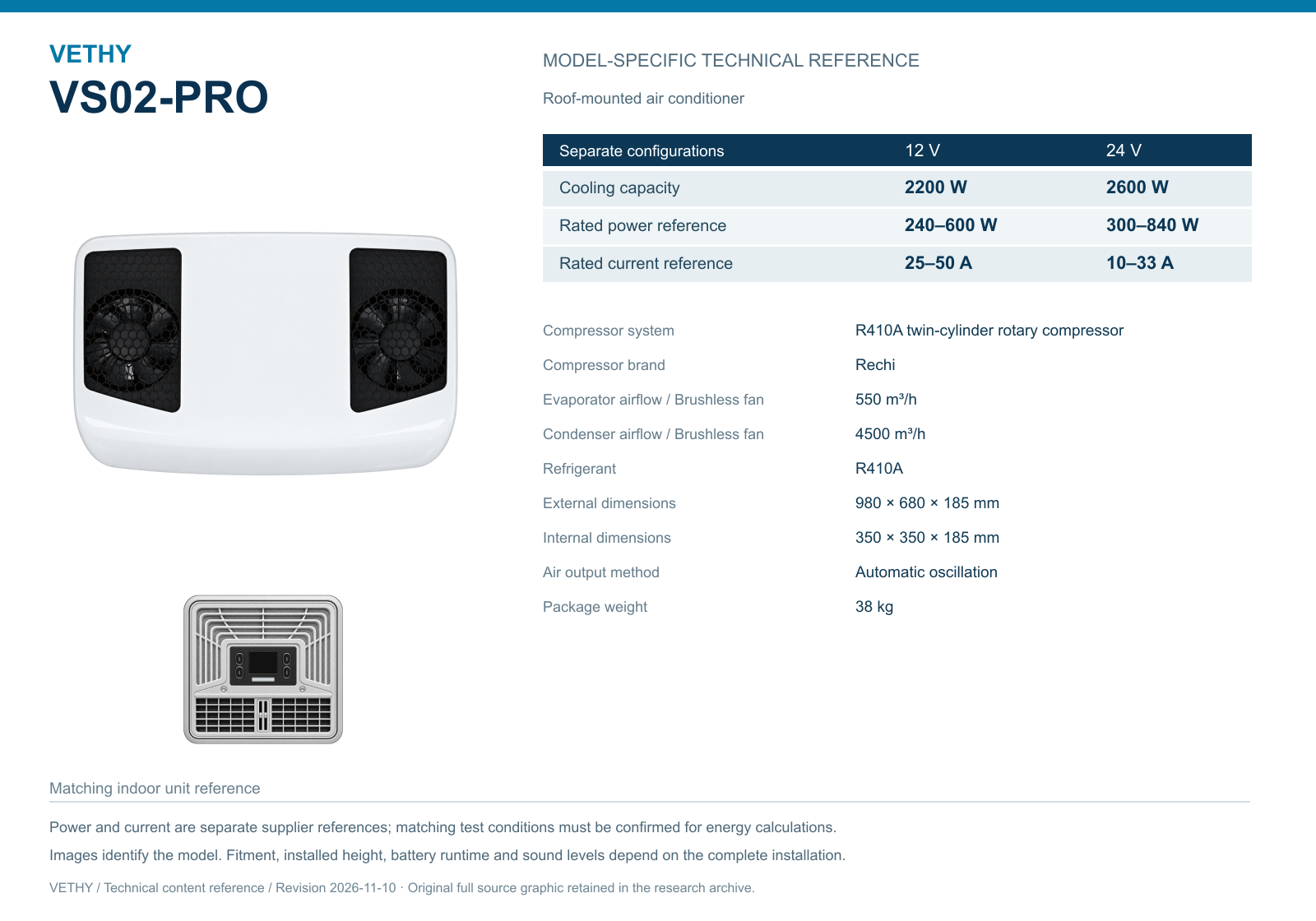
The supplied 12V VS02-PRO references list 2200 W cooling, a rated power range of 240–600 W and a rated current range of 25–50 A. The source does not supply a common condition that turns every endpoint into a matched operating point. Keep the fields separately labelled when preparing a quotation, presentation or energy worksheet.
| Published field | 12V reference | Proper role in planning |
|---|---|---|
| Nominal version | 12V | Select the correct electrical product |
| Cooling capacity | 2200 W | Screen the version against the cabin cooling task |
| Rated power | 240–600 W | Discuss manufacturer electrical references and request the relevant conditions |
| Rated current | 25–50 A | Support the electrical-design enquiry without replacing the installation requirements |
| Evaporator airflow | 550 m³/h | Plan indoor air delivery and return circulation |
| Condenser airflow | 4500 m³/h | Preserve the outdoor heat-rejection air path |
The cooling figure is thermal output, while the power field concerns electrical input. They are not interchangeable demands on the battery. It is equally inappropriate to select the highest cooling value and lowest unrelated electrical endpoint to create an impressive efficiency claim. Clear labelling lets the customer use the information accurately and gives the installer a sound basis for follow-up questions.
The distinction matters in customer-facing material as much as in an engineer's worksheet. Show the field names beside their units and avoid a single large electrical number with no explanation. A buyer should be able to tell which figure describes cooling and which describes input or current. This also protects comparisons: if another proposal supplies a measurement under a defined condition, compare like information or request clarification. The aim is to make the VS02-PRO offer easier to understand, with a traceable path from manufacturer reference to the complete installed design.
3. Define the cooling session in ordinary language
Before discussing battery size, describe what the driver wants the system to do. Include the approximate starting time, expected parking duration, occupied area and common door-opening events. Note whether the cab arrives already comfortable from driving or has been standing in the sun. Those details influence the real cooling task and make later measurements easier to interpret.
A driver waiting two hours for a loading slot may stay in the front seat and open the door frequently. A driver beginning a rest period may close the sleeper curtain and remain on the bunk. Both can be valid 12V VS02-PRO applications if the complete project is suitable, but they should not share an unexplained runtime promise. Their operating routines present different demands and different priorities for airflow.
The session description should also include how the vehicle will recover the energy used. The relevant charging arrangement depends on the vehicle project and should be assessed by the electrical specialist. The commercial benefit is a complete story: the customer is selecting a rooftop cooling product as part of a working daily routine, with the supply and recharging plan considered together.
4. Separate power from energy with a simple example
Power describes the rate at which electricity is used. Energy describes the amount used over time. A hypothetical appliance averaging 400 W for three hours uses 1200 Wh, or 1.2 kWh. This arithmetic explains the planning concept; it is not a measurement or prediction for VS02-PRO. The actual unit's average demand must come from the relevant configuration and operating conditions.
This distinction is useful because a single momentary reading cannot describe a whole evening. Initial cooling may differ from a later period, and other equipment can switch on during the stop. A session record that measures or integrates energy over a defined time window provides a clearer basis for auxiliary-power planning than a photograph of one instantaneous value.
A second hypothetical example illustrates other loads. If a separate appliance averages 30 W for five hours, it adds 150 Wh to the session. That contribution must be considered alongside cooling and all other equipment. No VS02-PRO runtime follows from these examples; they simply show why a complete energy budget matters. The buyer can then ask the installer for a plan that reflects the actual vehicle instead of comparing battery labels alone.
5. Start the battery conversation with usable energy
A battery's label does not by itself establish how much energy the installation should use during a parking session. The relevant usable amount depends on the battery system, permitted operating limits, condition, temperature, other requirements and the vehicle's reserve strategy. The battery and electrical suppliers should define those limits for the proposed installation.
For a driver, the reserve has an immediate practical meaning: the cooling plan should fit the vehicle's broader operating needs. The VS02-PRO product data do not establish a particular battery chemistry, battery-management strategy or starting reserve. Those are system decisions. Keeping them explicit makes the recommendation more useful and avoids implying that the air conditioner alone guarantees the next working shift.
Where an auxiliary battery arrangement is proposed, ask for the complete package to be described in the quotation. The customer should understand what storage, charging, monitoring and installation work are actually included. This is not an invitation to complicate the sale with unnecessary equipment. It is a way to ensure the selected 12V rooftop product has a supply arrangement suited to the comfort session the customer intends to use.
A useful battery discussion can also separate today's vehicle from a future upgrade. If the truck currently lacks enough usable reserve for the intended session, the buyer can compare a shorter cooling duty with a properly engineered auxiliary package. The AC model does not need to be rejected or oversold to resolve that decision. State the proposed duty, the storage arrangement under review and the remaining design work. This turns an uncertain runtime question into a concrete package choice that the customer and installer can assess together before installation begins.
6. Give the supply path the same attention as the battery
The battery can be suitable while the route to the rooftop unit still needs improvement. Cable length, conductor selection, connections and protection must be designed for the actual installation. A qualified installer should follow the supplied product requirements and applicable vehicle practices. This guide does not prescribe a universal cable size, fuse rating or acceptable voltage drop for every truck.
The planning benefit is concrete. A documented route gives the installer a defined job and gives future service technicians a way to understand what was fitted. It can show where the supply begins, how it is protected and where it connects to the VS02-PRO. That information is especially valuable when several workshops may service the same commercial vehicle over time.
Physical routing also matters to the product experience. The supply should be protected from the vehicle's relevant mechanical and environmental conditions, with access for inspection where required. Avoid treating a roof penetration and a long hidden cable as minor finishing details. A professional electrical path supports consistent operation and makes the complete VS02-PRO package more credible to a customer who depends on the truck every day.
7. Make lower heat demand part of the value proposition
An energy-conscious installation reduces avoidable heat gain before asking the cooling unit to work harder. Shade, suitable glazing protection, cab insulation and controlled door openings can all change the task presented to the system. The practical advantage is that a larger share of the cooling effort can serve the occupied space instead of continually replacing avoidable incoming heat.
VS02-PRO's automatic oscillation and 550 m³/h evaporator airflow reference give the installer useful air-delivery features to apply within that space. Position the indoor assembly so cooling can reach the seat or bunk that matters. Keep the return path open. A smaller intended zone is not useful if a curtain or bag prevents air from circulating through it.
These measures should be explained without a fixed saving claim. Their impact depends on the actual cab and surroundings, and the supplied product information does not establish a percentage reduction. The confident recommendation is that VS02-PRO belongs in a thoughtfully prepared 12V comfort package. Reducing unnecessary demand and delivering cooling deliberately are sensible ways to get more practical value from the installation and the available electrical energy.
8. Build calm comfort without inventing a low-power mode
The Rechi twin-cylinder rotary compressor system and brushless airflow components are relevant to a discussion about smooth, calm operation. The finished result also depends on roof mounting, trim security and air direction. A driver who can rest comfortably without a concentrated stream at the pillow receives a practical benefit that is broader than a number on a sales sheet.
The supplied VS02-PRO data do not establish a named sleep mode, a minimum compressor speed or an automatic battery-saving algorithm. If a customer requires a particular control behavior, put that request into the configuration enquiry. A clear confirmation is more useful than assuming a function exists because another model offers it or because an inverter explanation appears in general marketing.
During a demonstration, use the controls and instructions for the actual offered unit. Let the driver assess the occupied position with normal bedding and curtains in place. This keeps the recommendation grounded in what the customer will receive. It also makes energy and comfort conversations compatible: the goal is a sensible cooling experience supported by the correct supply, rather than a dramatic blast of cold air that reveals little about a real rest period.
The customer's own comfort preference should appear in that assessment. Some drivers want to use the bunk almost immediately; others complete paperwork or eat before resting. A fitting demonstration can move between those positions so the buyer can feel the air distribution rather than infer it from an outlet photograph. The benefit is a more personal and useful product recommendation. VS02-PRO's documented features remain the same, while the way they serve the driver becomes clear enough to shape the roof location, interior arrangement and final handover instructions.
9. Use a representative session to validate the package
A well-chosen trial should resemble the intended use. Record the selected 12V VS02-PRO configuration, the vehicle, the starting battery condition and the period being observed. Include relevant surroundings and other electrical loads. These details allow the measured energy and the driver's comfort observations to be interpreted as a result for that installation.
A useful record can divide the period into initial cooling, settled occupancy and interruptions. This does not require an elaborate research program. It simply prevents a session with frequent door openings from being compared casually with a quiet shaded rest period. The measurements become a practical design tool, helping the installer understand whether the supply and comfort plan match the customer's duty.
If the result needs improvement, the record points toward a concrete next action. Review airflow if the bunk remains uneven, the power arrangement if reserve is insufficient, or the session assumptions if the actual stop differs from the brief. Avoid changing several unrelated elements and then attributing every improvement to the AC model. VS02-PRO's value is strongest when the complete installed package can be understood and repeated.
A representative observation should also reflect the driver's tolerance for air movement. If a trial is conducted with an unusually direct stream solely to obtain a fast initial impression, it may not represent the way the owner will actually rest. Use the intended occupied arrangement and preserve the supplied control setting information with the record where appropriate. The resulting energy observation is then connected to a useful comfort state. This helps the customer assess a complete session rather than an electrical figure collected while the cab was being used in an unrealistic way.
10. Keep the roof package visible in the energy discussion
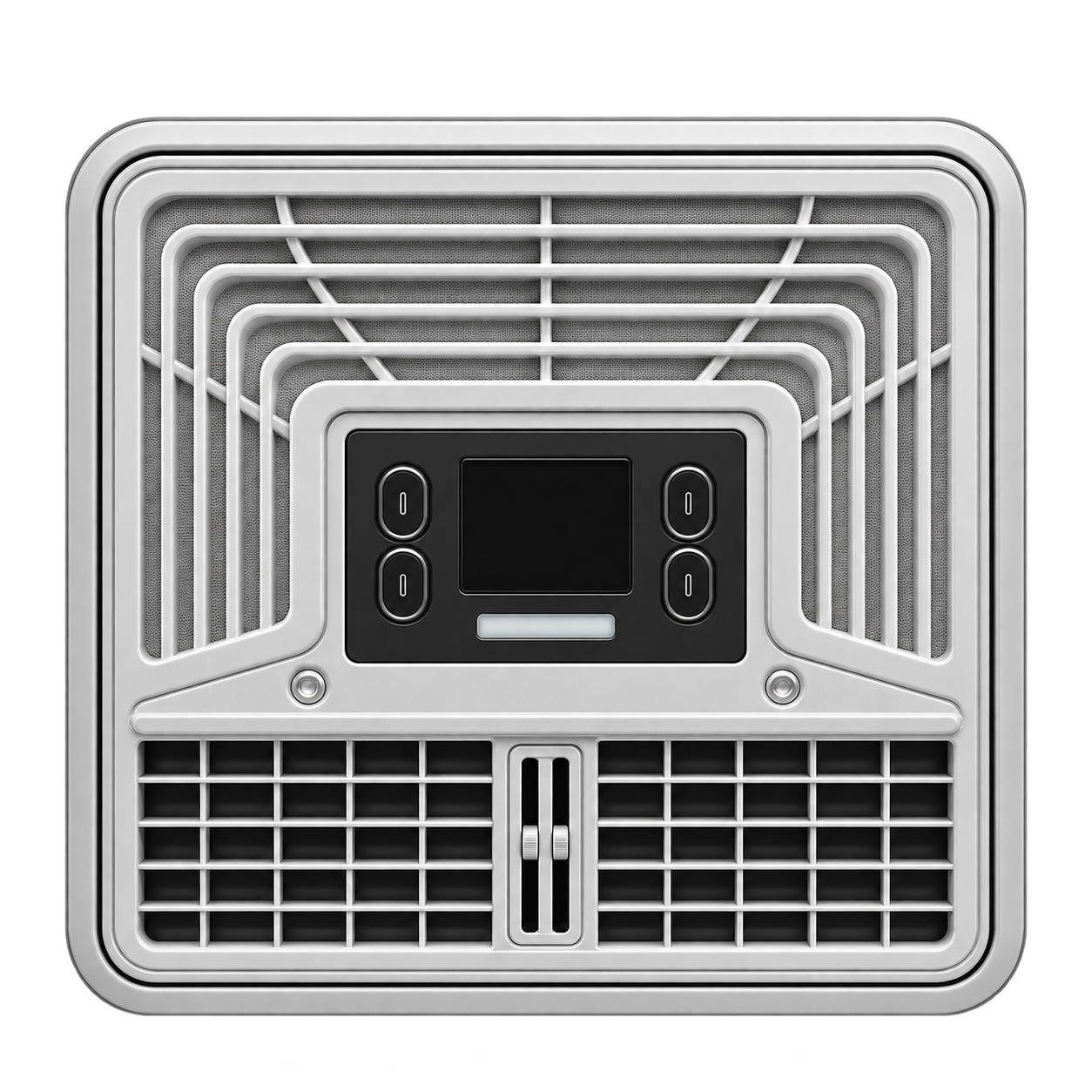
Electrical planning does not replace the physical installation survey. The outdoor dimensions are 980 × 680 × 185 mm, and the indoor dimensions are 350 × 350 × 185 mm. These help assess packaging, while the actual mounting opening, support and sealing details require the applicable installation information. Package weight is listed as 38 kg; it should not be relabelled as the bare installed unit's mass.
The condenser side must also remain open. VS02-PRO lists 4500 m³/h condenser airflow and uses a standard aluminum microchannel condenser, with a copper condenser optional. Roof accessories should be planned around the required air path and service access. The cooling system's outdoor task belongs in the same conversation as its indoor comfort benefits.
A complete proposal can therefore show three things together: the product location, the occupied air path and the electrical supply route. This makes the 12V recommendation easier for a customer to review and for a workshop to execute. The VS02-PRO product page provides the model reference, while the installation discussion connects that product to the actual truck.
11. Present the complete price around a defined duty
A product-only price may be useful for a distributor buying stock, while an owner-driver often needs a complete installed offer. State the model, 12V version and condenser configuration, then describe the actual installation and auxiliary-power scope. If charging or storage equipment is part of the proposal, identify it clearly so the customer can compare offers on a consistent basis.
The duty description should travel with the quotation. A buyer who requested short daytime waits should not later discover that an assumed overnight requirement drove an entirely different package. Equally, a driver planning extended rest should see that period reflected in the supply discussion. Connecting price to the intended use makes the VS02-PRO recommendation more credible and reduces ambiguity when the vehicle is handed over.
For fleets, this also provides a better basis for a pilot decision. Review the first complete installation, refine the vehicle-specific details and preserve the successful record for comparable trucks. The truck application guide can help frame the use case, while the VS02-PRO guide collection supports focused follow-up reading on airflow, packaging and daily comfort.
After the pilot, keep the energy observation with the truck's configuration record. A later change to the battery, roof accessories or sleeper layout can then be assessed against a known starting point. This is particularly useful for fleets whose trucks move between depots or for distributors whose installation partner also provides later service. The record does not need to be long. The important point is that it identifies the actual equipment and session so an observed result remains meaningful when someone else reviews the vehicle months later.
12. Questions about 12V cooling energy
Does 2200 W mean the battery must supply 2200 W electrically?
No. That figure is the manufacturer cooling-capacity reference. The supplied electrical power reference is a separately labelled 240–600 W range, and the current reference is 25–50 A. The source does not provide a matched test condition for every endpoint. Use the appropriate electrical information and installation requirements when developing the supply plan.
Can the lowest power reference be used to promise a long rest period?
It cannot establish a complete session's energy use. Actual conditions, the control configuration and the vehicle duty influence operation over time. Assess usable battery energy and other loads, then evaluate representative use. A fixed overnight guarantee is not supported by the supplied VS02-PRO specification set.
Should a customer choose 24V only to avoid planning 12V wiring?
The product version should match the engineered vehicle supply and the cooling requirement. The 24V VS02-PRO also has different capacity and electrical references, so it is a separate configuration decision. Have the electrical installer review the vehicle rather than treating a voltage change as a casual substitute for a proper supply design.
What information makes a 12V quotation more useful?
Provide the vehicle model, supply arrangement, battery details available to the installer, roof photographs and intended parking schedule. Describe the occupied area and other important loads. This lets VETHY discuss the actual 12V product configuration and helps the installation team propose a complete package around the customer's expected comfort period.
Make the 12V recommendation practical
The 12V VS02-PRO is a compelling candidate when 2200 W reference cooling, an R410A Rechi twin-cylinder rotary system and deliberate rooftop air delivery fit the vehicle brief. Its value grows when the electrical route, usable energy and daily recharging plan are considered alongside the cab. Share the intended session through the technical enquiry form and ask for a configuration-specific recommendation that connects the product to the truck's actual working day.
Product sources
- VETHY VS02-PRO current manufacturer specifications — VETHY.
- VS02-PRO technical reference sheet — VETHY.
VETHY product recommendation and application analysis. Specification references identify the selected model and voltage. Installation examples are planning examples; measured project results are identified explicitly when available.
Discuss your VS02-PRO application
Send your vehicle, supply voltage, occupied space, parking schedule and installation photographs for a model-specific recommendation.
Prepare your vehicle brief ↗