
VETHY / VS02-PRO / PRODUCT AND APPLICATION GUIDE
VS02-PRO and Sleeper Curtains: Cool the Occupied Space Deliberately
VS02-PRO is worth considering when the indoor assembly and sleeper curtain can define a useful occupied cooling zone. Its brushless airflow and automatic oscillation should serve the bunk with a clear return path. Demonstrate the normal curtain, bedding and storage arrangement, then match the selected voltage and complete supply to the actual parking duty.
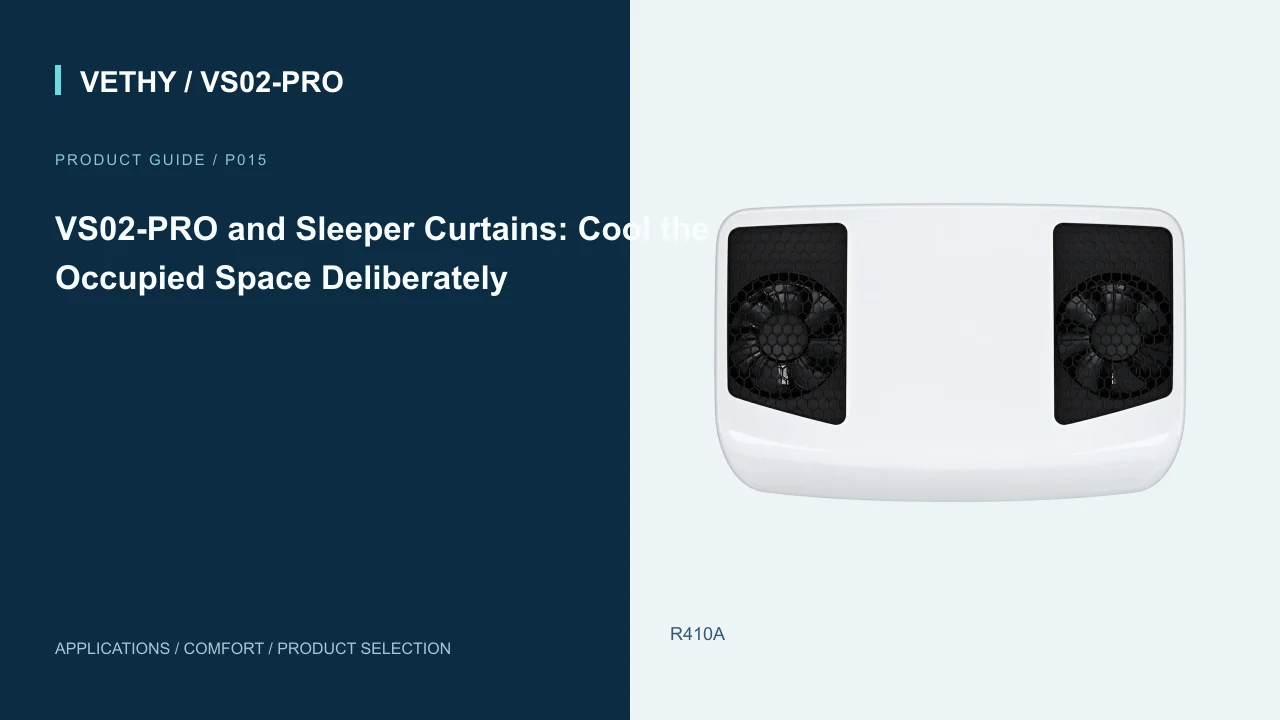
VS02-PRO is a useful rooftop parking AC candidate when a sleeper curtain can help define a deliberate occupied cooling zone. The product offers an R410A Rechi twin-cylinder rotary compressor system, brushless indoor airflow and automatic oscillation. Those features are most useful when the indoor assembly and the curtain work together to serve the bunk rather than leave the driver separated from the intended air path.
The buying benefit is practical focus. An owner-driver can explain which part of the cab is used during rest, and the installer can plan the product around that space. The selected voltage, roof position and auxiliary supply remain important, but the curtain makes the occupied scene more specific. It turns a broad request for cab cooling into a defined resting arrangement.
This guide explains how to make that recommendation around VS02-PRO. It does not promise a fixed energy saving from closing a curtain. Instead, it shows how to connect the documented product features to a normal sleeper setup that the customer can demonstrate, understand and use every working day.
1. Choose the space the driver wants to use
A truck cab contains several possible occupied areas. During a wait, the driver may sit at the front; during rest, the bunk becomes the priority. The first zoning question is therefore about use, not equipment. Describe where the person spends the important part of the parking period and how the curtain is normally positioned.
A clear answer helps the installer evaluate VS02-PRO's indoor location. If the bunk is the main zone, the air-delivery arrangement should serve that zone deliberately. If the front seats remain occupied, the curtain relationship may need a different discussion. The product recommendation should follow the real routine rather than impose one idealized scene on every driver.
This focus also helps the customer compare complete offers. A proposal intended to cool a defined sleeper arrangement describes a different duty from one intended to serve an open cab throughout a busy work period. State the intended scene so the selected product, air path and electrical plan can be assessed on a consistent basis.
The practical advantage is a more understandable purchase. VS02-PRO is being recommended for a recognizable resting space, with named features and a clear layout. The driver can see why the model belongs on the shortlist and what the installation is intended to deliver during ordinary parking periods.
The curtain also belongs to the driver's ordinary sense of privacy and rest. A useful cooling proposal should work with that preference rather than require the person to abandon the normal sleeper arrangement just to obtain airflow. Discuss the intended scene openly during the survey. If the proposed product position and preferred boundary do not work together, the installer can review the feasible options before fitting. This gives the customer a more practical VS02-PRO recommendation, with comfort understood as a usable occupied space rather than only a temperature impression.
2. Map the curtain relative to the indoor assembly
The curtain track and normal closed position should appear in the interior survey. A photograph showing the bunk, panel location and curtain is often enough to begin a useful discussion. The installer needs to understand which side of the curtain contains the indoor assembly and how the intended air path connects to the occupied area.
A panel outside the enclosed zone may have a different relationship to the bunk once the curtain closes. That does not establish a universal rule about the right location, because cab geometry and the actual assembly matter. It does mean the curtain should be considered before the roof position is treated as final.
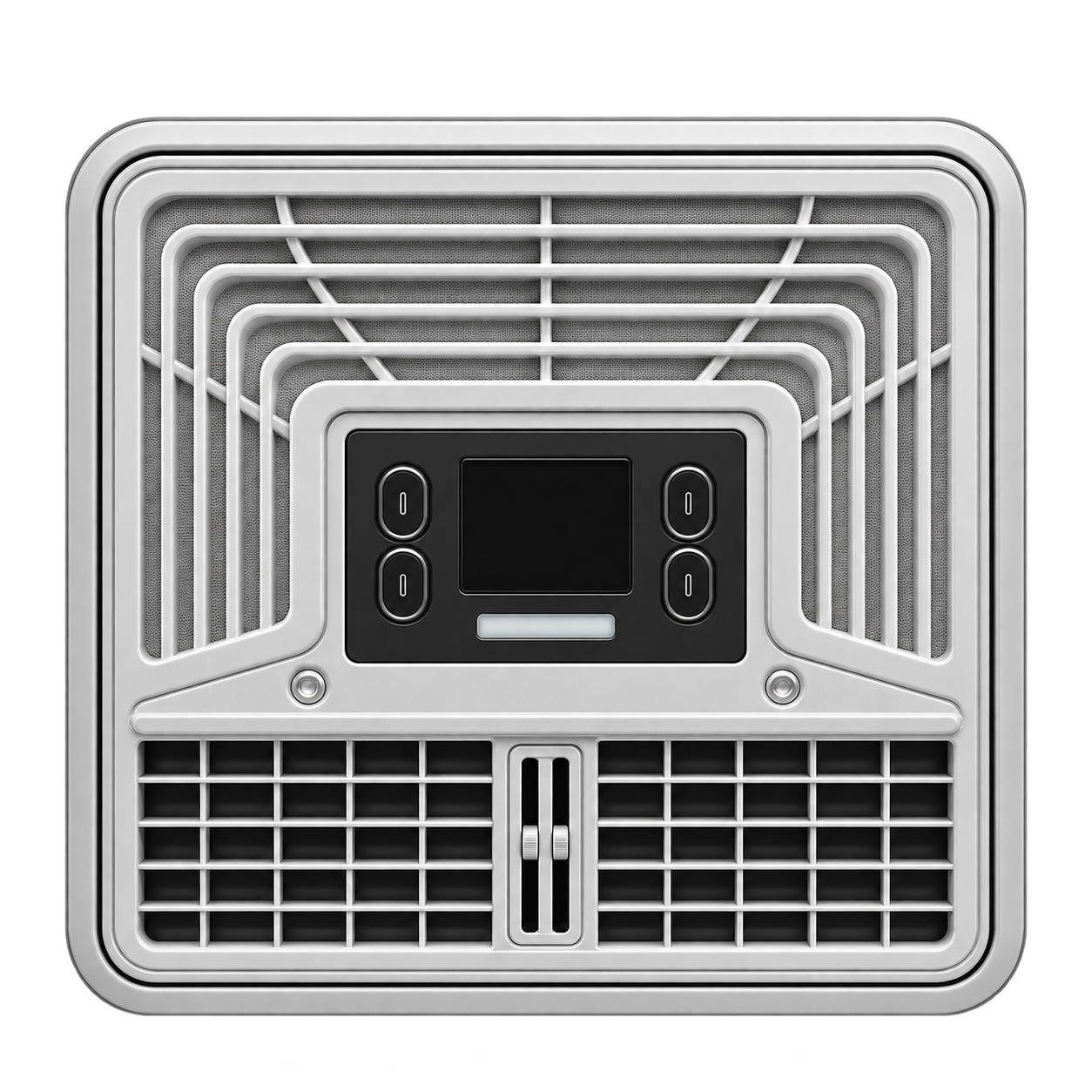
VS02-PRO's indoor dimensions are listed as 350 × 350 × 185 mm. Present the complete dimensions and use the applicable installation drawing for fit. The final number is not confirmed as the visible faceplate thickness, so avoid using a product photograph to imply that specific interpretation.
This is a useful early planning step because it makes the recommendation concrete. The customer can point to the resting space and the installer can explain the proposed relationship to the product. The conversation becomes about a buildable occupied-zone arrangement rather than an abstract promise that cooled air will find its way through any curtain position.
3. Use automatic oscillation inside a suitable zone
Automatic oscillation is documented for VS02-PRO. It can be demonstrated as a way to distribute the stream through the occupied space, particularly when the driver wants movement around the bunk without keeping a concentrated jet aimed continuously at the pillow. The benefit depends on a suitable panel location and an open circulation path.
Show the feature with the curtain arranged as the driver intends to use it. Let the person recline with normal bedding present and describe where the stream feels useful. This is more informative than a doorway demonstration with the curtain tied back and the sleeper cleared for photography.
The supplied information does not establish independent climate zones or a special curtain mode. Use the actual controls and guidance for the offered unit. If the customer requires a particular control behavior, describe it to VETHY directly so the configuration discussion remains clear before an order is placed.
For a distributor, this creates a strong product demonstration. The documented outlet feature is connected to a specific comfort need, and the customer can experience the proposed arrangement. VS02-PRO's air delivery becomes a reason to choose the model for that cab, supported by the layout that makes the feature useful.
4. Keep the return route within the arrangement
A cooling zone needs more than a delivered stream. Air must also be able to return from the occupied area to the indoor assembly. The curtain should not be treated only as a boundary on a drawing; its normal hanging position can influence the practical route through the cab.
Review the relevant return access with the curtain closed and ordinary belongings in place. Follow the supplied instructions for the areas that must remain clear. A bag or hanging garment can change the path even when the outlet still looks open, so the survey should represent the working interior.
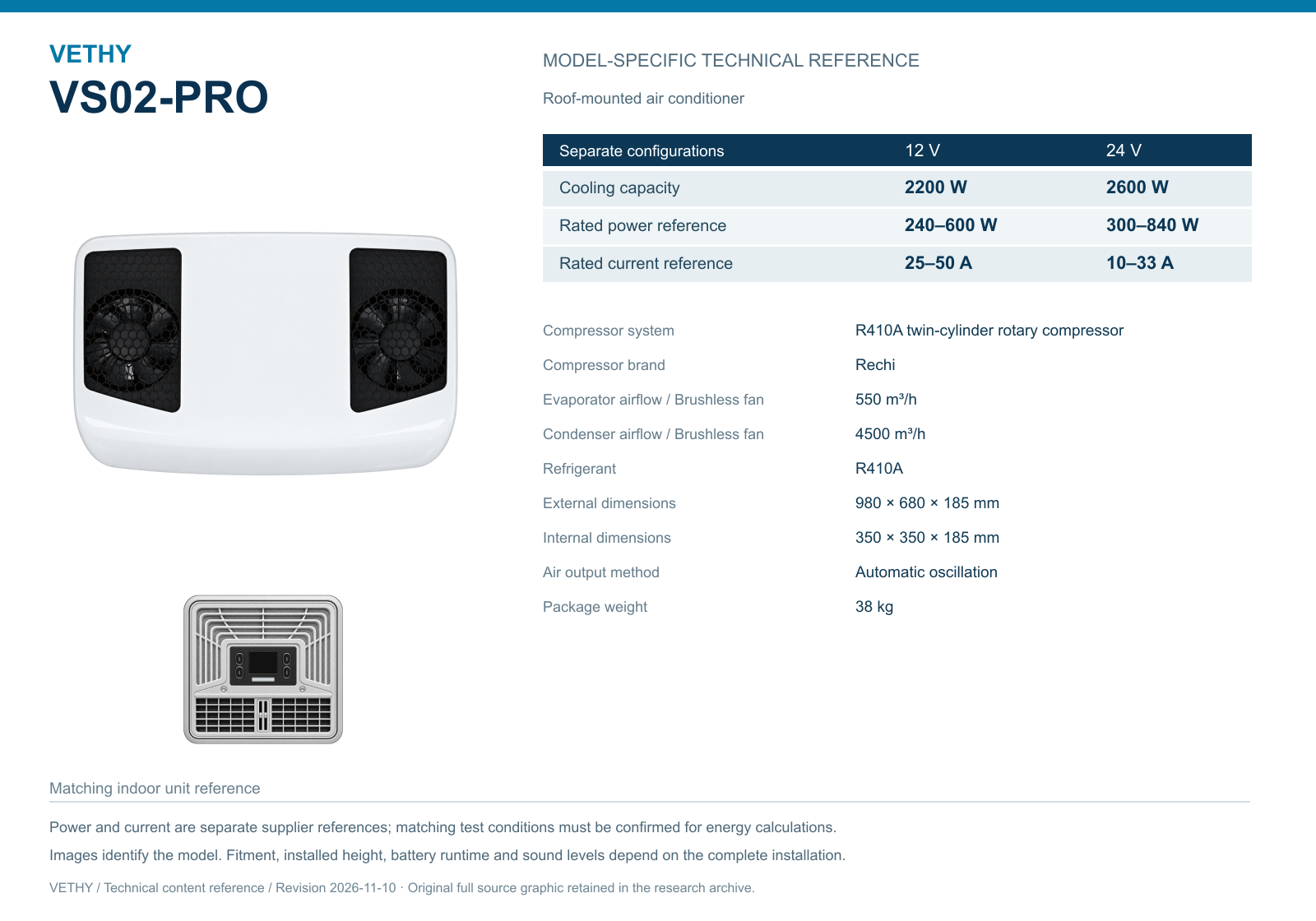
The VS02-PRO evaporator airflow reference is 550 m³/h with a brushless fan. That is a product characteristic, while the occupied layout determines where the movement is useful. A clear route through the intended zone helps translate the specification into a comfort benefit the driver can recognize.
The return-air guide examines that subject more narrowly. For curtain zoning, the central recommendation is to plan the boundary and the complete air path together. The buyer gains a deliberate sleeper arrangement rather than a smaller-looking space that is disconnected from the indoor assembly.
5. Consider the front glazing and solar scene
The curtain can help describe which parts of the cab are intended to be occupied during rest. That discussion may be particularly relevant when the front seats and glazing are not needed while the driver uses the bunk. The exact heat-gain result depends on the vehicle, surroundings and curtain arrangement.
Suitable shading and parking position can also form part of the preparation routine where practical and appropriate. These are useful ways to reduce avoidable solar entry, but they do not replace selecting a suitable product or planning the supply. The VS02-PRO package should still be assessed against the defined cabin duty.
Do not attach a fixed saving percentage to the curtain or claim that every front-cab arrangement produces the same result. The supplied model data do not establish such a figure. The confident message is qualitative: define the occupied area deliberately and avoid asking the cooling installation to serve an unclear scene.
For the customer, this is a practical comfort strategy. Prepare the intended zone, demonstrate the airflow and assess the actual resting position. The product's Rechi twin-cylinder rotary system and brushless air delivery remain the hardware foundation, while the cab arrangement helps make their work relevant to the driver.
6. Plan the transition from paperwork to rest
A driver may need the front seats before closing the curtain for the bunk. The installation should account for that sequence if it is part of the intended duty. The same VS02-PRO can be evaluated in both arrangements, with the customer identifying which stage matters most.
During the seated stage, show how the documented airflow serves the upright position. During the bunk stage, arrange the curtain and bedding normally and let the driver assess automatic oscillation from the pillow. This makes the product demonstration match the working day rather than a single staged scene.
The transition also helps explain why initial comfort may differ from later rest. Door openings, stored heat and changing solar exposure can influence the first part of a stop. The supplied data do not establish a universal cool-down time, so a useful routine is one demonstrated in the actual cab under relevant conditions.
For fleets, this can become a short, practical handover. Drivers understand the intended sequence and can describe which stage feels different if feedback is needed. The product recommendation is stronger because it has been connected to ordinary work, not only to a closed curtain photographed in an empty sleeper.
7. Make storage compatible with the intended boundary
Curtains share the cab with clothing, bags and bedding. Those items should appear in the interior review so the proposed zone is realistic. The goal is a usable space for the driver, with essential air paths preserved according to the actual product instructions rather than a permanently empty demonstration area.
A curtain that hangs neatly during installation may sit differently when a storage bag is placed beside it. Bedding can also change the local stream near the bunk. Let the driver show the normal arrangement so the installer can assess the product in the setting that matters.
The benefit is daily convenience. The owner can prepare the sleeper naturally without wondering whether ordinary belongings are defeating an unexplained layout. A clear photograph of the intended setup can help communicate the essential arrangement without turning every personal storage decision into a technical issue.
This supports the VS02-PRO value proposition because the documented airflow is being applied to a real occupied interior. The buyer sees more than a specification: the product is part of a practical resting environment that accommodates ordinary life inside a working truck.
A distributor can demonstrate this realism by preparing the display bunk as it would be used during a route. Include the ordinary bag, pillow and curtain position, then show how the documented outlet movement relates to them. The customer can recognize the scene and connect it to the intended truck. This is a useful way to explain the product's advantages without inflating a component specification: the buyer sees a defined VS02-PRO arrangement serving an actual resting space and can ask a focused question about the corresponding installation.
8. Match the version and supply to the zoned duty
VS02-PRO lists 2200 W cooling for 12V and 2600 W for 24V. Choose the version that matches the engineered vehicle supply and the complete cabin duty. A curtain can help define the intended occupied zone, but it does not justify selecting a voltage version without reviewing the actual vehicle and use.
The manufacturer power references are 240–600 W for 12V and 300–840 W for 24V. Separate current references are 25–50 A and 10–33 A. Their endpoints do not share a documented common condition, so they should not be paired to claim efficiency or multiplied into an unsupported overnight promise.
The auxiliary-power plan should consider usable stored energy, other loads, charging and the intended parking period. Representative observations can support that plan when they preserve the actual curtain arrangement and starting conditions. The result then describes a useful session in that installation rather than a universal VS02-PRO runtime.
The VS02-PRO product page is the central model reference. Keep the selected voltage and condenser configuration with the zoning brief so the demonstration, quotation and electrical discussion all refer to the same offered package.
9. Compare useful curtain arrangements
The right curtain discussion depends on the driver's routine and the panel relationship. A practical comparison helps the customer recognize the scene being proposed without treating one arrangement as universally correct.
| Intended use | Curtain question | VS02-PRO planning emphasis |
|---|---|---|
| Bunk-focused rest | Does the indoor assembly serve the enclosed zone? | Align panel location, oscillation and return path |
| Paperwork before rest | How does the arrangement change between stages? | Demonstrate seated and reclining positions |
| Two occupants in different areas | Does the boundary divide the required air path? | Assess both normal occupied positions |
| Shared truck with changing drivers | Is the normal setup easy to explain? | Provide an illustrated vehicle-specific handover |
| Cab with substantial storage | Do ordinary items alter the curtain or circulation? | Review the working interior with belongings present |
The table organizes the application decision. It does not add a mode or compatibility claim to the product. The useful outcome is a defined scene in which the buyer can assess VS02-PRO's documented air delivery and understand why the proposed layout serves the occupied space.
10. Keep roof integration part of the recommendation
The outdoor assembly measures 980 × 680 × 185 mm. Those dimensions help place VS02-PRO in the roof plan, while the applicable installation drawing must establish the opening, support, mounting and sealing arrangement. A convenient curtain relationship inside does not replace the need for a suitable roof installation outside.
The product lists 4500 m³/h condenser airflow with brushless airflow. Preserve the relevant intake, discharge and service access according to the supplied requirements. Solar equipment, antennas and other roof accessories should be considered in the same plan so the complete package remains workable.
The documented standard condenser is aluminum microchannel, with copper optional. The evaporator and piping are copper. Keep those choices accurate in the quotation and installed record, rather than describing the standard unit broadly as all-copper. The selected configuration should remain clear throughout ownership.
For the buyer, the benefit is an integrated product proposal. The roof, indoor zone and supply are planned together around a named VS02-PRO configuration. The customer can see why the model fits the project and what work turns the product into a usable sleeper-comfort arrangement.
11. Use one representative trial to refine the zone
Consider a hypothetical fleet driver who completes paperwork before drawing the curtain and resting. A useful pilot reproduces that sequence with the selected VS02-PRO version. Record the normal panel, curtain and storage arrangement so the driver's observations can be connected to the actual scene.
Let the driver assess the stream in both positions. If comfort changes after the curtain closes, describe where the difference is felt and review the relevant path with the installer. The purpose is to refine the package, not to assume that every change proves a particular internal fault or requires a different product.
Keep the surroundings and starting condition with any recorded observation. The pilot belongs to that configuration and period. It can support a practical fleet decision without becoming a broad claim about every truck, curtain or climate. Accurate presentation makes the result more useful to purchasing and later service staff.
The VS02-PRO guide hub supports focused reading on the connected airflow and rest-comfort subjects. The zoning article contributes a narrower decision: make the curtain a deliberate part of the occupied layout and assess the product in that real arrangement.
For an owner-driver, the trial can remain simple and relevant. Use the intended resting position, note the curtain setup and describe whether the stream feels useful around the bunk. If electrical energy is being observed as well, keep the same session boundary and other-load information with the record. These observations support that complete package decision. They should not be separated from the configuration and promoted as a general claim that every sleeper curtain produces the same comfort or battery result with the model.
12. Give the driver a setup worth preserving
A useful handover shows the normal curtain position, relevant clear areas and documented outlet movement. Use the actual product instructions for operation and care. The supplied summary does not establish a named curtain mode, automatic zoning algorithm or phone control, so those functions should not appear in the explanation without confirmation.
Retain the model, voltage and condenser choice with the vehicle record. A photograph of the prepared sleeper can help later drivers understand the intended setup quickly. The goal is to preserve the essential circulation arrangement while allowing ordinary personal preferences and storage within the working cab.
If the curtain, storage or roof equipment changes later, review the relationship to the installed AC as appropriate. A useful support report describes what changed and where comfort differs. Qualified staff can then assess the actual installation instead of working from an assumed diagnosis.
This continuing clarity is part of the product's practical value. VS02-PRO is easier to recommend when the customer receives a recognizable cooling package and a usable occupied-zone arrangement. The installation remains understandable after delivery, supporting ordinary ownership and more focused follow-up when questions arise.
13. Questions about VS02-PRO and sleeper curtains
Does closing a curtain guarantee lower energy use?
The supplied information does not establish a fixed saving. A curtain can help define the intended occupied zone, but the panel location, complete air path and actual conditions determine the useful result. Assess the normal arrangement in the vehicle rather than attach a universal percentage to it.
Can the panel sit anywhere if automatic oscillation is available?
The location still matters. Automatic oscillation distributes the stream within a suitable layout; it does not remove physical barriers or establish universal reach. Review the actual curtain and return path with the installer before finalizing the roof and indoor arrangement.
What if one occupant remains outside the closed sleeper zone?
Demonstrate that actual shared-cab routine. The supplied VS02-PRO data do not establish independent climate zones, so the panel and curtain relationship needs a focused discussion. Describe the requirement directly if both areas must be served at the same time.
Why consider VS02-PRO for a deliberate sleeper zone?
It offers a defined R410A rooftop package with Rechi twin-cylinder rotary architecture, brushless airflow and automatic oscillation. Those features provide useful foundations when the selected version, roof installation and indoor circulation can be planned around the occupied bunk.
Recommend a defined occupied space
Choose VS02-PRO when its rooftop cooling package can serve the sleeper zone deliberately. Place the curtain, panel and return route in one practical plan, then demonstrate the normal rest arrangement. Send the vehicle voltage, interior photographs and parking routine through the technical enquiry page so VETHY can develop a configuration-specific recommendation that connects the product to the driver's everyday space.
Product sources
- VETHY VS02-PRO current manufacturer specifications — VETHY.
- VS02-PRO technical reference sheet — VETHY.
VETHY product recommendation and application analysis. Specification references identify the selected model and voltage. Installation examples are planning examples; measured project results are identified explicitly when available.
Discuss your VS02-PRO application
Send your vehicle, supply voltage, occupied space, parking schedule and installation photographs for a model-specific recommendation.
Prepare your vehicle brief ↗