
VETHY / EcoMax 3S / PRODUCT AND APPLICATION GUIDE
EcoMax 3S Version Selection: Voltage, Ratings and Complete-Set Weights
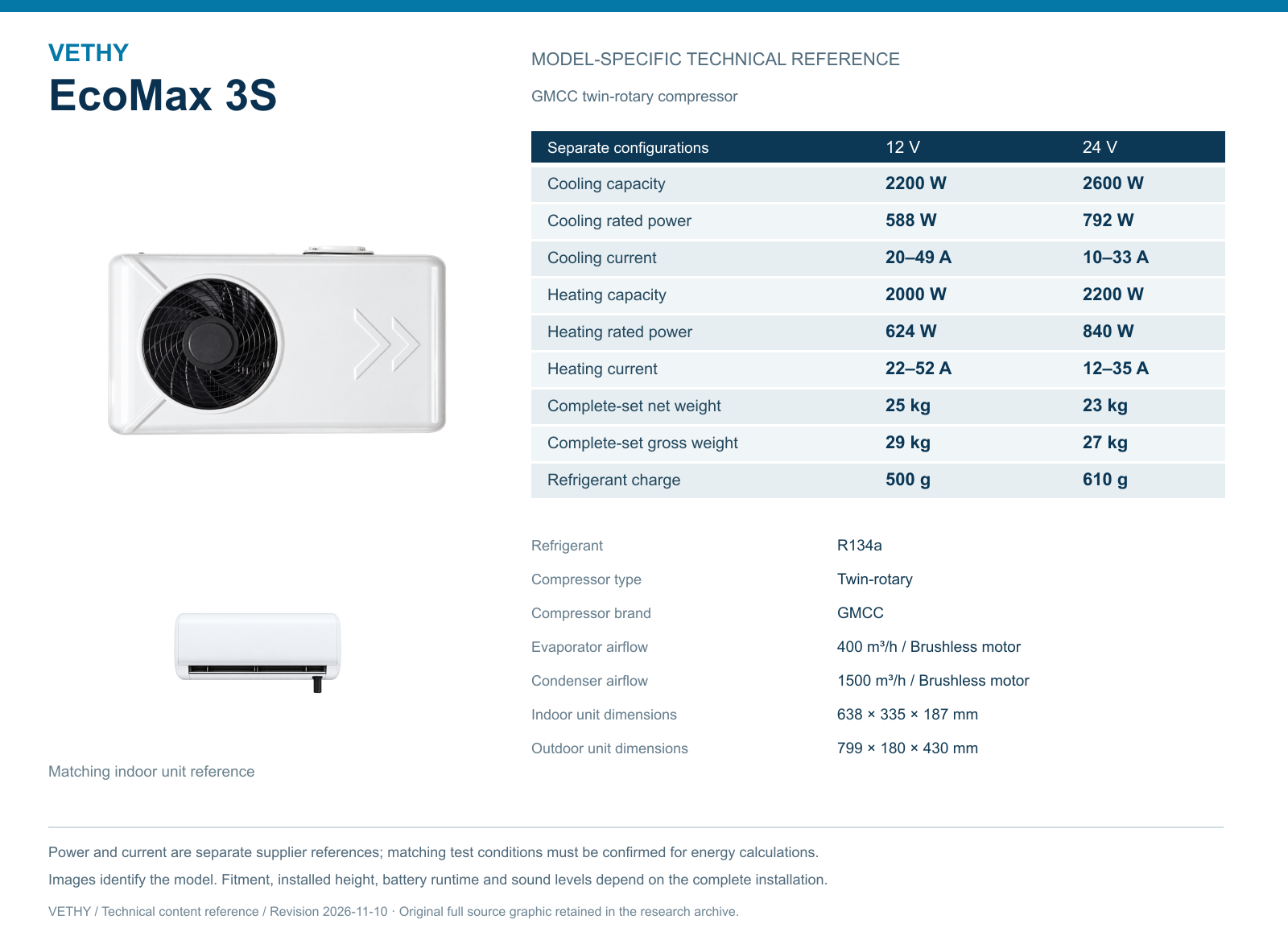
EcoMax 3S version selection starts with the vehicle supply and separate cooling and heating tasks. The 12V complete set is listed at 25 kg net and 29 kg gross; the 24V set at 23 kg net and 27 kg gross. Indoor weights are separate reference fields already within the complete-set scope, so do not add them again.
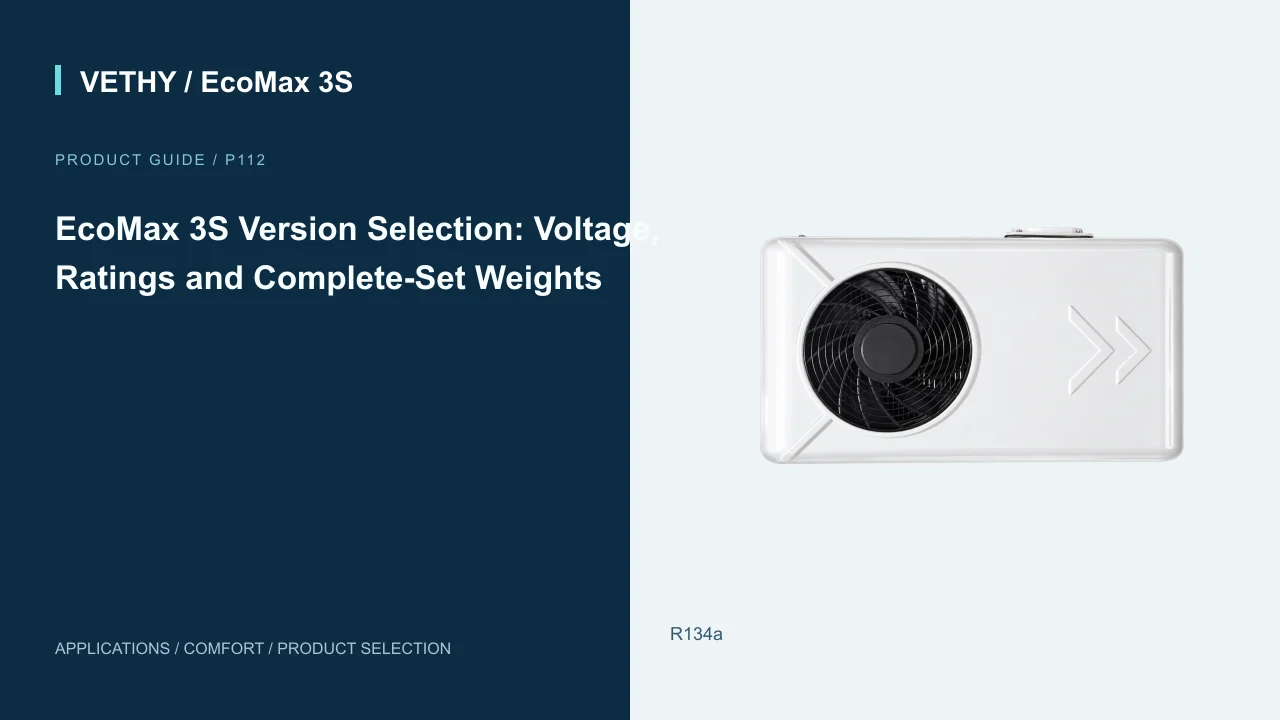
EcoMax 3S has two voltage-specific configurations, and a good order keeps their ratings and complete-set weights distinct. The 12V package is not simply the 24V row with a different label. Cooling, heating, electrical references, refrigerant charge and set weights each belong to the correct version. Reading those fields clearly helps the buyer choose equipment, prepare receipt and give the installer an accurate starting record.
The model uses R134a GMCC twin-rotary technology in a split cooling and heating package with brushless indoor and outdoor fan motors. Its source gives both complete-set weights and separate indoor weights. The key practical point is straightforward: the indoor values must not be added to the complete-set figures again. This guide explains that distinction alongside voltage selection, physical dimensions and purchase scope, turning a detailed sheet into a usable configuration for the actual vehicle.
Begin with the actual supply platform
The first version question is whether the intended vehicle package uses 12V or 24V. The customer should identify the existing supply and any planned auxiliary-system work. The qualified technical team can then assess the appropriate integration. A different voltage arrangement is a separate engineering decision, not an assumed feature included because both versions appear on one sheet.
Keep the voltage visible in the quotation and vehicle record. The cooling references are 2200 W for 12V and 2600 W for 24V. The heating references are 2000 W and 2200 W respectively. These values support the assessment of two different comfort tasks on the actual platform; they do not replace the vehicle brief.
The EcoMax 3S guide collection provides the wider product context. The buyer's inquiry should add the occupied cab, normal route and supporting supply information. A clear starting description helps purchasing and the workshop discuss the same configuration, preventing the complete-set weight or a capacity figure from being taken from the wrong row later in the order process.
Keep the main version references in one table
The following table preserves the source labels and version boundaries. It is a configuration aid, not a calculated efficiency comparison or an installation approval.
| EcoMax 3S reference | 12V version | 24V version |
|---|---|---|
| Cooling capacity | 2200 W | 2600 W |
| Cooling named rated power | 588 W | 792 W |
| Cooling current range | 20–49 A | 10–33 A |
| Heating capacity | 2000 W | 2200 W |
| Heating named rated power | 624 W | 840 W |
| Heating current range | 22–52 A | 12–35 A |
| Refrigerant charge reference | 500 g | 610 g |
| Complete-set net weight | 25 kg | 23 kg |
| Complete-set gross weight | 29 kg | 27 kg |
A common paired operating condition is not established across all electrical and capacity fields. Do not combine selected values into an asserted COP or EER or use a current endpoint to promise a fixed duration. The source also does not establish a cold-weather heating envelope. The useful buying decision connects the correct row with the actual vehicle and seasonal tasks, while the technical team uses appropriate information for the complete installation and supporting supply.
Assess the 12V configuration as a complete package
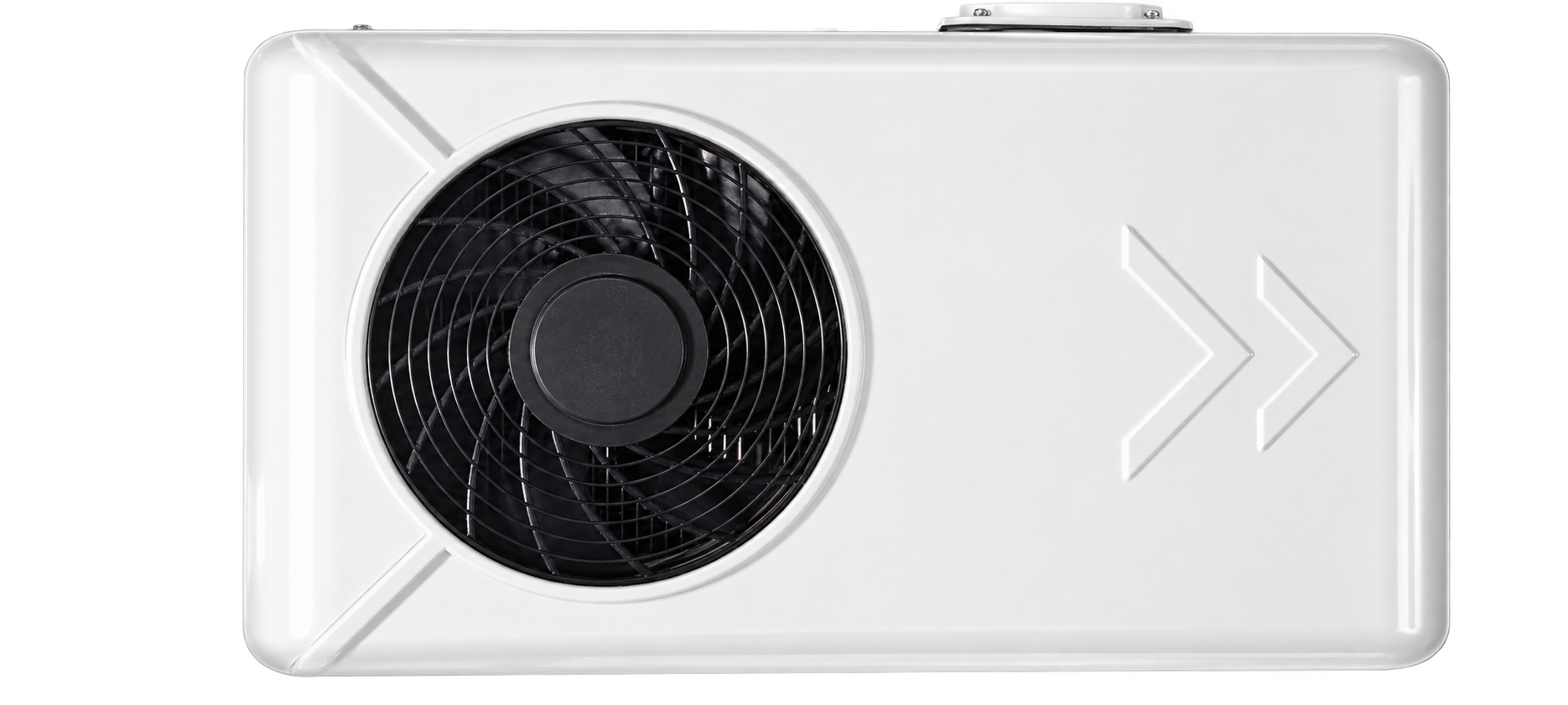
The 12V version lists 2200 W cooling and 2000 W heating. Its complete-set weights are 25 kg net and 29 kg gross. Keep these fields together in a 12V proposal so a colleague receiving the equipment can identify the intended configuration. The refrigerant charge reference for this version is 500 g, retained as technical system information rather than an owner service instruction.
A buyer with a compatible 12V platform should describe the actual cooling and heating requests. The product can be assessed for the occupied seat, bunk or both, with the split layout and supporting energy plan prepared around those tasks. The supplied numbers help define the package, while the cab and route determine the application review.
This is a practical reason to consider EcoMax 3S: the customer has a documented dual-function split option with a clear voltage row and handling references. The recommendation should explain why that option fits the intended vehicle rather than compare only the largest capacity number. A well prepared 12V proposal identifies the complete equipment, installation scope, support information and representative seasonal assessment, making the purchase concrete enough for the workshop and buyer to review.

Assess the 24V configuration without borrowing the 12V fields
The 24V version lists 2600 W cooling and 2200 W heating. Its complete-set weights are 23 kg net and 27 kg gross, with a 610 g refrigerant charge reference. These values belong to that version. Do not use the 12V complete-set weight simply because the outdoor appearance and dimensions share the same product family description.
The higher listed cooling and heating references should be assessed with the actual 24V vehicle supply and cab task. They do not make an unplanned voltage change the default recommendation for a 12V platform. The technical team needs the complete supply configuration, other loads, reserve and recharge context to prepare the supporting system.
For a fleet with compatible 24V trucks, the useful next step is a representative split-layout review and seasonal brief. The technical project information form can gather those details. The buyer can then request an exact EcoMax 3S 24V configuration, with the correct function-specific ratings and set weights retained in the order. That clarity is more useful than a short product name that leaves colleagues to infer which row was intended.
Understand what complete-set net weight means in the record
The source explicitly identifies the version-specific net and gross figures as complete-set weights. They describe the set scope rather than a single indoor or outdoor component. The net field and gross field have different planning roles and should remain labeled, just as the voltage rows remain separate.
For the customer, the practical benefit is a clear equipment record. Purchasing can retain the correct version and complete-set references, while the installer obtains any additional component-specific information needed for the actual mounting and handling plan. The complete-set value should not be treated as though every kilogram is located at one mounting point. The split architecture places units separately, and the technical proposal should reflect the actual equipment arrangement.
A fleet can use the complete-set field for consistent configuration records across vehicles. A distributor can use it to avoid mixing a shipping description with an installed component description. The source does not ask the buyer to derive missing outdoor-only weights by subtraction. Keep the supplied scope and obtain appropriate information where the installation requires more detail. This preserves the usefulness of the data without turning a clear set reference into an invented component specification.
Keep the indoor weights separate without adding them again
The source separately lists indoor net and gross weights of 6.9 kg and 10.5 kg. These are useful indoor reference fields, but the user confirmed that the complete-set figures already describe the complete set. Do not add the indoor weight to 25 kg or 23 kg net again, and do not add the indoor gross field to the complete-set gross figure.
The same principle applies when comparing products. Another model may label its weights as package weights for separate parts, while EcoMax 3S provides a complete-set scope. The buyer should compare the source labels and purposes before treating the figures as equivalent. A good technical sheet preserves those distinctions visibly.
This is a valuable practical detail for an importer or fleet receiving several configurations. Clear weight scope helps organize handling, documentation and equipment records without creating a false total. The workshop can ask the supplier for any additional detail needed for safe technical planning. The product recommendation remains confident because it uses the data as supplied, with each value contributing to the correct decision rather than being combined merely because the numbers are available.
A useful review can ask which decision each weight field is supporting. The complete-set reference helps describe the ordered configuration. The indoor reference identifies a particular part's supplied scope. The installation team may need additional information for the separate mounting locations, while the receiving team uses the packaging and gross references for its own planning. Keeping the purpose visible prevents the same number from being reused as though it answered every question.
This is particularly helpful when the technical sheet is forwarded between sales, purchasing and the workshop. A shortened message can easily lose the words complete set or indoor. Retain the full label with the value rather than sending an isolated weight. The next colleague then has enough context to recognize the data and request the relevant detail if the actual handling or installation needs more information.
Read overall dimensions without inventing axis names
The EcoMax 3S indoor dimensions are supplied as 638 × 335 × 187 mm overall, and the outdoor dimensions as 799 × 180 × 430 mm overall. The source preserves those ordered numbers without assigning length, width and height axes. Use a full overall-dimension callout until the actual installation information provides the orientation needed for the vehicle drawing.
This is especially useful when product images are rotated or arranged for a page layout. A graphic's visual direction should not silently change the dimension meaning. The buyer can provide the actual interior and possible outdoor positions in photographs, while the installer reviews fit, mounting, air environment and the connecting route.
The VETHY engineering overview provides context for this coordinated split installation. The weight and dimension references work together as inputs, but neither establishes universal compatibility. A useful proposal shows how the selected EcoMax 3S version fits the actual vehicle spaces and remains serviceable. The customer can then approve a concrete layout rather than infer that matching familiar dimensions or a lower set weight automatically resolves the installation.
Plan receipt using packaging references at their proper scope
The supplied indoor package dimensions are 695 × 485 × 295 mm, and the outdoor package dimensions are 940 × 330 × 530 mm. Keep these as packaging references rather than product-body dimensions. They help the receiving team prepare space and organize the equipment record before installation begins.
The complete-set gross weight belongs with the version-specific set description. The separate indoor gross field remains an indoor reference. A clear receipt record can identify the model, voltage version, supplied items and matching documents. The buyer should compare what arrives with the actual order scope rather than assemble a new total from fields describing different scopes.
For a distributor, this is practical commercial value. A well labeled package and record are easier to allocate to the intended customer or vehicle group. For a fleet, the workshop can see which version is scheduled for each truck and find the relevant product information. EcoMax 3S's seasonal functions remain central to the purchase, while clear receipt information helps the organization move from delivery to a completed installation without avoidable confusion about which configuration was ordered.
Connect set selection with the occupied comfort task
The right version is selected for the supply and the actual cooling and heating requests, not for weight alone. Describe where the driver sits or rests, how the curtain is used and what the normal route asks from each function. The indoor unit should be positioned to serve those occupied areas with ordinary storage and bedding present.
The source lists 400 m³/h indoor airflow with a brushless motor and 1500 m³/h outdoor airflow with a brushless motor. It does not establish automatic oscillation for EcoMax 3S or a numerical quietness result. Demonstrate the delivered controls and actual air delivery without importing a feature from a similar-looking indoor unit in another model.
The VETHY truck application overview connects the product with the wider parked comfort assignment. A defined complete set becomes valuable when the installation makes its functions useful to the driver. The buyer should therefore retain both the version data and the occupied brief. That gives the supplier a sound basis for recommending the package and gives the workshop a clear account of the result the vehicle is intended to support.
Keep energy planning separate for cooling and heating
The two seasonal functions have different source electrical references, so the supporting plan should account for both requested uses. Identify the schedule, other loads, usable energy, reserve and recharge opportunities. The qualified energy team can determine what further information is needed for the actual selected version and conditions.
Do not turn the cooling power field into a heating estimate or the heating current range into a cooling-duration claim. A common paired operating condition is not established across the fields. The source also lists a compressor component power reference, but that is not permission to substitute it for the whole-unit function-specific data or derive a new efficiency claim.
For the buyer, this makes quotation comparison more useful. Two offers may use the same EcoMax 3S version while proposing different supporting energy arrangements. A clear scope explains the difference. The product can be recommended for its documented cooling and heating capability, GMCC twin-rotary system, brushless fans and split layout, with a realistic supporting package prepared for the route rather than an unsupported promise based on one selected number.
Make the order easy for the receiving workshop to recognize
The final order should name EcoMax 3S, the voltage version, separate cooling and heating references and the agreed installation scope. Retain the correct complete-set net and gross fields, the separate indoor reference and the matching product information. The workshop should not have to guess which row purchasing approved.
For mixed fleets, connect each version to its intended vehicle group. If the physical layout or supporting supply differs, identify that in the configuration record. The common model name can remain useful while the version and installation details stay explicit. This is more manageable than a set of short order lines whose technical meaning depends on one colleague's memory.
A practical receiving check can confirm that the supplied equipment and documents match the order scope before installation is scheduled. Technical inspection and handling procedures belong to the appropriate personnel and supplied information. The buyer's benefit is continuity: the product selected in the proposal remains identifiable through delivery, installation and handover. EcoMax 3S's seasonal value reaches the driver through a package the organization can recognize and support.
The order record can also identify who confirms the version before the equipment is allocated to a vehicle. In a mixed fleet, that simple responsibility can avoid confusion between similar-looking packages. Purchasing confirms the approved scope, the receiving team identifies the delivered configuration and the workshop connects it with the intended truck. Each person performs a practical task without reconstructing the whole selection process.
For a distributor, the same clarity helps when customer materials are prepared in advance of delivery. The product image and seasonal description remain consistent, while the selected voltage and weight references identify the actual set. If the customer's platform changes before the order is finalized, the relevant version can be reviewed explicitly. The recommendation remains tied to the finished vehicle brief rather than an old configuration copied into a new quotation.
Retain the configuration after installation
The completed vehicle record should add the indoor and outdoor positions, approved connecting arrangement, supporting supply and driver demonstration. Keep cooling and heating observations separate so later colleagues can understand what was assessed. If a condition or route changes, the relevant part of the application can be reviewed without losing the stable product facts.
An example is a fleet with the same cab but different auxiliary platforms. The selected EcoMax 3S voltage version and complete-set record should remain clear for each group. A different mounting area may need a layout review, while a different recharge schedule may need an energy review. The source ratings and weight scopes continue to identify the actual equipment.
This is a practical reason to read the detailed sheet carefully. The buyer gains more than a collection of numbers. The data supports a clear configuration, a manageable receipt process and an installation record that later drivers and technicians can use. A premium seasonal product is easier to recommend confidently when its voltage, functions and complete-set scope stay accurate from the first inquiry through everyday ownership.
The same clarity helps a distributor prepare customer materials. Use the real EcoMax 3S outdoor and indoor images with the correct technical reference. Explain the dual-function package and the chosen version, then make the complete-set weight scope explicit. A customer can understand the product and provide the vehicle information needed for a concrete proposal without being asked to calculate missing component values.
The decision becomes straightforward: choose the version around the platform and seasonal task, preserve the source labels, and obtain the appropriate installation information for the actual split layout. The weight figures then do useful work in the purchase and ownership process instead of becoming misleading totals or a substitute for a vehicle-specific review.
Questions about EcoMax 3S versions and weights
Should the indoor weight be added to the complete-set weight?
No. The complete-set fields already describe the complete set. The separate indoor references are 6.9 kg net and 10.5 kg gross, and they must not be added again. Keep each field labeled so purchasing and the workshop understand the scope of the supplied data.
Which complete-set weights belong to the 24V version?
The 24V set is listed at 23 kg net and 27 kg gross. The 12V set is 25 kg net and 29 kg gross. Retain the voltage version with those fields in the order and vehicle record instead of treating the family name alone as a complete configuration.
Can the lighter set automatically be chosen for any truck?
Select voltage around the actual supply and seasonal assignment. Weight alone does not authorize a different voltage arrangement or prove installation suitability. The installer should assess the unit positions, mounting, air environment and connecting route using the actual equipment information and vehicle conditions.
Do the dimensions provide named length, width and height axes?
The source supplies overall dimensions in a defined order without axis labels. Preserve 638 × 335 × 187 mm indoors and 799 × 180 × 430 mm outdoors as full callouts. Obtain the appropriate orientation information for the actual installation rather than infer axes from a rotated image.
Select a complete set the vehicle team can identify
EcoMax 3S is worth assessing when both seasonal functions and a split layout fit the truck. Choose the correct voltage version, keep the cooling and heating fields separate and preserve the complete-set weight scope throughout the order.
Send the vehicle, supply and route information through the VETHY contact page. Request an EcoMax 3S proposal with the exact version, installation responsibilities and matching records. The next step should be a configuration purchasing can recognize and the workshop can prepare for the actual vehicle.
Product sources
- VETHY EcoMax 3S confirmed product specifications — VETHY.
- EcoMax 3S technical reference sheet — VETHY.
VETHY product recommendation and application analysis. Specification references identify the selected model and voltage. Installation examples are planning examples; measured project results are identified explicitly when available.
Discuss your EcoMax 3S application
Send your vehicle, supply voltage, occupied space, parking schedule and installation photographs for a model-specific recommendation.
Prepare your vehicle brief ↗