
VETHY / EcoMax 3S / PRODUCT AND APPLICATION GUIDE
EcoMax 3S or VX3000SP? Choose Around Heating Demand and the Split Layout
Prioritize EcoMax 3S assessment when the vehicle needs both documented cooling and heating; consider VX3000SP for its documented cooling-focused split role. Both use R134a and separate indoor and outdoor units, but their compressor descriptions, airflow, electrical fields and confirmed functions differ. Similar dimensions or indoor appearance do not make their capabilities interchangeable.
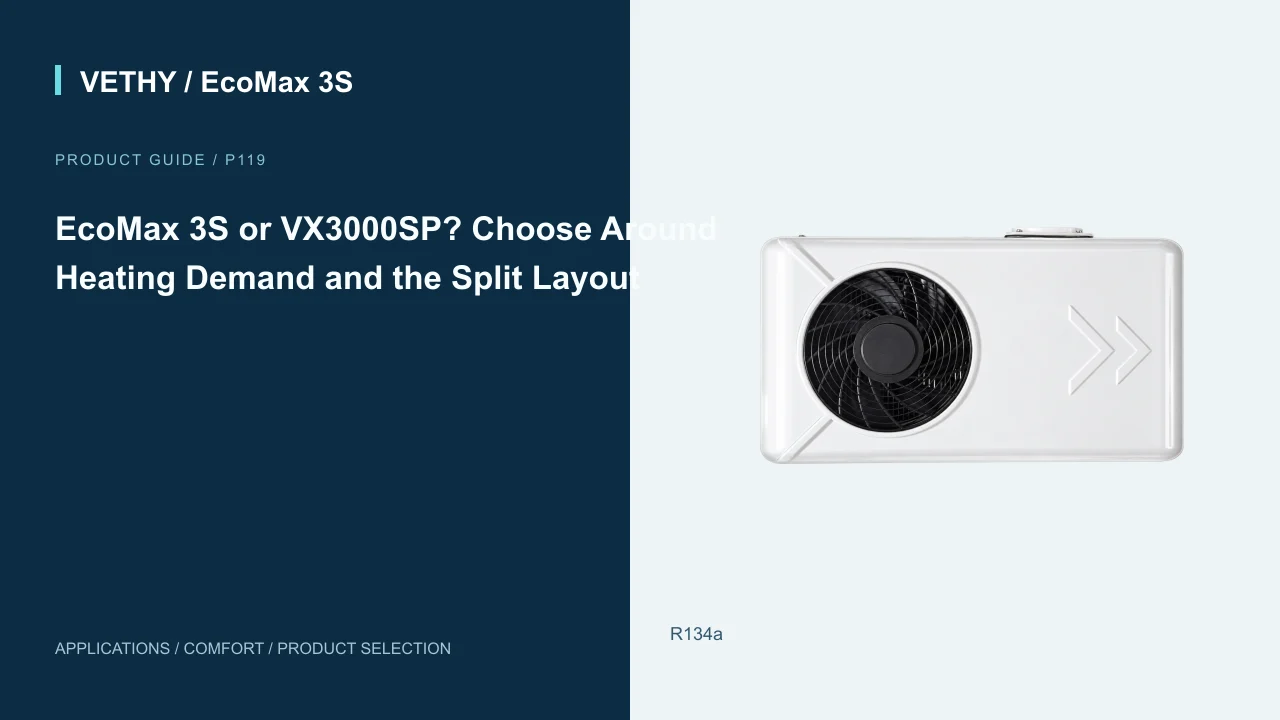
EcoMax 3S and VX3000SP are both split vehicle air-conditioning options, but they answer different comfort briefs. EcoMax 3S has documented cooling and heating functions. VX3000SP's supplied references describe its cooling role. The most useful first question is therefore whether the route genuinely needs heating as well as cooling, before comparing details of the shared split arrangement.
The models also have distinct technology and airflow records. EcoMax 3S uses R134a GMCC twin-rotary technology with brushless indoor and outdoor fan motors. VX3000SP uses R134a and a documented rotary compressor description, without a confirmed brand, cylinder count or inverter architecture. Similar dimensions and a related indoor appearance should not erase those differences. This guide compares the actual packages so the customer can request a vehicle-specific proposal with the right seasonal scope, product identity and supporting supply.
Begin with the comfort functions the route requires
A buyer who regularly needs both cooling and heating has a different brief from a buyer seeking cooling during warm stops. Describe the actual use before selecting a product. Where is the driver during each request, when does it occur and what vehicle conditions matter? These facts give the supplier a useful basis for the recommendation.
The heating request should be specific enough to assess. A cooler bunk rest is an application description, while a defined low-temperature requirement needs technical review. EcoMax 3S's source provides heating references but no cold-weather operating envelope. The buyer should not infer unlimited seasonal capability from the presence of a heating label.
The EcoMax 3S guide collection covers the dual-function package, and the VX3000SP guide collection covers the cooling-focused split model. Use those exact sources when preparing the shortlist. The decision becomes clearer when both products are assessed against the actual route instead of one being promoted through its confirmed functions while the other is given capabilities borrowed from a similar image or family description.
Understand the EcoMax 3S seasonal package
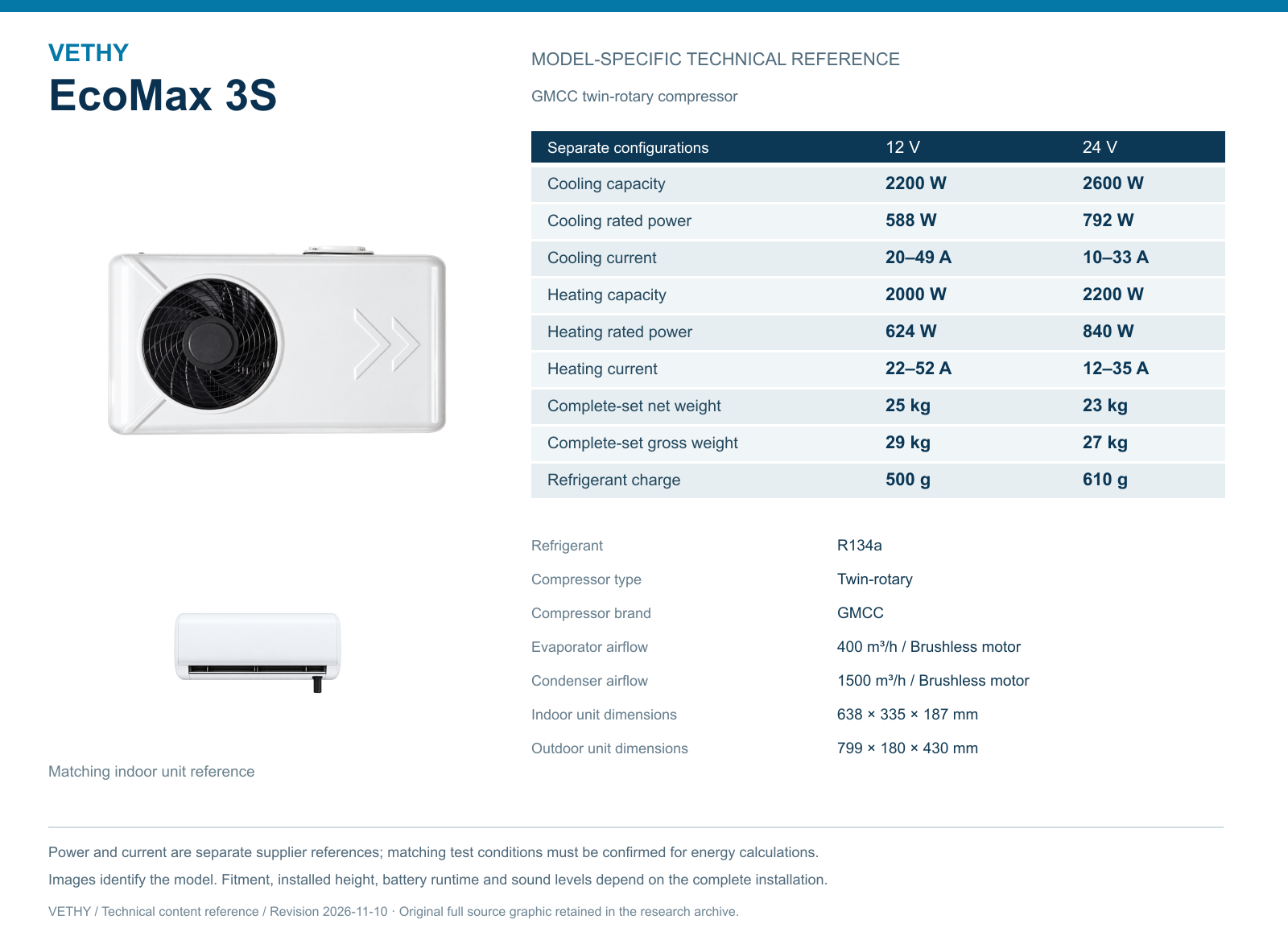
EcoMax 3S provides separate cooling and heating references for 12V and 24V. The 12V capacities are 2200 W cooling and 2000 W heating. The 24V capacities are 2600 W cooling and 2200 W heating. Keep the function and voltage labels visible rather than compressing the product into one general output figure.
Its documented technology is R134a GMCC twin-rotary, with brushless fan motors on both air paths. The source lists 400 m³/h evaporator airflow and 1500 m³/h condenser airflow. These are concrete product facts that make the dual-function offer understandable. The source does not establish inverter controls, a heat-pump mechanism, copper construction or automatic oscillation.
For the buyer, the reason to prioritize this package is the combination of confirmed seasonal functions and a split architecture that can be assessed around available vehicle spaces. The proposal should explain how the indoor and outdoor positions serve the actual cab and how the supporting supply addresses the requested sequence of uses. EcoMax 3S's value is strongest when heating has a real place in the route, not merely when an extra feature appears attractive on a comparison sheet.
Understand the VX3000SP cooling-focused offer
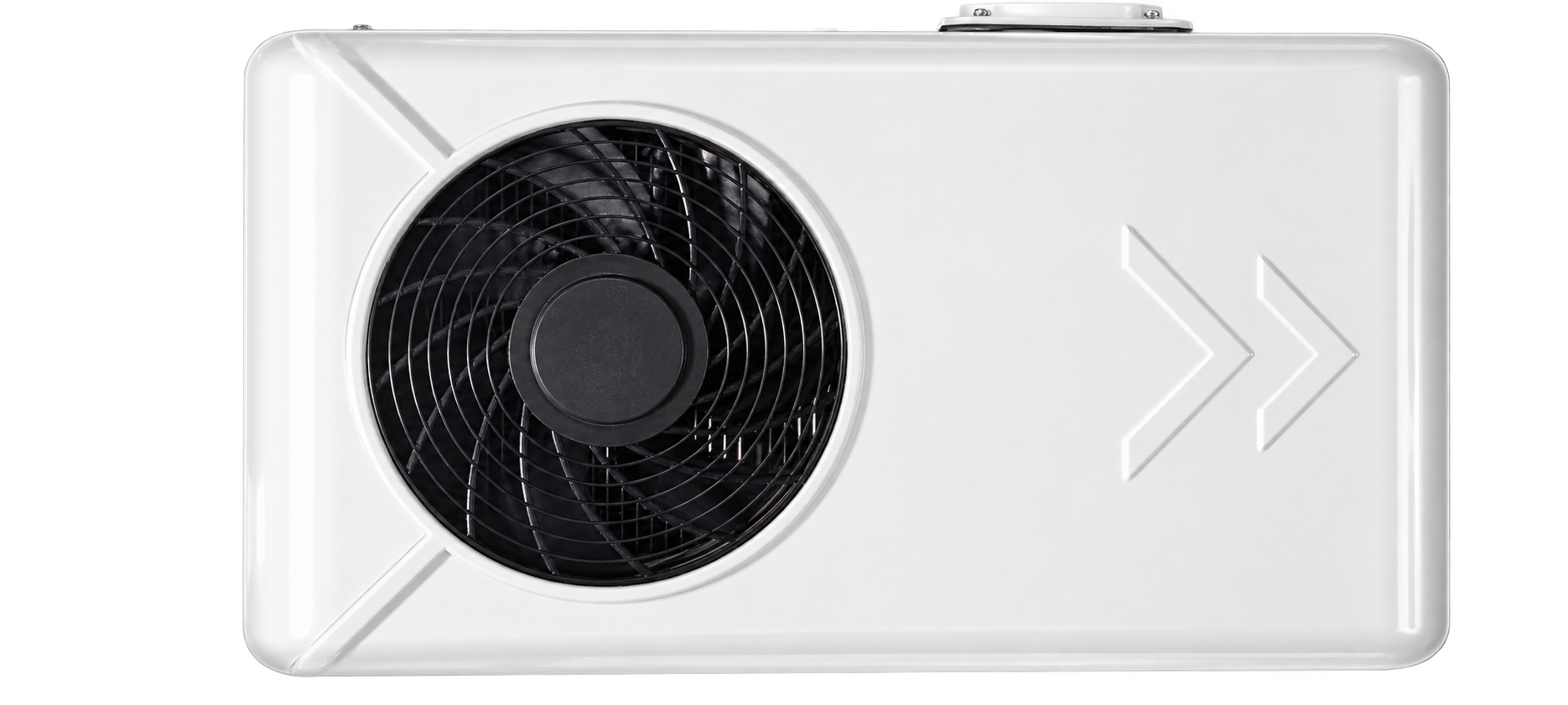
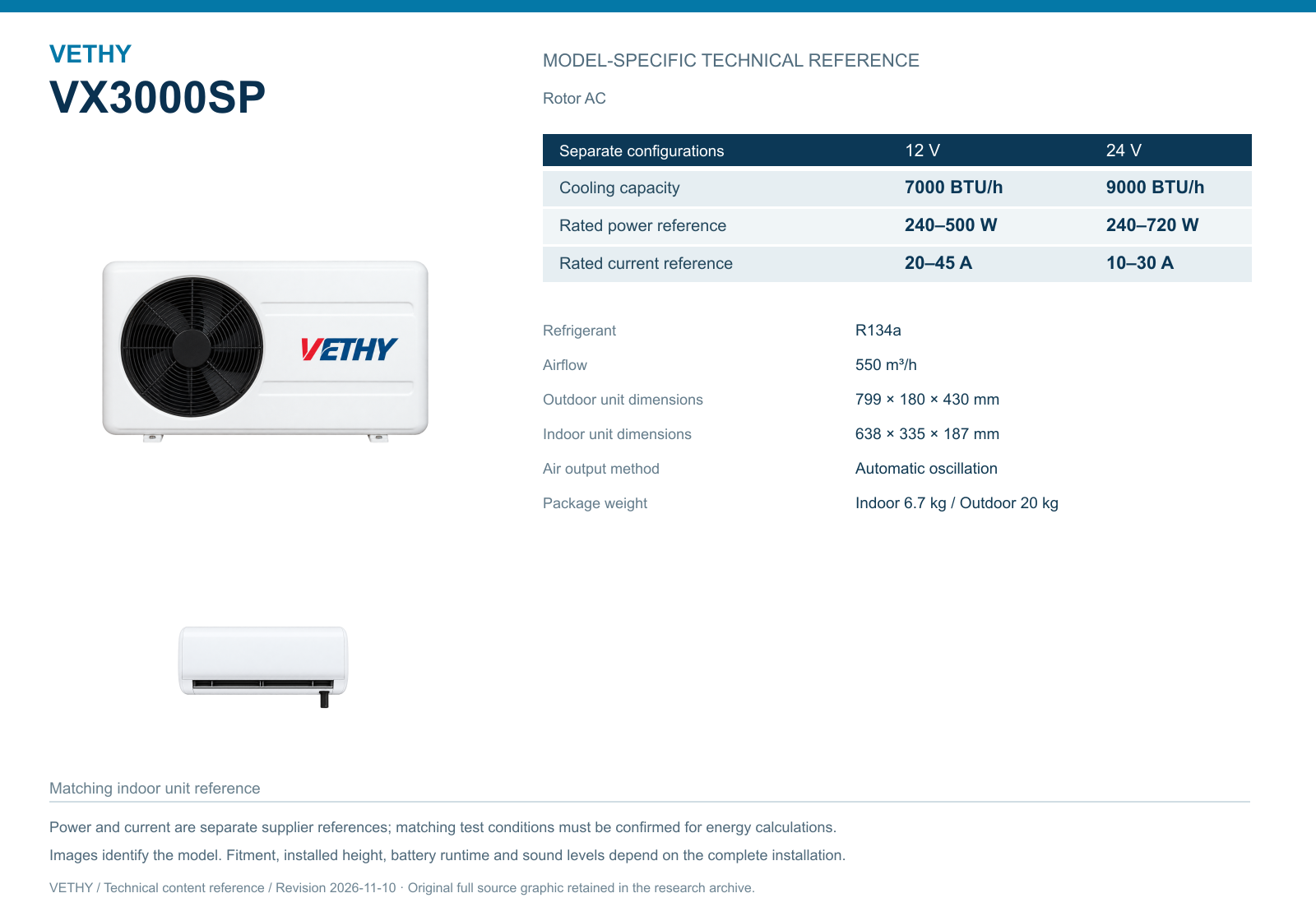
VX3000SP lists 7000 BTU/h cooling at 12V and 9000 BTU/h at 24V. It has a 550 m³/h indoor airflow reference and automatic oscillation. Its supplied source supports qualitative quiet positioning. These facts provide a clear cooling-focused split package to assess for an occupied cab and compatible supply.
The source identifies rotary technology and R134a, without establishing compressor brand, cylinder count or inverter controls. Do not transfer EcoMax 3S's GMCC twin-rotary description to VX3000SP. Likewise, do not transfer VX3000SP's confirmed automatic oscillation or quiet positioning into the EcoMax 3S record merely because the indoor image is related.
For a buyer whose task is cooling, VX3000SP deserves a focused proposal on its own documented features. A product does not need an unrequested seasonal function to be useful for a defined route. The installer should show suitable indoor and outdoor positions, the connecting arrangement and access. The buyer can then compare a complete cooling package with the dual-function alternative rather than assume the model with an additional function is automatically the best answer for every vehicle.
Compare the confirmed capabilities in one table
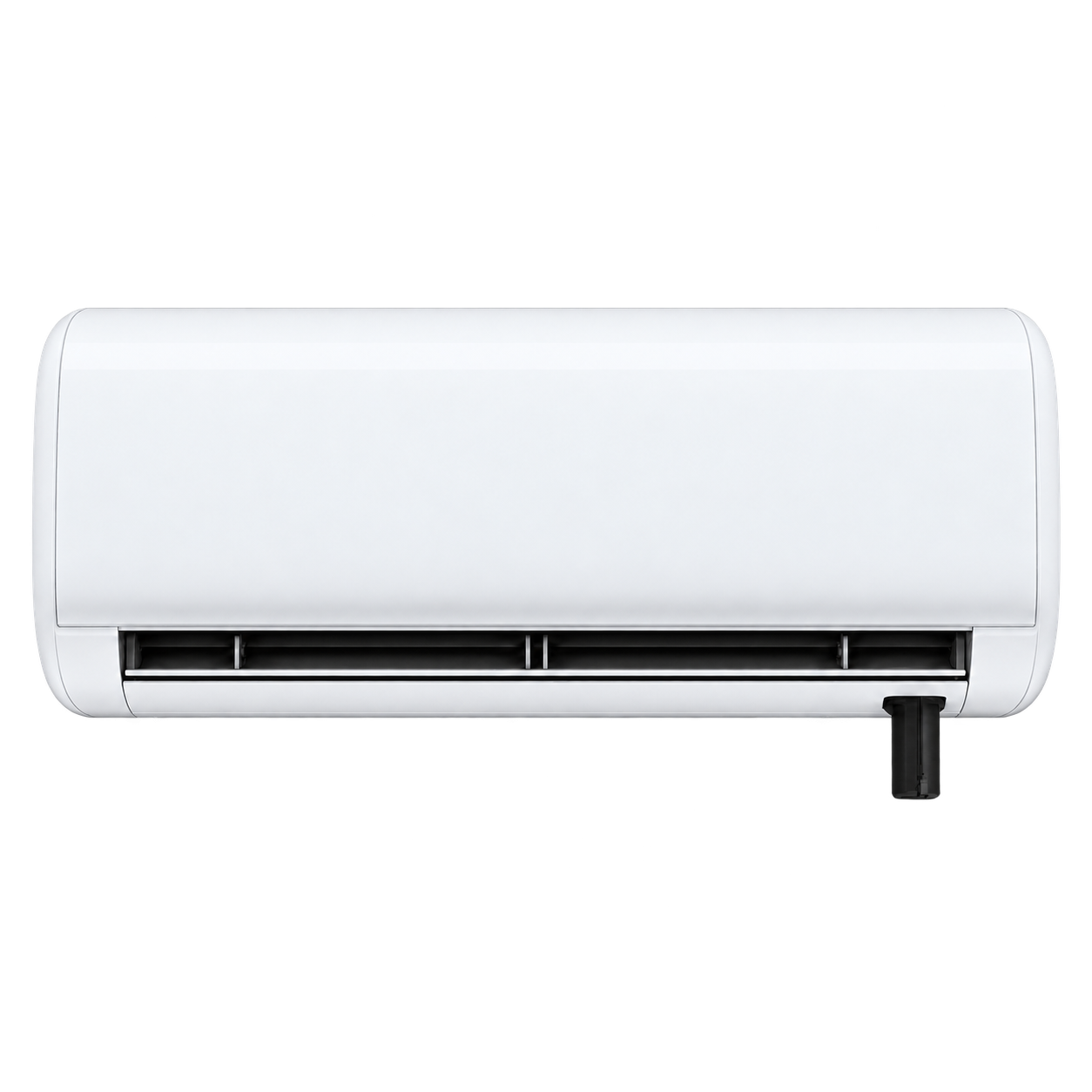
The following table keeps the two model identities distinct. Cooling capacities remain in the units supplied by their respective source records; no additional conversion or inferred rating is added.
| Reference | EcoMax 3S | VX3000SP |
|---|---|---|
| Documented seasonal scope | Cooling and heating | Cooling-focused references |
| 12V cooling capacity | 2200 W | 7000 BTU/h |
| 24V cooling capacity | 2600 W | 9000 BTU/h |
| 12V heating capacity | 2000 W | No heating reference established here |
| 24V heating capacity | 2200 W | No heating reference established here |
| Refrigerant | R134a | R134a |
| Compressor description | GMCC twin-rotary | Rotary; brand and cylinder count not established |
| Inverter architecture | Not established in the source | Not established in the source |
| Indoor airflow | 400 m³/h | 550 m³/h |
| Automatic oscillation | Not established in the source | Confirmed |
| Numerical sound result | Not established | Not established; qualitative quiet positioning confirmed |
The table helps the customer identify which features answer the actual brief. It should not become a ranking of every possible installed outcome. The complete vehicle, occupied route, supply and installation proposal remain necessary to choose the package that fits the truck.
Let a genuine heating request give EcoMax 3S a clear role
When the route regularly creates a heating request, EcoMax 3S has a concrete additional function to assess. The customer can identify the occupied zone, normal seasonal bedding and conditions requiring review. The supplier can then explain the relevant capacity reference and what further information is needed for the actual application.
The heating and cooling tasks should remain separate in the proposal and first-vehicle record. A successful cooling example does not establish every heating use. The source does not describe the heating mechanism or an ambient operating envelope, so those should not be inferred from the compressor brand or product category. A defined requirement belongs in the technical conversation.
This does not weaken the seasonal offer. It makes the added function meaningful. The buyer can understand why EcoMax 3S is being recommended for a route that needs both tasks and how the complete package will be assessed. The result is more useful than a general year-round promise with no occupied scenario. The product earns its place through a confirmed capability connected to an actual customer need.
Let a cooling brief keep VX3000SP focused
If the customer chiefly needs cooling, the comparison should give VX3000SP's documented features proper attention. Automatic oscillation and the 550 m³/h airflow reference are relevant to indoor delivery. Qualitative quiet positioning is relevant to a rest-stop discussion, with the actual installed experience assessed at the occupied position rather than assigned an invented decibel value.
The buyer should describe the normal cabin, curtain, storage and stopping routine. The installer can position the indoor unit to serve the seat or bunk and review the outdoor location and connecting route. This creates a complete cooling package on the actual vehicle. The absence of a heating reference in this supplied VX3000SP record should not be disguised, but neither should an unrequested function dominate a cooling-only decision.
A useful comparison therefore asks what the customer will actually use. EcoMax 3S may justify its seasonal role where both tasks matter. VX3000SP may deserve attention where the documented cooling brief and its user-facing functions fit the route. The supplier should explain each recommendation with matching source data and real product images, leaving the buyer able to identify the package being proposed.
Use shared dimensions as a starting point for layout
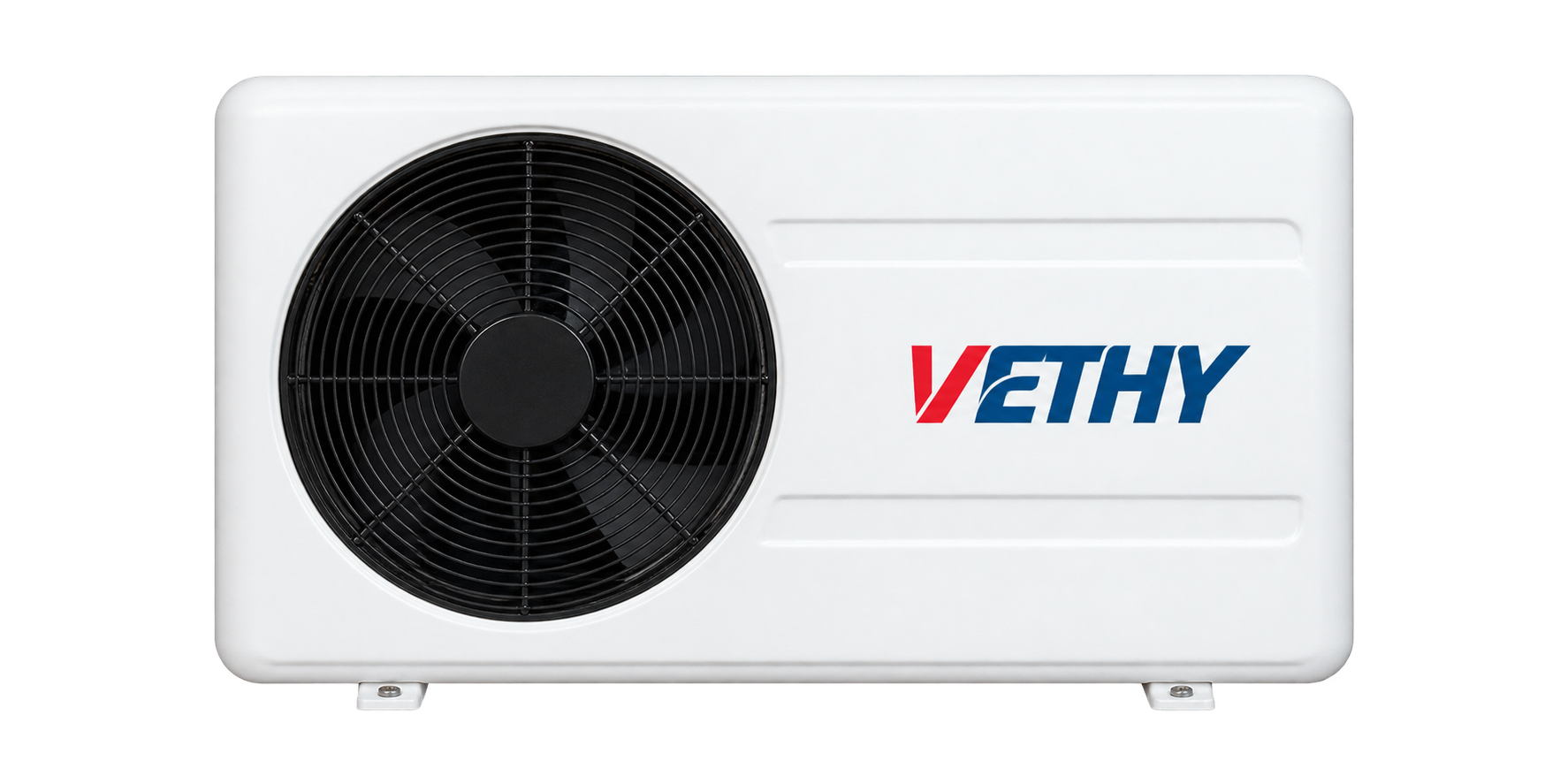
Both supplied records give overall outdoor dimensions of 799 × 180 × 430 mm and indoor dimensions of 638 × 335 × 187 mm. The source order should be preserved without inventing length, width and height axes. Similar dimension values provide a useful starting point for comparing physical packages, not proof that every mounting or service detail is interchangeable.
The installer should use the actual selected product information and vehicle conditions. Review indoor and outdoor positions, mounting, surrounding air environment, access and connecting route as one package. The customer can show possible areas in photographs and identify fixed equipment, while the qualified team determines an appropriate arrangement.
The VETHY engineering overview provides context for coordinated split integration. For the buyer, the practical benefit is a fair comparison on the same truck. Both candidates can be proposed against the same available spaces, with their own requirements visible. The decision then rests on a complete architecture and seasonal brief rather than an assumption that matching dimensions collapse two distinct models into one interchangeable product.
Do not transfer functions through a similar indoor appearance
The EcoMax 3S indoor image is associated with an explicit source instruction, but its performance and functions still come from the EcoMax 3S record. A related appearance does not establish automatic oscillation or the VX3000SP airflow figure for EcoMax 3S. Each model should keep its own documented controls and references in the customer materials.
This is important for distributors preparing a range presentation. Show the real matching assets and label the model clearly. The source facts can then explain what the customer is selecting. Exterior images should not be used to claim hidden construction, and a familiar panel should not be treated as evidence of every function offered elsewhere in the range.
During a demonstration, use the actual delivered controls and occupied cabin arrangement. The user can experience what the selected product provides without relying on a transferred feature. This makes the comparison more trustworthy and easier to carry into an order. The buyer can recognize the same model, function scope and installation package from the product page through the demonstration and final handover.
Compare supporting energy plans with the functions visible
EcoMax 3S has separate cooling and heating power and current fields for each voltage. At 12V, cooling is listed at 588 W with 20–49 A, and heating at 624 W with 22–52 A. At 24V, cooling is listed at 792 W with 10–33 A, and heating at 840 W with 12–35 A. Keep these as function-specific source references.
VX3000SP lists 240–500 W and 20–45 A for 12V cooling, plus 240–720 W and 10–30 A for 24V. These are separate source fields, not a complete matched energy comparison across the two products. Do not calculate an asserted efficiency or guaranteed duration from selected endpoints or compare a cooling field with a heating task as though they were the same condition.
The supporting plan should include the actual schedule, other loads, usable energy, reserve and recharge opportunities. The technical project information form helps gather a common brief. The buyer can then compare complete proposals that state which functions and operating routines the supply is intended to support.
Keep weights and service identity at their proper scopes
EcoMax 3S gives complete-set net and gross weights of 25 and 29 kg for 12V, and 23 and 27 kg for 24V. The separate indoor references of 6.9 and 10.5 kg are already within the complete-set scope and should not be added again. Preserve the labels in the receiving and configuration record.
VX3000SP lists separate package weights of 6.7 kg for the indoor unit and 20 kg for the outdoor unit. Do not relabel those as net installed weights or treat them as the same scope as EcoMax 3S complete-set data. The installer should obtain any additional information needed for actual technical planning rather than derive missing component values by subtraction.
For the buyer, the benefit is clarity across sales, receipt and support. The exact model and version remain identifiable, the supplied scope is preserved and the workshop can request the appropriate information. The comparison stays practical because it helps the customer recognize what is being purchased, rather than create a false total or an installation conclusion from unlike weight fields.
A useful supplier discussion can compare the products through the same two vehicle views. One shows the available exterior mounting space and surrounding equipment; the other shows the occupied cabin and normal storage. The installer can then identify the relevant arrangement for each exact model. The customer sees how similar overall dimensions still lead to a product-specific proposal with its own supplied information and seasonal scope.
This also prevents an incomplete commercial comparison. A quoted unit price may assume different local work or supporting supply from another offer. Ask each proposal to identify the included equipment, connecting work, documentation and installation responsibility. The buyer can then compare complete packages for the same task rather than infer value from a feature list whose local delivery remains undefined.
Demonstrate the selected product against the actual route
Choose a representative vehicle and occupied routine. For EcoMax 3S, keep cooling and heating observations separately identifiable where both matter. For VX3000SP, assess the documented cooling task with the actual controls and automatic oscillation. In both cases, include the normal curtain, bedding, storage and supporting supply.
Record the exact voltage version, unit positions and relevant conditions. The technical team determines the appropriate installation and application checks. The buyer should understand what the demonstration showed and which requirement still needs technical review. A limited example should not become an all-climate or all-vehicle guarantee.
For fleets, retain the completed configuration before repeating the package. A different route, exterior location or interior arrangement can deserve a focused review. The common split architecture remains useful context, while the actual model facts and seasonal functions stay distinct. This gives the buyer a clearer basis for approving a product and explaining the choice to purchasing, the workshop and drivers who did not attend the initial sales discussion.
The completed record can identify the priority behind the choice. For EcoMax 3S, that may be the route's real need for both seasonal functions in a reviewed split installation. For VX3000SP, it may be the documented cooling task and the relevant indoor features on a suitable vehicle. State the actual reason in plain language so a later colleague understands the decision without reconstructing the whole comparison.
If the route changes, that record gives the team a focused starting point. A new heating request can be made visible rather than assumed to exist on the installed product. A changed cabin or exterior layout can be reviewed against the actual configuration. The model identities remain accurate, and the organization can decide the next practical action with a clear account of what the original package was intended to serve.
The comparison can therefore end with a short decision note rather than a generic winner. Identify the selected model, the customer function that made it appropriate and the reviewed vehicle arrangement. A later colleague can understand the choice and recognize which change would require another assessment. The product's real capabilities remain clear, and the organization can repeat a suitable configuration without silently transferring functions between the two split models.
Make the order preserve the function the customer selected
The final description should name EcoMax 3S or VX3000SP, the voltage version, supplied cooling reference and, for EcoMax 3S, the separate heating reference. Retain the correct compressor description, fan and control facts, matching images and agreed installation responsibilities. The customer should be able to connect the quotation with the actual demonstration and intended vehicle package.
An illustrative fleet may have one route group with genuine heating and cooling requests and another group focused on cooling. EcoMax 3S deserves a seasonal proposal for the first group, while VX3000SP can be assessed for the second according to its documented features. The decision is based on the work each truck performs, not an assumption that one model is universally better because it has a larger feature list.
The buyer can keep the logic simple: identify the required functions, assess the split arrangement, choose the correct voltage and supporting supply, then demonstrate the occupied result. The two products remain distinct throughout. Their real strengths are easier to explain when the proposal shows which customer need each package serves and what the organization will actually receive and support.
A distributor can use the same comparison to make the range clearer. Common R134a and split-layout references help introduce the category, while model-specific functions and technology explain the choice. The customer receives a concrete recommendation rather than a blended specification whose heating, oscillation or compressor claims cannot be traced to one actual product.
This is practical premium value. EcoMax 3S offers a documented seasonal role where both functions matter. VX3000SP offers a defined cooling-focused role with its own confirmed user-facing features. A clear vehicle brief and complete proposal allow the buyer to choose the package that fits the route, with an accurate record ready for installation, handover and later support.
Questions about EcoMax 3S and VX3000SP
Which product has documented heating references here?
EcoMax 3S lists separate heating capacities and electrical fields for 12V and 24V. The supplied VX3000SP record describes cooling-focused references. A customer who needs heating should make the actual requirement visible and assess the EcoMax 3S package without inferring a cold-weather envelope absent from the source.
Does the shared indoor size prove the same airflow functions?
No. EcoMax 3S lists 400 m³/h airflow, while VX3000SP lists 550 m³/h and automatic oscillation. Similar dimensions or a related image do not transfer performance or controls. Use the actual selected model information and delivered equipment during the demonstration and handover.
Are both products documented as GMCC twin-rotary inverter systems?
No. EcoMax 3S is documented as GMCC twin-rotary without an established inverter architecture. VX3000SP is documented as rotary without confirmed brand, cylinder count or inverter. Preserve those exact descriptions instead of creating a common technology claim for the two packages.
What makes the comparison useful for a fleet?
Give both candidates the same vehicle and route brief, then compare their complete seasonal scope, split layouts and supporting supply proposals. Identify the exact version and occupied task. The outcome should be a product configuration the fleet can recognize, assess and repeat where the application fits.
Select the split package around the functions the route needs
EcoMax 3S deserves attention where both documented cooling and heating matter, while VX3000SP should be assessed through its cooling-focused role and confirmed features. Keep the shared layout context and distinct model facts visible throughout the decision.
Send the vehicle photographs, supply and seasonal requirements through the VETHY contact page. Request an EcoMax 3S-versus-VX3000SP proposal that identifies each package's scope and installation responsibilities. The next step should be a clear configuration prepared for the actual route and occupied cab.
Product sources
- VETHY EcoMax 3S confirmed product specifications — VETHY.
- EcoMax 3S technical reference sheet — VETHY.
- VETHY VX3000SP confirmed product specifications — VETHY.
- VETHY VX3000SP technical reference sheet — VETHY.
VETHY product recommendation and application analysis. Specification references identify the selected model and voltage. Installation examples are planning examples; measured project results are identified explicitly when available.
Discuss your EcoMax 3S application
Send your vehicle, supply voltage, occupied space, parking schedule and installation photographs for a model-specific recommendation.
Prepare your vehicle brief ↗